40 résultats
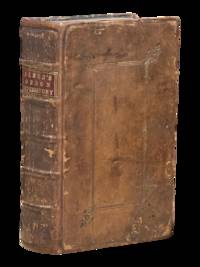
17079585London: Printed by T. Dawks for R. Chiswell M. Wotton et al. 1707. The Seventh edition corrected and amended. 8vo 877pp plus 3pp errata and ads at rear. Table of characters at front printed in two columns index at rear. Contemporary paneled calf red morocco spine label gilt tooled board edges. Expertly rebacked with original spine laid down and likely a newer label. Boards moderately rubbed. Corner chip to front endpaper title and prelims a bit soiled mild foxing throughout. An attractive copy. <br /> <br /> Very nice copy of William Salmon's eccentric and popular London Dispensatory which blended vernacular medicine with Galenic practice and Paracelsian alchemy. This is a greatly expanded edition from the original 1676 issue which consisted of only 3 parts. Though it was not sanctioned by the College of Physicians Salmon's anti-establishment writing gave the book a broader and more accessible appeal. It went through numerous editions and was widely used by apothecaries surgeons and independent practitioners alike. <br /> <br /> <br /> A cornerstone English medical compendium with fringe elements and in an attractive contemporary binding. . Printed by T. Dawks for R. Chiswell, M. Wotton, et al. unknown
176629075Leipzig Johann Paul Krause 1766. 8vo. Fine recent boards in old style. Engraved frontispiece. 14368 pp. The first leaves with brownspots in upper margin light browning to text. A few old annotations. Old owner's name inscribed in the cartouche of frontispiece:"Marcus Weisz parisiis 1788". <br/><br/><em>Scarce first edition. - "In diesem Buche versichert Jugel u. A. den Stein der Weisen selbst in Hände gehabt zu haben wie auch dass er einmal von dem Silber ausgehend zu der Darstellung eines weissen Glases gelangt sei welches von 100 Theilen Silber einem Theil in Gold verwandelt habe." H. Kopp "Die Alchemie" pp. 253-7.Duveen p. 313 omitting 'Freyentdeckte' - Ferguson I:p. 441. - Poggendorff I: 1208. </em> hardcover
178922014Zittau und Leipzig, Schöps, 1789. 5 n.n. Bll., 288 SS.; 306 SS., 9 n.n. Bll. Register zu beiden Teilen. 8°, Halbleder der Zeit über 5 Bünden, Rückenvergoldung, zwei goldgepr. Rückenschildchen, Lesebändchen, marmorierter Schnitt. Einband etwas berieben, Rücken am Schwanz mit kl. Fehlstelle am Leder.
17923488Aus dem Französischen. 2 in 1 Band. Mit 6 gefalt. gest. Tafeln. Liegnitz, D. Siegert, 1792. 8vo. (19,8 x 11,8 cm). 1: X, 260 S. 2: VI, 250 S. Schlichter hellblauer Pappband d. Zt. mit rotem Rückenschild.
178121865Berlin u. Leipzig, J. Decker, 1781. XXXII, 551 (1) SS., 2 Kupfertafeln, davon eine ausfaltbar, 5 Schemata im Text. 8°, Halbleder der Zeit über 5 Bünden, goldgeprägte Fleurons in 5 Feldern, oranges goldgepr. Rückenschildchen, die Einbanddeckel mit Kiebitzpapier bezogen. Ecken und Kanten wenig berieben.
17933897Mit 18 Abb. auf 2 gefalt. gest. Tafeln. Halberstadt, in Kommission in der Buchhandlung der Grossschen Erben, 1793. 8vo. (17,1 x 10,5 cm). Titel, 92 S., 2 Bll. Zwischentitel u. Vorerinnerung, (S. 93)-166, 1 Bl. Inhalt. Einfacher Pappband d. Zt. mit Kiebitzpapierbezug. [3 Warenabbildungen]
17054881Mit großer Holzschnitt-Druckermarke auf dem Titel. Jena, Sumptibus Johannis Bielkii, Litteris Christophori Krebsii, 1706 (Vorwort datiert 1705). Kl.-4to. (19,5 x 16,7 cm). 2 Bl., 60 S. Neuer Pappband.
176711147Wien, Krauß, 1767. Aus dem Französischen in das teutsche übersetzt; mit einem Anhang, wie man die nothwendige Salia, das Erz zu schmelzen, und die Metalle zu scheiden, machen und zurichten soll, vermehret . Heraus gegeben von Matthia Godar. 4 Bll., 165 S., 5 Bll. (Register). 1 gefalt. Kupfer-Frontisp. und 7 Kupfertafeln. Kl.-8°.HPgmt. der Zeit mit hs. Rückentitel (etw. fleckig und bestoßen, Rücken mit aufgeklebter hs. Nummer).
177122831(Frankfurt / M. und Leipzig, 1771). 318 SS., 1 Bl. w. 8°, Halbpergament der Zeit, Rotschnitt, Deckel mit Buntpapier bezogen. Einband stärker berieben, Pergamentrücken angegraut.
1731ALDR0665Frankfurt, Stockische Erben u. Schilling 1731. 8°. 60 S., 2 Bl., 384, 320 S., Ganzpergamentband d. Zt. mit Kiebitzpapier-Deckelbezügen, goldgepr. Rückentitel, umlauf. Rotschnitt, Spiegel mit gest. Exlibris des Christian Ernst Graf zu Stolberg (Wappen u. fig.Darst.). Deckelbezug rückseitig mit Fehlstelle, ansonsten sehr gut erhalten. Titelbl. rot u. schwarz gedruckt, recht eng beschnitten. Brüning 4109; Duveen 426. Teil 1 beschreibt die Geschichte des Goldenen Vlies im Altertum, der 2. Teil beschreibt die Bemühungen der Goldmacher, die Transmutation zu entdecken. Zu Naxagoras und seinen Werken und deren Beziehung zu denen von Anton Joseph Kirchweger, vgl. Ferguson (Bibliotheca Chemica), sowie Kopp (Die Alchemie).
170756571BBNürnberg, in Verlegung Johann Ziegern., 1707. 21x17 cm. 5 (von 6) n.n. Bl., 1463 S., 55 n.n. S. Register. Mit ca. 100 Holzschnitten im Text. Pergamentband der Zeit
1713027200Lucas Eding, Hamburg 1713. Halbpergament Sehr gut
17292100Salzburg, o. Dr., 1729. (6), 161, (21) SS. Mit 58 Figuren auf 10 (1 als Frontispiz) meist mehrf. gefalt. Kupfertafeln. Halblederband der Zeit mit Rückenschildchen und -vergoldung. 4to.
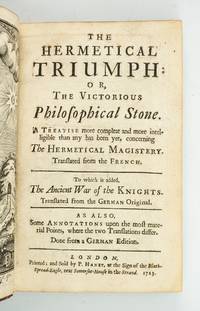
1723ST20781London: P. Hanet 1723. FIRST ENGLISH EDITION. 155 x 99 mm. 6 1/8 x 3 7/8". xxvi 2 147 1 39 1 pp.Translated from the French edition of 1699. <br/> Contemporary calf covers with double gilt rule raised bands. In a custom drop-back box. With engraved allegorical frontispiece. Front pastedown with large engraved Masonic bookplate front free endpaper with ink stamped emblem of a 33rd degree Mason and ink ownership stamp of John Glas Sandeman see below. Greenberg "From Alchemy to Chemistry in Picture and Story" pp. 189-91; Pritchard 451.1; Duveen 361; Ferguson I 394; ESTC T119227. See also Ferguson II 486. Leather on spine crackled and flaking and with label missing or at least hard to read joints and extremities somewhat rubbed boards rather chafed so the binding not pretty but entirely original and absolutely sound. Isolated small spots or marginal smudges but A FINE COPY INTERNALLY the text especially clean and unusually fresh.<br/> <br/> From the library of a 33rd degree Mason this is a pleasing fully contemporary and extremely rare copy of an important text that demonstrates the place of alchemy in the history of science. Beginning with a striking frontispiece rich in esoteric symbolism the text here is a typically obscure alchemical allegory structured as a discourse between Gold and Mercury personified as knights and the Philosopher's Stone. The text was first published as "Uralter Ritter-Krieg" "Battle of the Ancient Knights" in Leipzig in 1604 added to an edition of "Triumphwagen Antimonii" by the legendary alchemist-monk Basil Valentine. It was later translated into Latin and French; the present first English edition includes a translation of the French version as well as a translation from the original German. The authorship has traditionally been attributed to French alchemist and diplomat Alexandre-Toussaint de Limojon de Saint-Disdier 1630-89 who apparently edited the 1689 French edition though Ferguson disputes this. While its original authorship may be uncertain Greenberg writes that our English edition is "the definitive text" of a work that demonstrates a shift in alchemical thinking: "while the amusing aspect of this book is its use of allegory the most fascinating aspect is the manner in which solid scientific reasoning based upon experimentation is employed to discredit some fundamental tenets of alchemical lore. While the 'magistery' of alchemy wins the day 'The Hermetical Triumph' early stirrings of the Scientific Revolution are quite audible." Our copy has a notable--and esoteric--provenance. The named former owner is English antiquarian John Glas Sandeman 1836-1921 who served as Captain in the 1st Royal Dragoons in the Crimean War. He published archaeological tracts and built a notable collection specializing in Greek and Roman coins. The present copy also has an inkstamp and bookplate indicating it was the property of a 33rd degree Mason the highest degree in Scottish Rite Masonry. Whether this was Sandeman or someone else is unclear but evidently it was a person with an interest in the sort of occult tradition discussed in the text: the symbols on the bookplate bear a definite resemblance to those in the frontispiece. "The Hermetical Triumph" is very rare: besides ours we were able to trace just one copy since 1964 in RBH selling in 2024 for $7440. P. Hanet unknown
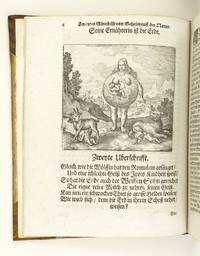
1708ST16190Frankfurt: Georg Heinrich Oehrling 1708. First Edition in German. 202 x 160 mm. 8 x 6 1/4". 2 p.l. 151 2 blank 152-53 pp. <br/> Original patterned paper boards and calf corners expertly and sympathetically rebacked with unadorned calf raised bands. WITH 50 FINE COPPER-ENGRAVED EMBLEMS BY MATTHÄUS MERIAN THE ELDER. Front pastedown with engraved "Mannington Hall" bookplate of English diplomat Horatio Walpole 1678-1757. Ferguson II 63; Duveen 385; Landwehr "German Emblem Books" 413; Kindlers Neues Literatur Lexikon X 886; Nummedal "How to Read the Alchemical Corpus" introduction to the digital edition at the Max Planck Institute; Thorndike VII 173. ◆A little soiling to boards but the binding solid and not without appeal leaves lightly washed one small rust spot to text one ink stain obscuring a couple of letters but AN EXCEPTIONALLY PLEASING COPY the text especially clean with excellent impressions of the engravings.<br/> <br/> Using the same Merian engravings created for the 1617 original printing entitled "Atalanta Fugiens" this is the second edition and the first in German of a work described by Kindlers as "indisputably the most beautiful the strangest and most inventive work of 17th century esoteric alchemy." Maier begins with the myth of Atalanta told in Ovid's "Metamorphoses" and then brings in poetry music alchemical symbols and emblems. This "Chemical Cabinet" presents 50 emblems "each containing a motto a copper plate engraving by the renowned Matthäus Merian an epigram in German and Latin an accompanying fugue or canon for three voices and a discourse explicating the emblem’s alchemical meaning. The parts of each emblem and the book as a whole are meant to work together with the music image and text as an interlocking guide to alchemical theory and to the production of the philosophers' stone. The multimedia 'Atalanta fugiens' was meant not only to link sound sight and intellect but also to spark discussion and laboratory practice making it an intriguing point of entry into an examination of the place of reading and writing—and their relationship to other bodily ways of knowing—in the production of early modern knowledge." Nummedal introduction to "Project Atalanta" the Max Planck Institute's digital edition of "Atalanta Fugiens" German physician courtier and alchemist Michael Maier 1568-1622 studied medicine at Padua and at the University of Basel and he served as physician and counselor to Holy Roman Emperor Rudolf II. According to Thorndike "Maier was a Rosicrucian and gained Robert Fludd for that fraternity"; DSB notes that he "helped to organize the publication of the works of Fludd in Frankfurt . . . and probably had a hand in the publication of the 'Fama Fraternitatis' 1616." This is a scarce edition in commerce and a good deal rarer than the dramatically more costly first edition: ABPC and RBH record seven other copies sold at auction in the past 50 years. This book and books like it almost never turn up in decent condition let alone as pleasing as the present copy. Georg Heinrich Oehrling unknown