Livre Rare Book

1 368 résultats
1486numéro 13 1976 in 8 broché 127 pages
français 0 Date de parution : 06/04/2011 Editeur : Payot Collection : Petite Bibliothèque Payot ISBN : 978-2-228-90645-6 EAN : 9782228906456 Présentation : Broché Nb. de pages : 304 pages Poids : 0,16 Kg Dimensions : 11,0 cm × 17,0 cm × 2,0 cm Imaginez une mère calme, sereine. Les contrariétés ne l'ébranlent pas. S'il lui arrive de manquer de sagesse ou de compassion, elle ne perd pas son temps à culpabiliser ; elle se dit simplement qu'elle fera mieux la prochaine fois. En sa présence, ses enfants se sentent bien, valorisés, compris. On loue sa gentillesse, sa lucidité, son esprit de décision. Il est possible de lui ressembler en appliquant certains principes du bouddhisme. Sarah Napthali, mère de deux enfants et bouddhiste pratiquante, montre ici comment gérer ses émotions, canaliser sa colère, et surtout ne pas se laisser envahir par les enfants tout en étant pleinement présente dans les moments importants. ESOTERISME FRANC MACONNERIE ALCHIMIE SPIRITUALITE RELIGION OCCULTISME SYMBOLISME
24656o.J. Alchimist. Feldherr im 30.jähr. Krieg. Kämpfte 1622 bei Wimpfen. Mitglied der Fruchtbringenden Gesellschaft. 1600 Altenburg - 1628 Weimar. Brustbild im Schriftoval, unten latein. Verse. Kupferstich von Wolfgang Kilien um 1625. 168 x 126 mm.
22702o.J. Chemiker, Arzt, Chirurg, Oculist, Stein- und Bruchschneider. Schrieb u.a. "Kleine Reiss- u. Haus-Apotheck". Hamburg um 1670. Brustbild im Schriftoval, oben in den Ecken chirurgische Instrumente, unten alchimistische Apparate, darunter deutsche Verse. Kupferstich von H. von Hensbergen. 128 x 71 mm.
253o.J. Alchimist, Mediziner. 1551 bei dem Markgrafen Albrecht Alcibiades von Kulmbach-Bayreuth, 1559 im Hüttenwesen in Tarrenz, 1571 Leibarzt des Kurfürsten Johann Georg von Brandenburg, wirkte bis 1584 auch als Astrologe, Kalendermacher, Apotheker u. Drucker in Berlin. 1531 Basel - 1596 Köln. Brustbild im Profil nach links, im Schriftoval. Kupferstich um 1640. 143 x 103 mm.
48 S. Rückenbroschur. Sehr seltene Verteidigungsschrift für den gerade dahin geschiedenen Exorzisten und Wunderheiler Gassner Bücher de
20925o.J. Luth. Theologe, Kirchenliederdichter. 1643 Prof. am Egidianum u. 1646 Prediger an St. Lorenz in Nürnberg, seit 1649 auch Kirchenrat des Grafen von Oettingen. Stifter und Direktor einer alchemistischen Gesellschaft in Nürnberg. 1617 Nürnberg - 1685 ebd. Kniestück vor einem aufgeschlagenen Buch stehend, im Schriftoval, unten lat. Verse. Kupferstich von J.A. Boener. 332 x 246 mm.
9021o.J. Luth. Theologe, Kirchenliederdichter. 1643 Prof. am Egidianum u. 1646 Prediger an St. Lorenz in Nürnberg, seit 1649 auch Kirchenrat des Grafen von Oettingen. Stifter und Direktor einer alchemistischen Gesellschaft in Nürnberg. 1617 Nürnberg - 1685 ebd. Brustbild. Kupferstich um 1720. 135 x 103 mm.
11069o.J. regierte seit 1593. Alchimist, gründete 1599 Freudenstadt. 1557 Schloß Horburg - 1608 Stuttgart. Brustbild im Schriftoval. Kupferstich bei D. Custos um 1600. 169 x 120 mm.
2629Deux documents in-plano (61 x 49 cm) en partie imprimé et manuscrite sur papier fort .
176629075Leipzig, Johann Paul Krause, 1766. 8vo. Fine recent boards in old style. Engraved frontispiece. (14),368 pp. The first leaves with brownspots in upper margin, light browning to text. A few old annotations. Old owner's name inscribed in the cartouche of frontispiece:""Marcus Weisz parisiis 1788"".
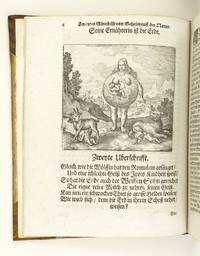
1708ST16190Frankfurt: Georg Heinrich Oehrling 1708. First Edition in German. 202 x 160 mm. 8 x 6 1/4". 2 p.l. 151 2 blank 152-53 pp. <br/> Original patterned paper boards and calf corners expertly and sympathetically rebacked with unadorned calf raised bands. WITH 50 FINE COPPER-ENGRAVED EMBLEMS BY MATTHÄUS MERIAN THE ELDER. Front pastedown with engraved "Mannington Hall" bookplate of English diplomat Horatio Walpole 1678-1757. Ferguson II 63; Duveen 385; Landwehr "German Emblem Books" 413; Kindlers Neues Literatur Lexikon X 886; Nummedal "How to Read the Alchemical Corpus" introduction to the digital edition at the Max Planck Institute; Thorndike VII 173. ◆A little soiling to boards but the binding solid and not without appeal leaves lightly washed one small rust spot to text one ink stain obscuring a couple of letters but AN EXCEPTIONALLY PLEASING COPY the text especially clean with excellent impressions of the engravings.<br/> <br/> Using the same Merian engravings created for the 1617 original printing entitled "Atalanta Fugiens" this is the second edition and the first in German of a work described by Kindlers as "indisputably the most beautiful the strangest and most inventive work of 17th century esoteric alchemy." Maier begins with the myth of Atalanta told in Ovid's "Metamorphoses" and then brings in poetry music alchemical symbols and emblems. This "Chemical Cabinet" presents 50 emblems "each containing a motto a copper plate engraving by the renowned Matthäus Merian an epigram in German and Latin an accompanying fugue or canon for three voices and a discourse explicating the emblem’s alchemical meaning. The parts of each emblem and the book as a whole are meant to work together with the music image and text as an interlocking guide to alchemical theory and to the production of the philosophers' stone. The multimedia 'Atalanta fugiens' was meant not only to link sound sight and intellect but also to spark discussion and laboratory practice making it an intriguing point of entry into an examination of the place of reading and writing—and their relationship to other bodily ways of knowing—in the production of early modern knowledge." Nummedal introduction to "Project Atalanta" the Max Planck Institute's digital edition of "Atalanta Fugiens" German physician courtier and alchemist Michael Maier 1568-1622 studied medicine at Padua and at the University of Basel and he served as physician and counselor to Holy Roman Emperor Rudolf II. According to Thorndike "Maier was a Rosicrucian and gained Robert Fludd for that fraternity"; DSB notes that he "helped to organize the publication of the works of Fludd in Frankfurt . . . and probably had a hand in the publication of the 'Fama Fraternitatis' 1616." This is a scarce edition in commerce and a good deal rarer than the dramatically more costly first edition: ABPC and RBH record seven other copies sold at auction in the past 50 years. This book and books like it almost never turn up in decent condition let alone as pleasing as the present copy. Georg Heinrich Oehrling unknown
195376489Barcelona: Edicions Hora 1953. First edition in Catalan Llull's native tongue and the first edition with Campany aquatints. One of XVI special copies. Text printed in Catalan Llull is known for being among the first authors to use his vernacular language Catalan to communicate his ideas. Folio . 175 1 pp. with 11 full page hand-colored etchings drawn engraved and colored by the artist and ten large chapter headings all signed in pencil by the artist. Loose as issued in vellum-backed chemise with gilt spine lettering. Housed in a custom acrylic slipcase. A wonderful copy.This is a Catalan translation of Llull's 1305 although first published in 1512 work entitled Liber de Ascensu et Descensu Intellectus The Book of the Ascent and Descent of the Intellect. Ramon Llull is often thought of as an alchemist of the first order but strictly speaking he was a philosopher/theologian. His magnum opus Ars Magna displays his chief theme; the understanding of eternal truths by way of the intellect. While not himself an alchemist the seekers of the philosopher's stone were very influenced by Llull's ideas. In this book Llull describes the movement of the intellect through the many levels of understanding which some Renaissance alchemists such as Heinrich Khunrath interpreted as analogous to the transmutation process in alchemy. This striking volume was issued in an edition of 165 copies. This copy is one of XVI #VII copies containing an original drawing of one of the plates or of 2 of the vignettes a complete set of the proofs a series of sanguine proofs of the plates and the vignettes and the final proof of all the plates. It is the most desired format. Ramon de Capmany y de Montaner 1899 - 1992 was a Catalan painter engraver and bibliophile. He trained as a painter at the Escuela de la Lonja where he studied under the supervision of Francesc Labarta. He was one of the members of the the Evolutionists and one of the regulars of the Sala Pares. The Evolutionists were an artistic group from Barcelona in the aesthetic sphere of Noucentisme and who rejected programmatic orthodoxy and influenced by Cezanne and the Fauvists developed a personal work constructed and of austere colors. Mainly a landscape painter he mostly painted the surroundings of the Montseny Massif and the old part of the city of Barcelonain a naturalistic style. He also illustrated bibliophile editions such as this one. He held the position of curator in the board of the Ateneo Barcelones during the presidency of Pedro Gual Villalbi between 1952 and 1962. Some of his works can be found in the National Art Museum of Catalonia.One of the proofs of the work apart from the one designated to be signed by the artist is dedicated by Capmany to a Mr. Riera with the following words: ‘Prueba dedicada al Sr. Riera por el artista. Ramon Campmany.’ An original steel etched plate one used in the making of this volume comes with the work. It’s an additional object and no other copies have such a plate. This plate was a gift from the artist to the same Mr. Riera. Edicions Hora hardcover
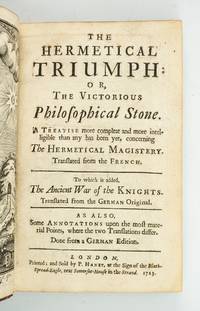
1723ST20781London: P. Hanet 1723. FIRST ENGLISH EDITION. 155 x 99 mm. 6 1/8 x 3 7/8". xxvi 2 147 1 39 1 pp.Translated from the French edition of 1699. <br/> Contemporary calf covers with double gilt rule raised bands. In a custom drop-back box. With engraved allegorical frontispiece. Front pastedown with large engraved Masonic bookplate front free endpaper with ink stamped emblem of a 33rd degree Mason and ink ownership stamp of John Glas Sandeman see below. Greenberg "From Alchemy to Chemistry in Picture and Story" pp. 189-91; Pritchard 451.1; Duveen 361; Ferguson I 394; ESTC T119227. See also Ferguson II 486. Leather on spine crackled and flaking and with label missing or at least hard to read joints and extremities somewhat rubbed boards rather chafed so the binding not pretty but entirely original and absolutely sound. Isolated small spots or marginal smudges but A FINE COPY INTERNALLY the text especially clean and unusually fresh.<br/> <br/> From the library of a 33rd degree Mason this is a pleasing fully contemporary and extremely rare copy of an important text that demonstrates the place of alchemy in the history of science. Beginning with a striking frontispiece rich in esoteric symbolism the text here is a typically obscure alchemical allegory structured as a discourse between Gold and Mercury personified as knights and the Philosopher's Stone. The text was first published as "Uralter Ritter-Krieg" "Battle of the Ancient Knights" in Leipzig in 1604 added to an edition of "Triumphwagen Antimonii" by the legendary alchemist-monk Basil Valentine. It was later translated into Latin and French; the present first English edition includes a translation of the French version as well as a translation from the original German. The authorship has traditionally been attributed to French alchemist and diplomat Alexandre-Toussaint de Limojon de Saint-Disdier 1630-89 who apparently edited the 1689 French edition though Ferguson disputes this. While its original authorship may be uncertain Greenberg writes that our English edition is "the definitive text" of a work that demonstrates a shift in alchemical thinking: "while the amusing aspect of this book is its use of allegory the most fascinating aspect is the manner in which solid scientific reasoning based upon experimentation is employed to discredit some fundamental tenets of alchemical lore. While the 'magistery' of alchemy wins the day 'The Hermetical Triumph' early stirrings of the Scientific Revolution are quite audible." Our copy has a notable--and esoteric--provenance. The named former owner is English antiquarian John Glas Sandeman 1836-1921 who served as Captain in the 1st Royal Dragoons in the Crimean War. He published archaeological tracts and built a notable collection specializing in Greek and Roman coins. The present copy also has an inkstamp and bookplate indicating it was the property of a 33rd degree Mason the highest degree in Scottish Rite Masonry. Whether this was Sandeman or someone else is unclear but evidently it was a person with an interest in the sort of occult tradition discussed in the text: the symbols on the bookplate bear a definite resemblance to those in the frontispiece. "The Hermetical Triumph" is very rare: besides ours we were able to trace just one copy since 1964 in RBH selling in 2024 for $7440. P. Hanet unknown
2495Paris, Editions Publications Premières, Collection "En Marge", 1970. In-8 broché, couverture rempliée. 340 pp.
2 Tle. 8 S.; 16 S. Rückenbroschur. Graesse, BMP 77. Bücher de
63242aafHeilbronn am Neckar, Claßische Buchhandlung, 1839, in-8vo, 284 S., unbeschnitten, „Hrsg. v. einem täglichen Augenzeugen u. Freunde der Wahrheit u. d. höhern Offenbarungen“, Original gedr. Verlags-Pappband. Anfang vom Mäusfrass am Schnitt (kaum nur Papier Verlust). (frühe Ausgaben sind selten).
193033313BBLondon, Published at the Office of the Co-Mason, (ca. 1930). 8°. 3 n.n. Bl., 67 S. mit einigen Diagrammen im Text. Grüner Originalleinwandband mit goldgeprägtem Rücken- und Deckeltitel.
193033313BBLondon, Published at the Office of the Co-Mason (ca. 1930). 8°. 3 n.n. Bl., 67 S. mit einigen Diagrammen im Text. Grüner Originalleinwandband mit goldgeprägtem Rücken- und Deckeltitel.
200097816FBMansfield, Connecticut:, Martino, 2000. (1) Bl. (vacat), (3) Bll. (Titelei), 669 (1) Seiten, XVI Tafeln, Fadenheftung, schwarzgeprägter OLnbd., 23 x 17,5 cm. [2 Warenabbildungen]
1780107395BB(Bern und Lausanne, 1780). 8° (20,5 x 17 cm.). 9 S. und 23 (1 gefalt.) Kupfertafeln. Moderner Kartonumschlag.
168 S. Rückenbroschur. Kein Exemplar über KVK nachweisbar. - Goed. VII, 572, 3, 3: "Ohne einen Titel vorzusetzen ließ H. (1783. 8.) das Rostockische Konsistorialprotokoll über sich und seine Schriften mit seiner Verantwortung darauf drucken." - "Friedrich Henning, geb. 1738 zu Sternberg im Mecklenburgischen, Gerber und Schuster, hielt sich 1781 bis 1783 in Altona auf, ging 1784 nach Philadelphia und von da nach Westindien." (Goed.; bezieht sich in dem ganzen Artikel auf Meusel III, 215 und Bolten, Kirchennachrichten II, 138-142). - Nach Bolten kehrte Henning nach einer erfolgreichen wirtschaftlichen Karriere in Surinam und auf St. Croix voller "schwärmerischer Grillen" nach Altona zurück; von großem religiösen Sendungsbewusstsein erfüllt, veröffentlichte er dort 1781-1782 das Werk "Reiner Krystallstrom", das eine völlig neue Interpretation der Bibel enthält. Die ersten drei Bücher Mose versteht Henning allegorisch, verwirft den Erlösungsgedanken durch den Tod Jesu und verneint die Kindstaufe. Die Kirche selbst sieht er vom Satan eingerichtet und als das babylonische Tier in der Offenbarung Johannes; die irdischen Vertreter werden mit Wonne beschimpft. Henning wurde vom Konsistorium vorgeladen, die Schrift natürlich sofort verboten und ein Schreibverbot ausgesprochen. Hier vorliegend nun die von Henning ungeachtet veröffentlichten Protokolle der Verhandlung und seine Verteidigung. - Teils fleckig, zum Schluss hin stärker feuchtfleckig. Die beiden letzten Blätter mit geknickten Ecken. Bücher de
4 Bll., 152 S. Pappband d. Zt. Erste Ausgabe. Der vermutliche Verfasser ist Michael Kajetan Hermann (1756–1835) im Böhmischen wirkender katholischer Pfarrer und Schulaufseher. Themen sind u.a. Gespensteraberglauben, Feuerbesprechen, Kalenderaberglauben und Wünschelrute. - Etwas gebräunt bzw. braunfleckig, Titel etwas geknittert. Vord. Vorsatz mit hs. Besitzvermerk und Exlibris der Landkapitelsbibliothek Stiefenhofen. Bücher de
178922014Zittau und Leipzig, Schöps, 1789. 5 n.n. Bll., 288 SS.; 306 SS., 9 n.n. Bll. Register zu beiden Teilen. 8°, Halbleder der Zeit über 5 Bünden, Rückenvergoldung, zwei goldgepr. Rückenschildchen, Lesebändchen, marmorierter Schnitt. Einband etwas berieben, Rücken am Schwanz mit kl. Fehlstelle am Leder.
178121865Berlin u. Leipzig, J. Decker, 1781. XXXII, 551 (1) SS., 2 Kupfertafeln, davon eine ausfaltbar, 5 Schemata im Text. 8°, Halbleder der Zeit über 5 Bünden, goldgeprägte Fleurons in 5 Feldern, oranges goldgepr. Rückenschildchen, die Einbanddeckel mit Kiebitzpapier bezogen. Ecken und Kanten wenig berieben.