BALZAC (Honoré)Livre Rare Book
334 résultats
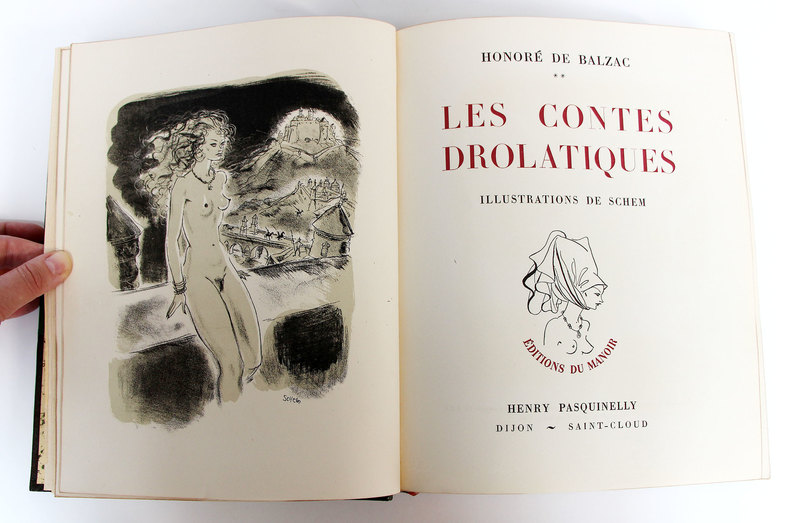
194891133Dijon - Saint-Cloud, éditions du Manoir, Henri Pasquinelly, impr. Les Presses de “La Ruche” A. et P. Jarach, à Paris 1948 2 volumes. In-4. Reliures demi-chagrin vert foncé à coins, filets dorés, dos à nerfs ornés de files dorés et encadrés de fers dorés avec incrustations de chagrin rouge, têtes dorés, couvertures et dos conservés, 416 pp. en pagination continue, belle illustration de Schem, composée de 40 lithographies hors-texte en deux tons et de nombreux dessins in-texte. Ouvrage très élégamment relié. Bel exemplaire.
Features: Satanism and the World Order - Professor Gilbert Murray explains how "The spirit of hatred, which rejoiced in any wide-spread disaster that was also a disaster to the world's rulers, is perhaps more rife today than it has been for a thousand years"; Santo Domingo - The Land of Bullet-Holes - Photo-illustrated article by Harry A. Franck describes how, crossing between Haiti and Santo Domingo, he found striking differences in the two peoples; Paradise Shares (fiction); The Making of a Book-Collector - William Harris Arnold; From a Door-Step in Leinster (Life in small Irish towns), I. The Door-Step, II. A Girl for the Kitchen; The Strange Paumotu Atolls - Frederick O'Brien describes his visit; Aaron Harwood (fiction); The Tide of Affairs - Comment on the times; Quaint Old Boston - Photo-illustrated article; Georgios Venizelos and Hellas; Her Promised Land (fiction); Mecca's Revolt Against the Turk - An explanation of current difficulties in the Middle East subsequent to Emir Feisal setting himself up as king of all Syria in March, 1920 - article with photos of Mecca, Medina, T.E. Lawrence, and The Emir Feisal; The Success of the Season - Theatre business is growing; Musical Adventures of the Season; Where is America Going? - The third (and final) letter by American reporter Webb Waldron to Bernard Roberval, French historian and philosopher; Investment and Banking; Colour frontispiece illustration "The Painted Desert", by Albert Groll. pp. 289-432, 56 [ads]. Includes a particularly wonderful assortment of nostalgic ads, with full-page color ads for Old Colony Trust Company of Boston (featuring John Hull, the mint master of the Massachusetts Bay Colony), W. & J. Sloane (rugs) of Fifth Ave., NYC, Indestructo Trunks, The Jordan Silhouette motor car, The Templar Motor Company, Mercer Motors Company, The Pantasote Company, Macbeth-Evans Glass Company, Kellogg's Krumbled Bran, G-E (General Electric) Fans, Davey Tree Surgeons, and Beech-Nut Ginger Ale. Somewhat above-average external wear. Contents clean and unmarked. Binding intact. Lacking back cover. A sound copy of this fascinating and informative vintage issue. Book
18607975New York Boston: D. & J. Sadlier & Co 1860. First American Edition. 8vo 3 324pp. Frontis plate illustration and a few vignette chapter headings. Publisher's brown diaper grain cloth vignette illustration and ruling stamped in blind on covers and spine. Mild foxing throughout more pronounced at prelims else clean and sound internally. Spine ends worn away corners frayed damp staining to front board. Very good. <br /> <br /> First American edition of the first work from 19th century French priest Abbé Boullan 1824-1893 who was later laicized by by the church and accused of being a Satanist due to extreme and controversial pious acts rituals and writings. This book a translation of Marie d'Agreda's Divine Life of the Holy Virgin from her Mystical City of God shows Boullan's roots in spiritualism and Christian Mysticism.<br /> <br /> Boullan began his holy work in Rome in the Missionnaires du Précieux Sang Missionaries of the Precious Blood who believed in their role as cleansers of people’s sins through violent self-flagellation. After his return to France in 1851 he began studying the mystics and produced this translation which immediately caused a controversy within the church due to its positive description of mysticism as it related to occult practice and Spiritualism. He would go on to further validate his stance and bring the ire of the church through various means such as: the clerical verification of supernatural miracles; the writing on and practice of soul repair; exorcisms involving spitting into mouths drinking urine wearing poultices made of feces; and a vision proclaiming his nomination as John the Baptist Elijah's successor. Then things got really weird.<br /> <br /> Boullan created a compound in Lyon where he and his followers could practice these kinds of rituals in peace. His main teachings included Kabbalistic interpretations of prophetic verse which involved naked bodily contact in groups sexual intercourse both with Boullan as a sacrament and with other initiates the blood of mice on communion wafers and it was even rumored sacrifice. Boullan decried these rumors and defended his status as a pious Christian until his death but his reputation had been created and forever solidified by the fervent occult circles in France at the time.<br /> <br /> This copy states First American Edition on the title page with a date of 1860 and with 1859 on the copyright page. We note an edition with only the copyright date of 1859 and an entirely different title page also published by Sadlier. Both editions are scarce and OCLC cites a single holding for the 1860 edition. <br /> <br /> . D. & J. Sadlier & Co unknown
Cm. 20, mezza pelle verde con tassello e fregi in oro a dorso, pag. XL, 318 più antiporta inciso in rame. Interessante opera di demonologia, sulle testimonianze dei rapporti tra demoni e umani. Lieve foxing ma ottimo esemplare in solida legatura. Non in Graesse, Brunet ne' Rosenthal.
1693000166Franeker: Jacobum Horreum 1693. Hardcover. See Description. 4to. pp. 12 768 28. Half title for each section. Bound in quarter vellum with paste paper boards - well rubbed. Library book plate on inside front cover. Title page displays a large woodcut device. Pages are clean overall with occasional spotting and age toning; faint inscription above title page device; outer margin of pp.735-6 reinforced with contemporary paper. Fore edge of the text block is a bit rubbed. The bottom edge is stamped with a library name. Board corner tips neatly repaired. Johann Van der Waeyen 1639-1701 was a Frisian Minister scholar and controversialist. In 1677 he was forced to leave his position in Middelburg and move to Franeker. See M'Clintock Cyclopaedia of Biblical Lit. Among his better known works is a commentary on Balthasar Bekker's book on witchcraft. Van der Waeyen's interest in demonology is also apparent in this collection of tracts which contains two essays 485 pages on the demon AZAZEL who was associated with the Israelite scape-goat ritual. The book also contains a commentary on Paul's Epistle to the Galatians and several other essays. <br/> <br/> Jacobum Horreum hardcover
1894Q121136Paris-Lyon, Delhomme et Briguet s.d. [ca. 1892-1894] Ouvrage complet en 2 volumes, 964,[56] + 960,[48] pp., avec plus de 120 portraits et illustrations dans le texte, 27cm., reliures uniformes cartonnées très solides et en bon état (br. orig. conservées et contrecollées aux plats et dos), texte très frais, bon état, rare, cfr. Caillet no. 4917, poids: 3.9kg., [A la fin du tome 1, on a relié: "Le diable au XIXe siècle. Bulletin mensuel (complément de la publication)" fascicules no.5 (5 aout 1893, 4pp.), no.10 (5septembre 1893, 8pp.), no.11 (5 octobre 1893, 8pp.), no.12 (novembre 1893, 4pp.), & no.1 (Janvier 1894, 32pp.) // A la fin du tome on a relié ce même bulletin, fascicules no.13 (décembre 1893, 4pp.), no.14 (janvier 1894, 4pp.), no.15 (février 1894, 4pp.), no.16 (mars 1894, 4pp.), no.17 (avril 1894, 4pp.), no.18 (mai 1894, 4pp.), no.19 (juin 1894, 4pp.), no.20 (juillet 1894, 4pp.), no.21 (aout 1894, 4pp.), no.22 (septembre 1894, 4pp.), no.23 (octobre 1894, 4pp.) & no.24 (novembre-décembre 1894), 4pp.) ], Q121136
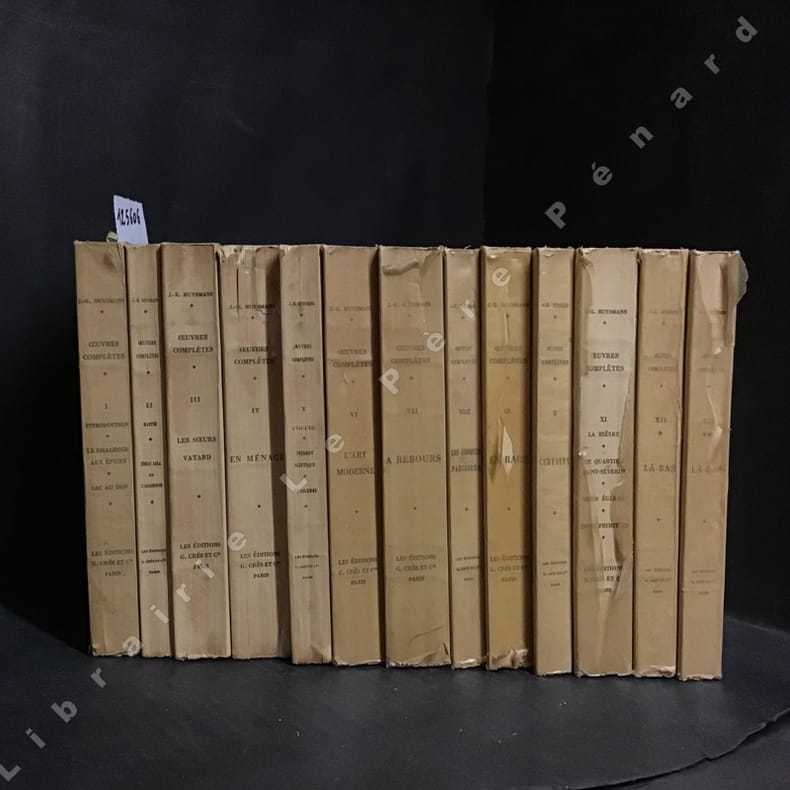
19281256061928-1934 Les Editions G. Crès et Cie, Paris - 1928-1934 - 18 tomes en 23 volumes in-8 (15x20,5 cm environ) brochés, couverture rempliée - XXIX-253 + 197 + 343 + 395 + 234 + 309 + 357 + 206 + 280 + 212 + 363 + 251 + 260 + 283 + 335 + 348 + 342 + 245 + 195 + 333 + 317 + 294 + 346 pages - Ouvrage tiré à 1500 exemplaires sur papier vergé des papeteries Navarre, les tomes I à XVII portent le numéro 489 sur et le tome XVIII porte le numéro 488
Very Good Turkish, Ottoman (1500-1928) Paperback. 8vo. (18 x 12 cm). In Ottoman script (Old Turkish with Arabic letters). 80 p. Probably taken from a volume. Minor wear on spine. Light fading on pages. Otherwise a very good copy. This interesting, very rare, and also pseudo-historical first book penned specifically on the Yezîdî people by an Ottoman statesman, initially prepared as a report and then published in 1912, before WWI in Ottoman Cairo. One of only three written Eastern sources about this interesting community that has been subject to extremely controversial approaches throughout history. The first is the travel corpus of Evliya Çelebi, the second is 'Abede-i Iblis', and the third is "Al-Yazidiyya Kadîmen wa Hadisen", which was published in Arabic in Beirut in 1934. Yezîdîs, a member of a Kurdish religious minority found primarily in northern Iraq, southeastern Turkey, northern Syria, the Caucasus region and parts of Iran. The Yezîdî religion includes elements of ancient Iranian religions as well as elements of Judaism, Nestorian Christianity and Islam. Although scattered and probably numbering merely between 200,000 and 1,000,000, the Yezîdîs have a well-organized society, with a chief sheikh as the supreme religious head and an emir, or prince, as the secular head. The origins of the Yezîdî faith can be traced to areas of the Kurdish mountains of northern Iraq where pockets of devotion to the fallen Umayyad dynasty persisted long after the death of the last Umayyad caliph, the half-Kurdish Marwan II, in 750. Some descendants of the dynasty settled in the area, further encouraging the development of mystical traditions in which the Umayyad lineage was prominently figured. In the early 12th century, Sheikh 'Adî ibn Musâfir, a Sufi and a descendant of the Umayyads, settled in Lâlish, north of Mosul, and began a Sufi order known as the Adwiyyah. Although his own teachings were strictly orthodox, the beliefs of his followers soon blended with local traditions. A distinct Yezîdî community living in the environs of Mosul appears in historical sources as early as the middle of the 12th century. This book includes descriptions of the Yezîdîs , albeit all the prejudices within it, on their geography, origins, mythology, religions, cosmogony, etc. The book has a long chapter on Yezîdîs' chief divine Malak ?âûs [or, Tavus] ("Peacock Angel"). Malak Taus has often been identified by outsiders with the Judeo-Christian figure of Satan, causing the Yezîdîs to be inaccurately described as "Devil worshippers", as seen in this pseudo-historical book as well. Özege 24.; OCLC 83228795.
16882Paris, Tresse & Stock, 1891. In-12, 441 pp., broché, couverture originale imprimée, chemise et étui de papier marbré (légère insolation à la chemise et l'étui, couverture légèrement empoussiérée).