41 résultats
1869684631869. London 1869. London 1869. "The Great Convent Trial" Trial. Star Mother Mary Joseph Defendant. Kennedy Mary Magdalen Sister Defendant. The Trial of Saurin v. Star and Another: In the Court of Queen's Bench Before the Lord Chief Justice and a Special Jury. An Action by a Sister of Mercy Against Her Superior for an Alleged Conspiracy to Cause her Expulsion. The Report Copied Verbatim from the Times. London: Diprose and Bateman 1869. ii 264 pp. Woodcut portrait frontispiece of Saurin. Octavo 8-1/2" x 5-1/2". Later library cloth red and black calf lettering pieces to spine. Light soiling and shelfwear a few minor stains minor edgewear to lettering pieces. Moderate toning to text minor tears to a few leaves faint embossed ink and library stamps to title page brief annotation to verso frontispiece detached and edgeworn just touching border of image title page partially detached. $350. Only edition. Mary Saurin Sister Mary Scholastica Joseph brought a case against her superior and another nun for assault and conspiracy to drive her from her convent and have her expelled from the order. Known as "the great convent trial" it was a sensational case that fueled contemporary prejudices against Catholics monastic orders and women. These themes are apparent in the Solicitor-General's opening remarks. This case shows "what women were capable of when they shut themselves up from their kind and did violence to the instincts of their nature and the great though mean and petty cruelty they could wreak upon a sister in the name of a religion of love" 2. The jury found in favor of the defendants on the counts of assault and for the plaintiff on the counts of libel and conspiracy to have her expelled from the convent. OCLC locates 6 copies in law libraries Harvard Northwestern UC-Berkeley and the Universities of Michigan Minnesota and Virginia. Catalogue of the Library of the Harvard Law School 1909 II:1182. unknown books
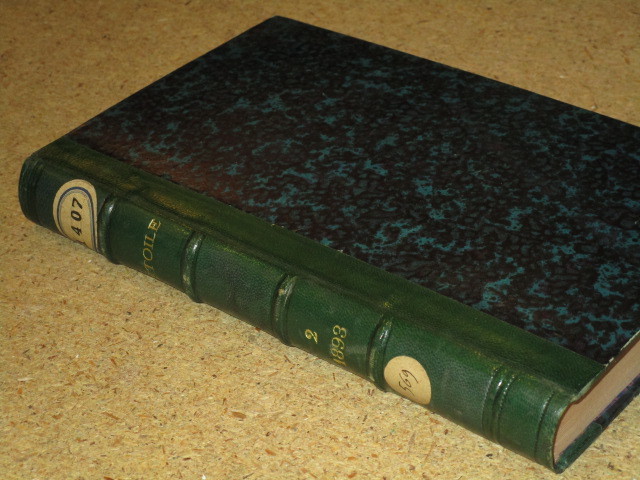
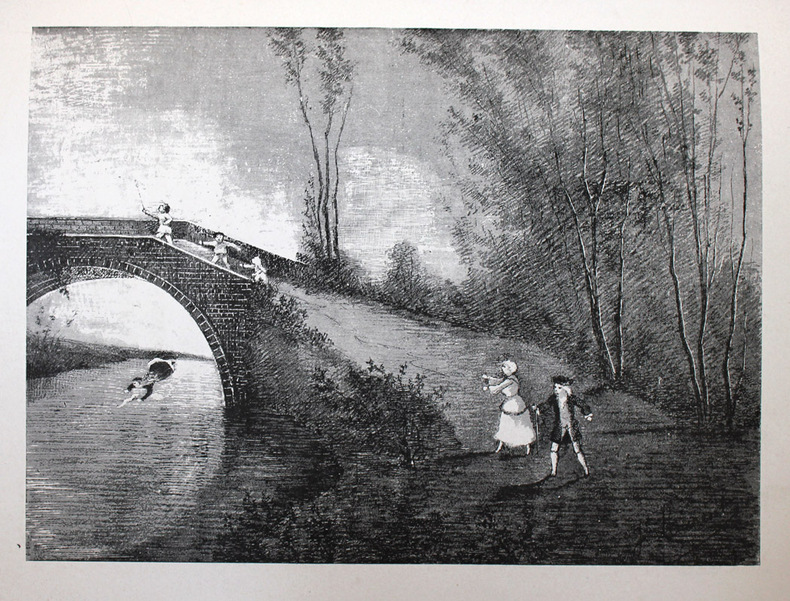
1893104077L'Etoile 1893 L'Etoile, 1893, 12 numéros reliés en 2 volumes (année 1893 complète), 408 p. par volume, demi-basane vert sapin, environ 22x14cm, deux étiquettes sur le dos et une autre sur le premier contreplat de chaque volume, quelques frottements d'usage sur les reliures, bon état pour le reste.
188039439.71880. Dated & SIGNED in lower right of the "June" sketch; titled & dated in lower left of the "July" sketch. Bit of age toning to extremities. The June drawing with thumbtack holes in the corners otherwise Very Good Plus as is the 2nd drawing. Single sheet each The June sketch oriented vertically: 9-3/4" x 6-3/8". The July sketch oriented horizontally: 6-3/8" x 9-7/8" <br/><br/>The two sketches depict "J. De Estrella" a cowboy or man of such an aspect. the first shows him grasping a six-shooter at a holster on the left waist; the second the man is relaxing in a chair reading a paper feet up on a nearby table. Booksin a Calfornia native who settled in the San Jose area ~ 1881 where he died almost 70 years later. Named after this individual is Booksin Elementary a high achieving elementary school located in the heart of San Jose's Willow Glen suburb. From the Jeff Sahadi collection of L A Booksin drawings. unknown books
181435872Philadelphia 1814. Single issue disbound. Pages 353 - 440. Moderately foxed or browned. Good.<br/><br/> This is the first magazine appearance of the National Anthem pages 433-434. It is titled 'Defence of Fort McHenry.' BAL notes six previous newspaper publications in October 1814. Like this Analectic printing none of them includes the author's name. <br/> This printing is also famous for the editor's oft-quoted anecdotal introduction: "These lines have been already published in several of our newspapers; they may still however be new to many of our readers. Besides we think that their merit entitles them to preservation in some more permanent form than the columns of a daily paper." The editor describes the "circumstances" under which the song was composed. "He watched the flag at the fort through the whole day with an anxiety that can be better felt than described. In the night he watched the bomb-shells and at early dawn his eye was greeted by the proudly-waving flag of his country."<br/>BAL 11081 Section One G. Sabin 1358. unknown books
189763672Album in-folio oblong (41 x 63 cm) pleine toile grise d'époque, armes d'Angleterre peintes sur le premier plat, médaille incrustée en bas du premier plat ("Victoria Regina et Imperatrix" à l'avers, "In Commemoration Victoria 1837-1897" au revers), Jubilé de la Reine Victoria. 22 juin 1897. Album unique composé de documents collectés par Ernesta Stern dont : Plan de l'itinéraire de la procession ; 6 photographies par Downey, photographe de la Reine ; Portrait de la reine par Nicholson (gravure sur bois en couleurs) ; 3 invitations diverses ; Programme du Royal Opera Covent Garden du 23 juin 1897, sur soie à galons d'argent ("To commemorate the sixtieth anniversary of Her Majest's Accession to the Throne") ; 5 ephemera dont invitation de Lord Chamberlain à l'Afternoon Party du 28 juin 1897 à Buckingham Palace ("The Lord Chamberlain is commanded bu The Queen to invite Monsieur & Madame Stern & Mademoiselle Stern to an afternoon Party on Monday, the 28th of June, from 5 to 7 o'Clock. Buckingham Palace") - Jubilee of Queen Victoria. June 22, 1897. Unique album composed of documents collected by Ernesta Stern including: Map of the route of the procession; 6 photographs by Downey, photographer to the Queen; Portrait of the Queen by Nicholson (colour woodcut); 3 various invitations; Program of the Royal Opera Covent Garden of June 23, 1897, on silk with silver braid ("To commemorate the sixtieth anniversary of Her Majest's Accession to the Throne"); 5 ephemera including Lord Chamberlain's invitation to the Afternoon Party of 28 June 1897 at Buckingham Palace ("The Lord Chamberlain is commanded bu The Queen to invite Monsieur & Madame Stern & Mademoiselle Stern to an afternoon Party on Monday, the 28th of June, from 5 to 7 o'Clock. Buckingham Palace")
188124481881 Paris, G. Charpentier, 1881. 28,5 x 21 cm (R), in-4, 90 pp. - 2 ff. n. ch. (annonce et imprimeur) - 11 planches hors texte en noir sous serpentes légendées dont l'une en frontispice, cartonnage de l'éditeur, premier plat orné d'une large composition à froid et dorée, dernier plat reprenant la même composition, cette fois-ci entièrement en noir, dos orné portant le titre en long, tranches dorées.
1857GD012820okBC8S6New York: Robert Carter & Brothers 1857. New York: Robert Carter & Brothers 1857 First Edition 12mo. 203 pages plus advertisements. Book bound in a blind stamped brown cloth with gilt lettering and gilt design on spine. Some edgewear to head and heal of spine. Page 31 where poem of Star Spangled Banner there is a 1/2 inch piece of the page missing at margin without loss of text. This is the first edition of the Star Spangled Banner in book form. This volume is a collection of poems written by Francis Scott Key published posthumously in 1857 the book includes an introductory letter by Chief Justice Roger B. Teney who was Key's brother-in-law. Some foxing to pages else book very good. First Edition. Hard Cover. Very Good/No Jacket. 12mo - over 6¾" - 7¾" tall. New York: Robert Carter & Brothers Hardcover
1857SP560Robert Carter and Brothers 1857. First Edition. Hardcover. Good. New York 1857. 8vo publisher's black cloth xii 13-203 pp. First edition. The first edition of the Star Spangled Banner in book form. It had been printed only as a broadside in 1814. A BAL 11093 binding B with no sequence noted. A good plus to very good minus copy with excellent contents. Lean to spine chipping to cloth at head and heel of spine contemporary ownership signature to title page light normal shelfwear. Remains well preserved. "'The Star-Spangled Banner' has been in recent times censured for its awkward melodic line but its lyrics are now so much a part of the popular patriotic imagination that any attempt at literary analysis would perhaps seem unusual. The second and third stanzas of the original song are often omitted in public ceremonies as a gesture of courtesy to the British; the words "hireling and slave" of stanza three refer to the common British practice of using mercenary soldiers. It is interesting that the critic Charles F. Richardson writing in American Literature mentions the "bald rude rhymes" in the work. He goes on to say that the song along with "Adams and Liberty" and "Hail Columbia" is "so closely enshrined in the patriotic heart . . . that no one stops to think of . . . its literary poverty" vol. 2 1889 p. 26. Richardson's comments seem a just assessment of a work that had not yet become a national symbol." - ANB. Please contact us for additional pictures or information. Sabin 37669. BAL 11093. Robert Carter and Brothers hardcover
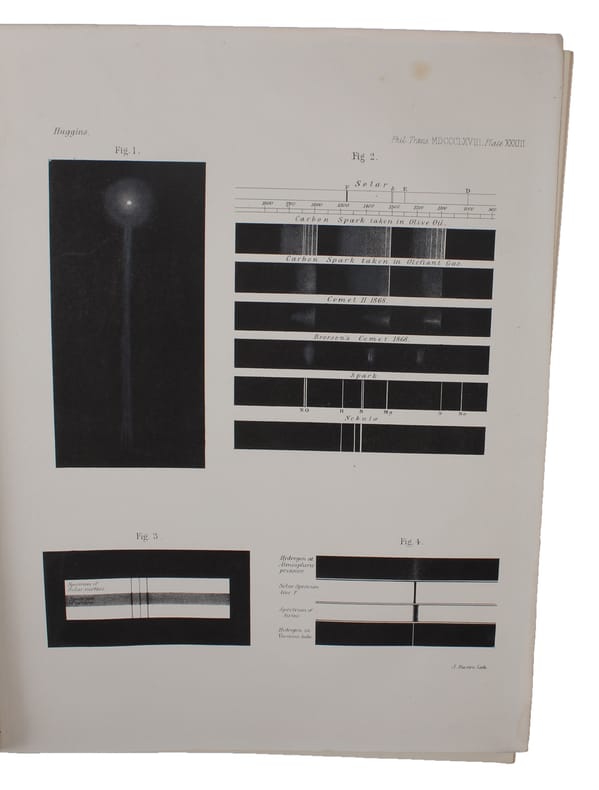
186842262(London, Taylor and Francis, 1868). 4to. No wrappers as extracted from ""Philosophical Transactions"", Vol. 158 - Part II, pp. 529-564 and 1 lithographed plate. Clean and fine..
186842262London Taylor and Francis 1868. 4to. No wrappers as extracted from "Philosophical Transactions" Vol. 158 - Part II pp. 529-564 and 1 lithographed plate. Clean and fine. <br/><br/><em>First appearence of this milestone paper announcing the very first determination of the movement and velocity of a star. Sirius. This discovery of the motion in the line of sight the radial velocity is of exceeding importence in astronomy for it can be determined by shifts in the position of the spectral lines without regard tothe distance of the star.In this paper Huggins applied to spectroscopic astronomy the principle enunciated by Doppler in 1841 that the positions of spectrum lines change as the object moves to or from the spectator. After consultingin 1867 with James Clerk Maxwell but wholly independent of him Huggins presented to the Ropyal Society early in 1868 this paper with the observation on the spectrum of Sirius from which a motion from the earth could be deduced of ab. 25 miles pr. second."William Huggins 1824-1910 English astronomer a pioneer in spectroscopy and photography. He examined spectroscopically the chemical constitution of stars and comets and the gaseous nature of planetary and diffuse nebulae; he applied the Doppler Principle to the measurement of the radial velocities of stars and published an atlas of representative stellar spectra" Ripley: Source Book in Astronomy. </em> unknown
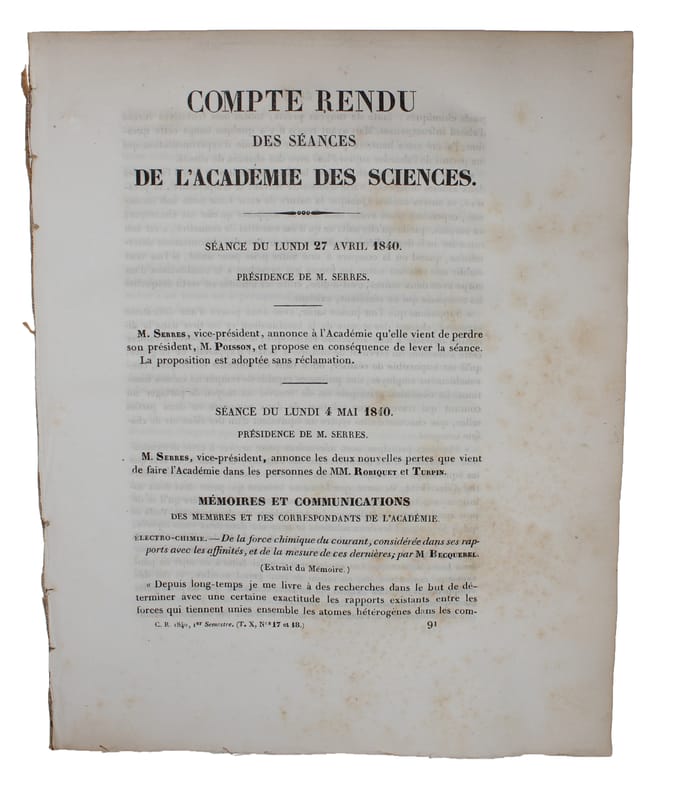
183847114Paris, Bachelier, 1838 a. 1840. 4to. No wrappers. In: ""Comptes Rendus Hebdomadaires des Séances de L'Academie des Sciences"", Tome 7, No 19 and Tome 10, No 17/18. Pp. (769-) 803 a. pp. (671-) 717. (Entire issues offered). Bessel's papers: pp. 785-793 a. pp. 703-710. Some scattered brownspots.
183847114Paris Bachelier 1838 a. 1840. 4to. No wrappers. In: "Comptes Rendus Hebdomadaires des Séances de L'Academie des Sciences" Tome 7 No 19 and Tome 10 No 17/18. Pp. 769- 803 a. pp. 671- 717. Entire issues offered. Bessel's papers: pp. 785-793 a. pp. 703-710. Some scattered brownspots. <br/><br/><em>First appearance of a milestone paper in astronomy giving the solution of the great problem of distances in the universe which had baffled astronomers ever since the time of Copernicus announcing the FIRST SUCCESSFUL DISPLACEMENT OR PARALLAX OF A FIXED STAR and hence deducing the FIRST RELIABLE DISTANCE OF THE EARTH TO A FIXED STAR. The parallax observed corresponded to ab. 600.000 times that of the earth from the sun. On these grounds Bessel calculated the distance to about 11 light years and this was confirmed by fresh investigations by Bessel in 1839-40 the second paper offered. In 1842-43 it was also confirmed by C.A.F. Peters at Pulkowa. It is the first published instance of the fathom-line thrown into celestial space.Bessel communicated his observations in Comptes Rendus in a letter to Humboldt the offered paper dated Nov. 5 1838 in "Monthly Notices" in letter to J. Herschel and in "Astronomische Nachrichten" Vol. 16 No 365-66 pp. 65-96 1838 where a more detail account was published.Ther paper "Bestimmung der Entfernung des 61sten Stern des Schwans" in "Astronomische Nachrichten" is dated at the end: Altona 1838 Dec. 13.Bessel's investigation was hailed by John Herschel when Bessel was awarded the R.A.S. gold medal "The greatest and most glorious triumph which practical astronomy has ever witnessed". "For determining the parallax of 61 Cygni Bessel selected two comparison stars of magnitude 9-10 at distances of roughly eight and twelve minutes of arc. 61 Cygni is a physical double star whose components differ in brightness by less than one magnitude. The distance of sixteen seconds of arc between the components favored the accuracy of the determination of the parallax because pointing could be carried out with two star images. After observing for eighteen months by the fall of 1838 Bessel had enough measurements for the determination of a reliable parallax. He found that p = 0.314 with a mean error of ±:0.020. This work was published in the Astronomische Nachrichten 1838 the first time the distance of a star became known. Bessel’s value for the parallax shows excellent agreement with the results obtained by extensive modern photographical parallax determinations." DSB.Parkinson "Breakthroughs" 1838 A. - Shapley & Howarth "A Source Book in Astronomy" pp. 216 ff. </em> unknown
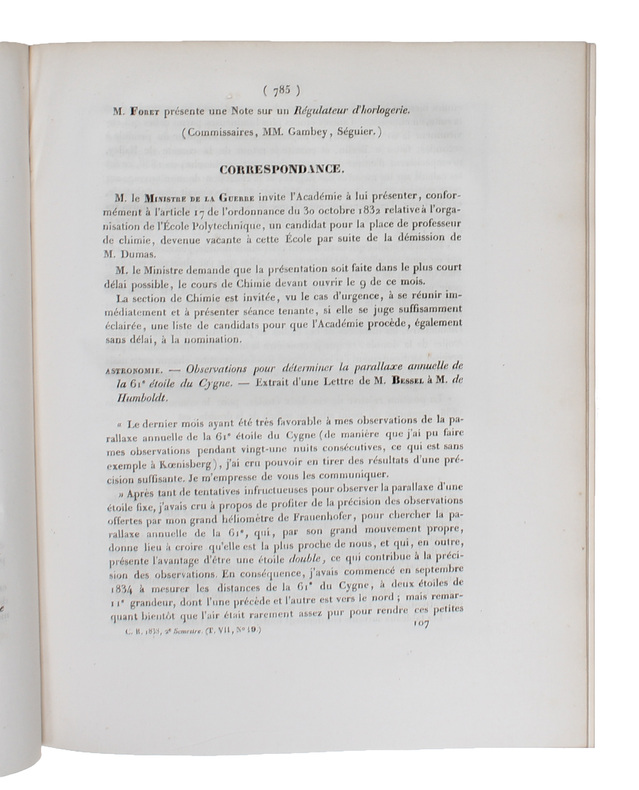
183849473Paris, Bachelier, 1838 a. 1840. 4to. No wrappers. In: ""Comptes Rendus Hebdomadaires des Séances de L'Academie des Sciences"", Tome 7, No 19 and Tome 10, No 17/18. With title-ages to vol. 7 and 10. Pp. (769-) 803 a. pp. (671-) 717. (Entire issues offered). Bessel's papers: pp. 785-793 a. pp. 703-710. Stamp on both titlepages. The second titlepage with a fes brownspots, otherwise clean and fine.
183849473Paris Bachelier 1838 a. 1840. 4to. No wrappers. In: "Comptes Rendus Hebdomadaires des Séances de L'Academie des Sciences" Tome 7 No 19 and Tome 10 No 17/18. With title-ages to vol. 7 and 10. Pp. 769- 803 a. pp. 671- 717. Entire issues offered. Bessel's papers: pp. 785-793 a. pp. 703-710. Stamp on both titlepages. The second titlepage with a fes brownspots otherwise clean and fine. <br/><br/><em>First appearance of a milestone paper in astronomy giving the solution of the great problem of distances in the universe which had baffled astronomers ever since the time of Copernicus announcing the FIRST SUCCESSFUL DISPLACEMENT OR PARALLAX OF A FIXED STAR and hence deducing the FIRST RELIABLE DISTANCE OF THE EARTH TO A FIXED STAR. The parallax observed corresponded to ab. 600.000 times that of the earth from the sun. On these grounds Bessel calculated the distance to about 11 light years and this was confirmed by fresh investigations by Bessel in 1839-40 the second paper offered. In 1842-43 it was also confirmed by C.A.F. Peters at Pulkowa. It is the first published instance of the fathom-line thrown into celestial space.Bessel communicated his observations in Comptes Rendus in a letter to Humboldt the offered paper dated Nov. 5 1838 in "Monthly Notices" in letter to J. Herschel and in "Astronomische Nachrichten" Vol. 16 No 365-66 pp. 65-96 1838 where a more detail account was published.Ther paper "Bestimmung der Entfernung des 61sten Stern des Schwans" in "Astronomische Nachrichten" is dated at the end: Altona 1838 Dec. 13.Bessel's investigation was hailed by John Herschel when Bessel was awarded the R.A.S. gold medal "The greatest and most glorious triumph which practical astronomy has ever witnessed". "For determining the parallax of 61 Cygni Bessel selected two comparison stars of magnitude 9-10 at distances of roughly eight and twelve minutes of arc. 61 Cygni is a physical double star whose components differ in brightness by less than one magnitude. The distance of sixteen seconds of arc between the components favored the accuracy of the determination of the parallax because pointing could be carried out with two star images. After observing for eighteen months by the fall of 1838 Bessel had enough measurements for the determination of a reliable parallax. He found that p = 0.314 with a mean error of ±:0.020. This work was published in the Astronomische Nachrichten 1838 the first time the distance of a star became known. Bessel’s value for the parallax shows excellent agreement with the results obtained by extensive modern photographical parallax determinations." DSB.Parkinson "Breakthroughs" 1838 A. - Shapley & Howarth "A Source Book in Astronomy" pp. 216 ff. </em> unknown
186524356.99<p>"<em>June 18. Reached Front Royal & met there the famous & very handsome rebel spy Belle Boyd who gave to me the rebel flag waving which she led the attack upon Kenly in May.</em>"</p><p>The "stars and bars" circular canton pattern with eleven-stars was used for First National flags from July 2 1861 when Tennessee and North Carolina joined the Confederacy until November 28 1861 when stars were added for Missouri and Kentucky. The other side of this rare two-pattern configuration is a tribute to the "Bonnie blue flag that bears the single star" the unofficial first Confederate flag.</p><p>Frederic d'Hauteville's small autograph note has been loosely stitched to the flag: "<em>Confederate flag. Taken by F.S.G d<em>'</em>H. and given by him to E.S.F. in 1862. To be given to Freddie d'Hauteville when he is fifteen.</em>" His first wife Elizabeth Stuyvesant Fish died in 1863. Freddy his son by his second wife was born in 1873 thus dating his note about the second gifting of the flag to between 1873 and 1888. The flag remained in his family preserved in perfect condition until 2015 when contents from their Swiss castle were sold clearing the way for the property to be sold; it is now on the market for $60 million dollars.</p><p><strong>ELEVEN-STAR "FIRST NATIONAL" FLAG WITH SINGLE STAR "BONNIE BLUE" FIRST UNOFFICIAL CONFEDEDERATE FLAG VERSO.</strong> Belle Boyd the "Siren of the Shenandoah" gave the flag to Captain Frederic Sears Grand d'Hauteville on June 18 1862 telling him that it was the flag she waived to urge on Confederate troops at the Battle of Front Royal a month earlier. D'Hauteville's 25-page autograph manuscript war memoir with his account of the gift of the flag quoted above is included. See below for complete transcript. With additional photographs and manuscripts. Homemade perhaps even by Boyd or a family member and used only briefly before being given to d'Hauteville the flag has been perfectly preserved retaining the short ribbons along its hoist and showing no tears holes fraying loss or staining. Over 5 x 3 feet.</p><p><strong>Historical Background</strong></p><p>D'Hauteville had joined General Nathaniel P. Banks' staff before Banks advanced south up the Shenandoah valley the Shenandoah river flows north into the Potomac at Harper's Ferry so you go "up" the valley to the south and "down" the valley to the north to Strasburg maneuvering against Confederate General Thomas J. "Stonewall" Jackson's army.</p><p>Belle Boyd had moved to Front Royal to stay with relatives when her hometown of Martinsburg West Virginia had been occupied by Union troops in March 1862. Shortly after her eighteenth birthday Boyd hid in a local hotel in Front Royal where she overheard General James Shields and his officers discussing orders to transfer his division to the Union army along the Rappahannock River in eastern Virginia. Boyd reportedly rode fifteen miles on horseback through Union lines to tell Confederate Colonel Turner Ashby of the reduced Union presence in Front Royal. When approximately 3000 of Jackson's men attacked the Union force occupying Front Royal on May 23 Boyd ran to meet Jackson's men as they advanced and urged them onward. The Union garrison approximately 1000 strong under the command of Colonel John R. Kenly of the Union 1st Maryland Volunteer Infantry was routed. Kenly was wounded and he and nearly 700 of his men were captured. Jackson later sent Boyd a note of gratitude for her role.</p><p><strong>Robert Gould Shaw </strong>1837-1863 another officer in Banks' command confirmed d'Hauteville's account. In a letter to his mother Shaw wrote "Perhaps you have seen some accounts of a young lady at Front Royal named Belle Boyd. There was quite a long and ridiculous letter about her copied into the 'Evening Post' the other day. I have seen her several times but never had any conversation with her. Other men who have talked with her tell me that she never asked for any information about our army or gave them the slightest reason to suppose her a spy; and they were probably as capable of judging as the correspondent who wrote about her. She gave Fred. D'Hauteville a very pretty Secession flag which she said she carried when she went out to meet Jackson's troops coming into Front Royal." Shaw went on to command an African-American regiment the 54th Massachusetts Volunteer Infantry which obtained fame in the Second Battle of Fort Wagner at Charleston Harbor on July 18 1863. Shaw died with many of his men that day and was immortalized in a memorial by Augustus Saint-Gaudens in Boston and in the 1989 film <em>Glory</em>.</p><p>That both d'Hauteville and Shaw believed Boyd's account that she waved this flag to encourage the Confederate attack demonstrates her ability to manipulate both men and narratives. In her own entertaining and exaggerated memoir Boyd later wrote "As I neared our line I waved my bonnet to our soldiers to intimate that they should press forward." Another key witness Henry Kyd Douglas 1838-1903 a member of Jackson's staff later recalled in his memoir seeing "the figure of a woman in white glide swiftly out of town" and that Boyd "seemed when I saw her to heed neither weeds nor fences but waved a bonnet as she came on." Whether she actually waived her bonnet or this flag or perhaps both at different moments during the battle that day she clearly gave it to d'Hauteville to curry favor and that apparently worked. Rather than being prosecuted for her role in aiding the Confederates in what was a disaster for the Union she was celebrated for her charm. Before being banished to England Boyd was arrested six or seven times and always managed with the help of gentlemanly Union officers to avoid the most serious consequences. Her seemingly innocuous flirtations apparently provided her with her greatest source of influence.</p><p><strong>Isabella Marie "Belle" Boyd </strong>1844-1900 was one of the most famous and notorious Confederate spies. After her father enlisted in the Confederate army Boyd became an espionage agent at the age of seventeen aiding the Confederate forces in the Shenandoah Valley. Forced from her home in Martinsburg West Virginia when Union troops occupied it she moved in with relatives in Front Royal Virginia. During the spring 1862 Valley Campaign she was a courier and provided valuable information to General Thomas J. "Stonewall" Jackson. General Jackson reportedly made her a captain and honorary aide-de-camp on his staff. On one occasion she wooed a Northern soldier to whom she was "indebted for some very remarkable effusions some withered flowers and last but not least for a great deal of very important information. I must avow the flowers and the poetry were comparatively valueless in my eyes." Boyd continued in her melodramatic style "I allowed but one thought to keep possession of my mind—the thought that I was doing all a woman could do for her country's cause."</p><p>After being betrayed by a lover she was arrested on July 29 1862 and spent a month in the Old Capitol Prison in Washington D.C. Exchanged a month later she lived with relatives in the South for a time. She was again arrested in June 1863 while on a visit to her birthplace of Martinsburg. Suffering from typhoid fever she was released on December 1 1863 and banished to the South. While attempting to sail to England on May 8 1864 she was arrested again as a Confederate courier. With the help of Lieutenant Sam Hardinge a Union naval officer she escaped to Canada and then to England where she and Hardinge married in August 1864. While in England Boyd had a stage career and published a highly fictionalized two-volume work entitled <em>Belle Boyd in Camp and Prison</em> 1867. She died in Wisconsin while touring the western United States telling her story.</p><p><strong>Frederick or Frédéric Sears Grand d'Hauteville</strong> 1838-1918 was born in Boston Massachusetts to a Swiss nobleman and American mother who returned to the United States while pregnant. Their marital conflict led to a contentious custody battle over Frederick in 1840 in a Philadelphia court which his mother won. D'Hauteville graduated from Harvard University in 1859. He was appointed volunteer aide-de-camp to General Nathaniel Banks in December 1861 and served at the Battle of Winchester in March 1862. Commissioned captain on June 30 1862 he served on General Samuel Crawford's staff including action at Cedar Mountain in August. At the Battle of Antietam in September his commanding general was wounded in the leg while talking to him and a few minutes later d'Hauteville himself was struck by a musket ball that was deflected by his boot but still seriously bruised his leg but. By December he returned to General Banks' staff in the Department of the Gulf. He resigned his commission on March 1 1863. He married Elizabeth Fish daughter of Hamilton Fish of New York in 1863 but she died the following year. In 1872 he married Susan Watts Macomb 1849-1928 with whom he had three children. She was the grand-daughter of Major General Alexander Macomb 1782-1841 general-in-chief of the U.S. Army from 1828 to 1841.</p><p><strong>Additional Items</strong></p><p>Five additional brief notes including one on letterhead marked "Newport" are loose in the notebook. Most were written by d'Hauteville and two are initialed "F d'H." This lot also includes cartes-de-visite of d'Hauteville and his commander Major General Nathaniel P. Banks and an albumen image of four officers who attended d'Hauteville's alma mater Harvard University and served with d'Hauteville in the Shenandoah Valley in 1862 from left to right Major James Savage Jr. 1832-1862 killed at Cedar Mountain; Captain Robert Gould Shaw 1837-1863 killed at Fort Wagner; Major Robert Morris Copeland 1830-1874; Captain Henry S. Russell 1838-1905.</p><p><strong>Provenance</strong></p><p>These materials descended in the d'Hauteville family until sold in September 2015.</p><p>The d'Hautevilles kept a home in Newport Rhode Island but they also lived much of the time at his family's palatial estate overlooking Lake Geneva in Switzerland. Approximately 1600 items from the family's estate were sold. Having been cleaned out the 30-room d'Hauteville chateau built in 1760 and its 64-acre estate were bouhgt by Pepperdine University in 2019.</p><p><strong>More Historic Background</strong></p><p>Learning that Confederates had captured Front Royal Banks retreated north to Winchester. There he tried to slow Stonewall Jackson's pursuit leading to another lopsided Confederate victory on May 25. Fearing that Washington D.C. was exposed President Abraham Lincoln ordered General John C. Fremont's forces in western Virginia and General Irvin McDowell's forces in Fredericksburg to converge and trap Jackson. The Confederates demonstrated against Harper's Ferry on May 29 and 30 but General James Shields leading the only division McDowell actually sent recaptured Front Royal on May 30.</p><p>Over the next week as Jackson retreated the opposing cavalries met in several small skirmishes. In battles on June 8 and 9 at Cross Keys and Port Republic Jackson repulsed Fremont's and Shields' armies and stopped their pursuit. After initially considering a counterattack in the valley Jackson instead joined General Robert E. Lee at Richmond opposing General George B. McClellan's Army of the Potomac. Although Jackson's daring actions had threatened Washington D.C. and relieved pressure on Richmond Union armies resumed their occupation of Winchester and Front Royal.</p><p><strong>Civil War Memoir of Frederick Sears Grand d'Hauteville </strong>included with the flag.</p><p>The notebook is bound in black leather stamped in blind and gilt with marbled endpapers and lined pages. Titled in manuscript "The War of Secession 1861" this memoir was written between 1887 and d'Hauteville's death clearly compiled from notes or a diary made during the conflict. The gilt decoration is still bright and the leather and pages still fresh.</p><p>D'Hauteville's Memoir includes fascinating accounts of and commentary on the Battles of Winchester Cedar Mountain and Antietam. At Cedar Mountain D'Hauteville was particularly moved by the losses of the 2d Regiment of Massachusetts Volunteers "one of the best in the whole Union Army… officered almost entirely by young men belonging to the leading families in the City of Boston. All of them were my friends & very dear friends. Their loss was enormous but they went to their deaths with sublime courage. There was no flinching there."</p><p><strong>Complete Transcript of Civil War Memoir of Frederick Sears Grand d'Hauteville </strong></p><p><em>The War of Secession 1861.</em></p><p><2> <em>I enlisted as "private" in the Fourth Battalion of Massachusetts State Infantry Militia at Boston Harbor Fort Independence in May 1861 & remained there for garrison duty and drill for one month. Afterwards drilled with the Battalion in Boston during the summer and autumn of that year.</em></p><p><em> Reported to Major General N P Banks commanding Fifth Corps Army of the Potomac at Darnstown Maryland about November 20 1861 as volunteer Aid de Camp without pay. Was appointed volunteer Captain & A.D.C. on General Banks Staff on December 5 1861. See General Orders no 70 Head Quarters Banks Division.</em></p><p><em> Was very busy learning duties during all the time that the division remained in Autumn field quarters at Darnestown and during the winter months at Frederick City.</em> <3></p><p><em>Darnestown Md. Headquarters of the Fifth Corps Army of the Potomac Banks Division November 1861.</em></p><p><em>Major General N. P. Banks Major General Commanding.</em></p><p><em>Major R Morris Copeland Asst. Adjt. Genl.</em></p><p><em>Major D. D. Perkins USA Chief Inspector.</em></p><p><em>Colonel S B Holabird Chief Quartermaster.</em></p><p><em>Colonel E S Beckwith Chief Commissary.</em></p><p><em>Captain Aberd U.S.A. Chief Engineer.</em></p><p><em>Captain C S Best Chief of Artillery.</em></p><p><em>Colonel John S Clark A.D.C.</em></p><p><em>Captain Schreiber German A.D.C.</em></p><p><em>Captain Schiffler German A.D.C. not speaking English</em></p><p><em>Captain Munther German A.D.C. not speaking English</em></p><p><em>Captain Strothers extra A.D.C. Old magazine writer Porter Crayon</em></p><p><em>Captain F. d'Hauteville Volunteer A.D.C.</em></p><p><em>Dr. King Medical Director </em></p><p><4></p><p><em> The Division left Darnestown for Frederick City Md on December 4 1861 arriving there on December 6<u>th</u>. Quarters were assigned to me in the law office of Colonel Bradley T. Johnson of the Confederate Army. All law books and papers were carefully looked after by me. Friends made during the winter at Frederick City: General Shriver & family & Colonel Maudsley & family.</em></p><p><em> The advance of the Army of the Shenandoah into Virginia began on February 26<u>th</u> Head Quarters Staff left Frederick City on February 27 reached Harper's Ferry on that day & crossed to Virginia by pontoon bridge. Visit from General McClellan & staff on February 28<u>th</u> Comte de Paris & Duc de Chartes ADC accompanied by the Prince de Joinville.</em></p><p><em> From Harpers Ferry marched to Winchester by Charlestown. Winchester occupied March 10. </em>Confederate General Thomas J. "Stonewall"<em> Jackson retiring down the Valley of </em><5> <em>of the Shenandoah.</em></p><p><em> March 22. First battle of Winchester or Kernstown in which General Jackson was defeated by General Shield's Division. General Shields wounded.</em></p><p><em> The pursuit of Jackson by General Banks entire Army Corps began on the following day by main road passing Cedar Creek. First camp at Strasburg.</em></p><p><em>April 1st advanced from Strasburg to Woodstock. Artillery duel Cothran Battery. Bridge at the narrow pass saved then on to Edenburg. Bridge burned by enemy. Rebuilt next day by Pennsylvania men. Very heavy storm.</em></p><p><em>April 17th Pursuit of Jackson resumed reached Mt Jackson General Shields Division leading. Next day to Newmarket frequent Artillery duels & rear guard & advanced guard skirmishes & picket firing. Lovely country.</em></p><p><em>April 25. Moved on to near Harrisburg</em> Harrisonburg. <6></p><p><em>May 5. Started on return towards Strasburg after many reports of impending battle with Jacskon who report said had been largely reinforced. Strasburg May 13.</em></p><p><em> <strong>May 23. Colonel Kenly attacked & overwhelmed at Front Royal. The first news was received by <u>me</u> at Head Quarters at 4. P.M. General Banks was absent but Captain Brown of the 2d Mass was with me at the time.</strong></em></p><p><em> May 24. Retreat commenced towards Winchester by Middletown Newtown & Kernstown.</em></p><p><em> May 25. Battle of Winchester. See General Banks Official Report. United States War of the Rebellion Series I Volume XII. Part 1 pages 550</em><em> 552 606</em><em> Personal notice of myself. In this battle my attention was called to the very gallant conduct of a Confederate General Officer in leading his men alone on horseback over the Hill on the Federal right to what appeared</em> <7> <em>certain death. </em><em>After the conclusion of the war I asked General Richard Taylor whose Brigade fought on the Confederate side if he could tell me the name of that gallant Officer. He replied very modestly that it was himself and that it gained for him the rank of Major General.</em></p><p><em> Banks defeated & much demoralized Army retreated in disorder to Williamsport & remained there until June 10.</em></p><p><em> On June 10 the army largely reinforced recrossed the Potomac & marched towards Winchester through Falling Waters and Bunker Hill.</em></p><p><em> <strong>June 18. Reached Front Royal & met there the famous & very handsome rebel spy Belle Boyd who gave to me the rebel flag waving which she led the attack upon Kenly in May.</strong></em></p><p><em> July 6. Advance again passing through Chester Gap Luray Amissville Little Washington</em> <8> <em>Sperryville Gaines Cross Roads to Fairfax Culpepper August 4<u>th</u>. </em></p><p><em> Although ordered several weeks previously by the War Department to report to General Crawford for assignment as Ass<u>t</u> Adj<u>t</u> Gen<u>l</u> to his Brigade General Banks short of Staff Officers could not spare me and he ordered me to remain with him until the Army reached Culpeper and it was not until August 4 that I was detached from his Staff.</em></p><p><em>Advanced towards Cedar Mountain on August 8 and crossed the Creek.</em></p><p><em> August 9 1862 Battle of Cedar Mountain. See Official Reports War of the Rebellion Series 1. Volume XII. Part II. Page 149 150.</em><em> Personal notice</em></p><p><em> During the battle my blankets strapped behind my saddle were pierced by one ball making more than a dozen holes.</em></p><p><9></p><p><em>The battle of Cedar Mountain was one of the most sanguinary of modern times having in view the numbers engaged and the losses sustained. It should never have been fought. The Commander of the Corps </em>Banks<em> was a political General without military experience or training & the plan of the battle was thoroughly bad. Nothing but disaster could have been the result & there was no co-operation from beginning to end. The right flank of the attacking Brigade General Crawford was exposed to the fire of a largely superior force. No reconnaissance of the ground was made during all the morning previous to the enemy's advance while the troops were lying idle under arms & there were no reserves. Any advantage which the Union Army might have temporarily gained was therefore lost in advance before the battle began as it could not be held. </em></p><p><10></p><p><em>General Banks was afterwards charged by General Pope the Commander in Chief with disobedience of orders in forcing the battle. This accusation was unjust and was clearly an afterthought on the part of General Pope. As the Assistant Adjutant General of the advanced Brigade these written orders were shown to me by General Banks and no question whatever arose in the minds of everyone who saw them in regard to their purpose & intent. They were worded as follows & taken down in writing when they were given: "If the enemy advances attack him instantly & be reinforced from here." Culpepper. The enemy certainly forced the attack to which General Banks replied with disastrous results. The explicit orders were strictly obeyed but the disposition for the attack & the general management of the battle could not have been worse. </em></p><p><11></p><p><strong><em>General Pope afterwards claimed that General Banks should have attacked only with his "skirmishers" & wait to be reinforced on the following day. The written orders cannot be twisted into such a construction as this. An instant attack against any advance of the enemy was ordered early in the morning in writing and it was naturally inferred that the necessary orders for reinforcements were arranged for <u>then</u>.</em></strong></p><p><strong><em> The 2d Regiment of Massachusetts Volunteers one of the best in the whole Union Army in General Gordon's Brigade was officered almost entirely by young men belonging to the leading families in the City of Boston. All of them were my friends & very dear friends. Their loss was enormous but they went to their deaths with sublime courage. There was no flinching there.</em></strong></p><p><em> The retreat began on August 11<u>th</u> & the</em> <12> <em>Brigade reduced in numbers by exactly one half reached Culpepper on August 12.</em></p><p><em> August 18. fell back towards the Rappahannock.</em></p><p><em> August 19. Brandy Station & Beverley ford. Sharp skirmish across the river & very heavy rain.</em></p><p><em> August 20. Sulpher Springs. Very heavy shelling from Confederate batteries. Next day to Bealton Station by Fayetteville then Catletts. August 28. Kettle run. First day of second battle of Manassas.</em></p><p><em> August 30. Broad run.</em></p><p><em> August 31. Burned by urgent orders all wagons including ammunition. Attack expected at any moment by overwhelming forces. It did not come. Passed through Brentsville & forded the Occoquan to Bull Run & Centreville.</em></p><p><em> September 1<u>st</u> Battle of Chantilly. Generals Kearny & Stevens killed. The Brigade was on the extreme right of the</em> <13> <em>line & was not actually engaged.</em></p><p><em> September 2. on towards Alexandria.</em></p><p><em>September 3d camped near Fort Albany</em></p><p><em>September 4<u>th</u> Crossed the Potomac & encamped just outside of Washington on the Rockville turnpike.</em></p><p><em>September 5. Rockville.</em></p><p><em>September 9. Advanced along the Rockville Road & encamped near Middlebrook. The 124 125 & 128 Pennsylvania Regiments new were assigned to Crawford's Brigade.</em></p><p><em>September 10. Encamped near Damascus.</em></p><p><em>September 12 General Crawford in command of Division.</em></p><p><em>September 13 Crossed the Monocacy and encamped just outside Frederick City.</em></p><p><em>September 15 Battle of South Mountain Brigade acted as reserve & was not engaged. General Reno killed.</em> <14></p><p><em>September 16. Advanced during the day. Crossed the Antietam and encamped in fields just across the stream. Heavy rain at night.</em></p><p><em>September 17. Under arms at 5. AM and advanced. Was very promptly met by very heavy firing from both Artillery & infantry. The battle in our immediate front had its ups & downs all day long & the Regiments became very much broken up & formations lost. General Crawford was with the old Regiments & I was with the new ones from Pennsylvania. About noon when we were together under very heavy fire & close to the enemy General Crawford was wounded in the leg & a few minutes later a musket ball struck the calf of my leg but my heavy top boots stopped its entrance.</em> <15> <em>The leg however was very much bruised. Shortly before this <strong>General Williams temporarily in command of the Corps General Mansfield having been killed early in the Battle gave an order for the Commanding Officer of a small Brigade which did not belong to his Command to charge the woods from which we had just been driven back.</strong></em></p><p><strong><em> I took the order under a very heavy fire but the Commanding Officer very properly questioned the authority.</em></strong></p><p><strong><em> To obey it would have been the destruction of his Brigade without the slightest chance for success.</em></strong></p><p><em> Colonel Wilder Dwight of the 2d Massachusetts & a very dear friend was killed at Antietam.</em></p><p><strong><em> From the eighth of August when we marched from Culpepper en route for Cedar Mountain until the battle of</em> </strong><16><strong> <em>Antietam on September 17<u>th</u> I had slept for four nights only under any kind of shelter. The weather had been very wet & officers & men slept on the grass without shelter tents. Everyone was starved during Pope's retreat as all supplies were cut off & our principal ration was the growing green corn. I remember very well picking up a piece of "hard tack" dropped in the mud by a soldier & eating it ravenously. The horses from want of fodder could hardly stand. </em></strong><em>The result was a very severe attack of diarrhea which I could not shake off for many weeks.</em></p><p><em> For the official reports of General Crawford's Division at the Battle of Antietam see No 107 167 page 484 Official Records War of the Rebellion. Series 1. Vol XIX Part I Personal record.</em></p><p><17></p><p><em>After Antietam General Crawford's wound obliged him temporarily to relinquish his command & he ordered me to report to General Banks who was then in command of the Defences of Washington to help me to recover from an attack of jaundice which the acute diarrhea had promptly brought on. General Banks assigned me to the task of passing upon all applications for furlough for the whole army around Washington. My offices were on the whole of the ground floor in the historic building which had served as Head Quarters for the General in Chief since the beginning of the war. It was a very arduous & responsible duty as the orders from General Halleck were very positive. No leaves of absence were to be given except upon Surgeons certificate that there was danger to life or permanent disability.</em></p><p><em> I remained in Washington on duty for about a month. My dear Mother</em> <18> <em>my Grandmother & Mr Amory paid me a visit of a few days.</em></p><p><em> In the early part of October General Banks invited me to go with him as one of the Assistant Adjutant Generals in his Staff on a proposed expedition South by sea no one knew where. I accepted promptly as General Banks paid me the compliment of asking me first before any other officer to join his staff. The expedition was being fitted out in New York & the Head Quarters of the Command were located there. About October 15 General Banks paid an official visit to Boston and I went with him. My dear Mother was then far from well but upon the advice of Dr Warren I went back to New York as it was feared that by remaining with her & missing</em> <19> <em>the Expedition the worry & anxiety of my remaining near her would very likely do her more harm than good. On the evening of November 29 Mr Frank Davis brought me a telegram from Boston telling me that my dear Mother was dying and that all hope was gone. I was able to catch the night train & reached her bedside very early in the morning.</em></p><p><em> My darling mother was then unconcious & at half past nine on November 30 1862 she passed away.</em></p><p><em> About December 10 I returned to New York. General Banks Expedition having sailed I was ordered to report to General Andrews who was in charge of a number of regiments to be dispatched later on.</em></p><p><em> While with him I had charge of sanitary inspection duty among other things & I found that there was much irregularity which required correction.</em></p><p><em> On January 5<u>th</u> I was ordered by</em> <20> <em>General Andrews to report at once to General Banks & I sailed for New Orleans by way of Havana. I remained at New Orleans for about six weeks with nothing to do but office work & on occasion uneventful expedition up the Mississippi to Baton Rouge & elsewhere.</em></p><p><em> My resignation was offered on March 1st & accepted as my Mothers death & the consequent urgency of winding up her estate & other matters called me home.</em></p><p><em> I shall never cease to regret as long as I live that I did not remain in the Army until the end of the war.</em></p><p><21></p><p><em>Details.</em></p><p><em>Private Fourth Battalion Massachusetts State Militia May 1861.</em></p><p><em>Volunteer Aid de Camp to Major General N. P. Banks Commanding Division Army of the Potomac Darnestown November 1861. Rank of Captain Volunteer December 5 861 Frederick City M<u>d</u></em></p><p><em>Head Quarters Department of the Shenandoah February to July 1861.</em></p><p><em>Captain & Assistant Adjutant General N P Banks Commanding Department of Washington September 1862.</em></p><p><22></p><p><em>Assigned to duty with "Banks Expedition" as Assistant Adjutant General with others November 1862. Sailed for New Orleans Department of the Gulf January 5 1862</em></p><p><em>Resigned alas! March 1 1863.</em></p><p><em> During all my services with General Banks from Frederick City to Culpepper I always acted as his personal Aid de Camp. All his private & official papers & dispatches came under my notice & I occupied not only a very interesting but also a very responsible position on his Staff.</em></p><p><em> During the retreat of General Banks</em> <23> <em>Corps from Strasburg to the Potomac in the temporary absence of the Assistant Adjutant General Major R. Morris Copeland practically all the duties were performed by me & I think to the entire satisfaction of the Commanding General. Proof of this is forthcoming in the double offer of Generals Crawford & Gordon to accept the regular position of Assistant Adjutant General upon their Staff. Both of these Generals had recently been appointed to the command of Brigades in General Banks Army Corps & both were present during the retreat.</em></p><p><em> During all the spring months I alone in all the Army Corps was entrusted with the Government Cyphers. During General Pope's retreat I was one day sent for by Generals Pope & Banks to</em> <24> <em>put into cypher a very important dispatch to General McDowell with whom direct communication had been cut off by the enemy.</em></p><p><em> I was obliged to reply that during the severest part of the Battle of Cedar Mountain when I was in the greatest danger of being killed or captured at any moment I had felt it my duty to destroy the cypher which I tore up into a hundred or more very small pieces & swallowed some of them. My action was approved. I then offered to carry the orders unwritten myself to General McDowell if I could find him and take my chances.</em></p><p><em> My offer was accepted but while</em> <25> <em>the instructions were being prepared the advance of General McDowells Corps came in sight & I was relieved from a duty which would have put me in the greatest danger of capture or otherwise.</em></p>
186524356.99<p>"<i>June 18. Reached Front Royal & met there the famous & very handsome rebel spy Belle Boyd who gave to me the rebel flag waving which she led the attack upon Kenly in May.</i>"</p><p>The "stars and bars" circular canton pattern with eleven-stars was used for First National flags from July 2 1861 when Tennessee and North Carolina joined the Confederacy until November 28 1861 when stars were added for Missouri and Kentucky. The other side of this rare two-pattern configuration is a tribute to the "Bonnie blue flag that bears the single star" the unofficial first Confederate flag.</p><p>Frederic d'Hauteville's small autograph note has been loosely stitched to the flag: "<i>Confederate flag. Taken by F.S.G d<i>'</i>H. and given by him to E.S.F. in 1862. To be given to Freddie d'Hauteville when he is fifteen.</i>" His first wife Elizabeth Stuyvesant Fish died in 1863. Freddy his son by his second wife was born in 1873 thus dating his note about the second gifting of the flag to between 1873 and 1888. The flag remained in his family preserved in perfect condition until 2015 when contents from their Swiss castle were sold clearing the way for the property to be sold; it is now on the market for $60 million dollars.</p> <b>ELEVEN-STAR "FIRST NATIONAL" FLAG WITH SINGLE STAR "BONNIE BLUE" FIRST UNOFFICIAL CONFEDEDERATE FLAG VERSO.</b>Belle Boyd the "Siren of the Shenandoah" gave the flag to Captain Frederic Sears Grand d'Hauteville on June 18 1862 telling him that it was the flag she waived to urge on Confederate troops at the Battle of Front Royal a month earlier. D'Hauteville's 25-page autograph manuscript war memoir with his account of the gift of the flag quoted above is included. See below for complete transcript. With additional photographs and manuscripts. Homemade perhaps even by Boyd or a family member and used only briefly before being given to d'Hauteville the flag has been perfectly preserved retaining the short ribbons along its hoist and showing no tears holes fraying loss or staining. Over 5 x 3 feet. <p><b>Historical Background</b></p><p>D'Hauteville had joined General Nathaniel P. Banks' staff before Banks advanced south up the Shenandoah valley the Shenandoah river flows north into the Potomac at Harper's Ferry so you go "up" the valley to the south and "down" the valley to the north to Strasburg maneuvering against Confederate General Thomas J. "Stonewall" Jackson's army.</p><p>Belle Boyd had moved to Front Royal to stay with relatives when her hometown of Martinsburg West Virginia had been occupied by Union troops in March 1862. Shortly after her eighteenth birthday Boyd hid in a local hotel in Front Royal where she overheard General James Shields and his officers discussing orders to transfer his division to the Union army along the Rappahannock River in eastern Virginia. Boyd reportedly rode fifteen miles on horseback through Union lines to tell Confederate Colonel Turner Ashby of the reduced Union presence in Front Royal. When approximately 3000 of Jackson's men attacked the Union force occupying Front Royal on May 23 Boyd ran to meet Jackson's men as they advanced and urged them onward. The Union garrison approximately 1000 strong under the command of Colonel John R. Kenly of the Union 1st Maryland Volunteer Infantry was routed. Kenly was wounded and he and nearly 700 of his men were captured. Jackson later sent Boyd a note of gratitude for her role.</p><p><b>Robert Gould Shaw </b>1837-1863 another officer in Banks' command confirmed d'Hauteville's account. In a letter to his mother Shaw wrote "Perhaps you have seen some accounts of a young lady at Front Royal named Belle Boyd. There was quite a long and ridiculous letter about her copied into the 'Evening Post' the other day. I have seen her several times but never had any conversation with her. Other men who have talked with her tell me that she never asked for any information about our army or gave them the slightest reason to suppose her a spy; and they were probably as capable of judging as the correspondent who wrote about her. She gave Fred. D'Hauteville a very pretty Secession flag which she said she carried when she went out to meet Jackson's troops coming into Front Royal." Shaw went on to command an African-American regiment the 54th Massachusetts Volunteer Infantry which obtained fame in the Second Battle of Fort Wagner at Charleston Harbor on July 18 1863. Shaw died with many of his men that day and was immortalized in a memorial by Augustus Saint-Gaudens in Boston and in the 1989 film <i>Glory</i>.</p><p>That both d'Hauteville and Shaw believed Boyd's account that she waved this flag to encourage the Confederate attack demonstrates her ability to manipulate both men and narratives. In her own entertaining and exaggerated memoir Boyd later wrote "As I neared our line I waved my bonnet to our soldiers to intimate that they should press forward." Another key witness Henry Kyd Douglas 1838-1903 a member of Jackson's staff later recalled in his memoir seeing "the figure of a woman in white glide swiftly out of town" and that Boyd "seemed when I saw her to heed neither weeds nor fences but waved a bonnet as she came on." Whether she actually waived her bonnet or this flag or perhaps both at different moments during the battle that day she clearly gave it to d'Hauteville to curry favor and that apparently worked. Rather than being prosecuted for her role in aiding the Confederates in what was a disaster for the Union she was celebrated for her charm. Before being banished to England Boyd was arrested six or seven times and always managed with the help of gentlemanly Union officers to avoid the most serious consequences. Her seemingly innocuous flirtations apparently provided her with her greatest source of influence.</p><p><b>Isabella Marie "Belle" Boyd </b>1844-1900 was one of the most famous and notorious Confederate spies. After her father enlisted in the Confederate army Boyd became an espionage agent at the age of seventeen aiding the Confederate forces in the Shenandoah Valley. Forced from her home in Martinsburg West Virginia when Union troops occupied it she moved in with relatives in Front Royal Virginia. During the spring 1862 Valley Campaign she was a courier and provided valuable information to General Thomas J. "Stonewall" Jackson. General Jackson reportedly made her a captain and honorary aide-de-camp on his staff. On one occasion she wooed a Northern soldier to whom she was "indebted for some very remarkable effusions some withered flowers and last but not least for a great deal of very important information. I must avow the flowers and the poetry were comparatively valueless in my eyes." Boyd continued in her melodramatic style "I allowed but one thought to keep possession of my mind—the thought that I was doing all a woman could do for her country's cause."</p><p>After being betrayed by a lover she was arrested on July 29 1862 and spent a month in the Old Capitol Prison in Washington D.C. Exchanged a month later she lived with relatives in the South for a time. She was again arrested in June 1863 while on a visit to her birthplace of Martinsburg. Suffering from typhoid fever she was released on December 1 1863 and banished to the South. While attempting to sail to England on May 8 1864 she was arrested again as a Confederate courier. With the help of Lieutenant Sam Hardinge a Union naval officer she escaped to Canada and then to England where she and Hardinge married in August 1864. While in England Boyd had a stage career and published a highly fictionalized two-volume work entitled <i>Belle Boyd in Camp and Prison</i> 1867. She died in Wisconsin while touring the western United States telling her story.</p><p><b>Frederick or Frédéric Sears Grand d'Hauteville</b> 1838-1918 was born in Boston Massachusetts to a Swiss nobleman and American mother who returned to the United States while pregnant. Their marital conflict led to a contentious custody battle over Frederick in 1840 in a Philadelphia court which his mother won. D'Hauteville graduated from Harvard University in 1859. He was appointed volunteer aide-de-camp to General Nathaniel Banks in December 1861 and served at the Battle of Winchester in March 1862. Commissioned captain on June 30 1862 he served on General Samuel Crawford's staff including action at Cedar Mountain in August. At the Battle of Antietam in September his commanding general was wounded in the leg while talking to him and a few minutes later d'Hauteville himself was struck by a musket ball that was deflected by his boot but still seriously bruised his leg but. By December he returned to General Banks' staff in the Department of the Gulf. He resigned his commission on March 1 1863. He married Elizabeth Fish daughter of Hamilton Fish of New York in 1863 but she died the following year. In 1872 he married Susan Watts Macomb 1849-1928 with whom he had three children. She was the grand-daughter of Major General Alexander Macomb 1782-1841 general-in-chief of the U.S. Army from 1828 to 1841.</p><p><b>Additional Items</b></p><p>Five additional brief notes including one on letterhead marked "Newport" are loose in the notebook. Most were written by d'Hauteville and two are initialed "F d'H." This lot also includes cartes-de-visite of d'Hauteville and his commander Major General Nathaniel P. Banks and an albumen image of four officers who attended d'Hauteville's alma mater Harvard University and served with d'Hauteville in the Shenandoah Valley in 1862 from left to right Major James Savage Jr. 1832-1862 killed at Cedar Mountain; Captain Robert Gould Shaw 1837-1863 killed at Fort Wagner; Major Robert Morris Copeland 1830-1874; Captain Henry S. Russell 1838-1905.</p><p><b>Provenance</b></p><p>These materials descended in the d'Hauteville family until sold in September 2015.</p><p>The d'Hautevilles kept a home in Newport Rhode Island but they also lived much of the time at his family's palatial estate overlooking Lake Geneva in Switzerland. Approximately 1600 items from the family's estate were sold. Having been cleaned out the 30-room d'Hauteville chateau built in 1760 and its 64-acre estate is now on the market.</p><p><b>More Historic Background</b></p><p>Learning that Confederates had captured Front Royal Banks retreated north to Winchester. There he tried to slow Stonewall Jackson's pursuit leading to another lopsided Confederate victory on May 25. Fearing that Washington D.C. was exposed President Abraham Lincoln ordered General John C. Fremont's forces in western Virginia and General Irvin McDowell's forces in Fredericksburg to converge and trap Jackson. The Confederates demonstrated against Harper's Ferry on May 29 and 30 but General James Shields leading the only division McDowell actually sent recaptured Front Royal on May 30.</p><p>Over the next week as Jackson retreated the opposing cavalries met in several small skirmishes. In battles on June 8 and 9 at Cross Keys and Port Republic Jackson repulsed Fremont's and Shields' armies and stopped their pursuit. After initially considering a counterattack in the valley Jackson instead joined General Robert E. Lee at Richmond opposing General George B. McClellan's Army of the Potomac. Although Jackson's daring actions had threatened Washington D.C. and relieved pressure on Richmond Union armies resumed their occupation of Winchester and Front Royal.</p><p><b>Civil War Memoir of Frederick Sears Grand d'Hauteville </b>included with the flag.</p><p>The notebook is bound in black leather stamped in blind and gilt with marbled endpapers and lined pages. Titled in manuscript "The War of Secession 1861" this memoir was written between 1887 and d'Hauteville's death clearly compiled from notes or a diary made during the conflict. The gilt decoration is still bright and the leather and pages still fresh.</p><p>D'Hauteville's Memoir includes fascinating accounts of and commentary on the Battles of Winchester Cedar Mountain and Antietam. At Cedar Mountain D'Hauteville was particularly moved by the losses of the 2d Regiment of Massachusetts Volunteers "one of the best in the whole Union Army… officered almost entirely by young men belonging to the leading families in the City of Boston. All of them were my friends & very dear friends. Their loss was enormous but they went to their deaths with sublime courage. There was no flinching there."</p><p><b>Complete Transcript of Civil War Memoir of Frederick Sears Grand d'Hauteville </b></p><p><i>The War of Secession 1861.</i></p><p><2> <i>I enlisted as "private" in the Fourth Battalion of Massachusetts State Infantry Militia at Boston Harbor Fort Independence in May 1861 & remained there for garrison duty and drill for one month. Afterwards drilled with the Battalion in Boston during the summer and autumn of that year.</i></p><p><i> Reported to Major General N P Banks commanding Fifth Corps Army of the Potomac at Darnstown Maryland about November 20 1861 as volunteer Aid de Camp without pay. Was appointed volunteer Captain & A.D.C. on General Banks Staff on December 5 1861. See General Orders no 70 Head Quarters Banks Division.</i></p><p><i> Was very busy learning duties during all the time that the division remained in Autumn field quarters at Darnestown and during the winter months at Frederick City.</i> <3></p><p><i>Darnestown Md. Headquarters of the Fifth Corps Army of the Potomac Banks Division November 1861.</i></p><p><i>Major General N. P. Banks Major General Commanding.</i></p><p><i>Major R Morris Copeland Asst. Adjt. Genl.</i></p><p><i>Major D. D. Perkins USA Chief Inspector.</i></p><p><i>Colonel S B Holabird Chief Quartermaster.</i></p><p><i>Colonel E S Beckwith Chief Commissary.</i></p><p><i>Captain Aberd U.S.A. Chief Engineer.</i></p><p><i>Captain C S Best Chief of Artillery.</i></p><p><i>Colonel John S Clark A.D.C.</i></p><p><i>Captain Schreiber German A.D.C.</i></p><p><i>Captain Schiffler German A.D.C. not speaking English</i></p><p><i>Captain Munther German A.D.C. not speaking English</i></p><p><i>Captain Strothers extra A.D.C. Old magazine writer Porter Crayon</i></p><p><i>Captain F. d'Hauteville Volunteer A.D.C.</i></p><p><i>Dr. King Medical Director </i></p><p> <4></p><p><i> The Division left Darnestown for Frederick City Md on December 4 1861 arriving there on December 6<u>th</u>. Quarters were assigned to me in the law office of Colonel Bradley T. Johnson of the Confederate Army. All law books and papers were carefully looked after by me. Friends made during the winter at Frederick City: General Shriver & family & Colonel Maudsley & family.</i></p><p><i> The advance of the Army of the Shenandoah into Virginia began on February 26<u>th</u> Head Quarters Staff left Frederick City on February 27 reached Harper's Ferry on that day & crossed to Virginia by pontoon bridge. Visit from General McClellan & staff on February 28<u>th</u> Comte de Paris & Duc de Chartes ADC accompanied by the Prince de Joinville.</i></p><p><i> From Harpers Ferry marched to Winchester by Charlestown. Winchester occupied March 10. </i>Confederate General Thomas J. "Stonewall"<i> Jackson retiring down the Valley of </i><5> <i>of the Shenandoah.</i></p><p><i> March 22. First battle of Winchester or Kernstown in which General Jackson was defeated by General Shield's Division. General Shields wounded.</i></p><p><i> The pursuit of Jackson by General Banks entire Army Corps began on the following day by main road passing Cedar Creek. First camp at Strasburg.</i></p><p><i>April 1st advanced from Strasburg to Woodstock. Artillery duel Cothran Battery. Bridge at the narrow pass saved then on to Edenburg. Bridge burned by enemy. Rebuilt next day by Pennsylvania men. Very heavy storm.</i></p><p><i>April 17th Pursuit of Jackson resumed reached Mt Jackson General Shields Division leading. Next day to Newmarket frequent Artillery duels & rear guard & advanced guard skirmishes & picket firing. Lovely country.</i></p><p><i>April 25. Moved on to near Harrisburg</i> Harrisonburg. <6></p><p><i>May 5. Started on return towards Strasburg after many reports of impending battle with Jacskon who report said had been largely reinforced. Strasburg May 13.</i></p><p><i> <b>May 23. Colonel Kenly attacked & overwhelmed at Front Royal. The first news was received by <u>me</u> at Head Quarters at 4. P.M. General Banks was absent but Captain Brown of the 2d Mass was with me at the time.</b></i></p><p><i> May 24. Retreat commenced towards Winchester by Middletown Newtown & Kernstown.</i></p><p><i> May 25. Battle of Winchester. See General Banks Official Report. United States War of the Rebellion Series I Volume XII. Part 1 pages 550</i><i> 552 606</i><i>Personal notice of myself. In this battle my attention was called to the very gallant conduct of a Confederate General Officer in leading his men alone on horseback over the Hill on the Federal right to what appeared</i> <7> <i>certain death. </i><i>After the conclusion of the war I asked General Richard Taylor whose Brigade fought on the Confederate side if he could tell me the name of that gallant Officer. He replied very modestly that it was himself and that it gained for him the rank of Major General.</i></p><p><i> Banks defeated & much demoralized Army retreated in disorder to Williamsport & remained there until June 10.</i></p><p><i> On June 10 the army largely reinforced recrossed the Potomac & marched towards Winchester through Falling Waters and Bunker Hill.</i></p><p><i> <b>June 18. Reached Front Royal & met there the famous & very handsome rebel spy Belle Boyd who gave to me the rebel flag waving which she led the attack upon Kenly in May.</b></i></p><p><i> July 6. Advance again passing through Chester Gap Luray Amissville Little Washington</i> <8> <i>Sperryville Gaines Cross Roads to Fairfax Culpepper August 4<u>th</u>. </i></p><p><i> Although ordered several weeks previously by the War Department to report to General Crawford for assignment as Ass<u>t</u> Adj<u>t</u> Gen<u>l</u>to his Brigade General Banks short of Staff Officers could not spare me and he ordered me to remain with him until the Army reached Culpeper and it was not until August 4 that I was detached from his Staff.</i></p><p><i>Advanced towards Cedar Mountain on August 8 and crossed the Creek.</i></p><p><i> August 9 1862 Battle of Cedar Mountain. See Official Reports War of the Rebellion Series 1. Volume XII. Part II. Page 149 150.</i><i> Personal notice</i></p><p><i> During the battle my blankets strapped behind my saddle were pierced by one ball making more than a dozen holes.</i></p><p><9></p><p> <i>The battle of Cedar Mountain was one of the most sanguinary of modern times having in view the numbers engaged and the losses sustained. It should never have been fought. The Commander of the Corps </i>Banks<i> was a political General without military experience or training & the plan of the battle was thoroughly bad. Nothing but disaster could have been the result & there was no co-operation from beginning to end. The right flank of the attacking Brigade General Crawford was exposed to the fire of a largely superior force. No reconnaissance of the ground was made during all the morning previous to the enemy's advance while the troops were lying idle under arms & there were no reserves. Any advantage which the Union Army might have temporarily gained was therefore lost in advance before the battle began as it could not be held. </i></p><p><10></p><p><i>General Banks was afterwards charged by General Pope the Commander in Chief with disobedience of orders in forcing the battle. This accusation was unjust and was clearly an afterthought on the part of General Pope. As the Assistant Adjutant General of the advanced Brigade these written orders were shown to me by General Banks and no question whatever arose in the minds of everyone who saw them in regard to their purpose & intent. They were worded as follows & taken down in writing when they were given: "If the enemy advances attack him instantly & be reinforced from here." Culpepper. The enemy certainly forced the attack to which General Banks replied with disastrous results. The explicit orders were strictly obeyed but the disposition for the attack & the general management of the battle could not have been worse. </i></p><p><11></p><p> <b><i>General Pope afterwards claimed that General Banks should have attacked only with his "skirmishers" & wait to be reinforced on the following day. The written orders cannot be twisted into such a construction as this. An instant attack against any advance of the enemy was ordered early in the morning in writing and it was naturally inferred that the necessary orders for reinforcements were arranged for <u>then</u>.</i></b></p><p><b><i> The 2d Regiment of Massachusetts Volunteers one of the best in the whole Union Army in General Gordon's Brigade was officered almost entirely by young men belonging to the leading families in the City of Boston. All of them were my friends & very dear friends. Their loss was enormous but they went to their deaths with sublime courage. There was no flinching there.</i></b></p><p><i> The retreat began on August 11<u>th</u> & the</i> <12> <i>Brigade reduced in numbers by exactly one half reached Culpepper on August 12.</i></p><p><i> August 18. fell back towards the Rappahannock.</i></p><p><i> August 19. Brandy Station & Beverley ford. Sharp skirmish across the river & very heavy rain.</i></p><p><i> August 20. Sulpher Springs. Very heavy shelling from Confederate batteries. Next day to Bealton Station by Fayetteville then Catletts. August 28. Kettle run. First day of second battle of Manassas.</i></p><p><i> August 30. Broad run.</i></p><p><i> August 31. Burned by urgent orders all wagons including ammunition. Attack expected at any moment by overwhelming forces. It did not come. Passed through Brentsville & forded the Occoquan to Bull Run & Centreville.</i></p><p><i> September 1<u>st</u> Battle of Chantilly. Generals Kearny & Stevens killed. The Brigade was on the extreme right of the</i> <13> <i>line & was not actually engaged.</i></p><p><i> September 2. on towards Alexandria.</i></p><p><i>September 3d camped near Fort Albany</i></p><p><i>September 4<u>th</u> Crossed the Potomac & encamped just outside of Washington on the Rockville turnpike.</i></p><p><i>September 5. Rockville.</i></p><p><i>September 9. Advanced along the Rockville Road & encamped near Middlebrook. The 124 125 & 128 Pennsylvania Regiments new were assigned to Crawford's Brigade.</i></p><p><i>September 10. Encamped near Damascus.</i></p><p><i>September 12 General Crawford in command of Division.</i></p><p><i>September 13 Crossed the Monocacy and encamped just outside Frederick City.</i></p><p><i>September 15 Battle of South Mountain Brigade acted as reserve & was not engaged. General Reno killed.</i> <14></p><p><i>September 16. Advanced during the day. Crossed the Antietam and encamped in fields just across the stream. Heavy rain at night.</i></p><p><i>September 17. Under arms at 5. AM and advanced. Was very promptly met by very heavy firing from both Artillery & infantry. The battle in our immediate front had its ups & downs all day long & the Regiments became very much broken up & formations lost. General Crawford was with the old Regiments & I was with the new ones from Pennsylvania. About noon when we were together under very heavy fire & close to the enemy General Crawford was wounded in the leg & a few minutes later a musket ball struck the calf of my leg but my heavy top boots stopped its entrance.</i> <15> <i>The leg however was very much bruised. Shortly before this <b>General Williams temporarily in command of the Corps General Mansfield having been killed early in the Battle gave an order for the Commanding Officer of a small Brigade which did not belong to his Command to charge the woods from which we had just been driven back.</b></i></p><p><b><i> I took the order under a very heavy fire but the Commanding Officer very properly questioned the authority.</i></b></p><p><b><i> To obey it would have been the destruction of his Brigade without the slightest chance for success.</i></b></p><p><i> Colonel Wilder Dwight of the 2d Massachusetts & a very dear friend was killed at Antietam.</i></p><p><b><i> From the eighth of August when we marched from Culpepper en route for Cedar Mountain until the battle of</i> </b><16><b> <i>Antietam on September 17<u>th</u> I had slept for four nights only under any kind of shelter. The weather had been very wet & officers & men slept on the grass without shelter tents. Everyone was starved during Pope's retreat as all supplies were cut off & our principal ration was the growing green corn. I remember very well picking up a piece of "hard tack" dropped in the mud by a soldier & eating it ravenously. The horses from want of fodder could hardly stand. </i></b><i>The result was a very severe attack of diarrhea which I could not shake off for many weeks.</i></p><p><i> For the official reports of General Crawford's Division at the Battle of Antietam see No 107 167 page 484 Official Records War of the Rebellion. Series 1. Vol XIX Part I Personal record.</i></p><p><17></p><p><i>After Antietam General Crawford's wound obliged him temporarily to relinquish his command & he ordered me to report to General Banks who was then in command of the Defences of Washington to help me to recover from an attack of jaundice which the acute diarrhea had promptly brought on. General Banks assigned me to the task of passing upon all applications for furlough for the whole army around Washington. My offices were on the whole of the ground floor in the historic building which had served as Head Quarters for the General in Chief since the beginning of the war. It was a very arduous & responsible duty as the orders from General Halleck were very positive. No leaves of absence were to be given except upon Surgeons certificate that there was danger to life or permanent disability.</i></p><p><i> I remained in Washington on duty for about a month. My dear Mother</i> <18> <i>my Grandmother & Mr Amory paid me a visit of a few days.</i></p><p><i> In the early part of October General Banks invited me to go with him as one of the Assistant Adjutant Generals in his Staff on a proposed expedition South by sea no one knew where. I accepted promptly as General Banks paid me the compliment of asking me first before any other officer to join his staff. The expedition was being fitted out in New York & the Head Quarters of the Command were located there. About October 15 General Banks paid an official visit to Boston and I went with him. My dear Mother was then far from well but upon the advice of Dr Warren I went back to New York as it was feared that by remaining with her & missing</i> <19> <i>the Expedition the worry & anxiety of my remaining near her would very likely do her more harm than good. On the evening of November 29 Mr Frank Davis brought me a telegram from Boston telling me that my dear Mother was dying and that all hope was gone. I was able to catch the night train & reached her bedside very early in the morning.</i></p><p><i> My darling mother was then unconcious & at half past nine on November 30 1862 she passed away.</i></p><p><i> About December 10 I returned to New York. General Banks Expedition having sailed I was ordered to report to General Andrews who was in charge of a number of regiments to be dispatched later on.</i></p><p><i> While with him I had charge of sanitary inspection duty among other things & I found that there was much irregularity which required correction.</i></p><p><i> On January 5<u>th</u> I was ordered by</i> <20> <i>General Andrews to report at once to General Banks & I sailed for New Orleans by way of Havana. I remained at New Orleans for about six weeks with nothing to do but office work & on occasion uneventful expedition up the Mississippi to Baton Rouge & elsewhere.</i></p><p><i> My resignation was offered on March 1st & accepted as my Mothers death & the consequent urgency of winding up her estate & other matters called me home.</i></p><p><i> I shall never cease to regret as long as I live that I did not remain in the Army until the end of the war.</i></p><p><21></p><p><i>Details.</i></p><p><i>Private Fourth Battalion Massachusetts State Militia May 1861.</i></p><p><i>Volunteer Aid de Camp to Major General N. P. Banks Commanding Division Army of the Potomac Darnestown November 1861. Rank of Captain Volunteer December 5 861 Frederick City M<u>d</u></i></p><p><i>Head Quarters Department of the Shenandoah February to July 1861.</i></p><p><i>Captain & Assistant Adjutant General N P Banks Commanding Department of Washington September 1862.</i></p><p><22></p><p><i>Assigned to duty with "Banks Expedition" as Assistant Adjutant General with others November 1862. Sailed for New Orleans Department of the Gulf January 5 1862</i></p><p><i>Resigned alas! March 1 1863.</i></p><p><i> During all my services with General Banks from Frederick City to Culpepper I always acted as his personal Aid de Camp. All his private & official papers & dispatches came under my notice & I occupied not only a very interesting but also a very responsible position on his Staff.</i></p><p><i> During the retreat of General Banks</i> <23> <i>Corps from Strasburg to the Potomac in the temporary absence of the Assistant Adjutant General Major R. Morris Copeland practically all the duties were performed by me & I think to the entire satisfaction of the Commanding General. Proof of this is forthcoming in the double offer of Generals Crawford & Gordon to accept the regular position of Assistant Adjutant General upon their Staff. Both of these Generals had recently been appointed to the command of Brigades in General Banks Army Corps & both were present during the retreat.</i></p><p><i> During all the spring months I alone in all the Army Corps was entrusted with the Government Cyphers. During General Pope's retreat I was one day sent for by Generals Pope & Banks to</i> <24> <i>put into cypher a very important dispatch to General McDowell with whom direct communication had been cut off by the enemy.</i></p><p><i> I was obliged to reply that during the severest part of the Battle of Cedar Mountain when I was in the greatest danger of being killed or captured at any moment I had felt it my duty to destroy the cypher which I tore up into a hundred or more very small pieces & swallowed some of them. My action was approved. I then offered to carry the orders unwritten myself to General McDowell if I could find him and take my chances.</i></p><p><i> My offer was accepted but while</i> <25> <i>the instructions were being prepared the advance of General McDowells Corps came in sight & I was relieved from a duty which would have put me in the greatest danger of capture or otherwise.</i></p> books