ANONYME - Quelques Physiciens de l'EuropeLivre Rare Book
12 résultats
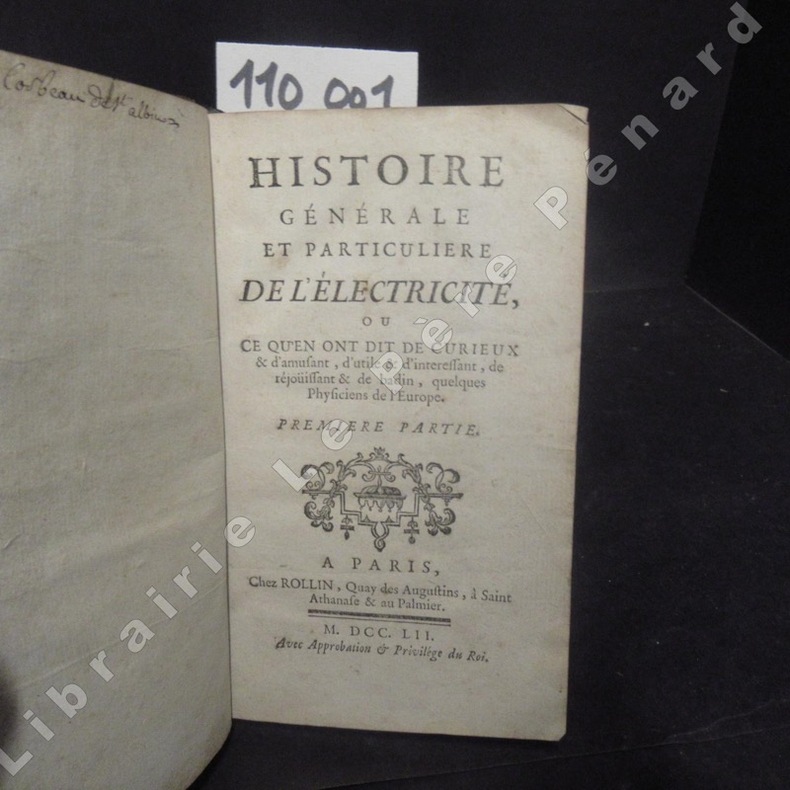
17521100011752 A Paris, Chez Rollin, Quay des Augustins, à Saint Athanase & au Palmier - M. DCC. LII. 1752 - Avec Approbation & Privilége du Roi - In-12 (9,,5 x 16,5cm environ), reliure pleine peau brune, 5 nerfs, fleurons dorés et pièce de titre au dos - Tranches rouges et signet - x, 197 pages - Rares bandeaux et lettrines
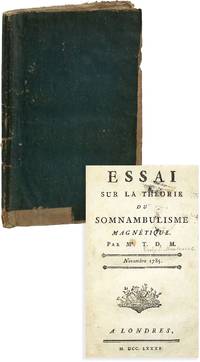
178587871A Londres" i.e. Paris 1785. First Edition. Octavo 20cm. Sewn pamphlet; early paste-paper wrappers; 108pp. A somewhat worn copy; lacking half-title; title page margins unevenly trimmed; neat mends to leaves A2 and B7; vertical tear to first text leaf; small puncture to final leaf costing a few characters but no loss of sense; wormhole to gutter of final three leaves just touching text on p.105. Else complete and Good with interior text quite fresh and clean. <br /> <br /> An early treatise on "magnetic somnabulism" a phenomenon originally announced by Puységur a year earlier. Tardy's findings are based primarily on his experiments with one "Mlle N" who ".seemed to possess certain extraordinary abilities already noted in magnetic somnambulists by Puységur and others.these included the ability to diagnose her own illness and those of others and the ability to perceive clairvoyantly.and see the magnetic fluid and describe its colors." Crabtree p.36. "Londres" is a false imprint; the book was almost certainly published in Paris. Worn but complete copy of a notable early work. ESTC T91390. CRABTREE 152. unknown
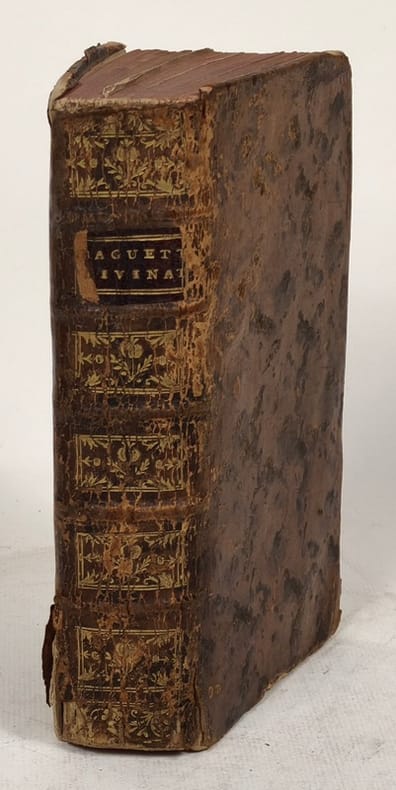
1762143272à La Haye, chez Adrien Moetjens 1762 In-16 17 x 10 cm. Reliure de l’époque veau havane, dos à nerfs encadrés de fers dorés, pièce de titre maroquin grenat, 275-246 pp., 24 figures gravées en taille-douce, dont un frontispice pour le tome I, quelques planches montrant la manière de tenir la baguette divinatoire et 8 autres indiquant les périodes de l'année où il faut couper la baguette pour trouver diverses sortes de métaux, tables. Coiffes arasées, manque en pied de dos.
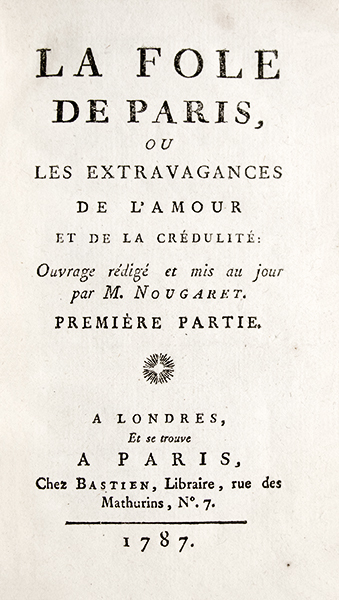
1787378901787 2 tomes reliés en un volume in-12, demi-basane fauve de l'époque, dos lisse orné de filets et fleurons dorés, pièce de titre de maroquin bordeaux, xiv, 224 p. et iv, 188 p. Londres et Paris, Bastien, 1787.
178419594Paris: Chez Prault 1784. First edition. Portions of the fragile spine perished; some wear and soiling; a good sound copy in its original condition. 12mo original blue wrappers 7.13 x 4.3 inches xxxv 1 251 1 pages unopened and untrimmed. An important study of animal magnetism and anticipatory of later psychological studies. Crabtree 116: "Thouret was a member of the Royal Society of Medicine in Paris and one of the leading spokesmen of the opposition of that society to animal magnetism and the teachings of Mesmer." With much on the historical context of hidden natural healing forces suggesting Mesmer was not novel in his approach. Faint early pencil and autograph ink notation to the coated front wrapper. Chez Prault, unknown books
1784(LCPCSCI-0007)"On convient assez généralement que pour bien juger une chose il faut au moins la considérer sous différentes faces. D'après ce principe, j'ai pensé que mon travail pourroit être de quelque utilité". THOURET Michel-Augustin. (Pont l'Evêque, 1748-1810) "RECHERCHES ET DOUTES SUR LE MAGNETISME ANIMAL". 1784, Paris, Prault. 1 volume in-12° (178x104 mm) (dimensions pages 185x112 mm) XXV pp. (faux-titre, titre, avant-propos et errata), (1), 251 pp. (y compris l'addition), (1) p. (a12, b6, A-K12), L6) Brochure bleu-grise de l'époque. Edition Originale, rare. Petite galerie de ver dans la marge intérieure d'une douzaine de pages, sans atteinte au texte, sinon superbe exemplaire imprimé sur papier fort, à toutes marges, non rogné, tel que paru dans sa brochure d'attente d'origine. Médecin et directeur de l'Ecole de Santé, Thouret dans cet ouvrage "plein d'érudition" émet beaucoup de réserve sur le magnetisme animal et son efficacité". "On a dit en parlant du magnétisme animal, qu'il est des objets qu'il ne faut pas réfuter sérieusement ; je laisse aux autres à juger du parti que l'on peut tirer de ce conseil. Mais je n'adopterois pas volontiers cette manière d'agir avec M. Mesmer, au moins par rapport à un certain ordre de ses partisans. Un nombre considérable de personnes croyent, dit-on, à sa doctrine : plusieurs même se louent de sa méthode, & dans ce nombre il en est dont les qualités, l'esprit & le rang méritent les plus grands égards. La bonne-foi surtout doit être toujours ménagée. (...) Il y a des faits d'un certain ordre qui, par le nombre & la grande variété, la grande mobilité des effets qu'ils présentent, par le caractère de singularité qu'ils offrent, qui faisant enfin spectacle, peuvent facilement induire en erreur, & qui frappent sur-tout si vivement les sens, qu'ils ne laissent pas à les sens la tranquillité nécessaire à la réflexion. (...) Ces réflexions peuvent trouver leur application ici. C'est en grand, c'est en public que les traitements du magnétisme animal ont lieu, & c'est sur des moyens connus comme propres à faire illusion, & qui ont été sur-tout dans bien des cas employés pour la répandre, que sont fondés en plus grande partie ses procédés. Je veux parler ici des accidents ou crises nerveuses & convulsives. On n'ignore point quel abus on en a fait pour établir des erreurs, & ces exemples doivent mettre en garde contre leur emploi... C'est sous ce voile qu'étoit caché tout le secret des prodiges de Saint-Médard, des possessions de Loudon". "Thouret was a member of the Royal Society of medecine in Paris and... spokesman of the opposition of that society to animal magnetism and the teachings of Mesmer. In this work Thouret claims that his main concern is not to examine the details of cures being performed by animal magnetism, but to trace the history of the theory and practice of animal magnetism. He nevertheless clearly sides with those who reject animal magnetism as an illusion. Admitting that many persons of stature accept animal magnetism as an effective cure, Thouret uses his considerable erudition to show that such cures are not new and that Mesmer was simply the most recent of a long tradition of thinkers who posited a hidden power of nature produces healings effects". "Thouret's learned critique was extremely influential and served as a starting point for much of the discussion at the time about the originally and effectiveness of animal magnetism". (Caillet, 10676 ; Crabtree, 116 ; Dorbon, 4855 ; Hirsch, IV, 576 ; Waller, 9569) (LCPCSCI-0007) (580,00 €)
17859321A Londres, et se trouve à Paris, chez Cailleau, 1785. In-12 de 86 pages, cartonnage de papier marbré, étiquette de titre verticale en maroquin noir. Reliure XXe.
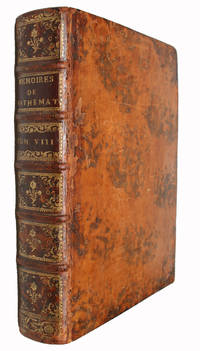
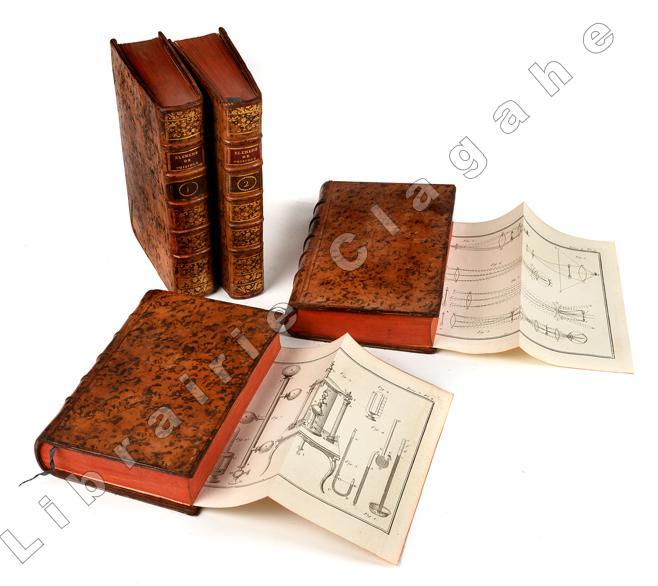
178044929Paris, Moutard, Panckoucke, 1780. 4to. Contemp. full sprinckled calf with 5 raised bands on spine. Richly gilt compartments, title-and tomelabels with gilt lettering. ""Mémoires fe Mathematique et de Physique, Présentés à l'Academie des Sciences par divers Savans"", Tome VIII. XXIV,624 pp., 8 engraved plates a. 52 folded tables. (Entire volume offered). Van Swinden's work: pp. 1-576, 3 folded engraved plates and 52 folded tables.
178044929Paris Moutard Panckoucke 1780. 4to. Contemp. full sprinckled calf with 5 raised bands on spine. Richly gilt compartments title-and tomelabels with gilt lettering. "Mémoires fe Mathematique et de Physique Présentés à l'Academie des Sciences par divers Savans" Tome VIII. XXIV624 pp. 8 engraved plates a. 52 folded tables. Entire volume offered. Van Swinden's work: pp. 1-576 3 folded engraved plates and 52 folded tables. <br/><br/><em>First edition of Van Swinden's large work on magnetism and the function of the compass and the variability of magnetic needles. It also explained the diurnal variation of the earth's magnetic force.In 1767 van Swinden obtained the chair of philosophy logic and metaphysics at Franekar University. He studied all the popular scientific topics of the period especially magnetism electricity meteorolgy and chemistry and corresponded with many leading scientists including Bonnet Euler Deluc J. C. Wilcke Bertholon and Lalande. His Tentamen de magnete 1772 dealt with his mathematical theory of magnetism and in 1777 he and Coulomb shared the gold medal of the Paris Academy of Sciences for a very detailed prize essay on magnetism Recherches sur les aiguilles aimantées. the essay offered.Poggendorff II 1057 </em> hardcover
178720311Paris, Griffier, 1787 ; 4 tomes in-8 (195 mm), veau marbré, dos à nerfs décoré et doré, pièce de titre rouge, tranches rouges (reliure de l’époque) ; XXXII, 635, [1 bl.] pp, 7 pl. dépl. ; 565, [1 bl.] pp., 10 pl. dépl. ; 576 pp., 4 pl. dépl. ; 622 pp, 4 pl. dépl. soit en tout 25 planches dépliantes gravées sur cuivre et portrait gravé par Coron d’après Naudin en frontispice.
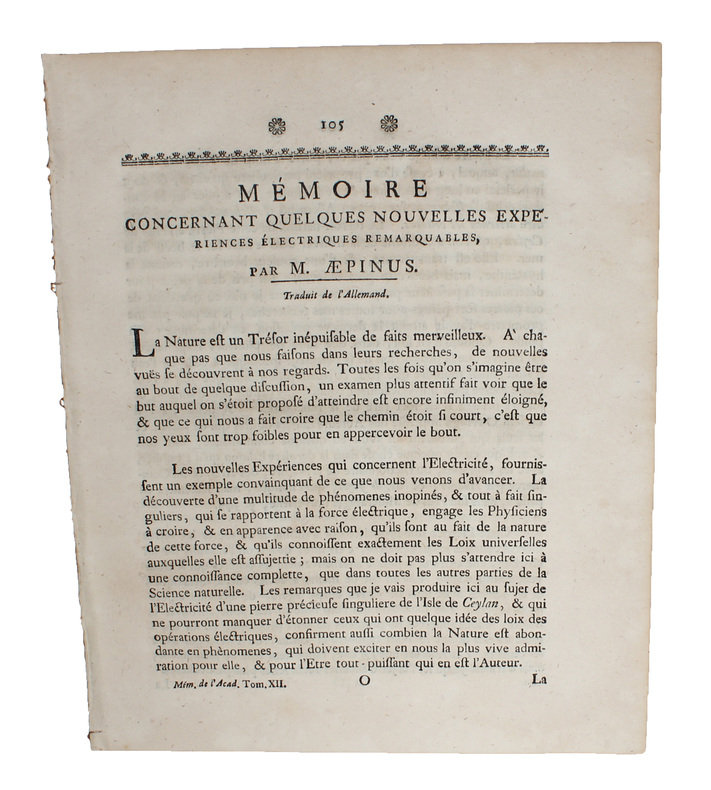
175846557Berlin, Haude et Spener, 1758. 4to. No wrappers, as issued in ""Mémoires de l'Academie Royale des Sciences et Belles-Lettres"", 1756, tome XII. Pp. 105-121. With titlepage to the volume, printed in red/blac and with engraved titlevignette. Also having the parttitlepage. Titlepage with 2 small wormtracts.
175846557Berlin Haude et Spener 1758. 4to. No wrappers as issued in "Mémoires de l'Academie Royale des Sciences et Belles-Lettres" 1756 tome XII. Pp. 105-121. With titlepage to the volume printed in red/blac and with engraved titlevignette. Also having the parttitlepage. Titlepage with 2 small wormtracts. <br/><br/><em>First appearance of a milestone paper in the history of electricity as Aepinus here found that a heated tourmaline attracted and repelled light bodies. He decided that the effect was electrical and that its ends was carrying charges of opposite sign much as soft iron is magnetized by a lodestone. This paper is a forerunner of his "Tentamen Theoriae electricitatis et magnetismi" - published 1759 and one of the most original and important books in the history of electricity. It is the first reasoned fruitful exposition of electrical phenomena based on action-at-a-distance."Aepinus’ first reseraches on the thermoelectric properties of this stone Tourmalin which was then of extreme rarity were fundamental. He recognized the electrical nature of the attractive power of a warmed tourmaline and attempted not altogether successfully to reduce its apparent capriciousness to rule. He was particularly struck by the formal similarity between the tourmaline and the magnet in regard to polarity which inspired him to reconsider the possibility then occasionally discussed that electricity and magnetism were basically analogous. This thought became the This thought became the theme for his masterwork Tentamen theoriae electricitatis et magnetismi 1759."DSB."Aepinus is known in the history of electricity for his attempt to develop the one fluid theory of Franklin. His theory was for a while generally adopted but was gradually displaced by the two fluid theory in consequence chiefly of the necessity of ascribing to uncharged matter repulsions of the same force as those which were ascribed to electrical charges. His theory exhibits interesting similarities to the present theory of the constitution of matter"Magie "A Source Book in Physics" pp.406-8.Ronalds p. 4. </em> unknown

_2.jpg)