3 résultats
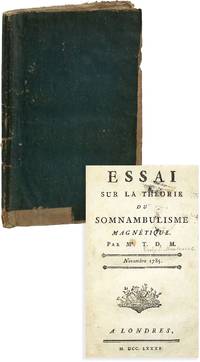
178587871A Londres" i.e. Paris 1785. First Edition. Octavo 20cm. Sewn pamphlet; early paste-paper wrappers; 108pp. A somewhat worn copy; lacking half-title; title page margins unevenly trimmed; neat mends to leaves A2 and B7; vertical tear to first text leaf; small puncture to final leaf costing a few characters but no loss of sense; wormhole to gutter of final three leaves just touching text on p.105. Else complete and Good with interior text quite fresh and clean. <br /> <br /> An early treatise on "magnetic somnabulism" a phenomenon originally announced by Puységur a year earlier. Tardy's findings are based primarily on his experiments with one "Mlle N" who ".seemed to possess certain extraordinary abilities already noted in magnetic somnambulists by Puységur and others.these included the ability to diagnose her own illness and those of others and the ability to perceive clairvoyantly.and see the magnetic fluid and describe its colors." Crabtree p.36. "Londres" is a false imprint; the book was almost certainly published in Paris. Worn but complete copy of a notable early work. ESTC T91390. CRABTREE 152. unknown
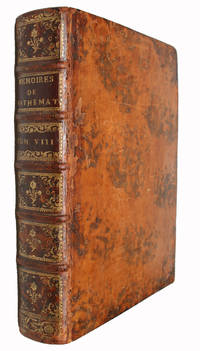
178044929Paris Moutard Panckoucke 1780. 4to. Contemp. full sprinckled calf with 5 raised bands on spine. Richly gilt compartments title-and tomelabels with gilt lettering. "Mémoires fe Mathematique et de Physique Présentés à l'Academie des Sciences par divers Savans" Tome VIII. XXIV624 pp. 8 engraved plates a. 52 folded tables. Entire volume offered. Van Swinden's work: pp. 1-576 3 folded engraved plates and 52 folded tables. <br/><br/><em>First edition of Van Swinden's large work on magnetism and the function of the compass and the variability of magnetic needles. It also explained the diurnal variation of the earth's magnetic force.In 1767 van Swinden obtained the chair of philosophy logic and metaphysics at Franekar University. He studied all the popular scientific topics of the period especially magnetism electricity meteorolgy and chemistry and corresponded with many leading scientists including Bonnet Euler Deluc J. C. Wilcke Bertholon and Lalande. His Tentamen de magnete 1772 dealt with his mathematical theory of magnetism and in 1777 he and Coulomb shared the gold medal of the Paris Academy of Sciences for a very detailed prize essay on magnetism Recherches sur les aiguilles aimantées. the essay offered.Poggendorff II 1057 </em> hardcover
175846557Berlin Haude et Spener 1758. 4to. No wrappers as issued in "Mémoires de l'Academie Royale des Sciences et Belles-Lettres" 1756 tome XII. Pp. 105-121. With titlepage to the volume printed in red/blac and with engraved titlevignette. Also having the parttitlepage. Titlepage with 2 small wormtracts. <br/><br/><em>First appearance of a milestone paper in the history of electricity as Aepinus here found that a heated tourmaline attracted and repelled light bodies. He decided that the effect was electrical and that its ends was carrying charges of opposite sign much as soft iron is magnetized by a lodestone. This paper is a forerunner of his "Tentamen Theoriae electricitatis et magnetismi" - published 1759 and one of the most original and important books in the history of electricity. It is the first reasoned fruitful exposition of electrical phenomena based on action-at-a-distance."Aepinus’ first reseraches on the thermoelectric properties of this stone Tourmalin which was then of extreme rarity were fundamental. He recognized the electrical nature of the attractive power of a warmed tourmaline and attempted not altogether successfully to reduce its apparent capriciousness to rule. He was particularly struck by the formal similarity between the tourmaline and the magnet in regard to polarity which inspired him to reconsider the possibility then occasionally discussed that electricity and magnetism were basically analogous. This thought became the This thought became the theme for his masterwork Tentamen theoriae electricitatis et magnetismi 1759."DSB."Aepinus is known in the history of electricity for his attempt to develop the one fluid theory of Franklin. His theory was for a while generally adopted but was gradually displaced by the two fluid theory in consequence chiefly of the necessity of ascribing to uncharged matter repulsions of the same force as those which were ascribed to electrical charges. His theory exhibits interesting similarities to the present theory of the constitution of matter"Magie "A Source Book in Physics" pp.406-8.Ronalds p. 4. </em> unknown