Charon, JeanBiblio.com
Vital Christianity
133342907X.Gpaperback. Good. Access codes and supplements are not guaranteed with used items. May be an ex-library book. paperback

Bonita · États-Unis54,79 $US≈ 46,36 €
18 résultats
197000003489McGraw-Hill 1970. Paperback. Fine. r. <br/><br/> McGraw-Hill paperback
133342907X.Gpaperback. Good. Access codes and supplements are not guaranteed with used items. May be an ex-library book. paperback
74010-13New. unknown
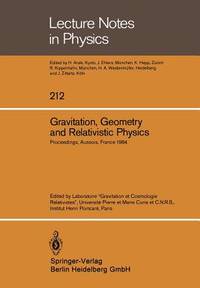
1984x-3540138811Springer Verlag 1984. Paperback. New. bilingual edition. 348 pages. French language. 9.60x6.69x0.72 inches. Springer Verlag paperback
19912090502113706363Not Available 1991. Soft Cover. Fine. The book is in fine condition. Not Available paperback
2111902158406072Institute for Earth and Space Peace N.A. Soft Cover. Fine. Number of pages: 425p Size: 21cm Institute for Earth and Space Peace paperback
19792090502113717494Not Available 1979. Soft Cover. Fine. The book is in fine condition. Not Available paperback
0444886591.Ghardcover. Good. Access codes and supplements are not guaranteed with used items. May be an ex-library book. hardcover
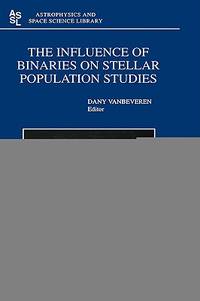
2001ML001Dordrecht: Kluwer Academic Publishers 2001 Shiny blue hardcover likely issued without jacket illustrated cover. Light general wear spine a little faded. xix 582 pages. Collects 37 articles and 11 poster papers on binary stars. First Edition. Hard Cover. Very Good/No Jacket. 6½" by 9½". Kluwer Academic Publishers hardcover
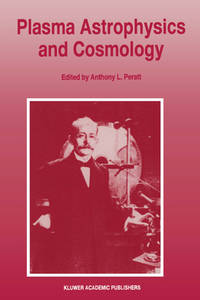
1995x-0792337840Kluwer Academic Pub 1995. Hardcover. New. 308 pages. 9.21x6.14x0.75 inches. Kluwer Academic Pub hardcover
1984Q-3540138811Springer 1984-12-10. Paperback. New. In shrink wrap. Looks like an interesting title! Springer paperback
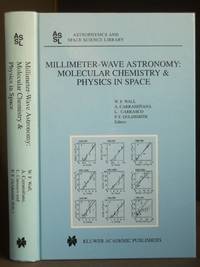
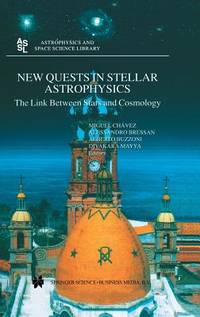
1999ML013Dordrecht/Boston/London: Kluwer Academic Publishers 1999. Astrophysics & Space Science Library volume 241 Proceedings of the 1996 INAOE Summer School of Millimeter-Wave Astronomy Held at INAOE Tonantzintla Puebla Mexico. Includes 27 papers. Glossy blue hardcover black titling. No jacket as issued. Spine ends bumped light shelf wear hint of spine fade. Text clean; ix 474 pages figures. . First Edition. Hard Cover. Very Good/No Jacket. 6½" by 9¾". Kluwer Academic Publishers Hardcover
2002x-1402006446Kluwer Academic Pub 2002. Hardcover. New. 1st edition. 311 pages. 9.25x6.25x0.75 inches. Kluwer Academic Pub hardcover
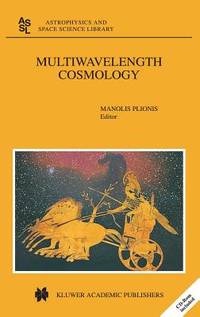
2004x-1402019718Kluwer Academic Pub 2004. Hardcover. New. hardback/cd-rom edition. 351 pages. 9.75x6.75x0.75 inches. Kluwer Academic Pub hardcover
20166San Carlos 7 San Angel Inn Mexico 20 D.F. 24 June 1963. Holland's obituary in the American Anthropologist vol. 67 issue 1 1967 pp.80-82 including bibliography accorded him high praise: 'The success with which he had applied himself during the greater part of the past six years to field work and the productivity he had shown in publishing his research results make his early death an incalculable loss to the field of Maya studies.' 1p. 4to. In fair condition lightly-aged and worn. In remains of Air Mail envelope addressed to 'Srta. Francoise Cabeaux 152 Chausee de Charleroi Bruxelles 6 Belgique'. He begins by thanking her for her letter adding 'The rainy season has started in Mexico and so things are quite similar to the way that you describe Belgium these days.' He thanks her again for her interest in his work and expresses his desire 'to publish in European newspapers and magazines with your help'. He will 'send along anything that might help you to interest a magazine in this work'. He is publishing 'another article in a Buffalo New York newspaper' with 'a larger number and variety of photographs' and 'will send it along as soon as possible'. His 'book' should be published 'within the next month or two' and he will send her a copy: 'You remember it will be published in Spanish and not in English. But if there is interest there I would certainly be in favor of publishing it in Europe.' He ends in the hope that he 'may get to Europe next summer for some scientific meetings in Madrid'. San Carlos 7, San Angel Inn, Mexico 20, D.F. 24 June 1963. unknown
199300002188Bulfinch Pr 1993. First edition first printing. Hardcover. As New/as new. r. 274 pp. <br/><br/> Bulfinch Pr hardcover
188042401London Harrison and Sons 1880. 4to. No wrappers as extracted from "Philosophical Transactions" Vol. 171 - Part II. Pp. 713-891. A few textilustr. Clean and fine. <br/><br/><em>First printing of a main work by the "Father of Geophysics" in which he set up the hypothesis that the results from his earlier investigations on the relations between the tidal frictions on the earth and the motion of the moon away from the earth could be used to explain the formation of satellites of the other planets and their movements in relation to the sun. In DSB it is called "a monumental paper"."Darwin's most significant contribution to the history of science lies in his pioneering work in the application of detailled dynamical analysis to cosmological and geological problems. That many of his conclusions are now out of date should in no way diminish the historical interest in his experiments nor the importent service thet he rendered cosmogony by the example he gave of putting various hypotheses to the test of actual calculations. Darwin's method remains a milestone in the development of cosmogony and subsequent investigators have favored it over the merely qualitative arguments prevalent until that time."DSB. </em> unknown
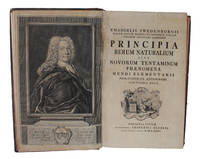
173450434Dresden et Leipzig Frederik Hekelius 1734. Folio. Contemp. full mottled calf. Upper half of spine rebacked. Raised bands. Lower part of spine gilt. A crack to leather at lower part of fronthinge cover not loose. Engraved portrait. 16452 pp. and 28 engraved plates on 26 sheets. A dampstain in upper part of inner margins throughout otherwise clean and wide-margined. The plates with some browning. <br/><br/><em>Scarce first edition of Swedenborg's main scientific work. The volume also form part one of his "Opera Philosophica et Mineralia"."In his Principia rerum naturalium Leipzig 1734 probably conceived as a counterpart to Newton’s Principia he sought a comprehensive physical explanation of the world based on mathematical and mechanical principles. While remaining faithful to the general principles of Cartesian natural philosophy which he had learned while studying at Uppsala Swedenborg elaborated upon them. According to his cosmogony the physical reality has developed from the mathematical point which was an entity between infinite and finite. Through a vortical movement implanted on the point a series of material particles developed the "first finiata "the second finita"and so on that eventually led to the cosmos in its present state. In contrast to Descartes Swedenborg believed that the planets had developed from the chaotic solar mass through expansion of its surrounding shell which finally joined to form a belt along the equatorial plane of the sun. It then exploded forming the planets and the satellites. Although the basic construction of Swedenborg’s thought heralded the later planetary theories of Buffon Kant and Laplace there is nothing to indicate that it exerted any direct influence on posterity." DSB.In 1738 Swedenborg's magnum opus was placed on the "Index Librorum Prohibitorum". </em> hardcover