84 résultats
193676703Hamilton Canada: Cecil Willliams 1936-1940. Edited by Cecil Williams. Monthly. Octavo. Vol. I. Nos. 6 7 8 9 10; Vol. 2. Nos. 1 2 3 5; Vol. 3 No. 1; Vol. 5 No. 1. 4 pp. each. Eleven issues. Very good but for Vol. ! no. 6 which has edge chipping. very good. By this date there were numerous theosophical organizations and the primacy was sought by many lead to much infighting. This little periodical was an attempt to display and praise the coming together of various factions. For example in Vol. 1 No. 9 we read “Evidence of the spread of fraternization: Adyar and Point Loma held joint White Lotus day meetings at Point Loma San Francisco and Oakland California in London England as well as in other cities.†That same issue has a photographic portrait of Aldous Huxley and a review of “Eyeless in Gaza.†Cecil Willliams unknown
a7108Madras 1910 Oriental Publihing. Hardcover. Octavo 279pp. cloth. Good. . hardcover
188476074Madras: Madras Christian College Magazine 1884. First edition of this infamous report. Extracted from the November 1884 issue of the Madras Christian College Magazine one suspects that this article comprised the entirety of the issue. Octavo. 112 pp. entirely devoted to this report by Emma Coulomb which severely damaged the Theosophical movement. Contemporary ersatz binding of plain brown wrappers with lighter brown taped for spine front cover with a paper label bearing the title in manuscript. Hinges reinforced. With the bookplate of noted 20th century magician Stanley Collins.A very good copy of the exceedingly rare publication.Blavatsky met Emma and Alexis in 1871 in Cairo. They founded the short-lived Societe Spirite. In August 1879 Emma and Alexis contacted Blavatsky because they had financial problems. They were stranded in Sri Lanka and Blavatsky helped them to get to Bombay and tried to find a job for them. As she could not find a job for them she provided them with a position in the Theosophical Society where they did various chores such as cooking and gardening. In February 1884 Blavatsky and H. S. Olcott travelled to Europe. Prior to their departure Emma had occasion to see what she considered to be fraud on the part of Blavatsky. Blavatsky was rightly famous for introducing the concept of Hidden Masters and their importance in Mankind's crawl toward apotheosis. Traditionally celebrants would seek the advice of a revered Ascended Master through Blavatsky. When Blavatsky asked a question the illuminati would send an answer down apparently originating in midair. Emma claimed to have gone to the room above where Blavatsky was hosting a seeker and she said she saw Blavatsky's assistant in that room dropping little slips of paper through a crack in the ceiling. After their departure a conflict between the Coulombs and the Theosophical Society escalated. The Coulombs tried to blackmail and threaten Blavatsky whereupon Blavatsky dismissed them.After the Coulombs were dismissed they went to their Christian missionary friends of the Free Church of Scotland and gave them letters that were allegedly written by Blavatsky to Emma. These letters suggested that Blavatsky was a fraud. The chaplain George Patterson published extracts from these letters in the Madras Christian College Magazine presented here The incident became well known all over India and also in America and Europe. Blavatsky immediately published a reply in several newspapers. Blavatsky and Olcott then traveled back to India at the end of 1884. Soon afterwards the Hodgson Report was published which further damaged Blavatsky's reputation. The Hodgson Report was an 1885 report by the Society for Psychical Research SPR on Helena Blavatsky and purportedly fraudulent Mahatma Letters. According to OCLC there is not record for the copy here presented. After wading throuh a miasma of red tape we think that there was a report issued in London in 1885 with a title page reading "Some account of my Intercourse with Madam Blavatsky" that followed the original report issued by the Madras Christian College Magazine in 1884 an obvious extract with the title page reading "Some Account of My Association with Madame Blavatsky. In either case it is exceeding rare with no copy ever ever having come up at auction and none ever offered in the trade that we could find. Madras Christian College Magazine unknown
192976692Sydney: Theosophical Society in Australia 1929-30. Edited by C. W. Leadbeater. Monthly. Octavo. Vol. V Nos. 1 2 3 4 5 6 7 8 1929-29. Vol. VI Nos. 1 2 3 4 5 6 1929. Vol. VII Nos. 2 3 5 6 1929-1930. Vol. VIII Nos. 1 3 1930. 20 issues. Printed in blue ink. Each volume is separately paginated. Numerous photographic illustrations. Publisher’s peach wrappers with lettering and decorations in blue. Some abrasion to spines but sturdy and clean throughout.We cannot best Pat Delavaney’s description so we present it here in it’s entirety; “From mid-1928 C.W. Leadbeater was editor of the journal. This was a fairly typical sectional journal of the Adyar Theosophists but its bland contents tolerance child welfare Indian independence practical domestic economy the World Mother messages from Leadbeater Annie Besant C.J. Jinarajadasa etc. conceal and gloss over the bitter internecine strife that preceded it. Dissatisfaction with the direction the Theosophical Society had taken under the guidance of Besant and Leadbeater had begun with Leadbeater's temporary expulsion from the T.S. in 1906 growing out of the accusations of Helen Dennis of Chicago about his "immoral sexual practices" with her son and another boy. Similar charges against Leadbeater and his protege James Wedgwood were made in Australia after World War I principally by Thomas Hammond Martyn - d. 1924 the head of the Sydney Lodge of the Society. Martyn besides his outrage over Leadbeater's and Wedgwood's sexual conduct also played a role in the bitter discussions over whether Besant had or had not said Wedgwood was an initiate -- and over whether she herself was an initiate or merely the dupe of Leadbeater. The furor in Australia centered around the Sydney Lodge and its attacks on the roles of Co-Masonry Krishnamurti the E.S. pederasty ceremonialism the "Back to Blavatsky" movement and the "T.S. Loyalty League." The convention of the Australian Section of the Society in 1922 was split leading to the expulsion of the Sydney Lodge the next year -- though it continued for decades as the Independent Theosophical Society. George Sydney Arundale 1878-1945 who edited this journal was General Secretary of the Australian Section 1926-1928 and went on to become third president of the T.S. in 1934. He was an English Theosophist prominent Co-Mason and bishop in the Liberal Catholic Church and firmly brought Theosophy in Australia back into the Besant-Leadbeater fold.†Krishnamurti broke with Theosophy in early August of 1929 and in the August 15 1929 of this periodical we find the below article - “Krishnaji Dissolved the Order of the Star.†The Order of the Star was the movement within the Theosophical Society that proclaimed Krishnamurti to be the World-Teacher/Messiah. And even before that in the issue of October of 1928 the lead article written by Leadbeater again was “Our Chief and Krishnaji I.e. Krishnamurti and it discusses the growing disparity between the teachings of Krishnamurti and those given by Annie Besant. The Australian Branch of the Theosophical Society was a continuous torn in its side as Leadbeater was determined to co-mingle Theosophy with his new Liberal Catholic Church. A Church found to be sorely lacking by the vast majority of sincere Theosophists. Theosophical Society in Australia unknown
192276325New York: Alfred A. Knopf 1922. Second edition auction records show only one copy of the first edition which was printed by Bragdon himself at his Mana Press. Octavo. 111 1 pp. Publisher's black cloth with gilt cover and spine lettering General fatigue to binding but solid and two stamps to front endpaper. A difficult book to find.Claude Fayette Bragdon was an American architect artist writer and publisher who was active in the Theosophical Society in America. He operated the Manas Press in Rochester New York and was the first publisher of P. D. Ouspensky's work Tertium Organum. He was extremely active in the American Theosophical Society. He was in great demand as a lecturer and published numerous books and articles. Alfred A. Knopf hardcover
196276694Penang: Dr. H. C. Yeang 1962-64. Edited by C H Yeang. Quarterly. Three issues. Vol. II Nos. 11 12 & 13. Printed in purple ink and with numerous ads for local Malaysian businesses. Publisher’s printed wrappers of various hues. Some aging but very good. None located by OCLC. Quite a vibrant publication. In the overall arc of Theosophy The Malaysian Theosophist is quite a late-comer but their enthusiasm makes up for it. Includes articles by Geoffrey Hodson Kut Humi Speaks Blavatsky’s Ascended Master Joel S. Goldsmith Sri Siddha Evangeline “LSD. 25 Mescaline Etc.â€. Adrienne Ashley Brown Landone & Martha Baker. In Vol. II. No. 12 April-September 1963 there is an article by Muhammad Subuh entitled “The Meaning and Purpose of Subudâ€. The first Subud periodical wasn’t published until 1964 but it did not contain any expository writings by Muhammad Subuh. He did publish some spiritual and autobiographical pieces is 1959 but this is almost surely his first published piece expounding upon Subud. Included in this lot is a separate publication ostensibly written by the same publisher/editor C. H. Yeang and it is uniform with the periodical in size and appearance. It is entitled “Hidden Secrets Revealed by ‘I AM’ that ‘I AM’.†It contains a listing of 53 metaphysical laws and is almost surely cribbed from various books published by Guy Ballard. The preface bears an inscription by Yeang and is dated 1963. As there are articles about such various movements as Baha’i and the Mazdaznan it would seem that this branch of the Theosophical Society was very un-doctrinaire. The covers all bear a variation of the Ballards’ I AM theosophical offshoot e.g. “WE ARE that I AMâ€. Dr. H. C. Yeang unknown
188675774Cincinnati: Robert Clark & Co. 1886. First edition. Small square octavo. 42 pp. including a full page allegorical illustration. Printed green wrappers Excellent.Jirah Dewy Buck received his medical training at Cleveland Homeopathic Medical College completing the program in 1864. He began practice that year in Cincinnati as a homeopathic physician in general practice. He also taught medicine at Cleveland Medical College and became Dean of the Pulte Medical College in Cincinnati until it was merged into Ohio State University. In 1890 Dr. Buck became President of the American Institute of Homeopathy. He practiced medicine for over 40 years. Dr. Buck became active in the Theosophical Society in 1879. In 1880 he was a member of the General Council of the Theosophical Society. On May 13 1884 he was appointed by Col. Olcott to be a member of the Board of Control of the Theosophical Society's activities in the United States. In Mahatma Letter 140 written in March 1886 Madame Blavatsky gave A. P. Sinnett an indication that Dr. Buck was being "helped" by the Mahatmas to make the Society "a grand movement" in America. The Cincinnati Theosophical Society was formed on May 9 1886 at the Buck home on Oak Street. Cincinnati was one of the earliest centers of theosophical adherents in the US and Buck was their patriarch. The first edition is signed lightly in pencil by a woman in his inner circle.Madame Blavatsky quoted an essay of his in The Key to Theosophy and commented "No living theosophist has better expressed and understood the real essence of Theosophy than our honoured friend Dr. Buck". She also referred to him as "a true Philaletheian" in her book quoting from an article he published in The Theosophist September 1883 p. 327 titled "The Ethics of Theosophy." Robert Clark & Co. unknown
188975793Cincinnati: Robert Clark & Co. 1889. Second edition. Octavo. Allegorical frontispiece 54 pp. Publisher's blue cloth with gilt spine lettering and floral endpapers. Very attractive. Robert Clark & Co. hardcover
191276700Auckland: The Lotus Press 1912. Edited by J. Prickett. Octavo. Vol. II Nos. 9 & 12 likely the last issue ever published. Each volume paginated so erratic numbering but 28 pp. each. Publisher’s string tied wrappers with elaborate borders surround the lettering on front. Each issue with the remains of a removed price stamp on the inner upper wrappers light edge wear. Very good. OCLC locate 4 runs but all are in New Zealand. Published as a theosophist magazine for children. The Lotus Press unknown
194876689Columbus OH: The Phoenix 1948-49. Edited by Frank Noyes. Quarterly. Quarto. Summer & Fall of 1948 and Summer of 1949. Mimeographed and consecutively numbered from pp. 205-288. Publisher’s printed wrapper of various colors stapled. No copies located by OCLC.A very obscure theosophical and astrological periodical out of Columbus Ohio. Frank E. Noyes b.1896 served with distinction in both world wars. He moved moving to Columbus Ohio in 1927. In 1938 he founded Frank Noyes Pies Inc. which he kept open until 1952. In the 1920s he developed an interest in Theosophy. He also believed in astrology and was a member of the American Federation of Scientific Astrologers from 1945 to 1950. Noyes and his friend Alan Hooker the manager of Noyes Pies were both active in Theosophy and traveled as lecturers for the Theosophical Society. Noyes sold his bakery in 1952 and settled permanently in Ojai He then spent more than two years developing glazes with Beatrice Wood a nationally renowned potter. Noyes remained a prolific and respected potter until his death in 1999 one year short of having lived in three centuries. The Phoenix unknown
192976701Point Loma: The Theosophical Society 1929-35. Edited by G. de Purucker. Monthly. Small octavo. Vol. I Nos. 1-12; Vol. II Nos. 1 2 5 8 9 10 11 12: Vol. III. Nos. 1 2 3 4 7 8 9 10 11 12; Vol. IV. Nos. 1 2 3 4 6 7 10 11; Vol. V Nos. 3 4 5 8 10 11 12: Vol. VI. Nos. 1 2 4 6 7 8 9 10 11 12; Vol. VII Only 1 2 & 4 are present. Fifty-seven issues. Each volume is separately paginated. The wood pulp paper used in the first two years is truly execrable-About half of these issues have problems e.g. on Vol. I No. 1 the last two pages have broken in half a few with wrappers loose edges chipped. They upgraded the paper stock for the later years. A very good and early assemblage.Katherine Tingley founded the Theosophical Society's main U.S. branch at Point Loma California in 1900. After her death in 1929 Gottfried de Purucker took over as leader of that community. He was a much more dedicated researcher and writer and he is still highly thought of in theosophical circles. He authored many works including The Esoteric Tradition and Studies in Occult Philosophy. He sold the Lomaland estate in 1942 and moved the branch’s headquarters to Covina but died within months of the move. The Theosophical Society unknown
a86149Leipzig 1934-1936. Monatsschrift zur Entwicklung der höheren Seelen- und Geisteskräfte herausgegeben von der Deutschen Theosophischen Gesellschaft. Thirteen issues of this monthy journal from February 1934 January 1936. 8 for 1934 4 for 1935 1 for 1936. In German. Octavo about 65p. per issue original printed wraps. The dimenions of this journal are smaller after 1934 small octavos. Good plus some chipping along edges of a few issues. Thirteen issues. . paperback
193176697Los Angeles: The Theosophy Company 1931-1942. Edited by John Garrigues. Monthly. Octavo. Vol. XX; Nos. 1 2 3 4 7 8 9 10 11 12 1931-1932; Vol. XXI. Nos. 1-12 1932-1933; Vol. XXII Nos. 3 4 5 6 7 8 9 10 11 12 1934-1935; VOL. XXVI Nos. 8 10 1928; Vol. XXVII Nos. 1-12 1938-1939; 52 issues plus 9 odd issues from 1940-1946. 6 issues with their covers off but present and 3 with stains to the front cover. Very good overall. This was the mouthpiece of the United Lodge of Theosophists formed by Robert Crosbie in 1909. Crosbie was a student of William Judge who headed the American Division of the Theosophical Society. With the death of Blavatsky the leadership was thrown into disarray with Annie Besant heading the International Society and Katherine Tingley the American Society. In 1900 Crosbie threw his lot in with Tingley and moved to Lomaland but by 1904 he had grown disillusioned with her increasing theatricality and moved to South Pasadena and 5 years later founded the ULT. The United Lodge adhered tightly to the teachings of Blavatsky and paid no attention to either Tingley’s Kingdom in San Diego nor to the Maitreya of Annie Besant. In every issue they state “This Magazine is an independent journal unconnected with any theosophical society or other organization.†The ULT is likely the most active remaining theosophical group in the world. The Theosophy Company unknown
188375773Madras: C. Foster and Co. 1883. First edition. Small octavo. 47. 1 pp. Publisher's printed buff wrappers. Some dust-soiling to wrappers else and excellent copy. Only four copies located by OCLC.We in the West tend to think of the Theosophical Society as a new religion practiced almost entirely in Europe and America but in fact there was a very large contingent of Indian Theosophists. Row a Vice-president of the Madras Branch of the the Theosophical Society explains the importance of the movement to him an Indian practitioner and why he joined. C. Foster and Co. unknown
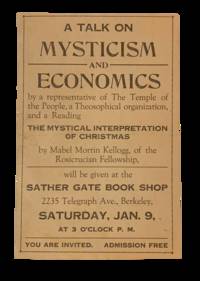
19255544Berkeley: Sather Gate Book Shop 1925. Leaflet advertisement 18x12cm recto only. Nearly fine with instances of faint creasing and soiling. <br /> <br /> Interesting advertisement for a talk on mysticism and economics and including a reading of The Mystical Interpretation of Christmas by Rosicrucian Mabel Morrin Kellogg at the iconic Sather Gate Book Shop in Berkeley. Though the flyer is undated we find the title it advertises listed as a Recent Rosicrucian Publication in the May 1921 issue of Rays from the Rose Cross. <br /> <br /> We find Kellogg's name in various Bay Area papers as a "dramatic reader" as early as 1908. She was also a member of the Temple of the People a theosophical organization in Halcyon CA following the teachings of Madame Blavatsky.<br /> <br /> <br /> A wonderful piece of California occult ephemera. . Sather Gate Book Shop unknown
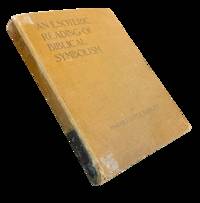
19167586San Francisco: Philopolis Press 1916. First edition. 8vo 166 1pp. Single plate at front. Brown cloth boards with lettering stamped on front cover and spine. Ex Oakland Theosophical Society library copy with stamps and card pockets at rear. Front fly leaf removed old tape repairs to plate and edges of several leaves at the front of the book notes in pencil on rear blanks.Hinges tender boards worn an frayed at corners. A good complete copy. <br /> <br /> Scarce theosophical text on occult biblical interpretation by Harriet Tuttle Bartlett who wrote a few books on the subject. We find little information on Bartlett other than she was a National lecturer for the Theosophical Society and a charter member of the Daughters of the American Revolution. <br /> <br /> OCLC cites 9 holdings for the first edition and 8 for the second edition of 1920. Philopolis Press unknown
186975650Cincinnati: Robert Clark and Company 1869. First edition. Octavo. 85 1 pp. Original wrappers expertly restored.J. Ralston Skinner was a man of tremendous and far-reaching learning. A denizen of Cincinnati he was deemed an expert on a great many matters. This book his first concerns Newtonian physics gone astray. The theory of Newton that every particle of matter attracts all other particles of matter in right lines joining their centers and in an inverse ratio to the squares of their distances b yvirtue of an inherent force called gravity accounted for the motions of the planets so satisfactorily that it has been almost universally adopted by subsequent physicists as a natural law. In this book he calls into doubt this firmly held theory/"The theory of Newton that every particle of matter attracts all other particles of matter in right lines joining their centers and in an inverse ratio to the squares of their distances bj"virtue of an inherent force called gravity accounted for the motions of the planets so satisfactorily that it has been almost universally adopted by subsequent physicists as a natural law. The latterof the essay in which it is attempted to sustainthe theory are as the author claims merely suggestive; the first part being devoted to the attempt to demonstrate mathematically that the theory of Newton is untenable" Scientific American 1869. J. Ralson Skinner was a die-hard mason and published numerous books of esoteric wisdom; Madame Blavatsky though very highly of him/ "H. P. Blavatsky’s hitherto unpublished letter to James Ralston Skinner is one of great consequence. Despite its relative obscurity evidence of its existence has been previously alluded to by J. D. Buck Modern World Movements and Boris de Zirkoff BCW VIII 220. Blavatsky herself mentioned the recipient of the letter on numerous occasions clearly revealing her admiration of his great learning as demonstrated in his â€wonderfully clever and erudite volume The Source of Measures†BCW XIII 258. Indeed it is no accident that Skinner is “constantly mentioned†in The Secret Doctrine. In his overview of letter’s recipient Assistant Editor Jerry Hejka-Ekins has observed that both the author and his Source of Measures are mentioned more often in The Secret Doctrine than any other author with the exception of Plato a remarkable observation given the relative obscurity of both Skinner and his work. It is no surprise that John Drais considered the book important enough to compile his Index of Hebrew and Numerical Terms contained in The Source of Measures by J. Ralston Skinner." Theosophical History January 2023. Robert Clark and Company unknown
19509014London U.K.: Various 1950. 30 publications journals monographs offprints generally 8x6" or smaller various paginations. Staple bound in wrappers occasional illustration or diagram. Several pamphlets with wrappers detached many chipped along edges few ownership signatures. All complete and good or better. Housed in a beat up open box labeled "T.R.C. Pamphlets. <br /> <br /> Very interesting collection of esoteric health and science pamphlets many of which deal with the Anti-Vivisectionist movement of the first half of the 20th century. The holistic view of health and belief in the spiritual evolution of all living things which were core tenets of Theosophy provided a natural link to the Anti-Vivisectionist movement as well as that of women's suffrage. Several prominent Theosophists of the time took up both of these causes including Anna Kingsford Mabel Collins Gertrude Baillie-Weaver and others. <br /> <br /> The Theosophical Research Centre was founded in the 1920s as a reorganization of the Theosophical World University. Its members included doctors psychiatrists and scientists who carried out research on scientific supernatural religious and philosophical subjects in relation to Theosophy and published their findings. <br /> <br /> This collection includes:<br /> Proteus: A Journal of the Science Philosophy and Therapy of Nature Nos. 1-4 and 6 1931-32<br /> The Art of Breathing by F.E. Pearce League of Healing N.D.<br /> Health and Nervous Stability by William Watson League of Healing N.D. Slip signed by the author laid in.<br /> Unseen Aspects of the War and Super-Physical Science by A.P. Sinnett. Theosophical Pub. Soc. 1916 1917<br /> Diet As A Basic Cause of Disease; The Problem of Antiseptics; Pernicious Anaemia; The Problem of Infection; The "Schick" Inoculation.2 copies; Some Little-Understood Effects of Serum Therapy; The Basic Principles of Health and Disease; The Futility of arguing.; Diet as a Basic Cause of Disease; Justice to the Sub-Human Kingdoms of Nature; Vivisection in the Light of Philosophy signed; Why Experiment on Animals; Influenza: A Criticism; and Acute Poliomyelitis all by M. Beddow Bayly. Generally 1930s offprints.<br /> Pathogenesis and Immunity by William F. Koch Offprint 1939<br /> A Brief Survey of Medical History. by Heracles Offprint 1935<br /> Cosmic Creation and Atomic Energy by V. Wallace Slater. Theosophical Pub. House 1950<br /> An Intro. to the Study of Analytical Psychology by Laurence J. Bendit and Phoebe Bendit. TRC 1947<br /> De Beweging voor een Theosofische Wereld-Universtiteit by J.J. Poortman. 1927.<br /> Crookes Digest September 1948-December 1948 No. 12<br /> The Regulation Between Thought and Action by Emile Boutroux. Oxford 1918.<br /> <br /> In all an interesting assemblage containing several quite scarce Theosophical publications with ties to the TRC. <br /> <br /> <br /> . Various unknown
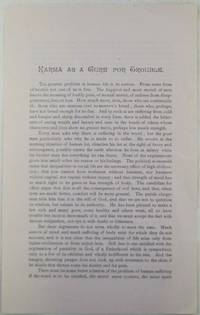
021031No Place: No publisher. Pamphlet. Good. No publisher place or date. Theosophical Society Circa 1890s. 4 page pamphlet. A circular issued by the Theosophical Society discussing the principle of karma and the belief of how one's actions affect one's "lot" in life. This appears to have been a circular issued perhaps to the public in an effort to broaden membership in the Theosophical Society with information on the society on the last page. GOOD. Minor fading and toning to the paper with some wrinkling and creasing. Tiny tear at the top center edge with a few small tears along the fore edge. No publisher unknown
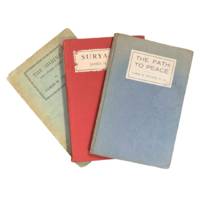
19286448Madras: Ganesh & Co 1928. First editions. 3 Vols 8vos 144 6; 10 1; and 60pp. Publisher's bindings of red cloth with printed paper labels; limp blue cloth covers with french flaps lettered in black; and blue cloth with printed label. Generally very good with chipping and toning to labels soiling to boards some scattered foxing. Owner's name in Surya-Gita else all clean internally. The Shrine partially split along spine of limp covers. <br /> <br /> Three scarce works from James Henry Cousins 1873-1956 Irish-Indian playwright and actor who left Ireland for India in 1915 at the behest of and funded by Annie Besant president of the Theosophical Society. The collection of poems Surya-Gita is actually three sequences of poetry which includes the first edition of the title sequence and second editions of The Garland of Life and Moulted Feathers which were published in 1917 and 1919. The Path to Peace is "An essay on cultural interchange and India's Contribution Thereto with a Prefatory Note on 'Mother India.'"<br /> <br /> Besides writing and publishing poetry and plays Cousins also became involved in theosophy vegetarianism and women's suffrage. His writings were heavily influenced by Blavatsky and he became close with then president of the Theosophical Society in Adyar Annie Besant. He wrote widely on theosophy Hinduism to which he converted in 1937 and the idea of "shared sensibilities" between Celtic and Indian peoples. Cousins' poetry is reflective of these ideas and beliefs and quite mystical in flavor. Ganesh & Co unknown
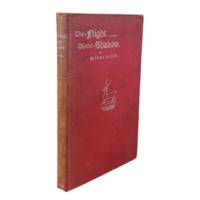
18995896Cincinnati: The Editor Publishing Co 1899. First edition. 17x11cm 128pp. Red cloth boards with vignette illustration and lettering in silver. Spine toned some soiling and bumping to boards. Scattered foxing else clean and sound internally. Very good. <br /> <br /> Unquestionably rare copy of this supernatural occult novel from Laura M. Dake née Wright 1844-1932. Likely published in a very small number we find little mention of the title save for a short review in the Columbia Missouri Herald August 11 1899 under the heading "Books by Home Folks:"<br /> <br /> <br /> "To lovers of the occult 'The Flight of the Shadow.' will appeal with fine fascination. It is a well-written argument for the astral world - a phrase which the theosophists are fond of employing. A gallant young Confederate officer is stricken almost unto death. In his delirium he is confronted by the spirit of a young man of his own age dead many years before. The latter tells his story which is strikingly like the events of the former's life and weaves through it the arguments of occultism. A note of love and mystery runs through the pages and makes of the volume a most charming one even aside from the queer theories it advances or supports."<br /> <br /> The short novel in part takes place on a plantation in Charleston and is steeped in the Southern culture of the time including slave dialect. <br /> <br /> The above review also gives clues as to the author's identity she being a resident of San Diego formerly of Columbia MO and wife of a Charles T. Dake. OCLC lists Dake as the author of a religious novel In the Crucible and an anti-Mormon novel which would make some sense given her upbringing in Missouri called A Man O' Wax published in San Francisco 1902. <br /> <br /> Interestingly an audiobook of this title was recently released. Otherwise we identify just the copy at the Library of Congress. A true rarity of the genre. <br /> <br /> Not in Bleiler not in Locke not in BAL. The New Sabin 9317. <br /> <br /> . The Editor Publishing Co unknown
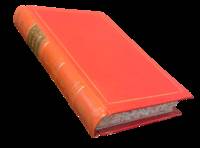
19147950Adyar Madras: Printed by Annie Besant at the Vesanta Press 1914. First edition. 24x17cm 280pp. Modern Indian binding of full soft red leather ruled in gilt with brown spine label and gilt lettering speckled page edges metallic textured silk endpapers. Samuel Weiser ticket loose in front. Spine a touch sunned boards with a few bumps. Internally clean and near fine. Housed in an orange cloth slipcase. <br /> <br /> First edition of this translation of the ancient mystical Hindu texts which became foundational to Theosophy. This collection was printed by Annie Besant who was then president of the Theosophical Society in Adyar. Though this edition is fairly widely held by institutions it is seemingly quite scarce in the trade.<br /> <br /> From the library of Blanche DeVries and Pierre Bernard. Printed by Annie Besant at the Vesanta Press unknown
1330264088.Gpaperback. Good. Access codes and supplements are not guaranteed with used items. May be an ex-library book. paperback
1887045260Boston: Cupples Upham and Company 1887. Book. Very Good. Hardcover. Owner name on fly. Blue ribbon-bound cloth binding. Cupples, Upham and Company Hardcover
1910049142Point Loma CA: Aryan Theosophical Press 1910. Book. Good. Hardcover. 2nd Edition. 16mo - over 5¾" - 6¾" tall. Beige cloth moderate age darkening and finger smudging text clean. 84pp ads. Aryan Theosophical Press Hardcover