774 résultats
Scholars' bookplate to inner cover (Slater & Dunbabin). Some discoloration to wraps. 1 faint crease to wraps. ; Studies in Greek and Roman Religion, Vol 6; Vol. 1; 267 pages; This is the first of a two-volume collection of studies in inconsistencies in Greek and Roman religion. Their common aim is to argue for the historical relevance of various types of ambiguity and dissonance. The first volume focuses on the central paradoxes in ancient henotheism. The term "henotheism" - a modern formation after the stereotyped acclamation: #EIS O QEOS# ("one is the god"), common to early Christianity and contemporaneous paganism - denotes the specific devotion to one particular god without denying the existence of, or even cultic attention to, other gods. After its prime in the 1920s and 1930s the term fell into disuse. Nonetheless, the notion of henotheism represents one of the most remarkable and significant shifts in Graeco-Roman religion.
Dustjacket has minor shelfwear and rubbing. ; A large number of Greek religious poems in hexameter were attributed to Orpheus, as they were to similar miracle-man figures like Bakis, Musaeus, Abaris, Aristeas, Epimenides, and the Sybil. Of this vast literature, only two examples survive whole: a set of hymns composed at some point in the 2nd or 3rd century AD, and an Orphic Argonautica composed somewhere between the 4th and 6th centuries AD. Earlier Orphic literature, which may date back as far as the 6th century BC, survives only in papyrus scraps or in quotations by later authors. ; 296 pages; Sandpiper reprint of 1983 Edition.
Foxing to top of textblock. Scholar's bookplate to inner cover (G. P. Goold). DJ spine a bit sunned. ; A large number of Greek religious poems in hexameter were attributed to Orpheus, as they were to similar miracle-man figures like Bakis, Musaeus, Abaris, Aristeas, Epimenides, and the Sybil. Of this vast literature, only two examples survive whole: a set of hymns composed at some point in the 2nd or 3rd century AD, and an Orphic Argonautica composed somewhere between the 4th and 6th centuries AD. Earlier Orphic literature, which may date back as far as the 6th century BC, survives only in papyrus scraps or in quotations by later authors. ; 296 pages
Very light shelfwear to book and DJ; 1996 Sandpiper reprint of 1978 Edition. ; 399 pages; Hesiod was an ancient Greek poet whose Works and Days discusses agricultural practices and society in general. Classicists and ancient historians have turned to Works and Days for its insights on Greek mythology and religion. The poem also sheds light on economic history and ancient agriculture, and is a good resource for social scientists interested in these areas. This translation emphasizes the activities and problems of a practicing agriculturist as well as the larger, changing political and economic institutions of the early archaic period. The authors provide a clear, accurate translation along with notes aimed at a broad audience. The introductory essay discusses the changing economic, political and trading world of the eighth and seventh centuries B. C. E. , while the notes present the range and possible meanings of important Greek terms and references in the poem and highlight areas of ambiguity in our understanding of Works and Days.
Gift inscription from Grottanelli to ffep to scholar. Back endpaper is torn along foreedge and creased (likely closed improperly) else Fine. DJ has chipping with a few small tears and rubbing. ; Collezione Storica; 307 pages; Signed by One Author
Initial in ink to front inner cover 'N' (Jenifer Neils). Else very minor shelfwear. ; Contributors: Irad Malkin; Walter Burkert; François de Polignac; Sanne Houby-Nielsen; Fritz Graf; Allaire Brumfield; Patricia A. Butz; Jan N. Bremmer; kevin Clinton; H. A. Shapiro; Nanno Marinatos; Marcel Piérart. ; Skrifter Utgivna Av Svenska Institutet I Athen / Acta Instituti Atheniensis Regni Sueciae, Series in 8°, XIV; 176 pages
Endpapers lightly browned. Light water (coffee? ) Staining to corners of textblock. Minor shelfwear to boards. ; Greek Text with Latin introduction. Xcvi, 202 Joannes Laurentius Lydus was an early Byzantine administrator and writer on antiquarian subjects. During his retirement he occupied himself in the compilation of works on the antiquities of Rome, three of which have been preserved. De Mensibus, a history of the different festivals of the year. ; Bibliotheca Scriptorum Graecorum Et Romanorum Teubneriana TEUBNER; 202 pages
Pages are tanned. Wraps have edgewear with light chipping and small tears. 1 tear to front wrap (2cm) ; Università Di Genova - Facoltà Di Lettere; 234 pages
48976Hachette.1891.2 vols.in-8 demi-reliés Etat correct malgré mouillure sur le 1er plat des Tomes 1 et 2.Demi-reliure avec dos orné.
Very minor shelfwear. Creasing to spine. Light shelfwear and tanning to wraps. ; French translation; Bibliothèque Des Textes Philosophiques; 299 pages
Very light shelfwear else Fine. ; A restudy of the peristyle columns of the fourth-century BC temple of Athena Alea at Tegea in the Peloponnese. ; Publications by the Department of Art History At the University of Helsinki, No. XVIII with the Finnish Institute At Athens; 192 pages
9.3 X 6.2 X 0.8 inches; 212 pages
Ex-library copy with usual stamps, call numbers and pocket. ; Arval Brethren (latin: Fratres Arvales) were a religious fraternity in ancient Rome who offered annual sacrifices to lares and gods to guarantee good harvests. The modern world knows them mainly for their stone-carved records of their oaths, rituals and sacrifices. ; 140 pages
Scholar's name to ffep with his underlining and marginalia in red and black pen. Small stains to back wrap. No other defects. ; Studies in Greek and Roman Religion, Vol 1; 264 pages; Collection of Wagenvoort's papers in an English translation.
Very light shelfwear else Fine. ; This book is a study of the transformation of the landscape, civic life, and moral values of the pagan city of Rome following the conversion of the emperor Constantine in the early fourth century. It examines the effects of the rise of Christianity and the decline of paganism in the later Roman empire. ; Oxford Classical Monographs; 416 pages
Explores the religious motivations for pilgrimage and reveals the main preoccupations of worshippers in Ancient Greece. Dillon examines the main sanctuaries of Delphi, Epidauros and Olympia, as well as the lesser known oracle of Didyma in Asia Minor and the festivals at the Isthmus of Corinth. He discusses the modes of travel to the sites, means of communication between pilgrims and the religious and ritual practices at the sanctuaries themselves. A unique insight into pilgrimage in ancient Greece is presented, focusing on the diverse aspects of pilgrimage; the role of women and children, the religious festivals of different ethnic groups and the colorful celebrations including music, athletics and equestrian events; 308 pages
Faint rubbing to DJ. ; 9.6 X 6.1 X 1.0 inches; 256 pages
Former owner's name on ffep. Light bump to lower front corner else Fine. ; Facsimile of the 1926 Leipzig & Berlin edition; 2 Volumes in 1; 355 pages
Original Publishers Cloth. 8vo. Xxvii, 285 p. Ages. [1] leaf of plates. Illus. 24 cm. Series: International studies of the Committee on International Relations, University of Notre Dame. Contents: Introduction. ; Philip E. Mosely's contribution to the comparative study of family /; Margaret Mead. ; Philip E. Mosely and his work, analyses of Mosley. ; Philip E. Mosely /; Leonard B. Schapiro --; Mosely on the zadruga /; Stavro Skendi. ; Philip E. Mosely and his work, Mosely on the family, especially the zadruga. ; The peasant family : the zadruga, or, communal joint-family in the Balkans and its recent evolution ; ; Adaptation for survival : the Varzic zadruga ; ; The distribution of the zadruga within southeastern Europe ; ; The Russian family, old style and new /; Philip E. Mosely. ; Philip E. Mosely and his work, the published work of Philip E. Mosely. ; Bibliography of books and articles. ; Historical and sociological studies of the zadruga. ; Some medieval evidence on the Servian zadruga : a preliminary analysis of the chrysobulls of Decani /; Eugene A. Hammel --; The zadruga and the contemporary family in Yugoslavia /; Olivera Buric --; The Romanian communal village : an alternative to the zadruga /; Daniel Chirot. ; The zadruga, past and present : some illustrations. ; A zadruga in Bileca Rudine /; Wayne Vucinich --; The Tomasevic extended family on the peninsula of Peljesac /; Jozo Tomasvich --; The democratice spirit of the Poljica commune /; Ante Kadic --; Time and form : contemporary Macedonian households and the zadruga controversy /; David B. Rheubottom --; The cultural ecology of Albanian extended family households in Yugoslav Macedonia /; C. J. Grossmith --; The last big zadrugas : Albanian extended families in the Kosovo Region /; Vera St. Erlich --; The zadruga community : a phase in the volution of property and family in an Agrarian Milieu /; Emile Sicard. Nice, clean copy in very good condition. (SEF39-13)
1857011032Caen Imprimerie de Delos 1857 plaquette in-8 Broché, couverture rose
186711212Paris Bureau de la Revue des Deux Mondes 1867 -in-8 demi-Maroquin un fort volume, reliure demi-maroquin cerise grand in-octavo à coins (binding half morocco with corners), reliure d'époque signée "PETIT" successeur de "SIMIER", dos 4 nerfs (spine with raised bands) décoré "or" et à froid (gilt and blind stamping decoration), titre et tomaison frappés "or" (gilt title and volume numbering) dans un encadrement d'un double filet fin "or", triple filets fins "or" en place des nerfs avec un filet à froid de part et d'autre des nerfs, plats décorés or (gilt decoration on the cover) avec 3 filets fins "or" aux mors et aux coins (joints and corners with three gilt line), papier marbré aux plats (cover with marbled paper), toutes tranches lisses (all edges smoothes) peignées (painting edges) rouge et bleu, sans illustration (no illustration), 1040 pages, 1867 Paris Bureau de la Revue des Deux Mondes Editeur,
33289Turnhout, Brepols, 2012 Hardback, approx. X 312 p., 20 b/w ill., 12 b/w line art, 156 x 234 mm. ISBN 9782503540481.
Sunning to part of rear board and spine. Very faint shelfwear. ; Oversized. ; Deutsches Archäologisches Institut; 4to 11" - 13" tall; 56 pages
Very light shelfwear else Fine. ; Potsdamer Altertumswissenschaftliche Beitrage (Pawb) Band 34; 532 pages; English summary: The ability to translate the inner world of ideas into image displays is one of the original human characteristics. The figments of imagination translated into the communicative sphere as images represent not only external forms, but also memories, conveyed fears, hopes, or other emotions. This is especially true as it pertains to religion. But what image of God did the majority of Greeks of the ancient world hold, and what were their godly images? The book by Peter Eich focuses on the prevailing ideas that religious image production held in Greece, as well as on the community-building function of religious images over the course of time. Contemporary testimonies are fully investigated and reinterpreted in their idiom and their contexts of meaning. German text. German description: Die Fahigkeit, die innere Vorstellungswelt in Bilddarstellungen umzusetzen, gehort zu den ursprunglichen menschlichen Eigenschaften. Die aus der Vorstellung in die kommunikative Sphare ubersetzten Bilder reproduzieren nicht nur aussere Formen, sondern verankern auch Erinnerungen oder transportieren Angste, Hoffnungen oder andere Emotionen. Dies gilt besonders auf dem Gebiet der Religion. Doch welches Gottesbild hatte die Mehrheit der Griechen der Antike, und was waren Gotterbilder fur sie?Das Buch von Peter Eich konzentriert sich auf die in Hellas vorherrschenden Vorstellungen, die die religiose Bildproduktion bedingten, und die gemeinschaftsstiftende Funktion sakraler Bilder im Wandel der Zeit. Dazu werden die Aussagen der Zeitgenossen in ihrem Idiom und in ihren Sinnzusammenhangen umfassend untersucht und mit Hilfe eines verbreiterten Methodenkanons neu gedeutet.
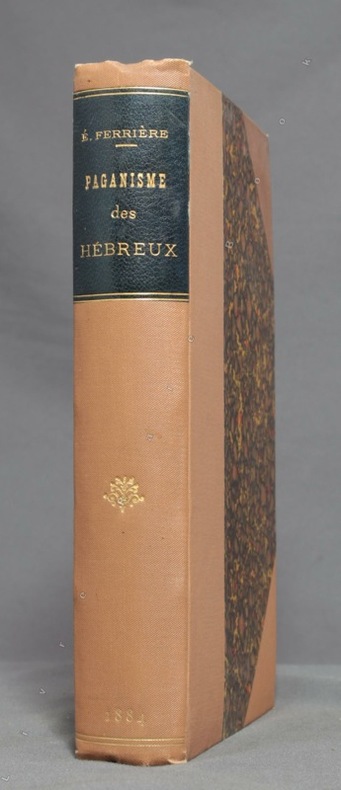
18849887Paris, Ancienne librairie Germer Baillière et Cie, Félix Alcan, 1884. In-12 de [4]-428 pages, demi-percaline tabac à coins, dos orné de filets, fleurons, date et titre dorés, étiquette de titre noire, couvertures conservées. Nom de possesseur sur la couverture, quelques rousseurs.