773 résultats
Full leather boards with five raised bands. Rear board is detached but present. Boards are very worn. Small former owner's plate to front inner cover. A few doodles in faded ink to first few blanks. Ffep has small 2 cm closed tear. Tiny upper corner of titlepage torn. Minor dampstaining to titlepage. Minor age-toning. Internally VG. ; IX, [1], 346, [16] pp; 346 pages
Skrifter Utgivna Av Svenska Institutet I Athen / Acta Instituti Atheniensis Regni Sueciae, Series in 8°, XIX; 421 pages; The focus of this book is the reconstruction of the mythicoritual nexus in Kios in Mysia through the in-depth investigation of the evidence (surviving in accounts by, and so shaped by the filters of, outsiders) and also of other issues implicated in its Problematik: ethnicity, cultural and religious interactions between Greeks and non-Greeks, colonial discourses (with special emphasis on the foundation mythopea of Kios’ mother city, Miletos) , the nature and functions of the Nymphs, the different personalities of Dionysos, advent festivals, certain problematic categories of cult recipients. Hylas’ myth and ritual had been constructed, through complex interactions between several mythicoritual schemata and included also elements that appear in non-Greek nexuses located in the area of Kios. The myth was both a foundation myth constructing cultural continuity with the heroic age and an immortalization myth: a Greek youth was abducted by Nymphs and became a diety rooted to the landscape and symbolically rooting the colony to the land; it established a poliouchos figure unique to Kios, connected Herakles with the city’s foundation, and articulated a relationship of cooperation and integration between Greeks and Non-Greeks. A ritual celebrated Hylas’ advent and commemorated the events that had led to Kios’ foundation, articulating a cooperative relationship between Greeks and locals.
Scholar's initial to inner cover (Jenifer Neils). Else minor shelfwear. ; 9.5 X 6.3 X 1.4 inches; 476 pages
Front upper corner bumped and a bit creased. Else light shelfwear. ; Religions in the Graeco-Roman World; 473 pages; The Early Amazons offers a new understanding of the ancient Amazon myth, situating mythical representations in the realm of cultural history. The first section examines how the Amazons have presented a challenge to views on history, myth and gender in classical mythology from the late eighteenth century up to the impact of structuralism. Topics included are nineteenth-century historiography and the interest in linguistics. The second section sheds new light on the culture of archaic Greece, offering a coherent assessment of literary and visual representations. Taking mythical narrative as a form of oral storytelling, it shows the emergence of the Amazon motif and its meaning in the world of epic. Iconographical analysis reveals how the visual arts have made a contribution of their own to the imaginary presence of the Amazons.
Minor creasing and edgewear to DJ. Very light wear to book. ; Religions in the Graeco-Roman World; 473 pages; The Early Amazons offers a new understanding of the ancient Amazon myth, situating mythical representations in the realm of cultural history. The first section examines how the Amazons have presented a challenge to views on history, myth and gender in classical mythology from the late eighteenth century up to the impact of structuralism. Topics included are nineteenth-century historiography and the interest in linguistics. The second section sheds new light on the culture of archaic Greece, offering a coherent assessment of literary and visual representations. Taking mythical narrative as a form of oral storytelling, it shows the emergence of the Amazon motif and its meaning in the world of epic. Iconographical analysis reveals how the visual arts have made a contribution of their own to the imaginary presence of the Amazons.
Minor creasing to wraps. ; 2 vol. (XXI-282 p. , 112 pp of pl. + 15 p. -[1] foldout ) La présente étude comporte une analyse des vestiges architecturaux du théâtre de Délos, une nouvelle publication des passages des comptes des gestionnaires de la caisse sacrée concernant sa construction et son entretien, enfin une synthèse sur les concours qui y étaient célébrés. Elle permet de restituer l’évolution du projet et les étapes du chantier entre la fin du ive siècle et les environs de 240 avant J. -C. , de préciser les modes de mise en scène des spectacles à l’époque hellénistique. Elle conduit aussi à cerner la place du monument dans l’architecture et l’urbanisme déliens. Le théâtre de Délos, qui associe des gradins en demi-cercles outrepassés et un bâtiment de scène à proskènion et skènè avec un étage à front percé de larges baies, est tributaire des édifices réalisés à Athènes puis à Épidaure. Certains de ses dispositifs se rencontrent uniquement dans les Cyclades, à Cos et sur une courte frange de la côte occidentale de l’Asie Mineure. ; Exploration Archéologique De Délos. XLII
Creasing to upper corner of front wrap. Laminate lifting along lower edge. Crease to spine. Minor shelfwear. ; L’histoire de Délos à l’époque classique est indissociable de celle d’Athènes : depuis la fondation de la Ligue de Délos en 478, les Athéniens sont les administrateurs du sanctuaire d’Apollon délien et, si la cité de Délos se maintient au cours des Ve et IVe siècles, ce n’est que dans l’orbite d’Athènes qu’elle peut exister. L’histoire de Délos classique se laisse essentiellement appréhender par les inscriptions et plus particulièrement les actes administratifs athéniens du sanctuaire d’Apollon délien. Convergeant avec les sources littéraires et archéologiques, ces textes épigraphiques permettent de définir précisément le statut de l’île de Délos, mais également de mettre en évidence la progressive élaboration, par l’autorité athénienne, d’un système administratif, financier et économique qui, parallèlement à la construction idéologique et religieuse élaborée par Athènes dans le cadre de sa politique impérialiste, rend compte des innovations introduites en Égée au cours de la période classique. ; Bibliothèque Des Écoles Française D'Athènes Et De Rome. BEFAR 331; 588 pages
Scholars' bookplate and former owner's name to inner cover. Top of spine and corners slightly bumped. Minor edgewear to extremities. Light soiling to back board. ; Contents: Part I. The Rise and Triumph of Astrology in the Latin world: I. Rise of Astrology in the hellenistic world; II. Conversion of republican Rome to astrology (250-44 BC) ; III. Astrologers - the power behind the throne, from Augustus to Domitian; IV. Astrology in Rome from Nerva to the death of Severus Alexander (96-235) ; Part II. Astrology in Roman Law until the End of the Principate: V. Expulsion of astrologers from Rome and Italy; VI. Empire wide legal restrictions of astrology and other divination during the principate. ; 291 pages
Very minor shelfwear to book and DJ. ; The first English volume dedicated specifically to the topic of aniconism in Greek antiquity since 1903 Challenges the perception and place of non-figural objects in Greek religious art and is likely to become the standard work on the subject of Greek aniconism Fully illustrated throughout with 94 in-text illustrations; Oxford Studies In Ancient Culture & Representation; 9.8 X 7.5 X 0.9 inches; 456 pages
Minor creasing to foreedges of wraps. ; Antiqua Picard; 10.9 X 8.7 X 1.0 inches; 303 pages
181041291810 1810 Charles Barrois, Paris, 1810. Edition originale. In-12 plein cartonnage vert, titre au dos, [1f.] blanc, faux-titre, page de titre, XXX, 166 pages, [1f.] blanc, plein complet des 54 hors texte en couleurs sous serpentes. Un cahier détaché mais présent. Plats et coins frottés. Bon exemplaire néanmoins, intérieur frais.
Unwrapped in plastic. ; Culture and History of the Ancient Near East; 11.25 x 1 x 8.5 Inches; 438 pages; This volume explores the Iron Age Phrygian rock-cut monuments in Anatolia and defines their role in religion. Among other features this book questions the traditional view of the Mother goddess Kybele being the only Phrygian deity. A detailed analysis based on the monuments provides new interpretations and aspects of Phrygian religion: the Mother goddess was not alone, but rather accompanied by a Superior male god. For the first time all known Phrygian rock-cut monuments are brought together in the useful corpus with plenty of illustrations. It is a unique and significant contribution to the study of Phrygian religion and spatial conceptualization and is useful both for those interested in Anatolian culture and archaeology but also in fields such as classical religion and archaeology.
Minor shelfwear. Scholars' bookplate to inner cover (Slater & Dunbabin). ; Potsdamer Altertumswissenschaftliche Beitrage (Pawb) Band 2; 631 pages
Former owner's name on ffep. Very light foxing to textblock. Very light shelfwear. ; 3 main sections: Poine in Homer; Poine from Homer to Dracon; Poine in Attic Tragedy. ; 427 pages
Gift inscription from author to E. W. Handley. Light rubbing to boards. ; Monographs in Classical Studies; 259 pages; Signed by Author
Minor creasing to spine. Light shelfwear. ; Skrifter Utgivna Av Svenska Institutet I Athen / Acta Instituti Atheniensis Regni Sueciae, Series in 4°, XXXVIII; 303 pages; The purpose of the Fifth International Symposium at the Swedish Institute at Athens, the papers and discussions of which are contained in this volume, was to initiate a discussion of the various phenomena characteristic of Greek cult practice of the pre-Hellenistic periods, ranging from sacrifice and libations to the handling of cult images and the placing of votive gifts in a sanctuary. It was planned as a cross-discipline symposium so as to allow the problems to be addressed by scholars from diverging points of view, by diverse methods and on the basis of the available evidence, be it archaeological, architectural, iconographical, literary or epigraphical. We also invited an anthropologist, Professor W. Arens, of the State University of New York at Stony Brook, in order to put Greek cult practice in the more general perspective of cultural anthropology. These efforts notwithstanding, it proved impossible to even touch upon all relevant aspects of the topic within the limited time of three days of sessions (and a one day field-trip). The result was a concentration of papers and discussions on a few central phenomena, such as animal sacrifice, votive offerings and ritual meals, and a number of single contributions dealing with a wide range of other aspects. It is our hope that the proceedings will inspire further research in this fascinating field. Robin Hägg
Slight colour fading to part of rear panel. ; Brill's Companions To Classical Studies; 9.7 X 6.5 X 1.2 inches; 454 pages
DJ Spine is sunned and very discolored. Very light shelfwear to book. ; This book offers a series of in-depth studies of the beliefs, attitudes, and rituals surrounding death in ancient Greece, from the Minoan and Mycenean period to the end of the classical age. Drawing on a wide range of evidence--from literary texts, to inscriptions, to images in art--Sourvinou-Inwood sheds light on many key, still problematic, aspects of Greek life, myth, and literature. She also looks at the problem of "reading" this material within the context of our own culturally-determined beliefs. ; 512 pages
E Ex-library copy with usual stamps, call numbers and pocket. Front hinge cracked but holding. Minor rubbing to boards. ; This book is about Roman religion in the age of Caesar, beginning with the ancestral cults of the Gens Julia at Bovillae and ending with the new cult of Divus Julius all over the Roman Empire. It deals with the old gods, politico-religious ideas, and ruler cult. Caesar is at the centre, as religious reformer rather than modern rationalist. This aspect of him, though remote and unfamiliar, rounds out the portrait of Caesar as the founder of the Empire of which one may get an occasional glimpse in the later writings of Mommsen but which has since been too seldom presented. ; 490 pages
New in plastic wrapping; Religions in the Graeco-Roman World, 157; 9 x 2.5 x 5 Inches; 447 pages; This study deals essentially with the knowledge of the Palestinian Rabbis concerning paganism in the days of Mishna and Talmud. The Late Professor Saul Lieberman wrote that "Many isolated items on idolatry and idol worshippers are scattered all over rabbinic literature. It would require a large volume to treat this topic". This valuable and exhaustive study proves methodically that the Rabbis had deeper knowledge about Syrian, Arabian, Anatolian and Graeco-Roman Pagan cults than is commonly believed. Clear, accessible and displaying considerable scholarship this work will undoubtedly provide an important challenge to both historians, archaeologists, and scholars of Rabbinic texts. Cette étude traite essentiellement du niveau de connaissances des Rabbins de Judée et de Galilée concernant les cultes païens dans le sens le plus large du terme. Le Professeur Saul Lieberman affirmait : "Many isolated items on idolatry and idol worshippers are scattered all over rabbinic literature. It would require a large volume to treat this topic" Ce travail exhaustif, à travers l’ensemble du corpus talmudique et au regard de la réalité historique propre à la Palestine romaine, montre méthodiquement que les connaissances des Sages, tant sur les divinités du paganisme que sur des rites syriens, arabes, anatoliens voire gréco-romains, étaient bien plus vastes et approfondies, que ce qu’il est communément admis aujourd’hui par la recherche historique. De part sa clareté et son accessibilité, ce livre intéressera aussi bien les historiens du peuple juif, que ceux des religions antiques. Les archéologues, les historiens du Levant à l’époque romaine, ainsi que les spécialistes de la littérature talmudique y trouveront également un vif intérêt en vertu de son aspect extrêmement novateur.
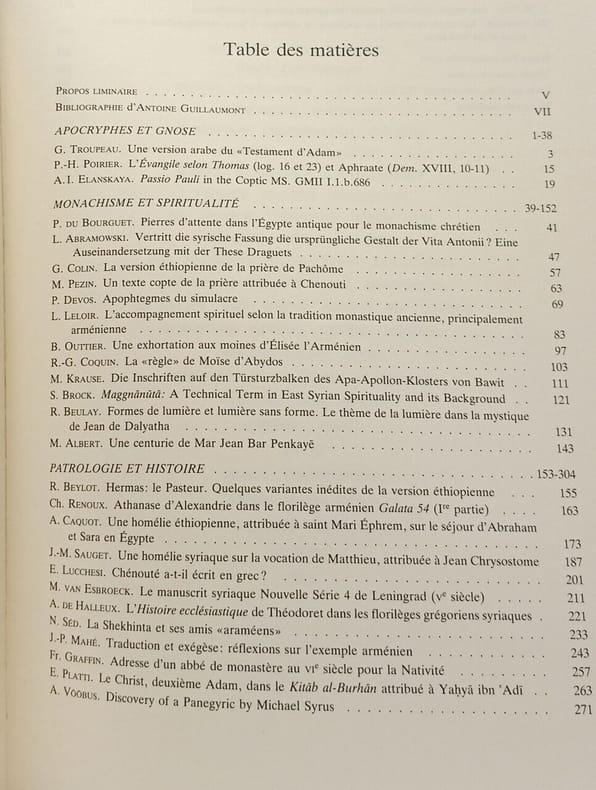
1988100150220Patrick Cramer Editeur 1988 in4. 1988. Cartonné.
Upper corners a bit bumped. Lower corners slightly edgeworn. Minor darkening to boards. Very minor bumping along top edges. ; 545 pages
Corners are bumped. Pen lines to margins on about 9 pages. Pencil markings on 2 other pages. Small chip to one corner of DJ. Dustjacket has minor shelfwear and rubbing. Writing in pencil to front DJ flap. ; 236 pages; In antiquity a considerable number of books of prophecies went under the general title of "Sibylline Oracles". Rulers as significant as Augustus consulted them in time of danger or crisis for advice and prognoses. Increasing numbers of "ex post facto" prophecies, laying a particular interpretation on facts of recent history, came to be attributed to one of the mysterious Sibyls. Perhaps the most famous of these is the Cumaean Sibyl, who guides the hero in the sixth book of Vergil's "Aeneid" . In fact she was somewhat unusual in her similiarity to other oracular prophetesses, such as the Pythia. For where the latter prophesied in response to particular inquirers, one of the distinguishing characteristics of Sibyls was that they composed discursive verses for distribution to the world at large. This, Professor Parke's last book, which was virtually complete on his death in 1986, is an account of a subject both rarely treated in recent decades and difficult to access for all but the most expert. In its pursuit of the sometimes elusive Sibyls it ranges from Heraclitus to Eusebius, from Archaic Asia Minor to Christian Rome. This book should be of interest to undergraduates, postgraduates and academics of classics.
Stamp to half-title (Ter Recensie). Notes to rear inner cover in pencil. Light dust-soiling to top of textblock. ; 409 pages
Front free endpaper has been torn out. Former's owner's name to titlepage has been covered with white label. Pages tanned. DJ has minor shelfwear with a couple of tiny tears. ; Detailed commentary of the Theogony. ; 459 pages