773 résultats
Book has been rebound in maroon boards with dark red spine label. Pages browned. Pencilling to titlepage. A few pages are close to falling out. Contents a bit shaken. ; 534 pages
Titlepage loose but present. Last couple of pages are also loose but present. 1/4 leather boards. Boards edgeworn with boards a bit exposed to extremities. Scholars' bookplate to inner cover (Slater & Dunbabin). ; Handbuch Der Klassischen Altertumswissenschaft, Band, 5. Abeteilung 4; 612 pages
Scratches to back panel of DJ else fine. ; 192 pages; In the earliest extant works of Greek literature, Zeus reigns supreme in the Olympian hierarchy. However, scattered and scanty though they may be, there are allusions to threats of rebellion which challenge Zeus' supremacy. This book examines these passages, drawn from Homer, Hesiod and the Homeric Hymns, to offer some new interpretations. While focusing on the theme of cosmic/divine strife, it becomes clear that hints of lost legends underlie these texts. Tracing their hidden logic helps to improve our understanding of early Greek poetry.
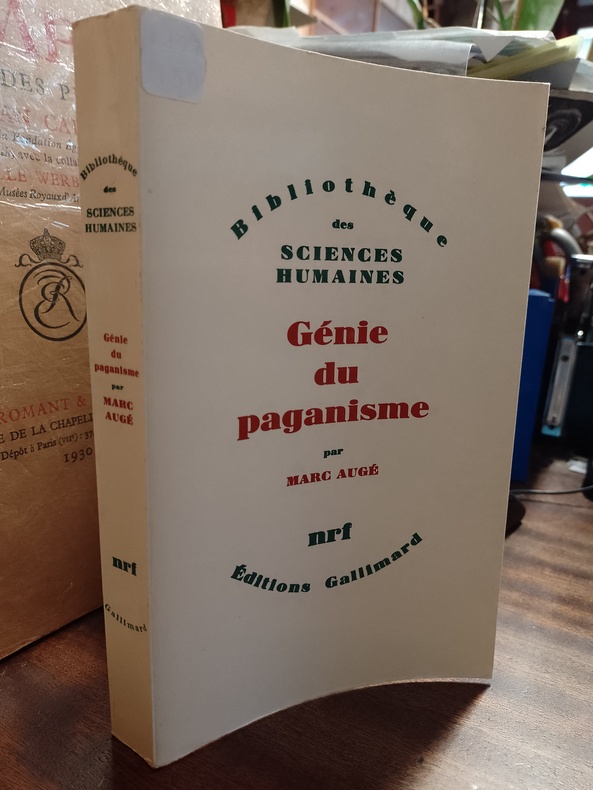
1982SHHHSSS300725Paris, Editions Gallimard, "Bibliothèque des sciences humaines", 1982, 14 x 22,5, 336 pages cousues sous couverture souple imprimée.
2000R101311Madrid, Revista Agustiniana 2000 486pp., 22cm., softcover, text in Spanish, in the series "Pensamiento" vol.5, very good condition, ISBN84-86898-78-1, R101311
486pp., 22cm., softcover, text in Spanish, in the series "Pensamiento" vol.5, very good condition, ISBN84-86898-78-1, R101311
2 volumes in-8°, 394-452p. belles et solides reliures demi-percaline à coins d'époque.- En très bonne condition. Tres bel ensemble, tres frais. [NV-40]
1882GITc606Paris Firmin Didot 1882. In-8 broché XVI 466pp. Orné de 160 figures dans le texte. Petit manque angulaire sur la couverture, quelques pâles rousseurs.
19585439New-York, Anchor, 1958 ; in-12, broché ; XXXIV, 363 pp. , couverture beige imprimée rouge et illustrée en couleurs.
1838A0211in-8 (10 cm X 17,5 cm), 290 pp, reliure pleine cuir, dos lisse, pièce de titre, ornements et titres dorés sur le dos, 3 tranches marbrées. Indication de livre de prix sur le 1er contre-plat (1er prix de récitation délivrée en 1849 dans la classe de 2dne du Collège de Valognes).
190011095S.l., s.n., s.d. (circa début XXe siècle) ; in-16, broché ; 15, (1) pp., couverture grise muette.
19401123Paris, PUF, 1940, in-12, broché, XX-130 pages.
Light bumping to base of spine. Minor shelfwear to DJ. ; Getty Trust Publications: J. Paul Getty Museum; 12.4 X 9.2 X 0.8 inches; 182 pages
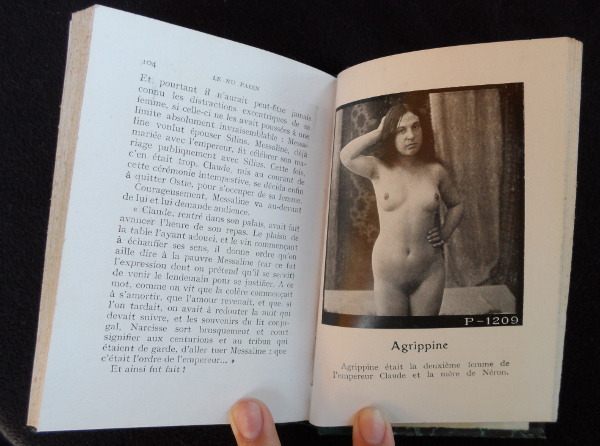
nu486Librairie d'art technique Academia Relié In-12 (10,5 x 15 cm.), relié demi-basane vert, 128 pages, titre doré au dos, tranches tachetées de rose, ouvrage documentaire illustré de 30 études de nu photographique noir et blanc en frontispice et dans le texte, sans date ; coiffes et mors très légèrement marqués, coins frottés, menus incidents aux plats, intérieur frais, bel état. Livraison a domicile (La Poste) ou en Mondial Relay sur simple demande.
Book is fine. DJ has 1 small tear (1 cm) to lower rear corner and very light shelfwear. ; This edited collection addresses the role of ritual representations and religion in the epic poems of the Flavian period (69-96 CE) : Valerius Flaccus' Argonautica, Silius Italicus' Punica, Statius' Thebaid, and the unfinished Achilleid. Drawing on various modern studies on religion and ritual, and the relationship between literature and religion in the Greco-Roman world, it explores how we can interpret the poets' use of the relationship between gods and humans, cults and rituals, religious activities, and the role of the seer / prophet and his identification with poetry. Divided into three major sections, the volume includes essays on the most important religious activities (prophecy or augury, prayers and hymns) and the relationship between religion and political power under the Flavian emperors. It also addresses specific episodes in Flavian epic which focus on religious activities associated with the dead and the Underworld, such as purification, necromancy, katabasis, suicide, and burial. It finally explores the role of gender in ritual and religion. ; 432 pages
Studien Der Skulpturhalle Basel, Heft 1; 86 pages
Small rubbed spot to DJ. Very faint shelfwear. ; Sonderbände Der Antiken Welt. Zaberns Bildbände Zur Archäologie; 4to 11" - 13" tall; 138 pages
Foxing to textblock and endpapers. Faint creasing to front wrap. ; 5.5 X 0.2 X 0.2 inches; 206 pages
Light Fading to letters on spine. Top corner is lightly bumped. ; Genius, appears in major Latin and vernacular works of the late Middle Ages. Originally a spirit or god that survived in Roman religion for at least seven centuries, its history and significance - religious, philosophical, and literary - have not previously been examined in detail; 0.79 x 9.23 x 6.23 Inches; 201 pages
Faint foxing to textblock. Boards a bit rubbed. 1 corner lightly bumped. ; The religious imagination of the Greeks, Robert Garland observes, was populated by divine beings whose goodwill could not be counted upon, and worshipers faced a heavy burden of choice among innumerable deities to whom they might offer their devotion. These deities—and Athenian polytheism itself—remained in constant flux as cults successively came into favor and waned. Examining the means through which the Athenians established and marketed cults, this handsomely illustrated book is the first to illuminate the full range of motives—political and economic, as well as spiritual—that prompted them to introduce new gods. ; 234 pages
Scholar's name to ffep (Jenifer Neils). DJ spine is sunned. Minor shelfwear to DJ. ; The religious imagination of the Greeks, Robert Garland observes, was populated by divine beings whose goodwill could not be counted upon, and worshipers faced a heavy burden of choice among innumerable deities to whom they might offer their devotion. These deities—and Athenian polytheism itself—remained in constant flux as cults successively came into favor and waned. Examining the means through which the Athenians established and marketed cults, this handsomely illustrated book is the first to illuminate the full range of motives—political and economic, as well as spiritual—that prompted them to introduce new gods. ; 234 pages
light shelfwear. ; Wisconsin Studies in Classics; 192 pages; This is the first book to show that the worship of heroines, as well as of gods and heroes, was widespread in the Greek world from the eighth through the fourth centuries B. C. Drawing upon textual, archaeological, and iconographic evidence as diverse as ancient travel writing, ritual calendars, votive reliefs, and Euripidean drama, Jennifer Larson demonstrates the pervasiveness of heroine cults at every level of Athenian society. Larson reveals that a broad range of heroic cults existed throughout the Greek world, encompassing not only individuals but couples (Pelops and Hippodameia, Alexandra and Agamemnon, Helen and Menelaos) and families such as those of Asklepios and the Dioskouroi. She shows how heroic cults reinforced the Greeks' gender expectations for both women and men through ritual status, iconography, and narrative motifs. Finally, Larson looks at the intersection of heroine cults with specific topics such as myths of maiden sacrifice, the Amazons, the role of the goddess Artemis, and folk beliefs about female "ghosts."
Very faint yellowing to upper edges of some pages. Faint edgewear to 1 corner. ; 82 pages
Spine is lightly faded. Former owner's signature on inner cover. ; 517 pages; Main theme of this book is an inquiry into the nature of the cultural and religious conflicts in the dark age of ancient Greece, out of which the historically known society emerged. Tackles a problem of immense importance to anthropology and literature: the origins of Greek drama.
Light fading to section of back board. DJ has edgewear and chipping. 3 cm tear to top of back panel of DJ. ; 517 pages; Main theme of this book is an inquiry into the nature of the cultural and religious conflicts in the dark age of ancient Greece, out of which the historically known society emerged. Tackles a problem of immense importance to anthropology and literature: the origins of Greek drama.