773 résultats
Faint yellowing to DJ. Very minor shelfwear to DJ. ; 10.6 X 7.9 X 1.0 inches; 264 pages
Very light shelfwear to book. Dustjacket has minor shelfwear and rubbing. DJ spine sunned. DJ is price-clipped. ; More perhaps than any other single writer, Plutarch has been responsible for transmitting to Europe the central historical and moral traditions of classical antiquity. His books have been a formative influence in western civilisation; they retain a direct appeal to which it is easy to respond. Mestrius Plutarchus (ca. 46- 127) was a Greek historian, biographer, and essayist. Born in the small town of Chaeronea, in the Greek region known as Boeotia, probably during the reign of the Roman Emperor Claudius, Plutarch travelled widely in the Mediterranean world, including twice to Rome. Due to his parents' wealth, after 67, Plutarchus was able to study philosophy, rhetoric, and mathematics at the Academy of Athens. He had a number of influential friends, including Soscius Senecio and Fundanus, both important Senators, to whom some of his later writings were dedicated. He lived most of his life at Chaeronea, and was initiated into the mysteries of the Greek god Apollo. However, his duties as the senior of the two priests of Apollo at the Oracle of Delphi (where he was responsible for interpreting the auguries of the Pythia or priestess/oracle) apparently occupied little of his time - he led an active social and civic life and produced an incredible body of writing, much of which is still extant. ; Classical Life and Letters; 183 pages
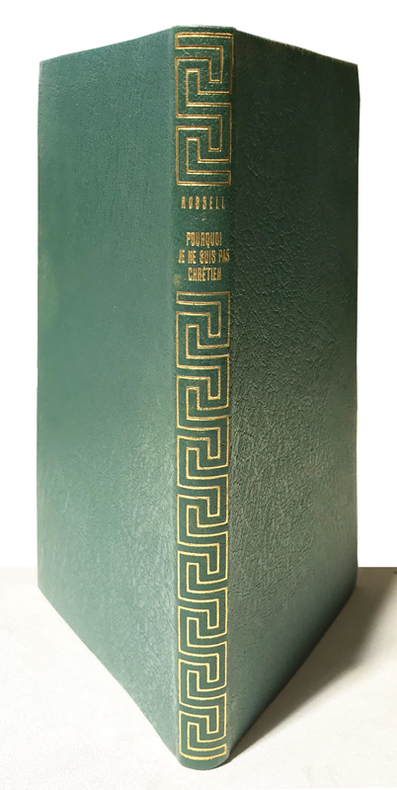
196014989Paris, Guilde Ernest Renan (Genève, Krundig), collection "Raison et Croyance" dirigée par le Professeur Louis Rougier, 1960 ; in-8, plein skinvertex vert, décor de grecque dorée au dos, titre doré (reliure éditeur) ; 380, (6) pp., imprimé sur vélin fin.
Bookplate on inner cover. 2 line note in ink on titlepage referencing additional work. No other markings in text. ; Reise Und Studium. ; 223 pages
Former classics scholar's bookplate on inner cover (D. M. Lewis). Very light shelfwear. ; Collection De La Maison De L'Orient Méditerranéen, No.8, Série Archéologique 6; 272 pages
Ex-library stamp to titlepage but no other markings. Endpaper has creasing and minor tears. Else VG. ; 463 pages
This study focuses on the "saucer pyres," a series of 70 deposits excavated in the residential and industrial areas bordering the Athenian Agora. Each consisted of a shallow pit, its floor sometimes marked by heavy burning, with a votive deposit of pottery and fragments of burnt bone, ash, and charcoal. Most of the pots were miniatures (including the eponymous saucers) but a few larger vessels were found, along with offerings associated with funerary cult. The deposits represent a largely Athenian phenomenon, with few parallels elsewherre. When first found in the 1930s, the deposits were interpreted as baby burials. Recent zooarchaeological analysis of the bones, however, reveals that they are the remains of sheep and goats, and that the deposits were sacrificial rather than funerary. The present study investigates the nature of those sacrifices, taking into account the contents of the pyres, their spatial distribution, and their relationship to buildings around the Agora and elsewhere. In light of a strong correlation between pyres and industrial activity, the author argues that the pyres document workplace rituals designed to protect artisans and their enterprises. ; Hesperia Supplement 47; 200 pages
9.3 X 6.2 X 0.8 inches; 212 pages
Light Edgewear to extremities. Small gold stamped stamped to front wrap. ; Harper Torchbooks; 312 pages
Edgewear to extremities. Chipping along spine ends. Former classics scholar's name on ffep (R. Shepherd). Light Pencil marginalia on a few pages. ; 312 pages
Former owner's name to titlepage. Rubbing has effaced most of lettering on spine. Else Fine. ; Reprint of 1898 Edition. ; 769 pages
Large stamp to verso of dedication page for the John Deyell company with number written in. Else book is fine. ; An important contribution to social history, linking the life and nature of the polis with its festivals and rituals and the legends which went with them and used for the elucidation of a state's self-identity. ; Phoenix Supplementary Volume; 1 x 9.5 x 6.5 Inches; 287 pages
Very light shelfwear else fine. ; An important contribution to social history, linking the life and nature of the polis with its festivals and rituals and the legends which went with them and used for the elucidation of a state's self-identity. ; Phoenix Supplementary Volume; 1 x 9.5 x 6.5 Inches; 287 pages
Large stamp to verso of dedication page for the John Deyell company with number written in. Else book is fine. ; An important contribution to social history, linking the life and nature of the polis with its festivals and rituals and the legends which went with them and used for the elucidation of a state's self-identity. ; Phoenix Supplementary Volume; 1 x 9.5 x 6.5 Inches; 287 pages
Edges and corners show some wear, though boards otherwise quite clean; spine slightly cocked, page ends bright. Intact dust jacket shows wear at all edges, small tears at upper and lower edges, piece of clear tape at bottom spine. Very young pic of Tom on back cover, smiling beside jester. Wrapped in protective jacket. Stated First Edition.
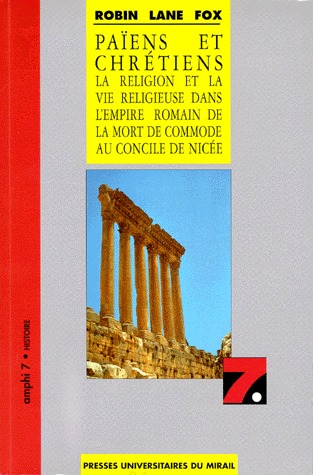
199703261Toulouse : Presses universitaires du Mirail, 1997. Fort in-8 (24 cm), couverture souple illustrée en couleur, cartes, 744 pages, 1188 gr.
Book is fine. DJ has very light shelfwear. ; xiii, 150pp.; The Transformation of the Classical Heritage 15; 150 pages
Dustjacket is protected in mylar. DJ is missing a small piece at spine. Bookplates of former owner; According to Riffert, the Great Pyramid was built by the biblical king Enoch, as 'God's Bible in stone'. As such, its measurements and construction are supposed to represent various messages about the nature of god and to prophesy key occurrences in the history of the world. I present a few of the events supposedly foretold (by an arcane and contrived method of taking dates from measurements of the turnings in the internal passageways of the pyramid) : * 4000 BC. The year of man's creation. Any evidence of man before this date must obviously be wrong, as unbiblical. * 2344 BC. The Great Flood. * Saturday October 6, 4 BC. Birth of Christ. * Friday April 7, AD 30. Death of Christ. * AD 1558. Start of the reign of Queen Elizabeth I. * 25 January, 1844. Amongst other items, the passing of the Bank Charter Act. * August 2, 1909. Czar of Russia met King Edward and inspected the Great Fleet at Clowes. * December 2, 1924. 'On this date the new English Parliament met for the first time, after the Labour Party Parliament, which resigned, had been in power only 286 days'. You would be entitled to think it a little odd that good King Enoch went to all that trouble to forecast a relatively minor date in British political history, but in Riffert's loopy worldview this is perfectly natural. For Riffert was one of the British-Israelites, who believed that the British were in fact the ten lost tribes of Israel, and hence God's Chosen People. Contents include: Great Pyramid and Modern Thought; World's Greatest Wonder; God's Bible in Stone; Modern Science of the Great Pyramid; Christ and Salvation of the Great Pyramid; Astronomical Timing of Man's Creation; Great Pyramid Versus Evolution; Great Pyramid and the Ten Lost Tribes of Israel; What the Great Pyramid Proves etc.. ; 233 pages
72952Paris, Casterman, 1953 15 x 21, 254 pp., broché, bon état (cachets de la bibliothèque du collège jésuite Saint Stanislas à Mons)
Very faint shelfwear. ; In this account, Alexandra Richardson reveals (as she says in her introduction) her quest to get to know a ‘remarkable man who wholly dedicated his later life and finances to restoring and excavating what is surely one of the finest classical Greek sites in the Western Mediterranean. I rapidly began to be drawn in to the sketchy, sometimes speculative, details surrounding the remarkable Captain Hardcastle…I thought back to his unlit villa beside the theatrically shining temples, and the more I got to know the man, the more it seemed entirely in keeping with his personality that his former home should still be not be sharing the spotlight with the great monuments he was so intimately involved with. He remained a mysterious and private person who kept his own counsel throughout life. I was to discover that he wrote very few letters home to his family from the Far East, South Africa, Italy. And when he did write to the chosen few, I had to learn to read between the lines. Luckily his own family wrote to one another making mention of him…With so little to go on, it was just the sort of challenge that a researcher relishes. The Anglo-Italian theme was yet another appeal, my instinctive habitat. No full-scale biography had ever been written about him and thus I was not stepping on any toes. I had the field all to myself, piecing together a profile from many sources, set largely in a period of modern Sicilian history, the 1920s and early ‘30s rarely “popularised” by foreign writers. That was all how the four-year journey began...’ 'This book is the labour of years of research and scholarship. In Alexandra Richardson's book, the personality of Alexander Hardcastle comes to life in all its many facets. Her detailed account of the history of Agrigento is historically correct and written in a fluid style. Her descriptions of Sicily are accurate and lyrical, her cameos of Sicilians witty and a pleasure to read. Richardson's rigorous research describes his painful and determined iter from London to Girgenti, his stubborness and his resilience.' - Simonetta Agnello Hornby, 'The Almond Picker' ; Archaeological Lives; 9.5 X 6.6 X 0.3 inches; 143 pages
1946986051946 Numéro 14 - Novembre 1946 - Rédaction de la Revue d'Information : Cabinet du Général Commandant Supérieur des T.O.A. - revue illustrée - broché - 64 pages
Former owner's name on ffep. Light bump to lower front corner else Fine. ; Facsimile of the 1926 Leipzig & Berlin edition; 2 Volumes in 1; 355 pages
Ex-library copy with usual stamps, call numbers and pocket. Stamp deletions on ffep, back inner cover and title-page with black marker. Rubbing to extremities. Colour loss along spine from previous removed call numbers (there are other call numbers on spine). Text is clean. ; With 192 illustrations of the tomb plans and types. The two maps show the Royal Cemeteries of the Abydos and the Saqqara Cemetery. This book was the first volume in Reisner's planned series on the Giza Necropolis. ; 428 pages
Former classics scholar's name on ffep (R. Shepherd). Pencil underlining on a few pages. Edgewear to extremities. Spine sunned. ; Study of mythology; 1.25 x 8.75 x 5.75 Inches; 449 pages