774 résultats
Former copy of Prof. J. F. Drinkwater. ; Classical Lives; 8.75 x 1 x 5.75 Inches; 249 pages
New English Paperback. Roy. 8vo. (24 x 17 cm). In French and Turkish. [xiv], 260 p. Journees Internationales d'Etudes sur l'Exotisme.= Uluslararasi Egzotizm Arastirma Günleri. Actes. 10-11 Mai 2007.
Light spotting to top of textblock. Very light shelfwear to DJ. Small knock to middle of foreedge of front board else Fine. ; 220 pages; John Lydus, a retired official at Justinian's court in the mid-6th century, is an important, neglected source for the study of the fate of the classical legacy in the newly Christianized Roman empire, Byzantium.<P>Examining his work <i>On Portents, On the Months</i> and <i>On Magistracies,</i> Michael Maas establishes Lydus as a credible witness to the political and cultural milieu in the age of Justinian--at the moment when the state re-historicized itself and its Roman legacy in Christian terms. Within a few generations, addressing antiquity from a non-Christian viewpoint would have been unthinkable. From his place on the edge of this shifting paradigm, Lydus' writings help us to see the emergence of medieval Byzantium through Roman eyes.
As New English Paperback. Pbo. Mint. Roy. 8vo. (23 x 16 cm). In Turkish. 196 p., color and b/w ills. Izmir'in Smyrna'si. Paleolitik Çagdan Türk fethine kadar.
New Persian Paperback. Roy. 8vo. (24 x 17 cm). Text is in entirely Persian with a bilingual title in English and Persian on cover. [10], 482 p. Islamic civilization in Abbasid's period.= Tamaddun-i Islâmî dar 'asr-i 'Abbâsiyân.
Mnemosyne, Bibliotheca Classica Batava Supplementum 115; 197 pages; Das Thema des Buches ist der Isiskult während der römischen Kaiserzeit, wie er in zahleichen Darstellungen der ägyptischen Göttin und solcher ihr angeglichener Frauen zum Ausdruck kommt. Während sich dadurch zum einen diese Frauen ganz allgemein als Dienerinnen der Isis zu erkennen geben, fällt zum anderen ein besonderes Licht auf die zur Angleichung ausgewählten Bilder der Göttin. Dabei handelt es sich, anders als bei den meisten bekannten Isistypen, um keine mythologisch erklärbaren Gottesbilder. Sie sind deshalb der Forschung ebenso rätselhaft geblieben wie die entsprechend angeglichenen und oftmals auch als Priesterinnen oder Mystinnen bezeichneten Frauen. Das Buch behandelt somit zwei Problemkreise, nämlich die Stellung jener Frauen im Kult sowie die damit verbundene Frage nach Sinn und Bedeutung der für die Angleichung verbindlichen Isisbilder. Das vorwiegend plastische Material ist in einem Katalog mit volständigem Abbildungsteil zusammengestellt. Auf dieser Basis bietet das Buch eine ikonographische und ikonologische Untersuchung des Themas. Die ausschliesslich in statuarischen Kopien überlieferten Isisbilder werden in angemessener Weise auf Originale hin rezensiert; die vorranging sepulkralen Darstellungen der Isisdienerinnen werden sowohl in quellenkritischer als auch archäologischer Hinsicht interpretiert. Daneben kommen auch religionsgeschichtliche Probleme zum Tragen. Ein längeres Exkurs am Ende des Buches ist der Frage nach der sozialen Stellung der Isisdienerinnen gewidmet.
Book has minor shelfwear. Old price sticker residue on ffep else unmarked. Dustjacket is a bit tatty with chipping and some small tears. ; Martin Classical Lectures 25; 157 pages
Very Good German Paperback. 4to. (29 x 21 cm). In German. [2], 579-624 pp., 43 unnumbered b/w plates, 2 color plates (Tafeln). Iran im Mittelalter (Sonderdruck aus Die Neue Propylaen-Weltgeschichte herausgegeben von Willy Andreas). Iran in the middle ages. Extremely rare. Only one copy in OCLC.
Former owner's name stamped to ffep and titlepage (James Fitton). Minor shelfwear. Pencil notes to about 10 pages of text. ; Greek Text with Latin introduction. Xlvi, 202 Joannes Laurentius Lydus was an early Byzantine administrator and writer on antiquarian subjects. During his retirement he occupied himself in the compilation of works on the antiquities of Rome, three of which have been preserved. ; Bibliotheca Scriptorum Graecorum Et Romanorum Teubneriana TEUBNER; 183 pages
Faint foxing to textblock. Boards a bit rubbed. 1 corner lightly bumped. ; The religious imagination of the Greeks, Robert Garland observes, was populated by divine beings whose goodwill could not be counted upon, and worshipers faced a heavy burden of choice among innumerable deities to whom they might offer their devotion. These deities—and Athenian polytheism itself—remained in constant flux as cults successively came into favor and waned. Examining the means through which the Athenians established and marketed cults, this handsomely illustrated book is the first to illuminate the full range of motives—political and economic, as well as spiritual—that prompted them to introduce new gods. ; 234 pages
Scholar's name to ffep (Jenifer Neils). DJ spine is sunned. Minor shelfwear to DJ. ; The religious imagination of the Greeks, Robert Garland observes, was populated by divine beings whose goodwill could not be counted upon, and worshipers faced a heavy burden of choice among innumerable deities to whom they might offer their devotion. These deities—and Athenian polytheism itself—remained in constant flux as cults successively came into favor and waned. Examining the means through which the Athenians established and marketed cults, this handsomely illustrated book is the first to illuminate the full range of motives—political and economic, as well as spiritual—that prompted them to introduce new gods. ; 234 pages
Very light edgewear along top of DJ. ; 9.3 X 6.2 X 1.0 inches; 316 pages
Very Good French Paperback. Some markings and underlined sentences on text. Large Roy. 8vo. 19 p. In French. Influence du Chamanisme Turco-Mongol sur les ordres mystiques Musulmans.
Very Good French Paperback. Large Roy. 8vo. (25 x 18 cm). In French. 19 p. Influence of Turco-Mongol Shamanism on Muslim mystical orders.
This study focuses on the "saucer pyres," a series of 70 deposits excavated in the residential and industrial areas bordering the Athenian Agora. Each consisted of a shallow pit, its floor sometimes marked by heavy burning, with a votive deposit of pottery and fragments of burnt bone, ash, and charcoal. Most of the pots were miniatures (including the eponymous saucers) but a few larger vessels were found, along with offerings associated with funerary cult. The deposits represent a largely Athenian phenomenon, with few parallels elsewherre. When first found in the 1930s, the deposits were interpreted as baby burials. Recent zooarchaeological analysis of the bones, however, reveals that they are the remains of sheep and goats, and that the deposits were sacrificial rather than funerary. The present study investigates the nature of those sacrifices, taking into account the contents of the pyres, their spatial distribution, and their relationship to buildings around the Agora and elsewhere. In light of a strong correlation between pyres and industrial activity, the author argues that the pyres document workplace rituals designed to protect artisans and their enterprises. ; Hesperia Supplement 47; 200 pages
Scholars' bookplate to inner cover (Slater & Dunbabin). Some discoloration to wraps. 1 faint crease to wraps. ; Studies in Greek and Roman Religion, Vol 6; Vol. 1; 267 pages; This is the first of a two-volume collection of studies in inconsistencies in Greek and Roman religion. Their common aim is to argue for the historical relevance of various types of ambiguity and dissonance. The first volume focuses on the central paradoxes in ancient henotheism. The term "henotheism" - a modern formation after the stereotyped acclamation: #EIS O QEOS# ("one is the god"), common to early Christianity and contemporaneous paganism - denotes the specific devotion to one particular god without denying the existence of, or even cultic attention to, other gods. After its prime in the 1920s and 1930s the term fell into disuse. Nonetheless, the notion of henotheism represents one of the most remarkable and significant shifts in Graeco-Roman religion.
Faint creasing to wraps at corners. ; Isbn: 9090236791 Text in English; summary in Dutch. ; Proefschrift (Diss. ) ; 339 pages; Elagabalus (218-222 AB) is one of the most peculiar emperors to have occupied the Roman throne. During his short reign, this remarkable ruler carried through some unprecedented reforms in Roman state religion. He put Elagabal, the sun god of the Syrian town of Emesa, at the head of the Roman pantheon and presented himself as the god's high priest on coins and in inscriptions. In March 222 AD, Elagabalus was killed by praetorians, His memory was condemned by the senate, his images destroyed...Images of Elagabalus attempts to reconstruct and explain the events of the period, in partuclar the elevation of Elagabal to supreme Roman deity. Consequently, it looks at the different images of the priest-emperor which have been generated throughout the ages; first by the imperial administration itself, then by ancient and Byzantine authors, and finally by scholars, literary authors and artists from the Renaissance up to the present.
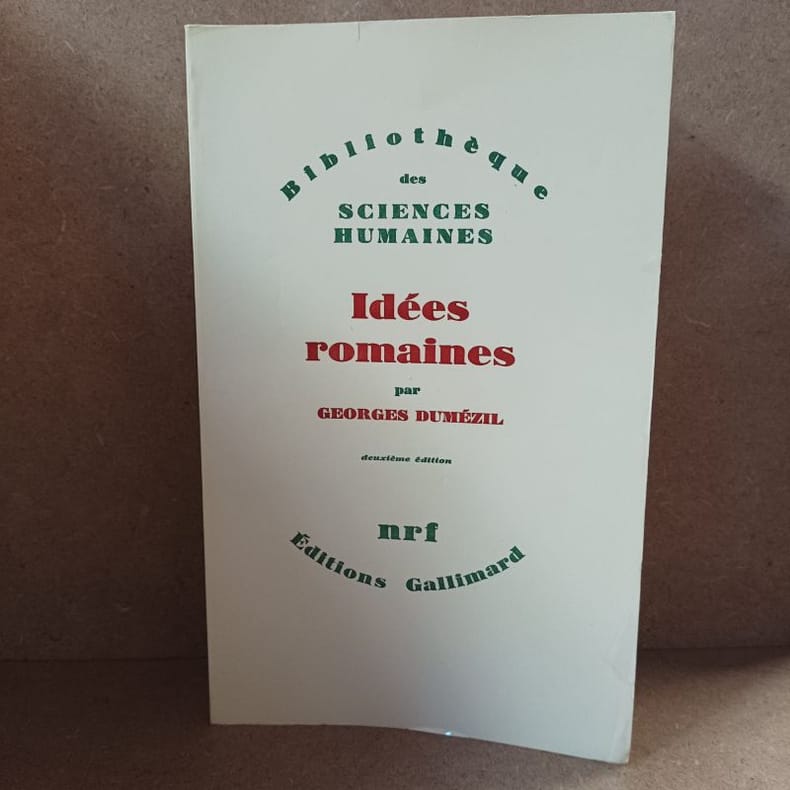
19797421979 - broché - Editions Gallimard NRF - Collection "Bibliothèque des sciences humaines" - 1979 - In-8 (22,5 x 14 cm) broché - 306 pages
Faint creasingn to corners. Tiny chip to upper edge. Tear to upper corner (3 cm) of half-title. Scholar's name to ffep (J. F. Drinkwater). ; Bibliothèque De La Faculté De Philosophie Et Lettres De L'Université De Liège; 378 pages
30058P., Radot, 1927, in 12 broché, 192pp. ; non coupé.
Scholars' bookplate to inner cover (Slater & Dunbabin). Slight creasing to wraps. One small tear to wraps (1 cm). ; Studi Ellenistici VII; 230 pages
Ex-library copy with usual stamps, call numbers and pocket. Traces of circulation page to ffep. Else book is Very Good. ; Indice: I culti egizi: Esame dei documenti, Conclusioni; I culti dell'Asia Minore: Cibele e Attis, Sabazio; Il culto di Mithra; Il Culto della Dea Syria. ...; Études Préliminaires Aux Religions Orientales Dans L'Empire Romain; 338 pages
1962100833Robert Morel, impr. Gouin et Vitrant, à ézanville 1962 In-8 20 x 13 cm. Reliure éditeur pleine toile beige, titre en noir sur le dos, contreplats et pages de garde dorés, 8 illustrations en noir & blanc hors-texte, premier plat orné dune vignette contrecollée, 277 pp.,hymnes et prières, index, bibliographie, table des illustrations, table générale. Exemplaire en bon état sur offset d’Arjomari.
Skrifter Utgivna Av Svenska Institutet I Athen / Acta Instituti Atheniensis Regni Sueciae, Series in 8°, XIX; 421 pages; The focus of this book is the reconstruction of the mythicoritual nexus in Kios in Mysia through the in-depth investigation of the evidence (surviving in accounts by, and so shaped by the filters of, outsiders) and also of other issues implicated in its Problematik: ethnicity, cultural and religious interactions between Greeks and non-Greeks, colonial discourses (with special emphasis on the foundation mythopea of Kios’ mother city, Miletos) , the nature and functions of the Nymphs, the different personalities of Dionysos, advent festivals, certain problematic categories of cult recipients. Hylas’ myth and ritual had been constructed, through complex interactions between several mythicoritual schemata and included also elements that appear in non-Greek nexuses located in the area of Kios. The myth was both a foundation myth constructing cultural continuity with the heroic age and an immortalization myth: a Greek youth was abducted by Nymphs and became a diety rooted to the landscape and symbolically rooting the colony to the land; it established a poliouchos figure unique to Kios, connected Herakles with the city’s foundation, and articulated a relationship of cooperation and integration between Greeks and Non-Greeks. A ritual celebrated Hylas’ advent and commemorated the events that had led to Kios’ foundation, articulating a cooperative relationship between Greeks and locals.
Faint foxing to top of textblock. Scholar's bookplate to inner cover (G. P. Goold). Very light shelfwear to DJ. ; Numerous ancient texts describe human sacrifices and other forms of ritual killing: in 480 BC Themistocles sacrifices three Persian captives to Dionysus; human scapegoats called pharmakoi are expelled yearly from Greek cities, and according to some authors they are killed; Locrin girls are hunted down and slain by the Trojans; on Mt Lykaion children are sacrificed and consumed by the worshippers; and many other texts report human sacrifices performed regularly in the cult of the gods or during emergencies such as war and plague. Archaeologists have frequently proposed human sacrifice as an explanation for their discoveries: from Minoan Crete children's bones with knife-cut marks, the skeleton of a youth lying on a platform with a bronze blade resting on his chest, skeletons, sometimes bound, in the dromoi of Mycenaean and Cypriot chamber tombs; and dual man-woman burials, where it is suggested that the woman was slain or took her own life at the man's funeral. If the archaeologists' interpretations and the claims in the ancient sources are accepted, they present a bloody and violent picture of the religious life of the ancient Greeks, from the Bronze Age well into historical times. But the author expresses caution. In many cases alternative, if less sensational, explanations of the archaeological are possible; and it can often be shown that human sacrifices in the literary texts are mythical or that late authors confused mythical details with actual practices. Whether the evidence is accepted or not, this study offers a fascinating glimpse into the religious thought of the ancient Greeks and into changing modern conceptions of their religious behaviour.; 8.8 X 5.7 X 1.3 inches; 316 pages