[MINIATURE - GERMAN].Biblio.com
2 résultats
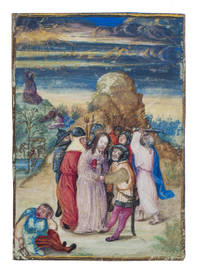
152082NHM8O8K9DUFlanders Bruges or Nürnberg 1520. Miniature painted on vellum 7.8 x 5.6 cm in numerous colours highlighted with gold and in a gold border probably from a book of hours but with no text. A finely rendered miniature showing great detail in bright colours highlighted with gold depicting the Arrest of Christ most likely from a diminutive book of hours. Surrounded by a bustling throng of Roman soldiers carrying spears and wearing halberds Christ appears calm just at the moment when a soldier takes him captive. An elder of the Jewish Temple stands directly behind him dressed in red. To the right stands Simon Peter sword raised having cut off the ear of the High Priest's servant Malchus who sits nursing his bleeding ear in the lower left corner of the composition. An earlier episode Christ's Agony in the Garden of Gethsemane when he learns that one of his disciples will betray him appears in the background at left. A genre scene with men working the fields and crossing a river on a narrow plank bridge occupies the middle ground to the left of the main scene and the towers of a castle or city the middle ground to the right.The general style recalls the art of the last generation of Ghent-Bruges painters especially that of the famed Simon Bening. Though the anonymous artist owes much of his style to Bening's model he was most likely German. The acidic palette bright yellow juxtaposed with blue and lime green and the facial types remarkably expressive even at this tiny scale recall Nürnberg painters in the circle of Glockendon. It is worth remembering that Bening himself collaborated with several Nürnberg painters whose presence in Flanders is thus confirmed.With some fine superficial cracks and an occasional tiny abrasion mostly near the edges but generally in good condition. A lovely miniature of Christ's arrest rendered in remarkably fine detail.l For the general style: U. Merkl Buchmalerei in Bayern in der ersten Hälfte des 16. Jahrhunderts 1999. hardcover
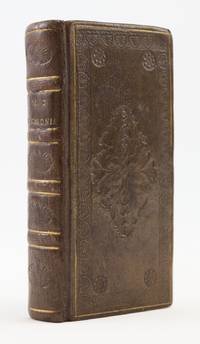
1515ST19567-062Venezia Venice: Alessandro Paganini 1515. 98 x 50 mm. 3 7/8 x 2". 3 p.l. CXXXII leaves. <br/> Early 19th century olive brown calf decorated in blind raised bands gilt lettering red morocco label marbled endpapers. Front flyleaf with mostly effaced ownership signature. Brunet II 21-22 "very rare"; EDIT16 CNCE 14575; USTC 822101. Two very small portions of lost patina minor signs of wear to the leather gilt on label not especially bright but the binding entirely solid and perfectly inoffensive. The first three leaves a little browned and with a dampstain in the top few lines other trivial imperfections but the text generally very clean and fresh.<br/> <br/> Small enough to fit into the palm of a hand this printing of five popular treatises by Cicero exemplifies three of printer Alessandro Paganini's innovations: the vigesimo-quarto or 24mo book a typeface that's a blend of italic and roman and the concept of a publishing series. The son of Venetian printer Paganino Paganini Alessandro fl. 1509-38 sought to outdo rival Aldus Manutius in the production of small format versions of classics as well as cursive-style typefaces. In 1515 he began producing a series of books in 24mo beginning with Dante and Petrarch and continuing with a mix of Classical and Italian authors. The Oxford Companion to the Book declares his books "visually splendid if not always easy on the eye"; that seeming contradiction is demonstrated by the text here a very elegant semi-italic that perhaps is not as easy to read as a simple roman serif--but worth the effort for the beauty. Offered in the most portable form available in the 16th century our volume contains Cicero's essays on moral responsibility friendship old age paradoxical Stoic aphorisms and the dream vision of Scipio. The diminutive size that makes this edition--and other books in this series--so appealing also makes them scarce since small books like other objects no bigger than a mouse tend to be easy to lose. Works from Paganini's series of 24mos are quite scarce in the market and we could trace no copies at all of the Cicero in RBH or ABPC. OCLC and USTC between them find just seven copies of the Cicero in libraries none in North America. Alessandro Paganini unknown