53 résultats
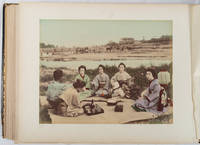
1890215089Japan. Circa 1890s. 50 hand-tinted albumen prints 30 captioned with studio stock references mounted on thick gilt-edged card leaves19.5 x 25 cms in an album 27.5 x 35 cms; elaborately lacquered boards scuffed and chipped inlaid with mother of pearl with loss over quarter calf renewed bevelled edges gilt dentelles endpapers gilt-flecked some fading and spotting to the images and toning to the margins of the card leaves but a very good handsomely bound collection.<P> Beautiful studio album containing a collection of 50 hand coloured photos of Japan with a splendid lacquered and decorated cover. The photos were commercially produced images which were sold to foreign visitors who had the studio place photographs in an album of their choice. This album is unusually interesting because unlike many where photographs were more randomly placed the images have been selected and arranged geographically beginning in Tokyo and moving southwards: Nikko Yokohama Miyanoshita & Hakone Lake Mount Fuji Kyoto Osaka Kobe and Nagasaki. <br> <br>There are fine images and portraits of geisha including an uncaptioned image of geisha seated possibly by the Kamo River in Kyoto entertaining a male guest. A lute is placed on the rice mat together with a tray of beer. One of the geisha is looking straight to camera a striking composition. Another uncaptioned in the Kyoto group is likely to be in Arashiyama shows a sandalled figure on a mountain path overlooking the leisure boating below. <br>There are also images of pagoda fishing rice planting street vendors and markets. <br> <br>More than half the photographs appear to be from the studio of the Yokohama based photographer Tamamura Kozaburo c.1856-192 who at his height was described as "the best photographer in Yokohama". As Terry Bennett has attested Tamamura's business strategy of selling souvenir albums of views and costumes to foreigners became a "winning formula". see Terry Bennett "Early Japanese Images" Tuttle 1996 and "Photography in Japan 1853-1912" Tuttle 2006<P> <b>When referring to this item please quote stockid 215089</b> . hardcover
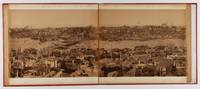
189054541Constantinople: Sebah & Joaillier 1890. First edition. Hardcover. vg- to vg. Oblong small folio. 12 1/4 x 14 1/4". Red pebbled cloth boards with decorative gilt ruling tooling and lettering on the covers. Rebacked maroon leather spine. Gilt-stamped crescent moon and star motif the national emblem of Turkey on the back cover.<br /> <br /> Taken from the Galata Tower in what is now the Karaköy neighborhood of Istanbul this magnificent panorama displays the skyline and cityscape of Constantinople as it appeared sometime in the late 1880s or early 1890s. The panorama is comprised of 10 original albumen photographs mounted on heavy card stock and bound together in accordion style leporello measuring a total of more then 11 feet when completely unfolded. Shot in a southwardly direction the viewer can see Galata Karaköy in the foreground and from left to right across the Bosporus to the Uskudar district on the Asian side and then across the harbor at the mouth of the Golden Horn the Galata Bridge and across to the Pérama neighborhood and the Faith district where many famous landmarks of the city can be seen including the New Mosque Topkapi Palace Hagia Sophia and many others. Each panel measures about 13" wide and 12" tall.<br /> <br /> The photography is credited to "Sebah & Joaillier" one of the most prominent and prolific photography studios of Ottoman Empire during the second half of 19th century. Originally founded sometime around 1857 in Instanbul by Syrian-Armenian photographer Pascal Sebah 1823-1886 the studio was one of the earliest in the city and all of Ottoman Turkey. By the 1870s Sebah had become among the most prominent Ottoman photographers having also opened a branch of the studio in Cairo. Upon Sebah's death in 1888 the firm was taken over by his 16 year-old son Jean Pascal Sebah who then partnered with photographer Policarpe Joaillier 1848-1904. The firm was renamed "Sebah & Joaillier". Therefore although this panorama is undated it could not have been issued earlier than 1888; most likely sometime shortly thereafter circa 1890.<br /> <br /> Spine of of the portfolio has been professionally re-backed. Plates with minor to light foxing although the images are still quite clean and vibrant. Binding in very good images in very good- to very good condition overall. A slightly later version of the panorama from Sebah & Joaillier simply titled "Constantinople" is comprised of 12 slightly smaller panels instead of 10 and measures around the same size in total.<br /> <br /> Bibliographic refences: Jacobson Ken. Odalisques & Arabesques: Orientalist Photography 1939-1925. Quaritch 2007; Özendes Engin. "Photography in the Ottoman Empire"; Öztuncay Bahattin. The Photographers of Constantinople. Aygaz 2003. Sebah & Joaillier hardcover
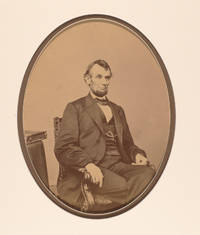
186442820809<p>Oval albumen print 8 x 6 in. original printed mount trimmed at bottom removing caption signed "BRADY & CO. PHOTOGRAPHERS." Browning and offsetting to mount light toning to image. Very good. Matted and framed.</p><p><strong>The classic Brady $5 bill photograph.</strong> This celebrated portrait the basis for the five-dollar bill engraving used for most of the 20th century is one of seven poses taken by Anthony Berger at Mathew Brady's Washington D. C. studio on February 9 1864. The most prolific photographer of Lincoln Brady himself did not actually operate his cameras during the war years instead training and employing men like Alexander Gardner and his successor Anthony Berger who took this picture to operate the camera.</p><p><strong>Lincoln's son Robert Todd Lincoln declared this famous portrait to be "the most satisfactory likeness" of Abraham Lincoln.</strong></p> Mathew Brady Gallery