BELLMER, HansLivre Rare Book
620 résultats
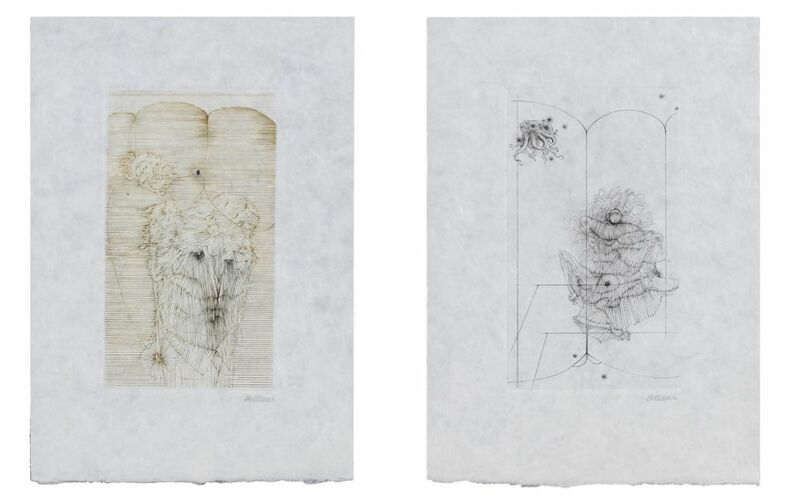
19672238Éditions Georges Visat, Paris 1967. La suite est contenue dans une chemise de vélin d'Arches imprimée (23 x 16 cm). - 7 GRAVURES ORIGINALES AU BURIN DE HANS BELLMER, SUR JAPON HASEKAWA NACRÉ, TOUTES SIGNÉES AU CRAYON PAR L'ARTISTE. Note historique et bibliographique : Ces gravures, commandées par Jean-Jacques Pauvert et exécutées en 1953, étaient à l’origine destinées à illustrer la première édition de L'Anglais décrit dans le château fermé d'André Pieyre de Mandiargues. Mais ce projet ne vit jamais le jour. "Bellmer y dessine la trame arachnéenne d'un réseau de lignes droites qui confère aux compositions une irréalité plus marquée qu'à l'accoutumée" (Pierre Dourthe). Ouvrages de référence : F. Flatuhez, Catalogue raisonné des estampes de Hans Bellmer, 1938-1975, n° 17. - Pierre Dourthe, Bellmer, le principe de perversion, Jean-Pierre Faur, 1999, p. 255 - Mandiargues, p.65-66.
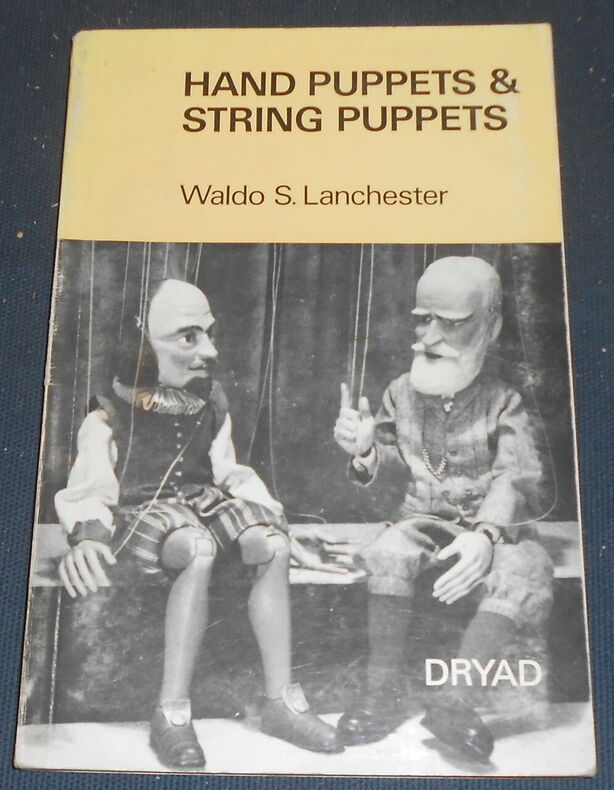
1972100074222Leicester. 14 cm x 21 5 cm. 1972. Broché. 63 pages. Leicester The Dryad Press 1972. Broché 14 cm x 21 5 cm 63 pages 13 planches photographiques 18 diagrammes plan hors-texte dépliant de construction d'une marionnette. Texte en anglais de Waldo S. Lanchester. Tampon de Foz L'Art de la Marionnette - Caen sinon très bon état
2004223092004 1 Acrylique sur papier, 2004 signée en bas à droite, titrée au dos, 23 x 30 cm., encadrée.
19661501Paris, Denoël, 1966. Grand in-4 (250 x 32,3 mm) en feuilles, 109 pages + fnch., sous chemise-étui cartonné recouvert de soie rose, dos lisse orné du nom de l'artiste estampé (emboîtage éditeur). ÉDITION ORIGINALE. Préface de Constantin Jelenski "Bellmer ou la douleur déplacée (20 pages). 86 photogravures (dessins, gravures, lithographies et photographies) en hors-texte. Tirage : 130 exemplaires numérotés sur vélin d’Arches pur chiffon, celui-ci l’un des 100 premiers exemplaires (n° 43) accompagnés d’ UNE GRAVURE ORIGINALE D'HANS BELLMER, NUMEROTÉE ET SIGNÉE au crayon. —— ENGLISH DESCRIPTION: Small folio (250 x 323 mm), 109 pp. in a cardboard slipcase covered in pink silk, smooth spine decorated with the artist's stamped name (publisher's slipcase). Préface by Constantin Jelenski. 86 plates reproducing almost one hundred drawings, engravings, lithographs and some photographic works by Bellmer. Edition limited to 130 numbered copies on vélin d'Arches (n° 43), each with an ORIGINAL ENGRAVING SIGNED IN PENCIL BY HANS BELLMER. A bibliophilic copy of this important study of Hans Bellmer's works on paper with the original signed engraving.
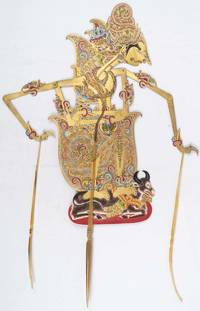
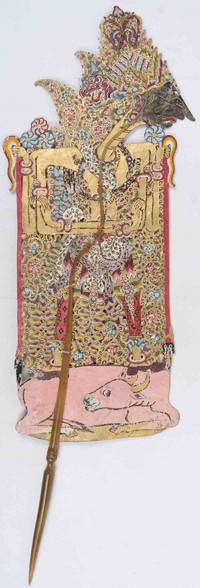
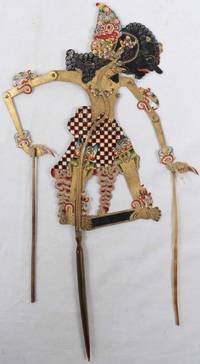
1970216158Indonesia. Before1970s. Water buffalo hide and pigment elaborately gilt and cut out 54 x 69 cms painted both sides jointed arms each affixed to horn batons and another spliced horn baton holds the body. This puppet represents the dewa Bathara Guru in the Javanese and Balinese 'wayang kulit' or leather shadow puppet theatre tradition. Batara Guru is the Indonesian embodiment of the Hindu deity Shiva and perhaps the most sacred of Indonesian shadow puppets. A dalang puppeteer must make offerings to Guru the supreme god creator and ruler of earth who stands at the origin point of humankind before commencing a shadow play performance. Batara Guru also known as Sang Hyang Manikmaya is conceived of as the younger brother of Semar. The figure is generally shown in meditative repose standing upon his mount the bull. He is viewed as a spiritual teacher and guide directing lesser deities and humans in their earthly endeavors. <br> <br>This particularly fine example is elaborately carved with gilt and rides on the mythical bull Nandini. Bathara Guru the Javanese name for the deity Shiva symbolized the imperfection of man represented in the bodily defects of the puppet: four arms small feet marks on the throat and often though not here depicted with fangs. <br> <br>Purchased in Java in the early 1970s. <br> <br>See: Joko Susilo Eisler Shadow-Puppet Collection Catalogue Bates College Lewiston Maine . hardcover
1970216219Indonesia. Before1970s. Water buffalo hide pigment gilt fabric and hair three of the four figures all with jointed arms painted both sides the arms and bodies affixed to spliced horn batons three for each puppet some abrasion and wear with some loss to the pigment but the set in very good condition: <br>Semar body: 35 x 35 cms; Gareng: 36 x 16 cms; Petruk: 53 x 20 cms; Bagong: 41 x 23 cms. A set of four comedic Punakawan figures. Chief of these is Semar one of the most well-loved figures in Wayang both a humble servant and powerful god. "Semar is usually accompanied by his three adopted sons Gareng Petruk and Bagong and together they are known as the Punakawan 'knowing friends or attendants'." Gregory Churchill et al "Semar ever so smartly" Winayangan 2009. <br> <br>In this set Gareng is the eldest son who limps and has a crippled arm; Petruk is the middle child depicted as tall and lanky who has a distinctive long nose; Bagong is the youngest of the three: a chubby figure with big round eyes thick lips and naïve behaviour. <br> <br>".the scene where Semar traditionally emerges is called the goro-goro “world in chaos”. The narration of the puppeteer speaks of earthquakes and storms that beset the cosmos but then announces Semar who appears like a shaft of light piercing the dark. Semar’s cosmic and comic humour promises the audience both laughs and wisdom. He is a clown who connects the cosmic and everyday. All opposites and contradictions dissolve in his wisdom and mythos." World Encyclopedia of Puppetry Arts <br> <br>Purchased in Java in the early 1970s. <br> <br>See: Joko Susilo Eisler Shadow-Puppet Collection Catalogue Bates College Lewiston Maine . unknown
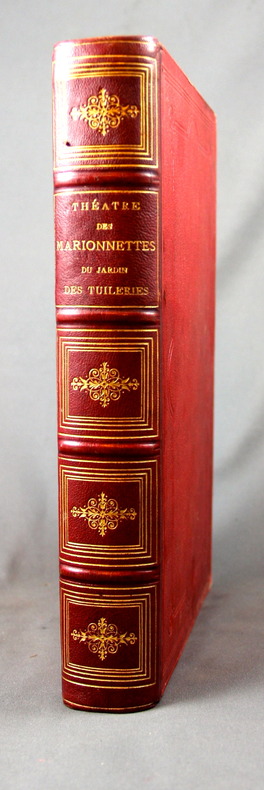
186219971Paris Dubuisson et Cie 1862 in-8 demi-chagrin un volume, reliure demi-chagrin couleur chocolat grand in-octavo Editeur (binding half shagreen in-8 editor) (18,5 x 27,5 cm), reliure d'époque, dos 4 nerfs (spine with raised bands), décorations or et à froid, titre frappé or (gilt title) avec filet or de part et d'autre du titre, entre-nerfs à caissons à fleuron or central avec double filets or, filet large mate et filet or en encadrement, filet à froid de part et d'autre des nerfs, filet or en tête et en pied, plats décorés à froid, percale marron ornée d'un trifle filet à froid en encadrement (plaque éditeur à froid), toutes tranches lisses dorées, marque-page en tissu vert (bookmark in tissue), orné de 24 planches hors-texte lithographiées et coloriées au pochoir et au pinceau + 25 gravures in-texte réhaussées en couleurs, en tête de chapitre, d'aprés les dessins de Duranty par V. Coindre gravées par Gillot, 387 pages, sans date (1862) Paris : Dubuisson et Cie Imprimeurs-Editeurs,
186415945Dubuisson, sd 1864 Grand in-8 demi-basane peignée, dos lisse ornée, 387 pp.50 compositions originales en couleurs, 24 hors-texte . Restauration à 1 ff. de texte mais très bon exemplaire.
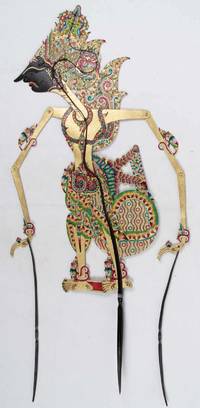
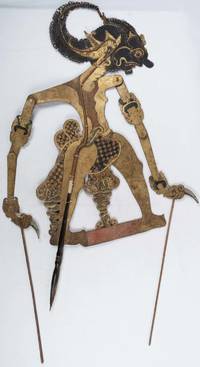
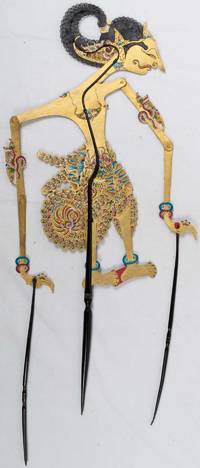
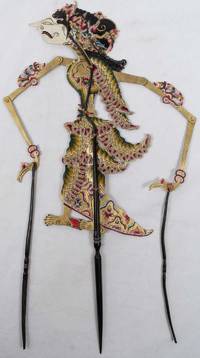
1970216707Indonesia. Before1970s. Water buffalo hide gilt and pigment elaborately chiselled and cut out 54 x 69 cms arms fully extended painted both sides jointed arms each affixed to horn batons and another spliced horn baton holding the body. This Javanese 'wayang kulit' or leather shadow puppet represents Kresna Krishna in the Hindu epic the Mahabharata. His importance and the reasons for his great regard is that he is considered the 8th avatar of the god Wisnu Visnu the protector and preserver of good and destroyer of evil. The 7th avatar is Rama. <br>In Soeharto’s New Order regime this “lineage” of avatars –particularly Rama--became significant in their own mythical presentation to themselves of the regime. It is in the Ramayana—not Mahabharata—that the final battle against evil forces was to be fought and the dharma upheld. <br> <br>"Kresna is part God an incarnation of the mighty Wisnu. He is the consummate politician diplomat and strategist of war. By far the most intellectually brilliant of the Pendawa sic faction it is Kresna who makes their final victory possible. On the other hand he is the conscienceless liar and an unscrupulous schemer who never hesitates to break the rules when he feels it necessary" Benedict R. O'G. Anderson "Mythology and the Tolerance of the Javanese" Cornell 1965. <br> <br>Also see: Joko Susilo Eisler Shadow-Puppet Collection Catalogue Bates College Lewiston Maine. <br> <br>A particularly fine example. Purchased in Java in the early 1970s. . hardcover
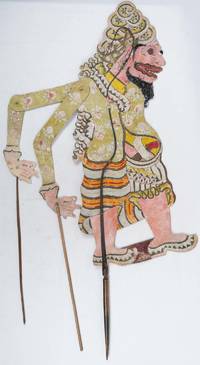
1970216682Indonesia. Before1970s. Water buffalo hide 63 x 90 cms extended pigment and gilt jointed arms painted both sides intricately punctured the jointed arms and body affixed to horn and wooden batons slight wear and rubbing with some loss of pigment overall in good condition. This impressive large puppet represents Bima /Werkadura / Bratasena the incarnation of the god who became the ruler of the wind in the Javanese 'wayang kulit' or leather shadow puppet theatre tradition. <br> <br>"Werkadura is the most feared of warriors creating havoc with his terrible club and atrocious fingernails…Merciless to his enemies gigantic ungainly heavily muscled hairy with protruding eyes and thunderous voice…Nevertheless his unswerving honesty loyalty fortitude and military skill make him among the most admired figures in wayang." Benedict R. O'G. Anderson Mythology and the Tolerance of the Javanese" Cornell 1965 <br> <br>Purchased in Java in the early 1970s. <br> <br>See also: Joko Susilo Eisler Shadow-Puppet Collection Catalogue Bates College Lewiston Maine . hardcover
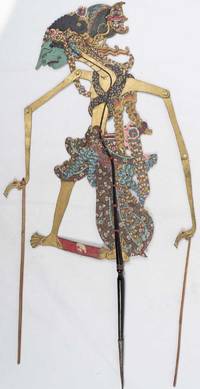
1970216715Indonesia. Before1970s. Water buffalo hide gilt and pigment elaborately chiselled and cut out 43 x 69 cms arms fully extended painted both sides jointed arms each affixed to horn batons and another spliced horn baton holding the body. This puppet represents Suryatmaja or Suryaputra son of Dewi Kunti in the Javanese 'wayang kulit' or leather shadow puppet theatre tradition. <br> <br>A particularly fine example. Purchased in Java in the early 1970s. <br> <br>Also see: Joko Susilo Eisler Shadow-Puppet Collection Catalogue Bates College Lewiston Maine . hardcover
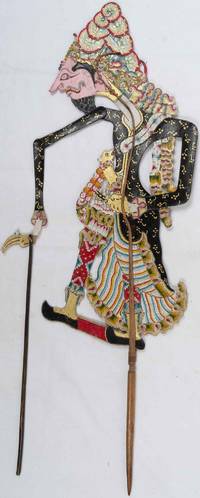
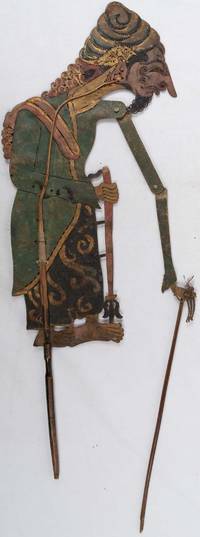
1970216718Indonesia. Before1970s. Water buffalo hide gilt and pigment chiselled and cut out 50 x 41 cms fully extended painted both sides one arm jointed and affixed to a bamboo baton the other arm stationary another spliced bamboo baton holding the body some minor loss of pigment. This puppet represents the priestly hermit Resi Gotama or Gotama Rishi in the Javanese 'wayang kulit' or leather shadow puppet theatre tradition. In this tradition Resi Gotama is married to a beautiful angel Dewi Indradi and despite his royal heritage spurns kingship for life as a hermit. <br> <br>A particularly attractive example. Purchased in Java in the early 1970s. <br> <br>See: Joko Susilo Eisler Shadow-Puppet Collection Catalogue Bates College Lewiston Maine . hardcover
186146403062Paris, Poulet-Malassis et de Broise, 1861 ; petit in-4, broché, couverture jaune illustrée. 2 ff., frontispice gravé, 34 pp., 1 f. avec la marque au caducée - Titre en rouge et noir - Impr. à Alençon.éressantes précisions sur ce livre. Malassis se débattait en 1861 dans toutes sortes de difficultés et ne put donner suite à la proposition de Duranty. Il ne publia donc que le prologue. Le livre de Duranty, qui par ses proportions représentait une considérable affaire d’édition paraîtra un an plus tard, chez un autre éditeur.L’argument du prologue de Desnoyers est le suivant: Polichinelle, ayant reçu de Pierrot le conseil de monter un théâtre, se procure les fonds en détroussant Cassandéressantes précisions sur ce livre. Malassis se débattait en 1861 dans toutes sortes de difficultés et ne put donner suite à la proposition de Duranty. Il ne publia donc que le prologue. Le livre de Duranty, qui par ses proportions représentait une considérable affaire d’édition paraîtra un an plus tard, chez un autre éditeur.L’argument du prologue de Desnoyers est le suivant: Polichinelle, ayant reçu de Pierrot le conseil de monter un théâtre, se procure les fonds en détroussant Cassandre puis engage ses acteurs, l’apothicaire, le pâtissier, le commissaire, le gendarme, la mère Gigogne, Arlequin, Scapin, Fracasse, la Mort, etc.Selon Crouzet l’eau-forte est rare et ne se trouve pas dans tous les exemplaires. Elle manque dans le celui de la Bibliothèque nationale de France.Les marionnettes avaient suscité l’intérêt de nombreux membres du cercle réaliste. C’était une distraction populaire très en vogue à Paris durant les années 1840 et 1850. Cependant lorsqu’en 1860 Duranty obtint l’autorisation d’ouvrir son théâtre aux Tuileries, on cria au scandale devant un acte interprété comme “un attentat à la dignité des lieux”. Pour la séance inaugurale on attendait un scénario de Champfleury et des décors de Courbet et pour les suivantes des arguments de Baudelaire, Banville et autres. La première représentation eut finalement lieu le 19 mai 1861, mais juste avant cette date Duranty reçut l’interdiction d’en informer le public.Exemplaire sur papier de l’édition, bien complet du frontispice.DESNOYERS (Fernand)Cette intéressante figure de la bohème littéraire est née à Paris en 1828. Il était l’ami de Roger de Beauvoir, de Murger et de Charles Baudelaire dont il avait salué le talent avant la parution des Fleurs du Mal. A ce titre MM. Pichois et Ziegler lui consacrent une notice à la page 302 de leur bibliographie de Baudelaire. Firmin Maillard évoque également F. Desnoyers dans les Derniers Bohèmes p. 217 et le décrit comme un de ces paons qui font la roue pour se mirer dans ses propres plumes : « retenez mon nom, disait Fernand, et il avait raison, c’est celui d’un poète, d’un vrai poète ; cette personnalité cassante et vaniteuse qu’il promenait bruyamment au milieu de nous, était bien à lui (…). Comme ses confrères, Desnoyers disait volontiers ses vers… mais il choisissait son endroit, son heure et son public, un public peu nombreux, bien qu’assez mêlé et dans lequel le lettré et la fille dominaient… Il est bien peu de cabarets à la mode dont les murs n’aient entendu, vers les 3 heures du matin les Assassins du Vin, le Mariage dans les blés… Quant au grand public, au public composé de tout le monde, Desnoyers le haïssait, le méprisait, il n’avait jamais assez d’invectives pour le conspuer :Bête à têtes de veau, de lapin et d’aspic,Nombre lâche, gros tas, qu’on appelle PublicD’îlotes, de bourgeois, pions et journalistes,Ecoute-moi ! Depuis le temps que tu m’attristesJ’ai bien acquis le droit de poète indignéDe te jeter un peu de mes vers par le nez.Mais on ne vieillit pas à faire des vers comme ceux-là, et surtout à les réciter régulièrement de 3 à 4 heures du matin à quelques fous. Fernand Desnoyers mourut jeune. C’est le dimanche 7 novembre 1869, que nous l’enterrâmes, au cimetière Montparnasse ». Il avait 41 ans.Fernand Desnoyers est tombé dans les oubliettes de l’histoire littéraire et rares sont les anthologies qui lui consacrent quelques pages.Il a publié peu de livres : un pantomime intitulée Le Bras Noir, ornée d’un frontispice de Courbet (1856), une autre pantomime chez Malassis en 1861, le Salon des refusés (1863) ; Une j heures du matin à quelques fous. Fernand Desnoyers mourut jeune. C’est le dimanche 7 novembre 1869, que nous l’enterrâmes, au cimetière Montparnasse ». Il avait 41 ans.Fernand Desnoyers est tombé dans les oubliettes de l’histoire littéraire et rares sont les anthologies qui lui consacrent quelques pages.Il a publié peu de livres : un pantomime intitulée Le Bras Noir, ornée d’un frontispice de Courbet (1856), une autre pantomime chez Malassis en 1861, le Salon des refusés (1863) ; Une journée de Pick de l’Isère (1864), deux recueils de vers : Les Chansons parisiennes (1865), Le Vin, vers fantasques (1869). Il fut aussi l’éditeur de l’Almanach parisien (entre 1860 et 1870), soit 9 numéros où collaborèrent Gautier, Banville, Murger, Baudelaire, Champfleury, Castagnary, H. Castille, Monselet, Duranty, Scholl, tous poulains de l’écurie Malassis. Ce fut également lui qui eut l’idée, avec A. Luchet, de constituer le fameux recueil collectif Fontainebleau, paysages, légendes…
1970216717Indonesia. Before1970s. Water buffalo hide gilt and pigment elaborately chiselled and cut out 49 x 72 cms arms fully extended painted both sides jointed arms each affixed to bamboo batons and another spliced horn baton holding the body; some fading and loss of pigment; stamped "H N" at the base of the puppet. This puppet represents the King/Knight Raden Astadarma in the Javanese 'wayang kulit' or leather shadow puppet theatre tradition. <br> <br>This character appears in the Wayang Madya stories. These stories were originally sponsored by the princely poet Mangkunegara IV 1811–1881 the fourth ruler of Mangkunegaran a principality based in Surakarta Java ruling from 1853 to his death in 1881. In recent times these stories are intended to retell 19th century heroic poems reflecting on 20th Century events linking Wayang Purwa with Wayang Gedog. <br> <br>Purchased in Java in the early 1970s. <br> <br>See: Joko Susilo Eisler Shadow-Puppet Collection Catalogue Bates College Lewiston Maine . hardcover
1970216160Indonesia. Before1970s. Water buffalo hide and pigment elaborately gilt and cut out 58 x 25 cms painted both sides a spliced horn baton holds the body some abrasions and fading to the painted surface in good condition overall. This puppet represents the dewa Bathara Guru in the Javanese 'wayang kulit' or leather shadow puppet theatre tradition. Bathara Guru the Javanese name for the deity Shiva symbolized the imperfection of man represented in the bodily defects of the puppet: four arms small feet marks on the throat and often though not here depicted with fangs. <br> <br>Purchased in Java in the early 1970s. <br> <br>See: Joko Susilo Eisler Shadow-Puppet Collection Catalogue Bates College Lewiston Maine . hardcover
1970216711Indonesia. Before1970s. Water buffalo hide gilt and pigment chiselled and cut out 40 x 39 cms fully extended painted both sides one arm jointed and affixed to a bamboo baton the other arm stationary holding a staff another spliced bamboo baton holding the body some fading and loss of pigment. This puppet represents the seer or sage Durwasa in the Javanese 'wayang kulit' or leather shadow puppet theatre tradition. <br> <br>Resi Durwasa Durvasa in the Indian Mahabharata was known as a bestower both of curses and boons. He invested Krishna with partial invulnerability. To Dewi Kunti he bestowed a mantra to invoke gods by whom she could beget sons. Unwisely trying this out she became pregnant by the Sun God Surya. Resi Druwasa enabled the birth of her son Karna via her ear and the infant was put into a basket and floated down a river to be found and adopted by others. In modern Wayang this story has reputedly been employed to address issues of gender equality. <br> <br>Purchased in Java in the early 1970s. <br> <br>See: Joko Susilo Eisler Shadow-Puppet Collection Catalogue Bates College Lewiston Maine . hardcover
18645987Paris, Dubuisson et Cie, 1864. In-4 de [4]-II-387-[3]p., demi-chagrin rouge, dos à nerfs orné de filets et fleurons dorés, tranches dorées (quelques rousseurs à la première et dernière page, premier cahier légèrement déboîté, coins à peine émoussés). Ex-libris moderne d'un collectionneur genevois.
1970216244Indonesia. Before1970s. Water buffalo hide 66 x 24 cms body pigment jointed arms painted both sides intricately punctured the jointed arms and body affixed to horn and wooden batons slight wear and rubbing with some loss of pigment to the top of the shoulder of one arm but in very good bright condition. This puppet represents the figure of Batara Yamadipati the god of death. Son of Semar he is responsible for collecting the souls of mortals when their time comes. In the Javanese Wayang he dwells with mortals and is invited to joke by the Punakawans. This example is brightly coloured joyful almost flesh-coloured rather than gilt and black--symbolically death hiding in plain sight. <br> <br>Purchased in Java in the early 1970s. <br> <br>Also see: Joko Susilo Eisler Shadow-Puppet Collection Catalogue Bates College Lewiston Maine . unknown
1970216722Indonesia. Before1970s. Water buffalo hide gilt and pigment chiselled and cut out 30 x 40 cms fully extended without batons painted both sides jointed arms one affixed to a horn baton the other bamboo the body affixed to a spliced horn baton minor loss of pigment. Dewa Ruci is the representation of Bima in miniature form. It is used in the story of the young Bima called Bratasena who goes in search of the meaning of life/the water of life. At the end of his journeys he finds it in a miniature of himself representing his true self. The story of Dewa Ruci thus represents the search for perfection and union with the divine and is thus important in Javanese mysticism. <br> <br>Purchased in Java in the early 1970s. <br> <br>See also: Joko Susilo Eisler Shadow-Puppet Collection Catalogue Bates College Lewiston Maine . unknown
1970216719Indonesia. Before1970s. Water buffalo hide gilt and pigment chiselled and cut out 34 x 54 cms fully extended painted both sides two jointed arms affixed to horn batons another spliced horn baton holding the body some minor loss of pigment. This puppet represents the goddess Dewi Naganini in the Javanese 'wayang kulit' or leather shadow puppet theatre tradition. She is the daughter of the serpent god Antaboga and is known for her virtues of loyalty love and devotion to her fellow creatures. <br> <br>Purchased in Java in the early 1970s. <br> <br>See: Joko Susilo Eisler Shadow-Puppet Collection Catalogue Bates College Lewiston Maine . hardcover
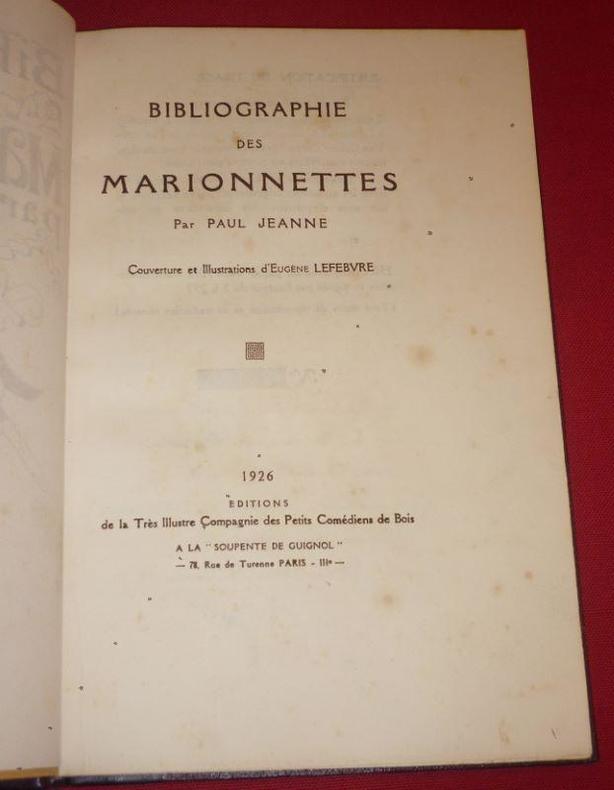
99262Paris, Editions de la Très Illustre Compagnie des Petits Comédiens de Bois, A La Soupente de Guignol, 1926, 1 volume in-8 de 255x165 mm environ, 99 pages, demi-basane aubergine, dos à nerfs portant titres dorés, orné de petits fers dorés. Un des 250 exemplaire sur vélin Alfa blanc (N° 21). Edition originale de la première bibliographie exhaustive, illustrée de 9 compositions d'Eugène LEFEBVRE (couverture, bandeaux). Des rousseurs, petits frottements sur les angles de la couverture, sinon bon état.
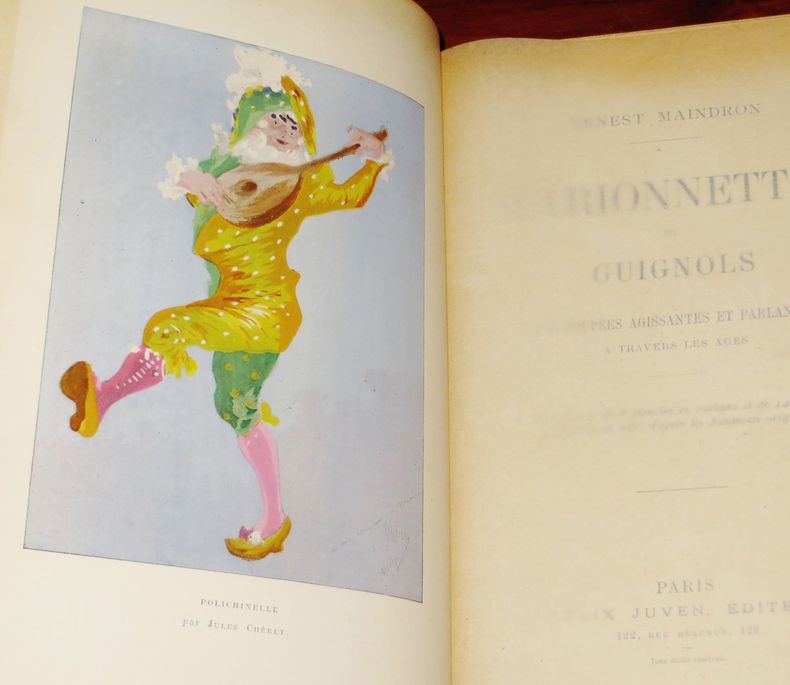
35502388Paris, Felix Juven, in-4, Broché 381 pp.Fameux ouvrage sur les marionnettes et autres automates. Illustré par 8 planches hors textes et 148 gravures. Ouvrage sans sa couverture, et recouvert d'une couverture cartonnée beige. Quelques rousseurs, dos légèrement décollé.
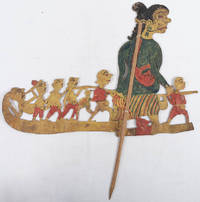
1970216154Indonesia. Before1970s. Water buffalo hide and pigment 29 x 44.5 cms affixed with cotton to a baton 41 cms. A folk puppet depicting Nyi Brayut and her husband Ki Brayut the small lead figure in red jacket and pants who have a great many children. Kyi Brayut is carrying on his shoulder a support which connnects the children to the basket like base on which the children are being carried. The term "brayut" comes from the word "brayat" meaning offspring. <br> <br>Of ancient origin this shadow puppet was traditionally used for the ritual ceremony held at the 7th month of pregnancy to safeguard the mother and baby during its birth. The display of the puppet would symbolically "bring down" Nyi and Ki Brayut and so magically intervene to assist in a safe birth. <br> <br>This puppet was often used from the early 1970s onwards in government campaigns urging the use of birth control to limit family size. <br> <br>Purchased in Java in the early 1970s. . unknown
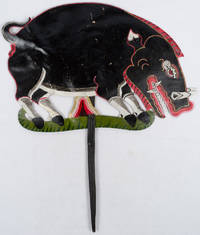
1970216164Indonesia. Before1970s. Water buffalo hide and pigment 28 x 40 cms painted both sides affixed to a spliced stick some surface wear but in vey good condition. Vivid example of the Wayang kulit Celeng/Babi Hutan or wild boar possibly the character Batara Kalagumarang. In Hindu lore the boar is an avatar of the god Vishnu and symbolizes courage strength and tenacity <br> <br>See: Joko Susilo Eisler Shadow-Puppet Collection Catalogue Bates College Lewiston Maine <br> <br>Purchased in Java in the early 1970s. . unknown
1900142351900 Paris, Félix Juven éditeur, 1900. Édition originale, illustrée de 8 planches en couleurs dont une en frontispice, de 24 planches en noir et de nombreuses figures dans le texte. Petit in-4, 28 x 19 cm., 381 pp. Reliure demi basane havane, dos à nerfs, lettres dorées. Reliure insolée au dos, sinon bon état, intérieur très frais.