36 résultats
19270005609London: "The Children's Companion" Office 1927. First edition. Hardcover. Very Good. 4 colour plates plus numerous black-and-whites by H. KA. Robinson. Quarto unpaginated clothbacked pictorial paper over boards a trifle loose extremities rubbed inked name on endpaper. <br/><br/>4 colour plates plus numerous black-and-whites by H. KA. Robinson. A scarce tome. Stories on "The Fairy of Simple Joy" "The Smile of the Sea Princess" " The Magic Knitting" "The Brave Tin Soldier" & "The Little Mermaid". Robinson's artwork is quite colorful and appealing the cover art is softer and more pastel and I am guessing that Robinson was an in-house illustrator for The Children's Companion but I find no listing of him/her in the DICTIONARY OF 20TH CENTURY BRITISH ILLUSTRATORS. "The Children's Companion" Office hardcover
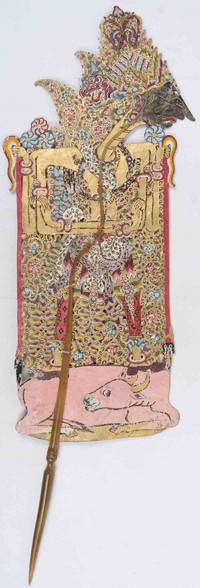
1970216158Indonesia. Before1970s. Water buffalo hide and pigment elaborately gilt and cut out 54 x 69 cms painted both sides jointed arms each affixed to horn batons and another spliced horn baton holds the body. This puppet represents the dewa Bathara Guru in the Javanese and Balinese 'wayang kulit' or leather shadow puppet theatre tradition. Batara Guru is the Indonesian embodiment of the Hindu deity Shiva and perhaps the most sacred of Indonesian shadow puppets. A dalang puppeteer must make offerings to Guru the supreme god creator and ruler of earth who stands at the origin point of humankind before commencing a shadow play performance. Batara Guru also known as Sang Hyang Manikmaya is conceived of as the younger brother of Semar. The figure is generally shown in meditative repose standing upon his mount the bull. He is viewed as a spiritual teacher and guide directing lesser deities and humans in their earthly endeavors. <br> <br>This particularly fine example is elaborately carved with gilt and rides on the mythical bull Nandini. Bathara Guru the Javanese name for the deity Shiva symbolized the imperfection of man represented in the bodily defects of the puppet: four arms small feet marks on the throat and often though not here depicted with fangs. <br> <br>Purchased in Java in the early 1970s. <br> <br>See: Joko Susilo Eisler Shadow-Puppet Collection Catalogue Bates College Lewiston Maine . hardcover
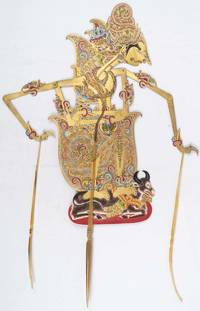
1970216160Indonesia. Before1970s. Water buffalo hide and pigment elaborately gilt and cut out 58 x 25 cms painted both sides a spliced horn baton holds the body some abrasions and fading to the painted surface in good condition overall. This puppet represents the dewa Bathara Guru in the Javanese 'wayang kulit' or leather shadow puppet theatre tradition. Bathara Guru the Javanese name for the deity Shiva symbolized the imperfection of man represented in the bodily defects of the puppet: four arms small feet marks on the throat and often though not here depicted with fangs. <br> <br>Purchased in Java in the early 1970s. <br> <br>See: Joko Susilo Eisler Shadow-Puppet Collection Catalogue Bates College Lewiston Maine . hardcover
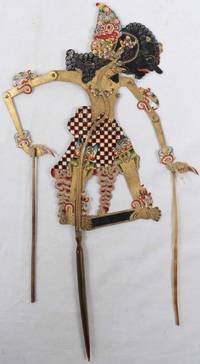
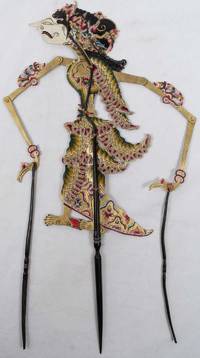
1970216244Indonesia. Before1970s. Water buffalo hide 66 x 24 cms body pigment jointed arms painted both sides intricately punctured the jointed arms and body affixed to horn and wooden batons slight wear and rubbing with some loss of pigment to the top of the shoulder of one arm but in very good bright condition. This puppet represents the figure of Batara Yamadipati the god of death. Son of Semar he is responsible for collecting the souls of mortals when their time comes. In the Javanese Wayang he dwells with mortals and is invited to joke by the Punakawans. This example is brightly coloured joyful almost flesh-coloured rather than gilt and black--symbolically death hiding in plain sight. <br> <br>Purchased in Java in the early 1970s. <br> <br>Also see: Joko Susilo Eisler Shadow-Puppet Collection Catalogue Bates College Lewiston Maine . unknown
1970216722Indonesia. Before1970s. Water buffalo hide gilt and pigment chiselled and cut out 30 x 40 cms fully extended without batons painted both sides jointed arms one affixed to a horn baton the other bamboo the body affixed to a spliced horn baton minor loss of pigment. Dewa Ruci is the representation of Bima in miniature form. It is used in the story of the young Bima called Bratasena who goes in search of the meaning of life/the water of life. At the end of his journeys he finds it in a miniature of himself representing his true self. The story of Dewa Ruci thus represents the search for perfection and union with the divine and is thus important in Javanese mysticism. <br> <br>Purchased in Java in the early 1970s. <br> <br>See also: Joko Susilo Eisler Shadow-Puppet Collection Catalogue Bates College Lewiston Maine . unknown
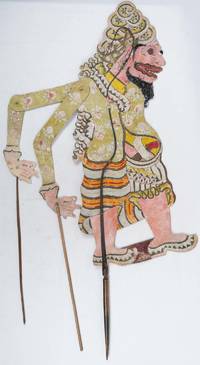
1970216682Indonesia. Before1970s. Water buffalo hide 63 x 90 cms extended pigment and gilt jointed arms painted both sides intricately punctured the jointed arms and body affixed to horn and wooden batons slight wear and rubbing with some loss of pigment overall in good condition. This impressive large puppet represents Bima /Werkadura / Bratasena the incarnation of the god who became the ruler of the wind in the Javanese 'wayang kulit' or leather shadow puppet theatre tradition. <br> <br>"Werkadura is the most feared of warriors creating havoc with his terrible club and atrocious fingernails…Merciless to his enemies gigantic ungainly heavily muscled hairy with protruding eyes and thunderous voice…Nevertheless his unswerving honesty loyalty fortitude and military skill make him among the most admired figures in wayang." Benedict R. O'G. Anderson Mythology and the Tolerance of the Javanese" Cornell 1965 <br> <br>Purchased in Java in the early 1970s. <br> <br>See also: Joko Susilo Eisler Shadow-Puppet Collection Catalogue Bates College Lewiston Maine . hardcover
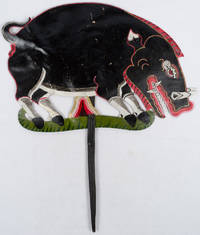
1970216164Indonesia. Before1970s. Water buffalo hide and pigment 28 x 40 cms painted both sides affixed to a spliced stick some surface wear but in vey good condition. Vivid example of the Wayang kulit Celeng/Babi Hutan or wild boar possibly the character Batara Kalagumarang. In Hindu lore the boar is an avatar of the god Vishnu and symbolizes courage strength and tenacity <br> <br>See: Joko Susilo Eisler Shadow-Puppet Collection Catalogue Bates College Lewiston Maine <br> <br>Purchased in Java in the early 1970s. . unknown
20012021864Marlboro VT: Tasha Tudor and Family Inc 2001. First Limited Edition. Fine. Tasha Tudor. Image size: 14 x 11 inches / 17.5 x 12.5 inches sealed in its original cardboard-backed plastic sleeve with TT&F sticker on the back <br/><br/>Numbered in pencil at the lower right corner this is no. 223/500. This has it all: Christmas tree trimmings children candles corgis and more. Surprisingly scarce. Tasha Tudor and Family, Inc unknown
1970216719Indonesia. Before1970s. Water buffalo hide gilt and pigment chiselled and cut out 34 x 54 cms fully extended painted both sides two jointed arms affixed to horn batons another spliced horn baton holding the body some minor loss of pigment. This puppet represents the goddess Dewi Naganini in the Javanese 'wayang kulit' or leather shadow puppet theatre tradition. She is the daughter of the serpent god Antaboga and is known for her virtues of loyalty love and devotion to her fellow creatures. <br> <br>Purchased in Java in the early 1970s. <br> <br>See: Joko Susilo Eisler Shadow-Puppet Collection Catalogue Bates College Lewiston Maine . hardcover
3211Folkmanis Puppets. TOY. 0. . Folkmanis Puppets unknown
31350Folkmanis Puppets. TOY. 0. . Folkmanis Puppets unknown
19640005951New York: Beginner Books 1964. First edition. Hardcover. Very Good/good . 8vo pictorial cover is of glossy stock some newsprint "burn" pp. 30-31; price on dj flap is 195/ 195; tips of dj spine nicked short tears <br/><br/>Things a child can make with paper string stick-um corks and other household odds-and-ends. Book B-37 in the series. Beginner Books hardcover
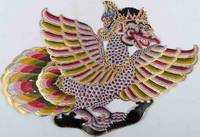
1970216677Indonesia. Before1970s. Water buffalo hide and pigment elaborately gilt 38 x 56 cms painted both sides minor surface wear and loss of pigment without the baton in very good condition. Figure of Jatayu a demi-god who takes the form of a vulture or an eagle used in the Javanese and Balinese 'wayang kulit' or leather shadow puppet theatre tradition. According to the Ramayana epic Jatayu died while trying to thwart the kidnapping of Dewi Sinta by Rahwana the king of Alengka. A very attractive example. <br> <br>Purchased in Java in the early 1970s. . hardcover
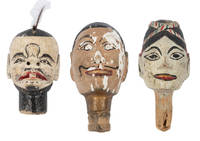
1970216774Indonesia. Before1970s. Wood and mixed media three puppet heads some loss of pigment and wear more severe in one example all approx 14 x 13 cms sold with an original wooden baton. Three puppet heads one representing Jiweng a clown figure in the Wayang Golek Menak tradition. The other two are from unidentified characters. <br> <br>Most common in West Java rod puppetry dates back to the early 17th Century. Stories may be of Hindu Buddhist or Islamic origin as well as more modern themes. This example is of Wayang Golek Manek is specifically concerned with the Amir Hamza cycle of stories. The stories narrate the exploits of an Arab warrior Hamza. Though from an oral tradition the stories were written down in Persian. <br> <br>Purchased in Java in the early 1970s. <br> <br>Also see: Gregory Churchill et al "Semar ever so smartly. Images of Semar in Indonesian Folk Arts". Winayangan 2009 . unknown
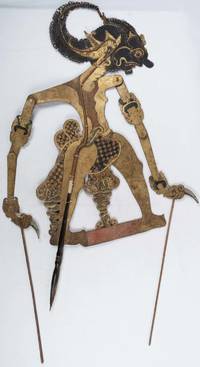
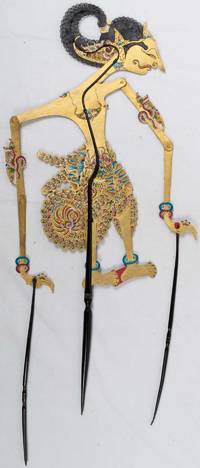
1970216715Indonesia. Before1970s. Water buffalo hide gilt and pigment elaborately chiselled and cut out 43 x 69 cms arms fully extended painted both sides jointed arms each affixed to horn batons and another spliced horn baton holding the body. This puppet represents Suryatmaja or Suryaputra son of Dewi Kunti in the Javanese 'wayang kulit' or leather shadow puppet theatre tradition. <br> <br>A particularly fine example. Purchased in Java in the early 1970s. <br> <br>Also see: Joko Susilo Eisler Shadow-Puppet Collection Catalogue Bates College Lewiston Maine . hardcover
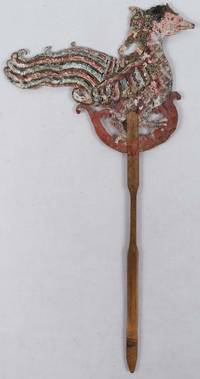
1970216726Indonesia. Before1970s. Water buffalo hide and pigment chiselled and cut out 17 x 22 figure only affixed to a bamboo baton worn with noticeable loss of pigment. This puppet represents the animal character of Kate Kancana or golden rooster a form assumed by Prince Arjuna in the Javanese Wayang Kulit tradition. <br> <br>Purchased in Indonesia in the early 1970s. <br> <br>See : Joko Susilo Eisler Shadow-Puppet Collection Catalogue Bates College Lewiston Maine . unknown
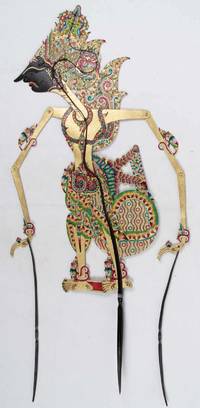
1970216707Indonesia. Before1970s. Water buffalo hide gilt and pigment elaborately chiselled and cut out 54 x 69 cms arms fully extended painted both sides jointed arms each affixed to horn batons and another spliced horn baton holding the body. This Javanese 'wayang kulit' or leather shadow puppet represents Kresna Krishna in the Hindu epic the Mahabharata. His importance and the reasons for his great regard is that he is considered the 8th avatar of the god Wisnu Visnu the protector and preserver of good and destroyer of evil. The 7th avatar is Rama. <br>In Soeharto’s New Order regime this “lineage” of avatars –particularly Rama--became significant in their own mythical presentation to themselves of the regime. It is in the Ramayana—not Mahabharata—that the final battle against evil forces was to be fought and the dharma upheld. <br> <br>"Kresna is part God an incarnation of the mighty Wisnu. He is the consummate politician diplomat and strategist of war. By far the most intellectually brilliant of the Pendawa sic faction it is Kresna who makes their final victory possible. On the other hand he is the conscienceless liar and an unscrupulous schemer who never hesitates to break the rules when he feels it necessary" Benedict R. O'G. Anderson "Mythology and the Tolerance of the Javanese" Cornell 1965. <br> <br>Also see: Joko Susilo Eisler Shadow-Puppet Collection Catalogue Bates College Lewiston Maine. <br> <br>A particularly fine example. Purchased in Java in the early 1970s. . hardcover
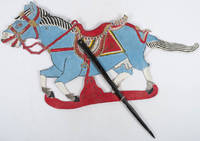
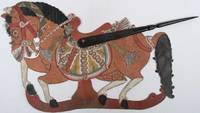
1970216155Indonesia. Before1970s. Water buffalo hide and pigment 48 x 78.5 cms with tail fully extended painted both sides affixed to an ebonized baton with cotton 51 cms head and tail articulated with string. A Javanese folk puppet depicting a saddled Kuda horse possibly representing the character of Jaran. In traditional all-night shadow puppet performances Jaran appears during the budhalan scene army leaving the kingdom. Purchased in Java in the early 1970s. . unknown
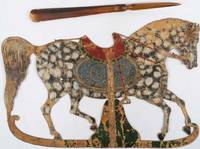
1970216167Indonesia. Before1970s. Water buffalo hide and pigment 37 x 54 cms the original spliced horn baton present but detached tail attached with thread surface wear and abrasion with significant loss to the pigment. A Javanese folk puppet depicting a saddled Kuda horse possibly representing the character of Jaran. In traditional all-night shadow puppet performances Jaran appears during the budhalan scene army leaving the kingdom. This example has older style colouring the horse with a dappled black and white coat. <br>Purchased in Java in the early 1970s. . unknown
1970216156Indonesia. Before1970s. Water buffalo hide and pigment 36 x 59 cms painted both sides affixed to an ebonized baton with cotton 43 cms. A Javanese folk puppet depicting a saddled Kuda horse possibly representing the character of Jaran. In traditional all-night shadow puppet performances Jaran appears during the budhalan scene army leaving the kingdom. Purchased in Java in the early 1970s. . unknown
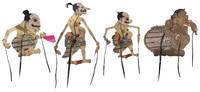
1970216219Indonesia. Before1970s. Water buffalo hide pigment gilt fabric and hair three of the four figures all with jointed arms painted both sides the arms and bodies affixed to spliced horn batons three for each puppet some abrasion and wear with some loss to the pigment but the set in very good condition: <br>Semar body: 35 x 35 cms; Gareng: 36 x 16 cms; Petruk: 53 x 20 cms; Bagong: 41 x 23 cms. A set of four comedic Punakawan figures. Chief of these is Semar one of the most well-loved figures in Wayang both a humble servant and powerful god. "Semar is usually accompanied by his three adopted sons Gareng Petruk and Bagong and together they are known as the Punakawan 'knowing friends or attendants'." Gregory Churchill et al "Semar ever so smartly" Winayangan 2009. <br> <br>In this set Gareng is the eldest son who limps and has a crippled arm; Petruk is the middle child depicted as tall and lanky who has a distinctive long nose; Bagong is the youngest of the three: a chubby figure with big round eyes thick lips and naïve behaviour. <br> <br>".the scene where Semar traditionally emerges is called the goro-goro “world in chaos”. The narration of the puppeteer speaks of earthquakes and storms that beset the cosmos but then announces Semar who appears like a shaft of light piercing the dark. Semar’s cosmic and comic humour promises the audience both laughs and wisdom. He is a clown who connects the cosmic and everyday. All opposites and contradictions dissolve in his wisdom and mythos." World Encyclopedia of Puppetry Arts <br> <br>Purchased in Java in the early 1970s. <br> <br>See: Joko Susilo Eisler Shadow-Puppet Collection Catalogue Bates College Lewiston Maine . unknown
3073Folkmanis Puppets. TOY. 0. . Folkmanis Puppets unknown
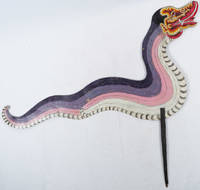
1970216676Indonesia. Before1970s. Water buffalo hide and pigment 37 x 76 cms painted both sides some surface wear and loss of pigment mounted on the original spliced bamboo baton in very good condition. Figure of a Naga or sea serpent used in the Javanese and Balinese 'wayang kulit' or leather shadow puppet theatre tradition. This puppet appears in many different stories in the Mahabharata epic and in the Javanese tradition can also represent the god and king of all snakes Bathara Naga. <br> <br>Purchased in Java in the early 1970s. . hardcover
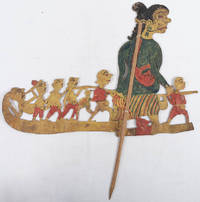
1970216154Indonesia. Before1970s. Water buffalo hide and pigment 29 x 44.5 cms affixed with cotton to a baton 41 cms. A folk puppet depicting Nyi Brayut and her husband Ki Brayut the small lead figure in red jacket and pants who have a great many children. Kyi Brayut is carrying on his shoulder a support which connnects the children to the basket like base on which the children are being carried. The term "brayut" comes from the word "brayat" meaning offspring. <br> <br>Of ancient origin this shadow puppet was traditionally used for the ritual ceremony held at the 7th month of pregnancy to safeguard the mother and baby during its birth. The display of the puppet would symbolically "bring down" Nyi and Ki Brayut and so magically intervene to assist in a safe birth. <br> <br>This puppet was often used from the early 1970s onwards in government campaigns urging the use of birth control to limit family size. <br> <br>Purchased in Java in the early 1970s. . unknown
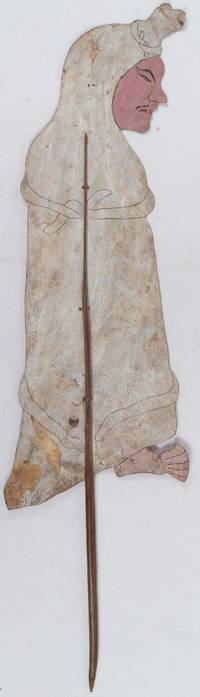
1970216170Indonesia. Before1970s. Water buffalo hide and pigment 42 x 16 cms painted both sides affixed to a spliced horn baton some surface wear and loss of pigment overall in good condition. Figure of a Pocong used in the Javanese and Balinese 'wayang kulit' or leather shadow puppet theatre tradition. <br> <br>A pocong is a ghost in the form of a corpse wrapped in its burial shroud. The deceased are typically wrapped in a white cloth which is tied at several places including feet torso and neck. Burial is often without a casket. Before closure of a grave the ties must be loosed so that the spirit of the person is released. If not they are doomed to wander the world haunting the living and places at will. Belief has it that they sometimes haunt bamboo or bannana tree groves in order to befriend the living. <br> <br>During early Covid lockdown in Java neighbourhoods would block road access to enforce curfew with one or two people dressed as pocongan as a warning to trespassers. <br> <br>Purchased in Java in the early 1970s. . hardcover