Walter Ben Hare, Jay TobiasBiblio.com

11 résultats
1519504616Chicago: T S Denison & Company 1915 1933. Softcover. Very Good/No Dust Jacket. Two booklets. A Poor Married Man 1915 Here Comes Charlie 1933 A Farce Comedy in Three Acts. Each play 4.75 x 7.25 inches approximately. 55 pages and 141 pages. Previous owner's name in pencil on front cover of each. Light underlining in pencil of the character Nora's name in Here Comes Charlie. Very good/near fine condition. Two staple binding. T S Denison & Company paperback
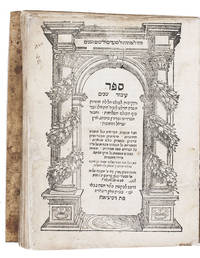
15465968Venice: Cornelio Adelkind for Daniel Bomberg 1546. First edition. Very Good/First printed edition editio princeps of the 11th century commentary on portions of the pentateuch by the Bulgarian poet and Talmudist Tobiah ben Eliezer. Published by the house of the seminal printer of Hebrew books Daniel Bomberg under the supervision of his scholar-in-residence extraordinaire Cornelio Adelkind. Venetian law at this time limited Hebrew publishing to Gentile printers. Bomberg a protestant from Antwerp entered this lucrative market and with Adelkind's help became its prime exponent until his death in 1549. . Folio 32 cm; 93 leaves. Text in Hebrew. Title within architectural border reproduced in Amram "Makers of Hebrew Books in Italy" p. 215 also in the Jewish Museum's 1989 exhibition catalogue "Gardens and Ghettos: the Art of Jewish Life in Italy" page 50. Some section headings within ornamental borders. Bound in c19 or c20 dark red crushed morocco ruled in gilt and decorated with arabesques on both boards; spine with raised bands and compartments tooled and titled in gilt; green polished leather doublures with red crushed morocco dentelles bordered in pointillé accented with arabesques; green moiré free endleaves. Edges gilt. Binding not signed. Joints and crown adroitly reinforced with Japanese paper; corners somewhat worn down. Occasional contemporary notes in manuscript in text; brief stain on leaf mem-tet and lightly along the bottom edge of leaves nun-bet and nun-gimmel. Text otherwise pristine. Title page light possibly washed. Old library ink stamps from an institution in Warsaw on title page. Red morocco ex-libris of mining magnate and philanthropist Adolph Lewisohn 1849-1938. References: Adams T-766; BM Italian 674; Steinschneider 7304 #1; Amram 215 illustration and 222. Cornelio Adelkind for Daniel Bomberg hardcover books
15465968Venice: Cornelio Adelkind for Daniel Bomberg 1546. First edition. Very Good. Folio 32 cm; 93 leaves. Text in Hebrew. Title within architectural border reproduced in Amram "Makers of Hebrew Books in Italy" p. 215 also in the Jewish Museum's 1989 exhibition catalogue "Gardens and Ghettos: the Art of Jewish Life in Italy" page 50. Some section headings within ornamental borders. Bound in c19 or c20 dark red crushed morocco ruled in gilt and decorated with arabesques on both boards; spine with raised bands and compartments tooled and titled in gilt; green polished leather doublures with red crushed morocco dentelles bordered in pointillé accented with arabesques; green moiré free endleaves. Edges gilt. Binding not signed. Joints and crown adroitly reinforced with Japanese paper; corners somewhat worn down. Occasional contemporary notes in manuscript in text; brief stain on leaf mem-tet and lightly along the bottom edge of leaves nun-bet and nun-gimmel. Text otherwise pristine. Title page light possibly washed. Old library ink stamps from an institution in Warsaw on title page. Red morocco ex-libris of mining magnate and philanthropist Adolph Lewisohn 1849-1938. References: Adams T-766; BM Italian 674; Steinschneider 7304 #1; Amram 215 illustration and 222. <br /><br />First printed edition editio princeps of the 11th century commentary on portions of the pentateuch by the Bulgarian poet and Talmudist Tobiah ben Eliezer. Published by the house of the seminal printer of Hebrew books Daniel Bomberg under the supervision of his scholar-in-residence extraordinaire Cornelio Adelkind. Venetian law at this time limited Hebrew publishing to Gentile printers. Bomberg a protestant from Antwerp entered this lucrative market and with Adelkind's help became its prime exponent until his death in 1549. Cornelio Adelkind for Daniel Bomberg hardcover
157821742Venice 1578. Small 4to 19.5 x 15 cm. Giovanni di Gara Contemporary limp sheepskin wrap-around cover with flap and fastened with strap sewn on 2 leather straps laced through the cover the sewing and most of the straps recent. With the title set in an elaborate woodcut architectural arch with garlands of fruits spiraling around the columns 6 round woodcut calendrical or astrological diagrams with text woodcut crown and olive branch ornaments decorations built up from arabesque typographic ornaments a vine leaf Vervliet 38 and many letterpress tables. Set entirely in Hebrew type the main text in semi-cursive rabbinical and the headings in meruba each of the two styles in at least 3 sizes. 136 ll. including the blank leaf 108. Rare second first authorised edition by far the best of an extremely important work on Jewish calendrical calculations also in relation to the liturgy choice of readings customs and dates for holidays. In addition to being a seminal work on the calendar and chronology it records customs and liturgical practices minhagim of the ancient Jewish communities of Palestine including even lore about the weather whose traditions were already threatened and in many cases were soon to be lost as a result of the influx of Sephardic Jews after their expulsion from Spain in 1492 and Portugal in 1497. It also includes similar information about the communities in northern Africa as well as astrological and astronomical information.Susan ca. 1510-1572 was a Maghribian northwest African Jew probably born in Fez in what is now Morocco. He moved to Jerusalem at an early age and studied with Levi ibn Habib chief rabbi there from 1525 in the early years of the Ottoman control of Palestine. He studied further in Safed then briefly sought work in Thessaloniki in 1539 when he was already preparing the present work and continued it in Damascus in 1540 before returning to Safed. With skilful repairs and restorations in the margins of first leaves but still in good condition and with generous margins. The best edition prepared by the author of an essential source for Jewish calendrical calculations and for Jewish customs surviving in Palestine in the mid-16th century.l Adams I20; Carlbach Palaces of time 2011 pp. 47-54; A.M. Habermann De Gara 52; hebrewbooks.org 45592; Marvin Heller The sixteenth century Hebrew book pp. 690-691; Steinschneider 5282.2; Zedner p. 393. hardcover
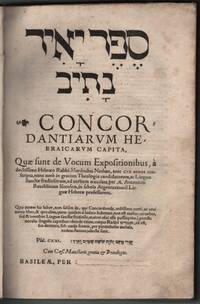
1556157Basileae Basel: Henricum Petri 1556. First edition. Printer’s device on last page. In contemporary vellum. Title on spine lettered in ink. Binding stained. Title page restored. Foxing and waterstain throughout. First edition. Printer’s device on last page. In contemporary vellum. Title on spine lettered in ink. 6°; A1–Ss6 8 p. 2 folding plates 980 col. 2 p. <p><br /> Isaac Nathan ben Kalonymus was a French philospher and contraversialist of the 15th century. Came from the renowned Nathan family which claimed it’s descent from King David. He is the author of the first Bible concordance and the division of the Old Testament into verses is attributed to him.<br /> <p><p><br /> Adams I. 188.<br /> <p>. Henricum Petri unknown
159933044-51Basel Konrad Waldkirch 1599. Printer's device and historiated initials at top of title-page. Double columns. 166 ff. Sm. folio. Old boards spine and all edges leather- rebacked. In a cloth case. Basel Konrad Waldkirch 1599. First Basel edition of this dictionary entitled "Arukh" of the entire post-biblical literature and a special dictionary to the Talmud and Midrash. Rabbi Nathan ben Jechiel b. Abraham c. 1020-1106 was a Jewish Italian and both a lexicographer and one of the most important Talmudic authorities of the 11th century. He quotes on individual headwords texts from many of today lost writings and leads rabbinic expressions on their supposed original in Greek Latin Persian etc. It attained great popularity especially at the work on Tamudic lexica up to the present. This work was first issued at Venice in 1533 but in fact it is not a word-for-word reprint.- Due to paper quality slightly browned throughout some small wormtracks in inner margin of last few leaves otherwise a good copy. - VD 16 N 160; Fürst III p. 21; Prijs 158; Wininger JNB vol. 4 p. 500. JUDAICA ; Basel, Konrad Waldkirch hardcover
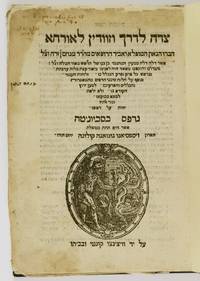
156753370Sabbioneta: Vincenzo Conti 1567. Second edition. Hardcover. Good. Small quarto. 261 1ff. Signatures: 1-65 alef - sameḥ-heh4 chi2 = 262 leaves. Woodcut illustration leaf 90. Final two leaves are folding broadsheets with letterpress charts the first leaf 261 with the final page of text at the verso. Printer's device Hercules slaying the Hydra at title. Modern black polished calf. A few skilfull paper repairs at top margin in early leaves. Clean marginal tear leaf 181. Light worm tracing with some text loss in final ten leaves; along with a small group of 4 to 6 very tiny worm holes in the final 30 leaves. Light mostly marginal dampstain at final 30 leaves. Both charts with old corrections and annotations and some loss of text due to worming each mounted on fine laid paper. A good copy with generally crisp clean text notably complete with the final two folding almanac charts.<br /> <br /> Second edition of this compendium of Jewish law composed in honor of Don Samuel Abravanel of Seville. It was intended principally for the use of persons in the upper social classes many of whom occupied positions in government and found it inconvenient to observe all the legal and ritual regulations or lacked the time to refer to the halakhic sources. First published at Ferrara in 1554 and arranged in five articles Heb. = ma'amarot "the work has an added importance on account of the introduction which contains valuable historical material including important details of the method of study in the yeshivot of France and Germany as well as contemporary incidents in the history of the Jews in Spain. Menahem writes reprovingly of those Jews who because of the demands of the times began to disregard the observance of the precepts. Although he shows great erudition in his knowledge of the Talmud and codes and was acquainted with the teachings of the earlier Spanish French and German scholars he relies mainly for his halakhic rulings on those of Asher b. Jehiel" EJ. This preference likely reflects the influence of Asher's son Judah who was one of Menahem's principal teachers at the yeshiva in Toledo.<br /> <br /> Among the very last Hebrew works published at Sabbioneta the title highlights the approval of Vespasiono Gonzaga the reigning prince. Previously in 1553 "the proprietors of this press attempted the hazardous work of republishing the Talmud and one Treatise saw the light; but the papal decree of that year made the further publication of the Talmud in Italy an impossibility. The end of this press came in the year 1559 due as De Rossi intimates to anti-Christian statements in some of their publications which finally brought down upon them the wrath of the church" Amram. When Vincenzo Conti briefly re-established the press at Sabbioneta to print the present work and two or three others he would have been keen to indicate his obedience to the temporal and ecclesiastical authorities.<br /> <br /> The verso of the last numbered leaf and the following unnumbered leaf both are broadsheets comprise a calendar or almanac entitled "Beʼur ha-luḥot" for the years 5025-6000. The first part is designated "Ha-Luaḥ ha-Rishon" and the second "Ha-Luaḥ ha-Sheni." Many copies appear to lack one or both of the broadsheets.<br /> <br /> Annotations: Old Hebrew entries in two hands at the margins of the title-page; some scattered marginal notes in Hebrew. Title in Hebrew: â€×¦×“×” לדרך וזוודין ל××•×¨×—× :†â€×•×”×’×“×œ× ×• ×•×”×•×¡×¤× ×• . בי×ור קצת מילות ערביות . ולוחות העבור . ×•× ×•×¡×£ על הלוח ×¡×™×ž× ×™ ×”×“×¤×™× ×ž×”×ž×מרות ×•×”×›×œ×œ×™× ×•×”×¤×¨×§×™× â€<br /> <br /> References: D. Amram The Makers of Hebrew Books in Italy pp. 292-3; Cowley 132; Enc. Jud. 11:1303-04; Goldstein 105; Roest Rosenthaliana p. 788 noting two tables; Steinschneider 6368.2 and 3617 Luah; Vinograd Sabbioneta 55; USTC 1791691; Zedner p.527. Vincenzo Conti hardcover
151831810Augsburg: S. Grimm and M. Wirsung 1518. Hardcover. Very good. Five parts small quarto 19.5 by 14 cm: a-d4 = 16 leaves. 32 pp. Text in Latin. Title within elaborate woodcut borders; woodcut initials. Modern marbled boards. Lightly toned with occasional faint smudges mostly marginal. Three discreet worm holes 1mm and less throughout sometimes obscuring a letter else a very good copy with crisp text.<br /> <br /> Early printing of the first Latin edition of Maimonides' Fi Tadbir al-Sihha On the Regimen of Health. Like his other medical and philosophical works it was composed in Arabic. The present translation however was likely based upon the 13th-century Hebrew version Sefer Hanhagat ha-Bri'ut attributed to Moses ibn Tibbon. The editio princeps first printed edition of this Latin version appeared at the monastic press of Sanctum Jacobum de Ripoli in Florence under the direction of Fra Domenico da Pistoia in an undated edition sometime between 1477 and 1481. In 1501 it appeared at Pavia as an appendix to a general treatise on the medical arts the Tabula Consiliorum of Giovanni Matteo Ferrari court physician to Francesco Sforza. The later editions of the Tabula which appeared at Venice in 1514 and again at Pavia in 1517 also include this Latin version of On the Regimen of Health. The present edition thus appears to be the first separate printing of this Latin translation to appear after the rare Florentine incunable.<br /> <br /> A philosopher physician rabbinic authority and codifier of Jewish law Maimonides Moses ben Maimon the Rambam; 1135 or 1138-1204 was the most illustrious Jewish scholar of the post-talmudic era. At the age of thirteen he and his family fled Cordoba to escape the Almohad persecutions and later settled in Fustat an ancient district of Cairo. "It was here that Maimonides started to practice and teach medicine. and became the physician of al-Qadi al-Fadil the famous counsellor and secretary to Saladin" Bos.<br /> <br /> On the Regimen of Health was composed at an unknown date for al-Malik al-Afdal Nur al-Din Ali ca.1169-1225 Saladin's eldest son. He was appointed by his father as governor of Damascus while still a youth and ascended to the throne as Sultan of the Ayyubid Empire in the winter of 1198/1199. Maimonides later served him in that capacity as court physician. In the Latin version of On the Regimen of Health al Malik al-Afdal is described as The Great Sultan of Babylon Magnifico Soldano Babylonie. In his preface Maimonides describes his work as divided into four tracts the first and last providing general medical advice suitable for all persons. The second treatise provides a regimen for the sick who are unable to consult a physician. The third is specifically intended for the Sultan who has informed Maimonides about his medical complaints -- constipation indigestion and depression -- through his emissary per suum nuncium significavit. There is a fifth part not mentioned in the preface which appears in the Florentine editio princeps as well in which Maimonides criticizes the treatment of the Sultan by other physicians.<br /> <br /> The "regimen of health" tadbir al-sihha genre has a long history in Islamic medical literature. Rooted in ancient Greek medical theory it was reinforced with the ritualistic hygiene of the Qur'an and the later Hadith traditions. "Maimonides teaches that physical convalescence is dependent on psychological well-being and rest. He stresses the necessity of hygienic conditions in the care of the body physical exercise and proper breathing work family sexual life and diet and suggests that music poetry paintings and walks in pleasant surroundings all have a part to play toward a happy person and the maintenance of good health" EJ.<br /> <br /> "On the Regimen of Health is frequently mentioned consulted and quoted in Hebrew literature; in the thirteenth century by Judah ben Samuel ibn Abbas and Shem Tov ibn Falaquera; in the fourteenth century by Israel ben Joseph Caslari Joseph ben Abba Mari ibn Kaspi Menahem ben Aaron ibn Zerah and Meir Aldabi. The physician Tobias ben Moses Cohn 1652-1729 quotes from Maimonides' On the Regimen of Health in his MaÊ¿aseh Tuviyyah which was 'the most influential Hebrew textbook of the sciences especially medicine'" Bos.<br /> <br /> Provenance: early 20th-century bookplate of Jan Kok at front pastedown. References: G. Bos Maimonides On the Regimen of Health: A New Parallel Arabic-English Translation Brill 2019 preface and intro; Durling NLM 16th 3304; Enc. Jud. 1st ed. 11: 779; Fürst vol. 2 p. 314; Proctor German 1501-1520 10875; Steinschneider 6513.145; VD16 M6423 providing imprint information: Sigmund Grimm and Marx Wirsung. For the first printed edition see British Museum 15th Century part VI Florence p. 623 IA. 27063; Hain 10525.<br /> <br /> Full title and imprint: Tractatus Rabbi Moysi de regimine sanitatis ad Soldanum Regem from colophon: Augustae Vindelicorum. Anno virginei partus. M.D.XVIII. die. ix Iulii.<br /> <br /> Opening line of text: Tractatus Rabbi Moysi quem domino et Magnifico Soldano Babilonie transmisit.<br /> <br /> Uniform titles: ספר ×”× ×”×’×ª הברי×ות Sefer Hanhagat ha-Bri'ut / FÄ« tadbÄ«r al-á¹£iḥḥah. S. Grimm and M. Wirsung hardcover
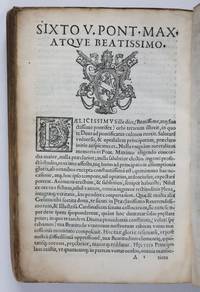
158747668Venice: Apud Ioannem de Gara Giovanni di Gara 1587. First edition. Hardcover. g- to g. Large quarto. Paginated double sided leaves throughout: 5 1 238 5-62 leaves. Period dark brown mottled leather boards with gilt lettering over a brown label on the spine. Raised bands. Speckled edges of the book block in red. Introductory text in Latin dedicates the book to Pope Sixtus V and includes his elaborate engraved papal coat of arms as well as large decorative initials. The initial text also gives biographical and historical background on the author and his roots. The Latin introduction is followed by a two-page Hebrew intoduction.<br /> <br /> This phenomenal volume is a pioneering trilingual Hebrew-Latin-Italian dictionary created by Italian Renaissance-Era Rabbi linguistic scholar and physician David ben Isaac De Pomis 1524-1594. De Pomis' aim with this work being as he was a scholar of both Jewish as well as secular subjects was to create a work which would who have crossover appeal and be useful to both Jewish and non-Jewish scholars alike. In many ways the work can be seen valuable outreach to the Christian and Italian communities of the period. Although De Pomis approaches this work from the perspective of Rabbinic/Biblical Hebrew he also includes numerous additional medical and biological terms given his background as a physician. The main body of the text consists of the dictionary which is organized alphabetically according to the Hebrew. Following sections include a glossary of common Rabbinic abbreviations a Italian-Hebrew Lexicon containing the original Italian in Roman script facing the Judeo-Italian in Hebrew script leaf 5-36 and a final alphabetical index of Latin words leaves 36-62.<br /> <br /> There are original printing errors resulting in the mis-pagination of 7 leaves #77 79 85 112 190 199 and #10 of the second pagination but all content is present.<br /> <br /> Text throughout in Hebrew Latin and Italian all printed in a two-column format.<br /> <br /> Binding with head and tail of spine chipped away hinges splitting and some additional rubbing to extremities. Some scratching to covers. Interior with some sporadic minor to light foxing water stains and/or smudges throughout the text. Title page loose but sill attached. A few minor sporadic instances of worming but all are in the margins. Leaves 222-228 of the first pagination contain minimal water staining along the bottom margin not affecting text. Small tears to the bottom corners of leaf 120 of the first pagination and leaf 35 of the second pagination. Starting at interior front cover. Book block tight overall. Binding in good- interior in good condition overall. Hebrew title: צמח דוד : בו הצמיח ופרש ב×ר היטב בקצור בשלשה ×œ×©×•× ×•×ª כל שורש מלה ומלה ×©×ž×¦× ×‘×¡×¤×¨ הערוך הגדול<br /> Author: פומיס דוד בן יצחק<br /> Alternate Transliterations: Tsemach David Zemah Dawid Tzemach David Zemach David<br /> References: Bartol. II. 37; Wolf I. 311 III. 195 196. Vinograd Venice 717. Roest 944. Zedner p.641. Cowley p.154<br /> <br /> About the author:<br /> David ben Isaac De Pomis 1524-1594 was a noted Italian Rabbi physician linguist and scholar born in Spoleto. De Pomis was respected as something of a savant in his time by both the Jewish and non-Jewish community for his excellence across numerous fields of study. He traced his roots back to the original Roman Jewish community of the ancient era who had first come to the Italian Peninsula during the fist century. In 1587 he published this work "Tsemah David" which many consider to be his magnum opus. Apud Ioannem de Gara (Giovanni di Gara) hardcover
158747873Venice: Apud Ioannem de Gara Giovanni di Gara 1587. First edition. Hardcover. g to vg-. Large quarto. Paginated double sided leaves throughout: 5 1 5-62 238 leaves. Recased in its original period vellum binding and reinforced with new endpapers. Introductory text in Latin dedicates the book to Pope Sixtus V and includes his elaborate engraved papal coat of arms as well as large decorative initials. The initial text also gives biographical and historical background on the author and his roots. The Latin introduction is followed by a two-page Hebrew intoduction.<br /> <br /> This phenomenal volume is a pioneering trilingual Hebrew-Latin-Italian dictionary created by Italian Renaissance-Era Rabbi linguistic scholar and physician David ben Isaac De Pomis 1524-1594. De Pomis' aim with this work being as he was a scholar of both Jewish as well as secular subjects was to create a work which would who have crossover appeal and be useful to both Jewish and non-Jewish scholars alike. In many ways the work can be seen valuable outreach to the Christian and Italian communities of the period. Although De Pomis approaches this work from the perspective of Rabbinic/Biblical Hebrew he also includes numerous additional medical and biological terms given his background as a physician. The main body of the text consists of the dictionary which is organized alphabetically according to the Hebrew. What was originally bound in as a separately paginated concluding section at the end of the volume leaves 5-62 here has been mistakenly rebound before the main pagination 238 leaves. These sections include a glossary of common Rabbinic abbreviations a Italian-Hebrew Lexicon containing the original Italian in Roman script facing the Judeo-Italian in Hebrew script leaf 5-36 and a final alphabetical index of Latin words leaves 36-62.<br /> <br /> There are original printing errors resulting in the mis-pagination of 6 leaves #77 79 85 112 199 and #10 of the other pagination but all content is present.<br /> <br /> Text throughout in Hebrew Latin and Italian all printed in a two-column format.<br /> <br /> Binding with some light rubbing and bumping to the edges. A strip of vellum has been torn away at the top of the front cover. Some additional period staining to the covers. Light water stains and foxing to the title page which includes the period ink signature of the previous owner J. Blacknell in the left margin. Text pages throughout with some light to moderate staining to the margins. Text mostly unaffected and overall clean and vibrant. Bottom corners of the final two leaves including the blank with some light chipping. Book block tight. Binding in good interior in very good- condition overall. Hebrew title: צמח דוד : בו הצמיח ופרש ב×ר היטב בקצור בשלשה ×œ×©×•× ×•×ª כל שורש מלה ומלה ×©×ž×¦× ×‘×¡×¤×¨ הערוך הגדול<br /> Author: פומיס דוד בן יצחק<br /> Alternate Transliterations: Tsemach David Zemah Dawid Tzemach David Zemach David<br /> References: Bartol. II. 37; Wolf I. 311 III. 195 196. Vinograd Venice 717. Roest 944. Zedner p.641. Cowley p.154<br /> <br /> About the author:<br /> David ben Isaac De Pomis 1524-1594 was a noted Italian Rabbi physician linguist and scholar born in Spoleto. De Pomis was respected as something of a savant in his time by both the Jewish and non-Jewish community for his excellence across numerous fields of study. He traced his roots back to the original Roman Jewish community of the ancient era who had first come to the Italian Peninsula during the fist century. In 1587 he published this work "Tsemah David" which many consider to be his magnum opus. Apud Ioannem de Gara (Giovanni di Gara) hardcover
152367625First Edition of this" Book of Education" Rearranging the 613 Commandments of Maimonides BEN JOSEPH HA-LEVI OF BARCELONA Pinhas. BEN JOSEPH HA-LEVI Aharon. MAIMONIDES association Sefer ha-Hinnukh. Venice: Daniel Bomburg 283 i.e. 1523. First edition. Quarto in eights 9 1/8 x 6 7/8 inches; 230 x 175 mm. 179 leaves. Possibly lacking a final blank but textually complete. This book being an arrangement of the 613 commandments of Maimonides was originally attributed to Aharon Ben Joseph ha-Levi the brother of Pinhas. Text in Hebrew in two columns. Only one complete copy that we could find in the traditional auction houses the last fifty years which was at Sothebys on December 1 2008 and sold for $21250. Full modern brick-red sheep. Boards panel-ruled in blind. Boards with gilt tooled frame and gilt woven center devices. Gilt floral corner devices to boards. Spine ruled in gilt and blind and gilt floral devices in four compartments. Board edges ruled in gilt. Title-page the following leaf and the final leaf with inner margin repair. Some light marginal stains to preliminary leaves and some mostly marginal dampstaining to the final 40 approx leaves. Small red pencil note on the verso of the title-page and some pencil notations on the verso of the final leaf. Overall a very good copy. This text Sefer ha-Hinnukh Book of Education is a rearrangement of the 613 commandments of Maimonides in the Sefer ha-Mitzvot Book of Commandments. They are listed according to the weekly Torah portion. "Sefer Ha-Hinnikh one of the most popular books on the reasons for the commandments written in the thirteenth century.it is directed to students ages eighteen through twenty and is a prÈcis of Moses Maimonides work on the rational nature of the commandments. Sefer Ha-Hinnukh stresses observance of the commandments and says that performance should precede intention. A person must not try to calculate the reward for the fulfillment of a commandment but may consider its reasons. The author recommends that students read the book on Sabbath eves so that they will not run wild in the streets and states that the book is also of value to adults as a source for the study of halakhah." The Oxford Dictionary of the Jewish Religion HBS 67625. $22500 Daniel Bomburg hardcover books