71 résultats
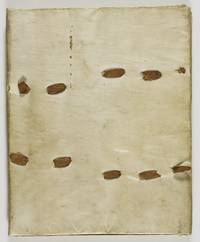
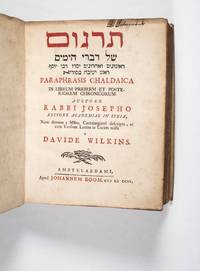
171549239Amsterdam: Jan Boom 1715. First edition. Hardcover. Very Good. Small quarto. asterisk4 a-f4 -blank f4 A-3F4 = 235 leaves. 54 415 1 blankpp. Contemporary vellum with exposed thongs boards somewhat bowed spine darkened early manuscript title in Hebrew and Latin at spine. Old owner entry at top margin title memorial label at front paste-down. A very good copy amply-margined with fine crisp text throughout.<br /> <br /> Important edition of this Aramaic version of the biblical books of Chronicles attributed to Joseph ben Hiyya d. 333 a Babylonian amora and head of the Pumbedita academy near present-day Falluja Iraq. "Ben Hiyya was also distinguished in biblical exegesis and left an Aramaic translation of parts of the Bible which is often quoted. It is not to be assumed however that Joseph translated the whole Bible though the Aramaic translation of the Books of Chronicles is ascribed to him. Enc. Jud. The editio princeps edited from an Erfurt manuscript by Matthias Frederick Beck and accompanied by substantial annotations was published at Augsburg in 1680. "After this David Wilkins gave the public an edition from a Cambridge manuscript of which the text was more pure and more complete. The critic should unite both these editions the former for the value of its learned notes and the latter for its full and accurate text†The Biblical Repertory. <br /> <br /> The Coptic scholar David Wilkens 1685–1745 was born of Prussian parentage in Memel Lithuania. Little is known about his education in Germany probably in Berlin or how he acquired his knowledge of ancient and Semitic languages which was extensive rather than profound. He referred to the antiquarian Ezechiel Spanheim the elector of Brandenburg's ambassador in England from 1701 to 1710 as his former teacher. By 1707 Wilkins was studying at the Bodleian Library in Oxford and had encountered a group of clerical protectors in London. In 1709 engaged in preparing a history of the patriarchs of Alexandria which remained in manuscript and the editio princeps of the Coptic Bohairic New Testament the Novum Testamentum Aegyptium 1716 he left for the continent. He called on scholars examined manuscripts in Vienna Rome and Paris and stopped in Amsterdam in 1714 to see to the publication of his first works -- an edition of the Aramaic paraphrasis of the books of Chronicles and an Armenian version of the apocryphal third epistle to the Corinthians 1715 -- and of John Chamberlayne's polyglot edition of the Lord's prayer to which he contributed. Wilkins was an industrious scholar. In the three years he spent as librarian at Lambeth he made important contributions to the cataloguing of manuscripts. In 1721 he edited the Anglo-Saxon laws in 1725–6 the complete works of John Selden and in 1731 the Coptic Pentateuch. His main work was his Concilia Magnae Britanniae et Hiberniae an account of British church councils from 446 to 1717. Wilkins had many detractors -- John Gagnier the professor of Arabic at Oxford who deplored his incompetence in Arabic and Hebrew Edward Harley who described him as ‘a very great scoundrel’ and the cantankerous Thomas Hearne who as librarian at the Bodleian had watched him turn from a young man ‘of a civil Courteous and modest behaviour’ into ‘a vain ambitious man of little judgement tho' great industry’ ready to ‘do anything in the World for a little Money’ Alastair Hamilton: "Wilkens David" -- ODNB online.<br /> <br /> Provenance: From the library of G.H.A. Juynboll 1935-2010 the celebrated scholar of Islamic Hadith literature with his printed memorial label at front paste-down. Hebrew title: ×ª×¨×’×•× ×©×œ דברי ×”×™×ž×™× ×¨××©×•× ×™× ×•××—×¨×•× ×™× ×™×¡×“×• ר×ש ישיבה בסורי×<br /> <br /> References: The Biblical Repertory 1834 6:248-249. Brunet 3:574 - "Livre recherché et peu commun". Enc. Jud. 10:229. Le Long Bibliotheca sacra 1723 1:92B. Le Long-Masch 2.1 p. 48: “Multo correctior est editio ac praecedens Beckiana.†long note in which the relation with the never published version by Clarke is discussed. Cf. D&M 2416: The editio princeps of the Targum on Chronicles printed from an Erfurt MS. and edited with a Latin translation by M. F. Beck Augsburg 1680-3 2 vols 4to. The present edition is “a more complete form of the text from a Cambridge MS. . edited with a Latin translation by D. Wilkins. Jan Boom hardcover
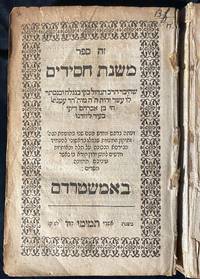
174042573Amsterdam: No Publisher Listed 1740. Hardback. 2nd edition. Period Vellum binding 12mo 132 leaves; 17 cm. In Hebrew. Mayer Sulzberger's copy with his bookplate. Like the Mishnah Mishnat Hasidim is arranged in "Sedarim" which are divided into "massechtot" and subdivided into "perakim." With an introduction entitled: Olam Katan. Includes index. Title-page has ornamental border. <br> Raphael Immanuel ben Abraham Hai Ricchi 1688-1743 was an "Italian rabbi cabalist and poet.After having studied Talmud under Nathan Pinkerle rabbi of Alessandria della Paglia Ricchi became tutor in the houses of several wealthy Jews. He was thus successively employed at Göritz Fiorenzuola Finale in Modena and Venice; in the last-named place he opened a school. He then went to Triest where he was ordained rabbi in 1717 by Hillel Ashkenazi rabbi of Canea after which he was invited to the rabbinate of Görz.<br> Owing to his great love for cabalistic studies and to his ascetic tendencies Ricchi resolved to settle in Palestine. He arrived at Safed in 1718 and during his stay there of two years he occupied himself with the study of the works of Isaac Luria and Hayyim Vital. He was also reordained rabbi by Hayim Abulafia. In 1720 an epidemic broke out in Palestine and Ricchi was compelled to return to Europe. <br> On the voyage he and all his fellow passengers were captured by pirates and brought to Tripolitza whence through the efforts of Abraham Halfon Ricchi and his family were allowed to return to Italy. He then occupied the rabbinate of Florence till 1723 in which year he removed to Leghorn where for twelve years he engaged in business as a merchant. He spent twenty months in travel visiting Smyrna Salonica Constantinople Amsterdam and London and in 1735 set out for Palestine spending two years at Aleppo and three at Jerusalem. In 1741 he returned to Leghorn and in 1743 while traveling in Italy for the purpose of selling his works he was killed by robbers who buried his body by the shore of the Reno. Six days later some Modena Jews discovered the remains and brought them to Cento for burial.<br> Ricchi's most important work is the above-cited 'Mishnat Hasidim' a cabalistic work begun in 1726 at Leghorn. <br> Like the Mishnah it is arranged in orders 'sedarim' which are divided into treatises 'massektot' and subdivided into chapters 'peraim' the names of the six Mishnah orders being taken in a cabalistic sense. But the chief divisions of the work are three termed 'mafteot' besides the introduction entitled ''Olam Kaon' = 'microcosmos' in which Ricchi endeavors to popularize the Cabala. <br> The first main division is the 'Maftea ha-'Olamot' in which the worlds are treated. It contains: 1 the order of Zera'im treating of the cabalistic cosmology and of metaphysics and divided into seven massektot and eighteen chapters; 2 the order Kodashim treating of the realm of emanation 'olam ha-azilut' which is styled 'the holy of holies' and containing twenty massektot and seventy-eight chapters; 3 the order ohorot treating of the three other realms namely those of creative ideas 'beri'ah' creative formations 'yezirah' and creative matter 'asiyah' and divided into nine massektot and twenty-seven chapters; and 4 the order Nezikin treating of the demons and 'kelifot' and divided into six massektot and seventeen chapters. <br> The second main division entitled 'Maftea ha-Neshamot' contains the order Nashim treating of souls in twelve massektot and forty-eight chapters. The third main division entitled 'Mafteah ha-Kawwanot' contains the order Mo'ed divided into fifty-eight massektot and 371 chapters and treating of the Kawwanah. It will be seen that the number of massektot in this work is 112 corresponding to the numerical value of the sacred name ; and the number of chapters 547 equal to the numerical value of Ricchi's name plus twelve the number of its letters. <br> The sources for this work besides the Zohar are mostly Isaac Luria's and Hayyim Vital's writings of which the 'Sefer ha-Gilgulim' 'Kanfe Yonah' and 'Shulhan 'Aruk' may be particularly mentioned. Ricchi drew also from other cabalists" M. Seligsohn in JE 1905.<br> NYU houses their copy in the Mitchell M. Kaplan Collection of Rare Judaica and Hebraica. Aviva Ben-Ur's Ladino catalog list #14. Judge Mayer Sulzberger "was closely associated with Isaac Leeser and assisted that scholar in editing The Occident contributing to it a partial translation of Maimonides' "Moreh Nebukim." After Leeser's death Sulzberger edited vol. xxvi. of The Occident. He was one of the founders of the Young Men's Hebrew Association which he served as president; and he has taken great interest in the Jewish Hospital of Philadelphia of which he has been vice-president since 1880. He was from the beginning in 1888 chairman of the publication committee of the Jewish Publication Society of America; was one of the original trustees of the Baron de Hirsch fund; and interested himself in the establishment of agricultural colonies at Woodbine N. J. and in Connecticut.Sulzberger had one of the best private libraries in America; it contained a very large number of Hebraica and Judaica" WIkipedia. SUBJECTS: Cabala -- Early works to 1800. Siddurim -- Texts. Judaism -- Ari rite -- Liturgy -- Kabbale -- Ouvrages avant 1800. Siddour -- Textes. Cabala. OCLC: 904949349. OCLC lists only 2 copies of this 1740 2nd edition worldwide NYU & Cambridge and only 3 copies of the first edition of 1727.<br> Boards slightly bowed with front hinge starting. Remains of 19th Century paper label on spine. Lacks front blank pastedown. Jewish institutional bookplate in addition to that of Sulzberger. Paper toning but strong. About Very Good- Condition. Attractive copy of early edition of an important cabalistic text. RAB-67-7. Amsterdam: [No Publisher Listed] unknown
176040177Nürnberg Raspe | Nurnberger (Nuremberg) 1760 | 10 x 17 cm | relié
176040177Nurnberger Nuremberg Nuremberg: Nürnberg Raspe 1760. Fine. Nürnberg Raspe Nurnberger Nuremberg Nuremberg 1760 10 x 17 cm relié First edition illustrated with 20 figures battle scenes at the end of the work. Gothic round typeface. Contemporary full brown sheep binding. Jansenist spine with raised bands. Tawny morocco title label. Blind title. German binding. History of the war between Prussia and its allied states and Austria and its allied states. It was Frederick II who triggered the hostilities between the two nations by attempting to seize Silesia this war took place within the conflict of the Austrian succession. Nürnberg Raspe hardcover
17384335Bruxelles, Jean Léonard, 1738, 2 tomes, 10 X 16 cm., reliés, LXXXIV-4 feuillets-358 ; 554 pages. Traduite sur l'original grec revu sur divers manuscrits par le janséniste Arnaud d'ANDILLY. Nouvelle édition. Enrichie d'un grand nombre de fines figures en taille-douce, inventées par Richard van ORLEY. Jolie paire de pleins veaux tachetés, au dos lisse orné et aux tranches marbrées. Coupes et coiffes émoussées, deux trous de vers en queue de chaque dos. Très peu de traces sur les feuillets.
1732006985London: J. Walthoe & 14 Others 1732. Perhaps the best-known play by the second-greatest playwright of the Elizabethan stage.This is a Near Fine copy of an early edition; very scarce.Marbled paper-covered boards with titling in gilt on a leather spine label. Clean text; 96 pages complete. Light toning throughout but textblock remains sharpand clear. The spine label has some tiny chips at the edges which do not intrude into the title. . Early Edition. Hard Cover. Near Fine/No Jacket. 12mo - over 6¾" - 7¾" tall. J. Walthoe & 14 Others Hardcover
176849937Fiyorda Furth: Hayim Ben Tzevi Hirsh 1768. Second edition. Hardcover. g to vg. Square octavo. 54 leaves. Rebound in modern brown cloth over marbled paper boards decorated with gilt. Decorative woodcut border on the title page. The scarce second edition of Rabbi Aaron ben Mordecai of Rödelheim's born ca.1695 Yiddish translation of the two known Targumim of the biblical book of Esther. The first of the Aramaic Targumim Aramaic Translations or paraphrases of the books of the bible is more common and well known while the second targum is noted for its embellishments on the Biblical account with considerable additional apocryphal material not always evidently related to the Esther story. The Yiddish text here is printed throughout in the traditional Vaybertaytsh script. This is the Rabbi Aharon's most notable work and the first addition was originally published in 1718 in Frankfurt.<br /> <br /> Binding with light rubbing to extremities. Back board lightly bumped along the side edge. Interior with some chipping/fraying to the edges of the first two leaves resulting in some minimal loss of text. Pages throughout with some sporadic soling or dampstaining. Some chipping and fraying to the final leaf as well. Binding in very good interior in good condition overall. Quite scarce. Hebrew title: ספר מצח ×הרן על מגילות ×סתר ×ª×¨×’×•× ×¨×שון ×•×ª×¨×’×•× ×©× ×™<br /> Author: ×הרון בן מרדכי של רודליי×<br /> Publication: ×הרון בן מרדכי מטריביטש<br /> Alternate transliterations: Sefer Mezach Aharon<br /> Bibliographic references: Vinograd Furth 387<br /> Bought at the Parke-Bernet Galleries auction from the Michael Zagayski collection May 12th 1970. Catalog of sale no. 3046 #68 page 36. Original typed slip with auction information laid in at the front cover of the book. Hayim Ben Tzevi Hirsh hardcover
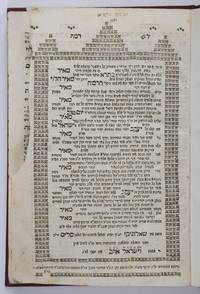
179148770Thessaloniki: Mordekhai Nahman ve-David Yisraelig'ah 1791. First edition. Hardcover. g- to vg-. Two volumes large quarto. Vol.1: 2 157. Vol.2: 3 158- 274 1 35. Double-sided leaves. Rebound in modern burgundy mottled faux-leather boards with gilt lettering on the front covers gilt lettering and ruling on the spines. Edges of the book block in red. Title pages bordered with small woodcut motifs.<br /> <br /> The first printed edition of this commentary on the Talmudic tractate Bava Batra by famed mediaeval Spanish Rabbi Meir Abulafia aka 'The Ramah' c. 1170 – 1244. The work is one of only three surviving parts Tractates Bava Batra Sanhedrin and Kidushin plus the fourth chapter of Tractate Gittin from his larger series of his Talmudic commentaries known as Yad Ramah meaning "Hand of the Ramah" or "The Upraised Hand". The final section of the second volume contains Shiyur Shitah Mekubetset with its own title page a subsequent commentary on the work by Rabbi Bezalel Ashkenazi c. 1520 – c. 1592 and an approbation at the start of the first volume by editor Yosef Elia Halevi. The first volume includes a few illustrated figures and diagrams on leaf 123.<br /> <br /> Text throughout in Hebrew printed in Rashi script in a two column format.<br /> <br /> Bindings with minor rubbing bumping and damp staining to the corners. Minor scratches and smudges to the covers. Title page in volume one torn along the left margin. Title page of volume torn along the left margin with no loss of text. Title page of volume 2 with tears worming and staining with some loss of text. Volumes quite clean overall with only minor sporadic staining in the margins. Worming throughout both volumes with some loss of text mostly in the second volume. A few pages throughout the volumes have been repaired with tape. Bindings in very good- interiors in good- to good condition overall. Scarce. Hebrew title: יד רמה<br /> Authors: רבי מ×יר הלוי ×בו××œ×¢×¤×™×™× ×”×¨×ž"×” יוסף ×ליה הלוי בצל×ל בן ××‘×¨×”× ××©×›× ×–×™<br /> Publication: ש××œ×•× ×™×§×™ בדפוס ×”×©×•×ª×¤×™× ×ž×¨×“×›×™ × ×—×ž×Ÿ ודוד ישר×ליג'×”<br /> <br /> Bibliographic references: Vinograd- Salonica 407. Mordekhai Nahman ve-David Yisraelig'ah hardcover
170133078Fulda 1701. Hardcover. fair. 4to. 185 leaves. Black cloth. Red edges. Illustrated title-page with Moses and Aaron on the sides and David killing Goliath at the bottom. Commentary on selections of the Zohar and other kabbalistic texts by Mordacai Ashkenazi published with the aid of his teacher Abraham Rovigo. These two kabbalists were both secret followers of the messianic claimant Sabbatai Sevi. Despite Sabbatai's conversion to Islam in 1666 and death in 1676 many of his followers continued to believe in him and worked to spread their particular heterodox brand of Judaism in defiance of the rabbinic establishment. As cover for his Sabbatian agenda Ashkenazi claimed that “Eshel Avraham†was simply a new interpretation of the Kabbalah based on his prophetic dreams. Ultimately this book is an important example of the success of the early eighteenth century Sabbatian underground to print books under the nose of the rabbinic authorities before it came out into the open with the printing of Nehemiah Hayon's “Migdal Oz.†Text in Hebrew. Backstrip missing but the book is still intact. Bottom corner chipped. Title-page torn and bottom strengthened. Slight worming to front leaves. Overall in fair condition. Steinschneider 4299:1. <br /> Samuel Wiener Bibliotheca Friedlandiana 991. hardcover
1711045339Berlin: Meschullam Zalman ben Wolf Fischhof 1711. Second Edition. Hardcover rebound in cloth. Fair Condition. Rebound in plain green cloth early and late leaves chipped at the edges with some repairs occasionally touching the text. Browned throughout. Rare work by the 17th century Cabalist. 28ff. Size: Octavo 8vo. Quantity Available: 1. Shipped Weight: Under 1 kilo. Category: Religion & Theology; Magic Paranormal & Occult. Inventory No: 045339. <br/><br/> Meschullam Zalman ben Wolf Fischhof hardcover books
171248353Frankfurt: Johann Kelner 1712. First edition. Hardcover. vg- to vg. Octavo. 1 143 double-sided leaves. Rebound in modern black buckram boards. Blue and white sticker on the spine with handwritten lettering in black in ink. Gilt ruling to the head and tail of the spine. Decorative woodcut borders on the title page woodcut tailpiece on the verso of the final leaf. A first edition of this important commentary on the biblical exegesis of Rashi by Rabbi Shabbethai ben Joseph Bass 1641–1718 considered his magnum opus. The work returns the reader to the original questions and confusions that Rashi himself faced with the original biblical text and chronicles his thought process in answering those questions. Also included in this text are summaries of much of the content of previous commentaries of Rashi 's writings most notebly including the writings of Rabbi Elijah Mizrachi c. 1455 – 1525 or 1526 aka "Re'em". This work is considered an essential text for the study of the commentaries of Rashi.<br /> <br /> The Hebrew text throughout is printed in Rashi script in a two-column format.<br /> <br /> Binding with some minor rubbing to extremities and slight bowing of the front cover. Interior with previous owner's ink stamps on the free endpapers and a small orange sticker on the interior front cover. Age toning to pages throughout. Minor chipping to the bottom edge of the initial leaf resulting in minor loss of border design and minor text loss on the verso. Sporadic light water stains and/or smudges throughout mostly in the margins. The final two leaves contain a few small wormholes resulting in minor loss of text. Tightly trimmed pages from the title p.24 with minimal text loss in a few instances. Binding in very good interior in very good- condition overall. Hebrew title: שפתי ×—×›×ž×™× : ×•×”×•× ×¤×™×¨×•×© על דברי רש״י על התורה וחמש מגילות<br /> Author: בס שבתי בן יוסף<br /> Publication: ×¤×¨× ×§×¤×•×¨×˜ דמיין יוה×ן ×§×¢×œ× ×¨<br /> Alternate transliteration: Sifte Hahamim Siftei Chachamim Sifsei Chachamim<br /> <br /> Bibliographic reference: Vinograd p. 585 Frankfurt A.M. #295<br /> <br /> Although this is the first publication of the work by itself the work had previously appeared as part of a publication of the Pentateuch which also included the commentaries of Rashi published in Amsterdam in 1680. Johann Kelner hardcover
172255261Offenbach Germany: Israel Ken 1722. Second edition. This is the copy of the Rabbi David Paul-Bernard Drach 1791-1868 who converted to Catholicism in 1823 and managed the library of the Propaganda Fide in Rome. The front endpaper has a note that is signed and dated by Drach: "Etudie et annote ce volume; supplee lets mots ronges par les vers et corrige les fautes typographiques." Notes to margins. Introductory note by Drach lauding the book: "Le calendrier juif dont les calculs sont d'une exactitude admirable etait deja en usage du temps de Rabbie Gamliel pas consequents a l'epoque ou le Verbe eternel caro factum est et habitavit in nobis." <br /> <br /> 8vo. 40 in Hebrew letters numbered leaves i.e. 80pp. re-cased in later vellum with leather strips. Engraved title page. Fascinating work on the Jewish calendar its estimation calculation of the New Moon methods of chronology et.al. Also contains a few pages on the Christian calendar. This work is one of the most profusely illustrated works of Hebraica and Judaica with charts ephemerides sketches and illustrations throughout. One volvell attached. In Hebrew. First ten leaves with one inch holes from bookworms. The rest of the volome with minor circular bookworm hole. Some loss of text on first ten leaves. "The volvelles as well as hand diagrams and tables were some of the tools used not just for calculating and identifying pivotal dates and worshipping times for Jews but also for ascertaining Christan holidays. This knowledge was a critical aid for protecting Jews from the danger posed by their having different worshipping times and habits from the dominant culture. The headings on the wheel denote the arrival of the new moon which marks the start of the Jewish month and the cycle of the sun. Whereas calendars appear in general to be a “convenient way to coordinate human movements with natural time†as Elisheva Carlebach points out the Sefer ‘Evronot demonstrates that the methods for doing so are culturally and historically shaped. The wheel computing information with each push of a finger demands interaction from the reader in order to yield knowledge not just to use but to live by." Ref: brevigrapher.interactive book. <br /> <br /> Furst I 99 & 360 Steinschneider 4988.4. Israel Ken unknown
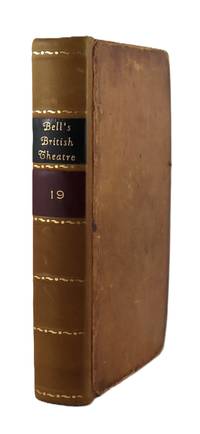
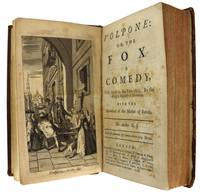
178023923<p>London: John Bell 1780. leather. Good /no dustwrapper. 16mo . frontispiece engravings Collection of five plays being volume 19 in the Bell's British Theatre and vol 10 of the comedies; the plays are please note full title given for Volpone the remainder containing equivalent sub-titling: Volpone or The Fox a Comedy as altered from Ben Jonson and performed at the Theatre-Royal in Covent-Garden regulated from the Prompt-Book by permission of the Managers by Mr. Wild Prompter; The Country Lasses Charles Johnson The Mistake Sir John Vanbrugh The Gamesters as altered from Shirley and The Lady's Last Stake Colley Cibber; each play with its own title page and facsimile engraving facing frontispiece engraving for Bell's British Theatre total of 6 engravings; all plays dated 1778 with frontispiece engraving dated 1780; period calf boards with new leather spine with black and maroon title labels and gilt titling new endpapers; scattered foxing throughout offset from engravings title pages and text block tanned o.w. Good; boards rubbed/scuffed worn at corners new leather with very mild scuff marks.</p> John Bell hardcover
174561985Frankfurt & Leipzig, 1744 & 1745. 8vo. Uniformly bound in two contemporary half calf bindings with four raised bands and gilt lettering to spines. Old paper-labels pasted on to top of spines. Wear to extremities, spines with a few holes. Internally nice and clean. (8), 118, (8), 132, 16 pp. 56, 31, (1), 46, (2), 96 pp. + 1 folded maps and 1 folded plate.
178919810Berlin: Hevrat chinuch ne'arim 1789. First edition. Hardcover. fair. Sm. folio. 2 pp. per leaf there being 64 leaves with Hebrew pagination thus there are 128 pp. Printed in double columns. Brown boards with brown leather spine. This work is extremely rare as OCLC only lists 4 libraries in the entire world that own this work. This is a commentary on the Talmud on the Tractate Baba Metsia the entire orders of Moed Nashim Nezikim and Kodashim. Text is entirely in Hebrew printed in "Rashi Script". Scuffing to boards and yellowing to pages due to age but text is clear and pristine. Boards detached but present. Exterior in fair interior in good condition. Hevrat chinuch ne'arim hardcover
1716L005.019GB: Not Known 1716. DISBOUND TEXT No covers. Text p3/4 commences at the title for CATILINE but has no overall title page. Catiline extends to page 115 then follow epigrams masques etc to page 488 where is stated "The End of the Third Volume". Fairly clean unspoted text shows signs of wear and age. First leaf heavily dust marked. Minor worm tracks in margin of last 12 pages. Just a good reading copy . Good. Not Known unknown
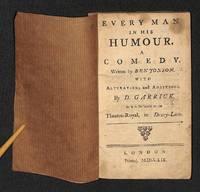
1716279London: J. Walthoe et al. 1716. First octavo and first illustrated edition. Armorial Fine Full Morocco. Good. First illustrated and first octavo set of The Works of Ben Johnson in beautiful armorial fine full morocco. Ben Johnson was Shakespeare's contemporary and rival considered second only to the Bard in importance and eminence by modern scholars during the reign of James I. Though at the time the distinction of superior literary merit was less clear.<br /> <br /> Set Condition: Good detached front board on Vol. I Scarce set to find complete.<br /> <br /> BOOK INFO<br /> <br /> Published in 1716 by J. Walthoe et al. in London. First octavo edition and first illustrated edition of The Works of Ben Johnson. Large paper edition. Rebound early 19th century by John Clarke in the style of 17th century fine French bindings for Rev. Theodore Williams of England 1785 -1875. <br /> An armorial full morocco fine binding. Covers with centered coat of arms of Thedoore Williams tooled in gilt. Raised spine bands separate compartments lavishly tooled and ruled in gilt; two compartments with gilt lettered and decorated morocco spine labels. All board edges ruled in gilt. All page edges gilt. Marbled endpapers and turn-ins ruled in triple gilt fillets with corner fleuron devices. Endpapers refreshed. Octavo 8 3/4" x 5 1/2". Copper engraved plates and woodcut initials and head- and tail-pieces. Collated and complete in six volumes including all 12 plates inlcuding frontispiece: <br /> <br /> Vol I: 512 pages 5 leaves of plates. Every man in his humour; Every man out of his humour; Cynthia's revels or The fountain of self-love; Poetaster<br /> <br /> Vol II: 2 448 pages 4 leaves of plates. Sejanus: his fall; Volpone or the fox; The silent woman; The alchymist<br /> <br /> Vol III: 488 pages 1 leaf of plates. Catiline's conspiracy; Epigrams; The forest; Entertainments masques speeches & c<br /> <br /> Vol IV: 455 1 pages 2 leaves of plates. Bartholomew Fair; The staple of news; The devil is an ass; The magnetick lady or Humours reconcil'd<br /> <br /> Vol V: 2 432 pages. A tale of a tub; The sad shepherd or A tale of Robin Hood; Under-woods: consisting of divers poems; Mortimer's fall; Masques<br /> <br /> Vol VI: 2 414 10 pages. Masques; Horace's Art of poetry translated into English verse; The English grammar; Explorata or Discoveries made upon men and matter; The new inn or The light heart; Epilogue<br /> <br /> CONDITION REPORT<br /> <br /> Volumes are Good overall. Front board detached in Volume I. Refreshed endpapers.<br /> <br /> Exterior and Binding: Volume I with front board detached and back board three-fourths detached may detach during shipment. Several volumes with vertical cracks down spine. Heavily rubbed joints cracking. Rubbed and worn extremities. Areas of soiling and darkening of leather.<br /> <br /> Interior: Descriptive note of set adhered to front pastedown of Volume I. Pages are generally clean and bright and off white to lightly toned. Light to sporadic foxing. Several areas with professionally repaired tears and neat marginal paper restoration. Some pencil writing and partially erased pencil writing on blanks. A few passages with marginalia in pencil in a 19th century hand. A few plates with very light offsetting. Other signs of light handling like some bent or nicked corners or light creases. No ex libris marks or former owner bookplates.<br /> <br /> PROVENANCE<br /> <br /> Theodore Williams 1785 - 1875 was the son of James Williams of Westmoreland Jamaica. He was the Vicar of Hendon for sixty-three years. As a young man he collected a magnificent library which he had sumptuously bound. The majority of his collection were bound by Charles Lewis or John Clarke often in the style of 17th century fine binding. His library was sold at auction in London in 1827. He lived almost another 50 years post-sale. An uncommon example of a cured bilbiomaniac - an example to which I cannot relate!<br /> <br /> ABOUT BEN JOHNSON <br /> <br /> Benjamin Jonson June 1572 – August 1637 was an English poet and playwright. Jonson's artistry exerted a lasting influence on English poetry and stage comedy. He popularized the comedy of humors. He is best known for the satirical plays Every Man in His Humour 1598 Volpone or The Fox c. 1606 The Alchemist 1610 and Bartholomew Fair 1614 and for his lyric and epigrammatic poetry. He is regarded by most modern scholars as the second most important English dramatist after William Shakespeare during the reign of James I.<br /> <p>Jonson was a classically educated well-read and cultured man of the English Renaissance with an appetite for controversy personal and political artistic and intellectual. His cultural influence was of unparalleled breadth upon the playwrights and the poets of the Jacobean era 1603–1625 and of the Caroline era 1625–1642.<br /> <br /> In 1616 Jonson received a yearly pension of 100 marks about £60 leading some to identify him as England's first Poet Laureate although the royal family never formally granted him the title.<br /> <br /> There are many legends about Jonson's rivalry with Shakespeare. Thomas Fuller relates stories of Jonson and Shakespeare engaging in debates at the Mermaid Tavern. That the two men knew each other personally is beyond doubt not only because of the tone of Jonson's references to him but because Shakespeare's company produced a number of Jonson's plays at least two of which Every Man in His Humour and Sejanus His Fall Shakespeare certainly acted in. Jonson's most influential and revealing commentary on Shakespeare is the second of the two poems that he contributed to the prefatory verse that opens Shakespeare's First Folio. This poem "To the Memory of My Beloved the Author Mr. William Shakespeare and What He Hath Left Us" did a good deal to create the traditional view of Shakespeare as a poet who despite "small Latine and lesse Greeke"60 had a natural genius. The poem has traditionally been thought to exemplify the contrast which Jonson perceived between himself the disciplined and erudite classicist scornful of ignorance and skeptical of the masses and Shakespeare represented in the poem as a kind of natural wonder whose genius was not subject to any rules except those of the audiences for which he wrote.</p> . J. Walthoe, et al. unknown
1729001923Dublin Ireland: Printed by S. Powell for George Risk George Ewing and William Smith Booksellers in Dame's-street 1729. 1st Edition Thus . Hardcover. Fair/NDAI No Dust Jacket As Issued. 16mo - over 5¾ - 6¾" tall. First vol only. Period binding of half dark leather and marbled paper. Spine leather is heavily cracked and chipped with scant lettering remaining and apparently reinforced with some type of binding agent. Boards overall heavily rubbed edgeworn and chipped; some dampstaining which barely affects interior. Binding tight. Interior moderately toned and soiled. Amateur repair with too-liberally applied glue and white paper tape at title page and following page which is the list of subscribers as well as rear hinge. Each play has its own title page. Several woodcut printers' ornaments throughout. Prev owner bookplate to front pastedown. Not ex-library. Pages are numbered to 382 though at a minimum pages 383-384 are missing. <br/> <br/> Printed by S. Powell for George Risk, George Ewing, and William Smith Booksellers in Dame's-street hardcover
1756201152William Stansby 1756. Paperback. Good. A selection from a later printing pages 113-176 bound in grey softcover with slight age toning to pages. The only condition issue are two small holes seen from the top down 1/4" deep that continue through the pages. William Stansby paperback
1759006439LONDON 1759. Soft cover. Good/No Jacket. Covers lightly rubbed pages mellowed title page lightly foxed. Clean throughout. Good. <br/> <br/> paperback
1791587413 volumes containing 9 plays each with there own title page 4 with frontispieces includes comedies and tragedies Published by John Bell hardcover
173245803London: J. Walthoe.And sold by W. Feales at Rowe's Head over-against Clement's Inn Gate 1732. Very Good. London: J. Walthoe.And sold by W. Feales at Rowe's Head over-against Clement's Inn Gate 1732. 12mo 17 cm; lacking series title page else complete. Woodcut frontis and section headers. Full contemporary boards in calf leather blind tooled at margins and board edges with gilt decoration and morocco leather label to spine. Boards generally scuffed and rubbed with minor abrasions to covers and rubbing to spine cracking slightly at hinges. Board corners and spine ends bumped. Endsheets offset at margins by leather and glue underneath with brief pencil to pastedown and penned date and name to top of first free endsheet. Lacking the title page though all volume title pages present. Interior toned and foxed throughout as expected. <br /> <br /> Four volumes bound together including a catalogue of English language plays and dramatic works up to 1732. Jonson's plays were often comedies and satires and influenced comedic drama beyond his era. He is considered to be the second most important Renaissance dramatist right behind Shakespeare to whom he will always be compared. What a fate. <br /> <br /> ESTC T79993. J. Walthoe...And sold by W. Feales, at Rowe's Head, over-against Clement's Inn Gate unknown
1732C204435London: J. Walthoe G. Conyers J. Knapton R. Knaplock et al. 1732 Hardcover. Hardcover Hardcover. Very Good. Bound in recent marbled boards leather spine label with gilt titles. Very good indeed. Excellent condition. J. Walthoe, G. Conyers, J. Knapton, R. Knaplock, et al., hardcover
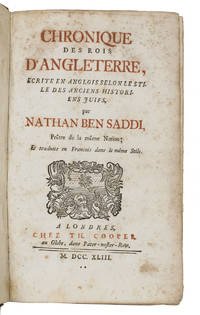
1743A4NB5NLVOA3M1743. 2 CALVIN Jean. Lettres de Calvin a Jaque de Bourgogne Seigneur de Falais & de Bredam & à son epouse Jolande de Brederode. Imprimées sur les originaux.Amsterdam Jacobus Wetstein 1744. Title in red & black with engraved vignette folding genealogical table. 3 C. A. Discours apologico-pathetique sur les vertus principales de L'eau de la Reine de Hongrie ou sur les moïens de faire triompher le bonne foi & par celle-ci rétablir & affermir en Europe la paix stable & durable qu'on lui a annoncé & garanti de la part des puisances qui ont accedé à la Pragmatique Sanction. Avec quelques remarques sur la prétenduë refutation des recrits circulaires de la cour de Vienne. Par Monsieur A.C. .The Hague Gerard de Mee 1743.4 FLEURY Andre´ Hercule de subject. Extrait de l'oraison funèbre de feu Mr. le Cardinal de Fleury tel qu'on l'a reçu de Strasbourg avec les remarques tirées de l'entrétien de deux officiers François à leur retour de la Bohème chargés de misere & de maladie.Strasbourg no publisher 1743. 4 works in 1 volume. 8vo. Contemporary calf spine labels with title and shelfmark. Ad 1: One of two probably simultaneous issues of the rarer of the first two French editions all dated 1743 of a chronicle of the kings of England that covers the period 1066-1603 first published in English in 1740. Robert Dodsley 1703-64 was a poet playwright and bookseller. Other sources ascribe it to Lord Chesterfield. Dodsley could not have written a work showing so much wit and literary force DNB. The present French translation is attributed to Louis Charles Fougeret de Monbron.Ad 2: Letters from Calvin addressed to Jacques the Bourgogne and Yolande de Brederode written between 1543 and 1553. They offer a case study in the interaction of politics and personalities that shaped the European reform movement in general and the position of Calvin in connection with the worldly powers of Europe in particular. Jacques de Bourgogne who encountered evangelical ideas in Louvain married into one of Holland's most prominent protestant families was denounced as a heretic for receiving a Reformed preacher at his chateau in Brabant sought refuge in Cologne Strasbourg and Basel and finally settled with Calvin's help in a village near Geneva. De Bourgogne's odyssey is exemplary for the upheavals experienced by a generation that heeded the reformer's call preferring exile to renouncing their new faith under pressure in their native lands.Ad 3: Very rare first and only edition of an up-to-date account of the political situation at the courts of Europe in the 1740s. The goal of the author described only as A. C. and not identified is to achieve a stable peace in Europe and to guarantee the authority awarded in the Pragmatic Sanction of 1713. This was a legal mechanism designed to ensure that the Austrian throne and Habsburg lands would be inherited by Emperor Charles VI's daughter Maria Theresa. It was part of the law of the house of Austria. Hungary which had an elective kingship had accepted the house of Habsburg as hereditary kings in the male line without election in 1687 but had not accepted semi-Salic inheritance. The Emperor-King agreed that if the Habsburg male line became extinct Hungary would once again have an elective monarchy. The Kingdom of Bohemia also followed this rule. Ad 4: Extremely rare extract of the funeral oration for André-Hercule Cardinal de Fleury French Bishop of Fréjus 1653 - 29 January 1743 and cardinal who served as the chief minister to Louis XV. The additional remarks are abstracted from a conversation between two French officers on their return from the Bohemian campaign. Fleury found the nation poorly prepared when in 1733 war was forced upon France. Library bookplate on inside front cover. Binding worn some parts of the spine gone front hinge slightly cracked otherwise in good condition. unknown
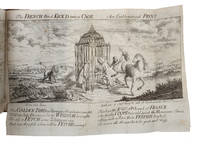
174561985Frankfurt & Leipzig 1744 & 1745. 8vo. Uniformly bound in two contemporary half calf bindings with four raised bands and gilt lettering to spines. Old paper-labels pasted on to top of spines. Wear to extremities spines with a few holes. Internally nice and clean. 8 118 8 132 16 pp.; 56 31 1 46 2 96 pp. 1 folded maps and 1 folded plate. <br/><br/><em>A rare sammelband containing six German “Ben Saddi†chronicles beginning with the very rare first German translation of Robert Dodsley’s â€The Chronicle of the Kings of England†London 1740. Written under the pseudonym Nathan Ben Saddi the work recounts the history of the English monarchy from 1066 to 1603 in the style of the King James Version of the Pentateuch. It was both a literary satire and a commentary on monarchy and politics. </em> hardcover