44 résultats
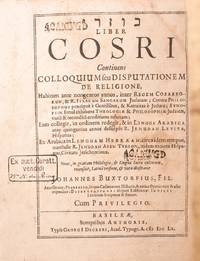
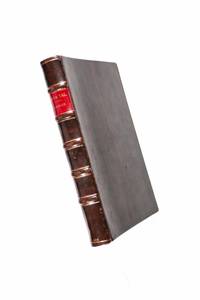
166066808Sumptibus authoris [l'auteur] typis Georgi Deckeri | Basileae [Bâle] 1660 | 16 x 20.50 cm | relié
1640217317London: Anonymous 1640. Very Good Minus. 4to - over 9¾" - 12" tall. A complete play published only a couple of years after the death of Ben Johnson a playwirght famous for his colourful life that included murder and for being a contemporary of William Shakespeare. This play is compelte in its own right with title page persons that act prologue Acts and Scenes from Acts 1 - 5 and the epilogue. It paginates from page 67 - 113 I2 - Q2 Almost certainly publsihed originally in a book of the Workes of Benjamin Jonson. The second Volume. This volume would have contained three plays followed by three sections each with separate pagination containing A Tale of a Tub within this latter section. The title page of this play has 7 ink near contempoary lines running in parallel dividing the text into sections and underlining the place and date of publication. A number of the page corners are slightly rounded and turned with slight loss perhaps most noticeable to the title page no loss of text p 97 - 113 have one worm tract two thirds of the way up the leaf of 2 cm to the margin of the page in no way affecting the text. There is a little loss to the front margin of pp 75 and there is a light stain to the lower margin of pp 77 - 90. Scattered slight foxing. Slight ink dashes in ink to the margins and occasional ink underlining of the occasional word of pp 84 86 88 89 93 94 95 96 and 98 The title page has split from the tail of the play but remains attached for half the length of the spine from the head. The play holds together by the original cords though of course is lacking the original boards. Normal age toning. A surprisingly well preserved contemporarneous copy of a 17th century play. Anonymous hardcover
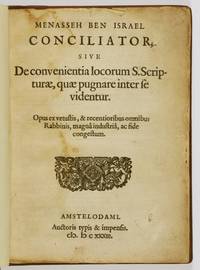
163355772Amsterdam: by the Author 1633. First edition. Modern calf. Good-. Quarto 19 by 14.6 cm. Collation: asterisk4 A-2G4. 8 240 pp. Woodcut printer's device at title; 4 half-titles; printed marginalia. Text in Latin. Recent full polished calf to style spine with raised bands. Text lightly toned with damstaining/spotting especially at outermost leaves; occasional slight chips or small tears at margins; one leaf with perforation resulting in loss of several letter on each side of page; small perforation in blank field at title. A fairly good copy.<br /> <br /> First part only of the first Latin edition of this classic work on Jewish apologetics written by the celebrated rabbi religious thinker and printer-publisher Menasseh ben Israel 1604-1657. The work was first published in Spanish at Amsterdam in four parts between 1632 and 1651. By providing a harmonization of all the apparent contradictions within the Hebrew Scriptures he hoped to encourage converso Jews of Iberian descent who had lost touch with their religious heritage to make the return to rabbinic Judaism. The present volume deals with the Pentateuch Five Books of Moses; the second volume treats the Prophetic books and the Hagiographa Writings. The work was first published a year earlier in a Spanish language edition.<br /> <br /> The work attempts resolution to no less than 180 seeming discrepancies in the Pentateuch. The breadth of Menasseh's encyclopedic knowledge is vast the Conciliador contains citations from 221 Jewish and 54 non-Jewish authorities. "No reader could fail to be impressed by the amazing range of titles which the author proudly appended to the work" Roth. References: Kayserling p. 69; C. Roth A Life of Menasseh ben Israel: Rabbi Printer and Diplomat Philadelphia 1945 p. 88. Silva Rosa 16. <br /> <br /> Full title and imprint: Conciliator sive De convenientia locorum S. Scripturae quae pugnare inter se videntur. Opus ex vetustis & recentioribus omnibus Rabbinis magnâ industriâ ac fide congestum. Amstelodami. Auctoris typis & impensis. M.D C XXXIII. by the Author unknown
163518006Amsterdam 1635. the author 2 works in 1 volume. 8vo. Contemporary calf rebacked with the original backstrip laid down. With a letterpress decoration on title-page Hebrew text of Psalm 85.11 in a frame a so-called "magical square" in which the the text can be read both horizontally as well as vertically some woodcut initials and some Hebrew passages in the text. 16 156 2 2 blank; 40 346 6 pp. Ad 1: First edition of a work on God's creation of Earth by the well-known Portuguese rabbi writer and printer Menasseh Ben Israel 1604-1657 who established the first Jewish printing office in the Netherlands. The work presents 30 questions or "problems" concerning God's creation of the Earth which Menasseh tries to answer and explain citing or referring to passages of the Tenach. Problems include "on which day were demons created" and "was there another world or earth before God created this one". The preliminaries including an important poem by Caspar Barlaeus which caused the Amsterdam authorities to consider the reintroduction of censorship for Jewish publications. As this didn't happen Barlaeus's poem can be seen as an indicator of the relationship between Jews and Christians and the religious tolerance in Amsterdam during the Golden Age.Ad 2: First edition of a work on the resurrection of the dead by the same author. The work is divided into three "books" and opens with several dedicatory letters an index of the chapters and 3 laudatory poems. The last page of the preliminaries gives a short list is of books translated from Hebrew into Spanish. The main text deals with the Last Judgment the resurrection of the dead and the immortality of the soul.With a bookseller's ticket and bookplate. Title-page of ad 1 slightly smudged browned throughout some water stains and small spots but still in good condition. Binding rubbed along the extremities and sides somewhat scratched rebacked with the original backstrip laid down.l Ad 1: Fuks & Fuks-Mansfeld p. 107; STCN 843242612 7 copies; ad 2: STCN 084840250 9 copies; for Menasseh in general: Fuks & Fuks-Mansfeld pp. 99-135; NNBW X cols. 604-613. unknown
164269492Amsterdam: Printed by the Author 1642. Full Description:<br> <br> MENASSEH BEN ISRAEL. Dissertatio de Fragilitate Humana ex Lapsu Adami Deque Divino in Bono Opere Auxilio. Amsterdam: Printed by the Author 1642.<br> <br> First edition. Small octavo 5 3/4 x 3 1/2 inches; 146 x 90 mm. 16 141 1 errata pp. Text in Latin interspersed with Hebrew. A woodcut device on title-page. Woodcut initials.<br> <br> Bound after:<br> <br> MENASSEH BEN ISRAEL. De Resurrectione Mortuorum Libri III. Amsterdam: Printed by the Author 1636.<br> <br> First edition. Small octavo . 22 133 11 137-241 11 245-346 6 index pp. Text in Latin interspersed with Hebrew. The woodcut printer's device on the title-page is a 'magical square' in Hebrew letters. Woodcut initials.<br> <br> Full contemporary vellum. Front inner hinge cracked but firm. Spine with torn paper label titled in ink manuscript. Some ink call numbers on spine but no other library markings. Vellum a bit soiled. Title-page of Dissertatio is backed with loss to fore-edge margin but not affecting text. Leaf A2 of the same book with repair to top margin just touching headline. Leaf T2 in Resurrectione with small closed tear touching some letters but with no loss. Front pastedown with bookplate from Rochester Theological Seminary. Overall very good.<br> <br> "Dissertatio de Fragilitate Humana ex Lapsu Adami" or "Dissertation on the Fragility of Man from the Fall of Adam" is a work in which Menasseh disputed the Christian doctrine of original sin. The work was also published in Latin in the same year.<br> <br> "As per many theological works by Amsterdam scholar and Hebrew printer Menasseh ben Israel Dissertatio de Fragilitate Humana was directed primarily to a Gentile audience. Dedicated to Gerbrandt Anslo a Christian Hebraist who was a pupil of Menasseh this study focuses upon the issue of predestination. In opposition to the Christian doctrine of Original Sin Menasseh was a staunch proponent of the traditional Jewish teaching that Man is born into the world pure and innocent." Kestenbaum and Company.<br> <br> De Resurrectione Mortuorum Libri III or 'Three books on the resurrection of the dead' is in Latin which suggests it was for a Christian audience. A Spanish version also exists however which indicates that this text was also written for a Jewish audience which in 1636 was split by theological dissent. This and the Sefer Nishmat hayim can be seen as a response to the challenges of Uriel Acosta 1585-1640. Acosta was a sceptic philosopher who in 1624 had published 'An Examination of the Traditions of the Pharisees'. Acosta was suggesting that rabbis were descended from the Pharisees. The Pharisees were theologically opposed by the Sadducees. Menasseh notes that his work is written "contra Zaducaeos" "against the Sadducee" almost certainly a reference to Acosta. Acosta questioned the idea of the immortality of the soul regarding it as a concept invented by the rabbis without any biblical foundation." University of Leeds.<br> <br> "Menasseh ben Israel 1604-1657 was among the most accomplished and cosmopolitan rabbis of his time and a pivotal intellectual figure in early modern Jewish history. He was one of the three rabbis of the "Portuguese Nation" in Amsterdam a community that quickly earned renown worldwide for its mercantile and scholarly vitality. Born in Lisbon Menasseh and his family were forcibly converted to Catholicism but suspected of insincerity in their new faith. To avoid the horrors of the Inquisition they fled first to southwestern France and then to Amsterdam where they finally settled. Menasseh played an important role during the formative decades of one of the most vital Jewish communities of early modern Europe and was influential through his extraordinary work as a printer and his efforts on behalf of the readmission of Jews to England." Menasseh ben Israel Rabbi of Amsterdam by Steven Nadler.<br> <br> "Menasseh ben Israel bridged the Jewish and the Christian worlds. He was a rabbi a scholar and a publisher who authored and printed works in Latin Portuguese Spanish and Hebrew. He also collaborated with Rembrandt who etched his portrait. Menasseh ben Israel is particularly interesting to Hebrew scholars and librarians. He revolutionised Hebrew printing and made Amsterdam the capital of Hebrew publishing. He helped create a new standard of Hebrew typography that became widely known imitated and pirated as "Defus Amsterdam" Amsterdam print and "Otiyot Amsterdam" Amsterdam Letters." University of Leeds.<br> <br> HBS 69492.<br> <br> $4000. Printed by the Author unknown
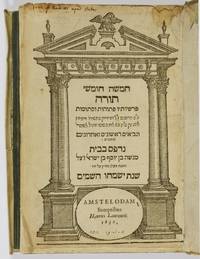
163155459Amsterdam: printed by Menasseh ben Israel for Henricus Laurentius 1631. First edition. Hardcover. Very good-. Octavo 16.8 by 11.4 cm. Collation: aleph-lamed-zayin8 = 296 leaves. 612 i.e. 592 pp: p. 464 erroneously numbered 484 465 as 485 and so on throughout. Two column text in unvocalized Hebrew; every fifth verse numbered in the margin. Title within architectural border; half titles with letterpress ornamentation for the Former and Latter Prophets. Contemporary vellumwith exposed thongs edges stained blue; yapp fore-edges; front joint cracked but holding strong. Intermittent light toning to text outmost leaves a bit more darkened; very occasional small stains. Title-page slighltly trimmed 4 mm at bottom edge; expert marginal repairs at bottom corners of 2 leaves; 1 leaf re-margined at fore-edge with no loss of text else a very good copy with crisp clean text.<br /> <br /> First Hebrew Bible published in Amsterdam printed by the rabbi diplomat publisher and religious thinker Menasseh ben Israel 1604-1657 one of the most distinguished members of the Portuguese Jewish community of Amsterdam and the first Jewish printer in the Northern Netherlands. The Amsterdam printer and publisher Hendrick Laurensz Lauretius provided the financing for this edition along with two other Bible editions and two editions of the Hebrew Psalms printed by Menasseh between 1631 and 1646. "These publications were not only made for the local market but mainly for international trade. Thanks to this financial help Menasseh was able to organize his printing office in a more professional way" Fuks hiring a Jewish compositor Judah Leb ben Mordecai Gimple from Posen and a gentile compositor Bartholomeus Laurensz. <br /> <br /> The printing activity of Menasseh was especially important in the steadily growing productions of the Hebrew press in the Northern Netherlands. Fulfilling the needs of the Sephardic community for Jewish ritual texts eliminated the need for expensive imports from Venice and Poland. Menasseh undersood that the relatively cheap paper and tools available in Amsterdam made it possible to compete in quality and prices with the Hebrew presses of Poland Italy and Basel. "Gentile publishers and booksellers in Amsterdam such as Jansonius and Laurentius were quick to see the opportunity of the opening Eastern European market and financed several of Menasseh's publications" Fuks. Menasseh was the first to introduce in the Netherlands waybertaytsch types for Yiddish publications along with illustrated Hebrew books. He was also the first Jewish printer to adopt the Dutch pocket-book format made famous by the Elzeviers.<br /> <br /> Notes on publication date and issue: The title is dated 1630 in Arabic numerals; the colophon notes the date of completion in Hebrew characters as 5 Adar 5391 = 7 February 1631 along with the printer's apology for being unable to provide the index of pericopes promised on the title-page due to lack of printing material. Darlow and Moule describe this issue as Variant A with a Latin imprint appearing in the cartouche beneath the Hebrew title.<br /> <br /> Provenance and annotations: early entry in brown ink at front paste-down with short Greek inscription Theos. dated 1700; old Latin inscription in black ink at top margin title in reference to Hebrew roots; date of 1812 beside Yiddish entry penned in black ink within imprint cartouche at title; old entry in German penned in black ink at verso title beneath which is an oval cartouche in imitation of the one at the title in which an owner has penned in black ink the Hebrew imprint information regarding Hendrick Laurensz as it would appear in the Varient B issue; old library shelf marks at rear paste-down; recent owner entry in blue ink in Hebrew at front paste-down. References: Darlow and Moule 5123a; Fuks/Fuks-Mansfeld no. 152; pp. 105; 111f.; Steinschneider no. 453; Vinograd Amsterdam 22.<br /> <br /> Full title and imprint: חמשה חומשי תורה פרשיותיו פתוחות וסתומות ×¢"פ ×”×¨×ž×‘× ×–"ל ומדוייק בחסירו' ויתרות להעתק ס"ת ×¢× ×œ×•×— בסופו מועיל לסופרי' ×•× ×‘×™××™× ×¨××©×•× ×™× ×•××—×¨×•× ×™× ×•×›×ª×•×‘×™×: × ×“×¤×¡ בבית ×ž× ×©×” בן ישר×ל ז׳׳צל והוגה בעיון × ×ž×¨×¥ על ידו ×©× ×ª ישמחו השמי×<br /> Amstelodami sumptibus Henrici Laurentii 1630. printed by Menasseh ben Israel for Henricus Laurentius hardcover
1695045340Amsterdam: Chaim ben Rabbi Judah Lieb 1695. Hardcover. Good Condition. Early marbled paper covered wooden boards backed in vellum. Spine perished and vellum largely lacking paper chipped and torn from boards corners cracked with some loss of wood. Binding structure still more or less intact browning to page edges old stamp to title and final leaf. 1 33ff. Scarce Cabalistic commentary on Ecclesiastes. Size: Octavo 8vo. Quantity Available: 1. Shipped Weight: Under 1 kilo. Category: Religion & Theology; Inventory No: 045340. Chaim ben Rabbi Judah Lieb hardcover
1695045340Amsterdam: Chaim ben Rabbi Judah Lieb 1695. Hardcover. Good Condition. Early marbled paper covered wooden boards backed in vellum. Spine perished and vellum largely lacking paper chipped and torn from boards corners cracked with some loss of wood. Binding structure still more or less intact browning to page edges old stamp to title and final leaf. 1 33ff. Scarce Cabalistic commentary in Ecclesiastes. Size: Octavo 8vo. Quantity Available: 1. Shipped Weight: Under 1 kilo. Category: Religion & Theology; Inventory No: 045340. <br/><br/> Chaim ben Rabbi Judah Lieb hardcover books
1685JLOebSOL70Amsterdam: '5445' ie. 1684 or 1685. 1685. folio. ff. 224. Hebrew title within elaborate woodcut border. woodcut ornaments & title vignette. 2 columns. Hebrew text. contemporary vellum overlapping fore-edges lacking rear endleaves Hebrew title repaired at lower & gutter edge some light browning. Third Edition including the second edition of the super-commentary Leket Shikchah first printed in the 1660-61 edition by Jacob Abendana Haham of the Spanish and Portuguese Synagogue London 1681-85. Amsterdam: '5445' [ie. 1684 or 1685]. hardcover
16724649Paris, Pierre Le Petit, 1672, 9 X 16 cm., relié, 550 pages. Avec ce que Philon Juif a écrit de son ambassade vers l'empereur Caïus Caligula. Traduite du grec par Monsieur Arnaud d'ANDILLY. Quatrième édition. Plein veau, dos à nerfs orné, tranches jaspées. Des épidermures et craquelures, coiffes abîmées, coupes et coins émoussés. Très peu de traces sur les feuillets.
16724650Paris, Pierre Le Petit, 1672, 9 X 16 cm., relié, 550 pages. Traduite sur l'original grec revu sur divers manuscrits par Monsieur Arnaud d'ANDILLY. Quatrième édition. Plein veau, dos à nerfs orné, tranches jaspées. Des manques de peau, épidermures et craquelures, coiffes abîmées, coupes et coins sérieusement émoussés. Notes à la plume sur une page de garde. Très peu de traces sur les feuillets.
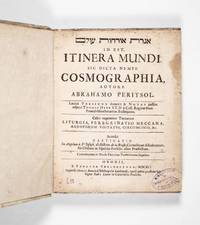
169048858Oxford: Sheldonian Theatre; Henry Bonwick 1690. First edition. Hardcover. Very Good -. Two parts quarto published in 1690 and 1691. A-Z4 pi4 b4 Aa4 Bb/CC4 Dd-Gg4 = 124 leaves. 16 196; 4 31 1 blankpp. Text in Hebrew and Latin in parallel columns. De Turcarum liturgia with separate title page dated 1690 and pagination. Contemporary vellum neatly rebacked. Old library stamp at bottom margin title front blank endleaf detached occasional oxidation spot and mild toning else a very good copy crisp and amply margined.<br /> <br /> First Hebrew-Latin edition of the first modern Hebrew work on geography the author’s most famous and important book. Abraham Farissol or Peritsol was a learned Jew from Avignon who compiled his cosmographical works at the court of the Estes in Ferrara. The present text was composed in 1524-25 and first published in Hebrew at Venice in 1586. The Latin translation and notes in the present edition were prepared by the English orientalist and librarian Thomas Hyde 1636-1703 with the assistance of R. Isaac Abendana working from a manuscript which Hyde located in the Bodleian Library. “Each of its 30 chapters deals with a certain geographical area or subject. In addition many cosmological and historical matters are also treated. The author collected all the evidence he could regarding Jewish settlements in each country. The inclusion of a description of the New World makes Farissol the first Hebrew writer to deal in detail with the newly-discovered America. The 14th chapter of Iggeret Orhot Olam which deals mainly with the settlements of the Ten Lost Tribes is of special interest. According to Farissol’s introduction to this chapter it is clear that what moved him to undertake this investigation was the appearance in Italy in 1523 of David Reuveni many of whose descriptions are included in this work†EJ 6.1185. Reuveni was "an adventurer who aroused messianic hopes in the early 16th century" EJ 14.114. The appended work is a tract on Islamic customs by Albert Wojciech Bobowski a Polish Christian who converted to Islam after his capture by the Ottoman Turks. Adopting the name Ali Ufki Bey he served as translator court musician at Topkapi and as a notator of Ottoman classical music. Bell F26. Christian Hebraism Cat. Harvard 1988 no. 39. ESTC R27480. Fürst Bibliotheca Judaica 1.276. Heller 17th Century pp. 1176-1177. Sabin 60934. Smitskamp PO 372. Vinograd Oxford 4. Wing F-438. Cf. Alden European Americana 1.187 Venice 1586; Heller 16th Century pp.732-733 ed. 1586. Full title beginning in Hebrew: ×גרת ×רחות על×<br /> Id est Itinera mundi sic dicta nempe cosmographia. Latinâ versione donavit et notas passim adjecit Thomas Hyde. Calce exponitur Turcarum liturgia peregrinatio Meccana aegrotorum visitatio circumcisio etc. Sheldonian Theatre; Henry Bonwick hardcover
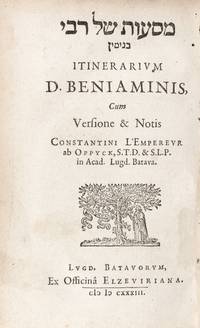
16336497Leiden: Elzevir 1633. First bilingual edition. Very Good. Octavo 16 cm.; 48 234 22 pages. Woodblock initials and vignettes. In marbled boards circa 1900 renewed endleaves spine artlessly reinforced in cloth worn at edges. Paper label apparently original. Provenance: Salomon Jakob Florsheim exlibris. Some light foxing. Reference: Willems 377; Blackmer 120. <br /><br />Hebrew text of "Ma'asot shel rabi Benjamin" accompanied by a Latin translation. This "travelogue" first published in Hebrew in 1543 and in Latin in 1575 recounts the author's journey through the Middle East and Central Asia in the 12th century. Da Tudela traveled from Spain through southern France Italy Greece Constantinople Cyprus Palestine Egypt on to Baghdad and visited many of the local Jewish communities. He is remembered as the most important traveler of Jewish origin in the Middle Ages. The narrative is an prime source for the history of the Jewish traditions in the Mediterranean area. He even described the lighthouse of Alexandria collapsed in 1326 one of the seven wonders of the ancient world. Elzevir hardcover
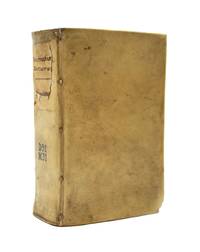
166066808Basileae Bâle Basel: Sumptibus authoris l'auteurtypis Georgi Deckeri 1660. Fine. Sumptibus authoris l'auteur typis Georgi Deckeri Basileae Bâle Basel 1660 16 x 20.50 cm relié Sumptibus authoris. Typis Georgi Deckeri Basileae Basel 1660 4to 16 x 20.5 cm 50 pp. 455 pp. 29 pp. modern vellum First edition of the Latin translation by Johannes Buxtorf The Younger of the first translation into Hebrew by Juda ibn Tibbon Juda Halevi's Arabic text not being rediscovered till 1887 today in the Bodleian. Modern vellum binding flaps. Skillful restoration to inside margin of final third of work without loss to text. A few small wormtracks filled in to lower margins of pastedowns as well as first and final endpapers. A few dampstains to lower portion and some pages browned. Stamp of the University Library at Leiden «Acad. Lugd.» to edges and title. Stamp of the restorer Willem Nicolaas du Rieu «Ex auct. Curatt. vendidi W. N. du Rieu» indicating its deaccession. A very rare copy of this classic of Medieval Jewish philosophy presenting the fears of Spanish Jews faced with two powerful religions Christianity and Islam. Written in 1140 in Arabic the Kuzari is couched in the form of a dialogue in five books. Charles Touati in his 1994 preface to the text summarizes the narrative thread of the work thus: «The king of the Khazars or Kuzari tormented by the religious question interrogates in turn a philosopher a Christian theologian and a Muslim one. Disappointed in their answers he feels he must turn to a learned man of the mocked and vilified minority a Rabbi who ends up convincing him at which the king converts to Judaism and continues his studies with the aid of this teacher.» This apologia allowed Juda Halevi to critique the appeal of philosophy Christianity and Islam for his contemporaries. According to him «philosophy denies all possibility of dialogue between Man and God and does not understand the religious phenomenon» ibid. Right from his starting point a proof of the existence of God he believes that we need only look to history and the revelation of God on Mount Sinai witnessed by thousands. Christianity and Islam are for him nothing but forgeries of Judaism: «they jeer at the humiliations and suffering of the Jews without realizing that they exalt in the founder of their own religions precisely that humiliation and suffering» ibid. The Kuzari is an emblematic text in the sense that it calls for the exiled community to return to Zion rather than submit. «It is better to leave everything and go back to Zion and there regain Divine favor instead of wearing ourselves out winning the favor of gentiles which in any case we will never have» ibid. Sumptibus authoris [l'auteur]typis Georgi Deckeri hardcover
16231724-22(Augsburg, 1623). Nunc primum latine publici iuris factae. 12°. Kupfertitel, 11 Bll., 428 S., 2 Bll. Pergament-Manuskripteinband. Etwas berieben, Deckel leicht fleckig. Erste Ss. mittig mit kleinem dezenten Löchlein (ohne Textverlust). EA. [2 Warenabbildungen]
17002008270673xbvkLeipzig, in Verlegung Friedrich Lanckischien Erben - Druckts Joh. Heinrich Richter, 1700. Gestochenes Frontispizportrait (Brustbild in ornamentalem Rankenwerk mit kalligraphischer Legende), Titelblatt gedruckt in Rot und schwarz; (6) S. 'Vorrede an den Leser', (6) S. 'Register derjenigen Fragen, welche in dem ersten Theile abgehandelt worden', 1.400! Seiten; mit unbedruckten fliegenden Vorsatzblättern. - Pergamenteinband der Zeit mit schwarzem Rundum-Farbschnitt (ca. 21 x 17 x 9 cm; ca. 1,5 kg.).
169555736Amsterdam: Be-veit ha-meshutafim Asher Anshil ben Eliezer ve-Yisakhar Ber ben Avraham Eliezer/ Moses Wiesel 1695. First edition. Hardcover. g to near fine. Small folio 30 by 18.8 cm. Collation: aleph-vav4 zayin2 = 26 numbered leaves. Full period brown paper boards re-backed with a brown leather spine with raised bands.<br /> <br /> Letterpress title-page with ornate floral woodcut device; additional engraved title-page mounted depicting Moses and Aaron along with six small biblical scenes within round borders all against an architectural background. Engraved folding map at rear mounted; main title with woodcut vignette; 14 half-page engraved illustrations in the text.<br /> <br /> This gorgeously illustrated work is the first edition of the famous and highly influential Passover Haggadah printed in Amsterdam in 1695. Simply known as the Amsterdam Haggadah this edition stands as among the most imitated and copied haggadahs in history and was the first to be illustrated with copperplate engravings. Previous illustrated haggadahs had used woodcuts. The popularity of these illustrations can be attested by the huge numbers of reprint editions over the centuries. There are 14 finely printed large in-text engravings plus the full page engraved title page showing Moses Aaron and Adam in the Garden of Eden. Some of these images illustrate the traditional content of the Passover seder and/or the exodus story while some are other biblical stories less directly related. Images include: the Rabbis of Bene Brak discussing the Passover story the four sons Abraham smashing the idols of his father Abraham welcoming the three angels Moses slaying the Egyptian overseer the rescuing Moses from the river Moses and Aaron coming to Pharaoh w/ staves turning to snakes the ten plagues the Egyptian army drowning in the Red Sea the Exodus the receiving of the Ten Commandments at Mt. Sinai the eating of the Pascal Lamb King David composing his psalms and finally an exterior view of the Holy Temple with the cityscape of Jerusalem in the background. All images are captioned underneath with relevant passages in Hebrew. The engravings were all created by Abraham ben Jacob a German convert to Judaism who had moved to Amsterdam although some sources over the years misattributed them to financier Moses Wiesel 6 of which were adaptations and/or modifications of previous images by Swiss artist Matthäus Merian 1593-1650 from his original work "Icones Biblicae" 1625-30.<br /> <br /> In addition to the in text engravings there is famously a phenomenal fold-out engraved biblical map of the holy land. Measuring a total of 19.5x11.5" the map shows the land of Israel the Sinai desert and Egypt in landscape orientation looking eastward towards the top of the map. It traces the journey of the Israelites starting with the Exodus from Egypt through the desert and into the Land of Israel. The map is detailed showing the areas of the twelve tribes important locations and cities as well as geographic features including the Red Sea Mount Sinai the Dead Sea the Sea of Galilee and many others. The map is decorated with additional illustrations near the bottom and includes a key. This beautiful work also by Abraham ben Jacob is considered among the earliest if not the first map of its kind to be printed within a Hebrew publication. It is now known to have been heavily based on the previously printed 1620 map in Hebrew by Jacob ben Abraham Zaddiq and Abraham Goos 1590 - ca. 1643 which itself was based on the map of 1590 by Christian Kruik van Adrichom Adrichem printed in Latin.<br /> <br /> Text throughout is printed in Hebrew with smaller text in Rashi script underneath containing famous commentary on the Passover Haggadah by acclaimed Portuguese Rabbi and scholar Isaac ben Judah Abarbanel 1437-1508. The verso of the title page contains the order of the Passover seder with brief instructions in both Ladino Judeo-Spanish and Yiddish Judeo-German a nod to the subtitle of Haggadah which references the both Ashkenazi and Sephardic traditions.<br /> <br /> This copy with binding in beautiful condition with being professionally restored includining spine re-backed to style. Book block tight. Interior with some staining to pages throughout from use. Binding in very good to near fine inteiror in good condition overall. Hebrew title: סדר הגדה של פסח ×›×ž× ×”×’ ××©×›× ×– וספרד <br /> Alternate transliterations: Seder Hagadah shel Pesah Seder Hagadah sel Pesah<br /> <br /> References: Friedberg 278 Fuks HTN II 521; Yudlov Haggadah 93; Vinograd Amsterdam 627; Ya'ari no. 59; Laor 876 Map; Nebenzahl pp.138-1389 Map; Yerushalmi plate 59-62; Rosenau "Vision of the Temple" p.135 146-7. Be-veit ha-meshutafim [Asher Anshil ben Eliezer ve-Yisakhar Ber ben Avraham Eliezer]/ Moses Wiesel hardcover
169555262Amsterdam: Be-veit ha-meshutafim Asher Anshil ben Eliezer ve-Yisakhar Ber ben Avraham Eliezer/ Moses Wiesel 1695. First edition. Hardcover. fair. Small folio 29 by 18.5 cm. Collation: aleph-vav4 zayin2 = 26 numbered leaves. Additional engraved title page engraved folding map at rear; main title with woodcut vignette; 14 half-page engraved illustrations in the text. Contemporary quarter calf over dark brown pastepaper boards skilfully rebacked. Images of Moses and Aaron at engraved title excised the seven small engraved vignettes along with letterpress text of engraved title and imprint mounted on old paper. Old marginal repairs at main title resulting in slight loss of initial letters along right margin and several leaves; slight strictly marginal worming and occasional tears. Stained throughout sometimes heavily though not impairing legibility. Map mounted to reinforce tears with virtually no loss of text or engraved imagery apart from printed border at right side. A fair copy at best; despite all defects the half-page engraved illustrations have survived intact with minimal staining. Housed in new maroon buckram slipcase.<br /> <br /> First edition of this gorgeously illustrated work now referred to simply as the Amsterdam Haggadah. The first such work to be illustrated with copperplate engravings it ranks among the most imitated of the Jewish manuals for the Passover seder. The popularity of these illustrations can be attested by the huge number of reprint editions over the centuries. Fourteen finely printed half-page engravings appear throughout the text. Some of these images illustrate the traditional content of the Passover seder or the Exodus story while others reference other biblical tales. Images include: the Rabbis of Bene Brak discussing the Passover story the four sons Abraham smashing the idols of his father Abraham welcoming the three angels Moses slaying the Egyptian overseer the rescuing Moses from the river Moses and Aaron coming to Pharaoh w/ staves turning to snakes the ten plagues the Egyptian army drowning in the Red Sea the Exodus the receiving of the Ten Commandments at Mt. Sinai the eating of the Pascal Lamb King David composing his psalms and finally an exterior view of the Jewish Temple with the cityscape of Jerusalem in the background. All images are captioned with relevant passages in Hebrew. The engravings were all created by Abraham ben Jacob a German convert to Judaism who had moved to Amsterdam although some sources over the years misattributed them to financier Moses Wiesel 6 of which were adaptations and/or modifications of previous images by Swiss artist Matthäus Merian 1593-1650 from his original work "Icones Biblicae" 1625-30.<br /> <br /> In addition to the in text engravings there is famously fold-out engraved biblical map of the Holy Land in a notable format. Measuring a total of 19.5 by 11.5" the map shows the land of Israel the Wilderness of Sinai and Egypt in landscape orientation looking eastward towards the top of the map. It traces the journey of the Israelites starting with the Exodus from Egypt through the Sinai and into the Land of Israel. The map is detailed showing the areas of the twelve tribes important locations and cities as well as geographic features including the Red Sea Mount Sinai the Dead Sea the Sea of Galilee and many others. Additional illustrations appear near the bottom along with a legend. This beautiful work also by Abraham ben Jacob is considered among the earliest if not the first map of its kind to be printed within a Hebrew publication. It is now known to have been heavily based on the previously printed 1620 map in Hebrew by Jacob ben Abraham Zaddiq and Abraham Goos 1590 - ca. 1643 which itself was based on the map of 1590 by Christian Kruik van Adrichom Adrichem printed in Latin.<br /> <br /> Text throughout is printed in Hebrew with smaller text in Rashi script underneath containing famous commentary on the Passover Haggadah by acclaimed Portuguese Rabbi and scholar Isaac ben Judah Abarbanel 1437-1508. The verso of the title page contains the order of the Passover seder with brief instructions in both Ladino Judeo-Spanish and Yiddish Judeo-German a nod to the subtitle which references both the Ashkenazi and Sephardi traditions.<br /> <br /> Provenance and annotations: Full page of text appx. 1500 words in neat Hebrew cursive at front endleaf which discusses aspects of the Haggadah text; inscription in German at front endleaf by Isidor Adler who mentions his friend Hermann Mechlenburg dated March 1906; old annotations throughout in at least two hands. In one notable instance the Hebrew phrase l'shana ha-ba'ah be-hamburg next year in Hamburg! has been added in fine block characters above the traditional phrase l'shana ha-ba'ah bi-yerushalayim next year in Jerusalem. Hebrew title: סדר הגדה של פסח ×›×ž× ×”×’ ××©×›× ×– וספרד <br /> Alternate transliterations: Seder Hagadah shel Pesah Seder Hagadah sel Pesah<br /> <br /> References: Friedberg 278 Fuks HTN II 521; Yudlov Haggadah 93; Vinograd Amsterdam 627; Ya'ari no. 59; Laor 876 Map; Nebenzahl pp.138-1389 Map; Yerushalmi plate 59-62; Rosenau "Vision of the Temple" p.135 146-7. Be-veit ha-meshutafim [Asher Anshil ben Eliezer ve-Yisakhar Ber ben Avraham Eliezer]/ Moses Wiesel hardcover
161249853Hannoviyah Hanau: Hans Yakop Hena 1612. First edition. Hardcover. vg- to vg. Quarto. 9 92 leaves. Rebound in modern dark brown leather boards with gilt lettering red label and raised bands on the spine. Title page illustrated with historiated woodblock lettering at the top and encircled by text borders. Missing the final unnumbered initial leaf containing approbations and the final two leaves index. <br /> <br /> First edition of this compendium of Kabblistic topics by Prague rabbi Shabtai Sheftel ben Akiva Horowitz 1565-1619. Illustrated throughout with a total of 15 prominent and intriguing Kabbalistic woodblock diagrams and charts in black as well as some small tables. Among the specific subjects the work provides commentary and analysis of the work of previous Kabbalists including "Iggeret ha-Te'amim" Letter on the Accents by 16th century rabbi Aaron Abraham ben Baruch Simeon ha-Levi the writings of Rabbi Moses ben Jacob Cordovero aka the RAMAK 1522–1570 Sefer Yetzirah and the Zohar.<br /> <br /> Text throughout in Hebrew printed in two and three-column formats in multiple size fonts and some of the text in Rashi script.<br /> <br /> Binding with some light scratches to the covers. Title page with some staining some small worm holes reinforcement along the gutter and most notably a repaired tear along the left margin resulting in some loss of border text and text on the verso. Repaired marginal tears also on the 2nd and 3rd unnumbered initial leaves with no loss of text. The large diagram on the leaf 8 has been trimmed in the margin resulting in minor loss of the image on the left side. Closed tear to leaf 18. Pages throughout with some age toning occasion minor chipping to the edges and some sporadic water stains and smudges. Binding in very good interior in very good- condition overall. Hebrew title: ספר שפה טל<br /> Author: שבתי שפטל בן ×¢×§×™×‘× ×”×œ×•×™ הורוביץ<br /> Publication: ×”×× ×© ×™×קופ ×”×¢× ×”<br /> Alternate transliteration: Shabtai Sheftel ben Akiva ha-Levi Horowitz<br /> <br /> Bibliographic References: Vinograd p.162 Hanau 13; Steinschneider col. 2241; Cowley 630. Hans Yakop Hena hardcover
162711886Basel: Azeleah 1627. First edition. Hardcover. fair. 8vo. 68 leafs. 3/4 leather over black paper covered boards. String ties. Printed on high quality thick cotton rag. Illustrated title page. Early book on Hebrew Grammar and Language. Covers and Spine are worn. Hinges starting. Abrasions on cover. Back slip is chipped. Inscriptions and stamps on inside covers. Minor rippling throughout. Minor foxing throughout not affecting text. Interior in good condition. In Hebrew. Binding in poor inside in good condition. Bet Eked V.3 P.979 #733. Azeleah hardcover
160636154Venice, Zan. Zanetti, 5422 (=1606). Small 4to. Later marbled paper over earlier blue paper-covered boards, paper spine over earlier cloth spine. Binding somewhat worn. Woodcut title-page and woodcut vignette at end, depicting two lions under a tree. Old owner's stamp to title-page and to second and last leaf (""D.L.W. - David Weissappel). Some marginal annotations in old Hebrew script. Last half of leaves turned brown, otherwise a bit brownspotted. Top-corner torn off last leaf, but this corner is present, and there is no loss of text. Fairly well preserved and complete copy of this early Hebrew book. (51 ff.)
160636154Venice Zan. Zanetti 5422 =1606. Small 4to. Later marbled paper over earlier blue paper-covered boards paper spine over earlier cloth spine. Binding somewhat worn. Woodcut title-page and woodcut vignette at end depicting two lions under a tree. Old owner's stamp to title-page and to second and last leaf "D.L.W. - David Weissappel. Some marginal annotations in old Hebrew script. Last half of leaves turned brown otherwise a bit brownspotted. Top-corner torn off last leaf but this corner is present and there is no loss of text. Fairly well preserved and complete copy of this early Hebrew book. 51 ff. <br/><br/><em>First edition of this fourth book of responsa by Joseph Ben David Ibn Lev.Joseph Ibn Lev 1505-1580 was a Turkish Rabbi who moved to Constantinople in 1550. He reacted against Pope Paul IV due to his cruelty against the Jews. He is called "The Great Jurist" and is known to have written the four books of Responsa which were highly thought of. This is the fourth of the four books of Responsa that he wrote. The three first were printed in Constantinople around 1560-1573 and this fourth was printed in Venice in 1606. Other editions appeared later on but every one of these four books in the first edition rare and only few copies are registered. </em> hardcover
163191764Robert ALLOT John BEALE | Londres 1631 | 20 x 32 cm | Relié
16401299690London: Richard Bishop 1640. Second Edition. Other. Title page only from 'The Alchemist' part of the second folio of Ben Johnson measuring 11.25" x 7.25"; JG consignment; shelved case 0. 1299690. Shelved Dupont Bookstore. Richard Bishop unknown books
1641LS18142London 1641. Fair. Folio extract. 66pp. The complete play. Disbound and stained. <br/><br/> unknown