72 résultats
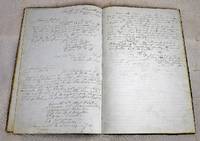
1861000615Chicago Illinois IL. Good. 1861. A wonderful archive of historically significant with detailed civil war content: 1 Two detailed Civil War diaries; 2 Ransom's first war letter home; 3 superb signed Ransom Civil War cartes des vistecdv; 4 Other photos: a tintype cdv gem photo and another hand colored cdv of his wife Louie Lucy Perham; 5 A book titled "Sacred Poems"; 6 Ransom's business card and property tag and lastly but of huge importance to genealogists; 7 Early name and address book of Dick Ransom mentioning many family members and Battery mates. Dick Ransom was from Chicago Illinois; enlisted on 8/7/1862 as a private. On 8/29/1862 he mustered into Chicago Mercantile Light Artillery. He was discharged for disability on 3/24/1863. Specifics: Diary #1 1861 2.5 x 3.5 inches full year January 1st through December 31st 1861 120 pages of which approx. 250 days with entries recorded dark brown period ink very legible. Great war content and a number of remarks made in great excitement; Lincoln as President; death of Col. Ellsworth and Steven Douglas. Battle excitement and the rout of the federal army at the first battle of Bull Run at Manassas. Diary #2 1862 : 3 x 5 inches entries from Aug. 7th 1862 through Mar. 6th 1863. 29 pages brown period ink very legible. Cover reads " Dick Ransom mercantile Battery Chicago Artillary 100 Washington Street Chicago". Signed in ink in Dick Ransom's hand on first page; "Dick Ransom 100 Washington Street Chicago Ill." Also included: 3 wonderful cdv/tintype of Lucy Ransom. Dick speaks of his proposal for marriage to Lucy in his 1861 diary. First is a tintype/cdv format of Lucy backmark Chicago dated Aug 19th 1866 and signed on reverse in Dick's handin brown ink "Louie Perham 1866 Dick Ransom". Secondly mounted Gem Albuman photo of Lucy on cdv mount ca. 1865. Cdv is handcolored image of Lucy dated Jan 23rd 1868. The address book includes all of Dick's friends and family and many of Mercantile Battery mates including Sinclair Willard Gunlock and Medal of Honor winner James Dunne. 3 x 5 inches many pages of entries mouse chew on cover edges. The date of 1883 can be found on the fep. Brown ink inscriptions this book is an important genealogy record and helps to identify all the people referred to in the diaries. Here are some snippets: " January 9th "my Birthday 19 years old born at South Woodstock Vermont""march 4th Abe Lincoln President of the United States"" Mar 19th " wrote a long letter to Lucy . with a proposal for marrige which I am sure will be accepted.I am in great anxiety for an answer". tintype of Lucy included "rec'd an answer alright = O.K."" April 25th -Intense excitement about . voluteers companies forming and drilling constantly all over the North"." May 2nd - douglas was received here by republicans and Democrates unanimously " May 3 - great war excitement for some time - volunteerism all over the country - great excitement". " May 5th - volunteers drilling in the streets "" May 8th - Lucy went for me to get a flag for the volunteers ."" May 9th - great war excitement companies guarding and driling". " May 24th - war message regarding the good and efficient commanders." " may 25th - Scott and President Lincoln col. Ellsworth the Zouave huro of Chicago killed in Alexandrea yesterday for tearing down a secsession flag. " June 3rd - Stephen A Douglas died at the tremont house this A.m. at 48. The city draped very very heavily mourning. col. Ellesworth funeral yeaterday at Bryan hall". " May 4th - Douglas laid in state at Bryan Hall all day." " May 5th - Douglas still in Bryan Hall ". " May 5th - Douglas still lies in state at Bryan hall is to be burried at Cottage Grove tomorrow ". "May 7th- Douglas funeral stores all shut up largest funeral ever in Chicago ". " June 10th - War excitement continues usual small battles and skirmishes but no large ones some expected soon". " June 20th - war and rumors of war some great battles expected soon in vicinity of Washington Sucession." " June 25th - Great riot in Milwakee yesterday - Dutch Mob attacks." " June 25 - all state banks in iowa Indiana and Eastern Missiouri counterfeits so plenty now". " June 30th - went out to Cottage Grove to see the camp" " July 8 - Telegraphs forbidden by the War department to transmit any war news of the intentions of the united states "." July 16 - the federal forces are beginning to move toward Richmond knowing where they will stop Gen. Scott don't tell everydody". " July 22 - At noon good news from the war high hopes night news the entire rout of the Federal army . and retreat back to Washington". referring to the first battle of Bull Run at Manassas " July 23 - News from war not encouraging - 600 killed ". " July 25- breacking accounts the battle and rout of the Union army though better than at first suspected ". " Sept. 25- think of joining T.E.G. Ransoms 11th regiment at Cairo had a letter from him wants me". referring to Gen. Ransom. " Oct 6th - another letter from T.E. G. Ransom still urges me. " " Aug 7th 1862 I enlisted in the Mercantile Battery of the Artillary of the U.S. for three years unless sooner discharges"" Aug 9th I was sworn in by capt. christopher U.S. mustering officer of Chicago". " Mr Sutter pastor presented each of the young men who had enlisted with a teatament". " Aug 11th - picked up duds to go to camp tomorrow- at 9 o'clock". "Aug 12th- at 9 o'clock at our headquarters at corner of Lake and State streets at the .Mercantile Association - marched to court house and examined by surgeon and then recieved our $ 60 ". " Aug 13th - arranged our camp as best we could not being organized . was on guard . skirmishing ." " Aug 14th -rec'd news that we were accepted by the government and were to have a full battery . powder smooth Bores . the Coffeemill . orders to fill up the company to 156 men. some photographs taken ". " Aug 25 - we elected our officers and then were visited by Adjutant General Fuller.Cooley Wilson Swan Bickford ". " Aug 29 - The Battery was mustered into service by lt. Knox ". "Sept. 1st- went to town to get more photographs". " Sept 23 - lient Wilson had a sword to be presented him ". " Oct. 3- went to camp and found that the Guns and all accoutrements and ammunition had come". . guns 2 .from riffle james cannon 2 to 8 ditto rebel guns -one made in Memphis and one in orleans which had been captured". " Oct 4th Seargents knights and Whitney Thomas and Throop drew cuts for the 4 bronze guns -knight & Thomas got the U.S. & Throop 7 Whit the rebels.". " Oct 5- had a great deal of company to look at the guns ." the Mercantile Association presented Crego with a sword . the accoutrements are being distributed and guns. today there was a sword Pistols presented to Capt. Cooley by the Mercantile Association." "Oct 15th " last evening the Asociation presented the Battery a splendid set of Colors. . to ft. Wayne.after the horses for the Battery ". " Oct 26th - we drill about 4 hours daily with our horses and guns on the prarie and five blank cartriges to break in the horses - we are almost ready mow for the field and fight". We are now likely to get our Captain Cooley to resign and have Morgan in his place. we have no guard around the camp now only on the horses guns ammunitionstores & officers tents and the boys go down town when they choose". " Dec. 25th - Vicksburg measels" "jan 2nd 1863. left Yazoo country- & Walnut Hills & c bluffs - Sherman's big retreat" . " Feb 14 - Arkansas Post- Sherman deserted - then back to Youngs Point". " Mar 6th Left Youngs Point for Hospital in Memphis on steame "City of Memphis". " April 1st 1863 - Mrs. Livermore brought me my discharge from the service- to Washington Hosptal Memphis.". " April 2 - left Memphis on Bostona -- homeward bound a free man". Remarkable archive.; Manuscript; 48mo - over 3" - 4" tall; KEYWORDS: HISTORY OF DICK RANSOM ALS CDV AMERICANA HANDWRITTEN MANUSCRIPT DOCUMENT LETTER AUTOGRAPH WRITER HAND WRITTEN DOCUMENTS SIGNED LETTERS MANUSCRIPTS HISTORICAL HOLOGRAPH WRITERS AUTOGRAPHS PERSONAL PERSONAL HISTORY MEMOIR MEMORIAL DIARY JOURNAL DIARIES JOURNALS LOG LOGS KEEPSAKE AMERICANA Civil War War Between the States VICKSBURG MANASSASS BULL RUN LINCOLN ILLINOIS MERCHANTILE ILLINOIS INFANTRY Zouave . unknown
181644516Paris Crochard 1816-25. Bound in 2 fine recent hmorocco. In: "Annales de Chimie et de Physique Redigées par MM. Gay-Lussac et Arago" Tome I IV IX X XI XV XVII XX XXI XXIII XXVIII and XXIX. Some memoirs with scattered brownspots. All but volume 15 with the orig. titlepages to the volumes. Vol. XV having instead of the titlepage a sample of the orig. printed wrappers December issue 1820. Bound at end of volume 2. The memoir no. 25a below is inserted at the end of volume 2. Some of the memoirs having textillustrations. Some versos of titlepages with stamps. <br/><br/><em>First appearances of this groundbreaking series of papers and memoirs in which Fresnel established the scientific basis for the wave theory of light and gave the theoretical framework for explaining in the context of his theory of the transversal nature of lightwaves the phenomena of double refraction refraction dispersion polarization interference diffraction patterns diffraction fringes as light spreads around objects etc. He developed mathematically the hypothesis of the wave nature of light and he demonstrates its conformity with experience. His study of light was a dynamic interplay between theory and observation between mathematics and experiment. - The offered series also comprises the contributions from Arago and the rapports from The French Academy's committees by Ampère Biot and Fourier - see below nos. 6111415a.nd 18."From the point of view of method his investigations extended from the manual operations of the laboratory to the most abstract mathematical analyses. Few physicists since Newton had been so versatile."Silliman in "Historical Studies in the Physical Sciences" vol. 4 p. 155."The wave-thory at this time was still encumbered with difficulties. Diffraction was not satisfactorily explained; for polarization no explanation of any kind was forthcoming; the Huygenian construction appeared to require two different luminiferous media within double refracting bodies; and the universality of that construction had been impugned by Brewster's discovery of biaxial crystals. The upholders of the emission theory emboldened by the success of Laplace's theory of double refraction thought the time ripe for their final triunph; and as a step to this in March 1817 they proposed Diffration as the subject of the Academy's prize for 1818. Their expectation was disappointed; and the successful memoir afforded the first of a series of reverses of which in the short space of seven years the corpuscular theory was completely owerthrown. The author was Augustin Fresnel."Whittaker "A History of the Theories of Aether & Electricity" vol. 1 p.107 ff."This concept of transverse waves met with the greatest hostility from the scientists of the day who could not imagine an extremely fluid and rarified ether which at the same time possessed the mechanical properties of a rigid body. Even Arago admitted that he could not follow the exuberant engineer in his ideas. ButFresnel was convinced that at last he had the key to many mysteries and with his model of waves he gave a full clarification of the phenomena of polarization. With insuperable precision he explained a long series of extremely complicated experiments such as those of chromatic polarization that Arago himself had discovered by chance in 1811 and which the followers of Newton could not explain in spite of all their efforts. Following this line Fresnel reached the synthesis which is his masterpiece.we must recall the final interpretation that he gave of the famous phenomenon of partial reflection by transparent surfaces that simple phenomenon which until then had puzzled Grimaldi Newton and Huygens and which in Malus's experiments had unexpectedly acquired a special importencee as it had been compared to the great mystery of double refraction."Ronchi "The Nature of Light" p. 255 ff.Comprising:1. Mémoire sur la Diffraction de la lumière où l'on examine particululièrement le phénomène des franges colorées que présentent les ombres des corps éclairés par un point lumineux. "Ann.Chim.P." Tome 1. 1816. With titlepage to vol. 1. Pp. 239-281 and 1 folded engraved plate.2. Extrait d'une Lettre de M. Fresnel à M. Arago sur l'influence de la chaleur dans les couleurs développées par la polarisation.Tome 4. 1817. With titlepage to vol. 4. Pp. 298-300.3. Lettre de M. Fresnel à M. Arago sur l'influence du mouvement terrestres dans quelques phénomènes terrestres dans quelques phénoménes d'optique. Tome 9. 1818. With titlepage to vol. 18. Pp. 57-70.4. Note additionelle à la Lettre de M. Fresnel à M. Arago insérée dans le dernier Cahier des Annales. Tome 9. 1818. Pp. 286-287.5. FRESNEL & ARAGO. Sur l'Action que le rayons de lumiére polarisés exercent les uns sur les autres. Tome 10. 1819. With titlepage to vol. 10. Pp. 288-305. - Also with "Extrait d'un ouvrage du P. Grimaldi intitulé: Traité physico-mathérmatique de la lumiere des couleurs et de l'iris". Pp. 306-312.6. ARAGO. Rapport par M. Arago à l'Academie des Sciences au nom de la Commission qui avait été chargée d'examiner les Mémoires envoyés au concours pour le prix de la diffraction. Tome 11. 1819. With titlepage to vol. 11. Pp. 5-30.7. Mémoire sur la Diffraction de la Lumiere. Extrait. This importent Price-Memoir was only printed in full in 1826. Tome 11. 1819. Pp. 246-296.8. Suite Du Mémoire sur la Diffraction de la Lumière. Tome 11. 1819. Pp. 337-378. Note sur des Essais ayant pour but de décomposer l'eau avec un aimant. Pp. 219-222.9. Note sur des Essais ayant pour but de décomposer l'eau avec un aimant. Tome 15. 1820. Pp. 219-222. No titlepage to vol. 15.10. Résume d'un Mémoire sur la Reflexion de la lumière. Tome 15. 1820. Pp. 379-386. Tome 15 is here represented with the last issue of the year Decembre 1820 pp. 337-448 and instead of the titlepage having the orig. printed wrappers bound at end of the second volume.11. ARAGO & AMPÈRE. Rapport fait à l'Academie des Sciences le lundi 4 juin 1821 sur un Mémoire de M. Fresnel relatif aux couleurs des lames cristallisées douées de la double réfraction. Tome 17. 1821. Titlepage to vol. 17. Pp. 80-102.12. Note sur le Calcul des teintes que la polarisation développe dans les lames cristallisées. Tome 17. 1821. Pp. 102-111.13. IIe Note sur la Coloration des lames cristallisées. Tome 17. 1821. Pp. 167-196.14. BIOT. Remarques de M. Biot sur un Rapport lu le 4 juin 1821 à l'Academie des Sciences par MM. Arago et Ampere. Tome 17. 1821. Pp. 225-258.15. ARAGO. Examen des Remarques de M. Biot. Tome 17. 1821. Pp. 258-273. 16. Addition à la IIe Note insérée dans le Cahier précédent par M. Fresnel. Tome 17. 1821. Pp. 312-315.17. Note sur les remarques de M. Biot publiées dans le Cahier précédent. Tome 17. 1821. Pp. 393-403.18. FOURIER AMPÈRE ET ARAGO. Rapport fait à l'Academie sur un Mémoire de M. Fresnel relatif à la double réfraction. Commission: Fourier Ampère et Arago. Tome 20 1822. With titlepage to vol. 20. Pp. 337-344.19. Note sur la double réfraction du verre comprimé. Tome 20. 1822. Pp. 376-383.20. Explication de la Réfraction dans le système des ondes. Tome 21 1822. Titlepage to vol. 21. Pp. 225-241. LAGRANGE. Sur la Théorie de la lumière d'Huygens. Pp. 241-246.21. Sur l'Ascension des nuages dans l'atmosphère. Tome 21 1822. Pp. 260-263.22. Réponse de M. Fresnel à la Lettre de M. Poisson insérée dans le tome XXII des Annales p. 270. Tome 23 1823. Titlepage to vol. 23. Pp. 32-49.23. Note sur le Phénomène des anneaux colorés. Tome 23 1823. Pp. 129-134.24. Suite de la Réponse de M.A. Fresnel à la Lettre de M. Poisson. Tome 23 1823. Pp. 113-122.25. Extrait d'un Mémoire sur la double Réfraction particulière que présente le cristal de roche dans la irection de son axe. Tome 28 1825. Titlepage to vol. 28. Pp. 147-161. 25 a Extrait d'un Mémoire sur la double Réfraction. Tome 28 1825. Pp. 263-279. According to Buchwald "The Rise of the Wave Theory opf Light" p. 462 these 2 extracts composes the entire memoire.26. Note sur la Répulsion que des corps échauffés exercent les uns sur les autres à des distances sensibles. Lue à l'Institut le 13 juin 1825. Tome 29 1825. Titlepage to vol. 29. Pp. 57-62.27. Extrait d'un Mémoire sur la Loi des modifications imprimées à la lumière polarisée par sa réflexion totale dans l'intérieur des corps transparens. Tome 29 1825. Pp. 175-187. This paper was never printed in full. </em> unknown
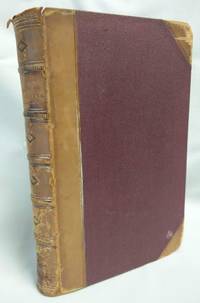
1823B1904London: Rodwell and Martin 1823. A very good and attractive copy. Binding: recent ½ calf with marbled boards spine with 6 compartments of densely blind tooled and gilt tooled raised bands. Red morocco label on two. All edges in gilt renewed endpapers. Notes: William Light was the son of Martinha Rozells and Captain Francis Light founder and governor of Penang. He was born in Kuala Kedah Malaya on 27 April 1786 When only fourteen years old he joined the navy. At twenty-two he served with the Dragoons in Spain and Portugal and in 1811 was appointed Lieutenant. A year later during the battle of Badajos he was attached to General Graham later Lord Lynedoch. From 1814 to 1821 he served in Scotland and Ireland and managed to travel to Sicily Florence and Turin. In 1835 Hindmarsh was appointed Governor of South Australia and recommended Light for the position of Surveyor General. He died on 6 October 1839 from tuberculosis. Size: 4to Illustration: Contains an engraved title and finely hand coloured 60 full page plates depicting various scenes of Sicilian life. Each plate has an accompanying description with English on one side and French on the other. Pages: P. half-title blank title blank plate listing 3 blank 60 plates and discriptions unpaginated. Category: Book Voyages General; Book Europe ItalyBook Plate Books Colour; Rodwell and Martin hardcover
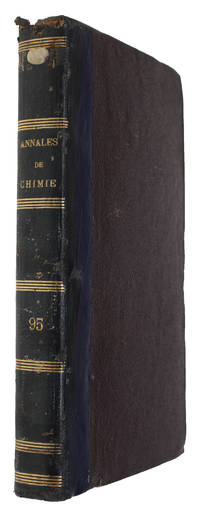
181644120Paris Crochard 1816 1819. Bound in 2 contemp. hcloth. Gilt lettering to spines. In: "Annales de Chimie et de Physique" Series 2 Tome 1 a. Tome 11. Entire volumes offered.4452 pp. a. 3 engraved folded plates. 448 pp. a. 3 folded engraved plates. Fresnel's papers: pp. 239-281 a. pp. 246-296 a. pp. 337-378. Arago's paper: pp. 5-30. Some scattered brownspots. <br/><br/><em>First appearance of Fresnel's landmark papers on the phenomena of diffraction presenting Fresnel's first priinted paper on the subject. These two papers won the Academy's prize for 1818 and were later expanded and published as a long memoir in 1826. The first paper offered initiated the attack on the corpuscular theory of light which was completely owerthrown by a series of succesfull papers by Fresnel the next few years. In the second paper Fresnel summed up all his work prior to this date in completed form. The paper is called "extract" but the longer memoir was not published until 1826. The paper is A CLASSIC IN PHYSICS."In broad context Fresnel's work can be viewed as the first successfull assault on the theory of imponderables and a major influence on the development of nineteenth-centurty energetics." DSB V p. 171.Diffraction arises because of the way in which waves propagate; this is described by the Huygens-Fresnel principle. The propagation of a wave can be visualized by considering every point on a wavefront as a point source for a secondary radial wave. The subsequent propagation and addition of all these radial waves form the new wavefront. When waves are added together their sum is determined by the relative phases as well as the amplitudes of the individual waves an effect which is often known as wave interference. The summed amplitude of the waves can have any value between zero and the sum of the individual amplitudes. Hence diffraction patterns usually have a series of maxima and minima. Wikipedia-The volumes contains many other importent papers by Arago & Petit Vaugelin Humphrey Davy d'Arcet Laplace Gay-Lussac Alex. v. Humboldt Thenard Will. Prout Stromeyer Berzelius Brewster Theod. de Saussure Ampère etc. </em> hardcover
186223052301021st Maine Light Artillery; Union Army 1862. First Edition. Hardcover. Good. Union Army Order Book Large folio. 75 pages. Written by a fine hand 1862-1864. Also includes original typed orders from General Butler etc. Includes orders received by the unit from January 16 1862 through July 14 1864. Much of this period the battery was assigned to Louisiana Mississippi the Gulf of Mexico. <br> The battery was attached to 3rd Brigade Department of the Gulf until September 1862. It was attached to Weitzel's Reserve Brigade Department of the Gulf until January 1863. It was attached to Artillery 1st Division XIX Corps Department of the Gulf until January 1864 and the 2nd Division until April 1864. It then served at Camp Barry Defenses of Washington XXII Corps until July 1864. <br> The Battery notably served in the following engagements: Siege of Port Hudson; Battle of Fort Stevens; Third Battle of Winchester; Battle of Fisher's Hill; Battle of Cedar Creek. 1st Maine Light Artillery; Union Army hardcover
186753255Kjöbenhavn Bianco Luno 1867. Contemp. hcalf. Gilt spine with gilt lettering. In: "Oversigt over det Kongelige danske Videnskabernes Selskabs Forhandlinger. i Aaret 1867". X273493 pp. textillustrations and plates. Entire volume offered. Lorenz's paper: pp. 26-45 and pp. 9-16 Resumé en Francais. Clean and fine. <br/><br/><em>Scarce first edition of Lorenz' landmark paper which contains his important studies on the electromagnetic theory of light in which he - less than two years after but independently of Maxwell - found that LIGHT MIGHT BE INTERPRETED AS ELECTROMAGNETIC WAVES and that his equations lead to the CORRECT VALUE FOR THE VELOCITY OF LIGHT. "The procedure which Lorenz followed was that of which Riemann had suggested in 1858 namely to modify the accepted formula of electrodynamics by introducing terms which though too small to be appreciable in ordinary laboratory experiments would be capable of accounting for the propagation of electrical effects through space with a finite velocity.The Lorenz- equations are however the fundamental equations of Maxwell's theory; and therefore the theory of L. Lorenz is practically equivalent to that of Maxwell so far as concerns the propagation of electromagnetic disturbances through free aether.he suggested that ALL LUMINOUS VIBRATIONS MIGHT BE CONSTITUTED BY ELECTRIC CURRENTS and hence that there was 'no longer any reason for maintaining the hypothesis of an aether since we can admit that space contains sufficient ponderable matter to enable the disturbance to be propagated" Edmund Whittaker in "A History of the Theories of Aether and Electricity I" p. 267-70. </em> unknown
188330043HARDBACK NO DUSTJACKET ISSUED 1883 ON COPYRIGHT PG NO DATE ON TITLE PG 1st edition THUS First PRINTING Octavo. Unpaginated. VG/NF NO JACKET ISSUED Original brown cloth binding with mulit-colour image SILVER BIRD PALLAS and gilt lettering. Gilt foredges top side bottom. Very dark brown endpapers. Heavy buff stock. Seventeen illustrations by W. L.Taylor. Book in very good to near fine condition with slight wear to head and foot of spine. First thus. TINY NICK ON SPINE CVR It tells of a talking raven's mysterious visit to a distraught lover tracing the man's slow descent into madness. The lover often identified as being a student is lamenting the loss of his love Lenore. The raven sitting on a bust of Pallas the goddess of wisdom seems to further instigate his distress with its constant repetition of the word "Nevermore". The poem makes use of a number of folk and classical references. Poe claimed to have written the poem very logically and methodically. His intention was to create a poem that would appeal to both critical and popular tastes<br /><br /> e. p. Dutton NY hardcover
1890000615bChicago Illinois IL. Good. 1890. Important archive of post Civil War GAR letters of the Chicago Mercantile Battery Light Infantry Chicago Illinois including two Medals of Honor winner's autographs Kretsinger and Stevens. This archive comes from the Dick Ransom estate from his former Civil War comrades specific to the GAR activities for the "Battery Boys." 1 Letter written on behalf of battery mate Dick Ransom by Gardner Willard and signed by 8 additional Chicago Mercantile Battery boys. Two of these signatures belong to Medal of Honor winners William Stevens and George Kretsinger. Other signatures include David Crego Orin Nash W. Brown Richard Powel Florus D. Meachem. Dated 1891. 2. Hand written letter in support of Dick Ransom and signed by battery mate J. H. Swan. 1891. 3. Dec. 15th 1890 carbon-type copy of a letter Ransom had sent to fellow battery comrade George Kretsinger. 4. great personal letter from fellow Battery comrade Henry C. Gray .single page ink dated Feb. 13 1888. 5. Wonderful period civil war letter from Battery Comrad to Ransom from Gardner G. Willard single sheet and dated during the civil war April 18th 1863. 6 wonderful 4 page letter from former Battery mate Chapin. Letter in ink dated Jan. 1876 being sent to Dick Ransom sharing Chapin's heart felt concern over the recent loss of Ransom's wife. 7. typed letter by Battery Mate James H. Swan in support of Dick Ransom. BIO NOTES: Dick Ransom; Residence Chicago IL; Enlisted on 8/7/1862 as a Private. On 8/29/1862 he mustered into Illinois Chicago Mercantile Light Artillery. He was discharged for disability on 3/24/1863. David R. Crego; First Lieutenant 8/29/62 through 2/6/63. Orrin Nash: 8/29/1862 through 7/10/65. William L. Brown : 8/29/1862 through 7/10/65. Richard Powel; On 10/5/1863 he mustered into IL Chicago Merc He was discharged for disability on 6/17/1864. Florrus D. Meachem; Served 8/29/1862 through 7/10/65. James H. Swan; Enlisted on 8/29/1862 as a 1st Lieutenant. George Kretsinger; Entered service at: Chicago Ill. Birth: Herkimer County N.Y. Date of issue: 20 July 1897. Citation: Carried with others by hand a cannon up to and fired it through an embrasure of the enemy's works. Medal of Honor Winner. Henry C. Gray; Enlisted on 8/15/1862 as a Private. Gardner G. Williard; Enlisted on 8/5/1862 as a Private. James H. Swan; Enlisted on 8/29/1862 as a 1st Lieutenant. Generally very good though a stain has affected a few items none touching signatures.; Manuscript; 4to - over 9¾" - 12" tall; KEYWORDS: HISTORY OF HANDWRITTEN MANUSCRIPT DOCUMENT LETTER AUTOGRAPH WRITER HAND WRITTEN DOCUMENTS SIGNED LETTERS MANUSCRIPTS HISTORICAL HOLOGRAPH WRITERS AUTOGRAPHS PERSONAL PERSONAL HISTORY MEMOIR MEMORIAL DIARY JOURNAL DIARIES JOURNALS LOG LOGS KEEPSAKE AMERICANA Civil War War Between the States VICKSBURG MANASSASS BULL RUN LINCOLN ILLINOIS MERCHANTILE ILLINOIS INFANTRY GAR GRAND ARMY OF THE REPUBLIC VETERANS . unknown
186942029London Taylor & Francis 1869 Large 4to. Without wrappers. Extracted from "Philosophical Transactions of the Royal Society of London." Vol. 158. Maxwell's paper: pp. 643-657. Clean and fine wide margins. <br/><br/><em>First appearance of this major paper on electromagnetic dynamics in which Maxwell improves the groundbreaking equations he had set forth in his famous paper of 1865 the "A dynamical Theory of Electro-Magnetic Fields". In the paper offered here he for the first time proposed to base the electromagnetic theory of light solely on 2 equations. The paper is one of Maxwell's 5 most importent contributions to electromagnetism."Formulas for the forces between moving charged bodies may indeed de derived from Maxwell's equations but the action is not along the line joining them and can be reconciled with a dynamical principle only by taking into account the exchange of momentum with the field. Maxwell remarked that the equations might be condensed but "to eliminate a quantity which expresses a useful idea would be rather a loss than a gain in this stage of our enquiry." he had in fact simplified the equations in his fifth major paper the short but importent "Note on the Electromagnetic Theory of Light." 1868 writing them in an integral form without the function A based on four postulates derived from electrical experiments. This may be called the electrical formulation of the theory in contrast with the original dynamical formulation." C.W.F. Everitt in DSB. </em> unknown
18142111902160200379Bunemon Maruya 1814. Soft Cover. Fine. Number of books: 1 Bunemon Maruya paperback
182149603Paris Crochard 1821. Contemp. hcloth. Gilt lettering to spine. Weak crack in fronthinge but still firm. In: "Annales de Chimie et de Physique Redigées par MM. Gay-Lussac et Arago". 448 pp. 1 folded plate. Some browning to htitle title-page and last leaf otherwise clean. Fresnel's papers: pp. 102-111 167-196 312-315 a. 393-403. Biot Arago Ampee: pp. 80-102 225-258 a. 258-273. <br/><br/><em>First printing of these milestone papers in which Fresnel finally established the transversal nature of lightwaves. The volume also having the notable rapports and notes by Arago Biot Ampere exhibiting the famous controversy over the subject."This concept of transverse waves met with the greatest hostility from the scientists of the day who could not imagine an extremely fluid and rarified ether which at the same time possessed the mechanical properties of a rigid body. Even Arago admitted that he could not follow the exuberant engineer in his ideas. But Fresnel was convinced that at last he had the key to many mysteries and with his model of waves he gave a full clarification of the phenomena of polarization. With insuperable precision he explained a long series of extremely complicated experiments such as those of chromatic polarization that Arago himself had discovered by chance in 1811 and which the followers of Newton could not explain in spite of all their efforts. Following this line Fresnel reached the synthesis which is his masterpiece.we must recall the final interpretation that he gave of the famous phenomenon of partial reflection by transparent surfaces that simple phenomenon which until then had puzzled Grimaldi Newton and Huygens and which in Malus's experiments had unexpectedly acquired a special importencee as it had been compared to the great mystery of double refraction."Ronchi "The Nature of Light" p. 255 ff. </em> hardcover
181643910Paris Crochard 1816 No wrappers. In: 'Annales de Chimie et de Physique' Tome I Sec. Series Cahier Mars 1816. With htitle to vol. I. Pp. 225-336 and 1 folded engraved plate. The entire issue offered. Fresnel's paper: pp. 239-281. The plate shows the diffraction patterns. <br/><br/><em>First appearance of Fresnel's landmark mémoir - this mémoir was his first paper on diffraction and was later given the prize of the French Academy and published in Memoires de l'Academie in 1826 in full together with his further developments of his light theory - in which he for the first time explained the causes of the diffraction effects as the mutual interference of the secondary waves emitted by those portions of the original wave-front which have not been obstructed by the diffraction screen. His methods of calculation utilized the principles of both Huygens and Young and he summed the effects due to different portions of the same primary wave-front. The memoir records also Fresnel's famous mirror-experiment."In broad context Fresnel's work can be viewed as the first successfull assault on the theory of imponderables and a major influence on the development of nineteenth-centurty energetics." DSB V p. 171."Augustin Fresnel seems to have adopted a wave theory of light from the very beginning of his studies. His first paper presented to the Academy.in October 1815 and entitled "La Diffraction de la Lumiere" the paper offered was written after a long correspondance with Arago who had promised Fresnel his full support. "The wave theory" Fresnel wrote "is well suited to explaining the complicated propagation of light phenomena and since as we know from the case of sound waves can surcomvent obstacles I decided to make a study of shadows.It is because they cross in regions common to them both that two pencils of rays can produce fringes. hence it follows that the vibrations of rays which cross at very small angles can cancel out whenever crests of one correspond to the throughs of the other." </em> unknown
183343919Leipzig Joh. Ambrosius Barth 1833. Contemp. hcalf. Spine gilt. Very light wear to spine ends and edges. In: "Annalen der Physik und Chemie. Hrsg.von Poggendorff" Jahrgang 1833 Bd. 30 Ergäntzungsheft. 376 pp. a. 2 folded engraved plates. 2 small stamps to p.1 and a small stamp to verso of plates. Entire volume offered. Fresnel's papers: pp. 100-255 a. pp. 255-261. Clean and fine. <br/><br/><em>First German edition of Fresnel's epoch-making memoir from the French Academy 1826 and incorporating his experimental results from the years 1815-19 in which he for the first time explained the causes of the diffraction effects as the mutual interference of the secondary waves emitted by those portions of the original wave-front which have not been obstructed by the diffraction screen. His methods of calculation utilized the principles of both Huygens and Young and he summed the effects due to different portions of the same primary wave-front. He demonstrates that the transverse wave theory of light explains the observed phenomena of reflection refraction interference polarization difraction patterns diffraction fringes etc. making a strong case for the theory of the transverse nature of light waves. The memoir records also Fresnel's famous mirror-experiment."In broad contect Fresnel's work can be viewed as the first successfull assault on the theory of imponderables and a major influence on the development of nineteenth-centurty energetics." DSB V p. 171."Augustin Fresnel seems to have adopted a wave theory of light from the very beginning of his studies. His first paper presented to the Academy.in October 1815 and entitled "La Diffraction de la Lumiere" the paper offered was written after a long correspondance with Arago who had promised Fresnel his full support. "The wave theory" Fresnel wrote "is well suited to explaining the complicated propagation of light phenomena and since as we know from the case of sound waves can surcomvent obstacles I decided to make a study of shadows.It is because they cross in regions common to them both that two pencils of rays can produce fringes. hence it follows that the vibrations of rays which cross at very small angles can cancel out whenever crests of one correspond to the throughs of the other."The voume contains further a notable paper by AMPÈRE "Bestimmung der krummen Fläche der Lichtswellen in einem Mittel dessen Elasticität verschieden ist nach den drei Hauptrichtungen d.h. nach debjenigen in welchem die von der Elasticität erregte Kraft in desselben Richtung wirkt in der die Theilchen dieses Mittels verschoben wurden." First German edition. Pp. 262-295. </em> unknown
181144092Leipzig Johann Ambrosius Barth 1811. Without wrappers. In: "Annalen der Physik. Hrsg. Ludwig Wilhelm Gilbert" Bd. 39 der Reihe Eilftes u. Zwölftes Stück. Titlepage to vol. 39. Pp. 129-244 a. 2 engraved plates. The entire issue offered. Young's papers: pp. 156-205 a. pp. 206-220. And pp. 245-360 a. 2 engraved plates. The entire issue offered. Young's papers: pp. 255-261 a. pp. 262-290. <br/><br/><em>First appearance in German of Youngs 3 groundbreaking papers On the Theory of Light and Colours 1802 - An account of some Cases of the Production of Colours not hitherto described 1802 - The Bakerian Lecture. Experiments and Calculations relative to physical Optics. 1804 - which gives the first really convincing evidence that the fringes are produced by interference of light waves and giving the experimental demonstrations of the general law of Interference.These importent demonstrations served as the experimental basis for the wave hypothesis of light. - In his two first papers "On the Theory of Light and Colours" 1802 and "An account of Some Cases of the Production of Colours not hitherto described" 1802 - he only partially announced his principle of Interference and the statement of it in "An Account." was entirely hypothetical and not experimental. Magie. Source Book in Physics gives extracts of this paper and a later paper under the head: Discovery of the interference of light pp.308-15.Young also shows here that diffraction effects can be explained by the interference law."The experimental basis for the wave hypothesis of light as Young formulated it was interference. The fact has already been observed that two trauins of water waves may be so superposed that in certain regions the throughs of one train will lie continuously on the crests of another thereby producing zero disturbance.Destryctive interference is said to occur between the two trains of waves in the former case and constructivee interference in lthe latter. Similarly two sound waves may be so combined as to produce alternate regions of silence and enhanced sound. The phenomenon of interference of which the forgoing are familiar examples is easely comprehensible in the case of combining waves but would be utterly incomprehensible in the case of combining streams of particles. So when Young demonstrated that two beams of light could under properly controlled conditions be made to combine in such a way as to produce alternate regions of darkness and light he was rightly considered to have identified in light a characteristic property of waves." Lloyd Taylor in: Physics. The Pioneer Science. p. 511.Of the three papers published in the years 1802-04 the last is the most importent as it gives the experimental demonstrations of the interference of light. Dibner in Heralds of Science No. 151 list the first paper so does PMM: 259. </em> unknown
181947357Paris Crochard 1819. 8vo. No wrappers. In "Annales de Chimie et de Physique" Tome X 2. Series Cahier 3. Titlepage to vol. X. Pp. 241-336 entire issue offered Cahier 3. Arago and Fresnel's paper: pp. 288-306. <br/><br/><em>First appearance of this seminal paper in which Arago and Fresnel described the experiments which demonstrated that light vibrates transversely to its direction of forward movement."In a further letter to Arago dated 29 April 1818 Young recurred to the subject of transverse vibrations comparing light to the undulations of a cord agitated by one of its extremities. This letter was shown by Arago to Fresnel who at once saw that it presented the true explanation of the non-interference of beams polarised in perpendicular planes and that the latter effect could even be made the basis of a proof of the correctness of Young's hypothesis; for if the vibration of each beam be supposed resolved into three components one along the ray and the other two at right angles to it it is obvious from the Arago-Fresnel experiment that the components in the direction of the ray must vanish; in other words THAT THE VIBRATIONS WHICH CONSTITUTE LIGHT ARE EXECUTED IN THE WAVE-FRONT." Edmund Whittaker in "A History of the Theories of Aether and Electricity I" p. 115. - Parkinson Breakthroughs 1819 P. - Magie "A Source Book in Physics p. 325 ff. </em> unknown
184644101Paris Victor Masson 1846. No wrappers as extracted from "Annales de Chimie et de Physique" Tome 17 Troisieme Série. Titlepage to tome 17. Pp. 172-199 a. 1 engraved plate pp. 316-338 textillustr. Brownspots to titlepage and some browspots to the second memoir. <br/><br/><em>First editions of two importent memoirs on polarization and reflexion of light by "the founder of the new optics".The first paper takes on a central role in Fresnel's dealing with polarization in general and specially with chromatioc polarization and the explaining the phenomena that arises when light travels through crystals. The paper was read at the Academy on march 30 was not printed at the time as it disappeared and only turned up many years later around 1845 when it was found in the papers of Fresnel's brother. "On croyait ou Mémoire perdu. Il a été retrouvé dans les papiers de M. Léonor Fresnel frère de l'illustre académicien." Thus the offered paper is here PRINTED FOR THE FIRST TIME AND IN ITS FULL LENGHT.The second paper deals with reflection and explains the different phenomena seen when light is reflected from glassplates having two surfaces parallel or with curvature interference of reflected waves and the measure of their different wavelenghts all explained according to the wave theory of light. The paper offered is for the FIRST TIME PRINTED IN ITS FULL LENGHT as it only appeared in the résumé-form in 1820 "Résumé d'un Mémoire sur la Réflexion de la lumière" Annales de Chimie et de Physique tome 15 pp. 379-386."As it was Fresnel succeeded fully in attaining his explicit goal the establishment of the wave conception of light. Not long after his death scientific opinion definitely shiftedin favor of waves and opened up the pathway leading to the deeper insight of Maxwell. In broad context Fresnel's work can be viewed as the first successfull assault on the theory of imponderables and a major influence on the development of nineteenth-centurty energetics." DSB V p. 171. </em> unknown
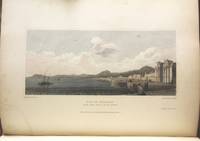
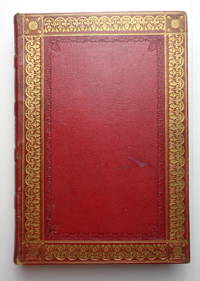
1823029204<p>London: Rodwell & Martin 1823. Un volume 18x26 cm frontespizio illustrato 60 tavole incise e 126 pagine non numerate con testo esplicativo delle tavole ognuna in inglese al recto e francese al verso. Il frontespizio un po' sbiadito e rifilato; le altre tavole in perfette condizioni. Incisioni di: Allen Askey Byrne Cooke Junr. Corbould Edwards Finden Goodall Heath Hollis Hobson Lacy Middiman Miller Pye Radclyffe Wallis e Westwood tratte da dipinti di Dewint. Bellissima legatura coeva in tutta pelle rossa con larga cornice dorata ai piatti dorso con fregi e titoli dorati; labbra e tagli dorati. Ex libris nobiliare inglese al retro del piatto. Uno dei più famosi e bei libri illustrati dell'800 sulla Sicilia. Riferimenti: Mira G. Bibliografia siciliana v. I p. 515; The first proofs of the universal catalogue of Books on art v. I p. 415; Pine-Coffin R.S. Bibliography of British and American travel in Italy to 1860 rif. 823.6. Peso: 1500 gr.</p> Rodwell & Martin hardcover
186755371København 1867. Contemp. marbled clothbacked boards. Titlelabel with gilt lettering on upper cover. Pp. 26-45. Extracted from "Oversigt over det Kgl. danskeVidenskabernes Selskabs Forhandlinger 1867 Nr. 1". <br/><br/><em>Extremely scarce first edition of the paper in which Lorenz independent of Maxwell stated that light is electromechanical in nature probably inspired by his former teacher H. C. Oersted the discoverer of electromagnetism and professor at the Polytechnic College he aimed at unifying the forces of nature without introducing new physical hypotheses. "The idea that the various forces in nature are merely different manifestations of the one and same force has proved itself more fertile than all physical theories".Most impressive of all Lorenz’ achievements in optics is his electromagnetic theory of light developed in a relatively unknown paper of 1867 two years after Maxwell’s famous paper on the same subject. At that time Lorenz did not know Maxwell’s theory and his own approach was quite different. Lorenz’ electromagnetic theory of light can be described briefly as an interpretation of the light vector as the current density vector in a medium obeying Ohm’s law. This paper contains the fundamental equations for the vector potential and the scalar potential or - for the first time - the corresponding retarded potentials expressed in terms of the current density vector and the electrical charge density. The concept of retarded potentials had already been introduced in an earlier paper by Lorenz in connection with research on the theory of elasticity. He found that the differential equation for the current density vector was the same as his fundamental wave equation for the light vector completed with a term which explains the absorption of light in conducting media and that his theory led to the correct value for the velocity of light." Mogens Pihl in DSB.The paper was published in English 1867 "On the identity of the vibrations of light with electrical currents." Philosophical Magazine 34: 287-301 and also in German in "Annalen der Physik" </em> hardcover
1830013641London: Henry Colburn and Richard Bentley 1830 Book. Illus. by Foldout Map and Three Illustrations. Good Minus. 3/4 Leather. 1st Edition. 12mo - over 6¾ - 7¾" tall. Original 3/4 leather over maroon cloth on boards. Marbled page edges. Five raised bands on spine with gilt and embossed decoration. Minor wear to edges and corners of leather. Top of spine a little frayed. Previous owner's bookplates in front. Front hinge broken but still holding. Medium hinge break between pgs. 120-121. Bad hinge break between pgs. 288-289. Rear hinge cracked. Foldout lithographed map of Nova Scotia counties is in very good condition - just a few extra folds at one edge. Captain Moorsom spent five years in Nova Scotia initially as an officer in the 52nd Regiment. This book is his observances of the people climate geography and economic prospects of the colony written in the form of letters home to friends in England. One biographer calls it "the most complete picture available of Nova Scotia during the 1820s." Some Nova Scotians were upset at some of his comments but Joseph Howe defended Moorsom since he'd promoted the colony in England. This book is on consignment so no discounts apply. It will be sent insured so expect a request for "extra shipping" to cover that cost. Henry Colburn and Richard Bentley hardcover
1891574<p>Nims & Knight Troy NY 1891. HB NODJ 1891 1st edition THUS Interior nice tight Clean light wear Fox & few small tear chips edges pages Brown Tan Green decorated Cloth Gold Gilt cover lightning TO cover EDGES & light wear rub light Fox O/W very nice Some pages with light stain at inner hinge NF/NF AS-IS NODJ121 pages Back Cover small staining copyright page says Copyright 1888 By Samuel E. Cassino. First Thus. Hard Cover.</p> Nims & Knight Troy, NY hardcover
185149596Paris Bachelier 1851. 4to. No wrappers. In: "Comptes Rendus Hebdomadaires des Séances de L'Academie des Sciences" Tome 33 No 13. With htitle and titlepage to tome 33. Pp. 329- 360 entire issue offered. Fizeau's paper: pp. 349-355. A stamp on upper right corner of title-page and a perforated stamp in lower margin of title-page. Clean and fine. <br/><br/><em>First appearance of this paper the first announcment of Fizeau's results of his experiments with the velocity of light."It the paper is less famous for some reason than the failure of Michelson and Morley to detect the aether drag but NO LESS SIGNIFICANT. For it showed that the velocity of light increases in a medium according to the formula v 1 - 1/n2 where v is the velocity of the medium and n is the refractive index"Gillespie in "The Edge of Objecticity" p. 427. Fizeau shows that the velocity of light is higher in water flowing in the direction of the beam than that of light propagating in the direction opposite the direction of flow. The paper offered is the shorter announcement of the research the paper in full was published later in 1859 in "Annales de Chimie et de Physique". Albert Einstein later pointed out the IMPORTENCE OF THE EXPERIMENT FOR SPECIAL RELATIVITY.Fizeau's result was replicated by Albert Michelson and Edward Morley in 1886 repeated the experiment on a larger scale and confirmed Fizeau's results. and in 1914 it was confirmed by Pieter Zeeman. It was Arago in 1838 who suggested this "crucial experiment" to decide between the corpuscular and undulatory theories of light by comparing the speed of light in water and in air. It vindicated the undulatory position.It was shown by Hendrik Lorentz 1892 1895 that the experiment can be explained by the reaction of the moving water upon the interfering waves without the need of any aether entrainment. On this occasion Lorentz introduced a different time coordinate for moving bodies within the aether the so called Local time an early form of the Lorentz transformation for small velocities compared to the speed of light. In 1895 Lorentz went a step further and explained the coefficient by local time alone and without mentioning any interaction of light and matter. </em> unknown
186249458Paris Mallet-Bachelier 1862. 4to. No wrappers. In: "Comptes rendus hebdomadaires des séances de l’Académie des sciences" Vol. 55 No 12 a. 21. Pp. 481--519 a. pp. 781-803. Entire issues offered. With title-page to vol. 55. Foucault's papers: pp. 501-503 a. pp. 792-796. Clean and fine. <br/><br/><em>First printing of Foucault's famous experiments on the velocity of light with the description of his improved equipment the rotating mirror. Foucault's method was later developed by Michelson and Morley in their famous experiment in 1887."Foucault’s first experiment carried out in 1850 and written up in full in his doctoral thesis of 1853 was purely comparative; he announced no numerical values until 1862. Then with an improved apparatus he was able to measure precisely the velocity of light in air. This result significantly smaller than Fizeau’s of 1849 changed the accepted value of solar parallax and vindicated the higher value which Le Verrier had calculated from astronomical data. Foucault’s turning-mirror apparatus was the basis for the later determinations of the velocity of light by A. A. Michelson and Simon Newcomb."DSB.Leon Foucault used a similar method to Fizeau. He shone a light to a rotating mirror then it bounced back to a remote fixed mirror and then back to the first rotating mirror. But because the first mirror was rotating the light from the rotating mirror finally bounced back at an angle slightly different from the angle it initially hit the mirror with. By measuring this angle it was possible to measure the speed of the light. Foucault continually increased the accuracy of this method over the years. His final measurement in 1862 determined that light traveled at 299796 Km/s. Magee "A Source Book in Physics" p. 342 ff. and "Source Book in Astronomy" p. 282 ff. </em> unknown
185147033Paris Bachelier 1851. 4to. No wrappers. In: "Comptes Rendus Hebdomadaires des Séances de L'Academie des Sciences" Tome 33 No 13. With htitle and titlepage to tome 33. Pp. 329-360 entire issue offered. Fizeau's paper: pp. 349-355. A stamp on erso of titlepage. Titlepage with faint brownspots. <br/><br/><em>First appearance of this paper the first announcment of Fizeau's results of his experiments with the velocity of light."It the paper is less famous for some reason than the failure of Michelson and Morley to detect the aether drag but NO LESS SIGNIFICANT. For it showed that the velocity of light increases in a medium according to the formula v 1 - 1/n2 where v is the velocity of the medium and n is the refractive index"Gillespie in "The Edge of Objecticity" p. 427. Fizeau shows that the velocity of light is higher in water flowing in the direction of the beam than that of light propagating in the direction opposite the direction of flow. The paper offered is the shorter announcement of the research the paper in full was published later in 1859 in "Annales de Chimie et de Physique". Albert Einstein later pointed out the IMPORTENCE OF THE EXPERIMENT FOR SPECIAL RELATIVITY.Fizeau's result was replicated by Albert Michelson and Edward Morley in 1886 repeated the experiment on a larger scale and confirmed Fizeau's results. and in 1914 it was confirmed by Pieter Zeeman. It was Arago in 1838 who suggested this "crucial experiment" to decide between the corpuscular and undulatory theories of light by comparing the speed of light in water and in air. It vindicated the undulatory position.It was shown by Hendrik Lorentz 1892 1895 that the experiment can be explained by the reaction of the moving water upon the interfering waves without the need of any aether entrainment. On this occasion Lorentz introduced a different time coordinate for moving bodies within the aether the so called Local time an early form of the Lorentz transformation for small velocities compared to the speed of light. In 1895 Lorentz went a step further and explained the coefficient by local time alone and without mentioning any interaction of light and matter. </em> unknown
182646535London W.Nicol 1826. 4to. No wrappers as extracted from "Philosophical Transactions" 1826 - Part III. Pp. 324-337 and 1 engraved plate. A faint dampstain to top of plate. <br/><br/><em>First appearance of Drummond's paper in which he described his and Goldsworthy Gurney's invention and coined the word 'limelight'. His apparatus demonstrated on the plate was originally used for surveying as the title of the paper shows. Drummond claimed the light to be 83 times brighter than any previous artificial light.The Scottish engineer Thomas Drummond 1797-1840 saw a demonstration of the effect by Michael Faraday and realized that the light would be useful for surveying. Drummond built a working version in 1826 and the device is sometimes called the Drummond Light after him. Limelight was first used in public in the Covent Garden Theatre in London in 1837 and enjoyed widespread use in theatres around the world in the 1860s and 1870s. Limelights were employed to highlight solo performers in the same manner as modern followspots spotlights. Limelight was replaced by electric arc lighting in the late 19th century. Wikipedia."John Hersehel describes the impression produced when the light was first exhibited in the Tower: "The common Argand burner and parabolic reflector of a British lighthouse were first exhibited the room being darkened and with considerable effect. Fresnel’s superb lamp was next disclosed at whose superior effect the other seemed to dwindle and showed in a manner quite subordinate. But when the gas began to play the lime being brought now to its full ignition and the screen suddenly removed a glare shone forth overpowering and as it were annihilating both its predecessors which appeared by its side the one as a feeble gleam which it required attention to see the other like a mere plate of heated metal. A shout of triumph and of admiration burst from all present."’ DNB.Parkinson "Breakthroughs" 1825 C </em> unknown
185242292London Richard Taylor and William Francis 1852. 4to. No wrappers as extracted from "Philosophical Transactions" 1852 - Part I. Pp. 25-56 textillustr. Clean and fine. <br/><br/><em>First appearance of a historical paper in electromagnetical theory. Faraday in this paper defines his key concept "lines of force" and summarizes in what connections he used it and he shows how it explains the pehenomena of magnetism and electricity. His insistance of the importence of the electromagnetic fields of force was the historical starting point of the electrical side of modern theories of field physics. Maxwell later translated these ideas into mathematical form and developed them into his theory of electromagnetic waves.Especially notable in this paper is: As all space is permeated by lines of force Faraday suggests that light and radiant heat might be tranverse vibrations propagated along these lines of force. In this way he proposed to "dismiss the aether" and to replace it by lines of force between centres the centres together with their lines of force constituting the particles of material substance. If the existance of a luminiferous aether were to be admitted he suggests that it might be the vehicle of magnetic force "for it is not at all unlikely that if there be an aether it should have other uses than simply the conveyance of radiations" section 3075 in this paper offered. This sentece may be regarded as THE ORIGIN OF THE ELECTROMAGNETIC THEORY OF LIGHT Whittaker in: A History of the theories of the Aether and Electricity I: pp. 194-95.From 1831 to 1852 Michael Faraday published his "Experimental Researches in Electricity" in The Philosophical Transactions of the Royal Society. These papers contain not only an impressive series of experimental discoveries but also a collection of heterodox theoretical concepts on the nature of these phenomena expressed in terms of lines of forces and fields. He published 30 papers in all under this general title.They represents Faraday's most importent work are classics in both chemistry and physics and are the experimental foundations for Maxwell's electro-magnetic theory of light using Faraday's concepts of lines of force or tubes of magnetic and electrical forces. His many experiments on the effects of electricity and magnetism presented in these papers lead to the fundamental discoveries of 'induced electricity' the Farday current the electronic state of matter the identity of electricity from different sources equivalents in electro-chemical decomposition electrostatic induction hydro-electricity diamagnetism relation of gravity to electricity atmospheric magnetism and many other."Among experimental philosophers Faraday holds by universal consent the foremost place. The memoirs in which his discoveries are enshrined will never ceaseto be read with admiration and delight; and future generations will preserve with an affection not less enduring the personal records and familiar letters which recall the memory of his humble and unselfish spirit."Edmund Whittaker in A History of the Theories of Aether and Electricity. </em> unknown