Imagerie Pellerin Epinal -Biblio.com

1 293 résultats
4-23435Album in-4° mezza tela con 36 tavole colorate a pochoir all'epoca 1918 circa su carta uniformemente brunita : tavole di soldati battaglie ed un gioco di percorso. hardcover
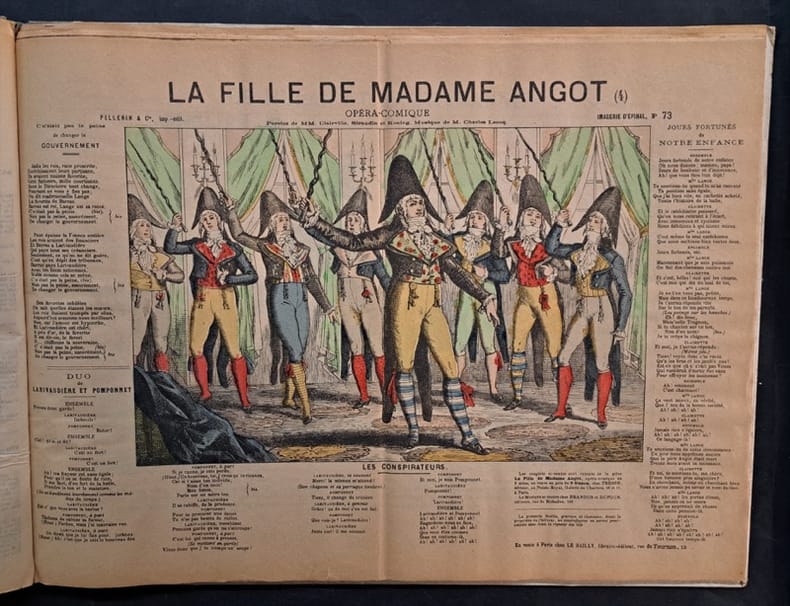
31756Epinal Pellerin et Cie In-4 à L'italienne 44 tirages anciens reliés d'imagerie de la Sainte Vierge, saint philomène Saint Donat, sainte joséphine, etc etc . les gravures sur bois sont en couleurs
1950127200épinal, Pellerin et Cie 1950 In-folio à l’italienne 30,5 x 40 cm. Reliure éditeur moderne, demi-toile grise, dos muet, report du titre en noir sur le premier plat de couverture, 34 planches. Exemplaire en bon état.
20740Pellerin, Epinal, s.d, [fin XIXe siècle] format oblong, 310 X 400, 48 pp, non chiffré, premier plat imprimé en caractères noirs, dos toile et deuxième plat muets, 48 pages de sujets religieux coloriés, pleine page ht, Marie, Joseph, et Grands Personnages de la Liturgie, un texte sur une colonne entoure la gravure, 1 page contenant 4 gravures, 6 pages contenant 16 images, 1 page contenant 49 images, 1 page contenant 54 symboles chrétiens, couleurs vives, exemplaire proche du neuf, état intérieur exceptionnel. Rare.The paper and layout of each print is similar to newspaper and quite fragile. Each page is dated, most from the late 19th century, but one is dated 1903. A very rare volume. All text in French.
RO80010891CHEZ L'AUTEUR. Non daté. In-Folio. Cartonné. Bon état, Couv. légèrement passée, Dos satisfaisant, Intérieur frais. 21 planches d'illustrations en couleurs. Dos toilé bleu.. . . A l'italienne. Classification Dewey : 391.1-Costume
46404408Ce timbre édité en 1951 reproduit une célèbre image populaire montrant Saint Nicolas et la cuve avec les enfants. Marge extérieure avec le tampon 63786. Il a été émis à l’occasion de l’inauguration du musée de l’imagerie française d’Épinal.Ce timbre, dessiné par Paul Lemagny (1905-1977) est le premier timbre gravé par Jean Pheulpin (1907-0991), un des phénix de la gravure philatélique.
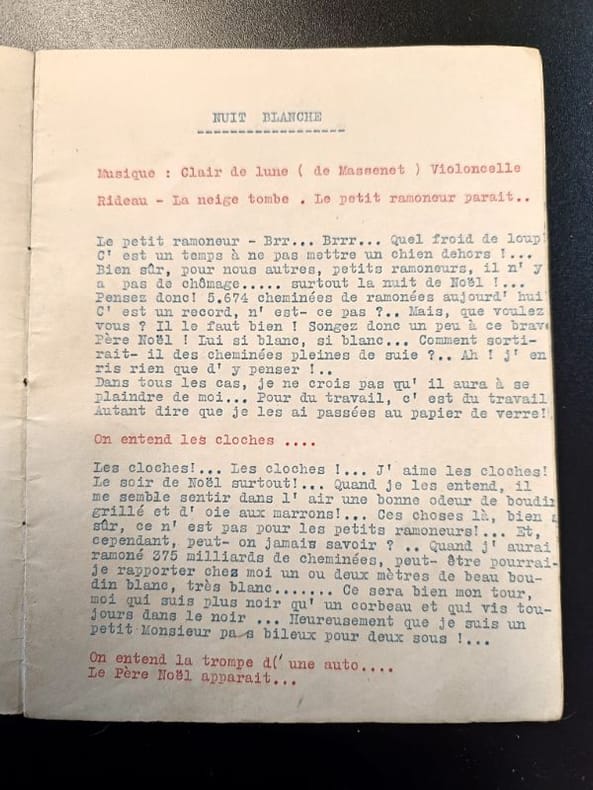
2595Sans lieu, ni mention de fabricant (fabrication artisanale sur mesure), sans date (circa début XXe siècle). Dimensions du théâtre seul : 100,5 x 64,5 x 41 cm ; théâtre monté avec tissu : 210 x 175 x 41 cm. Cet exceptionnel « jouet », entièrement démontable, n’est pas un simple théâtre de marionnettes pour enfants. Il a été spécialement conçu pour s’adapter aux fonds de scènes et coulisses de la série du Grand Théâtre Nouveau éditée par l’Imagerie Pellerin quelques années plus tôt. Un soin particulier a été apporté aux détails ornementaux, inspirés des plus beaux théâtres à l’italienne : des loges ont été placées sur les côtés et de multiples décors en métal doré entourent la scène… qui est éclairée par plusieurs petites ampoules ! En effet, le théâtre est électrifié afin que les spectateurs puissent pleinement profiter de la représentation. Sur le côté, une manivelle permet de faire monter et descendre un rideau peint sur une toile. Afin d’encadrer le théâtre et de dissimuler les manipulateurs des figurines, on peut suspendre un grand tissu en velours jaune orné de pans symétriques de toile rouge (faisant office de rideaux), qu’un système de cordes permet de plisser. L’ensemble comporte également : - 12 sujets (en plâtre, cire, papier mâché, textile et bois), que l’on suspend grâce à un fil de fer (un cuisinier, un lion, 2 pingouins, un ramoneur, un Père Noël, un personnage féminin et 5 masculins). - 3 livres miniatures (accessoires de scène)- une dizaine de décors différents (fonds et coulisses), découpés et montés sur cartons - 10 ampoules d’origine - Un petit projecteur pour l’arrière de la scène - des programmes et tapuscrits originaux pour deux spectacles présentés au milieu des années 20 : La Revue Déchaînée et Nuit Blanche. Ces charmant « programmes officiels », empreints d’humour et agréablement illustrés à la main, en couleurs, par un certain « Pigemoiça », ont été rédigés par Luap Noterbel et Lechim Noterbel, soit Paul et Michel Lebreton. Il s’agit probablement des heureux propriétaires du théâtre. Fils d’un fabricant de chaînes, Lebreton (& Usdin), ils vantent les mérites de l’entreprise paternelle dans la partie « réclame » de leur publication.
185724186Epinal Pellerin et Cie [1857] In-4, en feuilles, couverture imprime.Runion de 9 planches imprimes en couleurs en chromolithographie, non dcoupes, dont une grande reprsentant la scne du thtre (imagerie d'Epinal n1.541) et 8 dcors diffrents: chambre rustique et coulisses (planche n626) Prison et coulisses (planche n629) Fort et coulisses (planche n630) Moulin et coulisses (planche n631) Village et coulisses (planche n632) Chteau et coulisses (planche n633) Marine (planche n635) Place publique et coulisses (planche n1.524). Amusant ensemble pouvant se monter et se dmonter instantanment, pour lequel il ne reste plus qu' construire la bote de ce Thtre portatif dans une caisse de 36 cm de largeur, de 21 cm de longueur sur 8 cm de hauteur, suivant les indications que l'on trouvera imprimes au bas de la planche 1.541.
300 pages. Index. Bibliography. Illustrated with colour photos, black and white photos and images of the petroglyphs discussed. "Describes, among many other things, the solitary spiritual meditations of young people in the mountains, a form of education once essential to all those who wished to succeed in life with their particular talents... Opens a discussion of some of the issues in rock research that relate to 'notating' and 'writing' on the landscape, around the world and through the millennia. This landmark publication presents a well-researched hypothesis to explain the evolution of symbolic or iconic writing from sign language, trail signs and from the geometric and iconic imagery of the dreams and visions of shamans and neophyte hunters." - from dust jacket. Clean, bright and unmarked with negligible wear. A beautiful copy of this interesting work. Book
8vo., on laid paper, with 2 woodcut frontispieces and 16 woodcut illustrations (a number full-page) in the text, endpapers very lightly browned; original brown cloth, boards with elaborate floral roll in blind, back with four flat bands, second compartment with label lettered in gilt, red edges, backstrip lightly pulled at head else a very good, crisp, clean copy. With the contemporary binder's ticket of Smith Brothers of Paternoster Row on rear paste-down. Bunyan's allegory was first published in 1678, less than a handful of copies are known to exist. This much-needed facsimile includes the frontispieces and titles to both parts, the 14 woodcut illustrations of the first part and the 2 woodcut illustrations of the second part. All marginalia (comprising arguments and biblical references) are faithfully retained. The work was not divided into chapters until Burder's edition of 1786. A notable and very scarce facsimile edition.
309pp.with 183 bl/w illustratios, 29cm., editor's hardcover in brown cloth, illustrated dustwrapper, in editor's cart. slipcase, very good, S88025
20001329566PN. New. 2000. Soft Cover. Date is original print. This is a reprint edition . PN paperback
415pp., 8vo, green embossed cloth gilt. Good Copy. [P-15]
A clean, unmarked book with a tight binding. 95 pages. Previous owner's inscription. full dark blue cloth boards with a red spine. Sticker on dust jacket. The dust jacket does not have a price, though there is a sticker removal blemish in the area a price would be, so maybe the ink was pulled off - there is the faintest ink showing. The sticker on the dust jacket indicates National Book Award Prize Winner.
A clean, unmarked book with a tight binding. Full green cloth boards. Previous owner's name stamp inside. 516 pages.
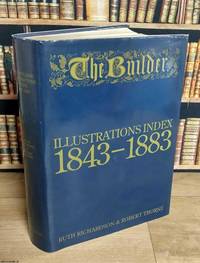
1994375791Hutton & Rostron London 1994. 1st Edition. Hardcover. Fine Condition/Very Good Condition. A monumental reference work by Ruth Richardson and Robert Thorne The Builder: Illustrations Index 1843–1883 catalogues more than 12000 engravings from the journal’s first forty years providing the definitive route into its vast pictorial record. The introductory historical essay offers an invaluable account of George Godwin’s stewardship and the magazine’s visual culture. A folio volume approx. A4 size : 14 pages 832 pages. Original cloth gilt & blind lettered top edge gilt marbled endpapers with dustwrapper. Gavin Stamp's copy with his label and a typed letter from the volume's publisher. Size: 21 x 30 cms. Category: Builder & Building News; Varied Books; New Arrivals; ISBN: 0907101062. ISBN/EAN: 9780907101062. This item may require more postage than the rates shown for delivery outside the UK. If extra postage is required we will contact you before processing your order and you will be given the details and option to decline the extra cost. 9780907101062 Hutton & Rostron hardcover
20021-0939837544Paradise Cay Publications 2002. Hardcover. New. illustrated edition. 916 pages. 11.00x8.50x2.00 inches. Paradise Cay Publications hardcover
DADAX0939837544Bowditch Nathaniel/ National Imagery and Mapping Agency 2015-12-01. 2002 Bicentennial Edition. hardcover. New. 8.50x2.00x11.00. Buy with confidence. Excellent Customer Service & Return policy. Bowditch, Nathaniel/ National Imagery and Mapping Agency hardcover
479275Chicago, Quadrangle Books, 1959. In-4 rel. pleine toile noire de l'éditeur, titre doré au dos, frontispice, XLIV pp. de texte et 344 pp. offrant de très nbr. reprod. de gravures classées chronologiquement.
1988S88025Vienna, IRSA 1988 309pp.with 183 bl/w illustratios, 29cm., editor's hardcover in brown cloth, illustrated dustwrapper, in editor's cart. slipcase, very good, S88025
20101250642010 Porterhouse Fine Art Editions - 2010 - Third edition - In-4, cartonnage illustré - 124 pages - Nombreuses illustrations en couleurs, hors-texte, dans l'ouvrage - Texte en anglais
Book is in excellent condition, in green cloth covers, large graphic in black on front cover, gilt lettering at spine. Many b&w illustrations on heavy cream colored paper, top page ends colored. Binding is solid and square, covers have sharp corners, exterior shows no blemishes, text/interior is clean and free of marking of any kind. Dust jacket shows the slightest signs of shelf wear only, is price clipped, no tears. Previous owner's name or sticker in front section of the book. From the flyleaf "Irked by the derogatory reaction of British critics who doubted that such books as Typee and Omoo could have been written by a common American sailor, Melville created Mardi -- on the surface, the record of an odyssey through imagined South Sea world. For the first time, Moore unravels the puzzle Melville created in Mardi, designed to dupe his elitist British readers, by exploring Melville's knowledge of astronomy, nautical navigation, astrology, and game theories. Hennig Cohen's foreword defends the traditional approach to reading Mardi and argues that Moore's heretical interpretation is interesting but narrow in scope. Moore then invites the reader to 'play Mardi'--to engage in games of wit, elaborate metaphor, and arcane learning-- to reveal the full meaning of the novel. The game may be plated most successfully by using the astronomy and astrology of Melville's time, but a knowledge of the Tarot and Ganjifa cards and of the usual Western decks of playing cards will add depth to your understanding. Mardi fulfills Melville's calim to originality and stands unique as a masterpiece of synthesis. Moore demonstrates a circular pattern in which metaphors intertwine and shows how Melville's use of The American Alamanac and his metaphor of time provides unity. She theorizes that Melville was a highly concious artist, capable of manipulating intricate strands of imagery, metaphor, and symbol through a detailed and precise method. Moreover, an elaborate system of puns gives his work an unsuspected economy even where it seems excessively and unnecessarily wordy. Though Mardi fails, perhaps from tediousness and overmanipulation, Melville followed through with the artistic implications in his later and greater books. Moore feels he had a highly developed concept of the errant or deceitful narrator and hoped to force his readers into an intense riddle-solving approach to Mardi."
Épinal, Pellerin & Cie, Imprimeur, Éditeur, s.d. (vers 1900); grand in-8 (243 x 314 mm), 16 pp., broché, couverture illustrée (nombreuses traces de doigt, dernière page déchirée, à recoller).
1900_201801759Épinal, Pellerin & Cie, Imprimeur, Éditeur, s.d. (vers 1900) ; in-4 (243 x 314 mm), 16 pp., broché, couverture illustrée (nombreuses traces de doigt, dernière page déchirée, à recoller).
ORD-12158(Epinal. S. d.) Album in-plano (320 x 425mm) cartonnage illustré couleurs de l'éditeur (dessin de H. Ferran), dos toile rouge, 25 planches couleurs sur papier fort. Dessins de Chauffour, Trock, J. B. (2), Steinlen, Loÿs, Henry Hennault, Zutna, Blondeau, Léon Rose, plusieurs anonymes et notamment 3 d'Henry de Sta, habitué des cercles littéraires comme ceux des Hydropathes, des Incohérents ou du Chat Noir. Petit accident sans gravité au sommet du 1er plat sinon bel exemplaire.