3 résultats
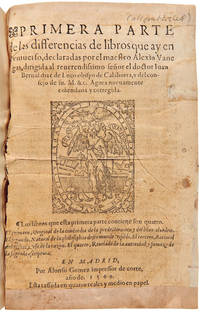
1569WRCAM5652Madrid 1569. 8242 leaves. 19th-century vellum lacking ties new endsheets. Some leaves heavily foxed. Marginal repairs to the first signature not affecting text. Else a clean decent copy. The third edition after Toledo editions of 1540 and 1546. An important geographical and cosmographical work with numerous New World references and an important early navigational guide. EUROPEAN AMERICANA 569/48. MEDINA BHA 128. HARRISSE ADDITIONS 156. hardcover books
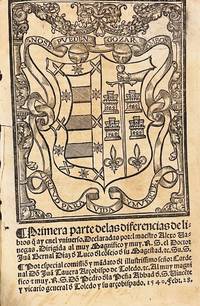
15403354Toledo: Juan de Ayala 1540. First edition only part published. Complete. Bound in modern full leather with raised bands and title vignettes on the spine. Occasional contemporary marginal notes and underlining. Artistically restored. Old possessor's inscription and stamp removed from the title page; a long partially open tear at the gutter. Small wormhole at the upper inner margin through the first ten leaves. Light stains and occasional spots throughout; faint stain on folios F1-2 with a small unrelated hole leading to minimal text loss 1-2 letters. Darker stain on the lower corners of e6-f4 and upper outer edge of g1-4 impacting the text block. Minor imperfections to the lower corners of e3-4 and the outer edge of h5. Overall in very good condition. Title page with armorial woodcut three large woodcut illustrations and woodcut initials throughout. Title page with armorial woodcut three large woodcut illustrations and woodcut initials throughout. First edition only part published. Complete. Bound in modern full leather with raised bands and title vignettes on the spine. ff. 8 240 many misnumbered; sign.: 8 a-z8 et8 A-F8. <p><br /> An important geographical and cosmographical work with early references to the New World.<br /> <p><p><br /> First edition of this significant work on geography cosmography and early explorations by Alexo de Vanegas a renowned scholar from Toledo acknowledged for his expertise in early Spanish language and noted as an influence on Cervantes.<br /> <p><p><br /> Primera parte de las diferencias de libros que ay en el universo is a foundational text in Spanish geographical and cosmographical literature and an important early reference to the New World. Chapters 21 22 26 and 29 offer detailed passages on Amerigo Vespucci and Christopher Columbus with early accounts of America and notable discussions on navigation and the mariner's compass.<br /> <p><p><br /> Illustrated with three woodcut diagrams depicting solstices and solar eclipses. Complete copies of this rare first edition are seldom available as many surviving examples are incomplete or in poor condition.<br /> <p><p><br /> References: Salvá 2438; Heredia 3731; Palau 351608.<br /> <p>. [Juan de Ayala] unknown
15316410Toledo: Lázaro Salvago Girones 1531. First Edition — Primera edición. Hardcover — Tapa dura. 191x140mm. 7½x5½". Toledo Lazaro Salvago Ginones 7 October 1531. En 4º menor 191 x 140 mm. TipografÃa gótica. 46 hojas. Portada dentro de un recuadro formado por cuatro tacos xilográficos mostrando a Harpocrates en la parte superior. Signatura: a-e8 f6. Encuadernación en holandesa marroquén firmada por A. Menard; lomera cuajada de dorados cabeza también dorada. Primera edición de la primera obra teórica sobre la puntuación escrita en lengua castellana. "Siguiendo los pasos de Nebrija algunos gramáticos comenzaron la publicación de ortografÃas siendo el primero de ellos Alejo de Venegas en 1531 cuyo<em> Tratado de orthographia y accentos en las tres lenguas</em> compara el español con el griego el latÃn y el hebreo" Nadeau & Barlow The History of Spanish 2013 p. 164. "El <em>Tractatado de orthographia</em> de Alejo Venegas constituye la primera obra teorética sobre la punctuacion escrita en lengua castellana. Distribuye el tratado en reglas y es en la regla xviii donde trata <em>De la puntuacion</em>. Comienza con una justificacion muy similar a la que acabamos de citar de Nebrija con la mirada puestatambien en el latin como modelo de imitación. Frente a los dos signos que únicamente reconoce el autor de las <em>Introductiones</em> Venegas reconoce en la lengua latina seis signos de puntuacion los cuales se comportan en las diversas funciones con la misma imprecisión que reconoceremos en el analisis de los textos contemporáneos sea cual sea el sistema al que se acojan prioritariamente. Estos seis signos que Venegas propone como los mas procedentes para la mejora de la escritura castellana son: coma colon paréntesis virgula e interrogante" Mediavilla <em>La Punctuacion en los siglos XVI y XVII</em> 2002 p.8. USTC localiza 10 ejemplares de ellos sólo 3 en España. No hemos localizado ningún ejemplar en venta de este rarÃsimo impreso en los últimos 90 años. Buen ejemplar. Algunas hojas varÃan su tamaño entre 187 y 189 mm.; la última hoja con restos de pequeño papel pegado en el margen inferior. Lázaro Salvago Girones hardcover