420 résultats
1894305505<p>Oblong octavo 9 5/8" x 6 1/4". 16 pages of plates from photographs accordion style panorama with captions in English German French and Spanish. Original elaborately gilt stamped red cloth later red cloth spine; corners and edges worn. Good. No signatures or bookplates. Numerous views of San Francisco Sausalito etc.</p> [San Francisco? Hergert & Frey?] hardcover books
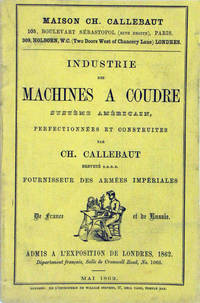
1862100967AParis & London Mai 1862. 8vo. 182 x 120 cm. 31 pp. Illustrated with woodcuts including 2 full-page.<br /><br /><b>Published for the London World Fair 1862 </b>with map of the exibition halls on the inside front cover. The "Expositions Universelles" or World Fairs were intended to show the latest innovations and inventions. The earliest of these fairs were held in France but were national. The first one of 1798 was the start of eleven national fairs. Sewing machines were invented during the first Industrial Revolution to decrease the amount of manual sewing work performed in clothing companies. Callebaut shows different models and explains the technqiue of them. Both full page illustrations of the factory show us what factories looked like at the time. At the 1862 exhibition about 50 types of sewing machine were on show on over 20 stands. M. Callebaut from Paris showed 'several modifications of shuttle sewing machines of the Singer type.' Callebaut was the Singer licencee in France the only occasion on which the Singer Co granted a licence rather than manufacturing itself. Callebaut patented these modifications in France and Britain in his own name. Most of them apply to the Singer No. 2 machine and enabled it to have a reversible wheel feed for finishing seams and to produce a 'herring-bone stitch' zigzag by moving the top feed presser foot from side to side. Another machine had twin needles on the same needle bar for making two lines of stitches on the top side and a zigzag on the underneath with a single shuttle thread. Not content with all these variants M Callebaut exhibited some glove making machines of fearsome complexity using detached lengths of thread!
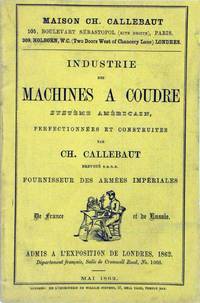
18621009671862. Paris & London Mai 1862. 8vo. 182 x 120 cm. 31 pp. Illustrated with woodcuts including 2 full-page. Published for the London World Fair 1862 with map of the exibition halls on the inside front cover. The "Expositions Universelles" or World Fairs were intended to show the latest innovations and inventions. The earliest of these fairs were held in France but were national. The first one of 1798 was the start of eleven national fairs. Sewing machines were invented during the first Industrial Revolution to decrease the amount of manual sewing work performed in clothing companies. Callebaut shows different models and explains the technqiue of them. Both full page illustrations of the factory show us what factories looked like at the time. At the 1862 exhibition about 50 types of sewing machine were on show on over 20 stands. M. Callebaut from Paris showed 'several modifications of shuttle sewing machines of the Singer type.' Callebaut was the Singer licencee in France the only occasion on which the Singer Co granted a licence rather than manufacturing itself. Callebaut patented these modifications in France and Britain in his own name. Most of them apply to the Singer No. 2 machine and enabled it to have a reversible wheel feed for finishing seams and to produce a 'herring-bone stitch' zigzag by moving the top feed presser foot from side to side. Another machine had twin needles on the same needle bar for making two lines of stitches on the top side and a zigzag on the underneath with a single shuttle thread. Not content with all these variants M Callebaut exhibited some glove making machines of fearsome complexity using detached lengths of thread! hardcover
181952180Portland OR: n.p. July 18 1902. One panoramic silver gelatin photograph printed on matte finish thick photographic stock sized 8 x 24 in. preserved in the original dark stained wood frame sized 10.25 x 26.5 in. with very faint title inscription in white ink below image in clear cursive hand very minor damage & loss to the very lower right corner of image still VG copy expertly cleaned with new archival backing. This exceedingly scarce original photograph records the site selection inspection by the Lewis & Clark Exposition Board of Directors July 18 1902 the day after the Site Subcommittee had recommended on July 17 1902 that the Board choose City Park for the Exposition site. In fact many different sites were proposed at the meeting including Henry Corbett’s preference for City park while the Ladd interests advocated for a site along Hawthorne Boulevard. Nonetheless the Board adjourned into executive session and as a result of a last minute proposal by Henry Dosch it decided that they would examine the Guild’s Lake site in detail as evidenced by this photograph showing the several board members standing upon the Electric Railway line tracks on the Willamette Heights next to the land proposed for development by the Scottish-American Investment Company. When the Board reconvened after an August hiatus the vote was 6-2 in favor of Guild’s Lake. Robert Livingstone who owned the Scottish-American Investment Company set about with his real estate development partners Russell & Blyth to build a group of Arts & Crafts homes designed by Emil Schacht in the Willamette Heights subdivision which would inspire Portland residential architecture in the decades following the Exposition. Peter Guild 1797-1870 led his family over the Oregon Trail in 1847 lost a herd of cattle to the Oregon Territorial militia during the Cayuse Indian War and eventually homesteaded on Guild’s Lake constructing a large octagon block house which proved to be a very popular Public House and later the site for the 1905 Lewis & Clark Exposition. See: Jim Heuer & Roy Roos The Emil Schacht Houses in Willamette Heights: The Cradle of Arts and Crafts Architecture in Portland 2002 pp. 2-10; Thacher The Site of the Lewis and Clark Exposition The Pacific Monthly Vol. 7 pp. 210-212; Finn J.D. John Long-lost Guild’s Lake was Once Portland’s Water Wonderland Offbeat Oregon October 21 2012. n.p., unknown
188235602New York: D. Appleton and Company 1882. First Edition. Hardcover. Good. Octavo. 1 vi 610 pages 3 pages advertisements 1. Errata page located between pages 342 343. Green cloth hardcover with illustrated gilt title inside a gilt circle on the front cover. Gilt title on the spine. Some rubbed spots to the cloth covers and spine. Light edge wear to the cloth extremities. The frontispiece is vertically creased and foxed. Pages 7 and 8 are loose. Binding cords visible in several sections but no other loose pages. Hinges are in good condition. Small piece of tape on the edge of pages 321 and 327. Light toning to the text. <br /> <br /> Illustrated with frontispiece engraved portrait of H. I. Kimball 4 plates in text folding "Plat of the Grounds and Buildings International Cotton Exposition Atlanta" engraved plate - "The Compound Tubular Steam Boiler Gold Medal Awarded." 2 more engraved plates a few illustrated advertisements and a folding plan - "Model of the Willimantic Company's Works at Willimantic Conn." Detailed contents make up this comprehensive report including history speeches reports agricultural sections a variety of forms and documents lists of groups awards committee members and much more. <br /> <br /> A nice inscription written on the front blank end sheet from Samuel Inman one of Atlanta's leading citizens of the period Inman Park in Atlanta is named after Samuel Inman. Inscription reads - "Henry S. Cave Compliments of Saml M. Inman Treasurer Atlanta Ga. June 23 1884." H. S. Cave from Atlanta inscription is written on the verso of the frontispiece. Another owners name in pencil on the front paste down "Augusta Wylie King." A later owner's address mailing label located in the upper left corner front paste down. From the New Georgia Encyclopedia:<br /> <br /> Atlanta held its first exposition named the International Cotton Exposition in Oglethorpe Park in 1881. The city then had fewer than 40000 residents and the primary sense in which the first exposition was “international†was the display of cotton plants from around the world. Nevertheless Atlantans were eager to host the 1881 exposition to promote investment and to help the city toward its goal of becoming an industrial center which was a primary component of Grady’s “New South†concept. Although attendance was lower than expected fewer than 200000 in paid attendance during its two-and-a-half-month run city leaders demonstrated that they could work together to host a major event and that Atlanta was serious about its role in textile production at a time when the North was beginning to grow dissatisfied with the efficiency of southern cotton processing. The exposition displayed new crop planters and cotton seed cleaners along with a model of Eli Whitney’s original cotton gin and speakers addressed the crowds about agricultural technology and political reforms. D. Appleton and Company hardcover
187660872Philadelphia: n.p. 1876. Oblong folio. 28.25 x 22.75 in. One woodblock-engraved printed linen scarf decorative borders large lozenge medallions for halls sewn at fore-edges minor age toning some spotting & soiling very slight foxing old pin-holes at corners still a VG exemplar. First edition of this wonderfully woodblock printed souvenir linen scarf for the 1876 Centennial International Exhibition held in Philadelphia that year. The large lozenge medallions feature the Main Exhibition Building which covered 21.5 acres constructed of wood & iron framework on 672 stone piers; the Horticultural Hall epitomized floral achievement in gardening and was designed in a Moorish style to be a permanent tribute to the Crystal Palace of London’s 1851 Great Exhibition -- it survived until severely damaged by Hurricane Hazel in 1954; and finally the Art Gallery now known as Memorial Hall and the only large exhibit building still standing on the Exposition site. President’s Washington & Grant anchored the upper corners with Centennial Medallions in the lower corners. [n.p.], unknown
1888AQ33282Glasgow: T. & A. Constable 1888. One of 370 large paper copies. 6 157pp 1. Unopened in original publisher's vellum-backed red cloth boards contrasting red morocco lettering-pieces A.E.G. A trifle rubbed spine dulled. Internally clean and crisp. Letterpress presentation leaf completed in manuscript inscribed to Glaswegian art collector B. B. MacGeorge Esq. The generously margined official catalogue of the fine art collection presented at the International Exhibition of Science Art and Industry Kelvingrove Park Glasgow in 1888. The seven month long event - staged in order to raise fund for the construction of a permanent gallery and museum in the park - attracted in excess for 5.5 million visitors. . First edition. Quarto. T. & A. Constable hardcover
18629027602London: Clay & Lea 1862. Hardcover. Very good. Expertly rebacked with original spine pieces. Gilt titling on spine is still bright. New endpapers. <br/><br/> Clay & Lea hardcover
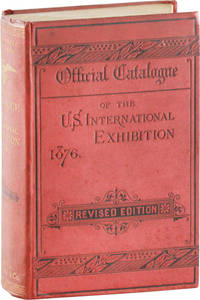
187653720Philadelphia: John R. Nagle 1876. Revised edition. Octavo 20cm. Publisher's decorated red cloth-covered boards titled in gilt on spine; 34611470102pp; illus; ads. A very nice copy straight and tight in the original binding just a trifle rubbed at extremities - Very Good. Stenciled ownership mark of an "Edward S. Whelen" to front free endpaper and title page. <br/><br/>Comprises the complete list of exhibits and exhibitors at the 1876 Philadelphia Centennial Exhibition arranged by subject: I. The Main Building; II: Department of Art; III: Department of Machinery; IV: Departments of Agriculture and Horticulture; the four sections together in one volume each with their own title page. An unusually well-preserved copy. John R. Nagle unknown books
189370375brChicago 1893. Book. Very Good. Soft cover. Folio - over 12 - 15" tall. Softcover booklet with colour-printed front cover. Much local advertising in addition to the programme listSome slight toning to covers; rear cover panel partly obscured by paste/paper residue from being previously pasted in a scrapbook. Otherwise clean tight and unmarked. Very neat -- still a sound and handsome copy. Measures 309x236mm. 10 coverspp. Paperback
1870761991870 Editions Musée d'art moderne de la ville de Paris - 1 vol in-8 - sans date ( fin des années 70 ) - broché - 28 pages - Illustrations en noir et blanc et en couleurs hors texte -
189310054Paris Ecole des Beaux-Arts 1893 1 Paris, Ecole des Beaux-Arts, 1893, in-12, br., 57 pp.
1867WOC-236Histoire Pittoresque de L'Exposition Universelle de 1867, publiée par G. Richard, avec le concours d'une Société d'Artistes. Trente-Deuxième livraison 7 septembre 1867. Nombreuses illustrations. Paris, Imprimerie de Charles Schiller, 1867.In-folio(37,5x26cm) relié demi basane rouge d'époque, dos à faux-nerfs dorés, petit manque sur le morspeau vers la coiffe supérieure.Texte sur 2 colonnes et 382pp.
188221804Paris Hachette et Cie 1882 In-12 Fort 1 frontispice et 562 pp ..... Ou exposé annuel des travaux scientifiques, des inventions et des principales applications de la science à l'industrie et aux arts, qui ont attiré l'attention publique en France et à l'étranger. intérieur frais malgré quelques rousseurs éparses; plats avec fer du lycée louis le grand
1820816171820 A Paris, chez Depélafol, Librairie, Rue des Grands-Augustins -1820 - 10 vol in-8 ( 23,5 x 17 cm), cartonnage éditeur brun avec étiquette de titre et de tomaison au dos. Très nombreuses gravures en et hors texte dont certaines rempliées et d'autres en couleurs. 413 + 236 + 292 + 315 + 320 + 260 + 278 + 288 + 315 + 268 pages. PHOTOS SUR DEMANDE
187852732Paris Librairie Illustre 1878 In-4, demi-maroquin bordeaux, plats de papier marbr, dos nerfs orn d'encadrements pousss froid; doublures et gardes de papier marbr, tranches lisses (reliure de l'poque). Edition originale, abondamment illustre de gravures sur bois, pleine page ou in-texte. Cette publication comprend d'importants chapitres consacrs aux machines, aux mines, la mtallurgie, la mcanique, aux chemins de fer et au gaz. On trouve aussi une intressante section concernant la Socit franaise de secours aux blesss militaires de terre et de mer, avec une illustration dpeignant du matriel de secours sur les champs de bataille.
187848970Librairie Illustrée 1878 In-4 raisin, reliure demi-basane rouge, plats jaspés rouges, dos lisse orné de filets dorés, titre doré, nombreuses gravures dans le texte et hors-texte, 636 pp. Couverture fatiguée, intérieur frais. En l’état.
190048968Librairie de l’Art Ancien et Moderne, Ancienne maison J. Rouam et Cie 1900 In-4 31 x 25,5 cm, reliure demi-percaline brune, plats granités verts, tête dorée,101 illustrations hors-texte et pleine page, nombreuses illustrations dans le texte, 513 pp. Couverture fatiguée, mors fragilisés, intérieur frais. En l’état.
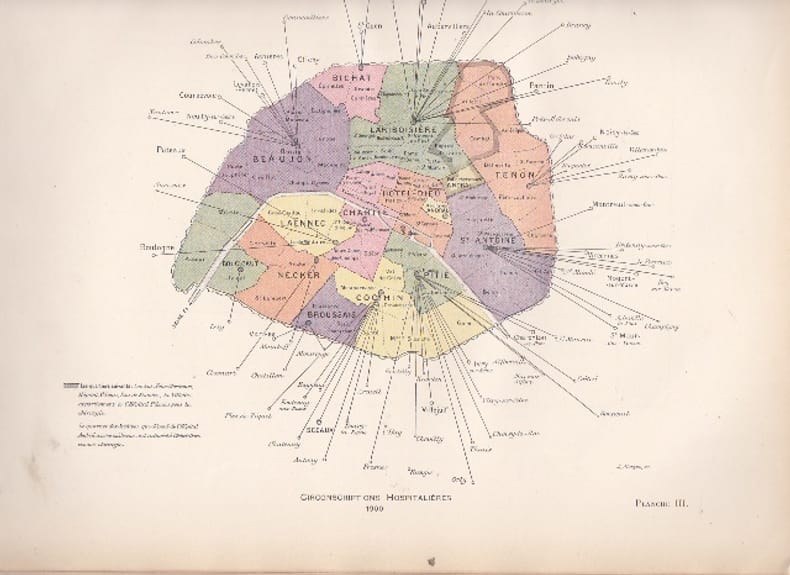
1900Zc53Paris Administration Générale De L'assistance Publique 1900 In4 Composé imprimé et broché par les pupilles de la Seine de l'Ecole d'Alembert à Montévrain - fort in4 demi reliure cuir dos à nerfs titres dorés - VII pages introduction + 812pp + 7plans et cartes en hors texte in fine - Historique, Administratif, Fonctionnement, Monographies d'établissements (une cinquantaine) - Nombreuses photographies schémas plans tableaux - Reliure frottée - Très bon état intérieur - LOURD HEAVY
1900Zc53Paris Administration Générale De L'assistance Publique 1900 In4 Composé imprimé et broché par les pupilles de la Seine de l'Ecole d'Alembert à Montévrain - fort in4 demi reliure cuir dos à nerfs titres dorés - VII pages introduction + 812pp + 7plans et cartes en hors texte in fine - Historique, Administratif, Fonctionnement, Monographies d'établissements (une cinquantaine) - Nombreuses photographies schémas plans tableaux - Reliure frottée - Très bon état intérieur - LOURD HEAVY
1867GITc125paris Dentu 1867. Grand in-8 II 383pp. Demi basane verte, dos lisse orné de filets dorés gras en place des nerfs, reliure de l'époque. Orné de 4 belles planches hors texte dont le portrait en frontispice d'Ismaël Pacha, 1 grand plan dépliant de mouvements douaniers. Bel exemplaire frais et bien relié, complet de toutes ses planches.
1873122615Milano. 1873. Illustriertes Reihentitelblatt, ein weiteres Zwischentitelblatt u. 598, (2) Seiten. Mit unzähligen, teils ganzseitigen u. doppelblattgrossen Illustrationen u. Ansichten im Text und auf fünf mehrfach gefalteten Tafeln. (Papier teils etwas fleckig u. mit leichten Knickspuren, Zwei Falttafeln mit größeren Einrissen u. an den Rändern mit stärkeren Knickspuren versehen). Halbleder-Einband der Zeit auf 4 Bünden mit marmorierten Deckeln. 31x23 cm
189444954Paris, Gauthier-Villars, 1894, in-8, (5), de 115 à 252pp, 1pl, demi-chagrin rouge. (Rel. mod.), Plan dépliant de l'exposition; figures dans le texte. Conférence donnée au CNAM par Emile Levasseur, professeur au Collège de France. Cette conférence est suivie de celle de Maximilien Ringelmann sur l'agriculture en Amérique. Ces deux textes sont extraits des Annales du Conservatoire des Arts et métiers Couverture rigide
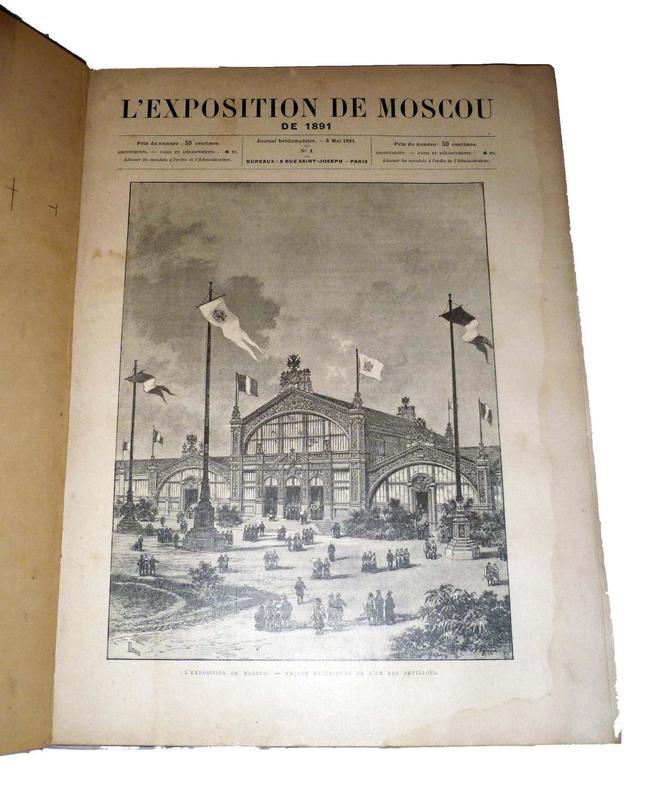
1891VBA-105Série complète des 8 numéros parus entre le 3 mai et le 17 septembre 1891. Reliure modeste demi toile à dos muet. 38 x 28,5 cm. Au total : 64 pages + hors-texte. Nombreuses illustrations (voir photos).
1878114011878 Paris, Librairie Illustrée, et Dreyfous, 1878, in folio, 327pp., relié demi percaline rouge, 327 pages ; quelques marges renforcées ; frottis d'usage.