3 644 résultats
One of only two books illustrated by Guido Reni, a most important Italian Baroque artist of the Bolognese School, in the same time according to Thieme/Becker the only authentic document which we possess about the »Accademia degli Icamminati« (Academy of the Newly Embarked, or Progressives), a most remarkably Bologna artist's circle whose major work was to fresco the Palazzo Farnese in Rome. – Illustrations: The spirited and delicate drawings and engravings with some etching of Reni are depicting 18 pictures of temporary, mostly allegoric and emblematic decorations (among them 4 rebuses) realised on occasion of the memorial service for his friend and co-member of the Bolognese circle, Agostino Carracci (1557-1602), held on January 18th 1603. Reni was inspired by works of the deceased and by paintings of his most prominent students, i.e. Alessandro Albino, Giovanni Battista Bertusio, Aurelio Bonelli, Francesco Brizio, Giacomo Cavedone, Agostino's cousin Ludovico Carracci, Baldasarre de gli Alvigi, Ippolito Ferrantino, Lorenzo Garbieri, Lucio Massari, Giulio Cesare Parigini, Sebastiano Rozali, Lionello Spada and Giovanni Luigi Valesio. Additionally to Reni’s exceptional illustrations a large plate shows etchings of 2 Doric columns situated on the front and rear side of a mausoleum constructed by the »Academia« in honour of Caracci. The underlying drawings and etchings for this plate are attributed to Francesco Brizio, as is the engraved and partly etched cartouche for the title page after a design by Ludovico Carracci. – Content: The main text of this publication, written by Benedetto Morello, is dedicated to patron of arts cardinal Odoardo Farnese, who between 1597-1600 had commissioned Agostino Carracci to assist his brother Annibale, Reni and other members of the Bolognese Progressives to fresco the Palazzo Farnese in Rome, one of the world's most famous Renaissance and Baroque palaces. It contains a description of Carracci's funeral and explanations of Reni's and Brizio's accompanying illustrations. Furthermore Lucio Faberio, since 1599 notary of the Bolognese colony of painters, delivered a funeral oration. Finally several poems in honour of the deceased by eminent poets like Cesare Rinaldi are also included. – Binding: Around 1860 present copy has been skilfully bound in a truly splendid old English ruby red morocco with rich gold tooling. The book-block then was cut marginally to 19:13,5cm to fit this unsigned binding. Nevertheless margins are still wide. – Condition: Lower right part of the title page with skilfully restored small fault, folded plated cropped probably by the bookbinder to fit the folding (but without loss of imaging) two small tears at joints of folded plate enforced with acid-free tape, otherwise well preserved copy indeed. – Rarity: Though not particularly rare in institutional holdings this important document of Italian Baroque art documentation very rarely appeared on the market at least since the early 1800s. Bartsch and Ciocognara already concede it's rarity around 1820. So does Leipzig antiquarian Weigel in one of his catalogues in 1843. Auction records quote one result only, probably for this very copy, sold at Sotheby's in 1920 as part of the Earl of Pembroke's Library at Wilton House, Salisbury. – References: Bartsch: Le peintre graveur, XVIII (1818), p. 265, no. 24 and p. 268, no. 30 (title and plate by Brizio); p. 306-12, nos. 54-60, cit. p. 306: „extrémement rare“; Ciocognara: Ragionato dei libri d'arte e d'antichità posseduti dal Conte Cicognara, 1821, p. 240, no. 1409 „… i disegni furono fatto, e intagliati da Guido Reni, il che lo rende raro e prezioso, quando sia di splendido conservazione“; Weigel, Kunstlager-Catalog, 13. Abt., 1843, no. 12261 („Von grösster Seltenheit“); Thieme/Becker VI, 55; Sotheby, Wilkinson & Hodge: Catalogue of Valuable Books. Selected from the Library at Milton House, Salisbury. The property of The Right Hon. The Earl Of Pembroke. 15th - 17th March 1920. London: 1920, lot 189 (there an "old English morocco gilt" binding ist stated).
2006500327446L'Inédite 2006 20 6x0 8x25 8cm. 2006. Broché. Cet ouvrage premier de la collection "L'atelier de l'oncle Pol" est un guide pratique pour s'initier au cartonnage. Il propose des plans et explications détaillées pour réaliser soi-même entre 9 et 10 objets utiles pour le bureau. Écrit à quatre mains par la cartonnière professionnelle Nadine Conty et l'Oncle Pol il combine astuces conseils pour éviter les pièges et plans de coupe précis
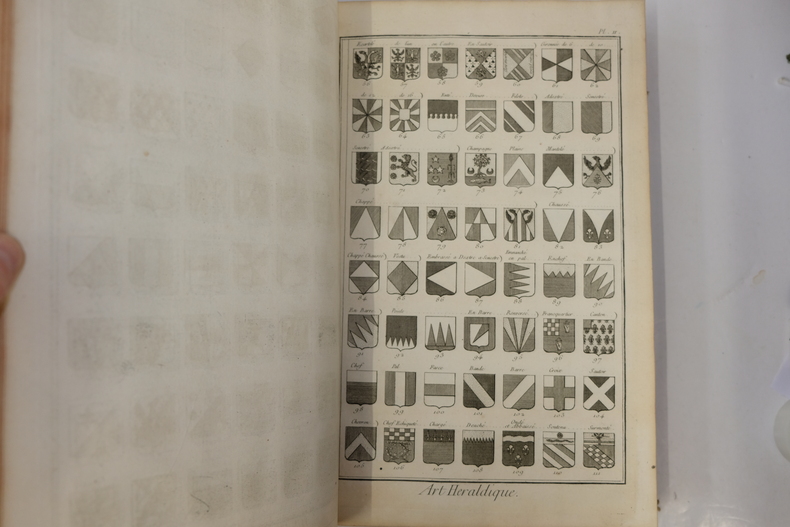
DICO50M1763, chez Briasson, David, Le Breton, Durand, Paris. Édition originale. In-folio, reliure de l'époque demi-veau marbré à coins, dos à 6 nerfs, 233 planches illustrant les entrées depuis Balancier à Charpente en passant par Blason, Boulanger et Caractère et Alphabets. Volume en tous points conforme à celui de la Mazarine (L'Encyclopédie. Volume 23. Planches 2). Reliure fatiguée à restaurer. Nombreux manques. Intérieur frais et complet malgré d'anciennes traces de menu travaux de vers.
Impressive collection of 18 folio drawings with painted and sprayed gouache probably from the 1920s, showing Art Deco motifs for terrazzo floors. – Content: Sketched with pencil, then painted with bright and varied gouache colours setting a contrast in opaque white, present designs are finished with a thin sprayed layer of black to insinuate it's use for terrazzo surfaces, very probably floors or wall mosaics. All leaves of this set are characterised by most attractive compositions of colour and form as well as detailed execution, each of them in a unique way. Geometric forms dominate, the choice of motifs cites various artistic traditions (Mesoamerican, Celtic, Classicist). The designs are presumably of Italian origin and were skilfully drawn for by order for custom made large floors. - Condition: Corners and margins partly with some colour wear, corners partly with crease marks, overall well-preserved set of this exceptionally handsome collection of samples.
1890LCI-4309Paris, Maison Quantin 1890 ca 1 in folio Cartable cartonné 50 planches reproduisant 250 motifs en aquarelle dont certaines rehaussées manuellement à l'or.
1775110332Paris, chez M. Roubo, Maître Menuisier, impr. de l’Imprimerie de L. F. Delatour, coll. « Descriptions des arts et métiers » 1775 In-folio 42 x 27,5 cm. Reliure de l’époque demi-veau havane, dos à nerfs encadrés de fers dorés, pièce de titre maroquin grenat et de tomaison de maroquin vert, initiales M. T. au dessus du premier caisson, VIII-390 pp., table des matières, complet des 45 planches à pleine page hors-texte, dont 1 pl. repliée et 12bis. Les planches ont été gravées sur cuivre d’après les dessins de l’auteur par Le Roy, Bénard, Pelletier, Berthault, Milsan, Beurlier et Michelinot. Coiffe de tête restaurée, coiffe de queue arasée, 2 pl. avec rousseurs marginales et 3 dernières planches avec humidité marginale.
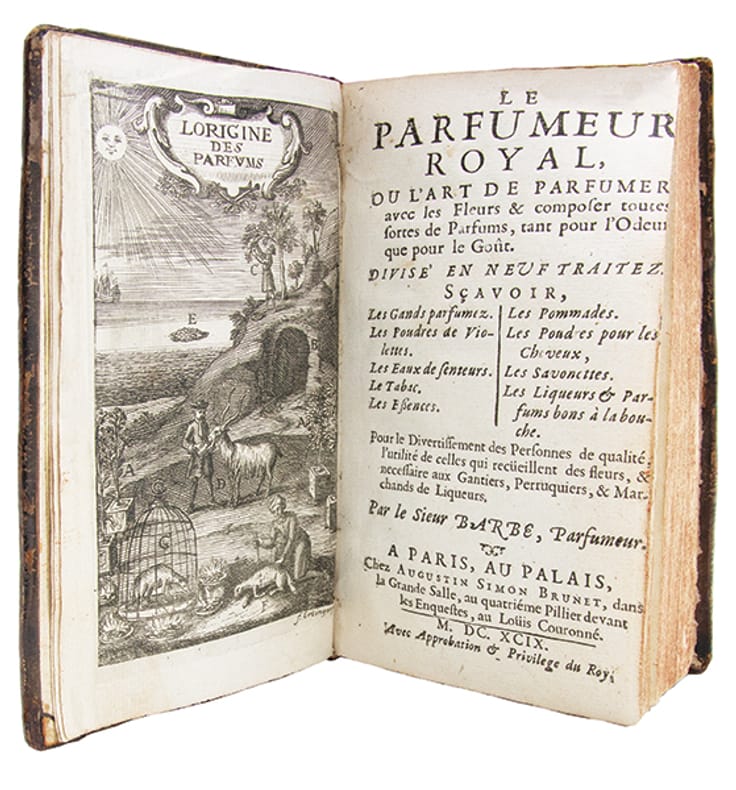
39137In-12 (160 x 77 mm), veau brun moucheté, dos à 5 nerfs orné de caissons fleuronnés et cloisonnés, pièce de titre en veau havane, roulette dorée sur les coupes (reliure de l'époque), planche frontispice, (36), 274, [22] pages. A Paris, au Palais, chez Augustin Simon Brunet, 1699.
17505511750 À Paris, chez la Veuve Estienne, 1750.
18930915# AUTEUR: Duchatel Edouard # ILLUSTRATEUR: Buhot # ÉDITEUR: Lemercier # ANNÉE ÉDITION: 1893 # COUVERTURE: Impr. illust - titre noir et blanc # DÉTAILS: Grand in 4° broché 52pp. 25 planches hors-texte. Première édition, premier traité de lithographies artistiques depuis celui d'Engelmann en 1835. Préface de Leonce Bénédite. Duchatel fut ”l'essayeur” en chef de Lemercier, une des plus grandes et des plus anciennes maisons d'imprimerie lithographique de Paris. Les ht sont sur différents papiers (papier viennois, végétal transparent, bristol chine à grains...); ”l'exemple en couleurs” comporte 6 planches, pierre de noir, de bleu, de rouge, de jaune, trait faux décalques et en quatre impressions. Très rare, tiré à 200 exemplaires. # PHOTOS visibles sur www.latourinfernal.com
Outstanding series of skilfully drawn and well printed monogram specimens for use in applied arts, artisanry and industry, particularly rare even in single issues. – Content, Artist: Besides a brief history of monograms with particular focus on Britain, present work by British engraver George Barclay (1830-72) and some contributors covers hundreds of illustrations of monogram specimens with two or multiple interlaced letters, Christian names and symbols, as well as crowns, heraldic attributes, trade emblems and typefaces. – The collection was designed „to assist medal, die, silver and gem engravers and chasers, or those who, like illuminators and embroiderers, have need to produce monograms or conventionalised alphabet. A clearly sensible written text is appended to a series of examples that have unquestionably been produced by persons of considerable taste, and whom study has qualified for the task.“ (Review for part A in »Athenaeum«, 15th Sept. 1860). – Present set contains 13 parts of 15 published (A, B, E, F, G, H, IJK, L, M, N, O&P, Q&R, S). Barclay had intended to issue a total of 20 parts, but publication ceased with the letter S upon his death. Alas, this set misses the part issues for letters C (1861, 5 pl., 1 text l.), D (5 pl.). All original typographic wrappers in differently coloured stock are bound in, as well as title pages for parts E, F and G. All plates are protected by lettered tissue guards. – Barclay also published »Thirty Varieties of the Monogram« and »What is a Monogram?« (an extract of present work) among others, works that he promotes on the rear wrappers of the part issues. – Condition: Ex library copy (K.k. Staatsgewerbeschule, Graz, Austria) with the institution's stamp on front wrappers and plates, the latter also with inventory stamp. The set was bound by the institution's bookbinder cutting the book-block at the tail-edge, no text loss however. – Rarity: Very rare in trade, even in less complete sets or single part issues. WorldCat, KVK and viaLibri Libraries locate only 8 holdings in institutional holdings worldwide, at least 3 with a higher number of missing parts (Cambridge; Edinburgh (NLS); London (BL [91 pl.], V&A [12 parts]), Oxford (Bodleian Lib.,[11 parts [A, C-N]), New York (Columbia), Paris (BnF [10 parts]). RBH shows no auction records at all.
19131574# AUTEUR: Rosenstiehl M.A. # ÉDITEUR: Dunod H. et E. Pinat - Paris # ANNÉE ÉDITION: 1913 # COUVERTURE: Imprimée - titre noir - dos plat # DÉTAILS: In 8° broché XV + 277pp + 2pp + XIV planches en couleurs dont 6 au pochoir et la dernière composée de 24 échantillons de couleurs en tissus. une page d'explication ht pour chaque planche. Auguste Rosenstiehl (1839-1916) professeur de chimie à l'école de chimie de Mulhouse (1865-69) puis de chimie industrielle appliquée aux matières colorantes, blanchiment, impression et apprêts au conservatoire national des arts et métiers (1905-16). Médaille d'or à l'exposition universelle de Paris 1900. Edition originale rare. # PHOTOS visibles sur www.latourinfernal.com
21571Paris, Béchet Jeune, 1854. 2 vols. In-8 (225x140mm) + un atlas in-4 (225x275mm) oblong reliés en demi-chagrin à coins, dos à nerfs. Deuxième édition revue, corrigée et augmentée par A. Salvétat. Pour les volumes : XXXI - 694 p. / 762 p. ; quelques ill. en tableaux en noir in et h.t. Atlas comportant 9 tableaux, plusieurs tables et 60 planches en noir, présentant des céramiques, leur mode de fabrication, des détails de pièces, des plans éclatés de fours... Quelques rousseurs intérieures, reliures décolorées sur le dos et frottées sur les mors, coins et chasses. Malgré ces quelques défauts, le tout reste en très bon état. Rare ensemble. Détails et photos sur demande.
DIV240MPanckoucke, Paris, 1793. Grand in-quarto (238 X 312), reliure cartonnée, pièce de titre grenat; 32 pages de faux-titre, titre et explication des planches, 132 planches (dont 18 formant 36 simples). RECUEIL COMPLET DES 114 BELLES PLANCHES HALIEUTIQUES signées BENARD, dont 18 à double page, formant la XIVe partie des planches d'histoire naturelle de l'encyclopédie PANCKOUCKE.
. – Contents: . – Illustration: . – Condition: Spine skilfully restored, boards occasionally with minor wear, some leaves with very minor foxing. – Rarity: . – References:
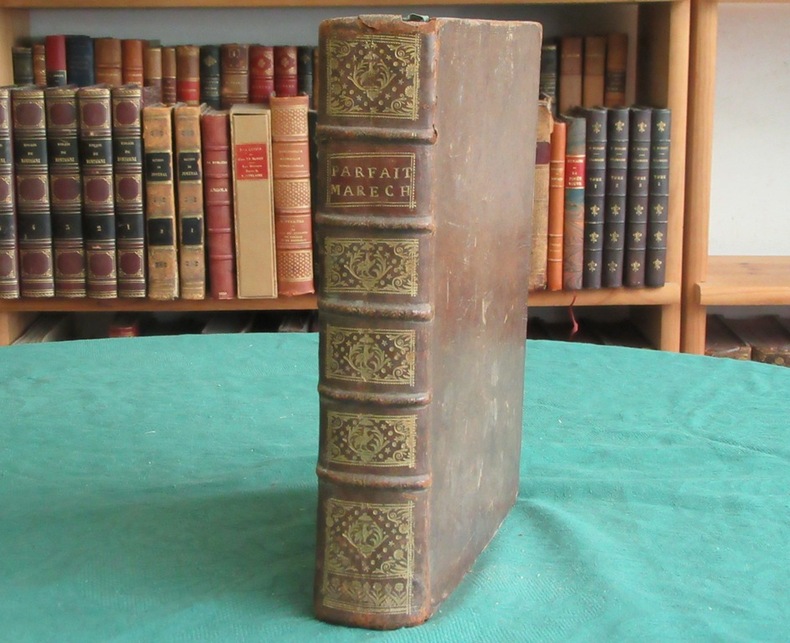
174119563Divisé en six Traités. 1° De sa Construction. 2° Du Haras. 3° De l'Ecuyer et du Harnois. 4° Du Chirurgien et des Opérations. 5° Du Maréchal ferrant. 6° De l'Apoticaire, ou des Remèdes. Avec un Dictionnaire des Termes de Cavalerie. Le tout enrichi de quarante-neuf Figures en Taille-douce. Par M. Fr. A. De Garsault, ci-devant Capitaine en Survivance du Haras du Roi.Édition originale. A Paris, Chez Louis-Estienne Ganeau - 1741 - 18 feuillets (Préface et Tables), 512 pages suivies de 20 planches (hors-texte, botanique) et cxxvij pages (dictionnaire et table des matières). 29 planches dépliantes dans le texte (pagination aléatoire), numérotées de I à XXVIII avec 2 planches numérotées X, bandeaux et lettrines. Complet des 49 planches totales. (Le portrait frontispice n'existe pas dans l'édition originale). Ex-libris manuscrit Huard sur une page de garde.Reliure plein veau moucheté de l'époque. Dos à nerfs orné et doré avec pièce de titre. Tranches jaspées rouges. Roulette dorée sur les coupes. Petit accident à la coiffe supérieur. Une petite déchirure sans manque page 7. Pas de rousseur. Très bon état pour ce bel exemplaire. Format in-8°(26x20).François-Alexandre Pierre de Garsault dit François-Alexandre de Garsault est un hippiatre, zoologiste, botaniste et dessinateur français. Il a décrit pour l'Académie royale des sciences plusieurs ouvrages des arts et métiers.
22488PARIS, Georges Fanchon, Ed. - Sans date (19..) -Fort in-4 - 1/2 Reliure frottée - Dos à nerfs - + de 1300 gravures en texte - 559 + 288 pages - Bel exemplaire.
PARIS, Georges Fanchon, Ed. - Sans date (19..) -Fort in-4 - 1/2 Reliure frottée - Dos à nerfs - + de 1300 gravures en texte - 559 + 288 pages - Bel exemplaire.
197710cb10in4 reliure toilée bordeaux à titres dorés - 522 pp illustrations nb et couleurs. Texte en Français, en Anglais et en Allemand
Most comprehensive and richly illustrated reference work of the world's second largest tapestry collection, nowadays based in the Vienna Kunsthistorisches Museum and once inherited by the Habsburg court. - Contents: Present particularly rare edition contains of 271 original photographies and 30 halftone prints of 301 (of about 900) tapestries made in the regions of Brussels (16th - 18th ct.) or Lorraine (18th ct.), once accumulated by the Habsburg emperors while controlling those territories. Each of the captions contain information about the title, date and place of production as well as inventory number. The exhaustive descriptions of art historian Ludwig Baldass also quote the measurements of the tapestries. - Condition: All traceable copies are loose sets of plates in publisher's portfolios with wrappers, i.e. like published. Our copy instead is skilfully bound in solid and elegant half morocco, though lacking the original wrappers. Joints in parts skilfully restored and with some little wear, otherwise very fine. - Rarity: Present edition was published in 300 numbered copies only, however our copy is without numbering. ABPC, Drouot Digital, LotSearch and JAP record 5 sets at auction since the 1970s (2006, 1988, 1987, 1984 (2), none of them bound like present.
20056Bruxelles Tircher, Imprimeur-Libraire 1860 in folio (33,5x26,5) 2 volumes reliures à la bradel cartonnées de l'époque entiérement recouvertes de papier marbré, dos lisses, pièces de titre noires. Volume de texte: XXXVIII, 272 pages (Histoire générale de la peinture sur verre) et 206 pages (Analyse descriptive des vitraux de Belgique, avec un index alphabétique des peintres verriers cités dans l'ouvrage). Volume de planches: bien complet des 37 planches hors-texte lithographiées, dont 27 planches tirées en chromolithographie. Toutes les planches, et les plis sont montés sur onglets de tissu. Rare. Bel exemplaire, parfaitement établi ( Photographies sur demande / We can send pictures of this book on simple request )
Extensive collection with striking lithographic plates in bright colours showing fine examples of folkloristic ornaments, many of them with Art Nouveau influence. – Contents: Starting with geometric patterns and followed by stylised floral designs, there are also included numerous borders of aprons, corner-pieces in fine open work, simple and ornamental patterns of trimmings, all from national dresses of various regions, accurately and faithfully drawn after the designs and colours of the original garments, adapted the for use in school of arts and crafts. Enclosed is a quarto booklet of 12 pages with explanations how to draw the patterns of different plates, as well as measurements on 15 b/w illustrations and 5 additional illustrations after photos of original garment. – The portfolio is skillfully executed an by Josef Šíma (1859-1929), a high school professor of drawing, collector of folk embroidery and pioneer of documenting folk culture through photography. – The present portfolio was also published with a English, French and German language cover and booklet. - Condition: Upper front band fragmented, cardboard map at edges and corners slightly bumped and worn, boards and last page of text booklet minimally stained title page with slight stains of former cleaning, some plates minimally finger-stained and browned at edges, plate no. XXVIII slightly bumped at upper edge; generally a well preserved portfolio throuhout, in all language variants a very rarely offered item indeed. – Rarity: As of August 27th 2021 there is no other copy available at the market in any of the versions. OCLC and KVK show only 5 copies of the Czech original version in institutional holdings outside of the Czech Republic (Cambridge UL, Cleveland PL, Harvard, Saint Louis PL, Paris [BnF]), none of them cataloguing the originally enclosed booklet. RBH quotes no auction result at all, neighter does JAP/APO. – Reference: Toman, Nový slovník ?eskoslovenských výtvarných um?lc?, 3rd ed., vol. 2 (1950), p. 72 cit. WBIS/CSBA.
191019765Recueil de 116 gravures Art nouveau, originales, avec un titre sur chaque gravure, mais sans description. Auteur Anonyme.Sans page de titre, sans date - Vers 1900-1910.Pages volantes rangées dans un emboitage Art déco. Des déchirures sur 5 ou 6 gravures. Reproduction d'une gravure manquante. Rares rousseurs. Très bon état. Format des gravures in-4°(34x24). Format de l'emboitage (40x30).
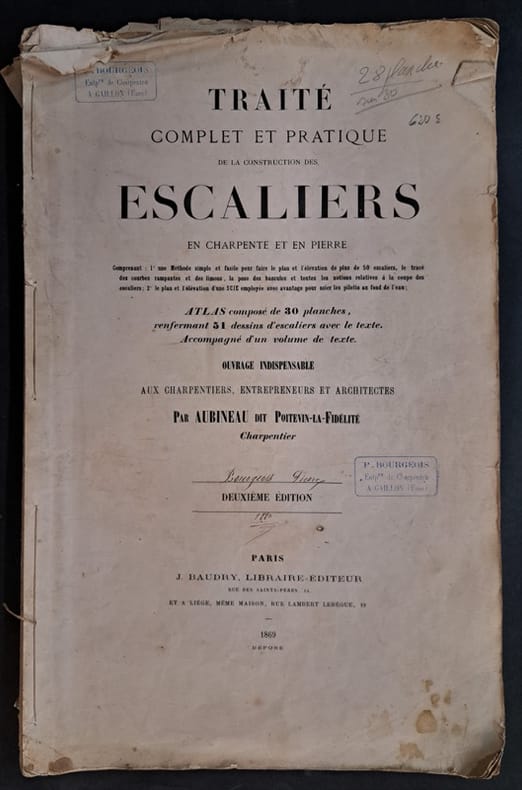
1869127571Paris, J. Baudry 1869 In-folio 43 x 27 cm. En feuillets, portrait lithographié de l’auteur en frontispice, avertissement & table [4] ff., 28 planches sur 30 planches à double page, manque planches 29 &30. Marges effrangées. Ouvrage d’une relative rareté.
166204Edimbourg, J. Taylor, 1814 in-8, [6]-III-[5]-171 pp., avec 15 planches légendées chacune d'une page en regard, [3] ff. n. ch. d'index, 8 pp. (catalogue de libraire), demi-cartonnage modeste, étiquette de titre en long (reliure de l'époque). Quelques rousseurs, mais bon exemplaire.
Erste illustrierte Werkschau des bedeutenden Bildhauers Johann Gottfried Schadow, mit detailreich in verschiedenen hochwertigen Drucktechniken auf großformatigen Tafeln abgebildeten Arbeiten. – Inhalt: Der Zeichner und Bildhauer Johann Gottfried Schadow (1764-1850) gilt neben seinem Schüler Christian Daniel Rauch als der bedeutendste Vertreter des deutschen Klassizismus in der Bildhauerei und als Begründer der Berliner Bildhauerschule. Die Bleistift- und Tuschfederzeichnungen der Schadowschen Basreliefs, Denkmäler, Skulpturen und -gruppen (u.a. seine Hauptwerke, das Grabmal des Grafen Alexander von der Mark (1790), die Prinzessinnen-Gruppe (1797), das Blücher-Denkmal (1819) in Rostock und das Luther-Denkmal (1821) in Wittenberg) stammen vor allem von Ludwig Buchhorn und Gustav Lüderitz; die klaren und detailgenauen Stiche und Radierungen nach zeichnerischen Vorlagen tätigten C. Becker, Fr. Grundmann, P. Habelmann, A. Heinze, Th. Jättnig, D. Marchetti, R. Ruschewey, G. Seidel und B. Woltze. Aufgenommen sind weiters 9 in Metallografie wiedergebenden Diaphanien von Heinrich Christoph Kolbe nach Gedichten Goethes, die der Maler anlässlich eines 1816 am Weimarer Hof abgehaltenen Künstler-Festes geschaffen hatte, an dem auch Schadow und Goethe teilnahmen. Vorliegende erste Retrospektive von Schadows Werk erschien im selben Jahr und Verlag wie des Bildhauers autobiographische Aufzeichnungen „Kunst-Werke und Kunst-Ansichten“. – Erhaltung: Die Decken des privaten Halbleinenbandes aus der 2. Hälfte des 19. Jh. stellenweise berieben und mit Lichtrand, Textteil und Tafeln an wenigen Stellen, mitunter aber stärker stockfleckig, insgesamt kompaktes Exemplar dieses Rarums.