464 résultats
4to., First Edition, with numerous fine coloured and monochrome photographs and reproductions throughout, small neat signature on front free endpaper; green cloth, upper board and backstrip lettered in gilt, patterned endpapers, yellow silk marker, a near fine copy in unclipped dustwrapper. LOOSELY INSERTED ARE 1) HOTEL RESERVATIONS LIST; 2) BIDDING SLIP (BROWNED AT UPPER EDGE); 3) PRINTED LIST OF PRICES REALISED; TYPESCRIPT LIST OF PRICES REALISED; 4) PHOTOCOPIED LIST OF ESTIMATES AND PRICES.
19431314705Stockholm, Fröléen, (1943). 4to. 8, 951, (1) S. m. vielen Meistermarken, 94 Abbildungen auf Tafeln. OHldrbd (Schweinslederrücken u. -ecken) m. goldgeprägtem Rückentitel (vorderes Innengelenk löeicht gelockert).
Madrid, Blas Román, 1790, 29 x 20 cm., cubiertas en papel blanco de época, 4 hojas incluso portada con escudo real grabado y última en blanco. (Al fin fechado en Madrid a 23 de Enero de 1790 y con firma impresa de Manuel Giménez Bretón. Obra rara de la que solo hemos encontrado en el WorldCat los ejemplares existentes en la Biblioteca Nacional de España y en la UC Berkeley Libraries de USA).
[8]-285 pages. Index. Sumptuously illustrated with colour photos and illustrations upon glossy stock. "At the crossroads of art book, historical research and technical manual, a book designed as a jewellery walk through time and space. From the Early Bronze Age to Fine Jewellery, 4,700 years surveyed, 32 historians consulted, 22 museums involved; 76 contributors, jewellers, artists and designers from 30 countries. Four millennia of inventiveness in jewellery are unveiled and illustrated with unpublished photographs; the operation of an ancient Egyptian clasp and the origin of the box clasp are finally revealed." - back board. Clean, bright and unmarked with very light wear. No just jacket, apparently as issued. An excellent copy of this very attractive and highly informative work. 10" x 8.75". Book
New English Original bdg. HC. Folio. (34 x 24 cm). Edition in English. 472 p., color ills. Sultan's Jewelers in the Ottoman Palace, 1853-1871. The book "Sultan's Jewelers in the Ottoman Palace" primarily sheds light on the 19th century administrative and cultural history of the Ottoman Empire during a period of significant transition. The information obtained from the records of the "Jewelers Chamber" situated in the core of the Imperial Mint, over a period of 17 years ( A.H. 1270-1287 / A.D. 1853-1871) while the institution was under the management of the Ottoman Armenian family Duz and the reigns of Sultans Abdulmejid and Abdulaziz presents us with an invaluable treasure of information, the like of which has not been seen before. The records in the registers of the Imperial Mint Jewelers Chamber basically relate to the craft performed in the shop, but at the same time reveal very important historical facts. The information that gats accentuated are the specifics regarding the types, nature and cost of the orders and medals awarded to the military and civilian dignitaries honored by the Sultan. Also from the type and cost of the gifts shipped to Kaaba, to custom made jewelry for the Imperial Harem, from repairs made to worn out objects, to the type of jewelry the crown princes preferred to wear, the extravagance of certain crown princes mothers, to the type and value of items crafted for people with or without rank and certain other data which are now completely out of our reach are found in these records. In these records, taking the circumstances of the period as a basis, we also learn a lot about the jewelers terminology used in mid 19th century, names and costs of medals and orders employed in the Empire, details of precious gifts delivered to kings, queens and dignitaries of great nations giving direction to the era s politics and economy, information on goods imported from abroad or manufactured at the Imperial Mint only to be used at dinner parties and now lost in history, as well as the names of masters outside the Imperial Mint, names of articles and furnishings used at dinner parties given at Neshad-abad and Feriye Palaces, and other diverse data reflecting the spirit of the Tanzimat era, somewhat related to the activities of the Jewelers Chambers but which have not found their way into official documents.
BN66624Schmuck der Moderne / Modern Jewellery 1960-1998 Falk Fritz and Holzach Cornelie <br/><br/> unknown
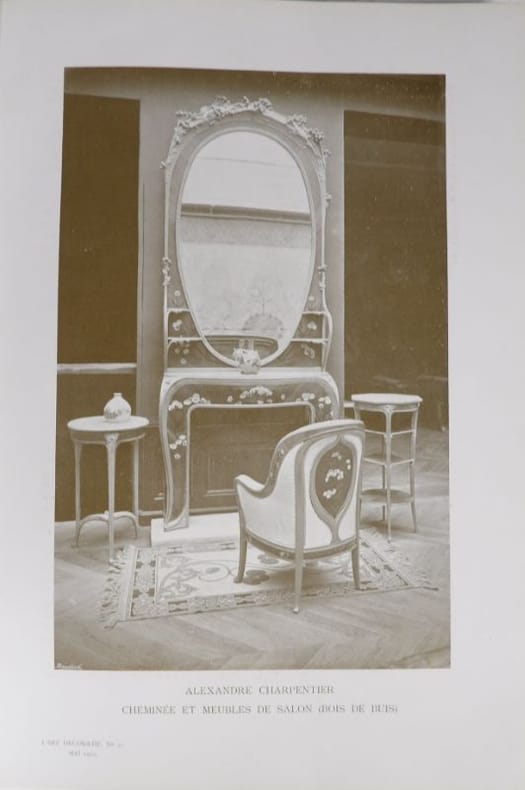
2404Paris, s.n., octobre 1900- mars 1902. 3 volumes consécutifs (n°25 à 42). In-4° - 20 x 29 cm. Cartonnages de l’éditeur à la Bradel en pleine percaline bleu-gris imprimés et illustrés sur le dos et le premier plat d’un décor bleu nuit de style Art Nouveau (filets et volutes), avec le même décor, mais à froid, sur les seconds plats. 2 ff. (table des matières, hors-texte en couleurs, illustrations), 268 pp. ; 266 pp., 2 ff.(tables) ; 260 pp., 2 ff. (tables). Fort belle série de 18 numéros reliés en 3 volumes consécutifs (n°25-30, 3e année-1e semestre, octobre 1900-mars 1901 ; n°31-36, 3e année-2e semestre, avril-septembre 1901 ; n°37-42, 4e année-1er semestre, octobre 1901-mars 1902) de cette prestigieuse revue fondée en 1898 par Julius Meier-Graefe, historien d’art, critique et galeriste allemand. Abondamment illustrées dans le texte (parfois à pleine page), et bien complètes de respectivement 12, 16 et 14 hors-texte en couleurs, soit 42 planches h.t. au total, les livraisons témoignent de la diversité des sujets abordés, ne laissant dans l’ombre aucun domaine des arts décoratifs : architecture, décoration intérieure, bijouterie, art textile, céramique, mobilier, reliure, typographie, sculpture, arts graphiques, orfèvrerie, etc. Plusieurs articles sont consacrés à l’Exposition Universelle de Paris 1900, et de nombreuses monographies évoquent les oeuvres des plus grands artistes européens du temps (T.-A. Steinlen, J. Chéret, H. Vever, G. d’Espagnat, A. Besnard, R. Lalique, G. de Feure, L. Métivet, Ch. Plumet, G. Auriol, T. Selmersheim, E. Gallé, L. Majorelle, V. Horta, A. de la Gandara, K. Moser, H. de Waroquier, E. Grasset, G. Canape, H. Guimard, F. Jourdain, A. Mucha, H. Sauvage, Tiffany, M. Michel, H. Rivière, A.Renoir, …). Rédigée avec le concours d’écrivains, critiques et intellectuels d’avant-garde, la revue contribua activement à la diffusion des principes de l’Art Nouveau triomphant. Chers clients Abebooks, le poids et le volume important de cet ouvrage entraîneront des frais postaux additionnels, merci de le prendre en considération avant votre achat. Dear Abebooks customers, the weight and volume of this book will entail additionnal shipping fees, thank you for taking it into consideration before ordering.
238 pages. Glossary, Index, Appendices, Author's signature upon title page. Numerous wonderful colour plates. Black and white illustrations throughout text. A rare signed copy by the author of the international bestseller 'The Mayan Prophecies.' "Using his own unique process Cotterell decodes the architecture, carving, jewellery and paintings of the Maya. His research reveals, for the first time ever, incredible pictorial evidence that proves the man in the tomb of Lord Pacal was no ordinary man... This man, with his message that touches on the very meaning of life, is one of the miracle-makers, the Supergods." - from dust jacket. Book clean and unmarked with light wear. Pages have partially yellowed at edges. Light wear to dust jacket which is now preserved in a protective cover. Very nice copy. Book
Reliure toile de l'éditeur. 160 pages. Jaquette. 21x28cm. Numéroté (269/300).
18594366Mit 37 Tabellen. Ein praktisches Handbuch für Juweliere, Gold- und Silberarbeiter... Dritte vermehrte, nach dem 1000theiligen Gehalt, dem Zollvereinsgewicht und dem 30 Thaler-, 45- und 52 1/2-Guldenfuß umgearbeitete Auflage. Mit 1 lithogr. Tafel mit 13 Abb. von Schleifformen der Schmucksteine. Breslau, Verlags-Comptoir (C. Tragmann), 1859. 8vo. (19,6 x 13,5 cm). 3 Bll., 175 S., (3 S. Inhalt). Neuer Pappband.
(Al fin:) Madrid, 27 de Abril de 1771, 30,5 x 21 cm., cartoné con el lomo en tela, portada orlada y con escudo real + 34 folios. (A la vuelta del último folio, firma manuscrita del Secretario del Rey, Luis de Alvarado).
Reimpreso en Santiago, por Ignacio Aguayo, 1793, 28,5 x 20 cm., cubiertas en papel, portada con escudo grabado + 61 págs. (Al fin firma manuscrita del escribano de Santiago Juan Antonio Paxaro. El Catálogo Colectivo recoge solo un ejemplar con igual título pero sin lugar ni año, existente en varias Bibliotecas Públicas, pero ninguno de esta reimpresión de Santiago).
1756623108Danzig, G. M. Knoch, 1756. 6 Bl., 106, 24 S. Mit 10 gefalteten Kupfertafeln. Halbpergament d. Zeit (berieben, verstaubt u. fleckig, Ecken bestoßen). [4 Warenabbildungen]
37621Paris 2015 in 8 (27,5x19) 3 volumes reliures toilées jaune de l'éditeur, étui toilé, dos et plats supérieurs titrés, avec de nombreuses illustrations en noir et blanc. Tome 1: Consulat - Empire - Restauration - Louis-Philippe. Tome 2: Le second Empire. Tome 3: La Troisième Rèpublique. Henri Vever, 1854-1942. Réédition intégrale en fac-similé. Bel exemplaire ( Photographies sur demande / We can send pictures of this book on simple request )
186021015041860. Probably French. n.d. c. 1860. 42 x 31 cm in acid free mount. Original French jewellery design in gouache with gum arabic highlighting. unknown
186021015021860. Probably French. n.d. c. 1860. 42 x 31 cm in acid free mount. Original French jewellery design in gouache with gum arabic highlighting. unknown
186021015031860. Probably French. n.d. c. 1860. 42 x 31 cm in acid free mount. Original French jewellery design in gouache with gum arabic highlighting. unknown
186021015011860. Probably French. n.d. c. 1860. 42 x 31 cm in acid free mount. Original French jewellery design in gouache with gum arabic highlighting. unknown
8vo., First Edition, small stain on blank lower margin of two leaves; handsomely bound in full navy morocco, sides with gilt frame border, back with raised bands, second and fourth compartments lettered in gilt, all other compartments tooled in gilt, uncut, a most attractive copy ideal as a gift or for presentation. Wide-ranging account of the international rare pearl trade by a lifelong dealer, with descriptions of quality, variety and values. EXTREMELY SCARCE.
Casablanca, Éditions de La Cigogne, 1953, 35 x 29 cm., carpeta en cartulina flexible y tapas originales en lomo tela y cartoné impreso, estuche en piel editorial, XV págs. Incluso frontis en colores + 18 págs. y 3 hojas de explicación de las láminas + XL láminas con numerosas reproducciones de joyas. (Acompaña a la obra otras 4 láminas de joyas de Marruecos que no pertenecen a esta obra).
2 catalogue of Jewellery Auction: "Notificazione del Lotto di Gioie da farsi dal Sagro Monte della Pietà di Roma". Roma. Stamp. Apostolica. 1762; pp. 20; "Sistema de lotto di Gioie che si farà dal Sagro Monte della Pietà di Roma… anno 1713". Pp. (4) with a folding plate. (Rome, Jewellery Auctions Catalogues) 1489/P
21824NP: NP ND. Fine. 21 x 16 inches gouache on paper of Art Deco jewelry shop designed by R. Tailliard. NP unknown
21824NP: NP ND. Fine. 21 x 16 inches gouache on paper of Art Deco jewelry shop designed by R. Tailliard. NP unknown books
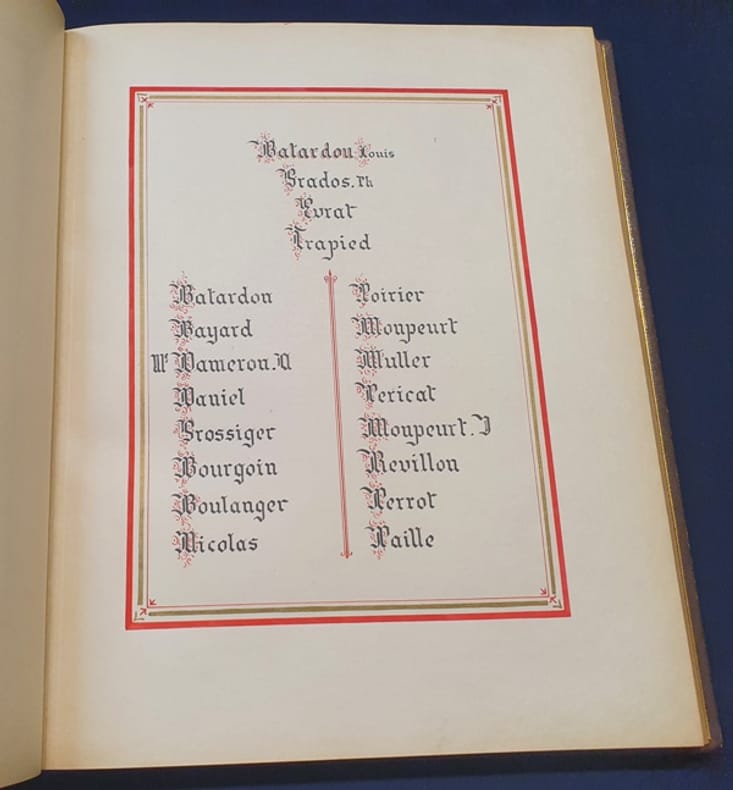
1903Arm3321903 Hommage respectueux à Madame Savard - 28 Mai 1903 - Grand In4 ( 33 x 27 cm ) Maroquin havane , dos à nerfs muet , initiales métalliques dorées en relief AS entremélées au 1er plat , filets et roulettes aux angles , guirlande intérieures , gardes en soie Bordeaux , tranches dorées - coiffes et coins frottés - Reliure signée M. Lortic ( Marcelin fils ainé ) 6 Ouvrage sur Japon entièrement réalisé à la main , calligraphie , dessins et encadrements couleur à la gouache , serpentes de protection . Un bijou pour une famille de bijoutiers ! Page de titre , Illustration allégorique aquarellée 1 page , testimonial 1 page , photographie contre collée 1 page , hommages 4 pages , blasons 2 pages , liste des médaillés d'honneur et liste des retraités 2 pages , liste du personnel de Paris classé par bureaux et ateliers 38 pages , liste du personnel de Guéret 10 pages , liste du personnel de Montignac 5 pages . Les reliures de Marcelin Lortic sont réputées et figurèrent dans nombre de bibliothèques de grands bibliophiles de son temps ( Fléty 115) . Auguste Savard ( 1803/1875) créa son entreprise de bijouterie en 1829 à Ferreux dans l'Aube . Travailleur et ingénieux , il mettra en place des procédés nouveaux qui changeront la vie et le travail des bijoutiers . Il déménagera en 1833 à Paris , puis installera deux autres usines à Guéret et à Montignac . De 1845 à 1850 , Savard applique dans ses ateliers l'estampage par la matrice d'acier qui lui permet de fabriquer des bijoux de qualité tout en économisant de la main d'oeuvre . En 1903 pour le centenaire de sa naissance un hommage lui est rendu . Le graveur René Rozet fait une plaque reproduite et décrite dans cet ouvrage et ses ouvriers rendent hommage à sa femme dans ce magnifique ouvrage unique ou chacun est cité en fonction de son poste de travail .