69 résultats
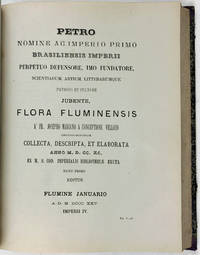
188145183Flumine Januario / Rio de Janeiro: Typ. Economica 1881. First complete edition. Half black morocco over marbled boards gilt spine title. A very good copy boards rubbed repaired tear and closed tear on Volume V half title and title page. xii vii 467 1 pp. 4to. Published in and taking up the entire volume of Archivos do Museu Nacional do Rio De Janeiro. Volume V. 1880 1881. Added title page: Petro nomine ac imperio primo Brasiliensis imperii perpetuo defensore . jubente Flora fluminensis a' fr. Josepho Mariano a Conceptione Vellozo Ordinis monorum collecta descripta et elaborata anno M.D. CC. XC. Ex M.S. cod. Imperialis bibliothecæ eruta nunc primo etitur. Flumine Januario A.D.M. DCCC. XXV imperii IV. José Xavier Veloso 1742-1811 born in what is now Minas Gerais Brazil was ordained in 1766 in the convent of St. Anthony in Rio de Janeiro where he studied philosophy and theology later geometry in San Paulo and finally natural history. He collected plants animals and minerals in the Rio de Janeiro area from 1783 to 1790 at which time he moved to Lisbon where he worked at the Royal Academy of Sciences while preparing Florae Fluminensis his greatest work for publication. Using the Linnaeus' system of sexual classification of plants he prepared very highly detailed texts and 1700 prints many of them of new species. But the publication of the work was beset by problems. First sent to Venice the plates were never completed. Later the French invasion of the Iberian peninsular sent the Portuguese government then Veloso and his manuscripts into exile in Brazil where he died in 1811. In 1825 an abbreviated version of the text was published followed by the eleven volumes of the Icones in 1827 of which few copies survive. The complete text was not published until this edition in 1881. Bound with and proceeded by Archivos do Museu Nacional do Rio De Janeiro. Volume IV. 1879. Rio 1881. viii 151 1 pp vii plates. Folded color plate split at fold. Volume subtitle: Insectologia. Includes Müller Fritz: A metamorphose de um insecto diptero among other works. Rodrigues 2473. Sabin 98833n. For the shorter version of 1825 see: Barba de Moraes II p. 343. Pritzel 468. Jackson 377. Innocencio V.5 4258; V.13 p.122. Also see Nissen BBI 2046. Typ. Economica hardcover books
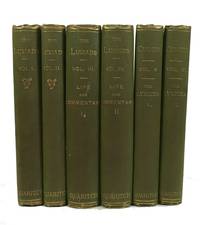
188484965London: Bernard Quaritch 1884. 1st ed. of these three two volume sets of Camoes-related Burton translations which were uniformly bound and also numbered I-VI on the backstrips. The "Os Lusiadas" volumes are the 2nd issue of the 1st ed. which is actually uniform in size and binding with the 1st eds. of the other 2 sets. Hardcover. Near Fine. 6 volumes xix 250 251-471 vii 366 369-738 265 269-540p. Original green cloth with lightly worn gilt corners on front cover and gilt lettering on front covers and backstrips. 18 cm. Minor soiling and wear. Leaves lightly browned. Each volume has the bookplate of Burke Casari a Burton collector and enthusiast. Camoes was a great 16th century Portuguese poet. Burton projected at least four more Camoes-related volumes but they were apparently never published. See Penzer's "Annotated Bibliography" at pages 103-106. Isabel Burton was identified as editor of these rather scarce volumes. <br/><br/> Bernard Quaritch hardcover books
1828321057London: J. Taylor 1828. Engraved title and 55 plates on thick wove paper. Uncut. 8vo. Early calf rebacked. Minor dampstaining. Engraved title and 55 plates on thick wove paper. Uncut. 8vo. Includes designs for gates garden seats alcoves temples baths entrance gates lodges facades prospect towers cattle sheds ruins bridges greenhouses a hot house & hot wall with plans and scales. First issued circa 1800 this later issue from the same plates. Variously ascribed to Elison or Middleton. A charming pattern book. Berlin Kat. 3433; Archer 68.1; ESTC N71679 J. Taylor unknown books
18374940London: Longman Rees Orme Brown Green & Longman 1837. First edition. References: Ibrahim-Hilmy i 310; Kalfatovic 0338. Fine/Living in Luxor in 1836 Hoskins traveled with Robert Hay and Frederick Catherwood to the oases of Libya where he ran into Joseph Bonomi. "A good account" Kalfatovic illustrated with maps and engravings from Hoskins's own drawings. 22 cm; xvi 338 i.e. 341 pages map and 20 engraved plates 3 of them folding. Bound in recent half leather over marbled boards in period style. Marbled edges. Ownership inscription of W. Cushman of Watertown. Longman, Rees, Orme, Brown, Green & Longman, unknown books
188461664Cleveland OH: S. Brainard's Sons 1884. Second edition. 4to. 11 pp. Long introduction on the verso of the title page the music with printed notes indicating stages of the battle. Thomas "Blind Tom" Wiggins Bethune 1849-1908 an African-American autistic savant and musical prodigy was born a slave on a plantation in Harris County Georgia near Columbus and began his musical career at an early age on his master's piano. At eight Tom was hired out to a promoter who toured him extensively in the United States earning prodigious sums of money; his former master took him to Europe in 1866 for a successful tour there. A series of custodial battles and other problems essentially ended Blind Tom's career in the mid-1890s. "In the wave of euphoria after Manassas Tom turned his hypersensitive ear into the music of the big-mouthed guns. He then framed these sounds with the South's triumphant version of events before composing what many believed was his masterpiece . Tom's impressionistic musical description of the battle pits the harmony of the right hand against the discord of the left. An insistent bass conjures the trudge of marching columns tonal clusters evoke the roar of cannon and musketry. A brooding soundscape then ducks weaves and punches its way into a medley of popular and patriotic songs . discord tugging at the heels of melody until it finally explodes into the chaos of a harem-scarem finale" from Deidre O'Connell's "The Ballad of Blind Tom Slave Pianist America's Lost Genius". The first edition of "The Battle of Manassas" was published in 1866 by Root & Cady in Chicago; this second edition including a catalogue of other war related pieces of sheet music available from the publisher was issued by Brainard's in 1884. Both editions are uncommon in institutional holdings and in trade. Not in Dichter & Shapiro Levy or Wolf. OCLC locates 9 copies of the first edition and 8 for the one offered here Yale Columbus State Allen County Public Detroit Public Michigan Virginia SE Illinois Library of Virginia; it's unclear how many of those still retain the color illustrated front wrapper but at least two include it. Spine with tape repairs several marginal tears to interior leaves one leaf with tape repairs not extending into text old tidelines in upper margin of several leaves not extending into text lower front wrapper chipped a good copy of a scarce printing of Blind Tom's masterpiece. Original chromolithographic wrappers illustrated with a Civil War battle scene by Goes & Quensel Lith. Chicago. 8686. <br/><br/> S. Brainard's Sons unknown books
1897WRCAM43100Circle City Alaska and on a steamer between Juneau and Seattle 1897. 12pp. typed on folio sheets of onion-skin paper plus three hand-drawn maps. A total of some 6750 words. Stapled at upper edge. Three horizontal folds. Near fine. A very interesting pair of typed letters from a young man in Alaska during the Klondike Gold Rush. The anonymous author wrote these two letters to his parents describing his journey overland and by water to the Birch Creek mining district his experiences mining for gold and his decision to go into business as a merchant. The letters are written in a detailed style that indicates an educated author. They include three manuscript sketches showing the routes traversed in Alaska and provide a great deal of information about the writer's experiences in the Klondike. These letters are typed but they were likely originally handwritten by the author who later typed them and included his manuscripts maps and sketch in order to send them to his family when he arrived in Seattle or San Francisco. <br> <br> The letter dated Nov. 10 begins with a description of the writer's boat journey from Juneau to Dyea which was a popular disembarkation point for the Chilkoot Trail to Dawson City a center of the gold rush. He arrived at Dyea on April 23 and notes that "dinner at the Dyea post was the last square meal I have had up to the present date November 10." After dinner he loaded his equipment on horses for the journey inland: <br> <br> "My outfit consisted of about 1000 lbs. of provisions guns amunition sic tools for boat building a whip-saw jack-plane cross- cut saw hand saw rip saw hatchet hammer draw knife brace and bits square etc. and clothing blankets tent sheet-iron stone and in fact I think I had about every thing that ever went down the Yukon. Altogether my outfit weighed about 1302 pounds which is much more than is usually taken into the interior." <br> <br> The author spent the next several days transporting his provisions between Dyea and Lake Linderman and he includes in his letter a sketch of the route from Dyea through the valley to the lake noting several camps along the way as well as a sketch of his sled. <br> <br> The second letter dated Feb. 17 1897 was written on board the steamer Al Ki between Juneau and Seattle. He continues the narrative of his trip inland explaining that he arrived at Lake Linderman on May 14. A month later on June 14 the author and a partner their canoe loaded with provisions departed for Circle City which they reached on June 29. There they stored most of their provisions and headed for the mines in the Birch Creek region. Mining was at its height in the middle of the summer but rather than seek out a claim on their own the author and his companion Jim Wishard decided to work for other miners earning some $10 a day. He describes working at mining from 7 p.m. until 6 a.m. the long days making the task of working at night possible. In August the author bought a claim in the Harrison Creek region but decided to forego mining in favor of establishing himself as a merchant: <br> <br> "From what I could see the miners are poorly supplied with food by the two companies and there is always a great demand for luxuries; that is something out of the ordinary and even the necessaries of life. I made up my mind last summer that I could do as well bringing in some food - in other words being something of a merchant - as in any other way to start and having a good knowledge of the country and keeping my eyes open I would undoubtedly have many good chances for speculation. It is a conceded fact that one cannot lose money taking in such an outfit. Everything brings in an average profit of 400 per cent. over the original cost and whatever any one has to sell in the 'grub' line is in demand." <br> <br> The author then describes his construction of a small cabin in Circle City and his decision soon afterward to leave Alaska for the winter. He describes the trip to Dyea undertaken in January and the hardships of winter overland travel in Alaska. Included are some very practical tips: <br> <br> "In crossing water when it is thirty or forty degrees below zero one should dip his moccasins into the water very quickly taking them out before the moccasin is wet through. They will then freeze in a mass on your feet and will serve the same purpose as rubber boots. You can then walk right through water though I would not advise any one to tempt Providence too much." <br> <br> The letter concludes with a description of a recently discovered gold strike called "Bonanza" not far from the Forty Mile camp. The author describes the high hopes around the strike and includes a manuscript map of the region indicating the location of a claim in which he himself has invested. He hopes that his mine will bring him some wealth but reiterates his belief that the way to wealth in the Yukon Gold Rush is by supplying miners with goods and that he is on his way to Seattle and San Francisco to buy provisions to resell. hardcover books
185148314San Francisco / New York: "Gregory's United States & California Express" 280 Montgomery Street / Thompson & Hitchcock 149 Pearl Street 1851. Shiny dark blue paper covers with gilt stamped lettering stapled. Buff paper mailing envelope. Wrapper insides: front instructions for use; rear 2 estimonials dated 1851 from the Panama Star newspaper. Unused Nr Fine with an envelope in similar condition. Unpaginated blank pages. 4-3/4" x 2-7/8" <br/><br/>From the inside of the front cover: "Gregory's California Express. This line one of the oldest established in the business dispatch messengers BY EVERY STEAMER leaving New-York and San Francisco in charge of Letters Parcels Packages Gold Dust and valuables for distribution throughout the United States and California. If possible letters should be directed to the care of mercantile houses or well-known residents in San Francisco or other parts of California by which means their earlier delivery may be insured. Letters directed simply to 'California' or 'at the mines' will not be forwarded as little probability exists of their reacing the persons so vaguely addressed." From the rear cover: "The Central Office of this Express is located in the throughly fire-proof building corner of Montgomery and Merchant Streets San Francisco from which the proprietor Daily dispatches Expresses by steamboat to all parts of the Mines and to Portland Oregon and Honolulu Sandwich Islands on the arrival of ecah steamer with packages from the States." A rare Gold Rush survivor documenting the 'letter & dispatch' business of the era. "Gregory's United States & California Express," 280 Montgomery Street / Thompson & Hitchcock, 149 Pearl St unknown books
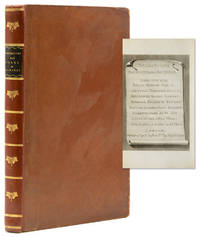
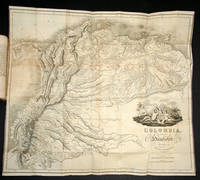
1824WRCAM35060ALondon: G. Cowie 1824. xvi208pp. plus folding map. 20th-century tan buckram spine gilt with a wax seal presumably covering a library call number. Bookplate removed from front pastedown. Light scattered foxing. A good solid copy. Published anonymously but attributed by the British Museum to John Hankshaw while THE ECONOMIC LITERATURE OF LATIN AMERICA Palau and OCLC assign authorship to Francis Hall. This record of a journey was published according to the anonymous author due to the desire "so universally felt in Great Britain of information as to the actual condition of the Republic of Colombia. The more that rich and beautiful country becomes known the greater will be the interest excited towards it among all Europeans. So extensive a field for the exercise of European industry and intelligence has not for ages presented itself." <br> <br> A travel journal composed in the form of letters the author describes the landscape the inhabitants the climate and soil natural resources commodities government and the possibilities for commerce. The highly detailed map of Greater Colombia is "taken from Humboldt and various other recent authorities." ALBERICH 1336. NAYLOR 85. SABIN 14598. PALAU 112082. G. Cowie hardcover books
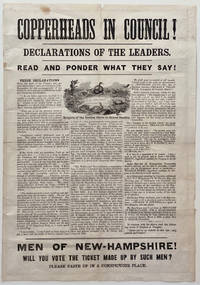
1863List1004New Hampshire: Printer Unknown 1863. First Edition. Printed broadside 16 ½ x 11 ½ inches archivally mounted and matted. A very good copy with some light toning small closed tear at upper margin light foxing at upper margin very tiny spot of loss to illustration at fold. Franklin Pierce remained politically active upon his return to New Hampshire following his presidency advocating for the Democratic cause and generally opposing the Civil War and Lincoln's policies. This scarce pro-Union anti-slavery broadside printed for the 1863 New Hampshire elections which happened March 12 takes aim at Pierce and his fellow Democrats repeating the unfounded claim first made in 1862 by William Seward that Pierce belonged to the secret Knights of the Golden Circle the secret society formed with the goal of forming a new territory out of the CSA Mexico Central America and the Caribbean. There was never evidence that Pierce had any involvement in the KGC though the society had members in southern parts of some Union states such as Indiana Ohio Illinois and Missouri.<br /> <br /> The broadside printed for the March 12 elections quotes heavily from Pierce as well as the other Democrat candidates and party officials who were either running for office in New Hampshire or involved in politics a group which included Ira Eastman John Goerge Josiah Minot Thomas Treadwell Daniel Marcy William Burns and George Stevens. The broadside includes an engraving of coiled snakes each with these politicians named and the caption "et id omne genus." Eastman the Democratic candidate for governor won the popular vote but lacked the constitutional majority necessary for election. Marcy was successful in his bid for the First District. "Men of New Hampshire!" the broadside asks: "Will you Vote the Ticket Made up by Such Men" with the final line imploring to "Please paste up in a Conspicuous Place." <br /> <br /> Overall an uncommon survival from the 1863 elections. A very good copy with some light toning small closed tear at upper magin light foxing at upper margin very tiny spot of loss to illustration at fold. Quite scarce with OCLC locating two copies only at the Huntington Library and the New York Historical Society. Printer Unknown unknown books
186538207Washington D.C. 1865. Letterpress broadside. 24 x 8 1/2 inches. Expert restoration on verso. An unusual broadside Civil War peace proposal.<br/> <br/>A little-known but highly eccentric character Evans first made a name for himself in 1818 when he walked from New Hampshire to Detroit in the middle of winter no less backtracked to Pittsburgh and continued his walk all the way to New Orleans publishing a narrative of his pedestrian journey the following year. After a failed Congressional run in New Hampshire and a failed attempt to become secretary of the Senate he ended up practicing law in Washington. In the midst of the Civil War Evans published a series of broadside letters all known in but few examples and likely printed in small quantities. In one in which excoriated the south for their role in the war he explained that he issued his missives as broadsides since his letters had no chance of publication in the already crowded pages of the newspaper press. The present broadside by Evans suggests a 20-point proposal for peace between the North and South including the abolition of slavery the federal assumption of Confederate debt universal amnesty restoration of all confiscated property the annexation of Mexico the expulsion of the Russians from the Pacific Northwest the seizing of the Hudson's Bay and Arctic fur trade from the British inviting Canada to become part of the United States the unification of Central America and the building of a trans-Darien canal the nationalization of the mining industry universal temperance fair pay charity from the rich and more. The broadside letter concludes: "Unhappy -- deeply unhappy am I in what I am now going to say -- tears of pity grief and shame for the whole country coursing down my cheeks: -- I solemnly declare that I have no doubt and never had that the longer the South holds out the nearer she will be so absolute annihilation ." We locate only four examples extant Boston Aethenaeum American Antiquarian Society Harvard and Minnesota Historical Society. unknown books
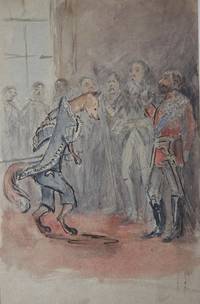
18800064001880-1917. Full Morocco. Very Good. Oblong 21 by 30 cm. 92 numbered leaves with content with log entries more or less statistical on all the versos and pictures and/or original drawings mostly mounted on 58 rectos with some additional loose material. 129 numbered leaves in all. Several of the log pages have mounted photos obscuring the log as it is clear that this game book was at some point re-purposed to be a more general album with some emphasis on sports including also fishing foxhunting and sailing but also there are two pages of photos from South Africa with photos of native tribesmen ostriches a hut Cecil Rhodes house etc. 13 original works of art -- watercolored pencil pen and ink -- in addition to numerous painted fish hook and fly vignettes these sometimes done directly onto the page. Most charming are the comical illustrations of anthropomorphic foxes. Sepia photos are of the country estates their stately homes and rural settings of the hunts as well as the people involved -- the hosts and guests during these country weekends. Many but by no means all of the photos have captions helpfully identifying the participants or the locations. And the log proper provides the names of those participating in the shooting and often what would now be regarded as obscenely large kills. Among the many aristocrats and wealthy in the photographs and/or logs are Lady Randolph Churchill Jennie Churchill Arthur Balfour Lady Minto Mary the famous 4th Countess Henry Lascelles the 5th Earl of Harewood the 5th Earl of Carnavon of King Tut fame as well as the owner of the castle used in Downton Abbey Baron Rothschild Lord de Grey Lord Ashburton Prince Murat the Duke of Buccleuch Prince Duleep de Singh Lord Rosebery and on and on. Country homes include Longleat Greystoke Castle the Hirsel Highcliffe Castle etc. Alexander McDonnell was a son of the 5th Earl of Antrim and a clerk in the House of Lords. Obviously he was very well connected and surely very popular among the upper echelons of English society back then. And we would note that many of the most illustriously titled have frequent entries here; what we have here is a window into a cohesive social network it is our sense. Condition: morocco binding has moderate to heavy wear along edges some scuffs on the boards and spine. The leaves can have a waviness the result of the interaction of the mounted material upon the leaves. A few photos are loose. There is a little bit of a scrappy quality to the book as befitting a log book that was partially turned into something much more and this quality is part of its charm as well. <br /><br /> books
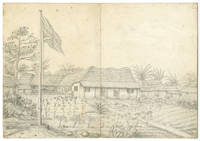
1836WRCAM52991N.p. but near present-day Prampram Ghana 1836. Three pencil sketches on wove paper each approximately 7 x 10 inches. Central vertical crease to each drawing the first two titled in a contemporary hand in pencil to verso the third similarly titled below the image. Very good. An attractive set of skillfully-executed original pencil sketches featuring British colonial structures in Prampram Gold Coast present-day Ghana likely between 1819 and 1836. The sketches are titled in pencil as follows: "Commandant's Residence Pam Pram Gold Coast" "Lower Town Pam Pram from the Upper Town" and "Abandoned Fort at Appolonia from the Beach." <br> <br> The Union Jack flies proudly in the foreground of the sketch of the Commandant's residence. Officially Great Britain colonized the Gold Coast region from 1867 until the independence of Ghana in 1957 though the British had maintained and controlled forts along the West African coastline since long before 1867. Fort Appolonia in the extreme southwestern corner of the country had been a British trading and military outpost from 1691 until 1819 and then again from 1836 onwards when it changed hands from the British to the Dutch then back to the British again. As such if the artist here labeled Fort Appolonia as "Abandoned" he or she must have sketched the fort during the period it was shuttered between 1819 and 1836. <br> <br> A fascinating trio of original sketches offering unique views from a rarely- visualized period in British colonial affairs in West Africa. unknown books
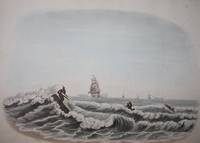
1806004050London: G. and W. Nicoll spelled on the plates with one "l". Printed by Bunney and Co. 1806. Half Leather Marbled Boards. Very Good Minus. Folio 34.5 by 27.5 cm. Only 25 of 49 hand-colored aquatint plates but including several of the most interesting of plates including the Cattamarans -- possibly the earliest depiction of surfing -- a Gentoo Zealot Snake-Men Plates are watermarked 1798 to 1801. A few bear no date. Abbey Travel 428. Rebacked with most of original spine preserved and laid on missing lower compartment. The surviving spine is rubbed cracked and dry but nonetheless a plus to have. Marbled boards are rubbed and worn. Corners are heavily rubbed and abraded. Hinges restored. Scattered light soiling and a few minor closed tears. <br/><br/> G. and W. Nicoll (spelled on the plates with one "l"). Printed by Bunney and Co. hardcover books
185128441New York: Nagel & Weingaertner 1851. Hand-coloured lithograph after Hanson titled below the image. Expert restoration closing tears into the image. The first America's Cup: a scarce hand coloured lithographed view of the winning yacht which gave its name to the cup.<br/> <br/>In 1851 the Royal Yacht Squadron proposed a race around the Isle of Wight. A group of New York Yacht Club members led by Commodore John Cox Stevens built a yacht designed to compete in such races. Designed by Steers and Co. and captained by Richard Brown the yacht America would win the race by eighteen minutes giving its name to one of the oldest and best-known trophies of the sport: the America's Cup. This lithograph and lithographer are unrecorded by Harry T. Peters; we find no other extant examples of this rare print.<br/> <br/>On Nagel and Weingaertner see Peters America on Stone pp. 291-294. Nagel & Weingaertner unknown books
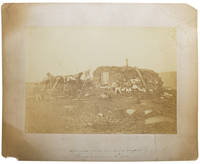
1872303445London 1872. Albumen print measuring 11-5/8 x 16-1/4 in 295 x 412 mm. Laid down on thick cream card with manuscript caption measuring 17 x 21 in. Image slightly faded card chipped with some minor soiling one tear not affecting image. Albumen print measuring 11-5/8 x 16-1/4 in 295 x 412 mm. A rare survival. This image appears in William Bradford's fabled book of photographs Arctic Regions. It was taken by either Dunmore or Critcherson the two professional photographers from Boston who accompanied Bradford on his 1869 expedition to the Arctic on the steamship Panther. It was probably taken at Upernavik a settlement on an island off Greenland's west coast or Godhavn.<br/><br/>Arctic Regions included 141 albumen prints in addition to Bradford's account of the voyage. The title of the photograph here varies from the printed caption in the book where it reads: "Plate Number: 116 Esquimaux igloe or winter hut made of turf and stones. The entrance is to the left through a door which is about three and a half feet high. The length of the passage is about twelve or fifteen feet and at the farther end is another door through which one almost has to crawl on his hands and knees. After passing through there is then room to stand erect but one is forced to leave very soon owing to the bad air." <br/><br/>This photograph is slightly larger than the one in the book which is 277 x 365mm. Furthermore the image in the book is cropped closer on the right and left margins. <br/><br/>The New York Public Library has a folio of 26 images of near identicle size mounted on card. The portfolio was donated to the library in 1892 as part of the Robert Stuart Collection. According to Horch originally all of these images were captioned in manuscript though were later remounted with typed captions as "the original ink-written captions for the photographs had badly faded by 1940." It's interesting that the caption on their duplicate of this image is the same as ours and the image itself has not been cropped. Horch writes that Bradford probably not only selected these images himself but "closely directed the actual taking of the photographs." <br/><br/>It's entirely likely that Bradford would have had extra prints made to distribute to friends repay favors and most of all to solicit subscribers to what was a very expensive book to publish. Given how it conforms to the examples in the Robert Stuart portfolio this particular image is probably one of them. Horch Frank. "Photographs and Paintings by William Bradford". American Art Journal 5.2 1973: pp 61-70; cf Parr and Badger I p31Prm/photo unknown books
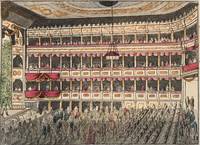
181210794Vienna: Maria Geisler 1812. Contemporary light green glazed paper boards with a ropework roll for an outer frame ochre endleaves gilt-ruled flat spine hinges rubbed gilt-lettered red paper label all edges gilt. The Austro-Hungarian capital in your pocket - her only view book. The prints include theaters opera houses the Imperial Riding School gardens parade grounds a swim club an obelisk coffee houses porcelain and weapons factories hospitals painting galleries the bustling Danube christoph de bac's famous hexadecagon circus building etc. The publisher's address 1200 Graben dates the suite. I have not located a set outside Austria. Individual prints were and are offered for sale. In good condition; two double-page views were likely issued later and are not present here. Two plates have been neatly mounted at the time of issue on the paper stock of the edition nos. 89 and 99. All but two views are in their first or only state.¶Nebehay & Wagner Bibliographie altösterreichischer Ansichtenwerke 193. Maria Geisler unknown books
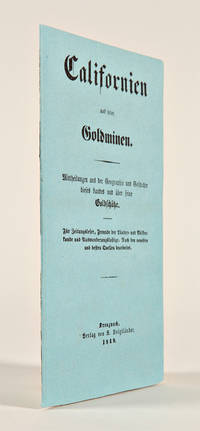
1849WRCAM52151Kreuznach: R. Voigtlander 1849. 32pp. Printed blue wrappers rear wrapper original front wrapper in facsimile. Small corner repairs to rear wrapper. Some foxing two ink stamps on titlepage. Else very good. In a half morocco slipcase and cloth chemise. The first edition of an exceedingly rare Gold Rush pamphlet printed in the hallowed year of that epochal event. "Like many guidebooks for Europeans this pamphlet gives general information on California's physical features history and 'Notes for Emigrants' on the gold discovery. The portion on California's gold riches consists primarily of an article reprinted from the KOELNER ZEITUNG of January 14 1849 which in turn summarizes R.B. Mason and others. The guide mentions the many German settlers in the Sacramento Valley and speaks proudly of Captain Sutter" - Kurutz. <br> <br> Only four institutions worldwide report a copy of this book: the California State Library the University of California at Berkeley Yale and the State Library in Berlin. It is even more difficult to encounter at auction this copy being the only one on record to pass through the rooms. COWAN II p.102. HOWES C43 "aa." KURUTZ 112. SABIN 9984. R. Voigtlander hardcover books
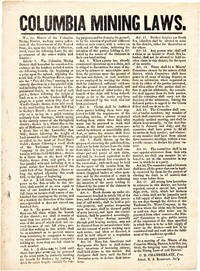
1853WRCAM46036Columbia Ca.: Gazette Print 1853. Broadside 10 3/4 x 8 inches. Printed in three columns. A bit of light foxing mostly in margins. Near fine. In a folding cloth clamshell case spine gilt. A rare broadside printing of the laws of the Columbia Mining District in California in 1853 created and enforced by the miners for their own self-government. The seventeen articles all deal with regulations for mining and claims. The first nine set out rules for making and operating claims. The next three address foreign ownership of claims. Article 10: "None but Americans and Europeans who have or shall declare their intentions of becoming citizens shall hold claims in this district." Article 11: "Neither Asiatics nor South Sea Islanders shall be allowed to mine in this district either for themselves or for others." Article 12 sets out a punishment for any miner who sells a claim to an Asian or a Polynesian. The final five articles set out rules for enforcing the laws including the creation of a Miners Committee and a system of binding arbitration. According to the text the laws were adopted "at a meeting of the Miners of the Columbia Mining District held Oct. 1st 1853." and the laws are signed in print by "C.H. Chamberlain Pres." and "R.A. Robinson Sec'y." <br> <br> "The item is of basic importance.as an example of how the California miners - or men beyond the reach of government anywhere else in our States and Territories for that matter - banded together and enacted and enforced codes of law for their own protection" - Eberstadt. The COLUMBIA GAZETTE which printed this broadside was according to Kemble the second newspaper to operate in Columbia starting operations in the fall of 1852. The first newspaper in the area the COLUMBIA STAR apparently printed only two or three issues in October-November of 1851 before the printing press was destroyed by vandals. <br> <br> Greenwood locates only three copies at the California Historical Society and the Bancroft Library and the Streeter copy which was sold at the Clifford sale in 1994. Rocq lists a copy at the Huntington Library. OCLC adds copies at Yale Library of Congress University of California at San Diego Stanford and DeGolyer Library at Southern Methodist University. A rare and interesting example of the search for order in the tumult of the gold rush. <br> <br> The Streeter copy sold to Howell for $550 in 1968. It later reappeared in the sale of California collector Henry Clifford in 1994. GREENWOOD 381. ROCQ 15427. EBERSTADT 131:105. STREETER SALE 2735. CLIFFORD SALE 26. OCLC 29876358. Gazette Print hardcover books
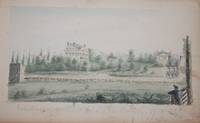
1828006534New York City 1828. Hardcover. Cloth spine. Marbled pastedown on boards. Leather centerpiece label on front board. Good. Original watercolors of rural Manhattan as it appeared in 1828. Among these and captioned are a farmhouse on Broadway and 8th Street; Kips Bay showing a boy sailing a small craft with a farmhouse in the background; a house in Bloomingdale the location of an early village now the Upper West Side along the river between 96th and 106th Streets; and a stately mansion surrounded by fields and less important buildings we would conjecture in or around Bloomingdale but captioned surely incorrectly the Battery. Most of the paintings are uncaptioned. Of these some are surely the Upper Hudson area or are scenes that we can't tell whether they are upstate or in the present day city. The artist also ventured away from the New York areas. Among the non-New York paintings are a depiction of the Cape Pogue Lighthouse on Martha's Vineyard which still stands; Fowey Harbour which is in Cornwall; and a few scenes which look very much like Scotland. Oblong 14 by 19.5 cm. 55 watercolors generally fully finished. Although the sketchbook has a label on its front board bearing the name of Walter Oddie who was a listed artist we believe a good amount of the artwork contained in this sketchbook is of his father-in-law Henry Meigs. Meigs had been a U.S. Congressman from New York and also held a number of other political positions in the city over the course of his career. More pertinently Meigs was known to be an amateur painter and as such an inspiration to Oddie. Given Oddies youth at the time -- he was 20 or 21 years old and from his diary for the years 1828 and 1829 now housed in the Winterthur Library we know he was just starting to paint we find it inconceivable that he would have had the skill yet to produce the sensitive and fine renderings of nature and buildings that typify this sketchbook. Further underlying our thinking about attribution is that some of captioning only makes sense if Meigs were the primary artist. We do consider it quite likely that Oddie may have done some of the sketchier work contained herein as well as contributing in bits and pieces to his father-in-laws work as well as perhaps copying some of it in this sketchbook. To us it isnt really so important who was responsible for particular paintings in the sketchbook. Rather the significance lies in the recording of New York City and its surroundings at the time we suspect that there may be no recording anywhere of some of the buildings and locations at this time. And of course not to be minimized is the beauty of the better paintings contained in the sketchbook.Whatever the degree of Oddies contribution the sketchbook does have something to say about his career and visa versa given that it contains the type of artwork for which he became known later. Oddie was born in Maryland Washington D.C. or possibly New Orleans but spent almost his entire life in New York and more specifically New York City Brooklyn or Long Island. In 1828 the year most of the watercolors in the catalogue were executed Oddie was spending much of his time in the city.Once Oddies interest in painting was sparked he was believed to have been largely self-taught but he did come to study art with Hudson River School painter Robert Walter Weir and Anthony Lewis De Rose a portrait and historical painter. From the diary we know that Oddie did work with De Rose in 1829; we believe that his tutelage with Weir came later. From the diary we know that Oddie was regularly going to art exhibits and critiquing what he saw. The diary also discloses or corroborates our prior sense that Oddie sometimes would work off of engraved prints. To what degree he was merely copying the prints as opposed to using the prints as a spur to his own imagination we can not determine with certitude. We tend to think the views of Scottish and Welsh castles contained in the Sketchbook were done by Meigs not Oddie and so they might well have been done from life.From the diary we know that Oddie had some day job that occupied him during the week and so he did most of his painting at that time on the weekends when he would often go for long hikes along the Hudson. Oddie also refers in the diary to having been in Hudson then and now the county seat of Columbia County and so it is very plausible that some of the upstate scenery is from around there. Again we think some of these paintings may have been done by Meigs.Oddie would become an associate member of the National Academy of Design where he frequently exhibited his artwork.One further note we spoke of questioning one caption referring to the Battery. In 1828 the urbanized part of the city didnt even reach 14th Street but the Battery as the oldest part of the city was thoroughly urbanized. Thus the painting could not be of the Battery. But the landscape is very consistent with the topography of Upper Manhattan. <br /> hardcover books