69 résultats
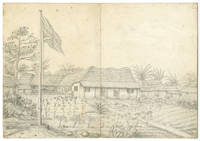
1836WRCAM52991N.p. but near present-day Prampram Ghana 1836. Three pencil sketches on wove paper each approximately 7 x 10 inches. Central vertical crease to each drawing the first two titled in a contemporary hand in pencil to verso the third similarly titled below the image. Very good. An attractive set of skillfully-executed original pencil sketches featuring British colonial structures in Prampram Gold Coast present-day Ghana likely between 1819 and 1836. The sketches are titled in pencil as follows: "Commandant's Residence Pam Pram Gold Coast" "Lower Town Pam Pram from the Upper Town" and "Abandoned Fort at Appolonia from the Beach." <br> <br> The Union Jack flies proudly in the foreground of the sketch of the Commandant's residence. Officially Great Britain colonized the Gold Coast region from 1867 until the independence of Ghana in 1957 though the British had maintained and controlled forts along the West African coastline since long before 1867. Fort Appolonia in the extreme southwestern corner of the country had been a British trading and military outpost from 1691 until 1819 and then again from 1836 onwards when it changed hands from the British to the Dutch then back to the British again. As such if the artist here labeled Fort Appolonia as "Abandoned" he or she must have sketched the fort during the period it was shuttered between 1819 and 1836. <br> <br> A fascinating trio of original sketches offering unique views from a rarely- visualized period in British colonial affairs in West Africa. unknown books
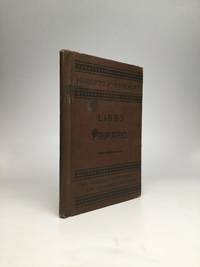
188768676San Francisco: The History Company Publicadores 1887. First Edition. Hardcover. Good. Scarce Spanish language schoolbook with lessons modeled after those in early American primers. Bancroft 1832-1918 is best known for his monumental 39-volume history of the Pacific Coast region from Central America to Alaska. Numerous textual illustrations. Small octavo. Original printed brown paper-covered boards. Pencil marginalia to a few pages. Period previous owner's ink signature to the front flyleaf with a pencil inscription to the front pastedown. The corners are showing with some general shelfwer and minor spotting to the boards. The History Company, Publicadores hardcover books
188461664Cleveland OH: S. Brainard's Sons 1884. Second edition. 4to. 11 pp. Long introduction on the verso of the title page the music with printed notes indicating stages of the battle. Thomas "Blind Tom" Wiggins Bethune 1849-1908 an African-American autistic savant and musical prodigy was born a slave on a plantation in Harris County Georgia near Columbus and began his musical career at an early age on his master's piano. At eight Tom was hired out to a promoter who toured him extensively in the United States earning prodigious sums of money; his former master took him to Europe in 1866 for a successful tour there. A series of custodial battles and other problems essentially ended Blind Tom's career in the mid-1890s. "In the wave of euphoria after Manassas Tom turned his hypersensitive ear into the music of the big-mouthed guns. He then framed these sounds with the South's triumphant version of events before composing what many believed was his masterpiece . Tom's impressionistic musical description of the battle pits the harmony of the right hand against the discord of the left. An insistent bass conjures the trudge of marching columns tonal clusters evoke the roar of cannon and musketry. A brooding soundscape then ducks weaves and punches its way into a medley of popular and patriotic songs . discord tugging at the heels of melody until it finally explodes into the chaos of a harem-scarem finale" from Deidre O'Connell's "The Ballad of Blind Tom Slave Pianist America's Lost Genius". The first edition of "The Battle of Manassas" was published in 1866 by Root & Cady in Chicago; this second edition including a catalogue of other war related pieces of sheet music available from the publisher was issued by Brainard's in 1884. Both editions are uncommon in institutional holdings and in trade. Not in Dichter & Shapiro Levy or Wolf. OCLC locates 9 copies of the first edition and 8 for the one offered here Yale Columbus State Allen County Public Detroit Public Michigan Virginia SE Illinois Library of Virginia; it's unclear how many of those still retain the color illustrated front wrapper but at least two include it. Spine with tape repairs several marginal tears to interior leaves one leaf with tape repairs not extending into text old tidelines in upper margin of several leaves not extending into text lower front wrapper chipped a good copy of a scarce printing of Blind Tom's masterpiece. Original chromolithographic wrappers illustrated with a Civil War battle scene by Goes & Quensel Lith. Chicago. 8686. <br/><br/> S. Brainard's Sons unknown books
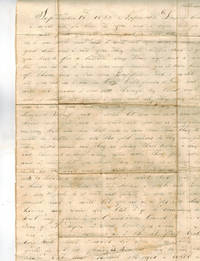
1855007164Sacramento California 1855. Two manuscript letters in ink both on ruled paper with folding creases the 1855 letter 8" x 12 1/2" with single spaced writing both sides approx. 500 words. The 1856 letter 15" x 10" folded in half to make 4 pp. approx. 300 words with small blindstamp top left corner depicting an eagle. The earlier letter is headed "September 18th 1855 Naperville Dupage County Illinois" and ends "Michael direct your letters Nevada County Nevada post office California". George writes to his brother Michael in Naperville that he has "seen a good dele sins i rote you they last letter" including a hundred "inshins" and some "Buffellow". He adds that "we had good luck all they way of may we left Council Bluff" and that he is not home sick yet. He then talks of the gold mines river mining what they are paying and the cost of things such as board "from five to ten dollars a week" "Beaf" "wors 15 to 20 cents" and "potato" "4 cent per pound". He adds that he intends to have some gold before he comes home and that "girls are not so plenty here as they are in state". He closes by asking his brother to write him and to remain at home in Illinois to care for their parents. The 1856 letter headed Sacramento august 3th 1856 informs his brother that he is well and "down to Sacramento now" working on a farm feeding a "schrasing" thrashing machine and that "they times is verry hard in California now". He adds that he had some money "stole" while he was in the mountains but since coming down into the valley he was making money and will send some home soon. The letter ends with George wishing to see them all soon and that he is not home sick. The third page of the letter bears a drawing of a wing or leaf eleven smaller versions of the same image interspersed on page 2. A fascinating testimonial on California during the gold rush written in a strong hand and in a wonderful vernacular style by a good observer. . HOLOGRAPH LETTER SIGNED. Manuscript. Very Good. books
188228712California 1882. 62 2 blank pp. Original printed wrappers lightly dustsoiled stitched. Rubberstamp at head of front wrap: "McKee J. Filed Feb. 25 1882." Text clean. Very Good. <br/> offered with NO. 8072. . POINTS AND AUTHORITIES FOR APPELLANT. MASTICK BELCHER & MASTICK ATTORNEYS FOR APPELLANT. 41 1 blank pp. Original printed wrappers lightly dustsoiled stitched. Ink correction on front wrapper changing "Appellant" to "Respondent." A few question marks in ink written in margins. Very Good. <br/> offered with NO. 8072. . RESPONDENT'S REPLY TO APPELLANT'S BRIEF. ESTEE & BOALT AND RAMON E. WILSON ATTORNEYS FOR RESPONDENT. 23 1 blank pp. Original printed wrappers lightly dustsoiled stitched. Light creasing of a few later leaves. Very Good. <br/> offered with NO. 8072. . RESPONDENT'S POINTS AND AUTHORITIES. ESTEE & BOALT AND RAMON E. WILSON ATTORNEYS FOR PLAINTIFF AND RESPONDENT. 42pp. Original printed wrappers lightly dustsoiled stitched. Text clean. Very Good. <br/><br/> The complaint charged that the plaintiff and defendant were owners of adjoining gold quartz mines near Plymouth California in Amador County the birthplace of the California Gold Rush; and that Defendant Empire had unlawfully entered Plaintiff Pacific Gold Mining Company's mine and taken ores of the value of $250000. Plaintiff brought suit in the Superior Court of Amador County for compensation. unknown books
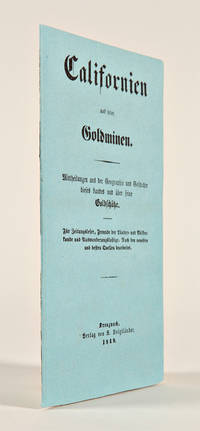
1849WRCAM52151Kreuznach: R. Voigtlander 1849. 32pp. Printed blue wrappers rear wrapper original front wrapper in facsimile. Small corner repairs to rear wrapper. Some foxing two ink stamps on titlepage. Else very good. In a half morocco slipcase and cloth chemise. The first edition of an exceedingly rare Gold Rush pamphlet printed in the hallowed year of that epochal event. "Like many guidebooks for Europeans this pamphlet gives general information on California's physical features history and 'Notes for Emigrants' on the gold discovery. The portion on California's gold riches consists primarily of an article reprinted from the KOELNER ZEITUNG of January 14 1849 which in turn summarizes R.B. Mason and others. The guide mentions the many German settlers in the Sacramento Valley and speaks proudly of Captain Sutter" - Kurutz. <br> <br> Only four institutions worldwide report a copy of this book: the California State Library the University of California at Berkeley Yale and the State Library in Berlin. It is even more difficult to encounter at auction this copy being the only one on record to pass through the rooms. COWAN II p.102. HOWES C43 "aa." KURUTZ 112. SABIN 9984. R. Voigtlander hardcover books
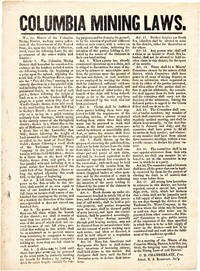
1853WRCAM46036Columbia Ca.: Gazette Print 1853. Broadside 10 3/4 x 8 inches. Printed in three columns. A bit of light foxing mostly in margins. Near fine. In a folding cloth clamshell case spine gilt. A rare broadside printing of the laws of the Columbia Mining District in California in 1853 created and enforced by the miners for their own self-government. The seventeen articles all deal with regulations for mining and claims. The first nine set out rules for making and operating claims. The next three address foreign ownership of claims. Article 10: "None but Americans and Europeans who have or shall declare their intentions of becoming citizens shall hold claims in this district." Article 11: "Neither Asiatics nor South Sea Islanders shall be allowed to mine in this district either for themselves or for others." Article 12 sets out a punishment for any miner who sells a claim to an Asian or a Polynesian. The final five articles set out rules for enforcing the laws including the creation of a Miners Committee and a system of binding arbitration. According to the text the laws were adopted "at a meeting of the Miners of the Columbia Mining District held Oct. 1st 1853." and the laws are signed in print by "C.H. Chamberlain Pres." and "R.A. Robinson Sec'y." <br> <br> "The item is of basic importance.as an example of how the California miners - or men beyond the reach of government anywhere else in our States and Territories for that matter - banded together and enacted and enforced codes of law for their own protection" - Eberstadt. The COLUMBIA GAZETTE which printed this broadside was according to Kemble the second newspaper to operate in Columbia starting operations in the fall of 1852. The first newspaper in the area the COLUMBIA STAR apparently printed only two or three issues in October-November of 1851 before the printing press was destroyed by vandals. <br> <br> Greenwood locates only three copies at the California Historical Society and the Bancroft Library and the Streeter copy which was sold at the Clifford sale in 1994. Rocq lists a copy at the Huntington Library. OCLC adds copies at Yale Library of Congress University of California at San Diego Stanford and DeGolyer Library at Southern Methodist University. A rare and interesting example of the search for order in the tumult of the gold rush. <br> <br> The Streeter copy sold to Howell for $550 in 1968. It later reappeared in the sale of California collector Henry Clifford in 1994. GREENWOOD 381. ROCQ 15427. EBERSTADT 131:105. STREETER SALE 2735. CLIFFORD SALE 26. OCLC 29876358. Gazette Print hardcover books
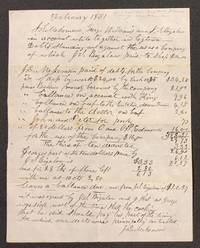
185148953Logtown Eldorado County California 1851. SIGNED by McKemson at conclusion. Now housed in an archival mylar sleeve. Bit of age toning. Fold-lines. Later pencil annotation at top noting location of Logtown. Very Good. Single sheet 25 lines of mss ~ 7 words per line ~ 175 words. 2 sums penned to right of sheet. Docket summary to verso. All writing clear & sharp entirely legible. 9-5/8" x 7-1/2" <br/><br/>An interesting & information-laden letter detailing the contractual & financial agreements between two individuals engaged in mining along with sums paid for divers aspects of same to wit: "to John and Peter for pork" .75 "balance on beef to the butcher down Town" 4.15 and "balance on account with King" 9.86. We note athat the value of labor is recognized e.g. "it was agreed by J. S. Bigalow and I that as George was sick most of the time that the cooking that he did should pay his part of the living for which our bebts were principally contracted." <br /> <br />A nice primary source ADs documenting divers aspects of mine life amongs those so practiciing. unknown books
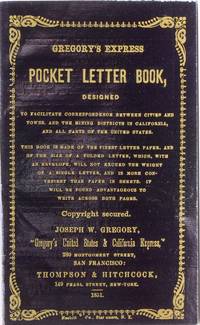
1851320912San Francisco: Joseph W. Gregory 1851. 20 blank leaves. 24mo. Original dark purple wrappers printed in gilt. Minor ink stains on inner wrappers otherwise a near fine copy with the original unused plain paper envelope. 20 blank leaves. 24mo. A lovely example of an unused Gold Rush letter book intended to advertise Joseph Gregory's California and New York Express Line by means of a convenient way for gold seekers in California to communicate with friends and family back home. According to the wrapper "this book is made of the finest letter paper and of the size of a folded letter which with an envelope will not exceed the weight of a single letter and is more convenient than paper in sheets." Gregory also published a pamphlet GREGORY'S GUIDE FOR CALIFORNIA TRAVELLERS; VIA THE ISTHMUS OF PANAMA 1850. This is a scarce California Gold Rush ephemeron. Joseph W. Gregory unknown books
185246494Vassalboro Maine 1852. Now housed in an archival mylar sleeve. Fold lines. Age-toning along some exterior folds. Red sealing wax remnants. Penciled "Grandma Keith" above address. Very Good. Biofolium of blue paper with 2-1/3 pages of manuscript writing containing 2 letters 53 8 lines ~660 100 words respectively. One panel hand addressed to South Braintree Mass with stamped No. Vassalboro ME postmark Mar 15 & "Paid 3" circular stamp. Unfolded: 9-3/4" x 7-5/8". Folded: 3" x 4-3/8" <br/><br/>Ms Keith begins as most mothers do. relating her regrets for not writing sooner followed by health news of divers relations. Page 2 starts with the news that "There is a great many men in this region gone to California it is thought Maine must suffer a good deal in consequence of so many of her Citizens going to that Country the loss of the men is not all the State is injured by having so much money carried out of it. Since the sufferings of those gone there have been made known & likewise how small the chance of making money enough to fetch them back even many who were calculating to go have given it up at least for the present." The second letter by Keith to affirm to Miss Marcy that she wishes good relations between the two of them expressing appreciation of the "complimentary manner in which you mentioned my son." An intimate look at the allure of California's the 1850s myth tempered with the reality relayed back by some of those who succumbed. unknown books
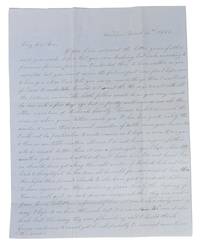
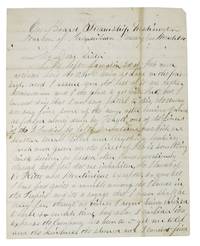
1851476391851. Now housed in an archival mylar sleeve. Age-toning especially along fold-line. Penmanship clear & easily read. Bifolium i.e. 4 pages of lined paper 23 lines per page ~ 10 words per line ~ 900 words. 9-3/4" x 7-5/8" <br/><br/>While no year is written on the ALs itself we posit 1851 as the Maritime Heritage website shows the only visit to San Francisco by the Washington was July 21 1851 arriving from Baltimore per a newspaper entry in the Daily Alta. That said per a online perpetual calender March 14th came on a Tuesday in 1852 not 1851. We lean towards 1851 as the actual year this letter was written. And this historic letter is replete with interesting content written by a man bound for the promised land of California. Chamberlin is from Boston writing a newsy letter his sister posted from the Harbor of Pernambuco Brazil March 14 where the ship in taking on supplies including coal. He describes the voyage thus far the expense of the company that sent him and the trip ahead around the Horn expecting to arrive in California in about 30 days. He describes conditions aboard the ship the places he has visited the people he has met in Brazil his own experiences with the heat and fever and more. Letters from this era are apprearing ever more infrequently on the market. unknown books
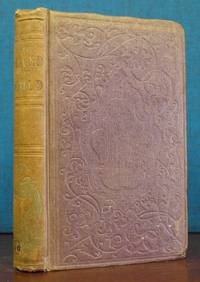
185525719.2Baltimore: Published for the Author 1855. 1st edition Bradford 2222; Cowan II p. 274; Graff 1848; Howes H-401; Kurutz 327; Rocq 15852; Sabin 31272. Brown cloth binding with eleborate blindstamped decorations. Gilt stamped lettering to spine with gilt illustration of a miner and pickax. Spine sunned as are board edges. Remnants of number label at base of spine. Prior owner signature to ffep. Withal a VG copy. xii 300 6 blank pp. 12mo signed in 6s. 7-3/4" x 5" <br/><br/>Per Kurutz "one of the most famous oft-quoted and entertaining books of the Gold Rush." Published for the Author hardcover books
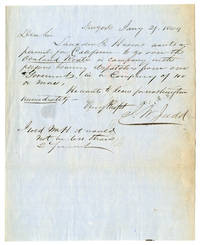
1849WRCAM49949New York 1849. 1p. of a bifolium docketed on verso of second bifolium leaf. Mailing folds slight edge discoloration else fine. An intriguing note regarding life insurance for a forty-niner traveling to California in 1849 with Henry Webb and John Woodhouse Audubon. The note reads: "Langdon H. Havens wants a life insurance permit for California to go over the Overland Route in company with persons bearing dispatches from our Government in a Company of 100 or more. He wants to leave for Washington immediately." Perhaps the twenty-six-year- old Haven sometimes spelled Havens originally intended to join a safe government- sponsored expedition from Washington but he was in fact among the 100 Forty-Niners who embarked on a famously ill-fated overland expedition led by Army Colonel Henry Webb with John Woodhouse Audubon son of the famous ornithologist as his second in command which left New York on February 8. <br> <br> The company proceeded by ship train stagecoach and riverboat to New Orleans and from there by steamer across the Gulf of Mexico to the mouth of the Rio Grande where they arrived on March 13 - an odd overland route dictated by Webb a veteran of the Mexican-American War. There disaster struck. A dozen men died of cholera the company's money was stolen and leadership conflict led Webb to leave the company with a dozen followers. Some of the remaining stalwarts including Haven followed Audubon onward trekking for seven months through Mexico and Arizona the survivors finally reaching San Diego in November. Some then took a boat to San Francisco; others continued overland to the gold fields. As meticulously recorded by Audubon a naturalist and painter in his own right the entire venture has gone down in history as "one of the most poorly-planned" Forty-Niner expeditions "on record." Haven though nearly dying en route was one of the fortunate few who "made it to California." An appealing note dated in the famous year of the California Gold Rush that eerily anticipates the dangers inherent in overland travel in America in the 19th century. unknown books
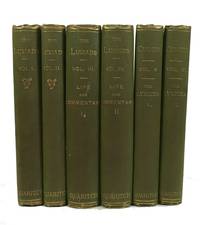
188484965London: Bernard Quaritch 1884. 1st ed. of these three two volume sets of Camoes-related Burton translations which were uniformly bound and also numbered I-VI on the backstrips. The "Os Lusiadas" volumes are the 2nd issue of the 1st ed. which is actually uniform in size and binding with the 1st eds. of the other 2 sets. Hardcover. Near Fine. 6 volumes xix 250 251-471 vii 366 369-738 265 269-540p. Original green cloth with lightly worn gilt corners on front cover and gilt lettering on front covers and backstrips. 18 cm. Minor soiling and wear. Leaves lightly browned. Each volume has the bookplate of Burke Casari a Burton collector and enthusiast. Camoes was a great 16th century Portuguese poet. Burton projected at least four more Camoes-related volumes but they were apparently never published. See Penzer's "Annotated Bibliography" at pages 103-106. Isabel Burton was identified as editor of these rather scarce volumes. <br/><br/> Bernard Quaritch hardcover books
186538207Washington D.C. 1865. Letterpress broadside. 24 x 8 1/2 inches. Expert restoration on verso. An unusual broadside Civil War peace proposal.<br/> <br/>A little-known but highly eccentric character Evans first made a name for himself in 1818 when he walked from New Hampshire to Detroit in the middle of winter no less backtracked to Pittsburgh and continued his walk all the way to New Orleans publishing a narrative of his pedestrian journey the following year. After a failed Congressional run in New Hampshire and a failed attempt to become secretary of the Senate he ended up practicing law in Washington. In the midst of the Civil War Evans published a series of broadside letters all known in but few examples and likely printed in small quantities. In one in which excoriated the south for their role in the war he explained that he issued his missives as broadsides since his letters had no chance of publication in the already crowded pages of the newspaper press. The present broadside by Evans suggests a 20-point proposal for peace between the North and South including the abolition of slavery the federal assumption of Confederate debt universal amnesty restoration of all confiscated property the annexation of Mexico the expulsion of the Russians from the Pacific Northwest the seizing of the Hudson's Bay and Arctic fur trade from the British inviting Canada to become part of the United States the unification of Central America and the building of a trans-Darien canal the nationalization of the mining industry universal temperance fair pay charity from the rich and more. The broadside letter concludes: "Unhappy -- deeply unhappy am I in what I am now going to say -- tears of pity grief and shame for the whole country coursing down my cheeks: -- I solemnly declare that I have no doubt and never had that the longer the South holds out the nearer she will be so absolute annihilation ." We locate only four examples extant Boston Aethenaeum American Antiquarian Society Harvard and Minnesota Historical Society. unknown books
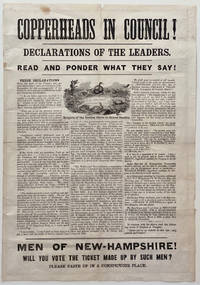
1863List1004New Hampshire: Printer Unknown 1863. First Edition. Printed broadside 16 ½ x 11 ½ inches archivally mounted and matted. A very good copy with some light toning small closed tear at upper margin light foxing at upper margin very tiny spot of loss to illustration at fold. Franklin Pierce remained politically active upon his return to New Hampshire following his presidency advocating for the Democratic cause and generally opposing the Civil War and Lincoln's policies. This scarce pro-Union anti-slavery broadside printed for the 1863 New Hampshire elections which happened March 12 takes aim at Pierce and his fellow Democrats repeating the unfounded claim first made in 1862 by William Seward that Pierce belonged to the secret Knights of the Golden Circle the secret society formed with the goal of forming a new territory out of the CSA Mexico Central America and the Caribbean. There was never evidence that Pierce had any involvement in the KGC though the society had members in southern parts of some Union states such as Indiana Ohio Illinois and Missouri.<br /> <br /> The broadside printed for the March 12 elections quotes heavily from Pierce as well as the other Democrat candidates and party officials who were either running for office in New Hampshire or involved in politics a group which included Ira Eastman John Goerge Josiah Minot Thomas Treadwell Daniel Marcy William Burns and George Stevens. The broadside includes an engraving of coiled snakes each with these politicians named and the caption "et id omne genus." Eastman the Democratic candidate for governor won the popular vote but lacked the constitutional majority necessary for election. Marcy was successful in his bid for the First District. "Men of New Hampshire!" the broadside asks: "Will you Vote the Ticket Made up by Such Men" with the final line imploring to "Please paste up in a Conspicuous Place." <br /> <br /> Overall an uncommon survival from the 1863 elections. A very good copy with some light toning small closed tear at upper magin light foxing at upper margin very tiny spot of loss to illustration at fold. Quite scarce with OCLC locating two copies only at the Huntington Library and the New York Historical Society. Printer Unknown unknown books
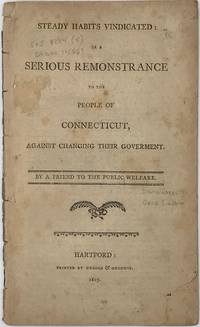
180565766Hartford CT: Printed by Hudson & Goodwin 1805. First edition. 8vo. 20 pp. Sabin 15859. American Imprints 8284. Disbound pamphlet. Bottom corner of title leaf chipped a good copy. <br/><br/> Printed by Hudson & Goodwin unknown books
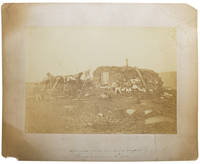
1872303445London 1872. Albumen print measuring 11-5/8 x 16-1/4 in 295 x 412 mm. Laid down on thick cream card with manuscript caption measuring 17 x 21 in. Image slightly faded card chipped with some minor soiling one tear not affecting image. Albumen print measuring 11-5/8 x 16-1/4 in 295 x 412 mm. A rare survival. This image appears in William Bradford's fabled book of photographs Arctic Regions. It was taken by either Dunmore or Critcherson the two professional photographers from Boston who accompanied Bradford on his 1869 expedition to the Arctic on the steamship Panther. It was probably taken at Upernavik a settlement on an island off Greenland's west coast or Godhavn.<br/><br/>Arctic Regions included 141 albumen prints in addition to Bradford's account of the voyage. The title of the photograph here varies from the printed caption in the book where it reads: "Plate Number: 116 Esquimaux igloe or winter hut made of turf and stones. The entrance is to the left through a door which is about three and a half feet high. The length of the passage is about twelve or fifteen feet and at the farther end is another door through which one almost has to crawl on his hands and knees. After passing through there is then room to stand erect but one is forced to leave very soon owing to the bad air." <br/><br/>This photograph is slightly larger than the one in the book which is 277 x 365mm. Furthermore the image in the book is cropped closer on the right and left margins. <br/><br/>The New York Public Library has a folio of 26 images of near identicle size mounted on card. The portfolio was donated to the library in 1892 as part of the Robert Stuart Collection. According to Horch originally all of these images were captioned in manuscript though were later remounted with typed captions as "the original ink-written captions for the photographs had badly faded by 1940." It's interesting that the caption on their duplicate of this image is the same as ours and the image itself has not been cropped. Horch writes that Bradford probably not only selected these images himself but "closely directed the actual taking of the photographs." <br/><br/>It's entirely likely that Bradford would have had extra prints made to distribute to friends repay favors and most of all to solicit subscribers to what was a very expensive book to publish. Given how it conforms to the examples in the Robert Stuart portfolio this particular image is probably one of them. Horch Frank. "Photographs and Paintings by William Bradford". American Art Journal 5.2 1973: pp 61-70; cf Parr and Badger I p31Prm/photo unknown books
1889JC4966Paris: Aux Depens de la Compagnie 1889. Hardcover. Near Fine. Gilt-ruled half red morocco and marbled paper gilt-stamped lettering and ornament on compartmented spine 5 raised bands top edge gilt. Near fine just a few tiny bumps or scuffs here and there along edges of boards. A pretty little volume of lesbian erotica. <br/><br/> Aux Depens de la Compagnie hardcover books
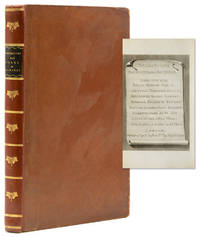
1828321057London: J. Taylor 1828. Engraved title and 55 plates on thick wove paper. Uncut. 8vo. Early calf rebacked. Minor dampstaining. Engraved title and 55 plates on thick wove paper. Uncut. 8vo. Includes designs for gates garden seats alcoves temples baths entrance gates lodges facades prospect towers cattle sheds ruins bridges greenhouses a hot house & hot wall with plans and scales. First issued circa 1800 this later issue from the same plates. Variously ascribed to Elison or Middleton. A charming pattern book. Berlin Kat. 3433; Archer 68.1; ESTC N71679 J. Taylor unknown books
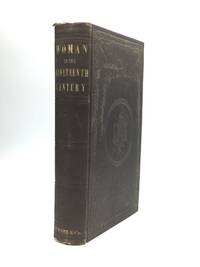
185572334Boston: John P. Jewett & Company 1855. Hardcover. Very good. Third Thousand. Widely regarded as the founding text of the women's rights movement in the United States as well as an important influence on many of the movement's leaders including Elizabeth Cady Stanton and Susan B. Anthony. Edited by Arthur B. Fuller. Introduction by Horace Greeley. Frontispiece portrait. Octavo. Original brown cloth binding with gilt titles and decorative blind stamping. Some foxing to the frontispiece and the opposing leaves. Period previous owner's ink signature to the front flyleaf. A bit of wear to the corners and tips; otherwise very good. John P. Jewett & Company hardcover books
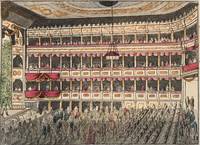
181210794Vienna: Maria Geisler 1812. Contemporary light green glazed paper boards with a ropework roll for an outer frame ochre endleaves gilt-ruled flat spine hinges rubbed gilt-lettered red paper label all edges gilt. The Austro-Hungarian capital in your pocket - her only view book. The prints include theaters opera houses the Imperial Riding School gardens parade grounds a swim club an obelisk coffee houses porcelain and weapons factories hospitals painting galleries the bustling Danube christoph de bac's famous hexadecagon circus building etc. The publisher's address 1200 Graben dates the suite. I have not located a set outside Austria. Individual prints were and are offered for sale. In good condition; two double-page views were likely issued later and are not present here. Two plates have been neatly mounted at the time of issue on the paper stock of the edition nos. 89 and 99. All but two views are in their first or only state.¶Nebehay & Wagner Bibliographie altösterreichischer Ansichtenwerke 193. Maria Geisler unknown books
18681375640th Cong. 2d Sess.: HED265. 1868. 166pp Disbound persistent light dampstain. Good. HED265. unknown books
1806004050London: G. and W. Nicoll spelled on the plates with one "l". Printed by Bunney and Co. 1806. Half Leather Marbled Boards. Very Good Minus. Folio 34.5 by 27.5 cm. Only 25 of 49 hand-colored aquatint plates but including several of the most interesting of plates including the Cattamarans -- possibly the earliest depiction of surfing -- a Gentoo Zealot Snake-Men Plates are watermarked 1798 to 1801. A few bear no date. Abbey Travel 428. Rebacked with most of original spine preserved and laid on missing lower compartment. The surviving spine is rubbed cracked and dry but nonetheless a plus to have. Marbled boards are rubbed and worn. Corners are heavily rubbed and abraded. Hinges restored. Scattered light soiling and a few minor closed tears. <br/><br/> G. and W. Nicoll (spelled on the plates with one "l"). Printed by Bunney and Co. hardcover books
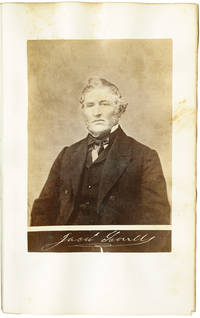
1877WRCAM18476Hartford 1877. 339pp. plus thirty mounted albumen portraits including frontispiece. Original cloth. Spine ends frayed corners bumped. Contents a bit shaken. Overall quite good. A thorough survey of the early settlement of Cornwall Connecticut. This work is notable for its thirty mounted photographic portraits of prominent citizens. Much on the ecclesiastical history of the town the service of native sons in the American Revolution etc. Also genealogical sketches of prominent families. hardcover books