8 résultats
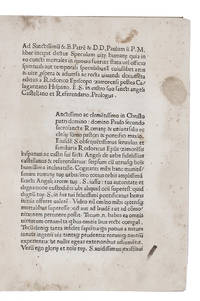
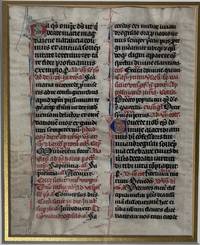
1450007081France 1450. No Binding. Very Good. A fine illuminated leaf on vellum from a Latin Breviary of Book of Hours containing part of the homily XXXIII on the Gospels by St. Gregory the Great read during the Office for the Feast of Saint Mary Magdaline. Written in two columns of 27 lines in a handsome Gothic Textualis Quadrata ruled in red in black and red ink with alternating blue and red initials heightened with delicate pen flourishing extending into the margins. Rubrics in red. The text opens "De sancta Maria Magdalena." recounting Mary Magdalene's penitence and devotion an evocative passage central to her medieval cult. Condition: Fine for its age. Vellum bright and clean with light natural cockling and a few faint handling marks. Inks unfaded rubrication vivid. Handsomely matted and framed with gilt border. Visible area: 5 x 4 in. 127 x 102 mm Frame size: 15 x 11 inches. An attractive and well-preserved example of 15th century devotional manuscript art <br/> <br/> unknown
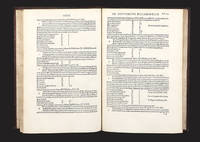
149455951494. 148 leaves including the final blank Roman letter except for the two-line title in gothic type 51 lines & headline capital spaces with guide letters. Folio 290 x 188 mm. late 17th-cent. panelled English speckled calf rebacked with the orig. spine laid-down minor staining to a few leaves in blank upper margins. Basel: J. Amerbach 1494.<br/> <br/> First edition of the “first bibliography to be compiled as a practical work of reference.â€â€“Grolier Club Bibliography 7. <br/> <br/> Tritheim 1462-1516 one of the leading polymaths of his age was appointed the 25th abbot of the monastery at Sponheim in 1483. “One of the first of his many self-imposed tasks was the reorganization and cataloguing of the monastic library if one can call reorganization the process of transforming forty-eight mongrel volumes into a splendid collection of 2000 printed books and manuscripts many of great importance and rarity…<br/> <br/> “It was during the progress of this work no doubt as his exceptional knowledge of books caused inquiries frequently to be addressed to him that he conceived the notion of compiling a new and ambitious bibliography of ecclesiastical writers. He began work in 1487 and by the spring of 1492 he was able to send the complete manuscript to the bishop of Worms. He then revised it and in 1494 the Liber de scriptoribus ecclesiasticis a folio of nearly 300 pages issued from the Basle press of Johann Amerbach…<br/> <br/> “From Alexander bishop of Cappadocia down to himself Tritheim sets out in chronological order nearly a thousand writers largely but not exclusively ecclesiastical giving a short account of each followed by a list of his or her writings. Nor are these lists merely perfunctory: it is obvious from such a heading as that for St. Augustine under which he enumerates 277 works that Tritheim must have lavished an immense amount of genuine research on his bibliography. In all about 7000 books are recorded. An alphabetical index of authors arranged of course by Christian names is added. The contrast between the feeble theological bibliographies of the manuscript age and this first attempt in the printing era is very striking.â€â€“Besterman The Beginnings of Systematic Bibliography pp. 7-8.<br/> <br/> The title of the book is somewhat misleading since the work is not restricted to ecclesiastical writers but also includes authors such as Dante Poggio and Sebastian Brant.<br/> <br/> A fine and crisp copy of a book which has become uncommon on the market preserved in a box. Bookplate of the Society of St. John the Evangelist Cowley Oxford. With a note on the rear paste-down referring to “Derby†the Earls of Derby and a shelf-mark.<br/> <br/> ⧠Goff T-452. unknown
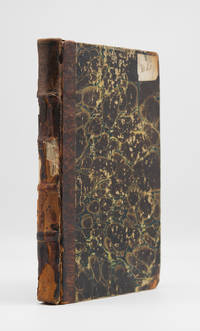
1480101214Cologne: Conrad Winders de Hombrach ca. 1480. 8vo. Initials some historiated in brown ink. 83 of 96 ll. 27 lines-to-a-page. Collation: b8b4.5 c8c1.8 2.7 d8d1.8 2.7 e-f8 g6 h8 i8 k8 l8 m6m1.6 n6 a6a.1 blank. Later half calf and marbled boards; spine perished joints cracked some dampstaining repaired closed tears to first leaf. Incunable printing of this philosophical work on eating table manners and the good life one of several undated Cologne editions printed in the 1480s. Variously attributed to Michael Scotus or Theobald Anguilbert who Simon describes as "an Irishman and a doctor of medicine who realized the paramount importance of the right choice and proper preparation of food and drink to maintain and recover good health." This copy though incomplete is from the celebrated incunable and post-incunable collection of the Frankfurt physician and bibliophile Georg Kloss and sold at his sale Sotheby's 7 May 1835.PROVENANCE: Georg Kloss M.D. bookplate his catalogue Sotheby's London 7 May 1835 no. 2535; Lewis Henry Machen purchased at Hyatt's Washington D.C.; thence by descent.REFERENCE: ISTC im00491000 17 copies; Goff M491; Klebs 676.2; BMC I 250; GW M22812 18 copies. Conrad Winders, de Hombrach hardcover
1490V68428Venice: Hermann Lichtenstein Coloniensis 1490 7th Sept. Hardcover. Very Good-. Guide Letters in red and blue red and blue markers several hundred . Quarto 244x175mm blindstamped pig spined wooden boards with 2 working clasps oldbut not original ink title to spine on 5 raised double cords repair to foot of spine/ old copper strengthening to lower board insertions of catches/minor worming but not weakening wood or leather inside of covers are part of a Spanish-Latin word list. 1st leaf has old ownership and neat caligraphic title Plura Opuscula St. Thome. Verso=Tabula listing the titles or all the works some damage bottom 7 titles Leaf 2-12 =Life of which first 5 leaves have repairs to foot of page but with loss to only the recto of the first leaf other paper repairs are marginal only and do not affect any print these leaves signed aa in 12's. The 72 Opuscula take up a-x A-Z AA-HH all in 8's except x & HH in 12's as listed on Register on last leaf. Some repairs to later pages of index with the last being mounted but only affecting 2 words of the Register leaf. Some worm holes mostly marginal and some marginal damp marks but the paper is strong and supple. Clean very thick book 436 leaves 872pp Printed in double columns 56 lines to a full column in Gothic letters. Collated complete. Reefernmces: Hain-Cop. 1541 BMC V 358 Proctor 4793 Goff T 258. Hermann Lichtenstein Coloniensis hardcover
141916009JUnion Hill / Grass Valley California 1914-1915. Original hardcover ledger 11.5†x 8†bound in half leather with gilt stamping over light brown corduroy metal spine with locking mechanism no key marbled paper pastedowns and gilt embossed leather alphabet tabs on front page edges. 168 pages of handwritten text showing detailed internal records from the historic Union Hill Mining Company that had offices in both Grass Valley and San Francisco. Union Hill is adjacent to Grass Valley. Detailed information for 1914-1915 including operating expenses profit and loss income expenses production vendors payroll cash bullion production tungsten production names vouchers insurance and marketing. Entries include operating expenses for the South Idaho Mine and names of the local companies they did business with such as Grass Valley Hardware Empire Mining Company Nevada County Narrow Gauge R. R. Company and Thomas Diggs Company an entry for Augustus D. Cox who was the Mine supervisor to very specific mining operating expenses for example: “Shaft Above 600’ Level†“Shaft Below 600’ Level†“Storage Dam 600’ Level†with expenses for mining tools hoisting compressing fire protection etc. A rare and unique Gold Country artifact this original handwritten Ledger offers compelling insight into an historic Mother Lode gold mine. The corduroy covers have some staining the rear leather corner has a corner chip the rear spine fold has a two inch half oval chip revealing the board beneath the front hinge is split and the metal spine has some rust internally the ink stamp of the Union Hill Mining Company on the front endpaper. Gold was discovered at Union Hill in 1854 the first recorded claim was in 1866 as Union Hill Gold Quartz Mine and Mining Stock Certificates for Union Hill Mining Company exist from the 1860’s. Although very profitable it appears Union Hill Mine opened & closed changed ownership &/or operators several times from the 1870’s until purchased by Idaho-Maryland Mines Company around 1920. In 2016 this historic mine was purchased by a gold mining company with plans to restart operations in the unexplored areas below the Idaho-Maryland Mine Property. hardcover
1486ABC_47548Strasbourg: Johann Prüss 1486. Contemporary blind-tooled pigskin over wooden beechwood boards by an Augsburg bindery Eindbanddatenbank workshop w002998 active ca. 1488-1497 sewn on 3 double supports each board in a panel design with 4 concentric multi-fillet rectangular frames the central field into 4 whole and 8 half-lozenges by 6 diagonal multi-fillets 3 in each direction each whole lozenge stamped with a double fleur-de-lis in a lozenge and each half lozenge with a crown stamp the immediately surrounding fields filled with 32 full and 4 half impressions of a rosette in a square and the next surrounding fields filled with a 10 mm and a 6 mm roll the outermost fields empty making in total 88 full and 8 partial impressions of 3 stamps plus the 2 rolls. Remnants of 2 strap fastenings catchplates and clasps lost 7 leather tabs or traces of lost leather tabs wrapped around the fore-edge margin 0.5 x 1 cm marking the opening of libri 2-8. Chancery folio 32.5 x 22 cm. Printed in 2 columns with 48 lines to the column. Set in 2 sizes of rotunda gothic types Prüss types 2 180G and 3 90G with spaces left some with and some without printed guide letters for manuscript initials 1 8-line 2 7-line 4 6-line 3 5-line and numerous 3- and 4-line. From the beginning to h3r these spaced have been filled in with manuscript lombardic initials in red and the text has been rubricated the first fifth of the book. Written around 1280 the Rationale divinorum officiorum is considered one of the principal sources for the western church liturgy. It focuses on the allegorical interpretation of the liturgy based on Amalario's work and Duanti is recognized as an excellent compiler. The book is divided into eight volumes and provides an elaborate account of the laws ceremonies customs and mystical interpretations of the Roman Rite. The first volume discusses religious art and architecture such as the church altar pictures bells churchyard and more. The second volume is dedicated to the ministers while the third volume focuses on vestments. The fourth volume discusses the Mass the fifth covers the canonical hours the sixth volume is about the Proprium Temporis the seventh is about the Proprium Sanctorum and the eighth covers the astronomical calendar the manner of finding Easter Epacts and more. The Rationale is considered the most comprehensive medieval treatise of its kind serving as a significant authority on medieval Latin liturgy. It had at least 44 editions during the incunabula age since its first printing in 1459 by Johann Fust and Peter Schöffer in Mainz. Even today it remains the standard authority for rituals clothing and symbolism from the thirteenth century.Guillaume Durand Bishop of Mende was an important liturgical author and canonist. Born in 1237 in Puimisson Provence a Canonist and prominent liturgical writer of the medieval period Durandus earned the nickname "Speculator" from his work Speculum Judiciale. After studying law under Bernard of Parma at Bologna he went on to teach law at Modena before being summoned by Clement IV to Rome. Lacking the final blank leaf L10. The leaves in the central part of the book h4-E2: about 160 leaves show only one or two small worm holes but in the leaves before and after about 60 leaves each the worm holes gradually multiply as one approaches the beginning and end. In general the bookworms were kind enough to tunnel straight through rather than turning to the side so that only a handful of leaves show trails and those are few and short in the worst leaves 2 trails of 1 and 1.5 cm. They did continue through the paste-downs boards and hinges leaving numerous very small holes in the pigskin though the spine remains almost untouched. The bookworms appear not to have grown fat from their feast because their holes measure only about 1.5 mm in diameter. Aside from the worm holes the book is internally in very good condition with only minor marginal stains in the last 5 leaves and an occasional small marginal tear or chip 4 of the 7 leather tabs have torn off sometimes also affecting the leaf before or after but none of these few minor blemishes comes close to the text. One can see where two catchplates were once attached to the fore-edge of the binding and remnants survive of the two leather straps that would have held the clasps. The boards are somewhat rubbed making it difficult to see details in some of the tooling but thanks to the numerous repetitions of the three stamps and one roll or possibly two rolls side by side the binding provides some clear impressions of most and all can be identified. An early edition of an important book on church liturgy in contemporary blind-tooled pigskin with an interesting provenance and nearly untrimmed several leaves preserving deckles at the foot quires b c and others fore-edge quires s y z and others and head quire K and others.l Collijn Uppsala 514; GW 9131; Goff G431; Hain-Copinger 6491; ISTC id00431000; Pellechet 4508; Polain 1379; USTC 744525; for Scheyern Abbey its bindery its library and Georg Waser see John Thomas McQuillen In manuscript and print: the fifteenth-century library of Scheyern Abbey PhD thesis University of Toronto 2012 mcquillen_john_t_2012nov_phd_thesis.pdf pp. 27-35 220-229 & 309. [Johann Prüss], hardcover
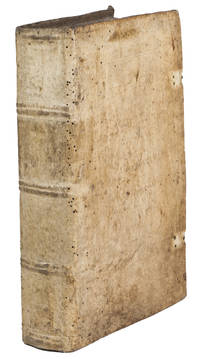
147314731Rome: Joannes Philippus de Lignamine 1473. Limp sheepskin parchment ca. 1740/50 sewn on 3 supports cut flush with the bookblock and attached to the cover with separate alum-tawed thongs with a hollow back 2 alum-tawed loop and knot fastenings extensive title hand-lettered across the spine possibly later in the 18th century. Small folio 26.5 x 20 cm. With spaces left for 2 large 6-line and about 80 small 3-line initials to indicate the beginning of the books chapters and a couple other divisions never filled in each preceded by an indented chapter or other heading mostly of 4 or 5 lines. Text block 19.5 x 11.5 mm with 31 lines per page. Set in a single roman type throughout Lignamine 125R. Second Rome edition published in 1473 of a popular philosophical moral and practical work by Rodrigo Sánchez de Arévalo bishop of Zamora 1404-1470. Known in English as the Mirror of human life it is divided into two "books" the first 30 numbered chapters devoted to secular life and the second 43 numbered chapters to spiritual life each dealing with various stages in human development. It discusses the benefits responsibilities and dangers of various trades and professions and was intended to help people choose a vocation. This makes it a valuable source for information about numerous occupations in a wide range of social strata. Lignamine's roman type used for the entire book first appeared in a book with colophon dated 3 August 1470 ISTC iq00024000 making it one of the very earliest roman types and it deserves more attention than it has received. Olocco convincingly argues that the earliest truly roman types were based on a style of humanistic manuscript hand that evolved in Padua where Andrea Mantegna revived classical roman inscriptions in his frescos in the 1450s and where manuscripts took inspiration from classical Roman inscriptions for their capitals and adapted the serif structure of the lowercase to them. Lignamine's type is also set with considerable sophistication already in its earliest uses with special characters for abbreviations and with T and V kerned to avoid white gaps in combinations like "To" without overdoing it something Jenson appears to have tried only in 1471 and quickly abandoned. The fore-edge margins contain frequent contemporary manuscript notes in brown ink often serving as a guide to the content and occasionally simple contemporary penwork decorations probably by the same hand drawing attention to short passages in the text. There are also slightly later manuscript notes. Engraved armorial bookplate of Manuel Gonzalez Salmon 1778-1832 Prime Minister of Spain in 1819 and 1826-1832. With some small holes in the last text leaf a worm hole restored in the fore-edge margin of the first 30 leaves leaving a small stain some minor foxing mostly in the first leaf and last leaf of the text and a couple small ink smudges. Otherwise in very good condition. Lacking the initial blank leaf. The book still has generous margins but occasionally a manuscript note has been shaved. The parchment of the binding is wrinkled and part of one fastening is lost. One of the earliest incunabular editions of an important work.l Bod-Inc R086; BMC IV pp. 31-32; Goff R220; Hain-Copinger 13943; GW M38496; IGI 8397; ISTC ir00220000; Klebs 857.9; Oates 1380; Proctor 3391; USTC 991529; for the early history of roman printing types: H. Carter A view of early typography 1968 pp. 47-49; R. Olocco The Venetian origins of roman type 2017 online at: http://articles.c-a-s-t.com/the-venetian-origins-of-roman-type-a856eb3f0cb. Joannes Philippus de Lignamine, unknown
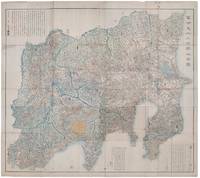
1418159850Shūseidō 衆星堂. Reprint. Tenpō 14 1843. Large folding handcoloured map of the thirteen provinces from which Mt. Fuji can be viewed. 159 x 178cm. Folds into paper covered card covers measuring 40 x 24cm. Title label upper cover. A little browning along folds occasional spotting and soiling. A little worming causing approximately 1cm of loss in places. Two chops in lower section. A very striking and attractive map. This very large handsome map is a detailed map of the thirteen provinces from which one can see Mt. Fuji. Provinces shown are the eight provinces of the Kantō region Sagami 相模 Musashi 武蔵 Kazusa 上総 Shimofusa 下総 Awa 安房 Kōzuke 上野 Shimotsuke 下野 and Hitachi 常陸 and five other provinces Izu 伊豆 Suruga 駿河 Tōtōmi 遠江 Kai 甲斐 and Shinano 信濃. The map offers a large amount of detailed information such as province and county borders rivers high ways post towns checkpoints villages and scenic spots. <br> <br>The cartographer Akiyama Einen or Nagatoshi 秋山永年 came from Edo and the editor Funakoshi Seizō 船越清蔵 studio name: Shugu 守愚 1805-62 a Confucian scholar from Nagato Province now the western half of present-day Yamaguchi Prefecture. A dedication by Funahashi Akira 舟橋徴 is dated 1843. . Shūseidō 衆星堂 unknown