37 résultats
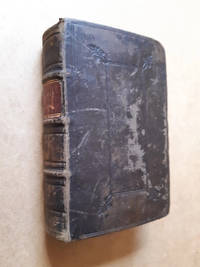
1581#BIBLIO-1187<p>Ioan. Ravisii Textoris Nivernen: dialogi aliqvot festiuissimi studiosæ iuuentuti cum primis vtiles: Item eivsdem epigrammata non pavca vt dictissima ita & lepidissima. Omniarecens diligenter recognita & emendata</p><p><em>John Ravisius or Johannes Ravisius Textor or Jean Tixier de Revisi the writer of Nivernen Nivernais: dialogues somewhat festive studious and very useful: also epigrams not very plain as very eloquent and very delightful. All recently diligently revised and amended.</em> Londini London: Ex officina H. Bynnemani Typographi Anno Domini. 1581. Hardback greyish-brown leather binding probably 18th or more likely 19th century with maroon title label gilt-blocked title and raised bands to spine. Blind-stamped design to boards and spine. Octavo/8vo collation but small measures around 3 1/8" x 4 7/8" x 1 1/4" circa 400-500 pages see below for explanation of unusual pagination and collation</p><p>Scuffing and wear to binding some discolouration but reasonably clean. Bumping and a little tearing to corners and to head of spine. Otherwise binding firm. A little cracking to title label but intact with some discolouration. Deckled page edges which are very browned scuffed and otherwise marked. small bookseller label to front pastedown. Some marking a little staining and foxing around pastedowns and endpapers. Toning staining a little light foxing and other marking throughout. Some creasing dog-eared corners and the odd tear with loss to a few leaves including to title leaf which is missing a few characters of text at bottom left-hand corner and is quite fragile and only attached at top. Heavy ink staining to several leaves towards end of book. Occasional underlining marginalia and a little text scored out in several latter pages.</p><p>Very unusual and defective page numbering. Firstly the numbering is of each leaf not each page and the print is a little unclear for some figures. It appears to run after the initial three blank endpapers and preliminary pages that could presumably be numbered i - vi being the tile page to end of 'epistole' from leaf 1 - 20 13 or 18 25 23 - 25 iB 27 blank 20 - 35 6 64 - 72 74 74 repeating 76 76 repeating - 92. However the leaves do not appear to be pages out of order nor duplications and the pages do all seem to be in correct sequence so it appears to be a printing fault rather than a binding one. The order of the page collation is more accurate sequentially though even then there are a few oddities running after the first three blank endpapers on the basis of numbers denoted on leaves as i-v then vi-viii blank from A i - F viii then G ii G G iv G iii blank G v - T viii no use of U V no use of W X - Z viii Aa i - Ff ii Gg ii-Gg iii Ff iv Gg ii Gg iv Gg iii Gg v - Ii v with blank leaves Ii vi-vii removed and three blank endpapers. See pictures for further information. About the author: <em>John Ravisius or Johannes Ravisius Textor or Jean Tixier de Revisi</em><em> c. 1470–1542 was a French Renaissance humanist scholar and professor of rhetoric. He was born in Ravisi which is near the commune of Saint-Saulge in the central province of Nivernais. His works which are mostly on the topic of education were widely accepted and employed by French academia. Tixier eventually adopted the Latinised name Johannes Textor Ravisius Nivernensis. Per the epitaph on his headstone Tixier was born in 1470 and died on 3 December 1542. According to Victor Gueneau other scholars pretend that he died on 13 December 1524 and that his brother Jacques completed Jean's book l'Origine de l'imprimerie "The Origin of Printing". Similarly some authors report his year of birth to be approximately 1480. Tixier studied humanities at the College of Navarre. When he graduated he accepted a position in the college's rhetoric department; there he impressed faculty and students alike. In 1520 he accepted a position as rector of the University of Paris. He held the position until 1525 succeeded by William Manderstown. More than thirty editions of his principal work Officina were published as he continued to expand it. Source: Wiki</em></p> H. Bynnemani Typographi hardcover
1510B6471Paris: Bertholdus Rembolt printer at Rue St. Jacques August 13 1510. . A superb example of fine and decorative early printing. Title is missing as usual otherwise in near fine condition text is clean and vibrant.<br><br>. Edition: Paris Edition. Binding: Contemporary full mottled calf on wooden boards boards with blind-ruled panels and floral corner pieces. Nineteenth century rebacking with raised blind bands gilt title on morocco label on two. Notes: colophon: “In Sole aureo uici Diui Jacobi Par=//rhisiensis.terminatum est hoc solenne Decreta=//lium volumen Per magistrum Bertholdum Rembolt. . anno Domini millesimo quingentesimo decimo die vero XIII. augusti.<br><br>As trained lawyer Pope Gregory edited and systematised the numerous compilations of early legal pronouncements or decisions codifying them while excising portions or “Exravagantes†thereby creating the 1234 Decretalium or Decretals. The work was published by Pope Bonifacius vii. <br>In the present legal example the Decretals are accompanied by flanking commentaries by Bernardus Bottoniensis and Johannes Andreas; the work also includes Dr. Lodovico Bolognini’s legal tables. <br>This body of canonical law would form the basis of canon law until in 1917 the law was further elaborated. Posterity would remember Pope Gregory for his Decretales Papal Inquisition ultimately with devastating long-term effects on Europe and his call for the Crusade of 1239 to retake Jerusalem. In 1233 Gregory IX would institute the Papal Inquisition to bring order and to deal with heresy appointing papal inquisitors - Inquisitores haereticae pravitati – in 1231. A consequence of the Decretals would become the suppression of followers of Judaism. The doctrine of servitus camerae imperialis or servitude immediately subject to the Emperor's authority promulgated by Frederick II directly proceeded from and built on the Decretals. The prevention of Jews to participate in the political life of Christian states continued well into the 19th century. Other population would experience similar suppression or persecution either directly by popes or indirectly their emperors or vassal s kings.<br><br> Size: Folio 385x254mm Illustration: Text in Latin. Gothic script in red and black ink.<br>Commentary in two columns flanking the central text likewise in two columns. <br><br>Illustrated by numerous rubricated ornamental initials; headings and openings mostly in red; the opening of the first of five books ornamented by a large central historiated wood-cut initial large woodcut on recto of cclvii. Provenance: Upper free endpaper and lower margin of fol.I stamped: ‘Bibl. Patr. DOM. S.J./ /IHS/V/MILLTOWN PAR.’ pertaining to an Irish Jesuite parish; few unobtrusive ink marginalia throughout i.e. fol. ccxli and verso of final leaf. References: Renouard ICP I 1510 n° 66; BP16_101501; Brunet general; Andrew Pettegree Malcolm Walsby editors: FB III & IV:Books published in France before 1601 . p.899. Pages: Ll: bl. 2 cccxxx aa1-8 bb1-6 cc1-8 dd1-9 bl.2. Category: Book Legal; Book Religious Christianity Bertholdus Rembolt, printer at Rue St. Jacques hardcover
155132892-1119Florence Lorenzo Torrentino 1551. With large historiated woodcut initial at the beginning. 90 pp. 1 blank leaf. Sm.-4to 193 x 138 mm. 17th-century polished calf gilt panelled spine red edges blind library stamps on first and last leaves back rep. From the collection of Charles Spencer 3rd Earl of Sunderland lot 10608 in his sale 1882. Florence Lorenzo Torrentino 1551. First edition. Probably originally published and later reprinted Palau: Se reimprimio en coleccion en la obras. as part of the larger work by the Spanish born Jesuit Torres 1509-1584 "De summi pontificis supra concilia auctoritate libri tres" 1551 against Ambrosius Catharinus Archbishop of Conza 1484-1553. Torres was professor at the Roman College and wrote more than seventy books principally polemical mainly against Protestants. "Can also exist independently": State Library Berlin transl. - Palau 33697 knows only the BN copy; FRBNF31481832; CNCE 48142 no copy in Florence; cf. Adams 1192; not in EDIT 16; not in STC Italian but cf. p. 687. Florence, (Lorenzo Torrentino) unknown
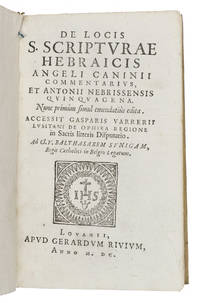
160019698Louvain 1600. 8vo. Gerardus Rivius Contemporary limp vellum with the manuscript title on the spine remnants of ties. With a woodcut "IHS" vignette on the title-page. 8 197 9 3 14 299-250 6 pp. Extremely rare edition containing several works most notably an important account of the New World and its discovery by Christopher Columbus: De Ophira Regione written by the Portuguese geographer Gaspar Barreiros = Caspar Varrerius d. 1574 first published in his Chorographia Coimbra 1561.The first two works by the Italian philologist Angelo Canini 1521-1557 and the Spanish classical scholar Antonio de Nebrija 1444-1522 reflect on the names of places also of people and animals etc. of Hebrew origin in the New Testament. The collection also contains Barreiros's letters including one to the King of Portugal and other short works. The collection was simultaneously printed in Antwerp by the Heirs of J. Bellerus and in Louvain. The present Louvain printing is of the utmost rarity.Some slight browning in a few quires. Good copy of an extremely rare collection of works including an early Americanum.l Alden & Landis 600/28; Belg. Typ. 548; Index Aureliensis 131.043; Leclerc 414; USTC 414149 3 copies; cf. Adams C-507 Antwerp ed.; Machiels C-85 Antwerp ed.; Sabin 3596 Antwerp ed.; not in KVK; STCV; WorldCat. ABE CAT Bibles Sermons & Psalmbooks hardcover
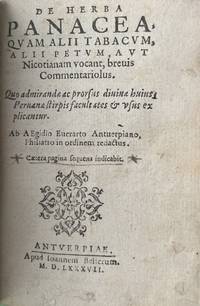
15873021Antverpiae Antwerp: Antverpiae Antwerp 1587. First edition a variant with 246 pages in the second part was published in the same year by the same publisher; no priority has been established. In 17th-century limp vellum. Title lettered in ink on spine. Occasional annotations and underlines by a 17th-century hand in ink. Binding restored new endpapers and thongs. Pages restored throughout heavily in the first third at some places affecting the text few leaves over trimmed. Overall in very good condition. First edition a variant with 246 pages in the second part was published in the same year by the same publisher; no priority has been established. In 17th-century limp vellum. Title lettered in ink on spine. Occasional annotations and underlines by a 17th-century hand in ink. 78 =98 4; 234 pp. The first book devoted entirely to tobacco.<br> <br /> <br /> “This little work produced by a physician who is said to have practiced with distinction in Antwerp appears to have been the first published entirely devoted to the subject of tobacco . a neat compendium of much of the information then available. It was consequently popular.†Arents <br /> De herba panacea concerns with the beneficial medicinal properties of tobacco and describes most of what was then known of this New World plant including its origin native methods of curing and cultivation and lore surrounding tobacco. Everard gives numerous recipes depending on tobacco for ailments to all kinds of illnesses. The book also contains texts by Castore Durante Gérard van Bergen Galen Jean de Jonghe and Andrés de Laguna.<br> <br /> <br /> The book was included in the John Carter Brown Library’s 1974-published Rare Americana list A Selection of One Hundred & One Books Maps & Prints not in The John Carter Brown Library.<br /> Ref.: Sabin 23218; Adams E1150; Alden 587/15; Arents 32; Books not in JCB 21. Antverpiae [Antwerp] unknown
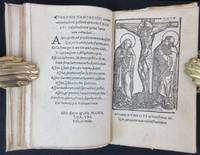
153612039Antwerp: Simon Cock Cocus. Good with no dust jacket. 1536. First Edition. Vellum. 44 ff. Small octavo. Newer vellum binding over card. Vellum has some light wear some browning to the rear. Newer end papers. Title page a bit grubby. Some occasional small staining/thumbing but otherwise very nice. Recto of last leaf has a full-page woodcut of the crucifixion verso has an errata and a neat older owner name in ink. A very scarce copy only 5 recorded in World Cat of a collection of religious verse hymns elegies and prayers by three Neolatin poets. The first is "Cornelius" which may refer to Cornelius Crocus Kroock 1500-1550 a Dutch theologian and educator; then Joannes Fernandus and Rodolphus Langius. There is an introductory poem by Faustus Andrelinus and a final poem by J. B. Cantalicius. Printed in March 1536. OCLC 69408729 NK 1631. ; 8vo 8" - 9" tall; 88 pages . Simon Cock (Cocus) hardcover
155252798<p>Lugduni apud Joan. Tornaesium 1552. TITLE CONTINUED: Accesserunt Gulielmi Philandri Castilionii civis Romani annotationes castigatiores & plus tertia parte locupletiores. Adiecta est Epitome in omnes Georgii Agricolae de mensuris & ponderibus libros eodem autoter cum Graeco pariter & Latino indice lucupletissimo. FIRST JEAN DE TOURNES EDITION OF VITRUVIUS 1552 Latin text. 4to approximately 235 x 155 mm 9¼ x 6¼ inches printer's device of vipers on title page a different De Tournes device on verso final page 83 woodcut illustrations 1 folding plate of an inscription portrait of Philandrier the editor on final page of prelims arabesque headpieces to the 10 books and historiated initials throughout pages: 16 447 57 - including index errata and Extrait du Privilege with last line: Achevé d'imprimer le huitieme février 1552 the last leaf with printer's device on verso bound in modern full blind panelled calf raised bands blind rules and gilt lettered morocco label to spine all edges red new endpapers. Small repair to inner edge of title page plus 2 ink names pages lightly age-browned tiny chip to fore-edge of 1 prelim page small closed tear to 1 margin repaired neatly some early mostly neat ink marginal notes some small corrections to text and a little neat underlining a couple of small ink stains and smudges text still easily legible very light foxing to a few margins. A good tight copy. This edition published in Lyon by Jean de Tournes was the second edited by Guillaume Philandrier the first was published in Strasbourg in 1550 as a 16mo. As the secretary to the bishop of Rodez the French humanist Philandrier friend of Rabelais had spent 10 years in Italy in Venice and Rome many of them studying Vitruvius and in 1544 he published his illustrated annotations separately in Rome. See: Laurence Hall Fowler The Fowler Architectural Collection of the Johns Hopkins University pages 318-319; Adams Books Printed in Europe 1501-1600 Volume II V908; Harvard French 16th Century Books Volume II No. 550. MORE IMAGES ATTACHED TO THIS LISTING ALL ZOOMABLE. FURTHER IMAGES ON REQUEST. POSTAGE AT COST.</p> Lugduni, apud Joan. Tornaesium, 1552. hardcover
157033006-178Ingolstatt Alexander Weissenhorn 1570. Title printed in red and black within woodcut-border. 16 232 8 leaves. 8vo. Contemporary blind-ruled vellum 1 of 2 metal claps small old library stamp and owner's ms. entry on title. Ingolstatt Alexander Weissenhorn 1570. Fourth issue of one of the many polemics written by Johann Nas 1534-1590 a Franciscan monk and counter-reformation preacher and controversialist notably at the court of the Archduke Ferdinand in Innsbruck where he followed Petrus Canisius. In 1580 he became Bishop of Brixen. - VD 16 N 102; STC German 643. GERMANY ; RELIGION ; Ingolstatt, Alexander Weissenhorn hardcover
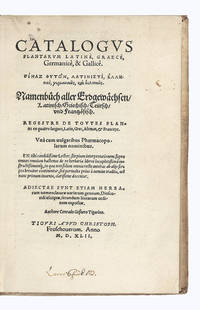
154255061542. 4 p.l. 162 leaves. Small 4to cont. blindstamped panelled pigskin remains of two deerskin ties. Zurich: C. Froschauer 1542.<br/> <br/> First edition of a very rare book on the market; this is a lovely fresh copy in contemporary blind-stamped pigskin. This Gesner’s second botanical work is “an alphabetically arranged catalog of plant names in four languages the first of its kind and an indication of the growing interest in botany beyond purely philological investigations into the writings of the classics. The Greek names are based on the works of Dioscorides. This early work is already characteristic of Gessner’s life-long endeavour to arrange scientific topics in alphabetical or systematic order; it also show his proficiency in languages and his interest in their comparative treatment.â€â€“Wellisch 8.1.<br/> <br/> A fine copy. Signature at foot of title of “Lucas Schröck M.D.†Schröck 1646-1730 was a professor of medicine at Jena and president of the Deutschen Akademie der Naturforscher see Hirsch V pp. 139-40. Early inscription on front free endpaper stating this is a duplicate from the Royal Library of Munich. Engraved armorial bookplate dated 1744 of Franziskus Topsl 1711-96 prior of the Polling Abbey in Upper Bavaria. Modern booklabel of D. Henry. Some minor worming to upper inner corner of first seven leaves touching a few letters of the first two leaves.<br/> <br/> ⧠Pritzel 3298. unknown
1593CA0273<p><strong>Groundbreaking treatise on exotic botany and tropical medicine</strong></p><p>4586blank leaf pages with numerous woodcut illustrations. Duodecmo 6 1/4 x 3 3/4" octavo bound in quarter leather with five raised spine bands with spine tooled in gilt over brown boards. Translated from the Portuguese into Latin by Carolus Clusius Charles de L'Ecluse. Fourth Edition.<br /><br />Garcia de Orta's groundbreaking treatise on exotic botany and tropical medicine to which are added two other important works on the subject. Orta's contribution comprises pp. 1-2177. It is followed by:<br /><br /><em>Christophori a Costa medici et cheirurgi Aromatum & medicamentorum in Orientali India nascentium</em>. Pp. 225-312. <br /><br /><em>Simplicium medicamentorum ex novo orbe delatorum quorum in medicina usus est historia. descripta à d. Nicolao Monardis.</em> Tertia editio. Pp. 313-4044 <br /><br /><em>Simplicium medicamentorum ex novo orbe delatorum quorum in medicina usus est historia. descripta à d. Nicolao Monardis</em>. Altera editio. Pp. 409-456.<br /><br />Rare combined edition of three major 16th century treatises in the history of botanical and medical knowledge of plants from India and the New World. These Latin editions had all previously been published by Plantin. Garcia da Orta's treatise originally published in 1563 in Goa in Portuguese is the first Indian materia medica written by a European and the first textbook of tropical medicine. The text of Acosta of which L'Ecluse gives an abridgment is a complement to the text of Orta. Finally the Latin translation also abbreviated of the treatises of Nicolas Monardes details the medicines and medicinal herbs of South America and describes their native uses. His text also contains the first representation of tobacco and also that of pepper and even the armadillo. A rare complete copy with the final unpaginated leaves including three privileges the colophon the large printer's device of Plantin and the final blank.<br /><br /><strong>Condition: <br /></strong><br />Some rubbing and wear to covers spine foot chipped; some minor foxing and aging within early ink underlines to the early leaves of the first work else good.</p> Ex officina Plantiniana, apud viduam, & Ioannem Moretum hardcover
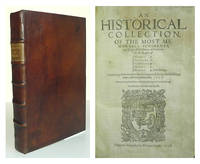
1598001041London: Thomas Creede 1598. First English language edition. . Hardcover. See Description. Small folio. Lacking preliminary blank leaf thus pp. 10 310 292 4. Page numbering is erratic. Leaf Ee3 is mis-signed as F3 but all leaves are present and in order. The title page contains a woodcut vignette/device. Each chapter begins with a woodcut decorative head piece and an initial. Bound in full dark brown modern calf with blind tooled borders and stamps after an early period style. The upper part of the title page is age-toned / tanned; a professionally sealed 7 cm. tear runs from the gutter part way across the upper portion of the title and is difficult to detect on first sight; a couple of tiny chips on the top edge are restored. Interior pages are generally attractive but with occasional mild age-toning and periodic faint marginal damp staining. A small repair patch is present on the inner margins of leaves A6 and V6. A tear on leaf V6 also carefully sealed extends vertically about 8.5 cm from the lower gutter and part way into the text but causing almost no obscuration. Printed by Thomas Creede who is best known for issuing dramatic works including some of Shakespeares plays. The book is divided into two parts. The first part is a translation of "Recueil des choses mémorables avenues en France sous le règne de Henri II François II Charles IX Henri III et Henri IV." This work is generally attributed to either Simon Goulart or Jean de Serres and was first printed in French no place or publisher in 1595 and again in 1598 expanded to include the reign of Henri IV up to the year 1597. See Brunet IV 1161-1162. The second part with new pagination provides translated selections from Pierre Matthieus 4 part "Histoire des derniers troubles de France" first published in Lyons 1594-95. A section at the end is titled "a brief recitall of the most memorable things which came to passé in Fraunce under the raigne of Henry the fourth until the middle of the Yeare 1598" which if written by Matthieu may possibly represent the first printing of some amendments which Matthieu later added to the second edition of his "Histoire" printed in 1600. This collection provides interesting testaments to the wars of religion in France during the 16th century. A separate 4 page tract at the end is titled: "A true discourse concerning the deliverie of Brittaine in the yeare 1598." ESTC S121331; USTC 513796; Lowndes p. 831; Hazlitt Biblio. Collections 2nd Series p. 231. <br/> <br/> Thomas Creede hardcover
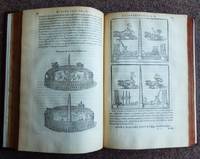
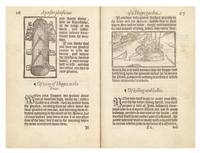
157665511576. Numerous woodcut illus. in the text. Largely printed in black letter. 7 p.l. first leaf blank except for signature mark 63 1 pp. Small 4to early 20th cent. polished mottled calf by Riviere triple gilt fillet round sides spine richly gilt red morocco lettering pieces on spine dentelles gilt a.e.g. London: H. Denham 1576.<br/> <br/> Second edition “nowe newly corrected and augmented†of the first English book on hops. The first edition appeared two years earlier; both editions are very rare. This is “an eminently practical treatise illustrating the various methods of setting the roots making the hills and ramming the poles tying the bine and its pulling up and preservation with a number of curious cuts. It was the work of a practical man written for practical men and in this respect is far in advance of most of Scot’s contemporaries who were still much interested in the superstitions of the time and the traditional pseudo-science of the Middle Ages.â€â€“Fussell I p. 12.<br/> <br/> Clinch in his English Hops a History of Cultivation and Preparation for the Market from the Earliest Times 1919 states that in many respects “the information is as useful today as it was nearly three-and-a-half centuries ago when it was published.â€<br/> <br/> Scot d. 1599 is most famous for his The Discoverie of Witchcraft 1584 in which he attacked the general belief in witchcraft and other forms of credulity and superstition including astrology alchemy and Catholicism. For more on Scot and his fascinating life see ODNB.<br/> <br/> Fine copy. Signature of T. Barling on first leaf.<br/> <br/> ⧠Henrey I p. 64 & no. 338. McDonald Agricultural Writers from Sir Walter of Henley to Arthur Young 1200-1800 pp. 34-36. unknown