Guidi, Giambatista (or Giovambattista)Biblio.com
117 résultats
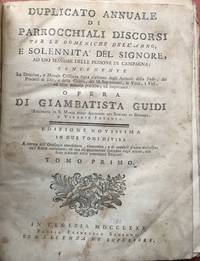
1780H2852Venezia: Presso Francesco Sansoni 1780. Hardcover. Good. Published 1780 4to 223 - 222 pp 2 volumes in one bound in later paper covered boards and paper spine contents good some worming to bottom edge and sporadic worming in other places title page somewhat soiled printed in two columns good used condition. Presso Francesco Sansoni hardcover
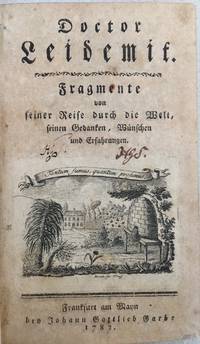
1783H291Frankfurt am Main: Johann Gottlieb Garbe 1783. First printing. Hardcover. Good. First edition 1783 12mo bound in late 19th century cloth backed boards 336 pp good copy with light library treatments bookplatles blindstamp on title page text VG and clean some tanning and foxing. The author 1723-98 was a German jurist politician and journalist. Johann Gottlieb Garbe hardcover
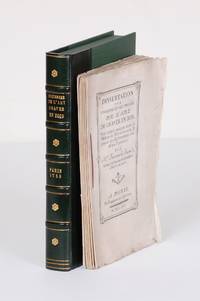
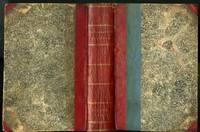
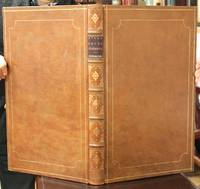
1758141839Paris: J. Barbou 1758. full brown leather border stamped in blind on the front and rear boards gilt ornaments on spine title in second compartment five raised bands all edges stained red marbled endsheets. small 8vo. full brown leather border stamped in blind on the front and rear boards gilt ornaments on spine title in second compartment five raised bands all edges stained red marbled endsheets. 1ff.-92 3 -263 pages. Pour éclaircir quelques traits de l"histoire de l'Imprimerie & prouver que Guttemberg n'en est pas l'Inventeur. Two works bound in one. Very rare first edition Bigmore and Wyman p.228. Private bookplate of Jackson Burke on the verso of the front free endpaper. Contemporary boards with some rubbing to the spine and extremities corners a bit worn gilt on the spine is lightly flaking evidence of bookplate removal to front and rear pastedowns. Else a fine copy of this very scarce work.<BR> <br /> <BR> <br /> Two works bound together. Complete titles are: Dissertation sur l'origine et les progrès de l'art de graver en bois 1758 and De l'origine et des productions de l'imprimerie primitive en taille de bois 1759.<BR> <br /> <BR> <br /> Fournier 1712--1768 was born in Paris and trained as a wood engraver. He later turned to steel engraving. In the first essay Fournier sets out to prove that Gutenberg was not the inventor of the printing press by examining the history of printing. He believes that the technology Gutenberg made popular existed long before the German printer's work. The second volume follows this up with further discussion of the origins of woodcut prints. <BR> <br /> <BR> <br /> Fournier wrongly disputes the dating of Mr. De Bure le Jeune concerning the Gutenberg Bible but he is the first with the help of an observation by Gerard Meerman to note the progressive increase in the number of lines per page in the early stages of Bible production. J. Barbou unknown
175876869Paris: J. Barbou 1758. unbound cord tied housed in a green half-morocco goat over cloth boards clamshell case spine tooled in gold leaf with title author and date. large 12mo. unbound cord tied housed in a green half-morocco goat over cloth boards clamshell case spine tooled in gold leaf with title author and date. 92 3 pages. Pour éclaircir quelques traits de l"histoire de l'Imprimerie & prouver que Guttemberg n'en est pas l'Inventeur. Very rare first edition Bigmore and Wyman p.227. Unbound textblock lightly soiled with minor creasing at corners. Faint moisture staining throughout with some affecting the text. In this text Fournier sets out to prove that Gutenberg was not the inventor of the printing press by examining the history of printing. He believed that the technology Gutenberg made popular existed long before the German printer's work. Fournier also followed up this text with two additional works which are not present: De l'origine et des productions de l'imprimerie primitive en taille de bois 1759 and Observations sur un ouvrage intitulé Vindiciae Typographicae 1760. These two works provided further discussion of the origins of woodcut prints including a passage refuting popular belief about the origin wood engraving and some ideas for further study. <BR> <br /> <BR> <br /> Fournier 1712--1768 was born in Paris and trained as a wood engraver and type founder being a member of the 18th century dynasty of the well-known Fournier family. He later turned to steel engraving. He published a table of the proportions of the different printing characters whose purpose was to propose for all typefaces a fixed measurement in "typographic points" and a systematic gradation. He worked closely with the collaborators of the Encyclopédie providing the printer Le Breton with all the documentation relating to the typographic foundry and plans for his own instruments as well as providing Diderot with his collection of ancient alphabets. Finally after multiple disputes with his Parisian colleagues he became infamous for the printing of his famous Manuel Typographique 1764 1766 just prior to his death. J. Barbou unknown
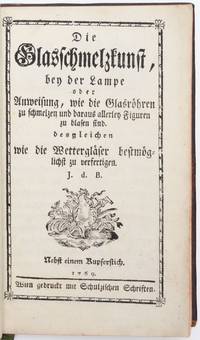
17691430Wien: gedruckt mit Schulzischen Schriften 1769. First edition. In contemporary leather. Spine gilt with red title vignette. Edges tinted. Woodcut headpiece on A1. Pages ruled with woodcut frame. Light brown stains on the plate. Otherwise clean. In fine condition. First edition. In contemporary leather. Spine gilt with red title vignette. Edges tinted. Woodcut headpiece on A1. Pages ruled with woodcut frame. 1 title page verso blank a–b8 c6 i.e. 24 leaves and 1 folded plate. <p><br /> A curious and scarce treatise on glassblowing and the making of scientific glass objects. <br /> <p><br /> <p><br /> The book is illustrated with an engraved plate showing a glassmaker or lampworker at his working table surrounded by examples of his craft various scientific apparatuses a Cartesian devil a glass eye and elaborate glass-figurines and a centerpiece whose technique of making together with the detailed instruction for manufacturing thermometers hydrometers barometers is described in the text. <br /> <p><br /> <p><br /> The author of Die Glasschmelzkunst remained unrevealed hidden behind the initials of “J. d. Bâ€. The second edition was published under different initials of “A. Z. G†Brünn: Tascher 1824. Both editions are often attributed erroneously to Karl Moritz Diesing 1800–1867. Duncan in the Bibliography of Glass attributes it to Disting. <br /> <p><br /> <p><br /> Duncan 3269.<br /> <p>. gedruckt mit Schulzischen Schriften unknown
1790H376Cüstrin Kostrzyn nad Odr : Carl Gottlob Trowitzsch 1790. Hardcover. Very Good. In English: The Gospels and Epistles for all Sundays and feast days throughout the year with the evangelical summaries and collections together with the stories of the Passion Resurrection and Ascension of our Savior Jesus Christ from the four Evangelists item the sending of the Holy Spirit from St. Luke and the destruction of the city of Jerusalem along with Johann Hermann's rhymed prayers on the Gospels and with Bible verses also morning and evening prayers for all days of the week multiplied with special diligence according to the Bible and corrected. 12mo 6 x 4 inches half leather and patterned boards unpaginated ca. 300 pp with many charming vignette woodcuts throughout that are done in an early 16th century style. Good to very good rubbing to spine solid copy with some wear to corners bit of darkening and finger soil to pages. RARE no copies on OCLC two or three citations on KVK. Printed in Cüstrin either part of Brandenberg or Poland depending on which side of the river. This appears to be a printing of some of the works of Johann Heermann 1585-1647 a German poet and hymnodist whose family roots were in Silesia. Carl Gottlob Trowitzsch hardcover
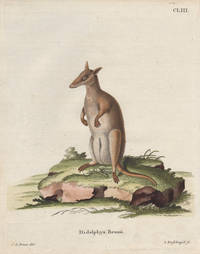
178013581780. Copper-line engraving with original hand-colouring. 230mm by 175mm platemark. German copper-line engraving from the German naturalist Johann Christian Daniel von Schreber's 1739-1810 'Die Saugthiere in Abbildungen nach der Natur mit Beschreibungen' 'Mammals Illustrated after Nature with Descriptions' published from 1774 onwards. unknown
1726CAT000635London: J. Nicholson 1726. Third Edition. Hardcover Full Leather. Very Good Condition. Half red leather over marbled boards marbled endpapers. In text illustrations and 2 plates 1 folding. A wealth of information on livestock from belching in cattle to vvhezing in horses distilling bees home remedies etc. Old Lawes Trust stamp to title scattered foxing. Size: 4to. Quantity Available: 1. Shipped Weight: Under 1 kilo. Category: Farming & Rural Life; Cooking Wine & Dining. Inventory No: CAT000635. J. Nicholson hardcover
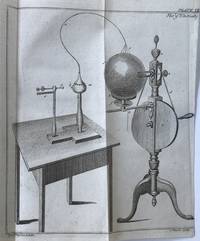
177756912'MILESTONE IN THE EARLY LITERATURE OF GAS ANALYSIS' <br />first edition tall 8vo. 2 title ii editor's 'advertisement' v-viii 471pp frontispiece plate advertisement leaf a cancel . bound after<br /><b>PRIESTLEY Joseph</b> A Familiar Introduction to the Study of Electricity. The Third Edition.London: Printed for J. Johnson tall 8vo. 4 half-title & title 5-85 3 advt.pp. 5 plates 4 folding <br />The two items bound together in contemporary calf spine paneled by gilt highlighted raised bands russet morocco title label the first plate in the Priestley cropped by the binder at the fold and thus missing the right-hand half else a nice copy. <br />Very neat contemporary signature on title "Edw. Roche". <br /><br />Magalhaes: ESTC t74551 <i>Dictionary Scientific Biography</i> Vol. 9 p.5-6The leaf following the title page pages i-ii is a cancel: 'Advertisement of the editor relating to the use of the simple glass machines for making mineral waters'. The pagination picks up a p.v and the book is complete thus. <br />Magellan Aveiro Portugal 1722- 1790 took to science while an Augustinian monk in Coimbra but he later left the order and moved to England and later Protestantism. Although he "produced no scientific work of serious consequence . He is known for his a wide circle of scientific acquaintances and for acting as an intermediary in disseminating new information. . He was a fellow of the Royal Society and a member of several European academies of science. . He wrote more about scientific instruments than about any other subject" D.S.B. This book is the first edition of "an important milestone in the early literature of gas analysis. . an account of his researches on gases addressed to his friend Joseph Priestley. The glass apparatus for impregnating water with fixed air carbon dioxide is described in detail. Newly improved by 'Mr. Parker' the apparatus was superior to that used by Priestley and described by him in 1772. Carbon dioxide was prepared by dissolving marble calcium carbonate in dilute sulphuric acid. Magellan also describes three new types of eudiometer he had designed; these and the apparatus for making carbonated waters are illustrated in the frontispiece" Neville II p.125. Further editions followed in 1779 and 1783.Priestley: ESTC t35302 Crook <i>Priestly Bibliography</i> S/473 To illustrate this work Priestly used plates nos. 2367 and 8 from his The History and present state of electricity and "it was not thought necessary to change the numbers of them" preface. Printed for W. Parker .. and sold by J. Johnson .. and W. Brown hardcover
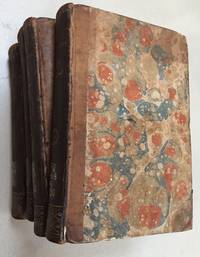
1731H334Venezia Venice: Presso Angiolo Geremia 1731. Hardcover. Good. 4 volumes complete published 1730-1731. 8vo old half leather marbled boards 458 441 383 373 pp. indices in each volume. Good plus set minor library marks call numbers on spines bookplates blindstamp on title pages barcode stickers on rear endpapers some darkening to spines rubbing to boards texts clean and bright. Poet and playwright. Text in Italian. Presso Angiolo Geremia hardcover
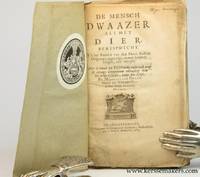
171540525s Graavenhaage s Gravenhage: Gysbrecht Gasinet 1715. 8vo 21x14 cm. Wrappers renewed. xxxii: "Voorrede"16 pp. Inner margin short; lower margin title repaired; sl. soiled mainly in lower margins. With charming engraved vignette on title. With 2 exlibris of F. Ouwerling Tilburg pasted on fly-leaf and on verso title. - Interesting booklet attributed by "Boekzaal der Geleerde wereld" to Nikolaas van Amerongen in the "Catalogus Jakobus Koning" to Pieter Le Clercq and we traced a 1712 edition with on the title Pieter Antoine Huybert mentioned as the author. - Very rare Gysbrecht Gasinet unknown
1759137120Paris: J. Barbou 1759. Full period French binding in Calf five raised bands gilt ornamentation on spine author and title in gilt on red leather spine label in second compartment. 8vo. Full period French binding in Calf five raised bands gilt ornamentation on spine author and title in gilt on red leather spine label in second compartment. 263 pages. First edition Bigmore and Wyman p.228. Minor soiling to the text block else a fine copy.<BR> <br /> <BR> <br /> In this volume Fournier sets out to prove that Gutenberg was not the inventor of the printing press by examining the history of printing. He believes that the technology Gutenberg made popular existed long before the German printer's work. <BR> <br /> <BR> <br /> "Peter Simon Fournier a French engraver and letter-founder was born at Paris 1712 and died 1768. He studied under Colson painter of the Academy of Saint Luc and devoted himself first to the art of wood-engraving; he afterwards as an engraver on steel rendered himself famous in all countries. In some of his works he seeks to prove that Gutenberg is not the inventor of printing and maintains that long before Gutenberg engraving on wood had been employed for printing images and inscriptions; that during his residence in Strasburg Gutenberg attempted the application of this art to the printing of books and that on his return to Mayence he first printed the Donatus and the Catholicon of Johannes de Janua with engraved and solid blocks. Fournier's ingenious theories were ably refuted by Baron Heinecken in his "Idée Générale d'une Collection complette d'Estamples" Leipsic: 1771" Bigmore & Wyman p 229. J. Barbou unknown
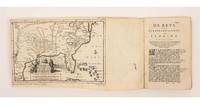
17063719Te Leyden: By Pieter Vander Aa Boekerkoper 1706. First edition. Later half-cloth boards covered with marbled paper spine with title vignette. Small wormhole affecting the first five leaves and the folding map; otherwise in very good condition. First edition. Later half-cloth boards covered with marbled paper spine with title vignette. 6 86 4 p. and an engraved folding map and 9 engraved folding plates. <p><br /> Scarce Dutch illustrated edition of the first eyewitness account of Hernando de Soto's expedition complete with a folding map of Florida and nine double-page engraved plates.<br /> <p><p><br /> Dutch abridged edition of the earliest published eyewitness narrative of Hernando de Soto's expedition to Florida and the interior of North America. The text derives from the Relaçam verdadeira dos trabalhos Évora 1557 written by an anonymous Portuguese gentleman from Elvas who participated in the expedition. That work is the first printed account of de Soto's journey and remains a foundational source for the early Spanish exploration of the southeastern regions of what is now the United States.<br /> <p><p><br /> De Soto landed in Florida in May 1539 and led a large expedition through present-day Florida Georgia the Carolinas Tennessee Alabama Mississippi Arkansas and Louisiana reaching the Mississippi River before his death in 1542. The narrative records sustained contact with Indigenous societies and documents the challenges of an extended inland expedition through the southeastern regions of North America.<br /> <p><p><br /> This Leiden edition was issued by Pieter van der Aa as part of his Naaukeurige versameling der gedenkwaardigste zee- en landreysen presenting the narrative in Dutch translation in an abridged form. It is illustrated with an emblematic engraved title a folding engraved map of Florida attributed to de Soto's discoveries and nine double-page engraved plates depicting episodes from the Spanish conquest. Van der Aa's engravings played a significant role in shaping early eighteenth-century European visual conceptions of Spanish America and its exploration.<br /> <p><p><br /> A well-preserved copy complete with the folding map and plates. An important Dutch contribution to European-Americana transmitting one of the principal sixteenth-century sources for the exploration of the North American interior.<br /> <p><p><br /> Not in Sabin. Scarce on the market; RBH records only four copies offered in the past 100 years. <br /> <p>. By Pieter Vander Aa, Boekerkoper unknown
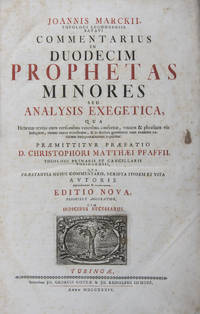
173443194Tubingae Tübingen: Jo. Georgii Cottae & Jo. Rudolphi Im Hoff 1734. Editio Nova New edition. Hardcover. poor to vg. Folio 15 1/4 x 10 1/4". 24 1300 36pp. Contemporary full calf. Title page in red and black lettering. Title vignette. Decorative initials and tailpieces. Book housed in a modern orange cloth covered clamshell box with gold lettering to spine. <br /> <br /> Written by Johannes Marckius 1656-1731 a Dutch reformed theologian and Church historian and edited by Christoph Matthäus Pfaff 1686-1760 a German theologian these commentaries on the twelve minor prophets are divided into the following two parts: <br /> <br /> - In Vol. 1 are featured Marckius' commentaries on Hoseah; Joel; Amos; Obadiah; Jonah; and Micah. <br /> <br /> - In Vol. 2: are featured Marckius' commentaries on Nahum; Habbakuk; Zephaniah; Haggai; Zechariah; and Malachi<br /> <br /> Binding heavily rubbed with abrasion to leather on spine. Both hinges starting. Ex-library bookplate on inside of front cover. Minor to moderate sporadic foxing throughout. Text in Latin with some Hebrew and Greek. Clamshell box in overall very good binding in poor interior in good to very good condition. Jo. Georgii Cottae & Jo. Rudolphi Im Hoff hardcover
179900TP99France 1799. Small handwritten recipe for a glue to hold porcelain together. Blending lead oils paper and flour. Biographical Notes: SIR THOMAS PHILLIPPS 1792-1872. Born in 1792 Sir Thomas Phillipps from childhood was obsessed with the idea of obtaining virtually anything written or printed on paper including cartloads of documents from wastepaper merchants and the entire inventories of booksellers. "I wish to have one copy of every book in the world" he declared to a friend. He very nearly succeeded. His collection ultimately grew to more than 100000 books and at least 60000 manuscripts. As a result of his extravagant purchases Sir Thomas was permanently on the verge of bankruptcy and was constantly pursued by creditors. So many books arrived at his house that it was impossible to unpack his acquisitions much less keep pace with them. Visiting scholars driven to distraction would spend days hunting for an elusive text in the dusty heaps that filled every room. Because Sir Thomas has a morbid dread of fire most of his collection was housed in coffinlike boxes that could be carted away quickly. Visitors to Middle Hill were struck too by the presence of numerous logs a ploy he used to lure beetles away from his books. As Sir Thomas relentlessly pursued his passion the house itself began to crumble and its floors started to sag under the cast weight of hundreds of tons of paper. His neglect of Middle Hill was partly deliberate however. Sir Thomas's chief enemy in life James Halliwell had married his daughter against his wishes. It appears that Halliwell was in Sir Thomas' eyes the worst kind of criminal a book thief who had stolen valuable works from university libraries and even from his father-in-law. Having no sons Sir Thomas was unable to prevent Halliwell from inheriting his estate. To ensure that his detested heir would never receive anything of value Sir Thomas's solution was to allow Middle Hill to fall unto complete disrepair. He even went so far as to chop down and sell for lumber the centuries-old oak trees that lined the majestic mile-long drive to his home. In 1863 Sir Thomas decided to move - in order to accommodate his books. With the aid of 160 men 103 wagonloads of books and papers drawn by 230 horses the books were lumbered from Middle Hill top their new estate in nearby Cheltenham. It is said that for years afterwards the countryside was littered with the remains of carts that had collapsed under the sheer weight of the Phillipps collection. Sir Thomas continues to add to his library until his death in 1872. After Sir Thomas's death his immediate family had no room for his collection. So vast was the library that although individual items and large sections were sold privately or through numerous auction sales the Phillipps collection is still being sold more than a century after the death of its owner. In the course of its sales many treasures have come to light. As late as 1964 part of the long-lost and unique medieval manuscript of the Roman poet Ovid's Metamorphoses appeared and was subsequently reunited with its other half at Magdalen College Oxford. Once destined for destruction as worthless wastepaper this and many other priceless works were saved by the single-minded obsession of the greatest bibliomaniac of all time. Autograph. Manuscript. Good. 16mo - over 5¾" - 6¾" tall. Paperback
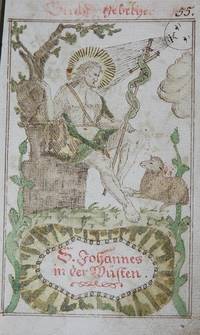
1797006602Keuth an der Crassen 1797. Full Blindstamped Calf. Good. A fine Folk Art manuscript prayer book from the late eighteenth century. 8vo. 17.5 by 10.5 cm. 3 516 13 1 pp. With eight full page paintings plus vignette decoration throughout. Besides the ubiquitous floral ornamentation all pretty accents the vignettes include a serpent a basilisk a skull etc. Most writing is a neat now archaic cursive but headings and the like rendered in an easily readable ornamental Fraktur Gothic. The paintings are the highlight most will find. Their subject matter is quintessential -- Momento Mori Saint Michael slaying the dragon Saint John in the desert Saint Sebastien the Christ child King David playing a harp etc. But while the subject matter may not be unusual the execution is done with uncommon flair even though it is resolutely naive or Folk Art. And the artist who we assume is one or both of the writers may be illustrating popular subjects there are original elements in his/her imagery or imagining of the subject. The authorship is stated but also a tad confusing. Our interpretation is that a Konrad Mueller created the book for Margaretha Pfaden-Hauerin. Condition: moderate wear to contemporary full calf binding. Unusual is a 13 page "Register" or Table of Contents in the rear. By unusual we mean for such a manuscript prayer book. Also a page of handwritten genealogical notes written on a prior blank leaf and written much later in the mid to late 19th Century. Moderate sometimes heavy soiling to margins of leaves. Corner cut out of front endpaper. Some loose gatherings. unknown
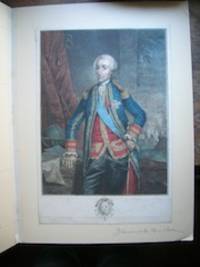
1790NSPrint006Paris ca. 1790. Color aquatint on paper 42.5 x 31 cm.; impression: 33.5 x 25.7 cm. Impression without text. Cf. Thieme-Becker 12: 486. stock#NSPrint006.
1786h42110Sulzbach: Ze l ben Aharon 1786. Hardcover. Fair. 8vo 8.5 x 7 inches in amateur cloth backed boards mid-20th century fair copy with title page and next leaf in photocopy the leaf after that with damage and loss the remainder of the text in very good condition; last leaf with some edgewear and loss resulting in the loss of some letters. Over 260 leaves seems complete with quite a number of small woodcut illustrations 2.75 x 1.5 inches on average. Tseno Ureno sometimes called the Women's Bible is a Yiddish-language prose work whose structure parallels the weekly Torah portions and Haftorahs used in Jewish prayer services. The book was written by Jacob ben Isaac Ashkenazi 1550–1625 of Janów Lubelski near Lublin Poland and mixes Biblical passages with teachings from Judaism's Oral Torah such as the Talmud's Aggadah and Midrash which are sometimes called "parables allegories short stories anecdotes legends and admonitions" by secular writers. Ze l ben Aharon hardcover
1742B6091Nuremberg/ Norimbergae:: Heirs of Homann c. 1742 . Near fine copy of the famous celestial atlas of copper engravings in contemporary hand-colour and attractive expertly restored contemporary binding; lacking the index sheet; two minor repaired tears at lower margins; fine plates depicting the solar system planetary motions constellations a moon map; small views featuring famous observatories in Berlin Kassel Nuremberg and Danzig. . Edition: First Edition of Doppelmayr’s important astronomic Binding: Contemporary full calf; panelled with outer double gilt filleted border and inner single fillet; expertly rebacked with five 5 raised bands gilt lettered title on brown morocco label on two and gilt ornamental design in remaining compartments; dated at bottom; red-black marbled endpapers. Notes: Text and captions in Latin. Johann Gabriel Doppelmayr 27 September 1677 – 1 December 1750 was a German mathematician astronomer and cartographer. His surname is also spelled Doppelmayer and Doppelmair. His studies included mathematics physics and jurisprudence. In 1698 he graduated with a dissertation on the Sun. After giving up his legal studies he then spent two years travelling and studying in Germany Holland and England spending time at Utrecht Leiden Oxford and London. He continued to study astronomy and learned to grind and figure his own telescope lenses. The DSB describes this work as a collection of diagrams with its explanations intended as introduction into the fundamentals of astronomy explaining the systems of Copernicus Tycho Brahe and Riccioli the elliptic theories of Kepler Boulliau Seth Ward and Mercator as well as the lunar theories of Tycho Brahe Horrocks and Newton and Halley's cometary theory. The atlas shows constellations cometary plates lunar maps lunar theories charts of satellite systems and the motion of planets with plates depicting celestial charts with diagrams tables and views of observatories. Size: Folio; 535x321mm. Illustration: Illustrated allegorical title by J. C. Reinsberger depicting Claud. Ptolemy Nic. Copernicus Ioh. Kepler and Tycho Brahe. preceding title in red and black with vignette of the heavens; extra illustrated with two additional double-page celestial maps entitled: 1. “SPHAERARUM ARTIFICIALIUM TYPICA REPRAESENTATIO†and 2.“PLANISPHAERIUM CAELESTEâ€; with the complete set of thirty 30 astronomical and cosmographical double-page plates in colour as listed under Rodney Shirley C.DOP-1c p.1336/7. Provenance: upper pasted endpaper bookplate of William Phelps. References: Shirley II C.DOP-1c 1136/7; DSB IV 166; Brown: 51; Warner Sky: 64a; Sotheran I: 1080; Poggendorff I: 593; LGK I: 177. Pages: Ff. 2f bl. Illustrated half-title leaf illustrated title leaf 32 double-page engraved plates 2f bl. Category: Book Astronomy; Book Europe Germany; Book Atlas & Cartography Heirs of Homann, hardcover
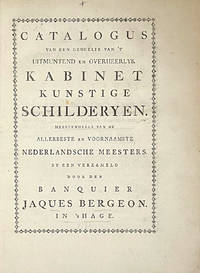
1773103006<p>'s Gravenhage Jacobus van Karnebeek 1773. 4to. 68 pp. Text within a decorative typographical border. Late 19th cent. 3/4 morocco binding with marbled boards. corners and hinges a bit rubbed.</p><p>Describes 200 paintings from the collection of Jacques Bergeon arranged by artist. Each painting has a short description and for each artist a short biography is given. Bergeon was a lawyer and banker in The Hague and the owner of 'Brittenrust' a country house in Alphen aan de Rijn. He continued collecting after this catalogue was printed but due to financial problems his collection was sold on 4 November 1789. Pages 61-68 contains the index with the names of the painters. We find paintings by Hendrik Avercamp Adriaan van Ostade Paulus Potter Petrus Paulus Rubens Jan Steen David Teniers the younger and many others among them a few women painters: Anna Barbara van Esch Catharina van der Meer. No. 112 is a painting by Louis de Moni Een kantwerkster met een bellenblazende jongen now in Mauritshuis.</p>
1793H3339Madrid: En La Imprenta Real 1793. First printing. Hardcover. Very Good. First edition 1793 original flame calf deep red spine label very good copy 8 290 3 pp. In three parts the first lessons for children on their obligations when they are grown to their king and lord the second addressed to priests and the third part addressed to Pius VI regarding the revolution in France and what it portends. The author was a well known priest orator and educator on very good terms with Spanish royalty who rewarded him by making him a bishop with his base in Rio de la Plata Argentina but also with bishoprics in Cordoba and Catamarca Bolivia. This book would have been part of his efforts to educate South American children on their duties to Spain one of his chief goals. En La Imprenta Real hardcover
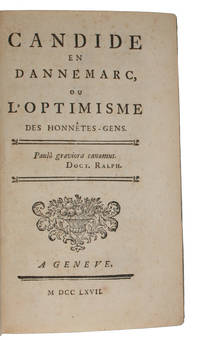
176745831Geneve 1767. Original blue cardboard binding with contemporary handwritten paper title-label to spine. Pencil-numbering to inside of boards. A very nice and clean copy. Woodcut vignette to title-page. With the ex-libris of the notes Danish book collector K.F. Plesner to inside of front board. <br/><br/><em>Rare first edition of this interesting anonymously written continuation of Voltaire's Candide which wraps up the adventures of the hero. "Turning his back on both Voltarian satire and scepticism the novelist proposes a moralistic fable - the focal point of which is a rehabilitation of Leibniz's Theory of Optimism. The main body of the novel tells the story of Candide and his new wife the noble Zénoïde in their sumptuous Copenhagen townhouse. Before achieving this happy state however the couple endures various trials and tribulations reminiscent of the newly minted gothic genre. "Candide au Dannemarc" also features a satirical portrait of Jean-Jacques Rousseau." Éduard M. Langille from the introduction to the new edition of "Candide au Dannemarc" edited by him. Voltaire's "Candide" had inspired a sequel that appeared in 1760 which is attributed to Charles-Claude-Florent de Campigneulles but which might be by Henri-Joseph du Laurens. The present work is a direct continuation of that sequel although it ignores the happy ending of the previous work but evidently from the preface it is not written by the same author. It has still not been determined who the actual author is.The part on Rousseau pp. 148-167 in the present work has become quite famous portraying him satirically as trying to make a living in Copenhagen from copying music while plotting to escape to America. The novel ends with Candide leaving Denmark to be the Danish ambassador in Russia.A secoond edition appeared in 1769. </em> paperback
1775038076Rome Circa 1775 1775. 1st Edition 1st Printing. No Binding. Very Good. Original Etching . Original Etching Trimmed To 3/16" Margins All Around. One Of A Large Collection Of Original Antique Engravings Formed By A Southern California Artist In The Early To Middle Twentieth Century. Each Plate Has Small Glue Marks On Reverse Where They Were Tipped In To An Album. <br/> <br/> unknown
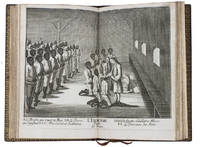
1758H6IG81I49TLCSaxony 1758. 8vo. Brown morocco Lyon ca. 1900 with gold-tooled turn-ins marbled end-papers headbands and ribbon marker in green red and yellow gilt edges signed by Louis GUÉTANT. With title-page printed in red and black and 16 numbered double-page engraved plates. 87 pp. First edition in French published one year after the first German edition of the first work attributed to David Cranz missionary in the Moravian United Brethren best known for his 1765 description of Greenland. The present work gives a history of the United Brethren their beliefs and their practices both in Europe and in their missions in America. The church was established in 1457 but the book concentrates on its history since its establishment in Herrnhut Saxony near the Moravian border under Count Nikolaus Ludwig von Zinzendorf in 1722. Under his guidance the church set up their mission in Greenland in 1733 and a 1747 act of Parliament under George II granted them permission to practice their religion freely in the British colonies in America. The illustrations show ordination induction baptism communion marriage exorcism an agape feast and other activities in the Moravian Church as well as their missionary work among black slaves in the West Indies 2 plates American Indians probably in Pennsylvania and native Greenlanders.With the gold-stamped leather armorial bookplate of Noé de Salvert. In very good condition with occasion light marginal foxing. The beautiful binding by the deluxe binder Louis Guétant active in Lyon ca. 1895-ca. 1920 is in fine condition with only a couple scratches on the back cover. A rare and important primary source for the Moravian United Brethren with remarkable plates of Greenland Eskimos American Indians and black West Indian slaves.l Brunet I col. 1258; James Ford Bell B-426; Sabin 7935 see also 97851 & note before 97846; KVK 3 copies; BN-OPALE plus 2 copies; Kirchenlexikon XVI cols. 324-336; not in Arctic Bibliography; Barbier; Church; Eberstadt; JCB; Quérard; Streeter. ABE CAT Alaska Canada & Greenland hardcover
178343848Lyon: chez Jean-Marie Bruyset Pere & Fils. A. 1783. 12mo. 17x 9.5cm Volume 5. In original full mottled calf real raised bands panels ornated full gilt decorated marbled endpapers edges stained red in contemporary binding style some wear on the edges hollow binding with the rear marbled endpaper re-used to line the hollow out recess which continue from page 30 the back interior box glued. – When opened the interior hollowed recess is not noticeable however the book is uncommonly light in very good sound condition. very good. These hollow book boxes were common before after the second war in the book stals on the banks of the Siene. They were made from broken sets which were common in that era and were considered a great keepsake in the growing tourist trade. As a bookseller you never had any money to hide away however we did keep the cash register float in a book box made from a small folio “Boy’s Own Annual 1912†for about forty years shelved with the reference and bibliography section behind the counter until it fell apart in complete exhaustion. chez Jean-Marie Bruyset Pere & Fils. A. unknown