[ROWLANDS WG or EDDOWES John 1795-1845]Biblio.com
307 résultats
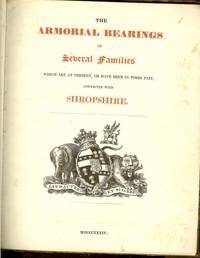
1834003452Shrewsbury: John Eddowes 1834. Hardcover. Fair. 4to - over 9¾" - 12" tall. OLIVER. VG 33 pls. In contemporary half calf over blue marbled boards corners & edges bumped & worn. Spine lacking at base gilt title edges bumped. Internally 2 24 leaves showing 9 coats of arms per leaf verso's blank followed from another work by 9 leaves of shields Royal Arms Funeral Bannesters Chiefs etc numbered 1-ix book label to fpd Fred R Jackson from Liverpool Copper plate engraver and printer Shrewsbury title page text in red and black with coat of arms vignette ink name to verso J Hirst Shrewsbury no pagination but inked in engraved by Oliver 23 Oxendeon Street Hay market printed in Shrewsbury by John Eddowes some occasional browning attributed to either WG Rowlands or the printer John Eddowes. folio 27.622 cms. Uncommon. <br/> <br/> [John Eddowes] hardcover
1862053672Athinais Athens: Ek Tis Typografias Ton Tekn. And. Koromilâ 1862. 1st Edition . Leather. Very Good. 8vo - over 7¾ - 9¾" tall. Original half morocco with four raised bands to gilt spine. Second compartment has title 'Ali Pasha' in Greek. All edges marbled. Text block slightly stained. A clean copy with minimal wear on extremities of boards and spine with no restorations of any kind. Marbled end-papers. Demy 8vo. 21 x 14 cm. In Greek Modern. 272 p. engraved portrait of Ali Pasha on frontispiece. This historical novel is written by Konstantinos Ramfos 1776-1871 and published in 1862 "accompanied by a new articulation of the enunciative and denotative position" is one of the most interesting cases of intertextuality in MG prose-fiction. Constantinos Ramphos was originally from Chios he devoted himself to trade was a member of the Hétairie and took part in the fights of the Greek war of independence before participating in the politics of his country. He was a diplomat and then a journalist from 1860 he began to publish stories devoted to the heroes of the insurrection Katsandonis "Despot l'Epirote" Ali Pasha for example and the most famous Halet Efendi. He mixed in his novels realism dreams patriotism against a historical background. Ali Pasha of Ioannina or Tepedelenli Ali Pasa Tepelena or of Janina the Lion of Yannina 1740-1822 was an Ottoman Albanian ruler who served as pasha of a large part of western Rumelia the Ottoman Empire's European territories which was referred to as the Pashalik of Yanina. His court was in Ioannina and the territory he governed incorporated most of Epirus and the western parts of Thessaly and Greek Macedonia. Ali had three sons: Muhtar Pasha who served in the 1809 war against the Russians Veli Pasha who became Pasha of the Morea Eyalet and Salih Pasha governor of Vlore. Ali first appears in historical accounts as the leader of a band of brigands who became involved in many confrontations with Ottoman state officials in Albania and Epirus. He joined the administrative-military apparatus of the Ottoman Empire holding various posts until 1788 when he was appointed Pasha ruler of the sanjak of Ioannina. His diplomatic and administrative skills his interest in modernist ideas and concepts his popular piety his religious neutrality his suppression of banditry his vengefulness and harshness . Western writers and poets such as Alexander Dumas Lord Byron were inspired and influenced by Ali Pasha in their works. Only two copies located in OCLC 835283685 Institut français d'études Byzantines and Sorbonne Université. A fine printing and a very early "historical novel" example in the Greek literature. First Edition. Very scarce. <br/> <br/> Ek Tis Typografias Ton Tekn. And. Koromilâ hardcover
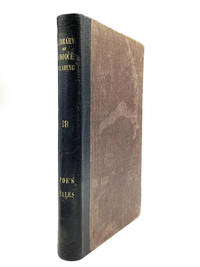
184578404New York: Wiley and Putnam 1845. First Edition. Hardcover. First edition third issue with the three-line copyright notice naming Wiley and Putnam and the Library of American Books half-title. Octavo: vi 228 4 ads pp. In the publisher's black gilt-stamped black morocco over plum cloth binding which has been expertly rebacked. The contents are clean and bright. Some general toning and minor staining to the cloth; otherwise very good. BAL 16146.<br /> <br /> ".the first important book of detective stories the first and greatest the cornerstone of cornerstones.the highest of all high spots.contains for the first time in book form all three Dupin stories" Queen's Quorum 1. While the tales herein were not selected by Poe and he expressed reservations about the editor "whose taste does not coincide with my own" they are in the end perhaps the single best representation of his broad range and lasting influence. The 1845 Tales contains not only the invention of modern detective fiction but also his supreme handling of psychological horror and contributions to both science fiction and the adventure story. Wiley and Putnam hardcover
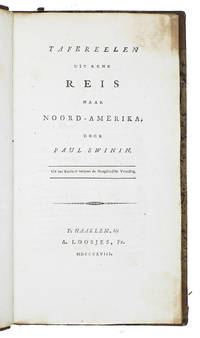
1818ABC_45491Haarlem 1818. Large 8vo. A. Loosjes Pz. Contemporary half calf marbled sides. 4 IV 127 pp. Very rare first and only edition of the only Dutch translation of a Russian description of the United States of America. The title-page notes that it is translated from the German translation 1816 and the preface notes that the first edition in Russian appeared in 1815. A second Russian edition appeared at St. Petersburg in 1818 and has sometimes been described as the first.The great Russian author Pavel Petrovic Svinyin or Svin'in here westernized to "Paul Swinin" is best known for his Sketches of Russia published in the West under the name "Suinine". The identity of the Dutch translator of the present work is unknown. It gives an interesting "picturesque" travel account of the United States spanning the year 1813 and provides five main accounts covering different subjects: a statistical survey; a religious overview with descriptions of the several Christian communities naming Methodists Quakers Shakers Baptists and more; a description of the different types of steamboats used in North America; a biography of the French general Jean Victor Moreau who lived in exile in the United States from 1805 to 1812; and a description of the dancing rituals of indigenous American "Indians" naming the Osage Arkansas Sioux and Saki tribes which the Russian author interestingly compares with tribes in the Caucasus.With the bookplate of the society Doctrina & Amicitia on the front paste-down. Some browning on the first and last few pages. Covers very slightly rubbed. Otherwise in very good condition.l NCC; Sabin 93997; WorldCat 10553560 & 656756512; not in Howgego. ABE CAT Anthropology & Ethnography unknown
1814D1409Paris: Gide Fils 1814. Hardcover. Very Good. Red paper over boards ruled and lettered in gilt on spine; 4 volumes 8vo 5 x 8.25 inches; pp. lxxx 432; 4 494; 4 434; xv 1 139 104 tables; all volumes with half-title page and title-page. Spine tips and corners lighly chipped; boards faintly rubbed; a little faint foxing but overall nice and clean. An excellent working set. <br/><br/> Gide Fils hardcover
1807GCHblKOC82Paris: F.Schoell 1807. 1807. 3 Volumes. 8vo. pp. 2 p.l. viii cxlii cciii ie. cci 1 253 3; 2 p.l. 331 1; 1 p.l. 181 90Tables Généalogiques Des Maisons Souveraines De L'Europe 126 2errata. with half-titles in Vols. I & II only. 5 folding engraved maps. contemporary calf joints bit rubbed some foxing. from Lord Lilford's library with engraved armorial bookplates printed book labels & signature on first title. Second Enlarged Edition. Hardcover. Very Good. Paris: F.Schoell, 1807. Hardcover
184747222Paris Bachelier 1847. 4to. No wrappers. In "Comptes rendus hebdomadaires des séances de l’Académie des sciences" Vol. 25 No 17. Pp. 561- 608. Entire issue offered. Niepce de Saint-Victor's paper: pp. 579-589. <br/><br/><em>First appearance of this milestone paper in the histroy of photography in which Niepce de Saint-Victor describes his invention of photography on glass or "glass negatives"."Early in 1847 Niepce de Saint-Victor experienced with the use of starch paste on his glass plates as a binding substratum for the iodide coating but he soon found that albumen was preferable; he also tried gelatine but laid it aside because it came off in the aceto-silver nitrate bath. By a mixture of honey syrup or whey with the albumen he oncreased later the sensivity. He published his process on October 25 1847 in the Comp. rend. the paper offered and soon had many followers. He also made many modifications Annexe to the memoir." Eder "History of Photography" Dover Publ. pp. 338 ff. </em> unknown
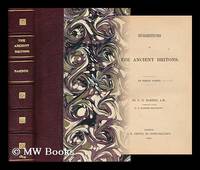
1854153243London : J. R. Smith 1854. First Edition. Hardback. Finely bound in modern aniline calf over marble boards. Raised bands with the title blocked direct in gilt. Spine compartments uniformly tooled in gilt. An exceptional copy - scans and additional bibliographic detail on request. ; 173 pages; Physical desc. : xii iii-vi xiii-xiv 4 173 1 288 p. ; 23 cm. Subject: Britons - Origin & Civilization. Wales - Antiquities Celtic. Notes: ""In three parts. "" Second and third parts have separate pagination 1-288 . Errata on p. vi 1st count. London : J. R. Smith hardcover
1804H5392Aberhonddu Brecan Wales: Argraffwyd gan Wm. a Geo. North 1804. Hardcover. Good. Published 1804 Welsh geographical and astronomical primer 8vo0 old dark brown leather fair to good copy some rubbing and wear to binding no spine label contents fair lacking flyleaf and any prelims before the title page some wear to first few pages to edges light loss and tears not affecting text majority of the text good or better age toning some foxing occasional tears and chips rear flyleaf messy. Vii 278 99 1 pp. No illustrations or maps. First published in 1784 this appears to be the second edition. OCLC locates 2 copies of this edition. Argraffwyd gan Wm. a Geo. North hardcover
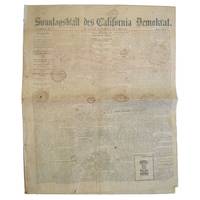
18982144San Francisco: Cal. Demokrat Publishing Co. 1898. Fair. 21-1/2 x 17-1/4 inches. 8pp. Tabloid format newspaper printed in seven columns per page. Occasional b&w illustrations. Text in German. In fair condition only with significant soiling and large light stains somewhat affecting readability; numerous small holes to first two leaves most pinhole-sized or slightly bigger a few as large as pea-sized all sporadically affecting text; several short tears to edges and last leaf; old folds. A scarce issue of this influential German-language daily which ran from 1852-1918. The front page devotes considerable space to coverage of the looming Spanish-American War which is here termed "unvermeidlich" inevitable. The increasingly ominous preparations of the two countries since the sinking of the USS Maine are described at length as well as England and various European countries beginning to choose sides. Also included in this issue is content about Japan's imperial ambitions in China viewed here as in a positive light given the potential for spreading Christianity to China news about the Klondike Gold Rush various events occuring on the Pacific Coast and more as well as advertisements in both English and German.Not located in OCLC although several institutions hold other issues of this paper and its earlier iteration the California Chronik. Cal. Demokrat Publishing Co. unknown
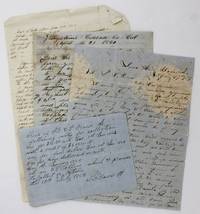
18604301Eldorado & Iowa Hill 1860. Good. Four manuscript documents including three letters totaling six pages. Old folds moderate toning minor edge wear a few tears a small hole in one letter. A neat group of four manuscript letters and documents all related to the mining activities of L.D. Davis of Georgia over a four-year period during the latter years of the California Gold Rush. Davis appears to be a lawyer living somewhere back east and may have been an investor in California mines or managing the financials for some mining concern from afar. The documents include an 1856 promissory note regarding "noted for collection" a long undated letter likely from California to Davis detailing amounts of gold taken from an unspecified mine and the mine's ownership situation and two letters overtly datelined from California -- the first from Iowa Hill in 1859 and the second from Georgetown in El Dorado County in 1860. Each document presents a unique set of concerns for Davis. Notable details of the three letters are as follows:<br /> <br /> 1 Autograph Letter Signed from A.J. Huff to Mr. L.D. Davis. Iowa Hill Ca. April 17 1859 2pp. The text reads in part "I have been very very sick for the last three weeks but am at this time improving.the disease is caused by the exposure of this last winter having worked continually in the rain and snow preparing my claim for the season. Times are very hard in this country now everyone has to work hard and is in big luck if he makes a decent living. A great many are making money very fast but in comparison not one in ten to the number than used several years back to make money or in other words the chances are about one in ten when they were one in fifty two and three in this country. If a man can get a good claim he can make more clear money out of it than he could then owing to the fact that everything is cheaper and experience has taught the People of California a great deal in respect to saving the gold and expediting the work. I think I have a very good claim which will last for a long time three or four years. It has been very expensive opening it but that is pretty well all over with now."<br /> <br /> 2 Autograph Letter Signed from J.D. Arranaut to L.D. Davis. Georgetown Eldorado County Ca. April 28 1860 2pp. Here a colleague of Davis's in California seems to be struggling and writes thanking Davis for a loan. The text reads in part with spelling normalized: "I was glad to hear from you and to.learn that you would comply with my request by letting my wife have $25 worth of corn for her use and please find enclosed a bank draft. I take it as a great favor as I am far from home. Let me know how my wife is getting along and if she stands in need of anything."<br /> <br /> 3 Autograph Letter Signed from J.H. Worley to L.D. Davis Esq. N.p. n.d. 1p. The letter concerns percentage ownership in an unspecified mine and opens with a four-line listing of the "amt. of gold taken from mine 513.51.1 while under my control." The author then writes in part: "The rent and expenses were take out of the above account and after the gold was sold one half after paying expenses. I know you are too well positioned in law to know that I dare not have settled with any other person unless I had been so instructed according to law. When Mr. Findley returned from Burke County he stated to me that one half the mine was for Mr Adams and myself and the other was for himself and his friends but did not say who they were. unknown
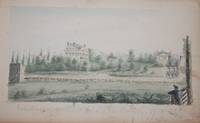
1828006534New York City 1828. Hardcover. Cloth spine. Marbled pastedown on boards. Leather centerpiece label on front board. Good. Original watercolors of rural Manhattan as it appeared in 1828. Among these and captioned are a farmhouse on Broadway and 8th Street; Kips Bay showing a boy sailing a small craft with a farmhouse in the background; a house in Bloomingdale the location of an early village now the Upper West Side along the river between 96th and 106th Streets; and a stately mansion surrounded by fields and less important buildings we would conjecture in or around Bloomingdale but captioned surely incorrectly the Battery. Most of the paintings are uncaptioned. Of these some are surely the Upper Hudson area or are scenes that we can't tell whether they are upstate or in the present day city. The artist also ventured away from the New York areas. Among the non-New York paintings are a depiction of the Cape Pogue Lighthouse on Martha's Vineyard which still stands; Fowey Harbour which is in Cornwall; and a few scenes which look very much like Scotland. <br /> <br /> <br /> Oblong 14 by 19.5 cm. 55 watercolors generally fully finished. <br /> <br /> Although the sketchbook has a label on its front board bearing the name of Walter Oddie who was a listed artist we believe a good amount of the artwork contained in this sketchbook is of his father-in-law Henry Meigs. Meigs had been a U.S. Congressman from New York and also held a number of other political positions in the city over the course of his career. More pertinently Meigs was known to be an amateur painter and as such an inspiration to Oddie. Given Oddie's youth at the time -- he was 20 or 21 years old - and from his diary for the years 1828 and 1829 now housed in the Winterthur Library we know he was just starting to paint we find it inconceivable that he would have had the skill yet to produce the sensitive and fine renderings of nature and buildings that typify this sketchbook. Further underlying our thinking about attribution is that some of captioning only makes sense if Meigs were the primary artist. We do consider it quite likely that Oddie may have done some of the sketchier work contained herein as well as contributing in bits and pieces to his father-in-law's work as well as perhaps copying some of it in this sketchbook. <br /> <br /> To us it isn't really so important who was responsible for particular paintings in the sketchbook. Rather the significance lies in the recording of New York City and its surroundings at the time - we suspect that there may be no recording anywhere of some of the buildings and locations at this time. And of course not to be minimized is the beauty of the better paintings contained in the sketchbook.<br /> <br /> Whatever the degree of Oddie's contribution the sketchbook does have something to say about his career and visa versa given that it contains the type of artwork for which he became known later. Oddie was born in Maryland Washington D.C. or possibly New Orleans but spent almost his entire life in New York and more specifically New York City Brooklyn or Long Island. In 1828 the year most of the watercolors in the catalogue were executed Oddie was spending much of his time in the city.<br /> <br /> Once Oddie's interest in painting was sparked he was believed to have been largely self-taught but he did come to study art with Hudson River School painter Robert Walter Weir and Anthony Lewis De Rose a portrait and historical painter. <br /> <br /> From the diary we know that Oddie did work with De Rose in 1829; we believe that his tutelage with Weir came later. From the diary we know that Oddie was regularly going to art exhibits and critiquing what he saw. The diary also discloses or corroborates our prior sense that Oddie sometimes would work off of engraved prints. To what degree he was merely copying the prints as opposed to using the prints as a spur to his own imagination we can not determine with certitude. We tend to think the views of Scottish and Welsh castles contained in the Sketchbook were done by Meigs not Oddie and so they might well have been done from life.<br /> <br /> From the diary we know that Oddie had some day job that occupied him during the week and so he did most of his painting at that time on the weekends when he would often go for long hikes along the Hudson. Oddie also refers in the diary to having been in Hudson then and now the county seat of Columbia County and so it is very plausible that some of the upstate scenery is from around there. Again we think some of these paintings may have been done by Meigs.<br /> <br /> Oddie would become an associate member of the National Academy of Design where he frequently exhibited his artwork.<br /> <br /> One further note - we spoke of questioning one caption referring to the Battery. In 1828 the urbanized part of the city didn't even reach 14th Street but the Battery as the oldest part of the city was thoroughly urbanized. Thus the painting could not be of the Battery. But the landscape is very consistent with the topography of Upper Manhattan. hardcover
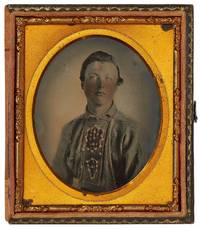
1859423474Salt Lake City 1859. Unbound. Near Fine. A hand-colored sixth plate ambrotype portrait of a young man wearing what appears to be a battle shirt identified on the verso of the plate and in pencil on the paper lining behind the image as "Leivingston Moore. Salt Lake" and dated April 22nd 1859. Slight tarnish along perimeter of image; some tarnish on mat; lacking half of the leather covered case.<br /> <br /> According to Census records Livingston Moore was born in 1840 in Jamestown Missouri lived in St. Louis and finally died in Moran Missouri in 1911. Likely a Mormon Livingston Moore lived most of his life in Missouri which had a large Mormon population until The Missouri Mormon War took place in 1838 and forced more than 10000 Mormons to leave the state. Many settled near or in the city of Nauvoo Illinois. Moore's census records do not indicate why he was in Salt Lake City in 1859 but it is possible that he was sent there as a member of the Nauvoo Legion a militia employed by LDS leaders for protection of the community. Between May 1857 and July 1858 a confrontation between the Mormon settlers in the Utah Territory and the U.S. Federal Government took place referred to as the Utah War. This armed dispute stemmed from an attempt by President James Buchanan's administration to replace Brigham Young as governor of Utah Territory. Although the conflict was over by April 1859 it is conceivable that Moore may have been stationed in Salt Lake in case any additional uprisings occurred against the Mormons. unknown
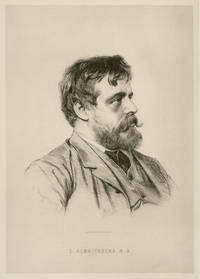
188319801883. Etching. 410mm by 295mm platemark. Rajon began his career as a photographer while studying at Ecole des Beaux-Arts Paris. This original etching of Alma Tadema was etched by Rajon on one of his annual visits to London. unknown
1879JROhuCAR64Vilnius: Romm 1879. 1879. Hebrew text. 8vo. pp. 1 p.l. vi 608. modern bds. text lightly embrowned. Late Vilnius printing of this classic Rabbinic code a digest of the larger Beth Yoseph which Caro considered to be his greatest work. Rabbi Caro a Spanish exile who removed first to Nicopoli Bulgaria and then to Adrianople where he acted for a long time as head of an academy eventually settled in Safed Palestine. See Waxman A History of Jewish Literature II pp. 144ff. Vilnius: Romm, 1879. unknown
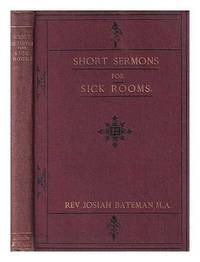
1870412648London : William Hunt and Company 1870. First Edition. Hardcover. Very good copy in the original gilt-blocked cloth. Signed by previous owner. Slight suggestion of dust-dulling to the spine bands and panel edges. Remains particularly well-preserved overall; tight bright clean and strong. Physical description; xiv 119 4 p. ; 19 cm. Notes; Publisher's advertisement on 4 pages at end. Subjects; Church of England ; Sermons 19th century. Sermons English 19th century. London : William Hunt and Company hardcover
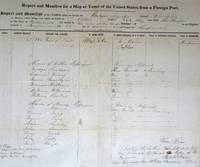
1850List2418Callao: Alsop and Company 1850. Folded ship manifest measuring 15 ¼ x 12 ½ inches. Fine condition with slight normal wear. A very scarce Gold Rush period shipping manifest for the Barque Equator captained by William Weir listing the passengers and cargo for a voyage to San Francisco in December of 1850 with notations showing the vessel’s arrival in San Francisco in May of 1851. Alsop & Co. was the work of Joseph Alsop the grandson of Continental Congress delegate John Alsop and his friend Henry Chauncey. Originally from Middletown Connecticut the pair established Alsop & Co. in New York City in 1824 and would eventually play a large role in the gold trade in California and trade extensively in South and Central America. Chauncey Alsop and others were among the partners in the trans-Panamanian railway that helped transform trans-continental trade in 1850. One of Alsop & Co.’s treasure boxes was aboard the S.S. Central America when it sank in 1857 carrying gold to the Eastern United States from Panama. <br /> <br /> The shipping manifest offered here lists the primary cargo as 195 tons of coal and also lists the names of fourteen passengers on the voyage. Imported coal - from Callao in this case - was essential to heat houses and run furnaces at factories including assay offices before the development of a local coal industry in California. We find only two instances of Gold Rush-era ship manifests - which were usually thrown away - surfacing in the trade or auction records this one and one other which sold for $3600 at PBA Galleries in 2014. Alsop and Company unknown
1804407003Hereford : printed by D. Walke 1804. 3rd edition. Hardcover. Poor copy in the original paper-covered boards. Spine lacking; spine bands and panel edges rubbed and bumped as with age. Hinges starting. Text remains clear and without blemish. Physical description; 369 pp. Subjects; Church of England ; Sermons. Hereford : printed by D. Walke hardcover
18704845Boston: Fields Osgood & Co. 1870. First edition. Hardcover. Good. 16mo green cloth cracking hinges <br/><br/>Coffin was a war correspondent in the Civil War and was called "the Ernie Pyle of his era". Most of his post-war books were historical fiction but this details his travel by train - especiallly the Northern Pacific R.R. - from Chicago up the Mississippi to Duluth then across to Portland. Large folding map in rear pocket. Woodcuts. Fields, Osgood, & Co. hardcover
184874990New York: Munn & Co. 1848-49. The entire fourth volume Nos. 1-52. Folio 11 x 15 inches. 419 pp with an index at the rear. Illustrated throughout. Each number is 8 pp. Full contemporary sheepskin with green morocco gilt lettering label. Leather a bit dry some scattered foxing and toning as to be expected. Overall a very good copy.Chiefly of interest for the many references to the Gold Rush in California. The first printed announcement of the famous discovery at Sutter's Mill was published in March of 1848 in Sam Brannan's San Francisco newspaper The Californian. The news was first announced in an East Coast newspaper the New York Herald on August 19th 1848. Issue No. 1 of Vol. 4 is dated September 23 1848 and we find an article about the Gold Rush on the second page. The header is Gold Gold and it gives an early report of about six months after the event “of the discovery of an immense bed of gold one hundred miles in extent on the American Fork and Feather riversâ€."The Golden Land" found in No. 13 states - "A short time ago the most flattering accounts were received in this city from California about the mountains of gold and the valleys flowing with silver. Some believed it was a joke while others believed it to be a ‘hue and cry’ for some speculative purpose and to the latter implication we must plead guilty. We believed that the accounts received here a short time ago about vessels being deserted by their crews and houses by their inhabitants who had proceeded to the El Dorado valley were all a hoax or something worse. But it seems after all that Madam Rumor sometimes tells true tales. The golden hills of California it seems are not imaginary elevations but bona fide treasure houses.â€In "Gold and Gold Washings" in No. 15 we read that the Gold Rush extends to both side of the Sierra Nevada Mountains and as far south as the headwaters of the San Joaquin River; an area 100 miles wide and 400 miles long. There are numerous other articles about the gold rush gold mining equipment and many other aspects of the 49er Gold Rush. Munn & Co. hardcover
1856B6046St. Petersburg;: Vasily Timm c. 1856 . Title leaf slightly soiled; but overall texts and plates are clean and crisp and in very good condition; tears to leaves # 27 28 29 33 have been expertly repaired. A very attractive example in full contemporary binding. . Edition: First 1856 Edition. Binding: Contemporary quarter morocco over marbled boards; spine with six flat gilt ruled bands forming five blind compartments with gilt lettered title on two and gilt date on four. Notes: Text in Russian. The Russian art periodical publication or gazette of printed collections of lithograph scenes was a chronicle of currents of the life of Russia published by leave of the Royal Family and by the artist himself - painter and draftsman - Georg Wilhelm Timm also known as Vasily Fyodorovich Timm or ВаÑилий Фёдорович Тимм 1820-1895 a Baltic-German painter lithographer and ceramic designer known for his genre and battle scenes; the period extending over 12 years from 1851 to 1862 in St. Petersburg. Having travelled extensively throughout Russia serving as a battle painter during the second phase of the Caucasian War he was chosen in 1852 to accompany the Tsar Nicholas I on a visit to Finland his main task continuing to faithfully share his impressions without criticism or analysis. Later he would make sketches of the Siege of Sevastopol at the height of the Crimean War of 1853-1856. In 1855 this earned him the title "Academician" conferred by the Imperial Academy. In 1860 the collection was compiled and an index of drawings prepared. The publication discontinued in 1862 due to the weakening condition of V.F. Timm's eyes. Scenes from Petersburg life portraits of popular figures reproductions from paintings cartoons etc accompanied by brief explanatory texts had been a great success with the public the complete series of having featured 432 illustrations with Timm referred to as the "Russian Gavarni" having primarily worked with lithography and woodcut engravings. Lithographs were printed in two tones along with a brief explanatory text authored by the Russian publicist and publisher N. I. Grech. and Timm's drawings executed by other artists with lithographs prepared in the workshop of A.E. Münster. <br>As of 2013 publications are estimated at 2-2.5 million rubels; in 2007 a reprint of the collection was made in St. Petersburg including three catalogs and three albums with 432 illustrations; publishers have tried to bring all illustrations as close as possible in color to the originals and leather bindings were chosen with covers gilt embossed.<br> Size: oblong folio 528x352mm. Illustration: Illustrated with 19 full-page 16 half-page and 24 smaller lithographs; and one map. Volume: Text leaves and lithogra Pages: 53 text leaves including one map plus 35 large oblong lithographed leaves. Category: Book Russia; Book Plate Books General; Vasily Timm, hardcover
1872ST17640-G121872-1921. 60 different editions in 61 volumes. <br/> Most items in their original publisher's bindings mostly cloth or wrappers and a few in limp suede; one in half morocco. Condition ranging from very good to very fine; many of the cloth items with light shelfwear rubbing to edges mild soiling fraying to head and tail of spine and minor condition issues internally light scattered foxing and browning a handful of items with more noticeable condition issues spine partially lost rubbed joints moderate browning etc. but on the whole an excellent group.<br/> <br/> Amassed over the course of many years by a passionate collector of the Rubaiyat this is a very substantial and wide-ranging group of 60 works that attest to the work's enduring popularity more than 150 years after Edward FitzGerald introduced it to the West. Son of a wealthy Irish landowner FitzGerald had enough money to pursue a rather desultory literary career as a "genteel gipsy" in Terhune's words before beginning to study languages in middle age. He started his translation of the quatrains "rubáiyát" in Persian attributed to "Umar Khayyam" in 1856; according to DNB about half of FitzGerald's final work paraphrases rather than directly translates portions of the 11th century poem while the rest is original verse inspired by Omar. "The result is generally seen as being in some ways an original English poem one that is much better known than Omar's poem is in Persian." DNB In Jewett's opinion it certainly earned FitzGerald "a prominent place among the immortals of English literature." In 1858 FitzGerald submitted 25 of the "less wicked" verses to "Fraser's Magazine" only to be rejected. He had 250 copies published anonymously at his own expense but had no luck selling them. Admitting defeat he gave 200 copies to Quaritch; these sold so poorly that they were relegated to the penny bin where Potter says they were discovered--and soon celebrated--by Dante Gabriel Rossetti and Algernon Swinburne. Those copies that remained unsold when Quaritch moved to Piccadilly in 1860 were either lost or destroyed but by 1861 Rossetti and his Pre-Raphaelite brethren along with Celtic scholar Whitley Stokes were evangelizing for the work embracing the lush lyrical verse that would move English poetry away from Victorian orthodoxy and convention. According to Day by the end of the 19th century "a copy of the 'Rubaiyat' upon an Oxford table was a symbol of sophistication. Today . . . it remains the most popular single poem of the Victorian era." The present collection is especially strong in illustrated editions with more than 25 artists represented including Edmund Dulac Elihu Vedder Willy Pogany Adelaide Hanscom Gilbert James Edmund J. Sullivan Arthur Szyk René Bull and Abanindro Nath Tagore. Notable text editions in this group include a Third Edition of FitzGerald's translation; a First Published American Edition; and a signed and inscribed copy of Eben Francis Thompson's translation. There is also a small group of fine press printings including examples by the Gregynog Press Thomas Mosher and Elbert Hubbard. There are no duplicated editions in this collection and there are no trade paperbacks. A full list of the collection's contents is available upon request. unknown
1820d025.999Jones & Co 1820. Five volumes bound in contemporary matching half leather lettered and decorated on spine in gold. Each titled just CAROLINE and numbered 1-5. Volumes 1-2 Memoirs is an eighteenth edition the others have no statement of edition . Each has the small label of J. Turner Bookseller & Binder of Godalming and the plain bookplate of William Martin Hailsham. 600 and 526 and 755 and 459 and 379 pages. Fairly clean tight texts but covers a bit worn and spines a bit scuffed. Generally approaching VG minus condition. Still presenting quite well. SPECIAL POSTAGE RATES APPLY Packed weight . Hardback. G/No DW. Jones & Co Hardcover
1896011575Portland OR: The Register Publishing Company 1896. First Edition. Hardcover. Good. 286pp; Blue cloth boards with gilt lettering to front & spine decoration to front original decorated endpapers hinges professionally repaired previous owner's name to front pastedown wear to spine ends frontispiece tissue guard intact text unmarked binding is tight Good condition. Register of the Republican party in the state of Oregon with photos history and biographical sketches. The Register Publishing Company hardcover
1855DEMO013877IWashington: Beverly Tucker 1855. First & Quarto edition. Hardcover. Fair. 13 chromolithographs. maps. 4to orig. sheep lacks t-p & spine. Ex libris House of Repr. Vol. #792. Half moon circular stain on bottom margin affecting chromolithographs. <br/><br/>This volume contains seven Reports by Gunnison Beckwith Pope Parke Emory etc. along the 38th & 39th & 41st Parallels. House Exec. Doc. no. 91. Howes P3; Wheat TRANSMISSISSIPPI 822ff; Wagner - Camp - Becker 262a-1; Rittenhouse 442. "This widely known work requires no comment - Cowan CALIFORNIA p.512." Also John Grubb Parke Wm. H. Emory. House Exec. Doc. no. 91 Pt. 792. Howes P3; Wheat TRANSMISSISSIPPI 822ff; Wagner - Camp - Becker 262a: nos. 1-7. Twelve chromolithographs 24 botanical and geological lithographs 2 folding maps in pt. 5 lacks four maps and title-page in pt.1. Part 1 has a semicircular stain on the lower margin affecting the chromos. 13 chromolithographs. maps. Beverly Tucker hardcover