123 résultats
19542081402109801727Dyeing Life Happodo 1954. Soft Cover. Fine. Number of books: 1 Dyeing Life Happodo paperback
A9780415476614Hardback. New. Gathers a broad range of philosophical viewpoints on gender in sport. This book collects the essays that cover four major themes - sport and the construction of the female; objectification and the sexualization of sport; homophobia; and sex boundaries - obstruction naturalization and opposition. hardcover

19752081402109802792Not Available 1975. Soft Cover. Fine. Number of books: 1 book Not Available paperback
6218112like new. unknown
6218112-nnew. unknown
2009DADAX0415476615Routledge 2009-09-28. 1. hardcover. New. 6.14x0.70x9.21. Buy with confidence. Excellent Customer Service & Return policy. Routledge hardcover
189749394Philadelphia: Textile Publishing Co. 1897. Tall 8vo. 324 pp. Over 1500 text illustrations diagrams weaving diagrams numerous illustrated ads. Black pebbled cloth gilt lettering on front cover & spine minor shelfwear slight rubbing w/ notes clippings & postcard laid-in from the library of Elisa Serin b. 1887 silk weaver married to Maurice Serin foreman of the Allentown PA plant of Broad Silk Mills. Early printing of this scarce and important guide intended to provide reference for 19th-century weaving students and textile manufacturers. Posselt 1858-1921 emigrated from Austria after managing his father’s textile mills and was a designer in mills all over New England and Pennsylvania. He became the first director in 1884 of the first successful textile school in the U.S. and later became editor of the Textile Record of North America the foremost journal on textile design and manufacturing at the end of the 19th-Century. Although his many works on textile machinery and manufacturing are now primarily of historical interest this well-illustrated work on weaving and loom design is still relevant and considered some of the most important books on textile design ever published. See: Ralph Griswold Emanuel Anthony Posselt 2004. Textile Publishing Co., hardcover
19642092902138901295Kyoto shoin 1964. Soft Cover. Fine. Number of books: 3 Kyoto shoin paperback
2092902140901501Kyoto shoin N.A. Soft Cover. Fine. Volume: 1 Kyoto shoin paperback
192757304Fall River MA: Dover Press 1927. 8vo. 160 pp. w/ errata slip bound-in before the ffep. With 83 weaving patterns 128 tipped-in fabric & weaving samples in assorted fabrics numerous illustrated ads for textile mills and textile mill weaving machinery. Gray-blue cloth black lettering on front cover & spine thumbing & soiling to covers darkening to spine ex-lib markings on endpapers still VG copy. First edition of this well-written and illustrated work intended to aid aspiring weavers and textile manufacturers on designing and weaving of cotton fabrics. This volume carefully outlines how to use graph paper to chart out certain weaving patterns what steps have to be taken to produce certain weight cotton fabrics continually referring to the included samples as they compare to the text diagrams. The supplied fabric swatches range from Tobacco cloth to Brassiere and Lingerie as well as Umbrella Muslin Sheeting Gingham Duck Oxford Denim Sateen Seersucker and many other cloths. Nichols 1872-1945 was the longtime principal and trustee for the Bradford Durfee Textile School in Fall River MA and Broomhead 1861-1956 primary weaving instructor. Dover Press, hardcover
2012x-9401068224Springer Verlag 2012. Paperback. New. 888 pages. 9.00x6.00x1.90 inches. Springer Verlag paperback
195859253New York: The Macmillan Co. 1958. 8vo. xii 225 1 pp. With over 350 text illustrations weaving diagrams sketches and photographs. Black publisher’s cloth white & blue lettering & decoration minor rubbing shelfwear w/ d.j. cover art by The Strimbans using handwoven textile by Virginia D. Aldridge minor shelfwear minor chipping head & foot of spine slight scuffing still VG/VG copy from library of Agnes Parsons w/ the original advance order form folded and laid-in. First edition of one of the scarcest and most significant manuals for handweaving in the Mid-20th Century. Following World War II and with increasing interest in designing and weaving textiles the author demonstrated the basic principles of cloth construction by focusing on harness-controlled patterns and four-harness fabrics. Frey 1893-1972 began as an occupational therapist in woodworking at the U.S. Army’s Walter Reed Hospital and began learning and teaching handweaving as well as training her students to construct weaving looms. After moving to New York she worked in the textile industry and later opened her own design studio taught weaving and by 1940 was one of the co-founders of the New York Guild of Handweavers whose first year’s weaving programs focused on studying Native American Weaving of the Cherokee Tribe. See: Diane Kirschner History of the NY Handweavers Guild 2022; The Macmillan Co., hardcover
19362111902160201165Dainippon Silk Association Shinano Branch 1936. Soft Cover. Fine. Volume: 1 Dainippon Silk Association Shinano Branch paperback
2009x-0415476615Routledge 2009. Hardcover. New. 1st edition. 240 pages. 9.53x6.46x0.71 inches. Routledge hardcover
192554342Philadelphia PA: Otto F. Schumann Philadelphia Textile School ca. 1925. Small 4to. 8.25 x 9.2 in. 75 leaves unnumbered including 32 leaves with detailed colour charts on weave formations producing various kinds of cloth 3 tipped-in textile samples together w/ weaving instructions in manuscript. Original limp leather 3-ring binder gilt lettering stamped on front cover ink lettering & association of Otto F. Schumann on front cover some soiling dustsoiling edgewear still VG exemplar. This Jazz Age weaving manuscript notebook complete with weave formation design plates fabric samples and instructions offer a remarkable and invaluable artifact of how a young American textile designer and weaver received training at the famed Philadelphia Textile School now Philadelphia University during the 1920s. These course books were judged on completeness and the aspiring weaver’s skill in presenting the details about the instruction as well as their abilities in running the machinery required to produce the cloth. This manuscript notebook includes Schumann’s detailed plates and notes on producing color effect on the plain weave creating Broken Twills Crowfoot Satins Checked & Figured Broken Twills Entwining Twills Basket Weaves and Broken Satins. The extensive manuscript notes detail the loom instructions how many lines are required composition and more in producing the assorted effects. Because of the poor quality of United States textiles exhibited at the Centennial Exhibition in 1876 the Philadelphia Textile Manufacturers pushed for a formalized vocational school to train weavers designers and textile workers. In 1884 it became part of the Pennsylvania Museum and School of Industrial Art with 81 students enrolled by 1885 and by 1894 the School of Textiles added a Department of Wool Carding & Spinning and a Department of Cloth Finishing and Design. By the 1920s the Philadelphia Textile School was offering extensive three-year textile courses chemistry and dyeing courses as well as design courses in cottons woolens worsteds silks Jacquard design and more. Schumann 1906-1967 was the son of Hugo Schumann founder and owner of the Maid Hosiery Mills in Reading PA through the opening decades of the 20th century for whom he worked with until after World War II as designer and sales executive. Otto F. Schumann, Philadelphia Textile School, hardcover
33036701Hang Zhou n.d. ca 1901-1920 Hang Zhou Qi Wen Si Zi Chang Zi Zao. Color silk weaving 84 x 19 cm. stapled to a wooden board gold wood frame the weaving has 1 spot at top center 2.5 x 2 cm. & a few other rubbed through spots else solid. THE SUBJECT: This is a very rare unusual and lovely item. It is a machine woven illustration of the inside of the Beijing Imperial Palace Gu gong & Forbidden City Zijincheng. Especially showing the area around the Summer Palace and Lake Kunming. It shows people in row boats on the lake with the lovely marble boat as the background as well as Jingshan Park also known as "Prospect Hill." DATE These are very obscure and most didn't last from such a long time ago. While there is a date stamp in red on the wooden mounting board lower right-hand corner it is very feint and hard to read anything other than "Nian" year & Yueh month but on numbers visible. We estimate this to have been done some where about 1901-1920's after the end of the Boxer Rebellion. COLOPHON/TITLES: On the left margin is the publisher's name: HANG ZHOU QI WEN SI ZI CHANG ZI ZAO: HANGZHOU SILK WEAVING FACTORY. Also on the left margin is "7 x 32" which likely refers to the size of the item in inches which are actually 7 3/8 x 33 inches when stretched and stapled to the backing board. The right margin states the title in Chinese: BEIJING WAN SHOU SHAN QUANJING: PANORAMA OF BEIJING WAN SHOU MOUNTAIN. CONDITION: The work has a hole at the center top margin in the sky and has a gray paper mounted behind the weaving to keep it intact. There are also some minor number of to her small rubs here and there. Because this item was stretched- mounted with staples this caused some "pull" to the fabric. At the left one-third of the weaving the sky is showing some stress lines going horizontally across to the center as is the right one third sky portion as well. Otherwise the work is nicely intact and not damaged. The old staples are copper plated therefore no rust is evident. We strive to point out every flaw of significance but commonly over describe such flaws. Overall and by and large this is a very nice stable and obscure item. Few have survived the ravages of time and attrition rate. FRAMING / BACKING BOARD: The backing board is 100% wood consisting of 7 panels glued on end to form one single and long board. Over this is a gold-painted wooden frame consisting of thin wood with mitered corners which acts as a mat to cover the edges and staples. This frame/mat wood is placed over the textile weaving and is therefore ready for a larger glazed frame. There is a silver label adhered to the gold frame at the bottom center it reads CHI WEN SILK WEAVOMG CO. and has Chinese characters above that name. Nice association with the weaving. RARITY. This and other works from the Chi Wen Silk Weaving Co. are quite rare and seldom found on the market. We have seen one other which is a panoramic view of Shanghai and the Huang Po river. Please inquire for information. SHIPPING: Being an extra long item appropriate extra shipping & packing charges will apply. Please inquire prior to ordering to request shipping cost information. We reserve the right to ship this by Federal Express as they are the most reliable & dependable shipper for delicate and large items. . unknown
2092902138900070Japan Textile Promotion Association N.A. Soft Cover. Fine. Volume: 2 Japan Textile Promotion Association paperback
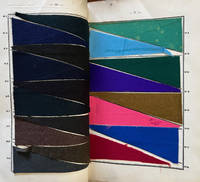
188262704Elbeuf Paris Berlin London & Chicago IL: L. Bertin Printing Office Levasseur March 1882 - Aug. 1882. Ten parts in one vol. Thick tall 8vo. With 96 of 98 tipped-in fabric swatch samples with the text a couple partially clipped by previous owner 3 thread samples and 169 pennant-shaped samples out of 181 1 additional woven-in to No. 654 series 12 removed divided amongst 30 different plates each installment featuring 3 numerous woodcut engraved diagrams weaving diagrams illustrations plates extra-illustrated with 5 additional engraved plates of Jacquard Loom & Power Loom weaving equipment. Half-calf over burgundy-coloured cloth gilt lettering on spine marbled endpapers rebacked preserving original spine edgewear creasing still VG exemplar. First editions in English of this series of periodical installments issued for weavers designers and fashion houses in the 19th-Century featuring the latest patterns instructions new and original designs shadings and dye-lots for woolen textiles. Originally published either weekly or bi-weekly these very ephemeral textile sample installments and weaving instructions were issued by subscription and heavily used and often most of the fabric samples removed along with the plates in order to offer specific hands-off patterns for workers setting up looms and weaving. In addition samples provided the latest dye lots of fashionable fabrics for women and men’s clothing with emphasis in the first few issues present here on use and settings for the Jacquard Loom. No. 646 for the April 30 1882 issue includes brilliantly dyed samples encompassing such vivid jewel colours in red pink green blue and browns. These fabrics also provide an essential tactile and visual reference for the latest textiles in production during the Gilded Age in both Europe and America. Worldcat locates only runs and partial runs of the 45 vols. originally issued in French German English & Italian in the Bibliotheque Nationale Issues at BN in English for Summer Season 1876-1877. L. Bertin, [Printing Office Levasseur], hardcover
3315Paris : n.p. n.d. Text in double columns within decorated woodcut borders. Page 1 is a front wrapper; bound into recent marbled boards; some browning and marginal staining. One of the earliest books on the construction and operation of a textile machine that fashioned hosiery. This invention introduced in the mid-eighteenth century contains the oldest known drawing of a hosiery-knitting device. The text which describes all the working parts of the machine and how to assemble it also gives detailed instruction on its operation. The remarkable plates are keyed to the text with a beautiful illustration of a hosiery maker's workshop. n.p. unknown
D7491Wattwil Switzerland late 19th century. Hardcover. Fine. Original morocco-backed black cloth "Bindungslehre" stamped in gilt on front board; 360 x 220 mm; pp. 107 filled with manuscript notes colored diagrams and fabric samples. Fraying at spine tips along joints and edges of boards. Internally nice and bright. <br/><br/>Student Sohnweiser's working manuscript detailing a course in weaving -- following the system of instruction founded in the early 19th century of Joseph-Marie Jacquard who invented the revolutionary loom. Using punch cards to program patterns the loom cause riots against the replace of people by machines. In spite of the controversy Jacquard's invention turned out ot be most successful and with it suse of binary logic and punch cards is widely regarded as a precursor to the modern day computer. hardcover
19232091502135500408Dyeing and Weaving Japan Company 1923. Soft Cover. Fine. Number of pages: thick Box size: 16x22cm Dyeing and Weaving Japan Company paperback
201298320Rizzoli. New. 2012. Hardcover. 0847838439 . FREE UPGRADE to Courier/Priority Shipping Upon Request - IN STOCK AND IMMEDIATELY AVAILABLE FOR SHIPMENT - Flawless copy brand new pristine never opened -- 240 pp. ; 225 color illustrations. -- with a bonus offer-- . Rizzoli hardcover
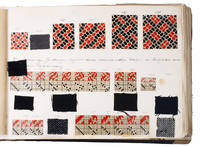
190019623Vaals-Aachen on the Dutch-German border 1900. Oblong folio 24 x 32 cm. Höhere technische Schule für Tuchfabrikation Contemporary beige half cloth sewn on 2 cloth tapes with a hollow back black cloth sides title in gold on the front board tissue interleaving tipped in between the leaves. Manuscript in German written in black ink in a neat and legible Latin hand on paperboard leaves comprising short instructional texts and about 2000 colour-coded weaving patterns and small samples of woven cloth mounted on both sides of the leaves. 2 blank 117 1 blank pp. Unique course in cloth weaving as taught in a German-language technical school probably carefully noted down by one of the pupils and beautifully illustrated with nearly 2000 weaving patterns drawn on grid paper with the various threads colour-coded and accompanied by hundreds of samples of woven cloth both the patterns and the cloth samples mounted on the leaves. Most pages contain primarily patterns and samples with only brief captions but the occasional longer text sometimes run over a few pages. This German text provides an explanation of the patterns and their colour-coding the various kinds of cloth and the weaving process. Many of the patterns are shown in red black and white but some add yellow and/or blue a few use brown and a few use only red and white or only black and white. The weaving patterns and cloth samples are numbered as 1214 figures but many numbers include two patterns or samples and some as many as five and occasionally a number has been accidentally repeated. There are also at least 80 unnumbered patterns and samples.The title's reference to the school in "Vaals-Aachen" probably means it was situated in Vaals but served German speakers in both communities. The area around Aachen had produced cloth for centuries but after an economic depression in the mid-19th century it emerged and became known for its textile manufacturing by the 1880s. The present manuscript course forms a rich and splendid example of the thorough education its young people received in technical schools for a career in the cloth industry around 1900.A piece has been cut out of three leaves and some have come loose from the pages but at least most of them are still present. The binding is slightly loose. The manuscript is generally in good condition. A remarkable and important source for any study of weaving and weaving education also graphically fascinating and colourful. ABE CAT Art History hardcover