627 résultats
1947ZB444775Denver: 1947. 136 25 ads pp. illustrated; minor glue residue at spine of paper wrappers and name of previous owner on front cover but overall very good. - If you are reading this this item is actually physically in our stock and ready for shipment once ordered. We are not bookjackers. Buyer is responsible for any additional duties taxes or fees required by recipient's country. Denver: unknown
Ex - library paperback, with bookplate, barcode, accession and withdrawn stamps. Contents otherwise very good; clean, sound, bright throughout. TPW Ex Library
473 pages. Index. List of illustrations. Many fascinating black and white photographic plates. Diagrams and fold-outs. Above-average external wear. Sunning to spine. Hinges intact. Usual library markings. Contains a wealth of historical B.C. documentation. A worthy reference copy. Book
55 pages. A play based upon the coal-mining Dunsmuirs of Vancouver Island. Few markings. Average wear. Binding intact. Book
Sarreguemines, Synchro/Pierron, 1992. In-4 relié toile avec jaquette, 143 pages de photographies en couleurs et en noir et blanc.
QWA-3901Brionne, Gérard Montfort, 1977, XIII-384 p., in-8 br., coll. "A l'écoute du Peuple", fac-similé de l'édition parue chez Michel Lévy en 1874, état de neuf
186846328Couverture souple. Revue hebdomadaire brochée. 16 pages. 21 x 28 cm. Pliure au milieu.
186746363Couverture souple. Revue hebdomadaire brochée. 16 pages. Non coupé 21 x 28 cm. Pliure au milieu.
35577N° Tome XXXIII - fasc II de 1945 - revue illustrée - broché
19663364638Bern, Stämpfli, 1966. 422 S. Mit Abbildungen auf Tafeln. OKart.
3792s.l, 1893, 51 pp. in-8, Ouv. ill. h.t. planche dépl. 32,5 X 45,6 cm, fascicule n°23 Industrie Minérale 3e série tome VII 1893 ; Bassin d'Autun, Boghead d'Autun, Coprolithes des schistes d'Autun.
Metz, éd. Serpenoise, 2001. In-4 cartonné, 187 pages abondamment illustrées.
Ex-library with the usual stamps, stickers, etc. Binding is solid and text/interior is clean and free of marking of any kind. 296 pages with graphs, charts, tables, maps.
167 p. Illustrated. 8vo. Original publisher's cloth binding. Original dust jacket, slight tear on top edge. The son of a famed Pennsylvania German printer, Cist developed the coal regions of the Wyoming Valley. PA 26.
89427Berlin, Borntraeger Frères/Verlag von Gebrüder Borntraeger, 1905. 17 x 26, 53 pp., nombreuses illustrations, broché, bon état.
42771Valenciennes, L'Auteur, 1983, in 8° broché, 151 pages ; illustrations ; couverture illustrée.
42768Valenciennes, Bavay, 1981, in 8° oblong, cartonnage rouge illustré de l'éditeur ; 119 photographies commentées ; signature sur la première garde blanche.
6 pages. Cover photo of Capt. M.W. Plunkett. Illustrated advertisement for song "Coal Black Mammy" inside front cover. Above-average wear. Tape repairs. Cover fold open. A worthy working copy. Sheet music
361 pages. Black and white photographic plates. Footnotes, bibliography and index. "A rich social history which traces the events, from the decades leading up to the blast, the frenetic rescue operation and mass funerals, through the series of acrimonious legal inquiries, to the divisive relief effort and the continued commemoration of the disaster by the community of Mt Kembla." - from dust jacket. Book clean and unmarked with moderate wear. Slight lean to spine. Minor bit of discolouration to top of dust jacket at spine. Average wear to dust jacket which is now preserved in glossy new archival-grade Brodart. A sound copy. Book
120p. + Photographs. Tall 8vo. Original pictorial wraps. Originally published in the Slovak language. PA PAMPH 20_15 BX7
190220871Philadelphia: George W. Jacobs 1902. First Edition. 7.5 x 5 in. 97 pp with three illustrations from photographs in original pictorial cloth. Light scuffing to corners and spine ends pale stain to frontis not affecting illustration previous owners' names on front endpapers. Very good. In 1902 the United States depended on anthracite or "hard coal" for domestic heating. Anthracite coal miners in Pennsylvania went on strike on May 12 demanding higher wages a shorter workday and recognition of their union the United Mine Workers of America. As the strike dragged on over several months public anxiety about fuel shortages led President Roosevelt to take the unprecedented action of stepping in to bring about a resolution. On October 3 1902 he met with presidents of the mine-owning railroads and union leaders. The owners refused to enter into negotiations with the union and the conference disbanded without resolving the crisis. Roosevelt then formed a commission to investigate the strike. Secretary of War Elihu Root and banker J. P. Morgan convinced railroad leaders to abide by the findings of the presidentially appointed commission. The union also accepted the commission and on October 20 voted to end the strike. In March 1903 the anthracite-coal commission recommended increasing miners' pay by ten percent one half of their demand and reducing the working day from ten to nine hours. Stewart Culin was a private in the Second Troop Philadelphia City Cavalry which was sent in August 1902 to maintain peace and order in Carbon County where the strike was centered. He later became an important ethnographer and his considered narrative and analysis of the strike reflects the eye of a keen observer. George W. Jacobs hardcover books
183926058Pennsylvania 1839. Manuscript broadside 11" x 22". Two drawings at head of report followed by detailed descriptions of each drawing: boundaries chutes directions of veins projected coal output etc. Old horizontal folds some splits along fold edges a few small chips. Drafted on paper which bears the watermark of "John C. Clark Phila" the oldest legal stationers in the United States founded in 1817 and the 9th oldest continuously operating business in Philadelphia according to its current website.<br/><br/> The Peach Mountain mines were situated near Pottsville in the county of Schuylkill Pennsylvania. Peach Mountain was one of several mines in the area which produced red ash anthracite. According to this offering the mine bordered the Delaware Coal Company which was responsible for working it. <br/> "Mr. Read thinks that the above coal can be delivered on the bank at $1. per ton. He would contract at that note after the tunnel was driven. The driving of the tunnel would effect a saving of 10c per ton on all the coal lying above the level of the present tunnel. The said 10c per ton are now paid for loading and running to and unloading into the chute of 79 feet whence it is again loaded into drift waggons on the deep level. It would take a year to drive the tunnel at a total cost of about $2500. unknown books
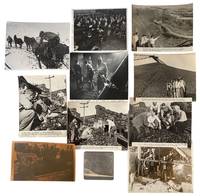
1943213381943. Anthracite coal mining photographs circa 1930s to 1950s document the daily labor conditions environmental hazards and union activity within Pennsylvania's coal industry and provide direct visual evidence of industrial work in one of the most significant energy sectors in the United States. Created during a period when anthracite coal production remained central to regional economies and national energy supply these images record both above ground and subterranean labor processes as well as the collective organization of workers responding to unsafe conditions and economic pressures. The archive supports research into labor history industrial practices occupational health and union movements in mid twentieth century America.<br /> <br /> Eleven silver gelatin photographs ranging approximately from 4 x 6 inches to 8 x 10 inches some with typed captions attached depicting mining activity and related scenes in Pennsylvania's anthracite region. Images include miners traversing severe winter conditions while guiding donkeys hauling coal carts through heavy snow; workers shoveling coal in enclosed dimly lit environments with airborne dust visible in the light captioned "Coal shoveling brigade or how I spent my summer vacation"; and inspection scenes in which workers examine coal samples prior to distribution. Additional photographs show large scale coal piles dwarfing individual laborers emphasizing production scale. One press photograph dated January 15 1943 documents a mass meeting in Hazleton Pennsylvania where union leader Andrew Yevchak addresses striking miners with caption noting that 17000 workers were ordered to return to work following the gathering.<br /> <br /> Produced during a period marked by ongoing labor disputes mechanization and heightened awareness of occupational hazards such as coal dust inhalation these photographs capture both the physical demands of mining and the organizational structures that shaped worker response. The inclusion of the 1943 Hazleton meeting situates the archive within broader wartime labor tensions when coal production was critical to the war effort and strikes carried national implications. Together the images provide a grounded record of industrial labor environmental exposure and collective action within the anthracite coal industry preserving visual documentation of work that was both economically essential and physically hazardous. Minor edge wear and light creasing to a few prints with strong image clarity overall; condition very good. unknown