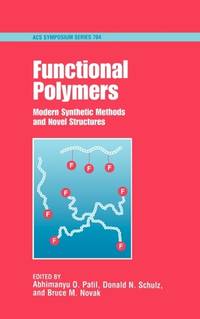
Functional Polymers: Modern Synthetic Methods and Novel Structures Acs Symposium Series
0841235775New. hardcover. New. Satisfaction Guaranteed or your money back. hardcover
SHIMedia · États-Unis99,99 $US≈ 84,60 €
1 932 résultats
2111902154800369Sekchanomizu Shobo N.A. Soft Cover. Fine. The book is in fine condition. Sekchanomizu Shobo paperback
19662090202117900290Sekchanomizu Shobo 1966. Soft Cover. Fine. The book is in fine condition. Sekchanomizu Shobo paperback
19672083002116204216Saburo Ienaga commentary edited by the Liaison Committee for Research on Meiji Historical Materials 1967. Soft Cover. Fine. The book is in fine condition. Saburo Ienaga commentary, edited by the Liaison Committee for Research on Meiji Historical Materials paperback
19562080502106915849Not Available 1956. Soft Cover. Fine. The book is in fine condition. Not Available paperback
19562080502106908166Not Available 1956. Soft Cover. Fine. The book is in fine condition. Not Available paperback
0841235775New. hardcover. New. Satisfaction Guaranteed or your money back. hardcover
0871701154.Ghardcover. Good. Access codes and supplements are not guaranteed with used items. May be an ex-library book. hardcover
1558994289.Ghardcover. Good. Access codes and supplements are not guaranteed with used items. May be an ex-library book. hardcover
1970739173PN. New. 1970. Soft Cover. Date is original print. This is a reprint edition. . PN paperback
19762091202132900140Taishukanshoten 1976. Soft Cover. Fine. The book is in fine condition. Taishukanshoten paperback
20172110502150701983Morikita 2017. Soft Cover. Fine. Number of pages: 153p Size: 22cm Morikita paperback
19971302028PN. New. 1997. Soft Cover. Date is original print. This is a reprint edition . PN paperback
1509891-nnew. unknown
1509891like new. unknown
19832111902156001654fashion journal 1983. Soft Cover. Fine. The book is in fine condition. fashion journal paperback
19222080502106913867Not Available 1922. Soft Cover. Fine. The book is in fine condition. Not Available paperback
1495268772.Gpaperback. Good. Access codes and supplements are not guaranteed with used items. May be an ex-library book. paperback
18590008449Cincinnati OH: John P. Walsh 1859. First edition. Paperback. Good. 16mo 24 pages blank sewn wrappers with the emboss of John Graham Bookseller and Emigrant Passenger Agt Chicago foxed and stained. Unknown No Copy Located Elsewhere. <br/><br/>The History is short - about 2 pages but twice as long as the treatment of Irish literature. John P. Walsh paperback
2111902160100178Not Available N.A. Soft Cover. Fine. The book is in fine condition. Not Available paperback
19742082702114602671Not Available 1974. Soft Cover. Fine. The book is in fine condition. Not Available paperback
1987778477PN. New. 1987. Soft Cover. Date is original print. This is a reprint edition. . PN paperback
19852110502150906440Not Available 1985. Soft Cover. Fine. Volume: 1 Not Available paperback
19772111902160102174Gifu Prefecture Soil Materials Research Council 1977. Soft Cover. Fine. Volume: 1 Gifu Prefecture Soil Materials Research Council paperback
094490484X.Ghardcover. Good. Access codes and supplements are not guaranteed with used items. May be an ex-library book. hardcover
200873705Princeton NJ: Princeton University Program on Science and Global Security The International Panel on Fissile Materials 2008. Presumed First Edition First printing. Wraps. Very good. 4 138 2 pages. Maps. illustrations. Endnotes. Cover has slight wear and soiling. The Panel produces an annual Global Fissile Material Report which summarizes new information on fissile material stocks and production worldwide as well as periodic research reports. Almost two decades since the end of the Cold War the United States and Russia still retain stockpiles of about 10000 nuclear weapons each and have committed only to reduce to about half that number by the end of 2012 when the Strategic Offensive Reductions Treaty comes into force. There are now seven other nuclear weapon states including North Korea which carried out its first nuclear test on October 9 2006. Their arsenals range from a few simple warheads to several hundred high-yield thermonuclear weapons. There are growing concerns about a loss of momentum in the nuclear disarmament process additional states acquiring nuclear weapons and the possibility of nuclear terrorism. Fissile materials ordinarily plutonium and highly enriched uranium HEU are the essential ingredients in all nuclear weapons. Securing consolidating and eliminating fissile material stocks worldwide are the common imperatives in the overlapping efforts to eliminate nuclear weapons in the countries where they exist halt their spread to still more countries and prevent terrorists from obtaining them. This is the third report by International Panel on Fissile Materials on the global situation with regard to efforts to secure and eliminate fissile materials. A Fissile Material Cutoff Treaty FMCT would ban the production of fissile material - in practice highly-enriched uranium and separated plutonium - for weapons. It has been supported by strong majorities in the United Nations. After it comes into force newly produced fissile materials could only be produced under international - most likely International Atomic Energy Agency - monitoring. Many non-weapon states argue that the treaty should also place under safeguards pre-existing stocks of fissile material in civilian use or declared excess for weapons so as to make nuclear-weapons reductions irreversible. This paper discusses the scope of the FMCT the ability to detect clandestine production and verification challenges in the nuclear-weapons states. The International Panel on Fissile Materials IPFM was founded in January 2006 and is an independent group of arms-control and nonproliferation experts from both nuclear weapon and non-nuclear weapon states. The mission of the IPFM is to analyze the technical basis for practical and achievable policy initiatives to secure consolidate and reduce stockpiles of highly enriched uranium and plutonium. These fissile materials are the key ingredients in nuclear weapons and their control is critical to nuclear weapons disarmament to halting the proliferation of nuclear weapons and to ensuring that terrorists do not acquire nuclear weapons. Both military and civilian stocks of fissile materials have to be addressed. The nuclear-weapon states still have enough fissile materials in their weapon stockpiles for tens of thousands of nuclear weapons. On the civilian side enough plutonium has been separated to make a similarly large number of weapons. Highly enriched uranium is used in civilian reactor fuel in more than one hundred locations. The total amount used for this purpose is sufficient to make about one thousand Hiroshima-type bombs a design well within the potential capabilities of terrorist groups. The Panel has been co-chaired since 2015 by Professor Alexander Glaser and Dr. Zia Mian of Princeton University and Professor Tatsujiro Suzuki of Nagasaki University Japan. Previously it was co-chaired by Professor Jose Goldemberg of the University of Sao Paolo Brazil 2006-2007 Dr. R. Rajaraman 2007-2014 Professor Emeritus of Jawaharlal Nehru University New Delhi India and Professor Frank von Hippel of Princeton University 2006-2014. Its members include nuclear experts from seventeen countries: Brazil Canada China France Germany India Iran Japan Mexico Norway Pakistan South Korea Russia South Africa Sweden the United Kingdom and the United States. This group of countries includes seven nuclear-weapon states and ten non-weapon states. IPFM research and reports are shared with international organizations national governments and nongovernmental groups. It has full panel meetings twice a year at capitals around the world in addition to specialist workshops. These meetings and workshops are often in conjunction with international conferences at which IPFM panels and experts make presentations. Princeton University's Program on Science and Global Security provides administrative and research support for the IPFM. Princeton University, Program on Science and Global Security, The International Panel on Fissile Materials paperback