15 résultats
1868LFA-126742841Un ouvrage de 356 pages, format 115 x 180 mm, illustré de 400 figures, relié cartonnage dos cuir, publié en 1868, Librairie de Firmin Didot Frères, Fils et Cie, bon état
1882mon0003855191Berlin: Gebruder Paetel 1882. Hardcover. Good. . ex-library copy with usual markings in a library binding. pages tanned. Berlin: Gebruder Paetel hardcover
1899301282London: George Redway 1899. Cloth. Very Good/No Jacket. 8vo - over 7¾" - 9¾" tall. Type: Book N.B. No dust jacket. Red cloth with gilt lettering to spine. Corners of boards and head and tail of spine a little rubbed. Some pencil underlining to text. PSYCHOLOGY George Redway hardcover
1843P-24832Washington: Classics of Medicine Library 1843. Hardcover. As New. Duodecimo. The first American edition for The Classics of Psychiatryof the rare 1843 London first edition of this classic in neurypnology covering hundreds of cases of its successful application in the relief of disease. Full green calf leather with raised bands gilt title and decorations all edges gilt marbled endpapers and silk ribbon. A pristine copy clean and unmarked. Classics of Medicine Library hardcover
1846004036Edinburgh: Maclachlan Stewart & Co. 1846. 1st ed. . Hardcover. VG-. 14 Cms x 21.5 Cms. Contains issues 90-93. vi474; clean & unmarked but textblock incipiently cracking between pp.176/177. Half leather and green cloth covers generally clean bar a few surface marks rubbing to corners sp. ends and joints cloth tear bottom back corner with some loss gilt paneled sp.label good. George Combe figures as usual Thomas Mayo has piece on a case of double consciousness brief notes on Dalton's colour-blindness and the brain of 'General Tom Thumb' the famous midget plus a piece by James Braid on Baron Reichenbach's ideas. <br/> <br/> Maclachlan, Stewart & Co. hardcover
1890OKKU1816Wien u. Leipzig, Urban & Schwarzenberg 1890. Gr.-8°. VI, 217(1) S. Mit 9 Textholzschnitten. Halbleinenbd. d. Zeit m. aufgez. Vorderdeckel des OEinbandes. Bibl.etik. auf Rü., Kanten berieben, Vorderdeckel angestaubt, Titelbl. gebräunt u. m. Namenseintrag. Vgl. ADB 53, 116-119. EA. Vorlesungen des englischen Physiologen William Thierry Preyer (1842-1897). 1867 habilitirte er sich in Jena für Physiologie und zwei Jahre später wurde er daselbst ordentlicher Professor dieses Faches. Er bekleidete dieses Amt bis zum Jahre 1888 und übersiedelte dann nach Berlin, woselbst er sich als Docent frisch habilitirte und bis 1893 unter anderen Vorlesungen über Geschichte der Physiologie und über Hypnotismus hielt. "Die wissenschaftlichen Leistungen Preyer's sind vielseitig und mannichfacher Art ... Durch seinen Vorgänger Czermak wurde P. wohl auf ein Gebiet des Forschens geführt, dem er eine große Zeit seines Lebens widmete, wir wollen kurz sagen, auf das psychische. Das 'Experimentum mirabile' des Jesuitenpaters Kircher, welches darin besteht, daß ein auf den Boden niedergedrücktes Huhn in dieser Stellung wie bezaubert verharrt, wenn man vor ihm von seinem Schnabel aus in der Längsrichtung seines Körpers einen Kreidestrich auf den Boden zieht, bildete den Ausgangspunkt jener Untersuchungen, welche die Cataplexie und den Hypnotismus (Jena 1878) zum Gegenstande hatten. Später, als Anfang der achtziger Jahre dieser Frage von Heidenhain und dem Verfasser im Anschluß an die bekannten Schaustellungen des Magnetiseurs Hansen wissenschaftlich nähergetreten wurde, betheiligte sich P. daran und wies namentlich auf die Verdienste des englischen Arztes Braid hin, dessen interessante, aber bisher ganz unbekannte Schriften über den Hypnotismus P. ins Deutsche übersetzte []. Auch veröffentlichte er eine Reihe von Arbeiten und populären Vorträgen über besagtes Thema." (ADB).
189612416Paris, Librairie Guillaumin ; Lyon, Auguste Cote (Montbrison, Imprimerie Eleuthere Brassart), 1896 ; in-12, broché ; (6), (1) f. blanc, II, (1) f. blanc, 148 pp., 1 tableau dépliant ; couverture grise imprimée.
189918801<p>Good hardcover no DJ. Ex-library. Dark maroon diaper-grain cloth over boards gilt titles on spine; dark brown end papers. Clean square covers and spine; lightly scuffed; few white paint spatters on rear cover; light rubbing wear at spine ends; old label remains t lower spine; tightly bound; owner name on half-title in ink; pencil notes on rear free end paper; library pocket remains on rear paste down; faint pencil erasures in some interior margins; otherwise clean interior; leaves remain supple. 8vo 380 pp; index biblio.</p> London: George Redway hardcover
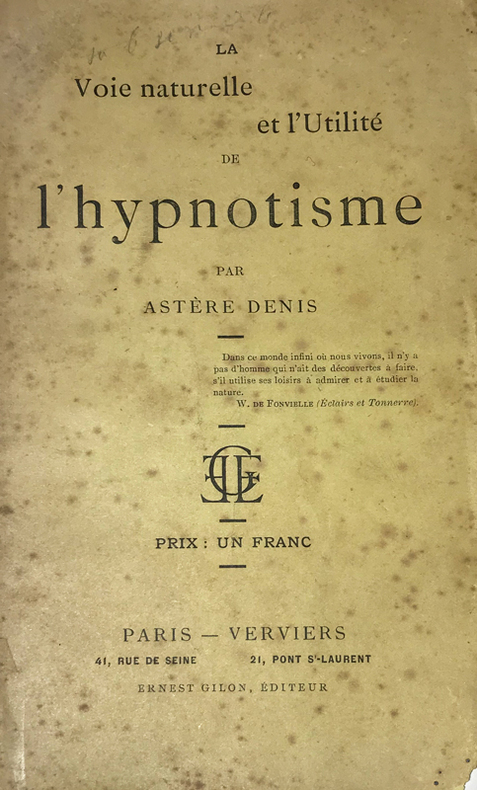
189215348Paris-Verviers (Belgique), Ernest Gilon éditeur-imprimeur, sans date (circa 1892-1893) ; in-16, broché ; 112 pp., (8) pp. de catalogue, couverture jaune paille.
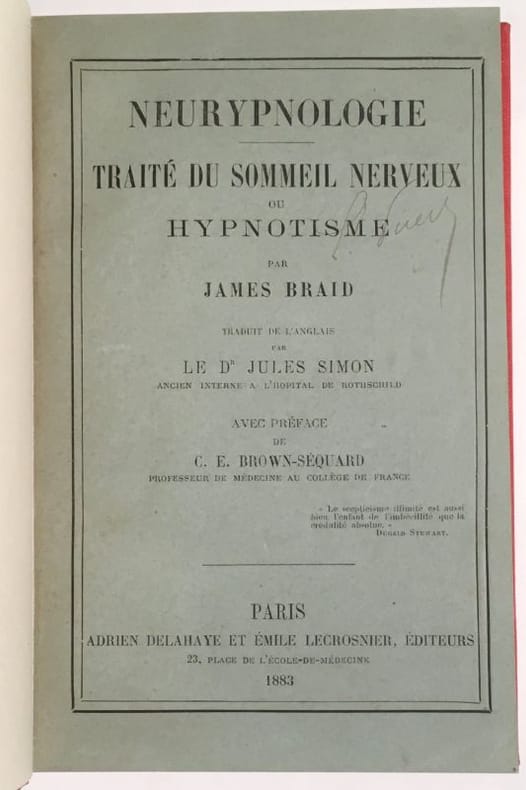
18832971883 Paris, Delahaye et Lecrosnier, 1883 ; in-12 de xv-272 pp., [1] f., bradel toile rouge moderne.
1843M14219London:: John Churchill; Edinburgh: Adam & Charles Black 1843. 1843. 12mo. iii-xxii 265 1 pp. Note: mispaginations: iv for vi 233 for 238. Errata; lacks half-title. Modern full calf leather spine label. Penciled notes covering errata faint. Fine. First edition. 'Braid introduced the term 'hypnosis' in his book Neurypnology 1843. He was mainly interested in the therapeutic possibilities of hypnosis and reported successful treatment of diseased states such as paralysis rheumatism and aphasia. He hoped that hypnosis could be used to cure various seemingly incurable 'nervous' diseases and also to alleviate the pain and anxiety of patients in surgery. / Braid's findings met with violent opposition at first but they soon provided a major impetus to the development of the French school of neuropsychiatry.' - Encyclopaedia Britannica. / 'The first full-length scientific treatise on what is now known as hypnotism. When he published Neurypnology Braid did not yet have a full understanding of the psychological processes involved in hypnosis believing that hypnotic phenomena were produced by functional changes in the nervous muscular circulatory and respiratory systems. However he did recognize as the Abbe Faria and Bertrand had before him that hypnosis was a subjective phenomenon dependent entirely on the state of mind of the hypnotized and not on any mystical fluid or occult magical power wielded by the hypnotizer. As Braid continued to investigate hypnotic phenomena his ideas of what caused them underwent several radical changes which are demonstrated in his later works. Braid's methods of hypnosis were published in France circa 1860 where they exerted an important influence on the work of Broca Charcot Liebeault and Bernheim whose teachings in turn influenced the work of Sigmund Freud.' - Haskell F. Norman 324. / James Braid born in Scotland was a Manchester physician who showed innovative treatments of clubfeet curvature of the spine bandy legs and strabismus. He is sometimes called the 'Father of modern hypnotism' Kroger Clinical and Experimental Hypnosis in Medicine 2008 p.3 though hypnotism is much older than with his introducing the field to western thought. PROVENANCE: J. Wayne Cooper M.D. no markings. REFERENCES: Bramwell pp. 21-27; Crabtree Animal Magnetism Early Hypnotism and Psychical Research 1766-1925 465; Fulton & Stanton The Centennial of Surgical Anesthesia I.17; Garrison and Morton 4993; Hunter & Macalpine Three Hundred Years of Psychiatry pp. 906-10. John Churchill; Edinburgh: Adam & Charles Black, 1843. hardcover
184313447FIRST SCIENTIFIC WORK ON HYPNOTISM <br />first edition 8vo. xxii 265pp. original blind stamped blue-grey cloth 1.5 cm. split at head of front joint and spine shade faded. Nice copy of this classic. <br /><br />GARRISON & MORTON 4993 OSLER 1384<br />"Braid inaugurated modern hypnotism the word itself being introduced by him" Garrison & Morton.Braid a Manchester doctor was stimulated by his attendance at a local seance to investigate carefully the phenomena he had observed. His careful sceptical and physiologically oriented experiments led him to the "apparently new laws of nervous sleep . soon to be accepted throughout the world as Hypnotism and Hypnosis the names he proposed in this book" Hunter & Macalpine <i>Three Hundred Years of Psychiatry</i>. John Churchill hardcover
1843030273London: John Churchill 1843 8vo. original blindstamped green cloth gilt neat cloth repairs hinges reinfored with binders cloth a little rubbed & bumped some marks & tears to leaves prev. owner's name to title page occ. pencil underlining and marginalia; pp. ii half-title last blank xxii 266 last 'Errata et Addenda'. A very good copy of a rare book especially signed. Inscribed on FFE to prev. owner by the author 'To Captn. Brown with the author's respects kind regards 7th July 1843'. James Braid 19 June 1795 - 25 March 1860 was an important figure in nineteenth century medicine and considered a significant pioneer in hypnotism and hypnotherapy. . Signed by Author. First Edition. Hard Cover. VG-. John Churchill hardcover
1843152778London: John Churchill London; Adam & Charles Black Edinburgh 1843. From the occult to the scientific First edition of the book that established hypnotism. Expanding on Franz Mesmer's theories of animal magnetism Braid argued that mesmeric trances were not caused by channelling an occult fluid but were a psycho-physiological state caused by manipulating the nervous system. The medical practices developed as a result of Braid's work constitute a major development in the history of psychology and psychotherapy. Braid's 1795-1860 interest in mesmerism stemmed from his attendance at a demonstration by French mesmerist Charles Lafontaine 1803-1892 in November 1841. The mesmerist movement had been established by the publication of Mesmer's 1734-1815 book Mémoire sur la découverte du magnétisme animal 1779 which detailed the discovery of a "universal fluid" that responded to magnetic forces and could be manipulated within patients to cure illness. The fluid could be transmitted inside people animals and objects first through magnets and later through sheer will. The theory although pervasive was controversial; Mesmer's detractors condemned him as a theatrical showman and many viewed mesmerism as a type of dangerous mind control that had contributed to the political crises of the late 18th century including the French Revolution. Braid was amazed by Lafontaine's demonstration but was sceptical of its causes. He did not share the view that it was merely an elaborate hoax nor did he believe an occult magnetic fluid truly caused it. To get to the truth of the matter Braid began experimenting with putting himself into a mesmeric trance by visually fixating on small bright dots of light. Just a week after attending Lafontaine's demonstration Braid delivered a lecture refuting animal magnetism and demonstrating his own techniques. Braid argued that the fact he was able to achieve similar effects on himself proved that there was no need for an operator to channel the fluid within him and that therefore the mesmeric effects were solely caused by manipulating the psycho-physiological state of the subject. He coined the term "neurypnology" from the Greek for "nervous" and "sleep" but was keen to stress that although "sleep" was the closest analogy to a state of hypnosis the prefix "nervous" distinguished it from natural sleep. He proposed various abbreviated forms of the term including the one that is most common today: hypnotism. Details of Braid's experiments were delivered at five public lectures which were reported in detail in the Manchester Guardian and the Manchester Courier. He then published a pamphlet "Satanic Agency and Mesmerism Reviewed" 1842 outlining a brief statement of his discoveries. The present work is Braid's only full-length definitive exposition of hypnotism. At the time of writing it Braid "did not yet have a full understanding of the psychological processes involved in hypnosis believing that hypnotic phenomena were produced by functional changes in the nervous muscular circulatory and respiratory systems. However he did recognize that hypnosis was a subjective phenomenon dependent entirely on the state of mind of the hypnotized and not on any mystical fluid or occult magical power wielded by the hypnotizer" Norman. Neurypnology was key to the transformation of animal magnetism into a psychological practice; although Braid did not believe that hypnotism could provide a "universal cure" for ailments as Mesmer had he promoted its use as a therapeutic tool in conjunction with medical treatments. "Braid's methods of hypnosis were published in France circa 1860 where they exerted an important influence on the work of Broca Charcot Liébeault and Bernheim whose teachings in turn influenced the work of Sigmund Freud" ibid. Provenance: blindstamp of occult collector Dr Michael H. Coleman 1928-2011 on the front free endpaper. A chemist by training Coleman applied scientific methodology to his psychical experiments and compiled an extensive library of books on the supernatural spiritualism and magic. Small octavo. Original brown cloth spine lettered in gilt covers panelled with centrepieces in blind yellow coated endpapers. Ink bookseller's marking and ownership initials to front pastedown. Spine sunned ends a little worn a couple of marks to cloth soiling to endpapers cords occasionally visible but holding: a very good copy. Bibliotheca Osleriana 1384; Garrison & Morton 4993; Hunter & MacAlpine Three Hundred Years of Psychiatry pp. 906-10; Norman 324. hardcover
1842317078Manchester 1842. Ink on paper 22 lines. 1 vols. 8vo. Old folds. Ink on paper 22 lines. 1 vols. 8vo. "My Dear Sir / I called yesterday but you were out. I wished to invite you to a conversazione at my house this evening at 7 oC where besides exhibiting explaining my modes of inducing the phenomena I expect a number of patients to be present who have been cured or relieved by the Neuro Hypnotic operations. I wish to afford those present an opportunity of judging for themselves as to the real facts of the cases free from all partiality or bias on my part as the offering of this new agency. / . to be / very respectfully / yours / Jas Braid"<br/><br/>The present letter dates from a period of active discovery and public debate about the topic of Hypnotism a term coined by James Braid 1795-1860 "the founder of modern hypnotism" a couple of months earlier. It is here rendered as three distinct words "Neuro Hypnotic operation." <br/><br/>During magnetist Charles Lafontaine's English tour of 1841 Braid was allowed as a medical man to examine the magnetised subjects and he witnessed that the phenomena was not being faked determined to study the nature of the effects and their causes. Braid immediately began auto-experimentation at home that refuted the idea of an operator's 'magnetic influence' but confirmed that the process did indeed generate a 'particular physiological state.' Braid began a series of five public lectures to exhibit his findings just one week after Lafontaine's last demonstration. He was attacked as a necromancer and satanic agent in April 1842 in a well-attended and well-publicized sermon by the controversial cleric Hugh M'Neile. Braid wrote a personal response letter to M'Neile inviting him to an upcoming lecture but was met with silence. Braid's defense "a work of the greatest significance in the history of hypnotism" was a pamphlet entitled Satantic Agency and Mesmerism Reviewed in a Letter to the Rev. H. Mc. Neile.of Liverpool. of which only two copies are known published in June 1842. Braid first uses his new more scientific terms 'neurohypnotism' 'hypnotic sleep' and 'hypnotise' in the pamphlet. In 1843 Braid published his only full-length book Neurypnology; or the Rationale of Nervous Sleep Considered in Relation with Animal Magnetism. His writings were published in France after his death where they became an important influence on the work of Azam Broca Richet Charcot Liébeault and Bernheim as well as Freud whose "earlier works clearly reflect the magnetic-hypnotic tradition." For Braid see Crabtree 450 465 and Norman sale lots 951-953 unknown books