131 résultats
190812220Philadelphia: George W. Jacobs & Co. Very Good with no dust jacket. 1908. First Edition. Hardcover. Inner hinges are just starting to crack although the book still feels very tight. The paint has flaked off the white title on the spine. Slight mottling along the bottom edge silverfish . Owner's name on the title page dated 1908. The contents are very fine. ; 8vo 8" - 9" tall; 322 pages . George W. Jacobs & Co. hardcover
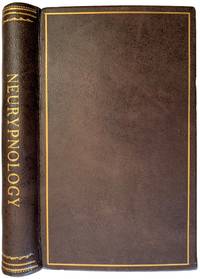
1994172855Alabama: Gryphon Editions 1994. First Edition; First Printing. Hardcover. AS NEW in shrinkwrap. Leather bound Accented in 22kt gold. Printed on archival paper with gilded edges. The endsheets are of moire fabric with a silk ribbon page marker. Smyth sewing and concealed muslin joints. This book is in full leather with hubbed spines. A Limited Edition. ; The Classics of Psychiatry & Behavioral Sciences Library.; First Gryphon Edition. Gryphon Editions hardcover

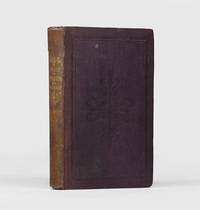
1843M14219London:: John Churchill; Edinburgh: Adam & Charles Black 1843. 1843. 12mo. iii-xxii 265 1 pp. Note: mispaginations: iv for vi 233 for 238. Errata; lacks half-title. Modern full calf leather spine label. Penciled notes covering errata faint. Fine. First edition. 'Braid introduced the term 'hypnosis' in his book Neurypnology 1843. He was mainly interested in the therapeutic possibilities of hypnosis and reported successful treatment of diseased states such as paralysis rheumatism and aphasia. He hoped that hypnosis could be used to cure various seemingly incurable 'nervous' diseases and also to alleviate the pain and anxiety of patients in surgery. / Braid's findings met with violent opposition at first but they soon provided a major impetus to the development of the French school of neuropsychiatry.' - Encyclopaedia Britannica. / 'The first full-length scientific treatise on what is now known as hypnotism. When he published Neurypnology Braid did not yet have a full understanding of the psychological processes involved in hypnosis believing that hypnotic phenomena were produced by functional changes in the nervous muscular circulatory and respiratory systems. However he did recognize as the Abbe Faria and Bertrand had before him that hypnosis was a subjective phenomenon dependent entirely on the state of mind of the hypnotized and not on any mystical fluid or occult magical power wielded by the hypnotizer. As Braid continued to investigate hypnotic phenomena his ideas of what caused them underwent several radical changes which are demonstrated in his later works. Braid's methods of hypnosis were published in France circa 1860 where they exerted an important influence on the work of Broca Charcot Liebeault and Bernheim whose teachings in turn influenced the work of Sigmund Freud.' - Haskell F. Norman 324. / James Braid born in Scotland was a Manchester physician who showed innovative treatments of clubfeet curvature of the spine bandy legs and strabismus. He is sometimes called the 'Father of modern hypnotism' Kroger Clinical and Experimental Hypnosis in Medicine 2008 p.3 though hypnotism is much older than with his introducing the field to western thought. PROVENANCE: J. Wayne Cooper M.D. no markings. REFERENCES: Bramwell pp. 21-27; Crabtree Animal Magnetism Early Hypnotism and Psychical Research 1766-1925 465; Fulton & Stanton The Centennial of Surgical Anesthesia I.17; Garrison and Morton 4993; Hunter & Macalpine Three Hundred Years of Psychiatry pp. 906-10. John Churchill; Edinburgh: Adam & Charles Black, 1843. hardcover
184313447FIRST SCIENTIFIC WORK ON HYPNOTISM <br />first edition 8vo. xxii 265pp. original blind stamped blue-grey cloth 1.5 cm. split at head of front joint and spine shade faded. Nice copy of this classic. <br /><br />GARRISON & MORTON 4993 OSLER 1384<br />"Braid inaugurated modern hypnotism the word itself being introduced by him" Garrison & Morton.Braid a Manchester doctor was stimulated by his attendance at a local seance to investigate carefully the phenomena he had observed. His careful sceptical and physiologically oriented experiments led him to the "apparently new laws of nervous sleep . soon to be accepted throughout the world as Hypnotism and Hypnosis the names he proposed in this book" Hunter & Macalpine <i>Three Hundred Years of Psychiatry</i>. John Churchill hardcover
1843030273London: John Churchill 1843 8vo. original blindstamped green cloth gilt neat cloth repairs hinges reinfored with binders cloth a little rubbed & bumped some marks & tears to leaves prev. owner's name to title page occ. pencil underlining and marginalia; pp. ii half-title last blank xxii 266 last 'Errata et Addenda'. A very good copy of a rare book especially signed. Inscribed on FFE to prev. owner by the author 'To Captn. Brown with the author's respects kind regards 7th July 1843'. James Braid 19 June 1795 - 25 March 1860 was an important figure in nineteenth century medicine and considered a significant pioneer in hypnotism and hypnotherapy. . Signed by Author. First Edition. Hard Cover. VG-. John Churchill hardcover
1843152778London: John Churchill London; Adam & Charles Black Edinburgh 1843. From the occult to the scientific First edition of the book that established hypnotism. Expanding on Franz Mesmer's theories of animal magnetism Braid argued that mesmeric trances were not caused by channelling an occult fluid but were a psycho-physiological state caused by manipulating the nervous system. The medical practices developed as a result of Braid's work constitute a major development in the history of psychology and psychotherapy. Braid's 1795-1860 interest in mesmerism stemmed from his attendance at a demonstration by French mesmerist Charles Lafontaine 1803-1892 in November 1841. The mesmerist movement had been established by the publication of Mesmer's 1734-1815 book Mémoire sur la découverte du magnétisme animal 1779 which detailed the discovery of a "universal fluid" that responded to magnetic forces and could be manipulated within patients to cure illness. The fluid could be transmitted inside people animals and objects first through magnets and later through sheer will. The theory although pervasive was controversial; Mesmer's detractors condemned him as a theatrical showman and many viewed mesmerism as a type of dangerous mind control that had contributed to the political crises of the late 18th century including the French Revolution. Braid was amazed by Lafontaine's demonstration but was sceptical of its causes. He did not share the view that it was merely an elaborate hoax nor did he believe an occult magnetic fluid truly caused it. To get to the truth of the matter Braid began experimenting with putting himself into a mesmeric trance by visually fixating on small bright dots of light. Just a week after attending Lafontaine's demonstration Braid delivered a lecture refuting animal magnetism and demonstrating his own techniques. Braid argued that the fact he was able to achieve similar effects on himself proved that there was no need for an operator to channel the fluid within him and that therefore the mesmeric effects were solely caused by manipulating the psycho-physiological state of the subject. He coined the term "neurypnology" from the Greek for "nervous" and "sleep" but was keen to stress that although "sleep" was the closest analogy to a state of hypnosis the prefix "nervous" distinguished it from natural sleep. He proposed various abbreviated forms of the term including the one that is most common today: hypnotism. Details of Braid's experiments were delivered at five public lectures which were reported in detail in the Manchester Guardian and the Manchester Courier. He then published a pamphlet "Satanic Agency and Mesmerism Reviewed" 1842 outlining a brief statement of his discoveries. The present work is Braid's only full-length definitive exposition of hypnotism. At the time of writing it Braid "did not yet have a full understanding of the psychological processes involved in hypnosis believing that hypnotic phenomena were produced by functional changes in the nervous muscular circulatory and respiratory systems. However he did recognize that hypnosis was a subjective phenomenon dependent entirely on the state of mind of the hypnotized and not on any mystical fluid or occult magical power wielded by the hypnotizer" Norman. Neurypnology was key to the transformation of animal magnetism into a psychological practice; although Braid did not believe that hypnotism could provide a "universal cure" for ailments as Mesmer had he promoted its use as a therapeutic tool in conjunction with medical treatments. "Braid's methods of hypnosis were published in France circa 1860 where they exerted an important influence on the work of Broca Charcot Liébeault and Bernheim whose teachings in turn influenced the work of Sigmund Freud" ibid. Provenance: blindstamp of occult collector Dr Michael H. Coleman 1928-2011 on the front free endpaper. A chemist by training Coleman applied scientific methodology to his psychical experiments and compiled an extensive library of books on the supernatural spiritualism and magic. Small octavo. Original brown cloth spine lettered in gilt covers panelled with centrepieces in blind yellow coated endpapers. Ink bookseller's marking and ownership initials to front pastedown. Spine sunned ends a little worn a couple of marks to cloth soiling to endpapers cords occasionally visible but holding: a very good copy. Bibliotheca Osleriana 1384; Garrison & Morton 4993; Hunter & MacAlpine Three Hundred Years of Psychiatry pp. 906-10; Norman 324. hardcover