67 résultats
19981312006PN. New. 1998. Soft Cover. Date is original print. This is a reprint edition . PN paperback
198012282Les Presses de l'Université de Montréal In-8 à l'italienne Couverture souple Montréal 1980
199766953Los Angeles: The Getty Conservation Institute and the J. Paul Getty Museum 1997. First Edition. Trade paperback. Fine. This book recounts the story of Simon Rodia and his creation as well as the considerable history of the Watts area itself. Other chapters discuss Rodia's building techniques and materials as well as the conservation efforts underway at the site. Signed by the authors on the title page. Quarto. Original pictorial paper wrappers. A fine copy. The Getty Conservation Institute and the J. Paul Getty Museum unknown books

1997Q-0892364912Getty Conservation Institute 1997-12-04. paperback. New. In shrink wrap. Looks like an interesting title! Getty Conservation Institute paperback
19833iiiFc0024Brooklyn NY: Multi-Type 1983. Book. Like New. Trade Paperback. Previously Owned by Author!. 8vo or 8° Medium Octavo: 7¾" x 9¾" tall. 271 pp. Flawless copy save for some minimal shelf wear and crease on front cover. Previously owned by author with relevant address label on full title page. Ex - Libris book Council on Foreign Relations with a couple of small library stamps and one CFR library label. Multi-Type Paperback
199210155Lyon Paquin 1992. Good. Neat slim softcover in black covers with large cover crease. Glossy and tidy with bright pages in French/en Francais. Included are letters notes memos and historical documents. Lyon Paquin paperback books
198725344Ville de Montréal Couverture souple Montréal 1987
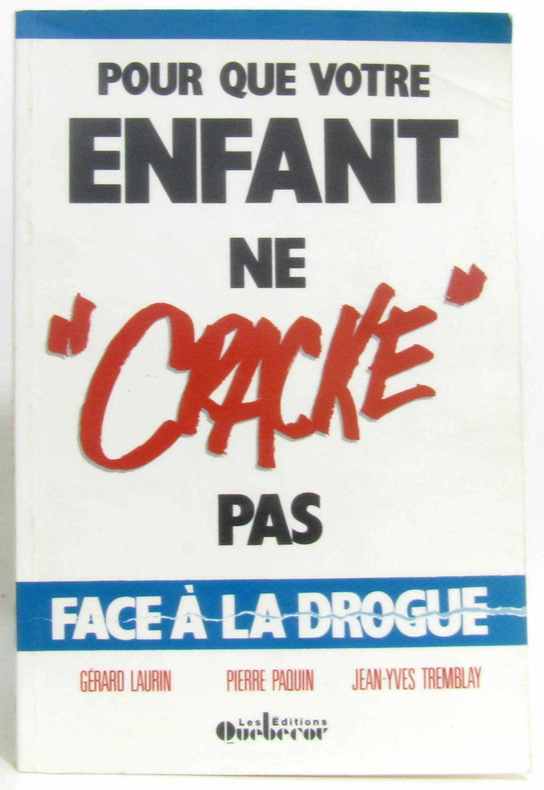
1990236556Québecor 1990 201 pages in8. 1990. Broché. 201 pages. Un guide pratique qui explique tout du phénomène: consommateurs drogues et leurs effets trafic suggestions aux parents aide aux toxicomanes
1979RO20027334Editions de la Différence. 1979. In-8. Relié. Bon état, Couv. convenable, Dos satisfaisant, Intérieur frais. 119 pages. Couverture en plié. Reliure éditeur. Jacquette Abimée.. . . . Classification Dewey : 152.4-L'amour
1979RO70077885HACHETTE. 1979. In-12. Relié. Bon état, Couv. convenable, Dos satisfaisant, Intérieur frais. 119 pages.. . . . Classification Dewey : 840-Littératures des langues romanes. Littérature française
199220272Pointe-Claire Roussan éd., "Panorama" 1992
191220676Partitions sur le Métier Fortin 1912
197415160Birmingham AL: Thom Henricks Associates 1974. First edition. Paperback. Near Fine. 10mo. A 20 pp poetry chapbook. With long INSCRIPTION by the author on the inside front cover. Plus two hand-corrections to the text. A clean very good example in small printed stapled wrappers. <br/><br/> Thom Henricks Associates paperback books
191070784Paris, Editions A. de Villers, c1910, in-12, 12x20cm, plaquette agrafée, 15 gravures en une couleurs avec tarifs. Couverture recto-verso en couleurs enluminée avec passage à l'or par G. Bordas, imagier. Couverture présentant une insolation et des rousseurs. Intérieur frais.
197512283Les Presses de l'Université de Montréal In-8 à l'italienne Couverture souple Montréal 1975
1992G0824787544I4N00CRC Press LLC 1992. Hardcover. Very Good. Disclaimer:May have limited writing in cover pages. Pages are unmarked. ~ ThriftBooks: Read More Spend Less.Dust jacket quality is not guaranteed. CRC Press LLC hardcover
1948ABE-9405718402EN COUVERTURE: "CECILE AUBRY UNE ETOILE FUTURE-SI CE FRANCAIS ETAIT ETRANGER, VOUS SAURIEZ SON NOM/BARTHELEMY/1P PAR JEAN PALAISEUL/TELEVISION/4 PHOTOS-LA VERITE SUR LE SERUM/C'EST UN PROCEDE DE GUERISON NON UNE METHODE POLICIERE/1P/2 PHOTOS-AU PAYS DE LA VERTU LE STRIP TEASE ENVAHIT LE MUSIC HALL!/1P PAR ALAIN JANVIER/4 PHOTOS-BATIE SUR LA GLACE SA FORTUNE N'A PAS FONDU/SONJA HENIE/1P PAR JEANINE DENEE/5 PHOTOS-JULIETTE VERNEUIL FAIT DES ROBES QUE LES MARIS PEUVENT ACHETER/1P/5 PHOTOS-MODE: LES FANTOMES DU PALAIS ROYAL/1P PAR ODETTE CORSAINT/4 PHOTOS 2 MODELES PAQUIN 2 MODELES ROBERT PIGUET
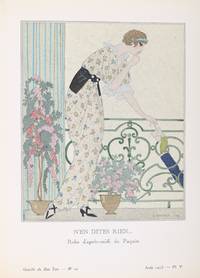
191389428Lucien Vogel éditeur | Paris Août 1913 | 19 x 24.50 cm | une feuille
191389428Paris: Lucien Vogel éditeur 1913. Fine. Lucien Vogel éditeur Paris Août 1913 19 x 24.50 cm une feuille Original colour print printed on laid paper and signed in the plate lower right. Original engraving produced for the illustration of La Gazette du Bon Ton one of the most beautiful and influential fashion journals of the 20th century celebrating the talent of French designers and artists at the height of the Art Deco era. A celebrated fashion magazine established in 1912 by Lucien Vogel La Gazette du bon ton appeared until 1925 with a hiatus from 1915 to 1920 due to the war the editor-in-chief having been called up for service. It consisted of 69 issues printed in only 2000 copies each and notably illustrated with 573 color plates and 148 sketches of the models of the great designers. Right from the start this sumptuous publication “was aimed at bibliophiles and fashionable society” Françoise Tétart-Vittu “La Gazette du bon ton” in Dictionnaire de la mode 2016 and was printed on fine vergé paper using a type cut specially for the magazine by Georges Peignot known as Cochin later used in 1946 by Christian Dior. The prints were made using stencils heightened in colors some highlighted in gold or palladium. The story began in 1912 when Lucien Vogel a man of the world involved in fashion he had already been part of the fashion magazine Femina decided with his wife Cosette de Brunhoff – the sister of Jean creator of Babar – to set up the Gazette du bon ton subtitled at the time: “Art fashion frivolities.”  Georges Charensol noted the reasoning of the editor-in-chief: “’In 1910Â’ he observed ‘there was no really artistic fashion magazine nothing representative of the spirit of the time. My dream was therefore to make a luxury magazine with truly modern artistsÂ…I was assured of success because when it comes to fashion no country on earth can compete with France.’” “Un grand éditeur dÂ’art. Lucien Vogel” in Les Nouvelles littéraires no. 133 May 1925. The magazine was immediately successful not only in France but also in the United States and Latin America. At first Vogel put together a team of seven artists: André-Édouard Marty and Pierre Brissaud followed by Georges Lepape and Dammicourt as well as eventually his friends from school and the School of Fine Arts like George Barbier Bernard Boutet de Monvel and Charles Martin. Other talented people soon came flocking to join the team: Guy Arnoux Léon Bakst Benito Boutet de Monvel Umberto Brunelleschi Chas Laborde Jean-Gabriel Domergue Raoul Dufy Édouard Halouze Alexandre Iacovleff Jean Émile Laboureur Charles Loupot Chalres Martin Maggie Salcedo. These artist mostly unknown when Lucien Vogel sought them out later became emblematic and sought-after artistic figures. It was also they who worked on the advertising drawings for the Gazette. The plates put the spotlight on and celebrate dresses by seven designers of the age: Lanvin Doeuillet Paquin Poiret Worth Vionnet and Doucet. The designers provided exclusive models for each issue. Nonetheless some of the illustrations are not based on real models but simply on the illustratorÂ’s conception of the fashion of the day.   The Gazette du bon ton was an important step in the history of fashion. Combining aesthetic demands with the physical whole it brought together – for the first time – the great talents of the artistic literary and fashion worlds; and imposed through this alchemy a completely new image of women: slender independent and daring which was shared by the new generation of designers including Coco Chanel Jean Patou Marcel Rochas and so onÂ… Taken over in 1920 by Condé Montrose Nast the Gazette du bon ton was an important influence on the new layout and aesthetics of that “little dying paper” that Nast had bought a few years earlier: Vogue. Lucien Vogel éditeur unknown
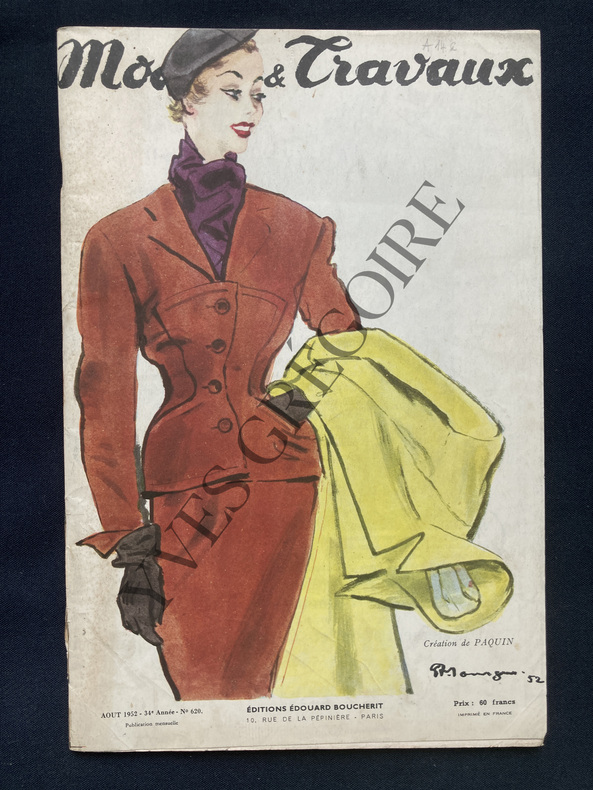
1952ABE-316290589680 PAGES-EN COUVERTURE CREATION DE PAQUIN/DESSIN COULEURS DE MOURGUE-MODE-FRANCOISE POUPEE DE MODES ET TRAVAUX-PUBLICITES
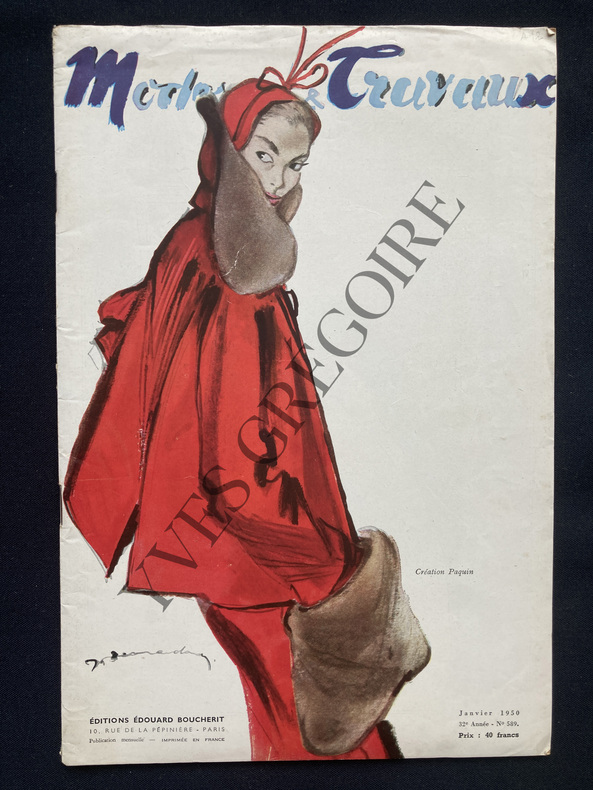
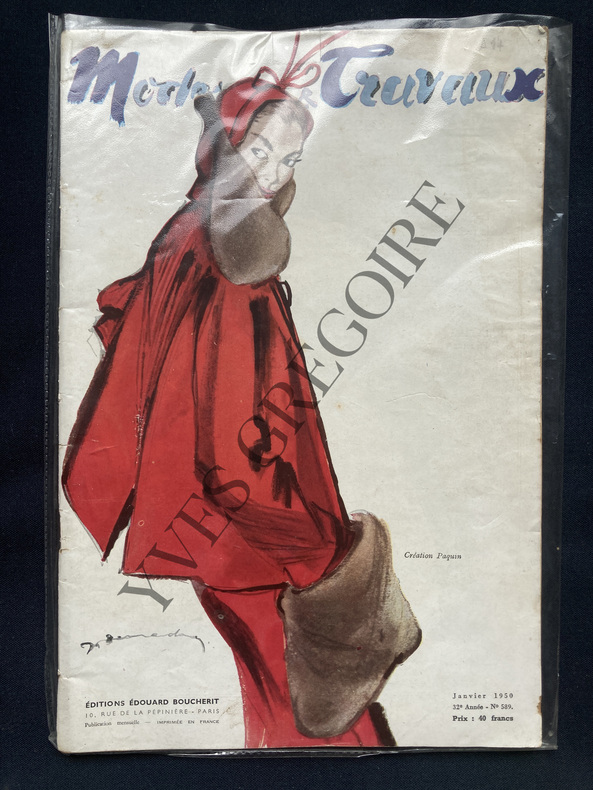
1950ABE-160218240641152 PAGES-19,8 CM X 29,2 CM-EN COUVERTURE: MODELE PAQUIN, ILLUSTRATION COULEURS DE JACQUES DEMACHY-PATRON
1950ABE-151102365821852 PAGES-EN COUVERTURE ILLUSTRATION COULEURS DE DEMACHY POUR CREATION PAQUIN-1 DECOUPE P13/14-ROBES DE MARIEE LANVIN ET JACQUES FATH-L'INDISPENSABLE PETITE ROBE-CORTEGES-VIVE LA MARIEE MASQUES ET TRAVESTIS, DESSINS SUR 2P
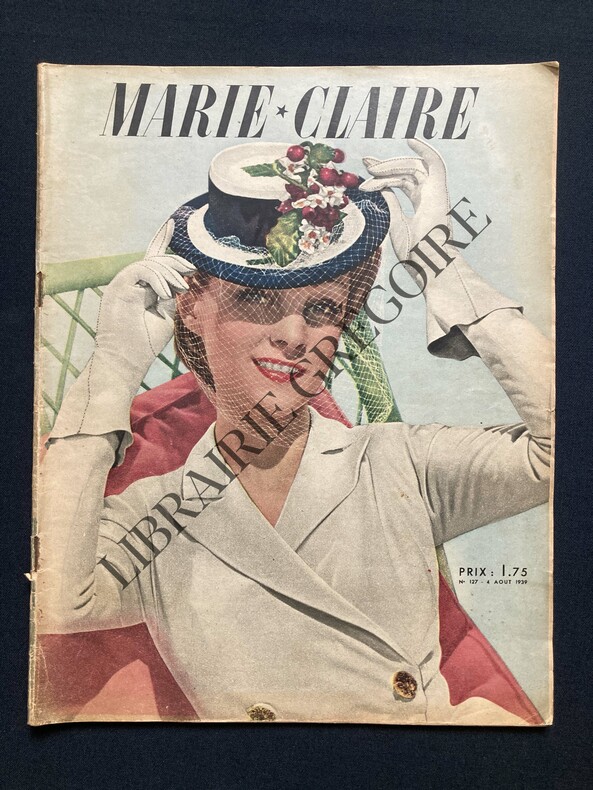
1939ABE-173793898074256 PAGES-COUVERTURE: ROBE DE MAGGY ROUFF CHAPEAU DE SUZY GANTS ARIS, PHOTO SAAD-ILS SERONT CELEBRES DEMAIN, ANDRE MATHIEU, TATIANA STEPANOVA, 2 PAGES, 8 PHOTOS-L'ABC DES SEMELLES, 2 PAGES-DERNIERES NOUVELLES DE LA MODE EN AOUT ON PORTERA DES COULEURS, 2 PAGES, HEIM, PAQUIN, BALENCIAGA-CINQ NOUVELLES MANIERES DE NOUER LES MADRAS, 3 PAGES-VOTRE ALTESSE SERA PUNIE., PRINCE EDWARD, 1P, 11 PHOTOS-UN JEU POUR VOS VACANCES: POURQUOI AVEZ-VOUS PARLE D'EUX?, 2 PAGES-EN 4 DE COUVERTURE: PUBLICITE BADOIT
197433400Sans lieu Jean-Pierre Paquin, éditeur 1974 In-16, 119p. Couverture illustrée.
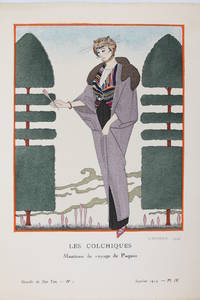
191484687Paris: Lucien Vogel éditeur 1914. Fine. Lucien Vogel éditeur Paris Janvier 1914 19 x 24.50 cm une feuille Original color print heightened with gold printed on laid paper signed at bottom right of the plate. Original engraving created for the illustration of La Gazette du bon ton one of the most beautiful and influential fashion magazines of the 20th century celebrating the talent of French creators and artists in the full bloom of Art Deco. Famous fashion magazine founded in 1912 by Lucien Vogel La Gazette du bon ton was published until 1925 with an interruption during the War from 1915 to 1920 due to the mobilization of its editor-in-chief. It consists of 69 issues printed in only 2000 copies and is illustrated notably with 573 color plates and 148 sketches representing models by great couturiers. From their publication these luxurious publications ""addressed bibliophiles and worldly aesthetes"" Françoise Tétart-Vittu ""La Gazette du bon ton"" in Dictionnaire de la mode 2016. Printed on fine laid paper they use a typeface specially created for the magazine by Georges Peignot the Cochin character adopted in 1946 by Christian Dior. The prints are created using the metal stencil technique heightened in colors and for some highlighted with gold or palladium. The adventure begins in 1912 when Lucien Vogel man of the world and fashion - he had already participated in the magazine Femina - decides to found with his wife Cosette de Brunhoff sister of Jean father of Babar the Gazette du bon ton whose subtitle was then ""Art modes et frivolités"". Georges Charensol reports the words of the editor-in-chief: ""In 1910 he observes there existed no fashion journal truly artistic and representative of the spirit of its time. I therefore thought of making a luxury magazine with truly modern artists . I was certain of success because for fashion no country can rival France."" ""Un grand éditeur d'art. Lucien Vogel"" in Les Nouvelles littéraires n°133 May 1925. The magazine's success is immediate not only in France but also in the United States and South America. Originally Vogel thus brings together a group of seven artists: André-Édouard Marty and Pierre Brissaud followed by Georges Lepape and Dammicourt; and finally his friends from the École des beaux-arts who are George Barbier Bernard Boutet de Monvel or Charles Martin. Other talents quickly come to join the team: Guy Arnoux Léon Bakst Benito Boutet de Monvel Umberto Brunelleschi Chas Laborde Jean-Gabriel Domergue Raoul Dufy Édouard Halouze Alexandre Iacovleff Jean Émile Laboureur Charles Loupot Charles Martin Maggie Salcedo. These artists mostly unknown when Lucien Vogel calls upon them will subsequently become emblematic and sought-after artistic figures. These same illustrators create the drawings for the Gazette's advertisements. The plates highlight and sublimate the dresses of seven creators of the era: Lanvin Doeuillet Paquin Poiret Worth Vionnet and Doucet. The couturiers provide exclusive models for each issue. Nevertheless some of the illustrations feature no real model but only the idea that the illustrator has of the fashion of the day. La Gazette du bon ton is a decisive step in fashion history. Combining aesthetic demands and plastic unity it brings together for the first time the great talents of the world of arts letters and fashion and imposes through this alchemy a completely new image of woman slender independent and audacious also carried by the new generation of couturiers Coco Chanel Jean Patou Marcel Rochas. Taken over in 1920 by Condé Montrose Nast La Gazette du bon ton will largely inspire the new composition and aesthetic choices of the ""small dying journal"" that Nast had bought a few years earlier: Vogue magazine. Lucien Vogel éditeur unknown