2 594 résultats
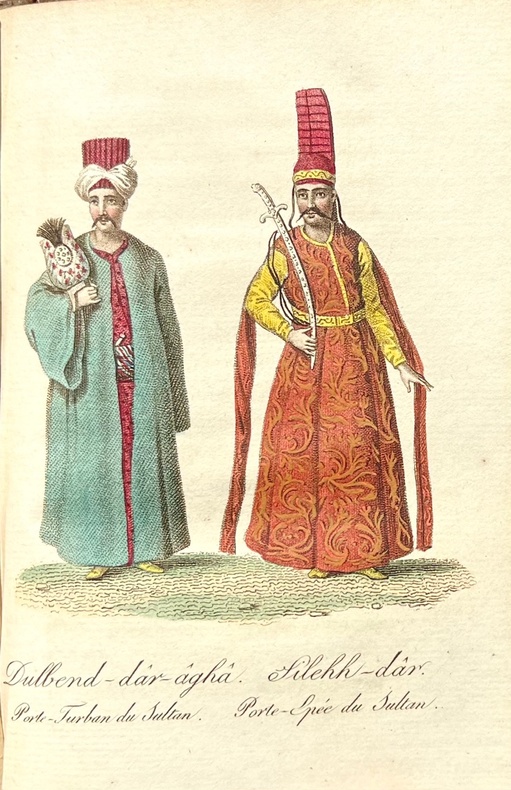
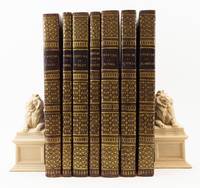
1800ST17757London: William Miller; T. M'Lean; William Bulmer 1800-18. 370 x 270 mm. 14 1/2 x 10 1/2". Seven volumes. <br/> Uniformly bound in stately contemporary dark burgundy straight-grain morocco covers with gilt palmette-and-wheat-sheaf border inner frame of blind-stamped grapevine raised bands spine compartments densely gilt with repeating botanical tools gilt lettering gilt-rolled turn-ins all edges gilt. Two engraved titles with hand-colored vignettes not included in plate count and 356 FULL-PAGE HAND-COLORED PLATES FEATURING COSTUMES OCCUPATIONS AND SOCIAL INTERACTION OF VARIOUS NATIONS. Volume I-III V and VI with text in French as well as English. Front pastedown with armorial bookplate of Edward Gordon Douglas-Pennant 1st Baron Penrhyn. Abbey Life 430; Abbey Travel 71 244 370 373 532 533. Joints and extremities lightly rubbed one board with a couple of faint scratches two rear boards with neat older repairs to short tears at tail edge but the bindings quite sound and most attractive on the shelf. Flyleaves a little foxed minor offsetting from plates to text leaves occasionally more pronounced but never offensive isolated minor marginal foxing to plates otherwise very fine WITH CLEAN BRIGHT PLATES.<br/> <br/> This is a collection of major early 19th century color plate books with well-drawn and richly-colored engravings in bindings that make a handsome appearance on the shelf. All of these works have appealing plates where the costumes of the various social strata are carefully and colorfully delineated. And two of the volumes--those showing British costumes and the book on Chinese punishments--contain in addition a good deal of diverting background detail that serves as a revealing context for each of the costumes depicted. The content of each of the volumes is worth noting. With a few exceptions the plates in the "Costumes of China" portray ordinary working-class men and women toiling at their trades. We see a bookseller with his wares spread out on a mat women sewing and embroidering a butcher a fisher a barber a man with a "magic lantern" show and a "man striking a small gong during an eclipse" an ancient ritual that the author tells us he was privileged to witness on 17 November 1789. The "Punishments of China" volume is filled with almost gleefully painful depictions of all degrees of disciplinary action from the relatively minor twisting of the ears or chaining to an iron pole to the humiliating ordeal of the wooden collar to methods of execution by beheading or by crucifixion using a cord. The opulent and brightly colored costumes in Dalvimart's volume on Turkey are mostly those of the ruling classes although also represented is a wide variety of native dress from the many regions of the vast Turkish empire of the day which included Bosnia Albania Syria Egypt and parts of Greece. It is particularly interesting to contrast the clothing of the very heavily veiled Turkish and Egyptian women with the much more relaxed style of the Greek women and the nearly immodest garb of the female Bedouin. We also are shown a eunuch an odalisque from the harem a grand vizier various royal functionaries and government officials all splendidly attired. The Russian costumes based on engravings done by C. W. Müller at the request of Empress Catherine the Great are focused on the ethnic dress of the empire's many holdings. The Laplanders and Finns wear clothing that would look familiar to most Europeans but the Mongols in their Oriental dress would be quite exotic. The clothing of the northern tribes such as the Kamchatkans Aleutians Koriaks and Tungoosi will impress the modern reader with their similarity to the traditional dress of Native American and First Nation peoples. The Tchutski woman is even depicted naked to display her tattoos. Bertrand de Moleville's Austrian costumes also illustrate the native dress of the empire's citizens but the illustrations here are less fashion plates than romanticized scenes: peasant couples are shown courting and dancing; Croatian women gossip beside a stream; and a wild-haired Bohemian gypsy whose "profession is not hard to guess" from her state of "déshabillé" flees with her naked and no doubt illegitimate child. Pyne's "Costumes of Great Britain" is one of the most highly praised works in this set and for good reason: the simple working men and women of Britain it depicts are always shown going about their daily tasks in the midst of a well-realized scene. The woman selling "salop" a hot morning beverage is seated at her cart with its urn judiciously located by the watchman's stall surrounded by customers including soldiers and a woman with her market basket. A fireman with an ax and a torch hurries toward his engine company while they unwrap their hose. The potter is at his wheel the tanner is cleaning skins and the bill-sticker posts the winning lottery numbers. The clothing while carefully detailed is almost secondary to the depictions of everyday life. The "Military Costumes of Turkey" illustrates the official regalia "uniform" is much too drab a word for these outfits worn by officers in various regions of the empire. Perhaps the most intriguing plate here is that of the Ladle Bearer a post that was also illustrated in "Costumes of Turkey." What appears to be a man with a giant spoon is in fact the holder of an important military position equivalent to the color-bearer in a western army. We are told that the loss of its ladles is the greatest disgrace that can befall a Turkish regiment: if the two great ladles the size of a grown man that are borne into battle at the head of the troops are captured the regiment must be disbanded and formed anew. Former owner Edward Gordon Douglas-Pennant 1st Baron Penrhyn 1800-86 was a leading figure in the Welsh slate industry; he owned the Penrhyn Quarry the largest slate quarry in the world at the end of the 19th century. He was known for his paternalistic attitude to his employees creating the "model village" of Llandegai to house the quarry workers. It was notable for having "no corrupting alehouse." He was ruthless enough to fire 80 men in 1868 because they did not vote for his son George who was running for a seat in Parliament. Single volumes from this set appear with frequency in the marketplace; full sets show up much less often; sets as handsome and well preserved as the present are rarely seen. William Miller; T. M'Lean; William Bulmer unknown
181710951Paris, [Imprimeries Michaud, Crapelet, Vassal, Essling], 1817-1827. Album de 115 planches reliées en 1 vol. in-folio (40 x 260 cm), veau glacé amarante, frise, écoinçons et plaque à froid sur les plats dans un encadrement de filets et frises dorés, dos orné à nerfs, pièce de titre en maroquin, signet de soie rose, tranches dorées (reliure de l'époque).
10718Neuwied sur le Rhin, Société Typographique, 1789 [1775-1783]. In-plano (468 x 364 mm), 1 f. n. ch., 37 pp., 38 pl. Maroquin rouge, triple filet doré d'encadrement sur les plats, dos à nerfs richement orné, auteurs et titre dorés, double filet doré sur les coupes, dentelle et roulettes dorées sur les chasses, tranches dorées, 16 planches sont réenmargées dont 6 uniquement d'une bande marginale en pied, frottements aux coins et aux coiffes (Canape).
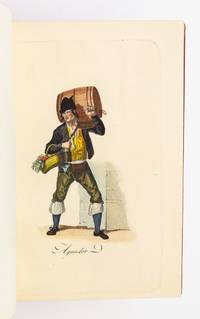
1832ST19313Madrid: Real Calcografía 1832-36. 240 x 160 mm. 9 1/2 x 6 1/4". <br/> ELEGANT MODERN RED MOROCCO VERY HANDSOMELY GILT in the style of the period BY ANTOLIN PALOMINO OLALLA hand-signed on front turn-in with swirling cornerpieces and central lozenge raised bands spine panels gilt gilt turn-ins all edges gilt in slightly worn red marbled paper slipcase. With engraved title page and 112 ENGRAVED PLATES by Juan Carrafa after drawings by Jose Ribelles y Helip and ALL WITH CONTEMPORARY HAND COLORING. Colas 646; Lipperheide 1224. Edges of some leaves with faint stains and thumb soiling of no consequence but the finely colored plates beautifully preserved and THE SPARKLING BINDING IN FLAWLESS CONDITION.<br/> <br/> This is a beautifully bound work filled with exquisitely hand-colored plates depicting early 19th century Spanish costumes. Neither Lipperheide nor Colas identifiy the artist but the San Fernando Royal Academy of Fine Arts in Madrid attributes the images here to the Spanish painter and draughtsman José Ribelles y Helip and identifies the engraver as Juan Carrafa. The plates were originally published by the Royal Academy in 1825 in 14 parts with eight plates per part and the present edition was produced around 1832-36 based on the dates found in the descriptive labels incorporated into two of the plates. The illustrations depict men and women in regional dress from across Spain as well as particular "types" including shepherds fishermen merchants musicians dancers bullfighters smugglers sailors and more. The superb hand coloring enlivens each illustration with vibrant colors and careful attention to shading patterns and accessories. Antolin Palomino Olalla 1909-95 was one of the great Spanish binders of the 20th century. A versatile and meticulous artist teacher and craftsman Palomino Olalla opened his Madrid workshop in 1942 and became especially renowned for his hand-gilding mosaic bindings and marbled paper techniques. He seems to have specialized in binding antiquarian books and attracted important institutional clients as well as discerning bibliophiles such as Bartolomé March Servera. The gilding on the present work is especially elegant and applied with laser precision adding another dimension of pleasure to an already appealing work. The book is uncommonly seen for sale at Anglo-American auctions. Real Calcografía unknown
47659Horizons de France.1942.Ex.106/300.51 pages de texte non coupées.8 planches en noir.1 carte du Maroc.60 planches de costumes dont 20 en couleurs,légendées sur les serpentes.In folio en feuilles sous étui fermé par 4 lacets. Bon exemplaire.Rares rousseurs en marges.Carte et planches parfaites.Coffret restauré en parfait état,avec étiquette d'origine sur le 1er plat.
1820D6906N.p. but Germany possibly Liechtenstein c. 1820. Hardcover. Very Good. 4to 245 x 165mm. A compilation of 73 brightly colored watercolors many with manuscript captions in German some are dated for the costume all clipped and mounted into book and illustrating the costumes and attributions of court officials knights Templar Tartar costume St. George on horseback German orders of nobility also for Spain France Holland Italian Turkish Egypt and Babylon and other various orders as in Order of the Garter in England and France and religious dress of ordained and lay members of various orders including German Italian Spanish and Cistercian Carmelite Carthusian Capuchin and Franciscan monks. Also Jesuit pilgrims and sisters of the Benedictine Sylvestrine and Cistercian among other lesser-known orders and historical figures such as Leopold III of Austria and Louis III of Tremoilles. Early 19th-century half calf over imitation silk cloth-covered boards and decorative endpapers spine with label COSTUME; some light foxing most severe at beginning otherwise the colors remaining extraordinarily fresh and bright. Armorial bookplate from the Princely house of Liechtenstein on front pastedown. <br/><br/>Unique compilation of 73 expertly executed hand-colored watercolors of various religious knightly and official orders with a bookplate of the royal arms of Liechtenstein. Each figure is executed with extraordinary talent and is superbly hand-colored in a range of washes; many of these costumes have changed very little and have a history stretching back to medieval times. In the twentieth century an interest in costume and fashion books was spurred on by the dawning Victorian age in England in the 1830s which then spread to the continent. Each picture in this unique set is an individual work of art full of expression and with strikingly attractive faces and gestures. The expert attention given to each work of art strongly suggests this book was a maquette for a larger print-run of a souvenir book of costumes. Captions are in German and early provenance points to possible creation in the principality of Liechtenstein. One can think of the principalitys official motto For God Prince and Fatherland and see how all these official garments best represent a history of European court and important religious connections for an established royal line such as Liechtenstein. Perhaps this book was once in the royal home of the Johann I Joseph Prince of Liechtenstein who had fourteen children and it may have belonged to his son Prince Friedrich Adalbert 1807-1885 who later became the 1018th Knight of the Order of the Golden Fleece in Austria. With interesting connections to the royal house of Liechtenstein and 73 examples of hand-colored historic costumes this truly is a unique survival. hardcover
1820D6906N.p. but Germany possibly Liechtenstein c. 1820. Hardcover. Very Good. 4to 245 x 165mm. A compilation of 73 brightly colored watercolors many with manuscript captions in German some are dated for the costume all clipped and mounted into book and illustrating the costumes and attributions of court officials knights Templar Tartar costume St. George on horseback German orders of nobility also for Spain France Holland Italian Turkish Egypt and Babylon and other various orders as in Order of the Garter in England and France and religious dress of ordained and lay members of various orders including German Italian Spanish and Cistercian Carmelite Carthusian Capuchin and Franciscan monks. Also Jesuit pilgrims and sisters of the Benedictine Sylvestrine and Cistercian among other lesser-known orders and historical figures such as Leopold III of Austria and Louis III of Tremoilles. Early 19th-century half calf over imitation silk cloth-covered boards and decorative endpapers spine with label COSTUME; some light foxing most severe at beginning otherwise the colors remaining extraordinarily fresh and bright. Armorial bookplate from the Princely house of Liechtenstein on front pastedown. <br/><br/>Unique compilation of 73 expertly executed hand-colored watercolors of various religious knightly and official orders with a bookplate of the royal arms of Liechtenstein. Each figure is executed with extraordinary talent and is superbly hand-colored in a range of washes; many of these costumes have changed very little and have a history stretching back to medieval times. In the twentieth century an interest in costume and fashion books was spurred on by the dawning Victorian age in England in the 1830s which then spread to the continent. Each picture in this unique set is an individual work of art full of expression and with strikingly attractive faces and gestures. The expert attention given to each work of art strongly suggests this book was a maquette for a larger print-run of a souvenir book of costumes. Captions are in German and early provenance points to possible creation in the principality of Liechtenstein. One can think of the principalitys official motto For God Prince and Fatherland and see how all these official garments best represent a history of European court and important religious connections for an established royal line such as Liechtenstein. Perhaps this book was once in the royal home of the Johann I Joseph Prince of Liechtenstein who had fourteen children and it may have belonged to his son Prince Friedrich Adalbert 1807-1885 who later became the 1018th Knight of the Order of the Golden Fleece in Austria. With interesting connections to the royal house of Liechtenstein and 73 examples of hand-colored historic costumes this truly is a unique survival. hardcover books
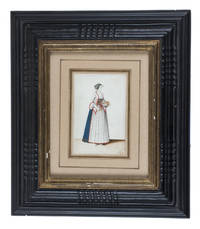
17209AHF2VYD4ZB1Augsburg 1720. Each mounted in a later passe-partout with a gold border in an ebonized wooden frame with a gilt lip glazed 23.5 x 20.5 cm. Four drawings in brown ink watercolour and coloured gouaches on vellum highlighted with gold each 5.9 x 9.0 cm. A matching set of four lovely and delicate watercolour drawings each depicting a young lady in a fancy German costume drawn and painted on vellum by the Augsburg artist Catharina Sperling Heckel 1699-1741. She learned painting and drawing from her father the Augsburg goldsmith Michael Heckel engraving from Johann Ulrich Kraus and married the engraver Hieronymus Sperling 1695-1777 in 1725. It is not clear whether she made these drawings shortly before or shortly after her marriage. She is best known for her ca. 1728 miniature portrait of Charles Edward Stuart Bonnie Prince Charlie the young pretender to the English throne. She never recovered from the birth of her first child in 1741 dying within a few weeks. Each drawing shows a young German lady wearing a long gown and a cap or bonnet but one also carries a hat. The four drawings differ in the style of the gowns and other elements.In very good condition. With a few small chips in the paint of the frame. Lovely watercolour costume drawings of four young German ladies perhaps from a court wedding in the free Imperial city of Augsburg.l Cf. Thieme & Becker XVI pp. 208-209. ABE CAT Costumes & Uniforms hardcover
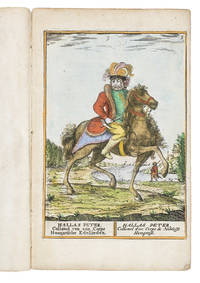
1787ABC_49498The Netherlands The Hague 1787. 8vo. Contemporary marbled paper wrappers sewn through 4 holes. Kept in a custom burgundy cloth case with a leather label on the spine lettered in gold. With 6 full-page numbered engraved plates vividly coloured by a contemporary hand. 16 pp. Second copy located of the second edition of an extremely rare work on 18th-century Central European military costumes. The work was first published in folio format in The Hague in 1742 with the title referring to the Central European soldiers in the service of the "Queen of Hungary" meaning Maria Theresa 1717-1780 ruler of the Habsburg monarchy from 1740 until 1780 and the "King of Prussia" meaning Frederick II the Great in/of Prussia 1712-1786. The title of the present second edition refers to the "Emperor" and the "King of Prussia" most likely meaning Holy Roman Emperor Joseph II r. 1780-1790 and either King Frederick II r. 1740-1786 or King Frederick William II r. 1786-1797. Thus the second edition was probably published after 1780 and possibly in 1787. Two English/French editions were published in 1742 and 1743 in "London" possibly meaning The Hague by Guillaume Meyer.The present copy contains 6 beautifully contemporary hand-coloured engravings of Central Europeans in their military costumes. They show: 1. Hallas Peter a Colonel of a corps of Hungarian nobles on horseback; 2. Captain of the Croats; 3. a Croat soldier; 4. a Slavonian from a historical region in present-day Croatia; 5. an officer of the Ulans also Uhlans originally Lithuanian irregular cavalry later generally meaning a lancer in service of the King of Prussia; 6. ordinary Ulan a lancer.With the book plate of F.C. Koch on the inside of the front wrapper. Wrappers slightly frayed and slightly faded minor foxing throughout the title page is slightly browned. Otherwise in very good condition.l STCN 240071050 1 copy; WorldCat 894593905 1 copy same as STCN; cf. for the first edition: Lipperheide 2224; Colas 2410. ABE CAT Costumes & Uniforms hardcover
1850008248Paris France: Ancienne Mon Aubert 1850. Book. Very good condition. Hardcover. First Edition. Quarto 4to. Two volumes containing a total of 365 beautifully hand-colored plates depicting the historic dress of villagers from various countries. Minor foxing to numerous plates occasionally entering into the image but mostly confined to the margins. Plates measure 103/8 inches 264mm in height. Bound in hardcover library cloth with unobtrusive stamps to top and bottom edge of closed pages with bookplates and stamps confined to the endpapers with no markings on the plates. Plates are titled at the top in French assigned a number and are given a brief description below the image. Many of the plates are credited at the bottom as "Musee Cosmopolite" while others are credited as "Musee de Costumes." Each is identified as having been printed by Aubert. Many of the artists are identified by their signature in the plate. There is no text associated with this publication. Volume I: Allemagne Germany 20 plates; Espagne Spain et Portugal 31 plates; Italie Italy 42 plates; France 86 plates. Volume II: Belgique et Hollande Belgium & Holland 4 plates; Suisse et Tyrol Swiss/Switzerland 25 plates; Russie Russia 37 plates; Turquie Egypte Grece Turkey Egypt and Greece 60 plates; Algerie Algeria/Africa 33 plates; Amerique America 27 plates. The American plates depict natives of Mexico Peru Argentina Paraguay and Uruguay. First edition. Ancienne Mon Aubert Hardcover books
18126383Paris, Nepveu, 1812. 1812 6 vol. in 16° (142 x 93 mm) de : I. 1 frontispice ; 20 pp. (faux-titre, titre, avant-propos) ; XXXI (précis historique) ; 119 pp. ; [1] p. table ; II. 1 frontispice ; [2] ff. (Faux-titre, titre) ; 225 pp. ; [1] f. (table) ; III. 1 frontispice ; [2] ff. (Faux-titre, titre) ; 251 pp. ; [1] (table) ; 15 planches ; IV. 1 frontispice ; [2] ff. (Faux-titre, titre) ; 282 pp. ; [1] table ; 16 planches ; V. 1 frontispice ; 9 planches ; [2] ff. (Faux-titre, titre) ; 231 pp. ; [1] p. (table) ; VI. 1 frontispice ; [2] ff. (Faux-titre, titre) ; 235 pp. (dont table) ; 26 planches ; un total de 72 planches gravées en couleurs (dont les 6 frontispices). (Quelques brunissures et traces de transfert face aux planches, ensemble frais). Plein veau glacé mosaiqué à froid dépoque, dos lisse orné et titré, frise dencadrement dorée sur les plats, roulette dorée sur les coupes et intérieure, tranches dorées, signets de soie verte, gardes de papier marbré.
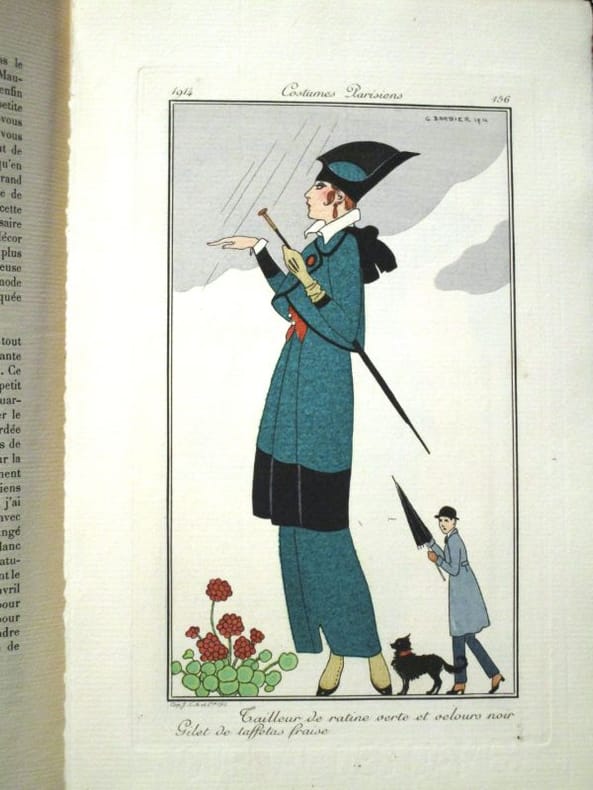
119437A Paris, Aux bureaux du Journal des Dames, de 1912 à 1914, 4 tomes in-8, contiennent les 79 numéros parus, complets des 186 planches gravées coloriées au pochoir (184 +2), menu illustré par Boscher au numéro du mois de décembre 1913, tirage à 1279 exemplaires numérotés, un des 1250 exemplaires numérotés sur papier de Hollande (n°1009). 79 fascicules aux cahiers non coupés, non cousus, sous leur couverture de livraison titrée bleue, bleu-vert, ou grise, regroupés sous 4 chemises éditeur papier bleues titrées (par année pour 1912, par semestre pour 1913 et 1914). Chaque numéro contient : 4 pages publicitaires en supplément, 8 pages de chroniques littéraires ou poèmes, 1 ou plusieurs planches hors-texte rehaussées au pochoir; le premier numéro contient en plus une préface de 8 pages et 1 feuillet fac-similé de la première page du Journal de mai 1812. Menus défauts aux chemises I et II (légères taches, petites déchirures), un numéro avec des traces de mouillures (n°73), de très rares rousseurs (pl.17 et 26), sinon intérieur en très bon état, les planches et les couleurs sont magnifiques, bon état général.
137072aafNapoli, Litografia Cuciniello e Bianchi, 1827, gr. in-4to, (35x23 cm) 1 feuille de texte (2 p.: Titre - Persone & Omaggio. en fait deux feuilles, la deuxième feuille ayant été montée sur le dos de la première) + 29 planches de costumes coloriées à la main, qqs légères rousseurs sur les bords de qqs planches seulement, reliure en toile originale. (Titre doré sur le plat devant: Les quatre grands Poetes d’Italie).
1804PHO-1187Paris, F. Buisson, 1804. 3 vol. in-8 de texte et 1 atlas de planches .Texte : I/ xv-[1]-408 pp. ; II/ [2] sq., 431 pp. ; III/ [2] sq., 473 pp. ; Atlas de 4 pp., 58 planches et cartes , relié demi basane époque (atlas reliure moderne) , coiffes usées, mouillure et quelques rousseurs dans l'atlas . Édition originale avec l'atlas complet des 58 cartes et planches dont 1 en couleur ,gravées en taille douce par Adam, Blondeau, Fortier, Dorgez, B. Tardieu d'après les dessins de l'auteur.
181841785Bordeaux, Chez les marchands d'estampes et chez l'Auteur, 1818-1819. In-4 de (32) pp. et 32 planches coloriées, demi-maroquin rouge à petits coins, dos lisse orné de filets dorés (reliure de l'époque).
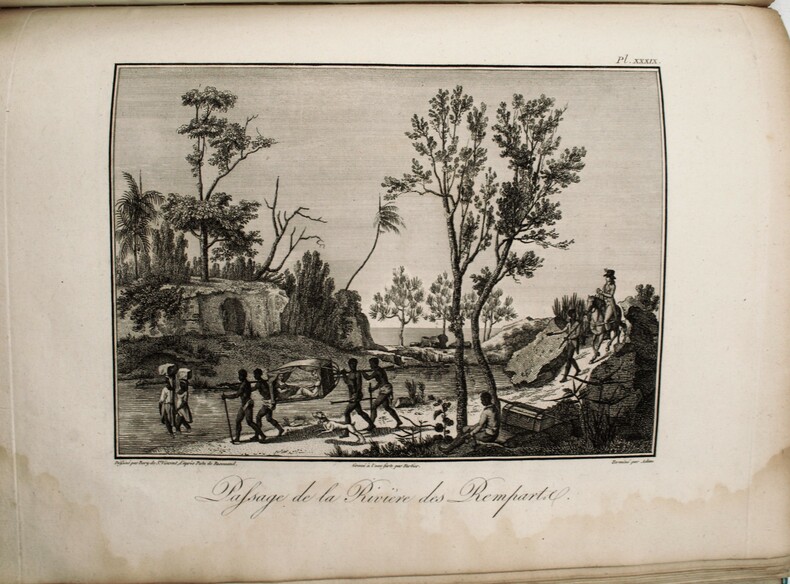
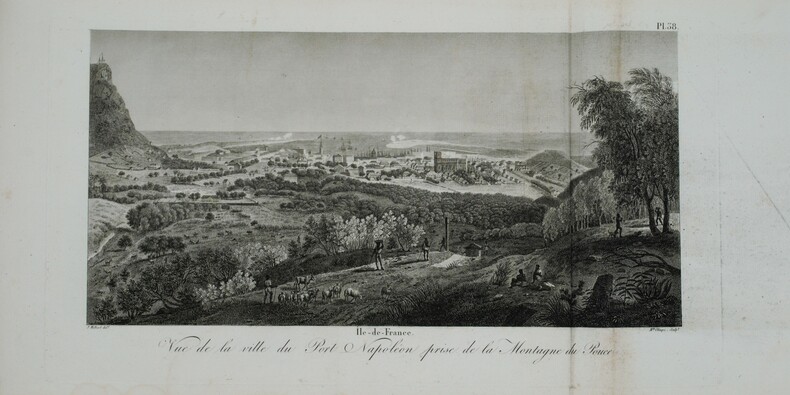
1812PHO-1228Paris, A. Nepveu, 1812. 2 volumes de texte in-8 (210x130), veau havane marbré, dos lisse orné, pièces de titre et de tomaison de maroquin rouge et tabac, roulette encadrant les plats, tranches mouchetées (reliure de l'époque) ,une coiffe usée, et un atlas in-folio oblong (420x280), demi-veau vert, dos lisse fileté or (reliure de l'époque) ,plats et dos frottés avec manques aux coins , début de fente . Première édition, illustrée de 3 tableaux dont 2 dépliants. L'atlas comprend 45 planches et cartes, dessinées et gravées la plupart par l'auteur ,certaines terminées par Coube, Hulk, Gossard ou Perdoux, (carte de l'île de France, vue de la ville du Port Napoléon, vue du Cap de Bonne-Espérance, etc.). L'ouvrage traite de l'histoire de l'île Maurice, de sa population et de son administration, de géologie et de sciences naturelles. Bon exemplaire. Mouillure très claire marginale à quelques planches, déchirure sans manque à la dernière avec réparation .
1804E5UG7Z4OCT3NLeipzig 1804. 16mo in 8s 14 x 10.5 cm. Friedrich August Leo Original publisher's paperboards printed from an engraved plate and hand-coloured each board with a costume scene in a decorated frame with caricature faces also with faces and decorations on the spine green paste-downs. With 2 stiff coated leaves at the end apparently intended for writing with a stylus. With 12 numbered engraved plates by Friedrich Wilhelm Nettling all coloured by a contemporary hand each showing several figures in carnival costumes. 31 1 blank pp. Very rare first and only published part of a series of hand-coloured carnival costume plates each of the 12 with a letterpress description in German and French. Only plates 9 and 10 bear the name of the German draughtsman and engraver Friedrich Wilhelm Nettling best known for his portrait of Bach but all may have been engraved by him. The mostly comical or farcical plates illustrate a fairy with her entourage a Chinese man Don Quixote and Sancho Panza a group of beast people and many other extraordinary figures. Two figures in one plate wear funnels as hats like the Tin Man in The Wizard of Oz. Besides the 12 plates in the booklet itself the engravings on the boards show two male figures gymnasts one in a clown-like costume on the front and a dancing woman with a tambourine on the back.With some minor stains and the front of the binding slightly damaged in the lower margin and lower right corner spine cracked. Good copy.l Baumgärtel Die Almanache Kalender und Taschenbücher 1750-1860 der Landesbibliothek Coburg p. 32; Köhring 111; WorldCat 633348944 465355875 3 copies; not in Colas; Hiler; Lanckoronska & Rümann; Lipperheide; for Nettling: Thieme & Becker XXV p. 400. ABE CAT Costumes & Uniforms hardcover
129324aafMilan, Impr. de l'editeur, s.d. (1824), in-folio, (37x27.5 cm), 823 p., Illustré de 103 magnifiques aquatintes en couleurs (vues et costumes) , reliure en d.-maroquin rouge originale, dos richement orné or, plats cartonnés récents. / Roter Hmaroquin. d. Zt. mit goldgepräg. Rtitel. (Etw. berieb. u. best., Kap. u. Gelenke etw. beschäd.)
138461aafBerne, chez J. L. Lang, 1819, In-4°, Superbe album orné de 24 gravures finement aquarellées à la main et gommées, contrecollées sur papier brun, représentant les costumes des 20 cantons (dont 4 planches pour Berne et deux pour Fribourg). Dimension des images : 16 x 21 cm. Un feuillet d'explication en face de chacune des planches. Avec feuilles de protection orig., reliure demi-maroquin rouge à coins dos à nerfs orné, plats recouverts de papier rouge maroquiné, encadrement de filet doré, (couverture de la brochure orig. imprimée cons.), sous emboîtage (Reliure de l'époque). Exemplaire très frais, quasiment sans rousseurs.
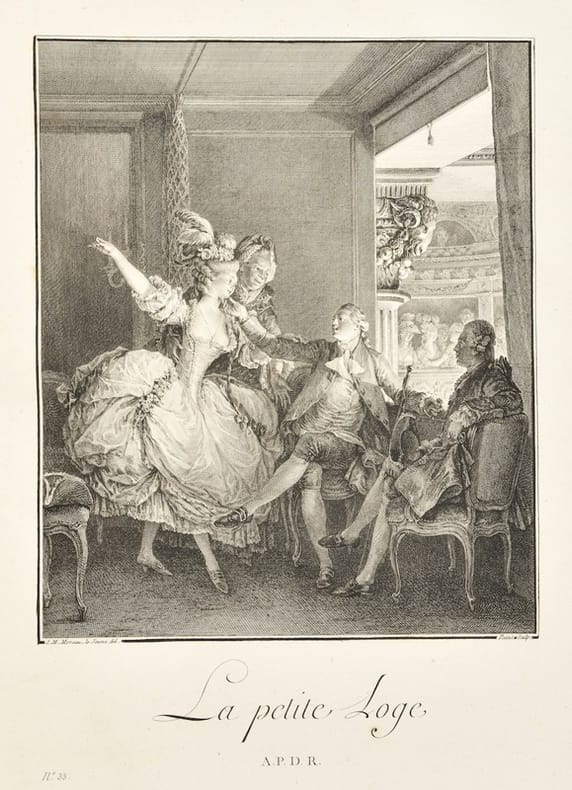
1790ST14261Paris: Drouhin 1790. FIRST EDITION. 265 x 205 mm. 10 3/8 x 8". Two volumes. <br/> VERY ATTRACTIVE CONTEMPORARY MARBLED CALF GILT IN A NEOCLASSICAL DESIGN covers with a cresting palmette frame featuring ornate urn ornaments at corners flat spine divided into compartments by Greek key roll floral spray centerpieces one green and one black label marbled endpapers. With 55 PLATES OF COSTUMES designed by Philippe Chéry and engraved by Pierre-Michel Alix 50 of these PRINTED IN COLOR five in black and white a couple of these with color highlights applied by hand and with a color portrait of the author from the 1802 edition tipped in at front. Colas 717; Hiler p. 542; Lipperheide 3203; Cohen-de Ricci 227; Brunet IV 1135. One corner worn to board joints and extremities lightly rubbed but the bindings lustrous and generally very attractive. First volume slightly browned throughout second volume occasionally so volume II with two-inch marginal stain to upper gutter affecting four quires and six plates but not touching text or images two plates with pen marks in margins touching lettering but not image other trivial defects but still an excellent copy internally the colors especially clear and pleasing.<br/> <br/> This is an elegant production with the Neoclassical binding being the perfect complement to the color engravings of ancient Greek and Roman costumes that illustrate the present history of theatrical attire. In the two volumes here theater critic and historian Jean Charles Le Vacher de Charnois 1749-92 covers Classical tragedies and comedies as well as later interpretations of these dramas by playwrights including Racine. Le Vacher de Charnois intended a series of books encompassing as the title indicates theatrical costumes from all nations and from the ancient to the modern; however the French Revolution interrupted his scheme and as a monarchist he was imprisoned in 1792 for his writings in support of the aristocracy. It was long thought that he had died in the massacres at the Abbaye prison in September of that year but later research indicates that he may have been executed during the Reign of Terror in 1794. The artists who illustrated this work were at the opposite end of the political spectrum. Painter Philippe Chéry 1759-1838 studied with Jacques-Louis David and adopted his master's passionate support for the Revolution as well as his Neoclassical style. Engraver Pierre-Michel Alix 1762-1817 was a specialist in color printing best known for his portraits of leaders of the French Revolution and later of Napoleon and First Empire dignitaries. While the handsome binding here is unsigned the palmette roll on the covers is very similar but not identical to one used by Bozerian see Culot "Jean-Claude Bozerian" roll #44 and plate #XXIV. Perhaps our binder had trained in that atelier as the design and workmanship are certainly of that level. Drouhin unknown
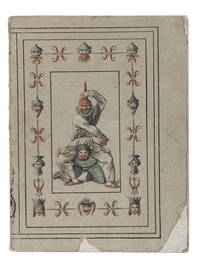
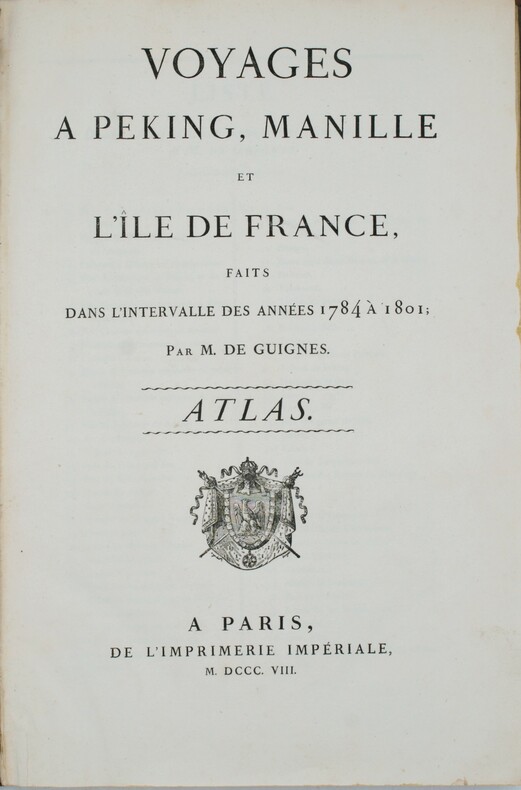
1808PHO-1461Imprimerie Impériale, 1808 , TEXTE et ATLAS ; Texte 3 volumes ,2ff-lxiij-439pp, 2ff-476pp, 2ff-488pp. relié demi cuir et coins , dos lisse avec pièces de titre et tomaison et un Atlas in-folio (400x270mm) , plein cuir époque , dos orné avec pièces de titre et tomaison rouge , frottements , début de fente, coiffe usée , gardes décollées ,petit travail de ver sur 10 feuillets sans atteinte ,intérieur très propre sans rousseurs ni piqûres , quelques rousseurs au texte. L'atlas comporte 92 illustrations gravées sur 61 feuillets par De Guignes d'après Mérite et 6 cartes gravées (4 pliantes) par Houdan.
1853143321853 Napoli, Stabilimento Typografico di Gaetano Nobile, 1853-1858 (en pages de titre) - 1857-1866 (en couvertures), 2 vol. grand in-8° (260 x 175 mm) reliés pleine percaline havane éditeur, auteur, titre et tomaisons dorés au dos, titre doré au centre des plats supérieurs, grand fleuron à froid au centre des plats inférieurs, couvertures imprimées en lithographie conservées, de XIX pp. (faux-titre, titre et « Cenno su Napoli ») de 324 pp. , 50 planches ; 340 pp. (faux-titre et titre inclus) - 50 planches. Cartonnages usagés (dos recollés, coiffes élimées, taches deau au plat supérieur du T.I et au plat inférieur du T.II), intérieur en très bon état.
18256434Paris, Librairie Nationale et Etrangere, 1825. 1825 2 vol. in-8° (210 x 140 mm.) , 3 ff., XI, 282 pp.; 2 ff., 243 pp et 60 planches lithographiées et coloriées dont 6 dépliantes, et une carte dépliante aux contours coloriés. (Rousseurs, déchirures et coin inférieur d'une planche restaurés). Cartonnage d'époque imitant le veau marbré, dos lisses ornés, titres et tomaison de maroquin rouge et bleu, tranches rouges.
PHO-1713Paris, Arthus Bertrand, sans date (1845-1850). In-folio, demi-basane vert à coins, dos à nerfs orné avec (reliure de l'époque). Atlas seul composé d’une carte dépliante, 59 planches dont 28 finement coloriées à l'époque et 4 dépliantes (1 en double). Reliure usagée, un plat détaché, manque un caisson au dos, frottements, coins et coiffes usés, très légères rousseurs, page de garde et une planche détachées, manque la liste des planches, 2 planches ont été ajoutées (Zoologie et Géologie), la carte , qui manque souvent est volante avec des petites déchirures aux plis sans manque.
163512943Amsterdam, Willem J. Blaeu, um 1635. Kupferstich, altkoloriert. Blattgröße: 48 x 60 cm, Druckspiegel: 41,5 x 56,5 cm. [3 Warenabbildungen]