JACQUARD L.Livre Rare Book
FAYARD, EnnemondLivre Rare Book
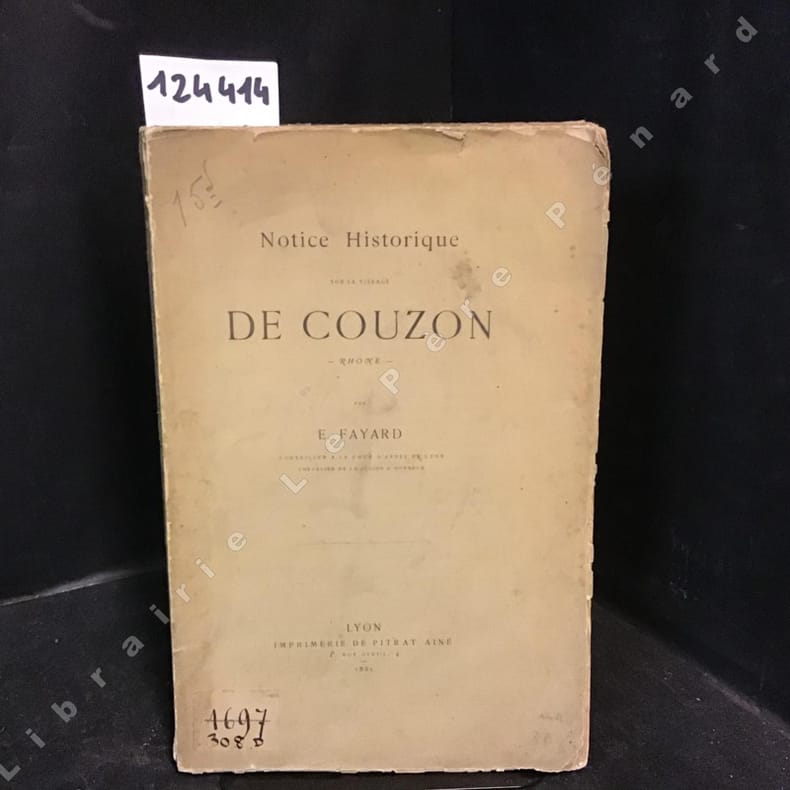
Notice Historique sur le village de Couzon, Rhône
18851244141885 Lyon, Imprimerie de Pitrat ainé - 1885 - In-8 broché - 156 pages
Librairie Le Père Pénard · Lyon, France40,00 €
14 résultats
1881ROD0007598Mégard et Cie. 1881. In-8. Broché. Etat d'usage, Plats abîmés, Dos abîmé, Quelques rousseurs. 96 pp., manque les plats de couverture - En l'état. . . . Classification Dewey : 664-Technologie des aliments
188597828452171471885, Mégard et Cie, Mégard et Cie, in-12 cartonné de 94 pages, couverture rouge | Etat : bon état (Ref.: ref90776)
1868ROD0049727Mégard et Cie. 1868. In-12. Cartonnage d'éditeurs. Bon état, Couv. convenable, Coiffe en pied abîmée, Intérieur frais. 192 pages. Frontispice noir et blanc, gravure couleurs sur 1er plat de couverture.. . . . Classification Dewey : 28.5-Enfantina
1878R260128732MEGARD ET Ce / BIBLIOTHEQUE MORALE DE LA JEUNESSE. 1878. In-12. Cartonnage d'éditeurs. Etat d'usage, Couv. défraîchie, Coiffe en tête abîmée, Intérieur frais. 120 pages. Couverture illustrée de motifs vert et or sur fond vert pale. Vigentte illustrée en couleurs sur le premier plat. Frontispice en noir et blanc.. . . . Classification Dewey : 840-Littératures des langues romanes. Littérature française
187635331876 1876 Librairie Hachette, Paris, 18761 volume in-8 demi basane bordeaux, dos à nerfs orné, 339 pagesBon état
18851244141885 Lyon, Imprimerie de Pitrat ainé - 1885 - In-8 broché - 156 pages
1840GITb494Paris Amédée Bédelet sd v 1840. In-8 304pp. Cartonnage éditeur toile bleu nuit, dos lisse orné d'attributs de métiers et d'une locomotive dorés, beau décor allégorique et mosaïqué sur le 1er plat, ornement doré et mosaïqué sur le 2e dans un encadrement de filets et volutes à froid, tranches dorées (Haarhaus). Orné de 12 beaux dessins hors texte en 2 teintes par Héloïse Lenoir, frontispice allégorique compris. Bel exemplaire complet de toutes ses illustrations.
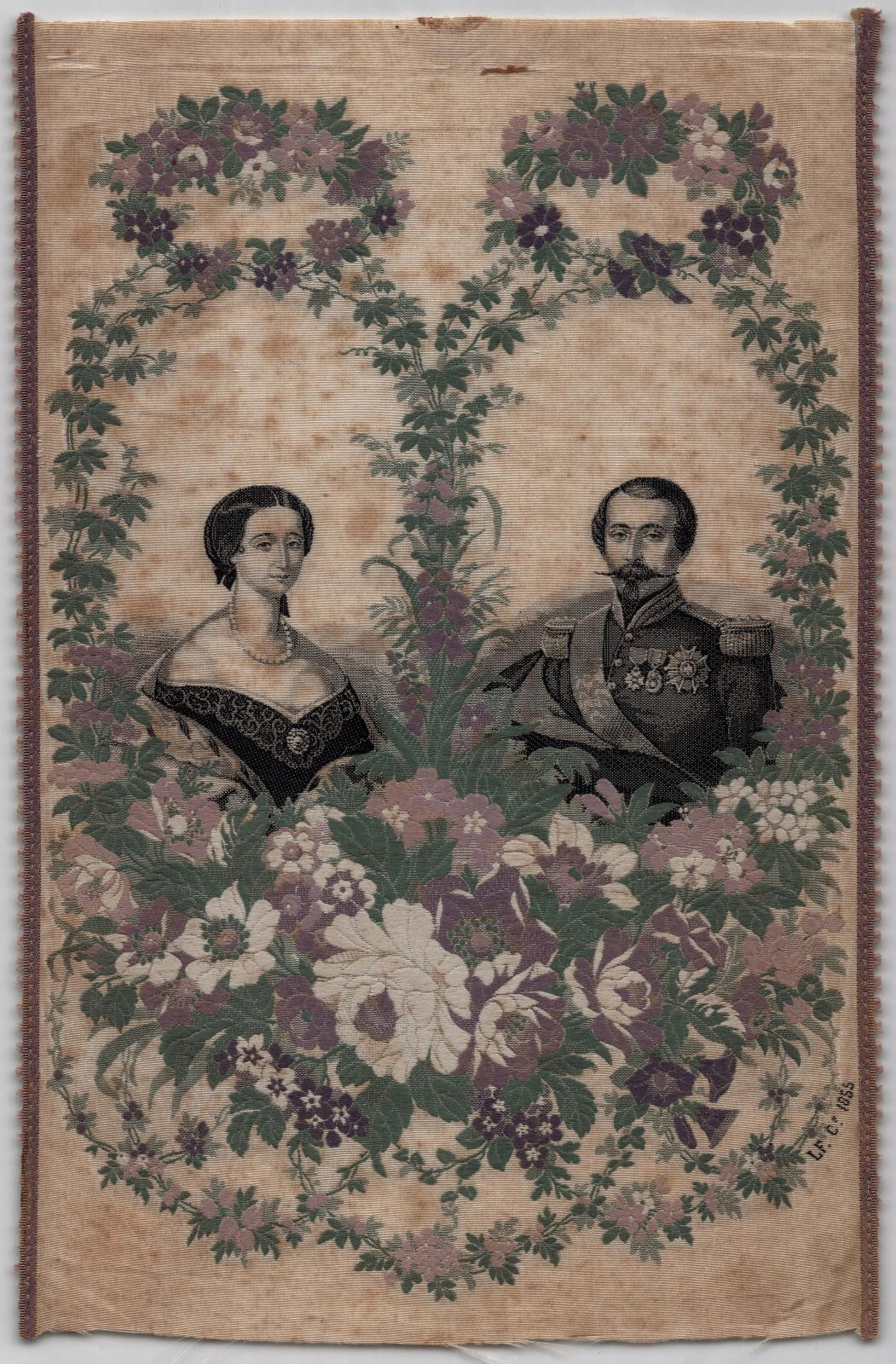
1855boz_006624Napoléon III et Eugénie - Ruban de soie tissé Jacquard - Second Empire - 1855 Fragment de soierie façonnée, tissée au métier Jacquard, représentant en buste l'empereur Napoléon III et l'impératrice Eugénie, réunis dans un médaillon en cœur composé de guirlandes de fleurs tissées en plusieurs coloris (vert, violine, ivoire). Pièce textile figurative, technique de prouesse caractéristique de la Fabrique lyonnaise ou stéphanoise du Second Empire, montrée à l'occasion des Expositions universelles pour illustrer le savoir-faire du tissage mécanique français. Une petite marque tissée, partiellement lisible, figure en bordure inférieure droite. Dimensions : 15 x 23,1 cm État : Bordée de galons tissés sur les côtés. Présente des rousseurs éparses, une tache d'oxydation et un léger accroc en partie haute. Voir photos pour plus de détails. Nombre de pages : 1 page Envoi soigné dans un carton rigide et étanche.
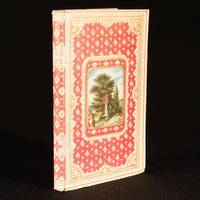
1880960F6Rouen: Megard 1880 . Hardback. Very Good. 8.5" by 5.5". Not Stated. L. Jacquard's very scarce juvenile novel set in Saint-Domingue beautifully bound in the publisher's decorative cartonnage binding. In the original French.L. Jacquard's very scarce novel.From the 'Bibliothèque Morale de la Jeunesse' series from Rouen based publisher Megard. This was a collection of works of literature and history aimed at younger readers beautifully bound in distinctive and highly decorative cartonnage bindings in order to attract the young.This series was part of a broader movement in nineteenth-century France to provide children with literature that combined moral instruction with engaging storytelling.Illustrated with a frontispiece.Jacquard's moralising children's novel is set on Saint-Domingue the French colony that now occupies the western portion of the island now called Haiti. It was established in 1659 and remained a French colony until Haiti gained independence in 1804 marking the end of the Haitian Revolution. In the publisher's original decorative cartonnage binding decorated in gilt and pink and with colour illustrated pictorial inlay to centre of front board. Externally bright. A touch of fading to back strip with bump to back strip tail. Front hinge strained but firmly held. Frontispiece detached and loosely inserted. Internally binding lightly strained throughout. Pages lightly age toned with spotting throughout. Very Good Megard hardcover
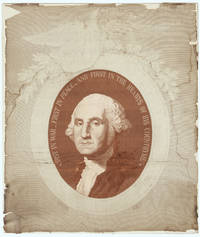
18565672B<p>FIRST "COMPUTER" PORTRAIT OF AMERICA'S FIRST PRESIDENT</p><p>Lyon Joseph Marie Jacquard 1856.</p><p>Silk machine-woven textile 49.8 x 42.2 cm. Mounted on old board. Edge wear some marginal tears and losses edge toning from mounting tape some damp staining and wrinkling. This said a remarkable survival.</p><p>Rare silk textile portrait of George Washington 1732-99 woven on the earliest programmable loom – the Jacquard Loom – which influenced the development of other programmable punch-card-driven machines that in turn would lead to the early versions of IBM's digital compiler. The present work thus may plausibly be considered the first 'computer' portrait of the first President of the United States. The textile carries the monogram 'JR' and is dated 1856 from Lyon the birthplace and home of Joseph Marie Jacquard 1752-1834 who invented his revolutionary device in 1804 to aid in the production of complex patterns of damask matelassé and brocade.</p><p>Based on Gilbert Stuart's 1755-1828 iconic portrait this two-color textile is inscribed with the famed line 'First in War First in Peace and First in the Hearts of his Countrymen' which is taken from Washington's eulogy delivered by Henry "Light Horse Harry" Lee 1756-1818 a major general in the Continental Army a member of the Continental Congress governor of Virginia father of the famous Civil War general Robert E. Lee and a close friend of Washington.</p><p>Now rare the textile was apparently well known to American audiences for decades after its initial production: A certain R. H. Thurston for example in his 1880 inaugural address as president of the American Society of Mechanical Engineers invoked history's greatest engineers including "Jacquard who perfected the pattern-loom which to-day weaves with equal facility the portrait of him who was 'first in war first in peace and first in the hearts of his countrymen' and the most beautiful and ingenious combinations of form and color of which decorative art is so wonderfully prolific" Thurston p. 9.</p><p>Provenance: Skinner Fine Books and Manuscripts 1 June 2013 lot 19.</p><p> J. Essinger <em>Jacquard's Web: How a Hand-Loom Led to the Birth of the Information Age</em>; R. H. Thurston "The President's Inaugural Address" <em>Transactions of the American Society of Mechanical Engineers</em> vol. 1 1880 pp. 1-16.</p> Joseph Marie Jacquard
1889E00911889. Titelblatt von J. Berjon in Tinte signiert / titre signé en encre par Berjon. 11 Lagen starkes Papier mit Kordelbindung. Lederband der Zeit mit goldgeprägtem Deckel- u. Rückentitel. Zustand 1.
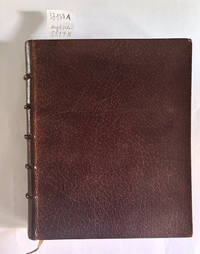
18868517BB1886. Lyon A. Roux 1886 "achevé . le VIII Sept. l'an de N.S. 1887". Small 8vo. 1 w. Bl. 25 beidseitig gewebte Bll. 1 w. Bl. Mit 3 ganzseit. Ill. Frontispiz mit leergelassenem Wappen zahlreichen Initialen u. durchgehenden floralen bzw. figürlichen Bordüren nach mittelalterlichen illuminierten Stundenbüchern. Text and illustrations entirely woven on a Jacquard machine with black and silver silk. Precious contemporary morocco leather in Jansenist-style 5 raised bands board edges with double gilt fillet top and bottom edge gilt doublures with burgundy moiré silk endpapers and inside boards with gilt tooled borders dentelles floral motifs and fillets. Binding signed J. Kaufmann and Ch. Meunier. Front board slightly concave. Dampstains throughout mostly on the bottom margins and only spreading on the first and last one or two leaves on the first few pages also affecting the top outer corners. All leaves with neat edges and free of any fraying. Overall in good condition. Extremely rare with only about 50 flawlessly woven copies. Vicaire V 342. - P. Marais "Note sur un livre de prières en tissue de soie" in: Bulletin du Bibliophile 1889 S. 163-166. - A. Laillier Une merveille artistique: notice sur un livre de prières tissé en soie" in: Bulletin de la Société industrielle de Rouen 1er janvier 1890 S. 267-270. - Michael Laird in The World from Here. Treasures of the Great Libraries of Los Angeles edited by C. Burlingham & B. Whiteman 2001 63. "Despite the fact that this rare volume is not a printed book it is of singular interest in that it was completely woven with silver and black silk thread. It also represents an extremely early book production involving automation and programming. The book was manufactured on silk looms that were programmed using the punched-card system developed by Joseph-Marie Jacquard 1752-1834. Several hundred thousand cards were required to program this curious magnum opus the actual figure is not known but estimates range from 106000 to 500000. After fifty failed attempts it took two years to weave approximately sixty copies. It will be observed that the weave in the present volume is almost microscopic it is exactly four hundred weft threads for every 2.5 centimeters approximately one inch. The movement of the machine was limited to one tenth of a millimeter the result being an extremely precise piece of bookmaking which on account of the material used truly gleams. It is noteworthy that Jacquard's looms only slightly modified are still in use today producing some of the world's finest fabric for furniture. The punched instructional cards utilized by Jacquard's weaving machinery served as the primary inspiration for the famous 'Analytical Engine' conceived by Charles Babbage 1791-1871". - A highlight of Jacquard production from Lyon the capital of silk and hometown of Joseph Marie Jacquard and possibly the only successful attempt at weaving a complete book with legible text. After weaving the silk leaves were folded and mounted on cardboard to give them the necessary strength. Each copy of the book was individually bound when sold but many copies remained in stock for years. - Lillian Randall noted that the "illuminations" of this particular prayer book came from a late 19th-century monograph the "Imitation de Jésus-Christ" Paris: Gruel et Engelmann which included reproductions of various illuminated manuscripts from the 14th to 16th century. The illuminations were chosen by R. P. J. Hervier who was also responsible for the overall design of the volume. A copy of the book was exhibited in the Lyon Pavilion at the Universal Exhibition in 1889 where its maker J. A. Henry won the Grand Prix. - With its small format the iconography and the general aesthetic featuring tendrils fillets miniatures and initials this work was clearly modelled on medieval books of hours. Just as a medieval manuscript was often tailored to the commissioner by inserting his coat of arms into a composition or by mentioning a saint to whom he was particularly devoted to this book of hours has a coat of arms in the frontispiece whose field remains empty to possibly embroider the coat of arms the name and the motto of the recipient. In our copy the field was left blank. hardcover
18868517BBLyon, A. Roux, 1886 ("achevé ... le VIII Sept. l'an de N.S. 1887"). Small 8vo. 1 w. Bl., 25 beidseitig gewebte Bll., 1 w. Bl. Mit 3 ganzseit. Ill., Frontispiz mit leergelassenem Wappen, zahlreichen Initialen u. durchgehenden floralen bzw. figürlichen Bordüren nach mittelalterlichen illuminierten Stundenbüchern. Text and illustrations entirely woven on a Jacquard machine with black and silver silk. Precious contemporary morocco leather in Jansenist-style, 5 raised bands, board edges with double gilt fillet, top and bottom edge gilt, doublures with burgundy moiré silk endpapers and inside boards with gilt tooled borders (dentelles, floral motifs and fillets). Binding signed J. Kaufmann and Ch. Meunier. Front board slightly concave. Dampstains throughout, mostly on the bottom margins and only spreading on the first and last one or two leaves, on the first few pages also affecting the top outer corners. All leaves with neat edges and free of any fraying.
188637158ABLyon, A. Roux, 1886 ("achevé ... le VIII Sept. l'an de N.S. 1887"). Kl.-8°. 1 w. Bl., 25 beidseitig gewebte Bll., 1 w. Bl. Mit 3 ganzseit. Ill., Frontispiz mit leergelassenem Wappen, zahlreichen Initialen u. durchgehenden floralen bzw. figürlichen Bordüren nach mittelalterlichen illuminierten Stundenbüchern. Text und Illustrationen vollständig mit Jacquard-Technik in Schwarz auf silbergrauer Seide gewebt. Wertvoller, dunkelbrauner Maroquin-Meistereinband d. Zt. auf 5 Bünden, mit doppelten Goldfileten auf den Kanten, Kopf- u. Fußgoldschnitt, Dublüre in burgunderroten Moiré-Seidenvorsätzen mit floralen Goldbordüren, - Prägungen à la Dentelle und -Filetierung der Innendeckel. Signiert J. Kauffmann (vorderer Innendeckel) u. Ch. Meunier (Rückdeckel). Einband an wenigen, kleinen Stellen sehr leicht berieben. Frontdeckel leicht konkav gewölbt. Durchgehende Feuchtigkeitsspuren vor allem am Fußssteg, zu Beginn und am Schluss etwas ausgedehnter, auf den ersten Seiten auch an der oberen Außenecke. Alle Seit