398 résultats
1839461741839. <p>Jacquard Joseph Marie 1752-1834. Portrait in silk of Joseph-Marie Jacquard after an original oil portrait by Claude Bonnefond manufactured by Didier Petit et Cie; woven by Michel-Marie Carquillat 1803-1884 in Lyon France 1839. The image including caption and Carquillat's name taking credit for the weaving is 55 x 34 cm.; the full piece of silk including blank margins is 85 x 66 cm. The visible portion of the image in the frame is 72 x 54.5 cm. and the frame measures 104 x 84 cm. Minor wear from folding barely visible in the image but with the image in clear unfaded and fresh condition. The weaving was professionally treated by a textile conservator whose conservator's report and images of before and after are available. Minor flaws visible in the large outer margins of the silk not affecting the image. In a large and attractive archival frame.</p> <p> This famous image of which only a very few examples are known was woven by machine using 24000 Jacquard cards each of which had over 1000 hole positions. The process of mis en carte or converting the image details to punched cards for the Jacquard mechanism for this exceptionally large and detailed image would have taken several workers many months as the woven image convincingly portrays superfine elements such as a translucent curtain over glass window panes. Once all the "programming" was completed the process of weaving the image with its 24000 punched cards would have taken more than eight hours assuming that the weaver was working at the usual Jacquard loom speed of about forty-eight picks per minute or about 2800 per hour. More than once this woven image was mistaken for an engraved image. The image was produced only to order most likely in a small number of examples. Recorded examples are those at the Metropolitan Museum of Art the Science Museum London The Art Institute of Chicago and the Computer History Museum Mountain View California Musée de Tissus Lyons.</p> <p> The image is the subject of the book by James Essinger entitled Jacquard's Web: How a Hand Loom Led to the Birth of the Information Age 2004. To Charles Babbage the incredible sophistication of the information processing involved in the mis en carte—what we call programming—of this exceptionally elaborate and beautiful image confirmed the potential of using punched cards for the inputting programming and outputting and storage of information in his design and conception of the first general-purpose programmable computer--the Analytical Engine. The highly aesthetic result also confirmed to Babbage that machines were capable of amazingly complex and subtle processes—processes which might eventually emulate the subtlety of the human mind.</p> <p> "In June 1836 Babbage opted for punched cards to control the machine the Analytical Engine. The principle was openly borrowed from the Jacquard loom which used a string of punched cards to automatically control the pattern of a weave. In the loom rods were linked to wire hooks each of which could lift one of the longitudinal threads strung between the frame. The rods were gathered in a rectangular bundle and the cards were pressed one at a time against the rod ends. If a hole coincided with a rod the rod passed through the card and no action was taken. If no hole was present then the card pressed back the rod to activate a hook which lifted the associated thread allowing the shuttle which carried the cross-thread to pass underneath. The cards were strung together with wire ribbon or tape hinges and fan-folded into large stacks to form long sequences. The looms were often massive and the loom operator sat inside the frame sequencing through the cards one at a time by means of a foot pedal or hand lever. The arrangement of holes on the cards determined the pattern of the weave.</p> <p> "As well as patterned textiles for ordinary use the technique was used to produce elaborate and complex images as exhibition pieces. One well-known piece was a shaded portrait of Jacquard seated at table with a small model of his loom. The portrait was woven in fine silk by a firm in Lyon using a Jacquard punched-card loom. The image took 24000 cards to produce and each card had over 1000 hole positions. Babbage was much taken with the portrait which is so fine that it is difficult to tell with the naked eye that it is woven rather than engraved. He hung his own copy of the prized portrait in his drawing room and used it to explain his use of the punched cards in his Engine.</p> <p> The delicate shading crafted shadows and fine resolution of the Jacquard portrait challenged existing notions that machines were incapable of subtlety. Gradations of shading were surely a matter of artistic taste rather than the province of machinery and the portrait blurred the clear lines between industrial production and the arts. Just as the completed section of the Difference Engine played its role in reconciling science and religion through Babbage's theory of miracles the portrait played its part in inviting acceptance for the products of industry in a culture in which aesthetics was regarded as the rightful domain of manual craft and art" Swade The Cogwheel Brain. Charles Babbage and the Quest to Build the First Computer 2000 107-8.</p> . unknown books
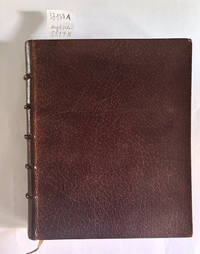
18868517BBLyon, A. Roux, 1886 ("achevé ... le VIII Sept. l'an de N.S. 1887"). Small 8vo. 1 w. Bl., 25 beidseitig gewebte Bll., 1 w. Bl. Mit 3 ganzseit. Ill., Frontispiz mit leergelassenem Wappen, zahlreichen Initialen u. durchgehenden floralen bzw. figürlichen Bordüren nach mittelalterlichen illuminierten Stundenbüchern. Text and illustrations entirely woven on a Jacquard machine with black and silver silk. Precious contemporary morocco leather in Jansenist-style, 5 raised bands, board edges with double gilt fillet, top and bottom edge gilt, doublures with burgundy moiré silk endpapers and inside boards with gilt tooled borders (dentelles, floral motifs and fillets). Binding signed J. Kaufmann and Ch. Meunier. Front board slightly concave. Dampstains throughout, mostly on the bottom margins and only spreading on the first and last one or two leaves, on the first few pages also affecting the top outer corners. All leaves with neat edges and free of any fraying.
188637158ABLyon, A. Roux, 1886 ("achevé ... le VIII Sept. l'an de N.S. 1887"). Kl.-8°. 1 w. Bl., 25 beidseitig gewebte Bll., 1 w. Bl. Mit 3 ganzseit. Ill., Frontispiz mit leergelassenem Wappen, zahlreichen Initialen u. durchgehenden floralen bzw. figürlichen Bordüren nach mittelalterlichen illuminierten Stundenbüchern. Text und Illustrationen vollständig mit Jacquard-Technik in Schwarz auf silbergrauer Seide gewebt. Wertvoller, dunkelbrauner Maroquin-Meistereinband d. Zt. auf 5 Bünden, mit doppelten Goldfileten auf den Kanten, Kopf- u. Fußgoldschnitt, Dublüre in burgunderroten Moiré-Seidenvorsätzen mit floralen Goldbordüren, - Prägungen à la Dentelle und -Filetierung der Innendeckel. Signiert J. Kauffmann (vorderer Innendeckel) u. Ch. Meunier (Rückdeckel). Einband an wenigen, kleinen Stellen sehr leicht berieben. Frontdeckel leicht konkav gewölbt. Durchgehende Feuchtigkeitsspuren vor allem am Fußssteg, zu Beginn und am Schluss etwas ausgedehnter, auf den ersten Seiten auch an der oberen Außenecke. Alle Seit
18868517BB1886. Lyon A. Roux 1886 "achevé . le VIII Sept. l'an de N.S. 1887". Small 8vo. 1 w. Bl. 25 beidseitig gewebte Bll. 1 w. Bl. Mit 3 ganzseit. Ill. Frontispiz mit leergelassenem Wappen zahlreichen Initialen u. durchgehenden floralen bzw. figürlichen Bordüren nach mittelalterlichen illuminierten Stundenbüchern. Text and illustrations entirely woven on a Jacquard machine with black and silver silk. Precious contemporary morocco leather in Jansenist-style 5 raised bands board edges with double gilt fillet top and bottom edge gilt doublures with burgundy moiré silk endpapers and inside boards with gilt tooled borders dentelles floral motifs and fillets. Binding signed J. Kaufmann and Ch. Meunier. Front board slightly concave. Dampstains throughout mostly on the bottom margins and only spreading on the first and last one or two leaves on the first few pages also affecting the top outer corners. All leaves with neat edges and free of any fraying. Overall in good condition. Extremely rare with only about 50 flawlessly woven copies. Vicaire V 342. - P. Marais "Note sur un livre de prières en tissue de soie" in: Bulletin du Bibliophile 1889 S. 163-166. - A. Laillier Une merveille artistique: notice sur un livre de prières tissé en soie" in: Bulletin de la Société industrielle de Rouen 1er janvier 1890 S. 267-270. - Michael Laird in The World from Here. Treasures of the Great Libraries of Los Angeles edited by C. Burlingham & B. Whiteman 2001 63. "Despite the fact that this rare volume is not a printed book it is of singular interest in that it was completely woven with silver and black silk thread. It also represents an extremely early book production involving automation and programming. The book was manufactured on silk looms that were programmed using the punched-card system developed by Joseph-Marie Jacquard 1752-1834. Several hundred thousand cards were required to program this curious magnum opus the actual figure is not known but estimates range from 106000 to 500000. After fifty failed attempts it took two years to weave approximately sixty copies. It will be observed that the weave in the present volume is almost microscopic it is exactly four hundred weft threads for every 2.5 centimeters approximately one inch. The movement of the machine was limited to one tenth of a millimeter the result being an extremely precise piece of bookmaking which on account of the material used truly gleams. It is noteworthy that Jacquard's looms only slightly modified are still in use today producing some of the world's finest fabric for furniture. The punched instructional cards utilized by Jacquard's weaving machinery served as the primary inspiration for the famous 'Analytical Engine' conceived by Charles Babbage 1791-1871". - A highlight of Jacquard production from Lyon the capital of silk and hometown of Joseph Marie Jacquard and possibly the only successful attempt at weaving a complete book with legible text. After weaving the silk leaves were folded and mounted on cardboard to give them the necessary strength. Each copy of the book was individually bound when sold but many copies remained in stock for years. - Lillian Randall noted that the "illuminations" of this particular prayer book came from a late 19th-century monograph the "Imitation de Jésus-Christ" Paris: Gruel et Engelmann which included reproductions of various illuminated manuscripts from the 14th to 16th century. The illuminations were chosen by R. P. J. Hervier who was also responsible for the overall design of the volume. A copy of the book was exhibited in the Lyon Pavilion at the Universal Exhibition in 1889 where its maker J. A. Henry won the Grand Prix. - With its small format the iconography and the general aesthetic featuring tendrils fillets miniatures and initials this work was clearly modelled on medieval books of hours. Just as a medieval manuscript was often tailored to the commissioner by inserting his coat of arms into a composition or by mentioning a saint to whom he was particularly devoted to this book of hours has a coat of arms in the frontispiece whose field remains empty to possibly embroider the coat of arms the name and the motto of the recipient. In our copy the field was left blank. hardcover
1889E00911889. Titelblatt von J. Berjon in Tinte signiert / titre signé en encre par Berjon. 11 Lagen starkes Papier mit Kordelbindung. Lederband der Zeit mit goldgeprägtem Deckel- u. Rückentitel. Zustand 1.
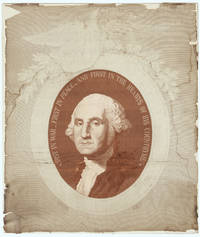
18565672B<p>FIRST "COMPUTER" PORTRAIT OF AMERICA'S FIRST PRESIDENT</p><p>Lyon Joseph Marie Jacquard 1856.</p><p>Silk machine-woven textile 49.8 x 42.2 cm. Mounted on old board. Edge wear some marginal tears and losses edge toning from mounting tape some damp staining and wrinkling. This said a remarkable survival.</p><p>Rare silk textile portrait of George Washington 1732-99 woven on the earliest programmable loom – the Jacquard Loom – which influenced the development of other programmable punch-card-driven machines that in turn would lead to the early versions of IBM's digital compiler. The present work thus may plausibly be considered the first 'computer' portrait of the first President of the United States. The textile carries the monogram 'JR' and is dated 1856 from Lyon the birthplace and home of Joseph Marie Jacquard 1752-1834 who invented his revolutionary device in 1804 to aid in the production of complex patterns of damask matelassé and brocade.</p><p>Based on Gilbert Stuart's 1755-1828 iconic portrait this two-color textile is inscribed with the famed line 'First in War First in Peace and First in the Hearts of his Countrymen' which is taken from Washington's eulogy delivered by Henry "Light Horse Harry" Lee 1756-1818 a major general in the Continental Army a member of the Continental Congress governor of Virginia father of the famous Civil War general Robert E. Lee and a close friend of Washington.</p><p>Now rare the textile was apparently well known to American audiences for decades after its initial production: A certain R. H. Thurston for example in his 1880 inaugural address as president of the American Society of Mechanical Engineers invoked history's greatest engineers including "Jacquard who perfected the pattern-loom which to-day weaves with equal facility the portrait of him who was 'first in war first in peace and first in the hearts of his countrymen' and the most beautiful and ingenious combinations of form and color of which decorative art is so wonderfully prolific" Thurston p. 9.</p><p>Provenance: Skinner Fine Books and Manuscripts 1 June 2013 lot 19.</p><p> J. Essinger <em>Jacquard's Web: How a Hand-Loom Led to the Birth of the Information Age</em>; R. H. Thurston "The President's Inaugural Address" <em>Transactions of the American Society of Mechanical Engineers</em> vol. 1 1880 pp. 1-16.</p> Joseph Marie Jacquard
1955155308Hangzhou.: 中國杭州都錦生絲織廠制. Dujin Silk Factory. No date. circa1955. Handcoloured silk jacquard panorama of the West Lake in Hangzhou. Measures 27.5 x 120cm. Lightly frayed at ends a very good copy. Silk jacquard weavings such as these were very popular in China from the mid to late 20th century as tourist souvenirs. It appears likely that this particular example was woven in the 1950s as traditional Chinese characters have been used and the Dujin Silk Factory where it was made changed its name to Dongfang Hongsi in 1966. The Dujin Silk Factory was well known in Hangzhou and beyond. It was originally established in 1922 and entered public-private joint management in the 1950s. Unfortunately it now no longer exists. . 中國杭州都錦生絲織廠制. [Dujin Silk Factory] unknown
In 4°; (166) pp. e (6) p. bianche .Vari disegni nel testo ed alcuni inserti di tessuti di seta. Legatura coeva in mezza tela con titolo impresso in oro al dorso. Magnifica grafia di metà ottocento di questa raccolta inedita di appunti, raccolti dallo studente Carlo Biraghi, di uno scritto del professore Luigi Bossi dedicato alla teoria e fabbricazione delle Stoffe di seta, secondo, probabilmente, le lezioni tenute dallo stesso Bossi. Il noto professore di tessitura serica ed ingegnere Luigi Bossi, autore di uno dei più celebri manuali sulla tessitura della seconda metà dell'ottocento (edito nel 1874) fu anche colui che costruì ed attivò la macchina a vapore con una potenza di 2 cavalli che riscaldò e mosse i 60 aspi, a partire dal 1846, della Filanda del Rag. Andrea Bossi. Luigi Bossi mise le proprie conoscenze al servizio della tessitura e dell'industria tessile del nord Italia, divenendo figura di riferimento per le nuove generazioni di imprenditori tessili. Partendo dalla teoria della seta, l'autore prosegue descrivendo il molinaggio, la trama, l'organzimo, varie qualità di sete lavorate come la granatina, l'ovale, il plate, la fantasia o Chappe, il fioretto, la crepe, il marabout, per proseguire poi con il titolo della seta, il perimetro o assaggiatore della seta, la stagionatura della seta, la cappiatura e assortitura della seta, la tintura della seta, i prodotti ottenuti dalla seta tinta in diversi colori per ogni Kg. Di seta cruda, la purga della seta, la tinta in cotto e a colori, la tinta in nero fino e minerale, la tinta in raddolcito o souple, la tinta in nero biscotto, tinta delle trame ingallate, la tinta a crudo, la tinta delle seti cotte e caricate, l'aspetto che presentano le sete tinte nei diversi processi, la cura per la conversazione della seta in magazzino, l'incannaggio delle seti, le precauzioni da usarsi nell'incannaggio, l'orditura, le precauzioni da usarsi nell'orditura, i rocchetti, l'imbancaggio, ordimenti-ombreggianti, l'imbancaggio per ombreggiati di 6 gradazioni primitive, l'avvertenza sull'incarnaggio delle sete per ompreggiati, gli schemi della regola per ottenere 21 gradazioni derivate da 6 gradazioni prmitive oppure 22 gradazioni d 8 gradazioni primitive. Segue un saggio o guidana con esempi, le regole per gli ordinamenti rigati, il piegaggio, il modo di fare il calcolo per disporre l'organzino alla tinta, il modo di calcolare la quantità di trama greggia da disporre alla tinta o già tinta, altri risultati che si possono ottnere coll'uso del divisore cost.se, il modo di calcolare la quantità di filato, la regola per il tessimento, vari esercizi o conti di fabbrica. Alla fine dell'opera seguono 60 pagine dedicate alla macchina Jacquard con un bel disegno spaccato dello stesso ed un attenta analisi delle sue parti e del suo utilizzo. Nel 1801 il francese Joseph-Marie Jacquard presentò questo tipo di telaio, dotato di un macchinario che permette, con l'ausilio di una scheda perforata, la movimentazione automatica dei singoli fili di ordito e che rivoluzionò il campo dell'industria tessile. Rarità bibliografica in perfette condizioni di conservazione.
BN316616Dunod. Hardcover. Technologie des installations frigorifiques <br/><br/>Technologie des installations frigorifiques Pierre Rapin et Patrick Jacquard Dunod hardcover
1974RO80168306SPRINGER VERLAG BERLIN HEIDELBERG NEW YORK. 1974. In-8. Relié. Etat du neuf, Couv. remarquable, Dos impeccable, Intérieur frais. 569 pages augmentées de nombreuses figures en noir et blanc dans le texte.. Avec Jaquette. . . Classification Dewey : 420-Langue anglaise. Anglo-saxon
1974209749New York: Springer-Verlag 1974. Hardcover. VG/VG-. Volume 5 of Biomathematics. 569 pages in very good clean condition. With 92 figures. Previous owner's name on the ffep. Green cloth with yellow titles on the spine. Very light wear on corners and edges. Green DJ with yellow titles. Light wear on corners and edges. VG/VG- <br/> <br/> Springer-Verlag hardcover
2021BN186310DUNOD 2021. 2021. Softcover. Technologie des installations frigorifiques - 11e éd. <br/><br/>Technologie des installations frigorifiques - 11e éd. Rapin Pierre; Jacquard Patrick; Desmons Jean DUNOD paperback
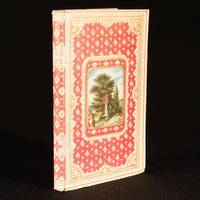
1880960F6Rouen: Megard 1880 . Hardback. Very Good. 8.5" by 5.5". Not Stated. L. Jacquard's very scarce juvenile novel set in Saint-Domingue beautifully bound in the publisher's decorative cartonnage binding. In the original French.L. Jacquard's very scarce novel.From the 'Bibliothèque Morale de la Jeunesse' series from Rouen based publisher Megard. This was a collection of works of literature and history aimed at younger readers beautifully bound in distinctive and highly decorative cartonnage bindings in order to attract the young.This series was part of a broader movement in nineteenth-century France to provide children with literature that combined moral instruction with engaging storytelling.Illustrated with a frontispiece.Jacquard's moralising children's novel is set on Saint-Domingue the French colony that now occupies the western portion of the island now called Haiti. It was established in 1659 and remained a French colony until Haiti gained independence in 1804 marking the end of the Haitian Revolution. In the publisher's original decorative cartonnage binding decorated in gilt and pink and with colour illustrated pictorial inlay to centre of front board. Externally bright. A touch of fading to back strip with bump to back strip tail. Front hinge strained but firmly held. Frontispiece detached and loosely inserted. Internally binding lightly strained throughout. Pages lightly age toned with spotting throughout. Very Good Megard hardcover
256p. Original full cloth binding. Limited edition. Extremely important and increasingly scarce study of loom woven coverlets. **PRICE JUST REDUCED! BEFORE ORDERING PLEASE Email to RareBooks@POBox.com so that we can CONFIRM AVAILABILITY
2002__0822329778Duke Univ Pr 2002. Paperback. New. 293 pages. 9.00x6.25x1.00 inches. Duke Univ Pr paperback
2011x-3642708390Springer-Verlag 2011. Paperback. New. 476 pages. 9.60x6.70x1.00 inches. Springer-Verlag paperback
8712Tête de collection complète du n° 1 au n° 18 (1981-1988). Bon état. // Textes de Raymond Aron, Roland Barthes, Marcel Bénabou, Walter Benjamin, Yves Bonnefoy, Paul Celan, René Char, François George, Jean-François Lyotard, Pierre Mertens, Bernard Noël, Maurice Olender, Georges Perec, Léon Poliakov, J.-B. Pontalis, Jean Pouillon, David Rousset, Leo Strauss, Tzvetan Todorov, Pierre Vidal-Naquet, Monique Wittig, Paul Zumthor
256p. Original full cloth binding. Limited edition. Extremely important and increasingly scarce study of loom woven coverlets. **PRICE JUST REDUCED! BEFORE ORDERING PLEASE Email to RareBooks@POBox.com so that we can CONFIRM AVAILABILITY
pp. 1-215. 8vo. Original full cloth binding. Includes also a significant important Pennsylvania-Dutch dialect vocabulary: LINGUISTIC VARIANTS OF THE PENNSYLVANIA GERMAN DIALECT, by Albert F. Buffington. Limited edition. Extremely important and increasingly scarce study of loom woven coverlets. Also issued as: Pennsylvania German Folklore Society. Volume XIII. BEFORE ORDERING PLEASE Email to RareBooks@POBox.com so that we can CONFIRM AVAILABILITY
201695like new. unknown
This is an almost very good hardcover copy. This copy is bound in the publisher's cream polished cloth with gilt titles and designs, with just light wear. The spine is a little darker than the front and back covers. Still it just looks like an antique finish. Top page edge gilt. Some foxing throughout to margins of pages. Most pages clean. Illustrated in color with 24 color plates on a glossy paper with no foxing. All tissue guards present. Also many black & white photographs. Bibliography. 12" high X 9" wide, 427 pages. This book will be securely wrapped and packed in a sturdy box and shipped with tracking.
201695-nnew. unknown
A9780822329770Hardback. New. Presents a dramatic portrait of the wanted terrorist and his extensive brotherhood. This title details how bin Laden became an international emblem of fundamentalist pan-Islamic anti-US fervour and the leader of a brotherhood so passionate that devotees who have never met him will act autonomously in his name. hardcover
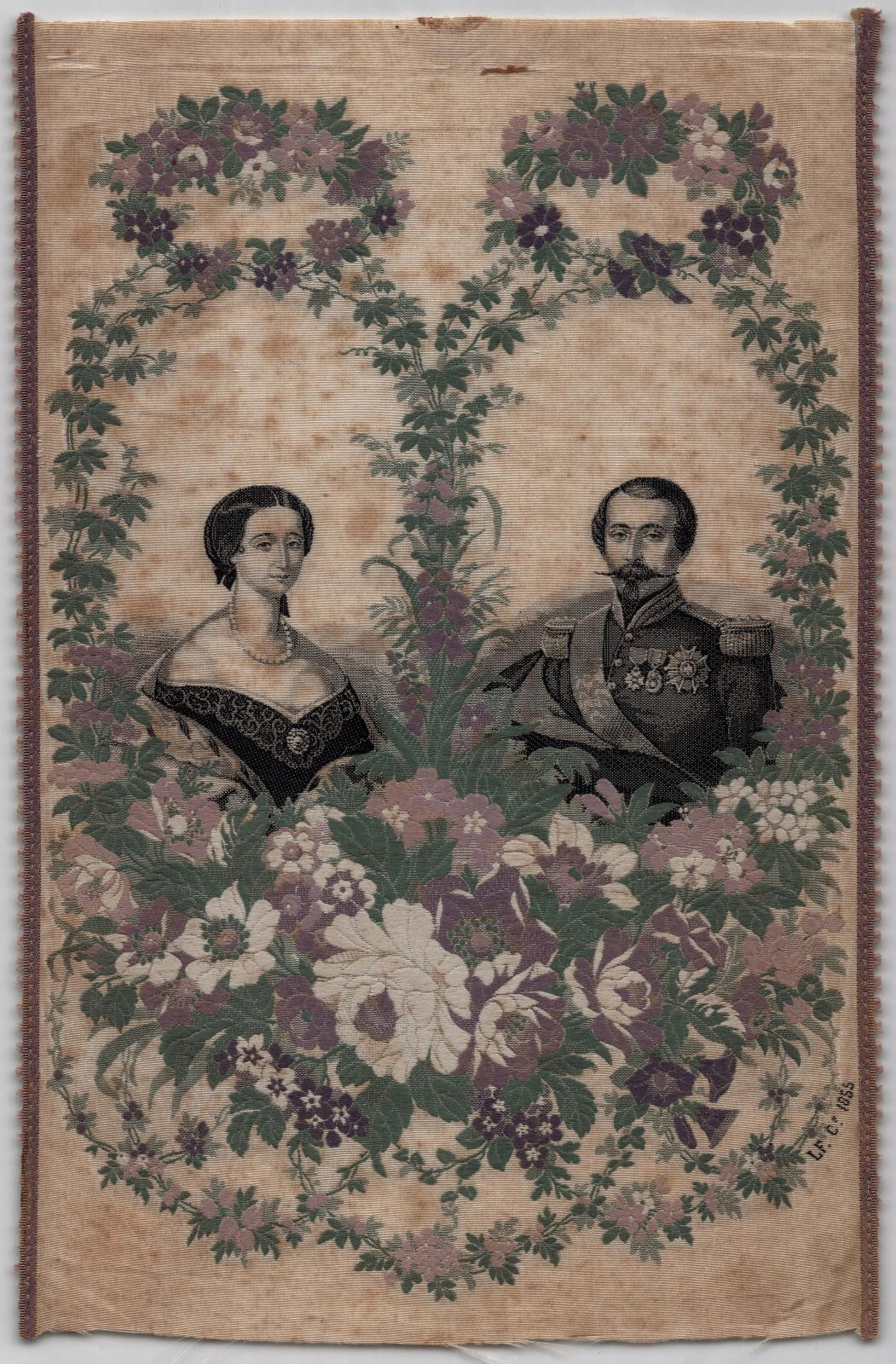
1855boz_006624Napoléon III et Eugénie - Ruban de soie tissé Jacquard - Second Empire - 1855 Fragment de soierie façonnée, tissée au métier Jacquard, représentant en buste l'empereur Napoléon III et l'impératrice Eugénie, réunis dans un médaillon en cœur composé de guirlandes de fleurs tissées en plusieurs coloris (vert, violine, ivoire). Pièce textile figurative, technique de prouesse caractéristique de la Fabrique lyonnaise ou stéphanoise du Second Empire, montrée à l'occasion des Expositions universelles pour illustrer le savoir-faire du tissage mécanique français. Une petite marque tissée, partiellement lisible, figure en bordure inférieure droite. Dimensions : 15 x 23,1 cm État : Bordée de galons tissés sur les côtés. Présente des rousseurs éparses, une tache d'oxydation et un léger accroc en partie haute. Voir photos pour plus de détails. Nombre de pages : 1 page Envoi soigné dans un carton rigide et étanche.
SLIVCN-9782100878116Dunod (7/2025)