[MATHEMATICS] [TOPOGRAPHY] FARRAR, JohnBiblio.com
54 résultats
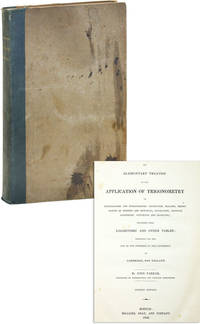
184048011Boston: Hilliard Gray and Company 1840. Fourth edition. Octavo; contemporary cloth-backed boards; viii155;75pp; 9 folding plates. Old ink-stains to front board; spine cloth slightly faded; still a solid Good or better copy. Early ownership signature "J.S.D. Taylor" in ink to front free endpaper overwriting an earlier now illegible pencil signature. Fourth and final edition first published 1822. A volume in the Cambridge mathematical series a series of textbooks initiated and largely written by Farrar Professor of Mathematics and Philosophy at Harvard from 1807 to 1836. KARPINSKY p.246. Hilliard, Gray and Company unknown
190833189London: Adam & Charles Black 1908. First Edition. Beautifully Illustrated with 24 Full-Page Plates in Colours by W. Biscombe Gardner. 8vo publisher's original navy blue polished cloth the covers and spine beautifully and richly decorated with overall designs and decorations in gilt t.e.g. xii 182 2 ads. pp. A fine and very bright copy beautifully preserved. FIRST EDITION WITH THE FULL COUNT OF TWENTY-FOUR PLATES OF SOME OF ENGLAND'S MOST BEAUTIFUL COUNTRYSIDE. The author and artist have joined forces to create here a fine and beautifully illustrated work on the uplands forming the High and Low Peak that southern vertebra of the rocky backbone that runs through the upper half of England with ribs stretched out along its lateral river-valleys. There are depicted here in the beautiful paintings by Mr. Biscombe Gardner the moors and tablelands and rugged ridges hollowed by deep glens the dales and cloughs which with their rich show of crag wood and torrent make its most striking scenery. Adam & Charles Black hardcover
19422082702114606291Not Available 1942. Soft Cover. Fine. Number of books: 1 Not Available paperback
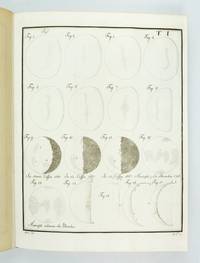
1796ST20813Helmstedt: Printed and commissioned by C. G. Fleckeisen 1796. FIRST EDITION. 275 x 225 mm. 10 3/4 x 9". XVI 250 2 pp. <br/> Contemporary brown paste paper boards smooth spine with red roan label. WITH 10 ENGRAVED PLATES one folding by "G. T." after Schröter. Honeyman 2825; de la Lande p. 635; Poggendorff II 846; cf. DSB XII p. 226 NDB XXIII 590 Schröter and 510 Schrader. See also Sheehan and Baum "Observations and inference: Johann Hieronymous Schroeter 1745-1816" Journal of the British Astronomical Association vol.105 no.4 p.171-175. Joints and extremities somewhat rubbed boards with a hint of chafing occasional very minor foxing including to the final plate half a dozen leaves with faint dampstain to head edge but a really excellent copy the other plates clean and bright the text especially clean and fresh and the binding entirely sound.<br/> <br/> This is a very rarely seen early work on the topography of Venus written by the astronomer who first observed the planet's so-called phase anomaly and illustrated with 10 folding plates. One of a series of "fragments" Schröter published--the others concerning the sun the moon Saturn and Mercury--"Aphroditographische Fragmente" discusses the author's observations of Venus' surface at the same time coining the term "Aphroditographie" in reference to the Greek version of the goddess' name. The most important observation contained in our work concerns the phases of Venus: like the moon Venus appears to wax and wane when observed through a telescope. However due to the thickness of its atmosphere the planet will always appear less full than mathematical calculations indicate it should be. This phenomenon known as Venus' phase anomaly--or the Schröter Effect--first observed by the man who gave it its name in 1793 is discussed in detail in this text which is accompanied by highly detailed plates. Eight of these are focused on Venus primarily depicting its phases; another is a diagram of the telescope; and the other depicts the Orion Nebula to which there is a short addendum. Schröter 1745-1816 built a state-of-the-art observatory at Lilienthal in Lower Saxony equipped with the largest telescopes available at the time. One such instrument which he built in his own workshop was an impressive 27-foot telescope discussed in the present work which has sometimes been incorrectly credited to Schröter's colleague William Herschel 1738-1822. Schröter made systematic long-term observations of the surfaces of the moon and planets something DSB tells us he was the first to do. Not everything he discovered or asserted turned out to be true. Based on his findings he posited the existence of a mountain range on Venus' surface and suggested a rotation period for the planet. Both subsequently were disproven modern scientists have suggested that Schröter's "mountain" may have been an overly optimistic observation of a cloud formation but like the rest of his work they demonstrated the commitment to observational astronomy that leads astronomy historians William Sheehan and Richard Baum to call Schröter "the man who laid the foundations of planetology and modern selenography." His long and impressive astronomical career came to an unfortunate end in 1813 when during the Napoleonic invasion the French reportedly set fire to his observatory. His library instruments unpublished notes and copies of many of his works which were published in small runs at his expense were said to have been destroyed in the fire a fact that may partly explain the current rarity of our book. We have been able to trace at auction only an ex-library copy of the book with significant condition problems that sold in 1981 for a hammer price of £260; the fact that such an unattractive copy came from the distinguished Honeyman collection reinforces how difficult the work is to obtain. Printed and commissioned by C. G. Fleckeisen unknown