William B CarpenterBiblio.com
5 résultats
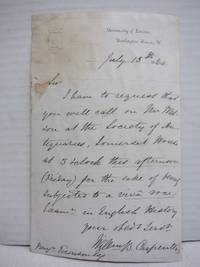
1518042657unknown July 15 1864. Good. autograph. Good signed letter on University of London stationery dated July 15th 1864. William Benjamin Carpenter 1813 -1885 was an English physician invertebrate zoologist and physiologist. He was instrumental in the early stages of the unified University of London. Off white embossed stationary Size 7.25x 4.5" is lightly soiled. Reverse blank but looks like it had been pasted into an album. unknown unknown
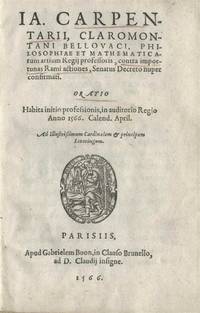
1566161EB1566. Paris G. Buon 1566. Holzschnitt-Druckermarke auf Titel 11 unnum. Bl. Pappband mit Inkunabelpapierbezug. Adams C 758 und IA 135.747 falsche Kollation beide innerhalb der "Orationes tres". - Das hier mit eigenem Drucktitel separat publizierte Werk den Bibliographen in dieser Form unbekannt enthält eine gegen Ramus gerichtete Streitschrift von Carpentarius der später zweimal 1568 und 1569 Dekan der medizinischen Fakultät in Paris wurde. Der aus Clermont bei Beauvais stammende Verfasser war bereits 16 Jahre lang Lehrer der Philosophie am Collège de Bourgogne zu Paris als er dort ein Studium der Medizin aufnahm. Leidenschaftlich verteidigte er in seinen Schriften die Lehren des Aristoteles. Als erbittertem Gegner des Calvinisten Peter Ramus' soll er schließlich an dessen Ermordung maßgeblich beteiligt gewesen sein siehe auch DSB XI 287 unter Ramus. Carpentarius starb 1574. Seine Schriften sind heute von größter Seltenheit. unknown
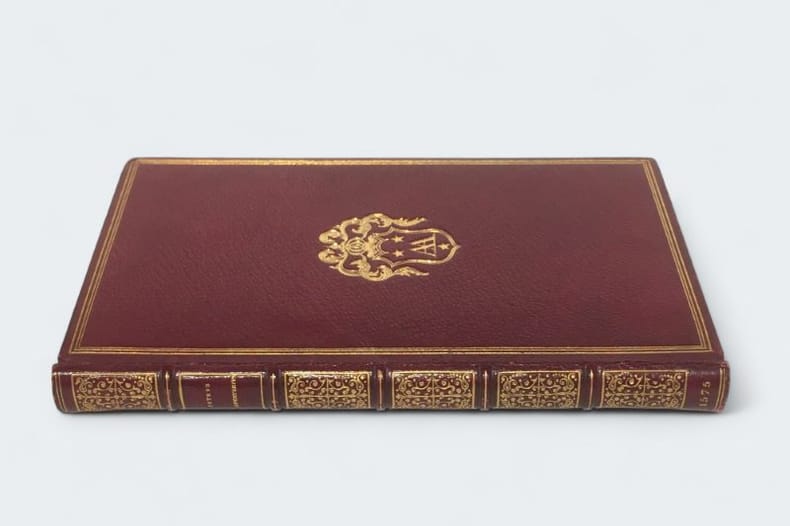
157571575 S. l. n. n., 1575 et 1573 ; 2 ouvrages en un vol. in-12, 55 ff., 1 f. bl. ; 26 ff., maroquin grenat, trois filets dorés en encadrement sur les plats, chiffre au centre, dos à nerfs orné, coupes filetées, roulette intérieure, tranches dorées (Thompson).
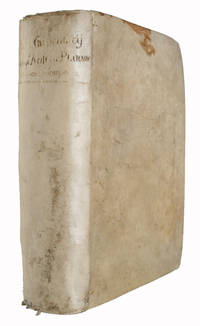
157347259Parisiis, Iacobi du Puys, 1573. 4to. Bound in one near contemporary full vellum. Printers woodcut device to booth title pages. Ex-libris [Luigi Imolae, physician to Pope VII] pasted on to pasted down front free end paper. Title written in contemporary hand to upper part of spine. Names written in contemporary hand and crossed out, except for 'Livius' and 'Imolae', to first title page. Very light uniform browning to leaves. All in all a fine and clean copy. (87), 477, (11), 328, (4) pp.
157347259Parisiis Iacobi du Puys 1573. 4to. Bound in one near contemporary full vellum. Printers woodcut device to booth title pages. Ex-libris Luigi Imolae physician to Pope VII pasted on to pasted down front free end paper. Title written in contemporary hand to upper part of spine. Names written in contemporary hand and crossed out except for 'Livius' and 'Imolae' to first title page. Very light uniform browning to leaves. All in all a fine and clean copy. 87 477 11 328 4 pp. <br/><br/><em>First edition of Charpentier's famous comparison of Aristotle and Plato - one of the most thorough and important works of its kind - which came to influence the way that the Renaissance viewed the two great thinkers and their works. The work which is profoundly anti-Ramist and also as such drew great attention constitutes a fabulous determination of the joint legacy of Aristotle and Plato and is one of the works that best illustrates the nuanced basis of Renaissance scholarship and philosophy. It is a curious but generally accepted conception that with the rise of the Renaissance came the fall of Aristotle. It is a fact that with the recovery of many lost works of ancient literature the widening of the range of classical studies and the renewed interest in Plato Aristotle was no longer the sole authority on a huge number of fields as he to a certain extent had been viewed during the Middle Ages. That this should mean a total ignorance of the teachings of Aristotle must be considered somewhat of a myth though a very frequently repeated one and in fact with the grand humanists of the late 15th and early 16th century the study of Aristotle fits perfectly with the broader comprehension of scholarship. The idea of nearing the thought of Aristotle to that of Plato and vice-versa is something that understreams much original thought of the Renaissance and Charpentier's work which explicitly and thoroughly compares and reconciles the two great thinkers gives us a fabulous insight into Renaissance thought as it is rarely presented."It was published at Paris in 1573. Charpentier shows a knowledge of other writers in this tradition namely Boethius Bessarion George Trebizond Giovanni Pico della Mirandola Symphorien Champier and Fox Morcillo among others." Riccardo Pozzo "The Impact of Aristotelianism on Modern Philosophy" p. 20. Jacques Charpentier 1521-74 Professor of medicine and philosophy Charles IX's physician taught mathematics at the Collège de France and philosophy at the Collège de Bourgogne and was later appointed Rector of the University of Paris. He passionately defended Peripateticism and was renowned for his philosophical and religious intolerance. Despite his remarkable merits he is today perhaps best known for his feud with Petrus Ramus French humanist and protestant convert with a liberal approach to Aristotelian teaching. In Ramus Charpentier saw the impact of Lorenzo Valla's criticism or Aristotle: "He thought that with Ramus the true idea of knowledge was in danger of eclipse" as expressed in the present work. Charpentier is often referred to as a Anti-Ramist due to his many - often fierce and personal - attacks on Ramus's teaching:"More intellectual provocative were three attacks by Jacques Charpentier. In 1551 as rector of the University Charpentier ruled that because Ramus did not teach the Aristotelian logic required by the statutes his pupils could not enjoy the privileges of Paris university students. Rasmus appealed first to the assembly of regents of Philosophy and later to the Parliament of Paris. Before the Parliament Ramus outlined a programme of study in which grammar rhetoric and dialectic led first to natural and moral philosophy and later theology or law. He argued that his method of teaching avoided wasting time on scholastic technicalities and produced graduates who were better prepared for practical life. The effectiveness of this speech and the support of his patron helped him to avoid censure and obtain a royal lectureship." Mack A History of Renaissance Rhetoric 1380-1620 Pp. 153-4."by 1565 he was leading opposition to the naming of Jacques Charpentier no relation a long-time adversary to the royal chair of mathematics. Charpentier who had by then succeeded Ramus as the Cardinal de Lorraine's protégé and who enjoyed Jesuit support kept his chair; and Ramus ever more threatened in 1567 again fled Paris taking refuge with the Prince de Condé." DSB. </em> hardcover