COOK, JamesBiblio.com
19 924 résultats
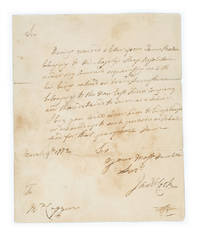
17725000783HMS Resolution at Deptford 1772. Slight wear along original folds but in excellent original condition. Autograph manuscript in ink on paper on one side of a single sheet small folio amounting to about 12 lines with a fine signature by Cook; docket-title on verso in a different hand. <p><p>Extremely rare: a full letter written entirely by Cook and signed boldly by him. The letter was written aboard HMS Resolution while the ship was at Deptford taking on final stores and provisions prior to sailing on Cook's arduous second voyage.</p> <p>In the letter dated 9 March 1772 and addressed to an official of the English East India Company Cook asks for the release of one of his men who has been press-ganged into the company's service. Such a letter written without the assistance of one of Cook's indefatigable clerks is particularly rare and attractive especially as the main corpus of material regarding his preparations for the second voyage takes the form of official correspondence frequently terse dealing with more conventional subjects.</p> <p>The letter reads in full:</p> <p>Sir</p> <p>Having received a letter from James Keaton belonging to His Majesty's Sloop Resolution under my command acquainting me with his being inticed on board the Devonshire belonging to the Hon. East India Company and there detain'd to serve as a soldier I beg you will order him to be discharged or delivered up to such persons as I shall send for that purpose. I am Sir</p> <p>Your Most Humble Servant</p> <p>James Cook</p> <p>To Mr. Coggin</p> <p>The activities of press-gangs at this period are well known and were a considerable hazard to a captain preparing to embark. This was especially true in 1772 for Cook who was enduring lengthy enforced delays in his preparations for the second voyage. Indeed a great many sailors were known to have "run" from the Resolution in the long months while the two vessels were going through their refit with an incredible fifty-eight recorded as having thus absconded and another thirty-nine discharged for various reasons see John Robson's online database.</p> <p>The depth of research that has been done regarding Cook's musters makes this manuscript document of especial interest as James Keaton is not otherwise known to Cook historians the similarly named "John Heaton" is recorded as running at the Nore on 14 May 1772 but Cook's hand is clear and the dates irreconcilable. It is also interesting that Keaton in Cook's words has been taken 'as a soldier' as his detachment of marines did not come aboard until 29 April 1772. Despite the bustle of Deptford it would seem that Cook was well informed about the fate of Keaton as the 499-ton East Indiaman Devonshire captain Robert Morgan was very likely in port; she later sailed from Portsmouth on 12 April 1772 see Charles Hardy A Register of Ships Employed in the Service of the Honourable the United East India Company p. 55.</p> <p>The letter is addressed to "Mr Coggin" undoubtedly a homophone for "Coggan" and almost certainly Charles Thomas Coggan one of the directors of the East India Company and Comptroller of Shipping. Coggan went on to a long and illustrious career in the company and by 1811 was the company's paymaster.</p> <p>The letter is not recorded in Beaglehole's calendar of documents for the second voyage although he does note three other letters apparently of the same day two to the Victualling Board and a third to Banks at a time when the naturalist was still intending to sail. Moreover while Beaglehole lists no fewer than ninety-two letters from Cook before he sailed on 13 July 1772 almost all of this material is quite boilerplate in form mostly addressed to the Admiralty or to official bodies such as the Victualling or the Navy boards. Other than the present urgent example the only letters not taking on a formal cast are one to Cook's friend Captain William Hammond two to Joseph Banks and a few to Cook's fellow officers on the Resolution or Adventure. Unlike most of the letters from this period and presumably because Cook wrote it himself in haste the text of this letter was never copied into the ship's record as would normally have been done by his clerk and thus does not appear in the Canberra Letter Book 1771-1778.</p> <p>This wonderful manuscript originally appeared for sale in the London dealer Francis Edwards' catalogue 904 1967 item 96 priced £330: in the same catalogue a copy of Magra's surreptitious account of the first voyage was priced £95. The export licence attached to the letter shows that it was sold to R.C. Bedell of Columbia Missouri.</p> </p> . Provenance: With Messrs Francis Edwards in 1967 their catalogue 904 item 96; sold to R.C. Bedell private collector of Columbia Missouri; acquired by Robert Parks private collector of Detroit Michigan; with Hordern House catalogue "Captain James Cook the Greatest Discoverer. The Robert and Mary Anne Parks Collection" 2008 item 34; private collection Australia. unknown
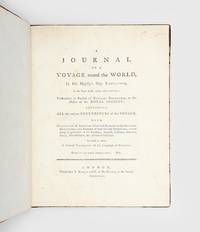
17875001042London: Alexander Shaw 1787. Quarto eight pages printed text followed by original blank leaves separating the 36 actual cloth specimens several full page as well as many smaller; original calf binding neatly lettered and decorated spine. <p><p>This rare and exotic publication of original Pacific artefacts is the most remarkable of the whole Cook canon: with a brief but significant letterpress introduction it mainly consists of actual specimens of eighteenth-century tapa cloth collected in the Pacific islands particularly Hawaii Tahiti and Tonga. </p> <p>In modern times the publication has become one of the great rarities of eighteenth-century Pacific exploration. This is an example of the first issue of the book with the strictly contemporary bookplate of Sir Corbet D'Avenant 1752-1823 Baronet of Stoke and Adderley. Donald Kerrr speculates in his census that D'Avenant was likely an original subscriber on first publication. </p> <p>Published only a few years after the return of the ships from Cook's third voyage it is not recorded how many of the cloth-books were prepared and up until the recent detective work of Erica Ryan at the NLA very little was known about the publisher Alexander Shaw either. However the limited supplies of the actual cloth must have dictated a very small edition - the most recent census of known copies by Donald Kerr stood at the tiny figure of 66 recently revised by us to 68 of which 57 were held by international libraries. This count of course includes the later issues of the book which continued to be sold often with dramatically varying contents as late as 1806. </p> <p>There has in effect never been a standard collation of the book - the fascinating dedication addressed to an unnamed "Sir" is genuinely vague on numbers - not least because it is obvious that Shaw was simultaneously selling individual samples and "fine specimens of the tree with the bark" at his shop in the Strand. </p> <p>Indeed as Forbes shows in some detail in the Hawaiian National Biography and others including Ian Morrison Maryanne Larkin Erica Ryan and Donald Kerr have all confirmed in more detail no two copies of the work are identical meaning that a precise collation is needed every time. Thus while 39 different samples are listed in Shaw's introductory list and "40" are mentioned at another point in the dedication many copies have quite different collations not least because the Jamaican sample perhaps the most surprising addition was apparently dropped in the course of publication. </p> <p>In short the present example has a total of 36 separate samples including particularly fine full-page examples of many of the more famous sheets. Almost none of the sheets have been particularly affected by the late-Georgian and Victorian practice of clipping: it is well-known that many collectors constructed what have become known as 'snippet books' of the Cook tapa cloths by cutting pieces from copies of Shaw's volume and pasting them into separate books or albums. </p> <p>As a result of this clipping habit copies of the original Shaw book survive in various states of completeness sometimes with only very small fragments of the once full-page specimens remaining. In this copy with its original blank leaves in place it is quite clear that the specimens have essentially retained their original shape with only four or perhaps five showing evidence of very minor clipping as can be shown from the ancient offsetting onto the adjoining blanks. </p> <p>The production of this book reflects the genuine curiosity aroused by tapa a fascination that drove competition between collectors of 'artificial curiosities' and generated an active market for the sheets brought home by Cook's men. The preface of the book contains descriptions of bark cloth manufacture by Cook Anderson Forster and an anonymous officer titled 'one of the navigators' and is followed by the list of the specimens compiled by Shaw. The list is indeed rich in fascinating details; for example we learn that the various uses of the tapa: 'wore sic by the people in the rainy season' or 'used at the human sacrifice'. Some of the notes in the list are longer and doubtless arise from tales told by the mariners who collected the tapa in the first place as boasted on the title page. </p> <p>Each island group used designs unique to its culture and the interest of Europeans in this material equalled the passion aroused by the extraordinary wood-carvings and exotic shells brought back by Cook. </p> <p>The Shaw Catalogue is of great significance as a repository of unique original tapa but it also speaks of the time when Cook's sailors were spreading their stories of the alluring South Seas while drawing-room chatter throughout the land luxuriated in descriptions of the new exotic. The publication forms a tangible link between these narratives the indigenous cultures of the South Pacific and Hawaiian islands the myriad personal and trading relationships that developed between the islanders and mariners and the genteel world of gentleman collectors and their cabinets of curiosities.</p> </p> . Provenance: Norton J. Whitmont collection; Kelton Foundation Los Angeles; original owner Sir Corbet D'Avenant 1752-1823 Baronet of Stoke and Adderley with armorial bookplate. Corbet d'Avenant was the son of Anne Corbet daughter of Sir Robert Corbet c.1670-1740 4th Bt of Stoke upon Tern. Upon the death of Anne's brother rector of Adderley from 1735 Sir Henry Corbet the seventh baronet on 7 May 1750 the baronetcy became extinct and the family estates passed to his nephew Corbet D'Avenant who assumed the name of Corbet and was created a baronet on 27 June 1786. Upon his death on 31 March 1823 the second baronetcy also became extinct. Alexander Shaw unknown
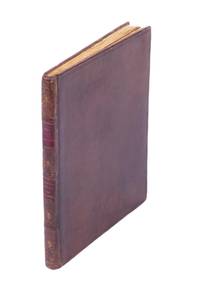
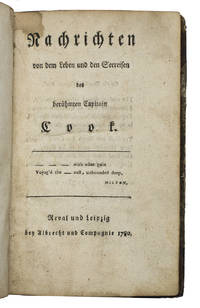
1780ABC_46167Reval = Tallinn Estonia & Leipzig: Albrecht und Compagnie 1780. Contemporary half calf brown sprinkled paper sides brown morocco spine label with title in gold. Stored in a professionally custom-made clamshell box with a red title label with gold lettering on spine. 8vo. With a woodcut ship on the title-page of ad 2 and woodcut headpieces in both works. 2 works in 1 volume. With: 2 Briefe aus England historisch-statistisch und artistischen Inhalts. 1s Heft.Reval = Tallinn Estonia & Leipzig Albrecht und Compagnie 1780. Extremely rare German account of Captain Cooks death published in Tallinn in Estonia "undoubtedly the first account of Cook's death to be published in book form" Beddie together with a letter concerning the 1775 Spanish voyage to the west coast of North America by Bodega y Quadra 1744-1794 also in German with many references to Cook. The first work opens with a short poem on the death of the English navigator and hydrographer James Cook 1728-1779 who died during a scuffle with the Hawaiian natives on 14 February 1779 after his relations with them had deteriorated. It is followed by a foreword and "a short account of Cook's life his voyages and his death with many inaccuracies on his early career" Beddie also in German. Much of the information in this small booklet comes from a letter Auszug des Briefes von Kensington den 4ten Febr. 1780 die Nachrichten von Kapitain Cook betressend.This letter "includes paraphrases of passages in Captain Charles Clerke's letter to the Admirality written at Kamchatka on June 8 1779 announcing the death of Cook at Hawaii" Forbes. Beyond the books importance as the first published account of Cook's death it also includes many passing references to the Hawaiian Islands. It ends with a laudatory poem on Cook's death "An elegy on the death of the late Captain Cook" followed by a German translation.In addition to the present edition in the original German Albrecht published a French translation more or less simultaneously: Précis de la vie & des voyages du Capitaine Cook. Écrit de Kensington ce 4 février 1780. The author of this account of Cook's death is uncertain though it has been attributed to Georg Forster 1754-1794 or Johann Reinhold Forster 1729-1798 German natural scientists who accompanied Cook on his second voyage.The second work in this volume by the same publisher in matching format in the same year is a letter concerning the 1775 voyage to the west coast of North America by the Spanish voyager Juan Francisco de la Bodega y Quadra. It contains many references to the voyages of Cook and is even rarer than the Nachrichten. Both works on Cook and the Pacific are rare the Briefe with only 1 copy in WorldCat even rarer than the Nachrichten. We have found only one other copy of either in auction record in fact the two works bound together.Binding slightly rubbed especially around the spine and along the extremities. Some leaves slightly browned some occasional stains slightly dust-soiled a small wormhole in the outer margin of pp. 15-26 but overall an extremely rare work in good condition.l Ad 1: Beddie 241; Forbes 18; Howgego C176; VD18 11228342; WorldCat 12 copies in 4 entries; cf. Du Rietz 1060 French & German eds.; not in Hill. Ad 2: WorldCat 1 copy; not in VD18. Albrecht und Compagnie, unknown
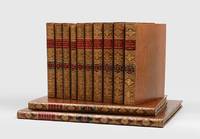
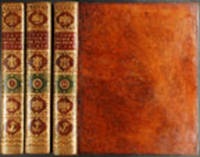
1773180309London: first two voyages: for W. Strahan and T. Cadell; third: by W. and A. Strahan: for G. Nicol and T. Cadell; Kippis: G. Nicol and G. G. J. and J. Robinson 1773-77-85-88. Presented by the dedicatee George III to the penitent Jacobite antiquary Andrew Lumisden Second and best edition of the first voyage first edition of the second and third voyages with the plates and maps for the first and second voyages bound separately. Unusually the plates for the second voyage have not been folded and are mounted on folio sheets. The set is bound uniformly with Kippis's work "the first English biography of Cook" Hill. This copy is inscribed on a preliminary blank in Volume I of the first voyage: "This fine and complete copy of Captain Cook's three voyages together with Lord Anson's voyage no longer present were a present which the King was graciously pleased to order for me for my attention in purchasing for his majesty's library several rare and curious books at the Duke de la Valliere's sale at Paris in spring 1784. Andrew Lumisden". Below Lumisden's signature is another inscription "Th Strange". The engraver Sir Robert Strange was Lumisden's brother-in-law. Andrew Lumisden 1720-1801 a Scottish Jacobite politician and antiquary "served as the under-secretary and the first clerk of the treasury to the Young Pretender Charles Edward Stuart "Bonnie Prince Charlie" throughout the campaign of 1745-6. He accompanied the army into England supplied money for its current expenses and left detailed and graphic manuscript accounts of the battles of Prestonpans Falkirk and Culloden. On the eve of the battle of Culloden 15 April 1746 special orders were given to ensure his safety as he carried with him 'the sinews of war' i.e. money and following the defeat he fled the field having first been entrusted with the safe keeping of the prince's seal" ODNB. After wandering the Highlands as a fugitive Lumisden returned to Edinburgh disguised as a lady's servant and escaped to the continent. He then became secretary of state to the exiled Jacobite court in Rome. With the arrival of Bonnie Prince Charlie Lumisden at first continued in this position. However he objected to the prince's drinking and womanizing and after an altercation left the Young Pretender's service. From 1772 he stopped writing annual letters to the Stuart princes and began to distance himself from their cause which bolstered a petition to allow him to visit Scotland once more. While in Paris he also bought a collection of rare books for George Prince of Wales which helped to secure his full pardon in 1778. As the joint founder of the Royal Society of Edinburgh Lumisden corresponded with figures such as Joseph Banks James Boswell Adam Smith and David Hume. His correspondence with Banks is commemorated in a letter dated 19 September 1783 viewable online in which he mentions staying with "my amiable and justly celebrated friend M. le Comte de Buffon" the great French naturalist. Lumisden continues "Words cannot express his gratitude to you for favoring sic him with the printed tables of the inclination and declination of the needle; which are to be given with Capt. Cooke's sic voyage which the public longs to see. He has already examined these tables but thinks that there are a few mistakes in them which must have proceeded either from the carelessness of the printer or the inaccuracy of the manuscript". This appears to be a reference to Appendix VII in the third voyage. 4 works in 12 vols 10 quarto 293 x 227 mm 2 folio 480 x 305 mm and 550 x 400 mm. With all plates maps and plans as called for and the famous "Death of Cook" plate. Life: engraved portrait frontispiece of Cook by Heath after Dance. Uniformly bound to style in recent tree calf richly gilt spines red and green morocco twin labels double fillet gilt border on sides marbled endpapers yellow edges. Minor paper flaw at the head of a handful of leaves in vols. II and III first voyage closed tear to title page of vol. I third voyage and blank margin of a couple of plates atlas folio neatly repaired erasure of old presentation inscription dated 1888 at head of contents leaf in Life scattered foxing: an excellent wide-margined set. Beddie 650 1216 1543; Hill 783 358 361; Howgego I C173-6; National Maritime Museum Catalogue Voyages & Travel 577 586; Printing and the Mind of Man 223 second voyage; Sabin 16245 16250. Life: Beddie 31; Hill 935. unknown
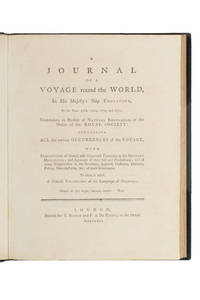
1773021328London England: Voyage. Very Good with no dust jacket. 1773 1777 1785. Hardcover. Ten volumes nine quarto volumes plus one folio atlas volume all bound uniformly in contemporary tree calf with elaborately gilt-decorated spines with raised bands and red and green morocco spine labels interspersed with gilt stamped image of Cook's ship the Endeavour or Resolution. Volumes have been expertly re-backed. Light rubbing to leather on board edges with some abraded areas. Overall text plates and maps are quite clean with occasional foxing and a rare small chip or tear to edges of pages. Plate XLII in volume II has a minor closed tear. One plate in atlas volume shows an archival repair expertly rendered. One leaf in volume 1 missing 3/4" piece from edge. Three volumes from the 3rd Voyage have extra-wide margins. Trimming to several plates is a little tight to plate margins but no content loss was observed. Within several of the folding maps are very small blemishes at folds not affecting content. Set includes the scarce first edition of the first voyage by Hawkesworth the second edition of Cook's official report of the second voyage and finally the second edition of the third voyage by Cook and James King. Superbly illustrated with more than 200 engraved charts maps and plates many of which are folding. All in all this is an outstanding set with exceptional and handsome bindings and clean interiors. A high point for any book collection on world exploration. James Cook embarked on three circumnavigations between 1768 and 1776 leaving a legacy of reliable maps of most of the Pacific Ocean and the western coast of North America. The official accounts of the three voyages were eagerly sought by a curious public with early editions selling quickly and leading to an amazing array of sets consisting of various editions and collations. The 1773 first edition Hawkesworth volume is accompanied by 52 charts and plates. According to Sabin 30934 the first edition is preferred for its plates. This set includes the directions for placing plates not that binders always followed these directions and the often missing "Chart of the Streight of Magellan". Our 1777 second edition of the 2nd voyage contains 64 plates maps and charts. The binders added an additional volume to our set which includes twenty-nine plates from the first voyage and sixteen plates from the second voyage forming a separate quarto volume bound uniformly with the text volumes. The 1785 second edition of the third voyage contains 24 plates with the aforementioned extra-wide margins. The beautiful atlas folio contains two large folding maps and 61 stunning finely engraved plates. Cook's reports were perhaps more holistic than previous reports including observations of astronomy botany ethnology and languages. Cook was commissioned in 1766 as commander of HM Bark Endeavour and proceeded to sail and explore thousands of miles across largely uncharted areas of the globe. He mapped lands of the Pacific Ocean from New Zealand and Australia to Hawaii in greater detail and scale not previously charted. His mapping and surveying led to the naming of thousands of features islands and coastlines which resulted in an evolution of mapping especially in Europe. Cook's third voyage after a visit to the Hawaiian Islands headed west in search of the fabled Northwest Passage. The party sailed northward along the California and Oregon coastline completely missing the Strait of Juan de Fuca in present day Washington. After exploring British Columbian and Alaskan waters Cook headed back to the Pacific Islands where he ran into trouble. A broken mast led to a month long layover at Kealakekua Bay. During this stay tensions rose and native islanders stole a cutter from the expedition. In an effort to bargain Cook's party kidnapped the Hawaiian King Kalaniopuu as ransom for the cutter. Negotiations turned out poorly resulting in the death of Cook and four of his men. The third voyage concluded under the leadership of James King. Howes C-729a Sabin 30934 16245 and 16250. . Voyage) hardcover
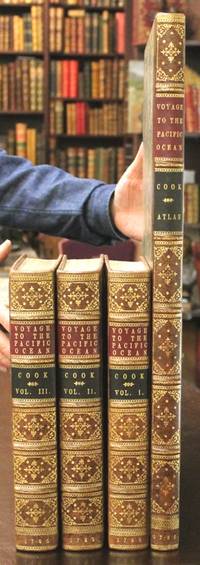
1773ABE-1742818913957<p>Hardcover. Condition: Near Fine. 1st Edition. This extraordinary offering comprises a complete first edition set of Captain James Cook's three voyages alongside the accompanying atlas. These volumes represent a cornerstone of maritime exploration cartography and historical documentation chronicling Cook's groundbreaking expeditions across the Pacific and Southern Hemisphere. Each voyage meticulously documented and lavishly illustrated offers invaluable insights into the 18th-century world capturing the spirit of discovery and the expansion of European knowledge. I. Hawkesworth John Editor. An Account of the Voyages Cook's First Voyage Title: An Account of the Voyages undertaken by the Order of His Present Majesty for Making Discoveries in the Southern Hemisphere And successively performed by Commodore Byron Captain Carteret Captain Wallis and Captain Cook. Editor: John Hawkesworth. Edition: First Edition 1773. Description Volume One: This three-volume set documents the official accounts of the voyages led by Byron Wallis Carteret and most notably Captain James Cook in HMS Endeavour. Cook's first voyage the centerpiece of this publication dramatically expanded European understanding of the Southern Hemisphere and the Pacific. Key features include a striking engraved frontispiece portrait of Cook by J.K. Sherwin after N. Dance Holland 25 mostly folding maps and charts and 27 folding plates. Notably this first edition includes the crucial "Chart of the Straits of Magellan" in Volume I often missing from early copies. Hawkesworth's editorial role was to elevate the raw expedition journals into a polished narrative reflecting the prestige and importance of these British maritime endeavors. Provenance: Castle Goring. II. Cook James. A Voyage Towards the South Pole Cook's Second Voyage Title: A Voyage Towards the South Pole and Round the World Performed in His Majesty's Ships the Resolution and Adventure. Edition: First Edition 1777. Description Volume Two: This two-volume set recounts Cook s groundbreaking expedition to circumnavigate the globe as far south as possible aiming to find Terra Australis. Cook crossed the Antarctic Circle for the first time dispelling the myth of a large southern continent. Discoveries included Easter Island Tahiti the Society Islands the Marquesas New Caledonia and South Georgia. Complete with all 64 plates including maps charts plans and fold-out illustrations. Frontispiece portrait of Cook and a fold-out map has been repaired at the original fold line. III. Cook James and King James. A Voyage to the Pacific Ocean Cook's Third Voyage Title: A Voyage to the Pacific Ocean Undertaken by Command of His Majesty for Making Discoveries in the Northern Hemisphere. Edition: First Edition 1784. Description Volume Three: This three-volume set chronicles Cook s final voyage aimed at determining the extent of North America's west coast and the feasibility of a northern passage. Despite Cook s death in Hawaii this voyage significantly expanded knowledge of the Pacific Northwest and Arctic regions. Includes 24 engraved maps and plans many folding detailing geographic discoveries. Occasional offsetting and toning. Webber John et al. Atlas to A Voyage to the Pacific Ocean Description Atlas: Rare 1784 folio atlas for Cook's third voyage. Features 61 engraved plates and 2 maps.</p> W. Strahan and T. Cadell [and others] hardcover
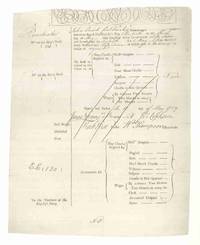
17595001037HMS Pembroke 1759. Folio single leaf partly printed and completed in manuscript in ink; docket-title on verso; original folds a little dusted head of leaf cropped; in excellent original condition tipped into a quarter morocco binding. <p><p>Original documents that relate to Cook's career are of extreme rarity and this example from a period of active duty off the American coast and a major stage in his early development is particularly desirable.</p> <p>Cook's time on the Pembroke was pivotal in his career. He served under the intellectual Captain John Simcoe on the voyage that took them to the Gulf of St. Lawrence for surveying work between 1757 and 1759. Simcoe guided the young Cook in the study of mathematics and astronomy and started him in the field of hydrographic survey. He lent Cook reference books and from various sources we know that during the very severe winter of 1758-59 at Halifax Cook used every moment for detailed study.</p> <p>The military surveyor Major Samuel Holland later recollected that when he met Cook in London in 1776 before he set out on his third voyage and by then the most famous sailor in the world Cook "candidly confessed that the several improvements and instructions he had received on board the Pembroke had been the sole foundation of the services he had been enabled to perform" Holland's letter to Simcoe's son 11 January 1792. He also remembered that "I was on board the Pembroke where the great cabin was dedicated to scientific purposes and mostly taken up with a drawing table. Under Capt. Simcoe's eye Mr. Cook and myself compiled materials for a chart of the Gulf and River St. Lawrence".</p> <p>Cook's time on the Pembroke was certainly the turning point in his career. The hydrographic skills that he acquired from working with Simcoe and Holland exemplified in the charting and survey of the St. Lawrence River led directly to his recognition by the Admiralty and his subsequent appointment to the Endeavour. This certificate to the Treasurer of the Navy is for payment of wages to First Lieutenant John Quick. It has four signatories James Cook as master along with James Norman Richard Wise as purser and William Thompson as boatswain.</p> </p> . unknown
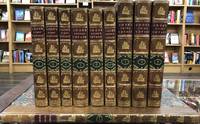
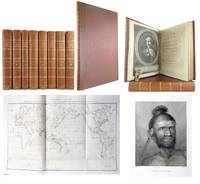
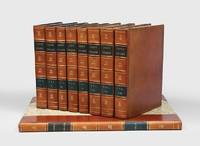
178541370London: Printed for W. Strahan; and T. Cadell in the Strand. H. Hughs for G. Nicol Bookseller to His Majesty in the Strand 1785. 8 Volumes 4to; Atlas folio. Vols: 11 1/4 x 9 inches. Atlas: 22 x 16 inches. Contemporary tan calf paneled with gold floral tooling spines elaborately decorated with gilt foliate in six compartments with raised bands red morocco lettering-piece in second compartment with brown letter-piece in third compartment giving the years covered in each volume in gilt. Atlas bound to matching style in half-calf with contemporary marbled paper boards spine in seven compartments with red morocco lettering-piece in second compartment and brown morocco lettering-piece in third compartment<br/> <br/> Provenance: Bookplates of Rev. William Goodall Samuel Alexander Cooke and G. N. R.<br/> <br/> A magnificent complete set of Cook's three voyages in eight volumes with very fine uniform original full calf bindings paired with an unusually fine atlas.<br/> <br/> "Captain Cook's three great voyages form the basis for any collection of Pacific books. In three voyages Cook did more to clarify the geographical knowledge of the southern hemisphere than all his predecessors had done together. He was the first really scientific navigator and his voyages made great contributions to many fields of knowledge." Hill The set comprises: An Account of the Voyages Undertaken by the Order of His Present Majesty for Making Discoveries in the Southern Hemisphere and Successively Performed by Commodore Byron Captain Wallis Captain Carteret and Captain Cook in the Dolphin the Swallow and the Endeavour. Vols. I-III. London: Printed for W. Strahan; and T. Cadell 1773. Three volumes. Second edition. Vol. I: 12 i-xxxvi 12 1-456. 21 cuts. 516 pp. Title Dedication Contents Introduction Nautical Terms Cuts Description Cuts Placement Preface Byron Wallis Carteret Compass Table. Vol. II: i-xiv 1-410. 22 cuts. 424 pp. Title Contents Introduction Cook's Voyage. Vol. III: 1-395. 8 cuts. 395 pp. Title Contents Cook's Voyage. 51 engravings folded maps and charts. A classic work of exploration this is the official account of Cook's first voyage commanding the Endeavour edited from his journal by Hawkesworth. It also contains the official accounts of the voyages of Commodore John Byron 1723-1786 Captain Samuel Wallis 1728-1795 and Captain Philip Carteret 1733-1796. Cook herein travels to Tahiti where he observed the Transit of Venus then mapped New Zealand and the east coast of Australia. With A Voyage Towards the South Pole and Round the World. Performed in His Majesty's Ships the Resolution and Adventure in the Years 1772 1773 1774 and 1775. Vols.I-II. London: Printed for W. Strahan; and T. Cadell in the Strand. 1784. Two volumes. Fourth edition. Vol. I: i-xl 1-378. 37 engraved plates. 418 pp. Frontispiece portrait by J. Basire after William Hodges Title Contents Introduction Plate List Voyage Towards the South Pole. Vol. II: 8 1-396. 27 engraved plates. 404 pp. Title Contents Advertisement A Voyage Towards the South Pole and Around the World. 64 engraved plates of maps portraits and views many of which folding. "The voyage where Cook proved there was no 'Terra Australis' which supposedly lay between New Zealand and South America and was the first to cross the Antarctic Circle. This voyage produced a vast amount of information concerning the Pacific peoples and islands proved the value of the chronometer as an aid in finding longitude and improved techniques for preserving scurvy in addition to the aforementioned discoveries." Hill. With: A Voyage to the Pacific Ocean. Undertaken by the Command of His Majesty for Making Discoveries in the Northern Hemisphere. Performed under the Direction of Captains Cook Clerke and Gore in His Majesty's Ships the Resolution and Discovery; in the Years 1776 1777 1778 1779 and 1780. Vols. I-III and Atlas. London: Printed by H. Hughs; for G. Nicol and T. Cadell 1785. In three volumes 4to with an atlas folio. Second Edition. Vol. I: 10 i-xcvi 1-421. 7 engraved plates with the rest in the Atlas. 528 pp. Title Contents Introduction To the Memory of Captain James Cook List of the Plates with Directions for Placing Them A Voyage to the Pacific Ocean. Vol. II: 14 1-548. 11 engraved plates with rest in Atlas. 562 pp. Title Contents A Voyage to the Pacific Ocean. Vol. III: 14 1-556. 6 engraved plates with the rest in the Atlas. 570 pp. Title Contents Appendix A Voyage to the Pacific Ocean Appendices I-VII. Atlas: 63 engraved plates including 2 fold-out maps. Cook's third and final voyage was a search for the Northwest Passage during which he anchored in Hawaii explored the Alaskan coast the Bering Strait and the Arctic Circle. On his southerly return Cook was killed in Hawaii. The expedition was then taken over by Charles Clerke and following Clerke's death John Gore. While en transit back to the UK the voyagers sighted Japan anchored in China and circled the Cape of Good Hope. Provenance: William Goodall 1757-1844 Lord of the manor Dinton Hall Buckinghamshire and an English artist known for his detailed watercolor illustrations of birds and animals.<br/> <br/> Beddie 648-50 1216-7 1543 1552. Forbes Hawaiian National Bibliography 62 85. Hill 358 361 782-3. Holmes 5 24 47A. Howes C729a. Howgego I C174. Jenks The Great Events Vol XVII p.238. Kroepelien 535. Lada-Mocarski 37. Mitchell Library Cook 648. O'Reilly Tahiti 433. Printing and the Mind of Man 223 Second voyage. Rosove 77 Second voyage. Sabin 16245 16250 30934. Spence 314. Printed for W. Strahan; and T. Cadell in the Strand. H. Hughs for G. Nicol, Bookseller to His Majesty, in the Strand unknown
1773166239London: various publishers 1773. Eight text volumes and an atlas. Comprising: 1. Hawkesworth John AN ACCOUNT OF THE VOYAGES undertaken by the order of his present majesty for making discoveries in the Southern Hemisphere and successively performed by Commodore Byron Captain Carteret Captain Wallis and Captain Cook in the Dolphin the Swallow and the Endeavour: drawn up from the journals which were kept by the several commanders and from the papers of Joseph Banks Esq. In three volumes. Illustrated with cuts and a great variety of charts and maps relative to countries now first discovered or hitherto but imperfectly known. Pp. xiixxxviviiiPreface to the Second Edition456xiv410396last blank 52 plates including maps and charts several folding or double page tables; med. 4to; minor production trimming fault to bottom fore-corner of pages 37/8 and 303/4 in Volume I the tip torn from bottom fore-corner pages 217/8 in Volume III a little light foxing and occasional slight soiling; printed for W. Strahan and T. Cadell London 1773. Second edition. Beddie 650; Hill 783. The second edition is considered the best as it contains in the Preface Hawkesworth's reply to the pamphlet A Letter from Mr. Dalrymple to Dr. Hawkesworth occasioned by some groundless and illiberal imputations in his account of the late voyages to the South Seas. 2. A VOYAGE TOWARDS THE SOUTH POLE AND ROUND THE WORLD. Performed in His Majesty's Ships the Resolution and Adventure in the years 1772 1773 1774 and 1775 . . . In which is included Captain Furneaux's Narrative of his proceedings in the Adventure during the separation of the ships. In two volumes. Illustrated with maps and charts and a variety of portraits of persons and views of places drawn during the voyage by Mr. Hodges and engraved by the most eminent masters. Pp. xl378viii396including an unpaginated title page to A discourse upon some late improvements of the means for preserving the health of mariners . . . by Sir John Pringle 64 engraved plates including a frontispiece portrait of Cook by William Hodges plus maps and charts many folding 2 with original tissue guards all but a couple with publisher's imprint a few small text figures several tables 1 folding Vocabulary of the language of the Society Islands; med. 4to; light damp stains to corners of frontispiece portrait and tiny hole affecting last numeral of page number on pages xxxix/xl in Volume I a couple of tiny wormholes to margins of last few leaves in Volume II with pages 213/4 reinserted onto stub minor production trimming fault to bottom fore-corner pages 299/300 & 357/8 and bottom fore-corner torn from pages 231/2 no text loss in same volume most of the plates faintly offset a couple of mainly small closed marginal tears occasional browning slight foxing and soiling; printed for W. Strahan and T. Cadell London 1779. Third edition. Beddie 1226. 3. A VOYAGE TO THE PACIFIC OCEAN. Undertaken by the command of His Majesty for making discoveries in the northern hemisphere. Performed under the direction of Captains Cook Clerke and Gore in His Majesty's ships the Resolution and Discovery; in the years 1776 1777 1778 1779 and 1780. In three volumes plus Atlas. Volumes I and II written by Captain James Cook F.R.S.; Volume III by Captain James King LL.D. and F.R.S. Published by order of the Lords Commissioners of the Admiralty. Pp. xxcvi422last blankxiv548xiv556 87 engraved plates including maps or charts several folding or double page 62 of the plates being in the atlas volume title page vignette each volume folding table in Volume III appendices; small closed tear to fore-edge margin pages 293/4 Volume I the plates in text volumes lightly offset tiny hole to fore-edge margin pages 247-250 Volume II light water stain to margins of most of the plates and neat repair to closed tears to two plates in the atlas volume occasional slight creasing a little mainly light foxing; printed for G. Nicol and T. Caddell London 1785. Second edition. Beddie 1552. Nine volumes including atlas. Seven of the med. 4to text volumes are uniformly bound in 19th century calf the boards with gilt edges double gilt rule surrounding a decorative blind border and gilt dentelles. The edges of the leaves in the first and third voyage volumes are marbled. Volume III of the Hawkesworth volumes is in a very similar binding but with a single gilt rule border no blind border and slightly different gilt edge decorations to the boards. All text volumes are neatly rebacked with later but not recent calf spines lettered and decorated in gilt and later endpapers. The boards are a trifle marked and rubbed with two tiny surface holes to upper board of Volume II of the Second Voyage; the spines are lightly rubbed. The impl. folio atlas is bound in 20th century half calf and brown cloth boards which are slightly scuffed and flecked. various publishers unknown
1773138403London: W. Strahan and T. Cadell and others 1773-85. Opening up the Pacific to western civilization A complete set of the official accounts of Cook's three Pacific voyages the second voyage in the first edition the first and third voyages in the often-preferred second editions. "Captain Cook's three great voyages form the basis for any collection of Pacific books. In three voyages Cook did more to clarify the geographical knowledge of the southern hemisphere than all his predecessors had done together. He was the first really scientific navigator and his voyages made great contributions to many fields of knowledge" Hill. His contributions to the advancement of knowledge were widely recognized in his own time. Cook's many discoveries resulted in British claims in Alaska British Columbia Oregon Australia New Zealand and Hawaii the last of which he regarded as his most valuable discovery but where he met his death. "Cook earned his place in history by opening up the pacific to western civilization and by the foundation of British Australia. The world was given for the first time an essentially complete knowledge of the Pacific Ocean and Australia and Cook proved once and for all that there was no great southern continent as had always been believed. He also suggested the existence of antarctic land in the southern ice ring a fact which was not proved until the explorations of the nineteenth century" PMM. This set includes some noteworthy and interesting additions: proofs before letters of "A Man of Van Diemen's Land" and "A Woman of Van Diemen's Land" in strong dark impressions beautifully inked both in the first volume of the third voyage with the captioned plates also present in the atlas volume. Bound as a frontispiece in the first volume of the third voyage is the stipple engraved portrait of Cook by Francesco Bartolozzi after John Webber published separately in June 1784. The first edition of the first voyage includes a new preface by Hawkesworth in reply to a letter from Alexander Dalrymple. The second edition of the third voyage has usually been preferred; the title pages are enhanced by the addition of vignettes of Cook's Royal Society medal and a portrait medal of Captain King and the text was entirely reset. Forbes points out that it was always considered "typographically superior". Thirty-five years after publication Cook's widow sent a copy to her doctor with an inscription noting that "the letter press of the second edition is much superior to the first both in paper & letter press". King George's copy now held at the British Library is also a second edition. Together 3 works in 9 vols: 8 quarto text vols 297 x 228 mm and folio atlas of plates 529 x 397 mm. With all plates maps and plans as called for; two additional proof plates and portrait of Cook see note. Contemporary marbled calf first five text vols and polished calf latter three text vols all uniformly rebacked folio vol. in modern half calf to style twin blue labels to spines and gilt capstan and fouled anchor devices in compartments marbled endpapers. Ownership signature of one K. H. Hermes dated 1874 to initial binder's blank of vols. I and II the signature apparently continental; bookplate of James Lenox William Naper 1791-1868 MP for Weobley 1813-1818 to front pastedown of vols. IV and V; contemporary ownership signature to title of vol. IV bleached out. Bindings recornered light rubbing and surface abrasion atlas volume with joints a little split and wear at extremities all holding firm. Contents with sporadic foxing or browning slight peripheral staining in vol. I and III generally clean leaves in sig. H in vol. II bound out of sequence. Plates with a few imprints trimmed a few folding plates with reinforcement to folds on verso or with closed tears along folds reinforcement in gutter to "A Fiatooka" plate in atlas volume. A very good set. Beddie 650 1216 1552; Books on Ice I.6; Hill 782 358 361 last for first edition; Howgego I C173-6; NMM Voyages & Travel 577 586; Printing and the Mind of Man 223 second voyage; Rosove 77.A1 second voyage; Sabin 16245 16250. unknown
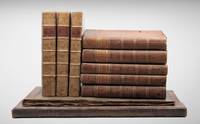
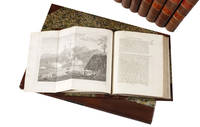
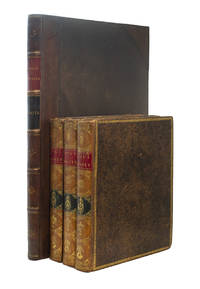
1784367088London: Printed for W. Strahan and T. Cadell 1784. First editions. Collations as below. 10 vols. 4to text and folio atlases. First editions. Collations as below. 10 vols. 4to text and folio atlases. FIRST VOYAGE - HAWKESWORTH John. An Account of the Voyages Undertaken by the Order of His Present Majesty for Making Discoveries in the Southern Hemisphere and Successively Performed by Commodore Byron Captain Wallis Captain Carteret and Captain Cook in the Dolphin the Swallow and the Endeavour. 51 engraved maps and plates many folding. 3 volumes. 4to. London: W. Strahan and T. Cadell 1773. First edition early issue without the Straits of Magellan map. Contemporary speckled calf sympathetically rebacked. Provenance: F. Norcliffe armorial bookplate. Beddie 648; Hill 782; Holmes 6; Sabin 30934.<br /> <br /> SECOND VOYAGE - COOK James. A Voyage towards the South Pole and Round the World. Performed in His Majesty's Ships the Resolution and Adventure In the Years 1772 1773 1774 and 1775. 64 engraved maps and plates. 3 volumes. 4to text and oblong folio atlas. London: W. Strahan and T. Cadell 1777. First edition rare issue with the maps and plates bound in an atlas. Contemporary speckled calf text and contemporary marbled paper boards atlas the atlas rebacked and retipped. Provenance: F. Norcliffe armorial bookplate in the text vols; Richard Clarke bookplate in the atlas. Beddie 1216; Hill 358; Holmes 24; Printing and the Mind of Man 223; Rosove 77.A1; Sabin 16245.<br /> <br /> THIRD VOYAGE - COOK James; and James KING. A Voyage to the Pacific Ocean. Undertaken by the command of His Majesty for Making Discoveries in the Northern Hemisphere. 24 engraved maps and plates in the text 63 engraved maps and plates in the atlas. 4 volumes. 4to text and folio atlas. London: W. Strahan and T. Cadell 1784. First edition. Contemporary speckled calf text and contemporary half calf and marbled paper boards atlas. Provenance: F. Norcliffe armorial bookplate in the text vols; Richard Henry Tidswell circular armorial bookplate in the atlas. Beddie 1543; Forbes 85; Hill 361; Holmes 47; Howes C729a; Lada-Mocarski 37; Sabin 16250.<br /> <br /> A fine complete set of all three of Cook's great voyages of discovery: "the basis for any collection of Pacific books" Hill. <br /> <br /> Cook's first voyage included visits to Tahiti and New Zealand and the tracing of the east coast of Australia was one of the most perilous feats of navigation in the whole recorded history of exploration. The second voyage pushed further south than any previous navigators in search of a southern continent as well as visiting numerous Pacific islands. The third voyage returned to islands previously visited discovered Hawaii and explored the northwest coast of America from Alaska to Oregon. The text of these official reports form an invaluable record of the voyages but they are enhanced enormously by the Plates maps charts and views. "In three great voyages Cook did more to clarify the geographical knowledge of the southern hemisphere than all his predecessors had done together. He was really the first scientific navigator and his voyages made great contributions to many fields of knowledge" Hill.<br /> <br /> Besides being first edition of each this set highly desirable as it includes the very rare separate atlas to the second voyage; almost all copies of the second voyage had the engraved plates trimmed and folded into the text volumes. We have seen only a couple of examples of this format which represented a distinct and special issue of the book. The text has demonstrably never had engravings bound within it and the superb impressions can be seen to their best advantage in this folio format where they are unfolded and untrimmed. Printed for W. Strahan and T. Cadell unknown
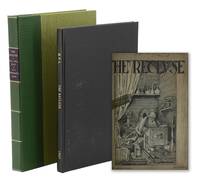
1927140947931Athol MA: W. Paul Cook 1927. First Edition. Near Fine. H. P. Lovecraft's own copy of the first and only issue of the legendary amateur periodical published by W. Paul Cook. Lovecraft has penned the title of his contribution "Supernatural Horror in Literature" and the page number and signed his name on the upper edge of the front cover. This marks the first appearance of Lovecraft's essay now considered a classic of literary criticism.<br /> <br /> <p>78 pp. Bound in serviceable black cloth lettered in gilt on the spine original olive green wraps preserved within. Near Fine with light soiling and foxing to wraps old repaired tear to left edge of front wrap offsetting from repair tape to following page and toning and thumbing to contents. Front board lightly scuffed; tight and sturdy binding commissioned by small press publisher and collector Gerry de la Ree. Housed in a custom clamshell case green cloth over quarter green morocco blue morocco title label lettered in gilt to spine.<br /> <br /> <p>The New England writer and publisher William Paul Cook was a friend and supporter of H. P. Lovecraft and encouraged the literary research that Lovecraft synthesized into his famous essay "Supernatural Horror in Literature." The essay occupied pages 23 through 59 of The Recluse a periodical Cook began for his own amusement. The contributors who included Clark Ashton Smith Donald Wandreiand Vrest Orton were not paid and Cook never got around to publishing a second issue. A loss to the world no doubt but the first issue alone -- printed in a run of just 100 copies -- made an outsized impact. The ultimate copy of this rare and influential publication. Joshi I-B.ii.335. W. Paul Cook unknown
17715000651London: Printed for T. Becket and P.A. De Hondt in the Strand 1771. A fine copy. Quarto; a fine copy in a Sangorski-style binding of half green morocco spine panelled in gilt between raised bands. <p><p>First edition of the earliest published account of Cook's first voyage to the Pacific: the rare first issue with the leaf of dedication to "The Right Honourable Lords of the Admiralty and to Mr. Banks and Dr. Solander" inserted by the publishers to add authenticity. This copy also has the first state of p. 90 recently identified and to be distinguished from an amended state where text begins "quantities.".</p> <p>This was the first of a series of so-called "surreptitious accounts" of Cook's various voyages to appear in print: the Admiralty found it practically impossible to enforce their ruling that no unofficial publications should pre-empt the official and lengthier accounts of the voyages naturally much slower in the press. In this case however legal action was taken against the publisher for using an unauthorised dedication forcing removal of the leaf during publication. "It is accordingly of the greatest rarity and copies of the book containing the dedication are far more valuable than those without it." Davidson. In this large copy the offending leaf has generous margins and retains its printed instruction to the binder "Place this next the title" which also interestingly indicates that the leaf was printed quite separately from the rest of the work.</p> <p>The British public's eagerness for news of the voyage needed more than newspaper accounts while the officially sanctioned narrative would be a long time coming. Published anonymously some two months after the return of the Endeavour and nearly two years before Hawkesworth's official account the Cook scholar Beaglehole demonstrated that the sailor James Magra was the author. His illicit sale of his journal to the publishers might well have confirmed Cook's opinion of him: 'one of those gentlemen frequently found on board Kings Ships that can very well be spared or to speake more planer good for nothing.'. He was a New Yorker and a loyalist. Whatever his skipper and the authorities may have thought of him it was Magra who got the first description of the voyage into print - the earliest printed account of the east coast of Australia published even before acceptance of the name Botany Bay here called Sting-ray Bay as Cook originally christened it.</p> <p>Magra later changed his name to Matra to claim a family inheritance. As Alan Frost has shown "The Precarious Life of James Mario Matra: Voyager with Cook; American Loyalist; Servant of Empire" 1995 Matra used his experiences on the east coast of Australia to draft his 1783 proposal for a penal colony at Botany Bay. Never shy in self-promotion he announced his hope of being made Governor. His plan like Sir Joseph Banks's before and George Young's after him had its effect on the planners of the First Fleet and he was called as an expert witness to the committee in charge of solving the question of transportation see Frost pp.113-122. His life has prompted a considerable literature with multiple studies of his career and importance including those by G.B. Barton George Anthony Wood James Watson who christened him the "Father of Australia" an accolade more often awarded to Joseph Banks and more recently Antonio Giordano who has him as "Australia's Spiritual Father" and Andrew Tink.</p> </p> . Printed for T. Becket and P.A. De Hondt, in the Strand unknown
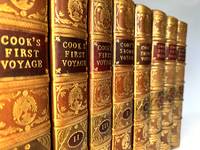
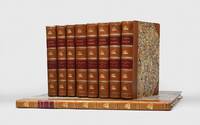
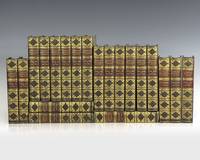
1773157169London: W. Strahan and T. Cadell and others 1773-85. The ablest and most renowned Navigator this or any country hath produced A complete set of the official accounts of Cook's three Pacific voyages all second editions; attractively presented in a uniform binding. "Captain Cook's three great voyages form the basis for any collection of Pacific books. In three voyages Cook did more to clarify the geographical knowledge of the southern hemisphere than all his predecessors had done together" Hill. Cook's first voyage in Endeavour combined an astronomical mission with an ambitious programme of exploration. After observing the transit of Venus at Tahiti Cook pushed south and west completing the first circumnavigation of New Zealand and then charting the entire eastern coast of Australia thereby transforming European understanding of the Pacific. The official account prepared by John Hawkesworth from the commanders' journals framed these achievements as a state-sponsored enterprise intended to enhance Britain's maritime reputation. Despite the controversy surrounding Hawkesworth's remuneration and editorial interventions the narrative established Cook's reputation and set the stage for further state-backed exploration. The second edition issued later in the same year adds a new preface in which Hawkesworth responds to Alexander Dalrymple's criticisms and is sometimes preferred for that reason. It also introduces separate pagination for the second and third volumes; in the first edition pagination was continuous through all three. Cook's second voyage the only official narrative written by Cook himself was designed to resolve one of the major geographical questions of the age: the existence of the hypothetical southern continent Terra Australis. Sailing in Resolution and Adventure he traversed high southern latitudes and proved conclusively that no such landmass existed within reach of navigation though he inferred the presence of Antarctica beyond the ice. The voyage also encompassed extensive exploration across Polynesia and the South Pacific with visits to Easter Island the Marquesas Tonga New Hebrides New Caledonia and South Georgia among others. Renowned for its scientific ethnographic and artistic record the expedition also demonstrated Cook's advanced approach to crew welfare which contributed significantly to its success. Cook's third voyage completed after his death by Captain James King sought a north-west passage through the Bering Strait and resulted in some of the most consequential discoveries of his career. The expedition charted the North American Pacific coast from California to Alaska with unprecedented accuracy and made the first recorded European landfall in Hawaii where Cook was ultimately killed. The official account edited from Cook's and King's journals documents major contributions to geography natural history and ethnology and its illustrations form an important visual archive of the regions visited. The second edition of the narrative typographically superior and preferred even by Cook's widow cemented the authoritative record of this final transformative voyage. Together 3 works in 9 vols: 8 quarto text vols 292 x 220 mm atlas folio of plates 592 x 425 mm. With all plates maps and plans as called for. Twentieth-century reddish brown half calf red morocco labels gilt ship devices in compartments publication date at foot of each raised bands gilt-tooled with geometric roll and edged with gilt fillets marbled boards edges sprinkled red. Folio atlas recently bound to style in matching half calf. Twentieth-century bookplate of C. C. Moseley "mos legem regit" on each front pastedown. Text vols: a touch rubbed professional neat repairs to spine and joints of vol. I with headcap raised other occasional judicious repairs to remaining vols scattered toning or offsetting a few plates repaired or reinforced some with small tears or trimmed paper creased or with small marks in places minor glue residue to gutter of title page in vol. II first voyage inner hinge cracked before frontispiece in vol. I second voyage; atlas volume: plates uncut charts on new stubs one with ink-stamped number on verso mounts worn at edges and some with minor repairs some without tissueguards. A very good and crisp set. Beddie 650 1216 1552; Books on Ice I.6; ESTC N33260 first voyage; Forbes 85 third voyage; Hill 782 358 361 last for first edition; Howgego I C173-6; NMM Voyages & Travel 577 586; Printing and the Mind of Man 223 second voyage; Rosove 77.A1 second voyage; Sabin 16245 16250. Philip Edwards The Story of the Voyage: Sea-narratives in eighteenth-century England 2004. hardcover
178535359London: H. Hughs for G. Nicol and T. Cadell 1785. 4 volumes text: 3 volumes 4to 12 5/8 x 9 5/8 inches;atlas: 1 volume folio 23 1/2 x 17 inches. Text: engraved medallion vignettes on titles 1 folding letterpress table. Atlas: 87 engraved plates plans maps and charts 1 folding 1 double-page and including the 24 small format plates usually found in the text here on unfolded full sheets. Extra-illustrated with very rare and possibly unique impressions of the 24 engraved plates on wove paper watermarked 1801 bound into the text. Original paper-covered boards expertly rebacked to style with contemporary brown paper. All contained within dark blue morocco-backed boxes.<br/> <br/> A fine unsophisticated set of the third edition of the third voyage with the plates in their most desirable form: all the plates usually found in the text volumes are here bound unfolded and uncut in the atlas volume. In addition this set extra-illustrated with a duplicate set of those plates being unrecorded 1801 impressions on wove paper.<br/> <br/> "The famous accounts of Captain Cook's three voyages form the basis for any collection of Pacific books. In three great voyages Cook did more to clarify the geographical knowledge of the southern hemisphere than all his predecessors had done together. He was really the first scientific navigator and his voyages made great contributions to many fields of knowledge . Cook's third voyage was organized to seek the Northwest Passage and to return the islander Omai to Tahiti. Officers of the crew included William Bligh James Burney James Colnett and George Vancouver. John Webber was appointed artist to the expedition. After calling at Kerguelen Island Tasmania New Zealand and the Cook Tonga and Society Islands the expedition sailed north and discovered Christmas Island and the Hawaiian Islands which Cook named the Sandwich Islands. Cook charted the American west coast from Northern California through the Bering Strait as far north as latitude 70 degrees 44 minutes before he was stopped by pack ice. He returned to Hawaii for the winter and was killed in an unhappy skirmish with the natives over a boat. Charles Clarke took command and after he died six months later the ships returned to England under John Gore. Despite hostilities with the United States and France the scientific nature of this expedition caused the various governments to exempt these vessels from capture. The voyage resulted in what Cook judged his most valuable discovery - the Hawaiian Islands" Hill. The typography of the third edition is similar to the second edition which is generally considered superior to the first: Hughs took over the printing from Strahan and re-set all the text. In addition the third edition includes the first appearance of William Wales's "A Defence of the Arguments advanced in the introduction to Captain Cook's last Voyage against the existence of Cape Circumcision" vol.III pp.557-564. This fine set in boards comprises the rarest and most desirable form of the third voyage with the 24 plates intended for the text volumes to be bound uncut and unfolded into the atlas. Thus plates which are generally severely trimmed close or into the image to fit into the text are here on full sheets with wide margins. An early owner of this set however has extra-illustrated his text with early 19th century impressions of those plates. This issue of the duplicate set of plates appears unrecorded being on wove paper watermarked 1801. That the plates were added is confirmed by the fact that the plates are tipped-in rather than sewn or guarded into the text.<br/> <br/> Cf. Beddie 1543; cf. Forbes Hawaiian National Bibliography 62; cf. Lada-Mocarski 37; cf. Printing and the Mind of Man 223; cf. Sabin 16250. H. Hughs for G. Nicol and T. Cadell unknown
1818109061London: John & Arthur Arch; Hackney: Conrad Loddiges & Sons et al 1818–1833. Rare first edition large paper issue set of Loddiges' renowned Botanical Cabinet with 2000 numbered hand-colored plates by George Cooke. Octavos 20 volumes bound in three quarters morocco over marbled boards with elaborate gilt tooling to the spine in six compartments within raised gilt bands red morocco spine labels lettered in gilt all edges marbled. Illustrated with 2000 numbered hand-colored botanical plates by George Cooke. In near fine condition. Armorial bookplates. An exceptional collection most rare and desirable in a complete set. Founded by Joachim Conrad Loddiges in Hackey north of London the renowned Loddiges plant nursery rose to great prominence during the early nineteenth century under George Loddiges who published in serial numbers the present Botanical Cabinet produced in connection with George Cooke one of the more highly sought after engravers of the era. The 2000 hand-colored plates catalogued the broad array of exotic plants trees shrubs ferns palms and orchids introduced into the famed nursery's hothouses and gardens from around the world. John & Arthur Arch; Hackney: Conrad Loddiges & Sons, et al hardcover
178421446London: W. & A. Strahan for G. Nicol and T. Cadell 1784. 4 volumes. Text: 3 vols. quarto 11 3/16 x 9 inches; Atlas: 1 vol. large folio 23 1/2 x 17 inches. Text: 1p. publisher's advertisements at end of vol.III. 1 folding letterpress table 24 engraved maps coastal profiles and charts 14 folding extra-illustrated with a duplicate folding engraved "Chart of the NW Coast of America and NE Coast of Asia" which is also present in the atlas. Atlas vol.: 63 engraved plates plans and maps one double-page one folding uncut. Text: contemporary tree calf expertly rebacked to style the flat spines divided into six compartments by double fillets enclosing a neo-classical roll red/brown morocco lettering-piece in the second compartment green morocco label with onlaid disc of red/brown morocco with volume number the remaining compartments elaborately tooled in gilt with stylised foliage cornerpieces around various large centrally-place tools; Atlas: expertly bound to style in half calf over marbled paper-covered boards the flat spine elaborately tooled in gilt uniform to the text.<br/> <br/> A fine set of the first edition of the official account of Cook's third and last voyage: a cornerstone among travel and voyage literature on the exploration of Hawaii and the northwest coast of America Canada and Alaska. This copy particularly desirable with the plates in the atlas uncut.<br/> <br/> "The famous accounts of Captain Cook's three voyages form the basis for any collection of Pacific books. In three great voyages Cook did more to clarify the geographical knowledge of the southern hemisphere than all his predecessors had done together. He was really the first scientific navigator and his voyages made great contributions to many fields of knowledge" Hill. "Cook's third voyage was organized to seek the Northwest Passage and to return the islander Omai to Tahiti. Officers of the crew included William Bligh James Burney James Colnett and George Vancouver. John Webber was appointed artist to the expedition. After calling at Kerguelen Island Tasmania New Zealand and the Cook Tonga and Society Islands the expedition sailed north and discovered Christmas Island and the Hawaiian Islands which Cook named the Sandwich Islands. Cook charted the American west coast from Northern California through the Bering Strait as far north as latitude 70 degrees 44 minutes before he was stopped by pack ice. He returned to Hawaii for the winter and was killed in an unhappy skirmish with the natives over a boat. Charles Clarke took command and after he died six months later the ships returned to England under John Gore. Despite hostilities with the United States and France the scientific nature of this expedition caused the various governments to exempt these vessels from capture. The voyage resulted in what Cook judged his most valuable discovery - the Hawaiian Islands" Hill.<br/> <br/> Beddie 1543; Forbes Hawaiian National Bibliography 85; Hill 2004 361; Lada-Mocarski 37; cf.Printing and the Mind of Man 223; Sabin 16250. W. & A. Strahan for G. Nicol and T. Cadell unknown
17855000614London: Strahan & Cadell; Strahan & Cadell; H. Hughs for Nicol & Cadell 1785. In generally very good condition with the inevitable odd spot or thumbmark; chart Friendly Islands at p.225 in volume 1 of the third voyage and the folding plate of coastal profiles at p.82 both with water stains. Together eight volumes quarto and folio atlas; a good set in old half calf and marbled boards double labels. <p><p>The full series of the official narratives of Cook's voyages - the cornerstone of any collection of books relating to Australia or the Pacific. Each of the three narratives is illustrated with marvellous engravings based on the work of the official artists on the voyages including Parkinson Hodges and Webber and the series stands as the great monument to Cook's achievements.</p> <p>These were the best-sellers of the second half of the eighteenth century; very expensive when published the first editions were sold out within a few days of publication. Their popularity meant that many copies were almost literally read to pieces; as a result good uniform sets of the voyages are fairly scarce.</p> <p>This set comprises the first edition of the first voyage in its first issue form; the unchanged second edition of the second voyage; and the preferred second edition of the third voyage. Sets of the voyages are seen in many combinations of editions: this particular combination generally regarded as a good way to have the set is one of those seen with some regularity.</p> <p>For full details see our analysis online. Briefly. the set is made up as follows:</p> <p>First voyage. HAWKESWORTH John. An Account of the Voyages. for making Discoveries in the Southern Hemisphere. </p> <p>First edition first issue. Three volumes quarto 51 engraved plates and maps. London 1773.</p> <p>Second Voyage. COOK James. A Voyage towards the South Pole and Round the World. </p> <p>Second edition. Two volumes quarto 64 engraved plates and maps many folding. London 1777.</p> <p>Third Voyage. COOK James and James KING. A Voyage to the Pacific Ocean.</p> <p>Second preferred edition. Three volumes quarto with 24 engraved maps and profiles; separate folio atlas containing two charts and 62 engraved plates. London 1785.</p> <p>---</p> <p>The set is made up as follows:</p> <p>First voyage</p> <p>HAWKESWORTH John. An Account of the Voyages. for making Discoveries in the Southern Hemisphere. </p> <p>Three volumes quarto 51 engraved plates and maps many folding. London Strahan and Cadell 1773.</p> <p>First edition first issue before printing of the chart of the Streights of Magellan and the "Directions for Placing the Cuts".</p> <p>Cook's great first voyage into the Pacific during the course of which he discovered and charted the entire east coast of Australia naming it New South Wales. This is in fact a compendium of four major voyage accounts to the Pacific which culminates with that of Cook's first voyage which fills two of the three large volumes giving an enthralling account of his exploration of Tahiti New Zealand and the east coast of Australia. The work was edited by the professional writer John Hawkesworth who was given the original journals of Captains Byron Wallis Carteret and Cook as well as the private journal of Joseph Banks in order to prepare it for publication a task which took almost two years. Cook himself was in the middle of his second voyage when it was finally published in London to widespread enthusiasm on 9 June 1773 Cook was actually in Cook Strait New Zealand at the time having just left Queen Charlotte Sound.</p> <p>Hawkesworth's involvement in the book was controversial and much ink has been spilt on the subject of his fitness for the task the dilettante man of letters Horace Walpole is known to have wittily criticised Cook's enthusiasm for the fishermen of 40 islands Samuel Johnson an apparent fixation with exotic insects while indignant letters to contemporary editors attacked everything from Hawkesworth's apparent lasciviousness to his godlessness but these reactions cannot distract from the fascinating story the moments of early contact and the great characters such as Banks or the Tahitian priest Tupaia. The plates charts and views are magnificent and most famously include the first astonishing engraving of a kangaroo charts of New Zealand and the east coast of Australia and the moving depiction of the Endeavour hauled on shore just north of Cape Tribulation on the north Queensland coast to fix the hole that nearly sent them to the bottom.</p> <p>Beddie 648; Hill 782; Holmes 5n; Kroepelien 535.</p> <p>Second Voyage</p> <p>COOK James. A Voyage towards the South Pole and Round the World. </p> <p>Two volumes quarto 64 engraved plates and maps many folding. London Strahan and Cadell 1777.</p> <p>Second edition: the official account of Cook's great second voyage prepared for publication by the navigator himself. The superb engravings here in fine black impressions are mostly the work of Hodges whose recording of the voyage resulted also in a famous series of oil-paintings. This was the second of four London editions of the full work there would be many abridgements and translations. Unhappy with Hawkesworth's rendering of his first voyage Cook was determined that the second would not be similarly treated: although he had the editorial help of Dr John Douglas this "is certainly Cook's book. There were to be no more Hawkesworths. 'The Journal of my late voyage' writes Cook to his friend Commodore Wilson at Great Ayton 'will be published in the course of next winter and I am to have the sole advantage of sale. It will want those flourishes which Dr Hawkesworth gave the other but it will be illustrated and ornamented with about sixty copper plates which I am of opinion will exceed every thing that has been done in a work of this kind. As to the Journal it must speak for itself. I can only say that it is my own narrative and as it was written during the voyage' ." Beaglehole. The two resulting quarto volumes with their dramatic illustrations after the expedition's official artist William Hodges 'would have given pleasure to any author' but they were never seen by Cook who had embarked on his fatal last voyage by the time they appeared.</p> <p>Early in the course of this remarkable voyage the Antarctic circle was crossed for the first time when Cook cruised as far south as possible round the edge of the Antarctic ice. His belief in the existence of a land-mass in the southern ice ring was eventually proved by the nineteenth-century explorers. In the Pacific he visited New Zealand again and either discovered or revisited many of the islands including New Caledonia Palmerston and Norfolk Islands Easter Island the Marquesas New Hebrides Tonga the South Sandwich Islands and South Georgia.</p> <p>Between February and May 1773 the two ships separated and Furneaux commander of the Adventure supplied Cook with the narrative of his experiences in the Adventure printed here: they called at Adventure Bay in Van Diemen's Land and sailed up the east coast "intending to coast it up along shore till we should fall in with the land seen by Captain Cook and discover whether Van Diemen's Land joins with New Holland". Before they stood away for New Zealand Furneaux had come to the opinion that "there is no straits between New Holland and Van Diemen's Land but a very deep bay.".</p> <p>Beddie 1216; Hill 358; Holmes 24; O'Reilly-Reitman 390; Printing and the Mind of Man 223.</p> <p>Third Voyage</p> <p>COOK James and James KING. A Voyage to the Pacific Ocean. Undertaken by Command of his Majesty for making Discoveries in the Northern Hemisphere.</p> <p>Three volumes quarto with 24 engraved maps and coastal profiles; with the separate folio atlas containing two charts and 62 engraved plates. London H. Hughs for Nicol and Cadell 1785.</p> <p>The official artist on the voyage was John Webber and his romantic views of the islands of the Pacific published here remain the most evocative portrayals of the islands - helping to create the notion of an island paradise that so affected the European public eagerly reading the voyages of discovery being published in the eighteenth century.</p> <p>This is an example of the second edition which is preferred to the first edition for a number of reasons. The most obvious difference is the use on the title-pages of the text volumes of engraved vignettes of the Royal Society Medal in volumes 1 and 2 and of an oval medallion portrait of Captain King in volume 3. The medal was awarded to Cook posthumously by the Royal Society in 1784 shortly after publication of the first edition of this book.</p> <p>This second quarto edition was printed by H. Hughs - rather than W. and A. Strahan who had printed the first edition - with the wording of the title-pages slightly modified and the text itself entirely re-set. As Forbes points out the second edition has always been "considered typographically superior to the first edition. That this was a contemporary opinion is borne out by a presentation inscription in a set Dixson Library State Library of New South Wales from Isaac Smith Mrs. Cook's relative and on her behalf addressed to Mrs. Cook's physician Doctor Elliotson: 'Clapham 5 May 1821. I am desired by Mrs Cook. to request your acceptance of the 4 books sent herewith being her Husbands last Voyage round the World as a mark of her respect. the letter press of the second edition being much superior to the first both in paper & letter press'.". It is interesting to note that the presentation on behalf of Cook's widow was made some 35 years after publication and even then Mrs. Cook chose to give a copy of the second rather than the first printing let alone the third or subsequent editions.</p> <p>The full story of the voyage and Cook's eventual murder while revisiting the Hawaiian Islands was so eagerly awaited by the English public that the entire first edition had sold out at the then huge price of four pounds fourteen shillings and sixpence within three days and copies were soon changing hands at up to ten guineas. King George III's copy of the official account preserved in the British Library is also an example of this second edition.</p> <p>Beddie 1552; Forbes Hawaiian National Bibliography 85; Hawaii One Hundred 5; Hill 361; Holmes 47n; O'Reilly-Reitman 434.</p> </p> . Provenance: Private collection Sydney. Strahan & Cadell; Strahan & Cadell; H. Hughs for Nicol & Cadell unknown
1785000823London 1785. Third Edition. Hardcover. Three Volume Set plus Atlas Vols. 1 and 2 written by James Cook Vol. 3 written by James King. Three volumes quarto with 24 charts and plates and a folding table large folio atlas with 2 large folding charts and 61 plates. The text Volumes in contemporary calf with red and green labels yellow edges joints of the first volume a little cracked small blemish in back board of the third volume; the atlas in contemporary half calf a bit wearing joints cracked end papers blemished with matching red label. Some offsetting on to text slight foxing. A fine set each volume with the early nineteenth-century bookplate of George Spurrell of Barking Essex. Third edition is named the best edition rare with the atlas. Size: Folio Larger than 12"/25.4 cm . Quantity Available: 1. Pictures of this item not already displayed here available upon request. Inventory No: 000823. . hardcover
178568797London: Printed by H. Hughs for G. Nicol 1785. An Exhibition Set of the Second and Best Edition of Cook's Third Voyage with Atlas<br> <br> COOK Captain James. KING Captain James. A Voyage to the Pacific Ocean. Undertaken by the command of His Majesty for making discoveries in the Northern Hemisphere. Performed under the direction of Captains Cook Clerke and Gore in His Majesty's ships the Resolution and Discovery; in the years 1776 1777 1778 1779 and 1780. In three volumes. Vol. I. and II. written by Captain James Cook F.R.S. Vol. III. by Captain James King LL.D. and F.R.S. Published by order of the Lords Commissioners of the Admiralty. The Second Edition. London: Printed by H. Hughs for G. Nicol 1785.<br> <br> Second edition. Complete. Three quartos volumes. 11 3/4 x 9 1/8 inches; 298 x 231 mm plus large folio atlas volume 21 3/4 x 15 15/16 inches; 552 x 405 mm. Three volumes: 10 prelims xcvi 421 1 blank; 14 prelims 548; 14 prelims 556 pp. Three text volumes with twenty-four engraved plates and charts thirteen of which are folding and appendix with 1 folding letterpress table facing p. 528 in Volume III. Title-pages with engraved medallion vignettes. Atlas with the remaining 63 large plates and charts. The two charts in the atlas are folding. Bound in alongside the atlas plates are twenty full-page manuscript descriptions of plates in a contemporary hand. Twenty-one plates are described on twenty sheets. No doubt this set was kept or exhibited at a museum or a library. According to Forbes this second edition was "printed by H. Hughs rather than by W. and A. Strahan with the wording of the title page altered and the three-volume text completely reset. A distinguishing feature of the second quarto edition is the addition of engraved vignettes of the Royal Society Medal to the title pages. Volume I has Cook in profile and Volume II has the verso of the same medal. The Volume III title has an oval medallion portrait of Captain King. The second edition of Cook's Third Voyage is considered typographically superior to the first edition."<br> <br> The first two volumes of this narrative were written by Captain James Cook. The third volume was written by Captain James King after Cook died during the voyage.<br> <br> Three volumes in contemporary speckled calf. Volumes appear to be rebacked but the repair is invisible. Boards tooled in gilt Spines with red and green morocco spine labels lettered in gilt. Spines elaborately stamped in gilt. Gilt dentelles. Marbled endpapers. All edges speckled brown. Board edges and corners slightly rubbed and bumped. Previous owner's bookplate in front pastedown of each volume. Some minor toning from plates and a bit of foxing. Atlas is bound in early cloth boards rebacked in half calf. Red and black morocco spine labels lettered in gilt. Boards tooled in blind spine stamped in gilt. All edges dyed brown. Two previous owner's contemporary bookplates and an early ownership signature on front pastedown. Approximately twelve plates in the atlas with marginal tears professionally repaired not touching the engravings. Plates 38 and 65 with repaired tears that touch engravings but with no loss. Both folding maps in the Atlas with some reinforcement repairs to backsides no loss. Plate 77 is trimmed and mounted on newer paper no loss. Some very light occasional dampstaining to Atlas margins but generally very clean. Overall a very good attractive set.<br> <br> "The famous accounts of Captain Cook's three voyages form the basis for any collection of Pacific books. In three great voyages Cook did more to clarify the geographical knowledge of the southern hemisphere than all his predecessors had done together. He was really the first scientific navigator and his voyages made great contributions to many fields of knowledge" Hill.<br> <br> "Cook's third voyage was organized to seek the Northwest Passage.Officers of the crew included William Bligh James Burney James Colnett and George Vancouver.the expedition sailed north and discovered Christmas Island and the Hawaiian Islands which Cook named the Sandwich Islands. Cook charted the American west coast from Northern California through the Bering Strait as far north as latitude 70 degrees 44 minutes before he was stopped by pack ice. He returned to Hawaii for the winter and was killed in an unhappy skirmish with the natives over a boat. Charles Clarke took command and after he died six months later the ships returned to England under John Gore. This voyage resulted in what Cook judged his most valuable discovery- the Hawaiian Islands" Hill p. 62.<br> <br> "Captain James Cook was the most intrepid and resourceful navigator of the century if not of all time. Thoughtful of the health of his men just in his dealings with the natives and strict in his discipline he most amply justifed the Admiralty in their choice of him as commander of the three voyages that go under his name" Cox p. 57.<br> <br> Hill 361. Mitchell Library Cook 1543; Sabin 16250. regarding 1st Edition; Forbes 62.<br> <br> HBS 68797.<br> <br> $26500. Printed by H. Hughs, for G. Nicol unknown
1886312762Charleston South Carolina 1886. 120 vintage albumen prints 4-3/4 x 8 inches with one measuring 7-1/4 x 8-3/4 inches mounted to stiff card album leaves most captioned in ink in a contemporary hand with an additional albumen print 4-3/4 x 8 inches mounted on card heavily worn with loss stamped "Geo. L.G. Cook photographer 265 King Street Charleston S.C.". Folio 12-1/4 x 10-1/4 inches. Contemporary black morocco gilt titled in gilt on front cover "The Charleston Earthquake / August 31st. 1886 / Francis W. Dawson. Spine perished but album intact extremities worn fading to some images occasional foxing to mounts and images. 120 vintage albumen prints 4-3/4 x 8 inches with one measuring 7-1/4 x 8-3/4 inches mounted to stiff card album leaves most captioned in ink in a contemporary hand with an additional albumen print 4-3/4 x 8 inches mounted on card heavily worn with loss stamped "Geo. L.G. Cook photographer 265 King Street Charleston S.C.". Folio 12-1/4 x 10-1/4 inches. An album of 120 vintage albumen photographs showing the devastation to the city of Charleston South Carolina following the earthquake of August 31 1886. Estimated to have reached a magnitude of between 6.6 and 7.3 on the Richter scale the earthquake left 60 people dead and caused substantial property damage to nearly every structure in the city. Felt as far away as Chicago and Cuba the Charleston earthquake remains the strongest recorded earthquakes on the east coast of the United States.<br /> <br /> The photographs collected in this album were taken by various Charleston photographers in the aftermath of the earthquake and document extensive property damage soil liquefaction sink holes and fissures ruptured rail lines and overturned train cars and the tent camps erected to house the newly homeless. "At least forty thousand people were 'tenting' in Charleston by September 3" Williams & Hoffius p. 53. A particular focus is placed on the damage sustained by the many Charleston churches and grand private residences. The photographers include George La Grange Cook 1849-1919 son of the prominent Civil War photographer George S. Cook 1819-1902. Cook's earthquake photographs were popular souvenir items and he offered some 200 images in his series "Cook's Earthquake Views of Charleston and Vicinity." Other identified photographers include the Irish-born James A. Palmer 1825-1896 who specialized in views of southern blacks and the English-born William E. Wilson d. 1905 who specialized in documentary photography of Mobile and Savannah. Photographs of the destruction - along with vials of "earthquake sand" - were popular souvenirs among the waves of "disaster tourists" who began arriving shortly after the earthquake to view the ruined city.<br /> <br /> This album belonged to the English-born Francis W. Dawson 1841-1889 who in 1862 emigrated to the South to fight for the Confederacy. At the time of the earthquake Dawson was co-owner and editor of the Charleston News and Courier a photograph of the paper's damaged office is included in the album and was the city's most prominent private citizen. Despite his earlier support for the Confederacy Dawson used his influential position to urge racial tolerance and support for Reconstruction. Dawson was appointed a member of the Executive Relief Committee formed in the aftermath of the earthquake and was instrumental in spearheading and supporting the rebuilding of the city. His newspaper urged optimism and resilience in the face of mounting racial tension and the ever-present fear of another cataclysmic natural event. "Almost single-handedly Dawson was attempting to prod his fellow citizens to buck up and rebuild their city" ibid p. 93<br /> <br /> Produced between 1886 and the time of Dawson's sensational murder in 1889 the album may have been presented to Dawson as a tribute for his efforts in the rebuilding of the city. The first photograph in the album shows Dawson's home at 99 Bull Street with Dawson and family sitting on their new front porch rebuilt after its destruction during the earthquake. To the left of the family is Hélène Burdayron the Swiss au pair who was at the center of a dispute that lead to Dawson's murder. Williams & Hoffius Upheaval in Charleston 2011; Roxana Robinson "The Strange Career of Frank Dawson" The New York Times 20 March 2012 unknown
1785B6042London:: for G. Nicol Bookseller to his Majesty in the Strand; and T. Cadell in the Strand. c. 1785; . In near fine condition. Text and plates are clean and crisp. A handsome and attractive set. Several mispaginations with no loss: Vol I p. 263 as “173â€; Vol II p. 247 as “347â€; Vol III p. 379 as “579â€; Vol IV p. 172 as “72â€. Vol I: pp.293-297 marginal light browning. Edition: Second and superior Edition. Binding: Text vols: expertly rebacked saving contemporary full calf; spine with five 5 raised gilt bands forming six 6 gilt ornamented compartments; gilt-lettered title on red and black morocco labels on two and three; all edges red; endpapers renewed. Atlas volume: Half-calf with gilt dog-tooth roll bordering to marbled boards; spine with six 6 raised bands forming compartments of gilt ornamental design and gilt lettered titles on red and black morocco labels on two and three; edges slightly blue. Notes: Cook’s third voyage continued the centuries-old search for the North-West Passage beginning from the west. After passing Tasmania New Zealand and many islands in the South Pacific the crew sailed north and discovered the Christmas and Hawaiian Islands; onwards to their primary destination the Northwest Coast of America and the Bering Strait then returning south along the West Coast to California and back to Hawaii. It was during this second visit to Hawaii that Cook was killed and the expedition continued under the leadership of Clerke and Gore who led the crew to the eastern coasts of Siberia and finally returned to England in 1780. Cook contributed to the advancement of geographical knowledge of the southern hemisphere to a degree that none of his predecessors had been capable of doing. “He was really the first scientific navigator and his voyages made great contributions to many fields of knowledge" Hill. Further he states about this work that it is “…an abridgement of Captain Cook’s third voyage… preferred by some readers because the nautical and technical parts having been deleted the work reads more like an adventure.†Hill.<br><br>Taking over from Strahan and setting out to print the second edition the present example of Cook’s third voyage Hughs re-set the text; since its typography is considered superior. Forbes refers to a book presentation inscription offered to Dr. Elliotson physician of Mrs. Cook: ".the second edition being much superior to the first both in paper & letterpress." <br> Size: 4to. 297x233mm Folio Illustration: Illustrated titles with vignette medallions incl. medallion portraits of the authors; as well as all 87 illustrations as listed on the table of plates: these of varying sizes: seven 7 engravings in vol I eleven 11 in vol II six 6 in vol III and 63 in the folio atlas. Volume: Three text volumes and o References: Beddie 1575; Cowan p.654-5; Cox II p.30; Ferguson p. 281; Forbes I 298; Graff 4456; Hill 2004 1753; ; Hill 362 later edition; Howes V-23; Judd 178; Lada-Mocarski 55; O’Reilly & Reitman 635; Sabin 16251 later edition; Sabin 98443; Smith 10469; S Pages: VOL I: 2 title blank contents 8 introduction i-lxxxvi To the Memory of Capt. James Cook lxxxvii-lxxxix bl. list of plates xci-xcvi; a voyage to the Pacific Ocean 1-421 3 including 7 plates; VOL II: 2 title blank contents 12 1- 548 2 including 11 plates; VOLIII: 2 title bl. contents 10 Contents Appendix bl. 1-487 bl. Appendix 489-556 with double page folding table 2; including 6 plates; Atlas VOL: 63 plates. Category: Book Pacific; Book Plate Books General; Book Voyages General; for G. Nicol, Bookseller to his Majesty, in the Strand; and T. Cadell, in the Strand. hardcover
1785140948368London: Printed by H. Hughes for G. Nicol bookseller to His Majesty in the Strand; and T. Cadell in the Strand 1785. Second Edition. Near Fine. Second edition Four volumes consisting of three quarto text volumes and one folio atlas. Complete with a total of 87 copper-engraved plates. Bound in period-style mottled calf morocco title labels to spines ornate gilt tooling to spines and edges. Near Fine with light wear to covers; binding strong and sound. A beautiful set. <br /> <br /> <p>Text volumes: 10 xcvi 421; xiv 548; xiv 556 pp. 24 single page and folding maps and charts. Marbled endpapers all edges marbled. Ownership inscription dated 1844 to fly-leaf of each volume. Light toning to endpapers light offsetting from plates and occasional foxing. Erased pencil inscription along lower edge of Vol. I title page short tears to gutter margins of several plates tiny stain to plate facing p. 410 in Vol. II and soft crease to upper right corner of Appendix pages in Vol. III. Contents bright plate folds crisp.<br /> <br /> <p>Atlas: unpaginated no title page as issued; begins with a large folding map titled A General Chart: Exhibiting the Discoveries made by Capt.n James Cook in this and his two preceeding Voyages; with the Tracks of the Ships under his Command. Followed by double page map Chart of the NW Coast of America and NE Coast of Asia explored in the Years 1778 & 1779 and 61 plates depicting people buildings landscapes artifacts and animals. Toning to marbled paper over boards light to moderate foxing to illustrated plates and very minimal foxing to maps. Short separation at fold intersection of first map lacking several tissue guards creasing to guards. Horizontal crease to final plate affecting text below illustration. The plate of the "Death of Cook" which occasionally appears in the second edition atlas but is not called for in the list of plates is not present in this copy. Holmes 19 Howes C729a Lada-Mocarski 37.<br /> <br /> <p>The second edition of the official account of Cook’s final voyage with the same collation as the first edition of the previous year. The eagerly-awaited first edition sold out within days despite its price of four and a half guineas – roughly $800 in today’s money. The books were printed with great care for George Nicole bookseller to the King and A Voyage to the Pacific Ocean is one of his finest works. John Webber was the expedition’s official artist and his evocative illustrations contributed to the book’s commercial success.<br /> <br /> <p>James Cook 1728–1779 was one of the greatest navigators in maritime history. The son of a laborer he went to sea as a teenager and worked his way up the ranks switching from the merchant navy to the Royal Navy in 1755. He saw combat in the Seven Years War and proved himself good at surveying rivers and coastlines in Canada. When the Royal Society proposed an expedition to the south Pacific to observe the transit of Venus across the face of the sun Cook was chosen to command it. He sailed for Tahiti on the Endeavor in 1768 accompanied by an astronomer botanist and two artists. Cook observed the transit and then sailed south in accordance with his secret instructions from the Admiralty: to search for the fabled “Great Southern Continent†and claim it for Britain.<br /> <br /> <p>The mythical continent was not uncovered but the Endeavor completed the outlines of Australia and New Zealand confirming that they were unconnected to any other landmass. Cook took possession of the Australian eastern coast he had charted in the name of King George named it New South Wales and upon returning to England in 1771 was promoted to commander.<br /> <br /> <p>The newly minted commander wanted another stab at finding the Great Southern Continent this time supported by an additional ship. The Resolution and Adventure sailed out in 1772 and the Resolution became the first ship to cross the Antarctic circle. After sweeping the southern Pacific and charting and naming a number of islands Cook finally decided that the only continent south of Australia was the uninhabitable mass that likely existed beyond an ice barrier he could not cross. Nonetheless the voyage was scientifically significant and filled in many barren spaces on British maps. Cook was promoted yet again when he returned to England in 1775 by this time an international celebrity.<br /> <br /> <p>The following year Cook set out on his third voyage with the Resolution and Discovery. The mission was find a northern sea passage from the Pacific to the Atlantic and although that too was a failure the expedition accomplished a great deal else. The crew members were the first Europeans to make contact with the inhabitants of the Hawaiian Islands which Cook called the Sandwich Islands after one of his patrons. The captain surveyed 4000 miles of the Pacific Northwest coastline and the fine engraved plates in the Voyage’s atlas provide a valuable record of the people and places he encountered along his long journey.<br /> <br /> <p>That journey was to be his last. Cook had been well received when he first wintered in Hawaii but the reception was less warm when he returned after a storm damaged one of his ships. Hostilities between the Hawaiians and Europeans came to a head when the Discovery’s cutter was stolen and Cook came up with an ill-advised plan to hold Chief Kalani’opu’u-a-Kaiamamao as hostage against the boat’s return. An angry crowd confronted him on the shore and he was killed in the fracas along with four marines. The survey of Hawaii was completed by Cook’s replacement Captain Clerke and after another unsuccessful hunt for an Arctic passage the ships turned homeward.<br /> <br /> <p>Captain Cook’s violent death made the renowned navigator into something of a saint. One of his first lieutenants was James Burney beloved brother of the novelist Frances Burney and her reaction upon hearing the news was typical:<br /> <br /> <p>“How hard after so many dangers so much toil – to die in so shocking a manner – in an island he himself had discovered – among savages he had himself in his first visit to them rendered kind and hospitable and in pursuit of obtaining justice in a cause in which he had himself no interest but zeal for his other captain! He was besides the most moderate humane and gentle circumnavigator who ever went out upon discoveries; agreed the best with all the Indians and till this fatal time never failed however hostile they met to leave them his friends.â€<br /> <br /> <p>The gentleness of James Cook is up for dispute but the accuracy and impact of his work is not. His voyages of discovery considerably advanced the fields of geography astronomy ethnography and natural history. He laid the groundwork for the expansion of the British Empire changing the lives of millions of people around the world – for better and for worse. This account of his last and most important journey is a cornerstone of Pacific exploration literature and an essential historical resource. Printed by H. Hughes, for G. Nicol, bookseller to His Majesty, in the Strand; and T. Cadell, in the Strand unknown
1771169427London: Printed for T. Becket and P. A. de Hondt 1771. The first published account of Cook's first circumnavigation First edition published two months after the return of the Endeavour and preceding Hawkesworth by two years. This copy has the leaf addressing the Lords of the Admiralty Joseph Banks and Daniel Solander. Written by Cook's mutinous midshipman "this was the first in a series of so-called 'surreptitious accounts' of Cook's various voyages to appear in print: the Admiralty found it practically impossible to enforce their ruling that no unofficial publications should pre-empt the official and lengthier accounts of the voyages naturally much slower in the press" Parks. This account was formally attributed to a host of figures including Banks Hawkesworth and even Cook himself. Arnold Wood in his Discovery of Australia 1922 was the first to suggest that the author was the American midshipman James Magra later Matra - subsequently a leading proponent of establishing a convict colony at Botany Bay - and this attribution supported by the editor of Cook's journals James Beaglehole is now widely accepted. Magra neglects to mention his unsavoury conduct on the voyage. "In May 1770. suspecting that Magra was implicated in the drunken cropping of his clerk's ears Cook suspended the midshipman from duty noting that he was 'one of those gentlemen frequently found on board Kings Ships that can very well be spared or to speake more planer good for nothing'" ADB. Magra was also likely the ringleader of an attempted mutiny at Tahiti which only failed because of a wave of venereal disease. Copies were sold with or without the leaf addressing the Admiralty "which has been misdescribed as a dedication. It is nothing of the kind but rather a provocative and brazen attempt to rebut an official notice which called into question the authenticity of the work and which is breathtaking in its temerity and even insolence. Because a relatively small number of copies of the book have survived with this additional leaf it is clear that the Admiralty responded by demanding the removal of this offending leaf" McCourt p. 145. The presence of the leaf is not conclusively indicative of first issue. This copy also has McCourt's uncancelled state of leaf N1. Quarto 269 x 211 mm pp. iv 130 3 1 blank. Nineteenth-century half calf green spine label spine ruled in gilt marbled sides edges sprinkled red. Binding refurbished abrasions where bookplate removed from front pastedown worming in upper margin but text unaffected couple of closed tears: very good. Beddie 694; ESTC T29208; Hill 1066; Holmes 3; Parks 6; Sabin 16242; Spence 229; Streeter 2405. James McCourt "A Second Cancel Leaf in A Journal of a Voyage round the World in His Majesty's Ship Endeavour in the Years 1768 1769 1770 and 1771" Script & Print vol. 46 no. 3. 2022. unknown
1771008201London in the Strand. and London: at No. 51 St. Paul's Church Yard; and T. JEFFERIES at Charing-Cross: T. BECKET and PA De HONDT. and NICOLL W. 1771. 1st Edition 1st Printing. Hardcover. Very Good. 4to - over 9¾ - 12" tall. JEFFERYS Thomas. The First Published Account of Cook's First Voyage to the Pacific complete with Dedication Leaf. A cornerstone of any Cook collection. Two works in one bound in modern to style half calf over marbled boards some blind edge tooling spine with raised bands gilt tooling gilt titles to red calf labels. Internally Journal of a Voyage 1771 First Edition First Issue with the Dedication and printers instructions plus the two 'Otahitee Vocabulary' leaves bound in at end. BOUND AFTER: Description of East-Florida 1769 Third Edition much enlarged 2 parts in one 3 folding engraved maps title with small library ink-stamp & repair to fore margin small ink correction to C3v professional repairs to maps some loss to the first occasional small stain some soiling and light browning scattered spotting. 281214 mm. Folding map frontis 2 title & dedication 1 ii-viii; Stork - Description of East Florida 1 2-40 1 folding map; Bartrams Journal 1 xii 35 pp 1 errata & binders list1 folding map; Magra's Voyage 1 title 2 dedication 1 2-130 pp 3 Vocabulary of the Language of the Otahitee. The 3 folding maps engraved by T. Jefferys are: 1.East Florida. 2.St. Augustine the Capital of East Florida. 3.The Bay of Espiritu Santo in East Florida. Signatures: East-Florida - 2ff b-b4 B-G1. G-G2 2ff H-M4. Voyage round the World - 2ff B-S1 2ff Vocab. Public appetite for a detailed narrative encouraged a publishing race of which this work published less than three months after the expedition's return to England and almost two years prior to Hawkesworth's authorised version was the winner. This first issue containing the dedication leaf was swiftly withdrawn following the publicly advertised consternation of the dedicatees the Admiralty Joseph Banks and Daniel Solander. Published anonymously the work is generally attributed to James Magra an American mid-shipman aboard. Hill II:1066without dedication leaf; Hocken p9; Holmes 3; O'Rielly-Reitman 362; Sabin 4246 & 16242; DuRietz-catalogue of the Kroepelien Collection p215; Frost Life of James Mario Matra: Voyager with Cook 1995; Beddie 693/4; STC T29207. The work is a short but interesting narrative of Cook's first voyage which relates his visits to Tahiti New Zealand Australia New Guinea Batavia and Rio de Janeiro. The author is noteworthy because he is one of the few to criticize Cook in any meaningful way. Despite problems with the accuracy of the text this work will always hold the place of being the first account of that voyage and the first account in print of the Australian coast. in translation it also gave the French their first account of that voyage. <br/> <br/> T. BECKET and PA De HONDT. and NICOLL W. hardcover