152 résultats
2019__0198778767Oxford Univ Pr 2019. Hardcover. New. 504 pages. 9.50x6.75x1.25 inches. Oxford Univ Pr hardcover
193064180Boston MA: Little Brown and Co. 1930. 8vo. xii 173 1 pp. Frontisp. numerous plates. Illustrated mustard-coloured publisher’s cloth wine glass illustration front cover w/ d.j. Art Deco cover art by Herold of drunken revelers minor shelfwear darkening to spine still NF/NF copy from the library of Eleanore Weinstock. First edition of this nicely illustrated and fascinating satirical examination of Prohibition Speakeasies Alcohol and the possible futures at the end of the Roaring 20’s as Americans invented a myriad of ways to keep drinking and socialize. Seldes has managed to inventively interweave a myriad of cocktail recipes into his observations along with a legion of cautionary and humorous tales. Little, Brown, and Co., hardcover
2014BN170915LA VIE DU RAIL 2014. 2014. Softcover. ENCYCLOPEDIE DES MOUCHES QUI PECHENT L' <br/><br/>ENCYCLOPEDIE DES MOUCHES QUI PECHENT L' Philippe Boisson LA VIE DU RAIL paperback
1999SONG0521652421Cambridge University Press 1999-09-28. hardcover. Used: Good. 6.50x1.75x9.75. Buy with confidence. Excellent Customer Service & Return policy. Cambridge University Press hardcover
19322110502150400420Publishing and printing person Taizo Ishiba Hinoue-cho Kita-ku Osaka 1932. Soft Cover. Fine. Volume: 1 Publishing and printing person Taizo Ishiba (Hinoue-cho, Kita-ku, Osaka) paperback
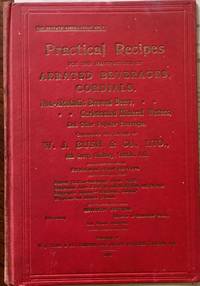
190956759Hackney London & Montreal Canada: W.J. Bush & Co. Ltd. 1909. 8vo. 183 20 pp. plus 17 pp. illustrated publisher’s ads. With a couple text illustrations. Red publisher’s cloth gilt lettering advertising on front cover illustrated endpapers a.e.g. minor darkening & soiling to spine edgewear still VG- copy w/ TL laid-in from W.J. Bush & Co. to Drewrys Ltd. in Winnipeg with formula for making up Dry Ginger Ale w/ Bonsante Preservative and two Dept. of Customs & Excise circulars for manufacturing pharmaceutical preparations from library of Mabel R. Beley 1885-1979 whose husband was Ernest G. Beley 1883-1951 longtime manager for the Olympia Brewing Co. in Olympia WA and later managed the Seattle Brewing & Malting Co. w/ label on front pastedown. Ninth edition of this essential handbook of recipes for flavorings and essences for producing carbonated drinks as well as non-alcoholic and alcoholic cordials. The recipes encompass those for Hop bitters Colas Orangeade Root Beers Sarsparilla Ginger Ale Tennis Ale Dandelion Ale Cream Soda many different beers champagnes flavored syrups of all kinds and more. The company was founded in 1851 by William John Bush and was the first producer in Britain of flavourings and essences with locations in Canada as well. W.J. Bush & Co., Ltd., hardcover
192855137Shieldhall Govan Scotland: Scottish Co-operative Wholesale Society Ltd. 1928. Oblong 4to. 10 x 9.25 in. 9 leaves unnumbered. on thick brown paper stock title w/ gilt lettering & ornament. With 8 tipped-in silver gelatin photographs sized 5.25 x 7.5 in. 1 w/ minor scuffing from offsetting of removed guard sheet. Thick brown softcovers punch sewn at gutter margin w/ brown silk braid yapp edges embossed logo on front cover minor edgewear rubbing minor soiling to title still a VG- exemplar. First edition of this very scarce photographic souvenir of the Scottish Co-operative Wholesale Society Exhibition held in Glasgow for their grocery departments. The noted Co-op recreated several different exhibits in order to display sell and advertise their toffees candies tomato ketchups pickles marmalades and the workers who manned the booths. At the time the S.W.C.S. was supplying over 690000 families through 268 affiliated retail Co-op societies achieving £17.7 million in sales. The photographs show artfully created counter displays wonderful period product advertisements and all manned primarily by young rosy cheeked Scottish lasses and nearly all in uniforms. Of special interest is the large lighthouse display stretching nearly 20 feet above the exhibition floor and composed entirely of marmalade and jam jars. The S.C.W.S. was formed originally in 1868 for purchasing manufacturing goods and eventually set up an entire factory complex at Shieldhall Glasgow producing a wide range of foodstuffs furniture clothing and housewares for their affiliated Co-ops. No copies located in Worldcat; See: David Jeremiah Architecture and Design for the Family in Britain 1900-1970 pp. 61-62 228-229. Scottish Co-operative Wholesale Society, Ltd.], paperback
193063169Austin & Minneapolis MN: Minnesota Utilities Company; Northern States Power Company - Home Service Department Cooking School; Federal Public Service Corporation of Minnesota ca. 1930-1936. Eight parts. 4to. 46 pp assorted separate numbering. w/ most leaves printed on recto only but 2 printed on recto & verso in mimeograph typescript stapled at upper left corners separately 1 part w/ “Seasons Greetings†printed in red minor age toning edgewear still a VG group. A culturally significant group of mimeographed recipes instructions and promotional flyers for the Home Economics & Cooking School demonstrations put on by Naoma Rice for three different Minnesota utility and public utility companies through the depths of the Great Depression. Spearheaded by Rice 1899-1937 the demonstrations emphasized the use and advantages of electric ranges and refrigerators as their popularity and use slowly became more widespread in the 1930’s with an emphasis on local produce and fruits. The first group of recipes includes instructions for such confections as Cranberry Sponge Cake Cider Sherbet Macaroon Pie Spagetti sic Sauce and Bran Refrigerator Rolls. Mixed through the other recipes there are instructions for Crunchy Potato Chip Cookies Apple Cheese Cake Parmesan Veal Frozen Pumpkin Pie and Corn Flake Crust. Several of the recipes emphasize the use of popular Minnesota fruits including Apple Quince Grapes and others.The importance of refrigeration was also emphasized in the “Cooking School†and Model Kitchens with instructions on temperatures needed for home rangers and refrigerators for cooked foods meats butter opened jelly or preserves cheeses and more. Rice suffered through an unspecified childhood illness by by the early 1920’s had become a public school Home Economics Teacher and then by 1928 was listed in Austin MN street directories as a “Demonstrator†for home economics and cooking classes. The Minnesota Utilities Company had been created in 1917 from several smaller utilities and my the Great Depression had grown large enough that it became subject to both the TVA and the Rural Electrification Project as Roosevelt’s New Deal programs attempted to encourage increased use of electricity and electric appliances to boost the economy. The Northern States Power Co. was based out of Minneapolis MN and extended across Minnesota Michigan into the Dakotas and operated an extensive Home Service Dept. The Federal Public Service Corporation of Minnesota appears to have been one of the short-lived outgrowths of WPA and PWA-sponsored programs under the New Deal. This cataloguer could not locate any similar surviving documents for Naoma Rice cooking classes or the Minnesota-based utility companies. Minnesota Utilities Company; Northern States Power Company - Home Service Department, Cooking School; Federal Public Service Cor unknown
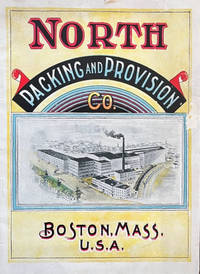
189359948Chicago & Boston MA: North Packing & Provision Co. Alfred Mudge & Son Printers 24 Franklin St. Swift & Co. 1893. Small 4to. 64 pp. Photo-illustrated throughout. Colour-illustrated softcovers birds-eye view of Packing House on Medford Street in Somerville colour labels of all the company’s meat products on the back cover minor creasing to spine age wear slight scuffing at fore-edge very small closed tear at upper fore-edge still a VG bright copy. First edition of this exceedingly scarce promotional catalogue for the Swift & Co.’s newly opened subsidiary packing house in Boston MA featuring on the rear cover all the New England market specific product labels. The new packing house in Somerville MA included 6 acres of cold storage for dressed meats and packaged meats brought into the East from Chicago as well as maintaining local stockyards and slaughter house operations in and around Boston. Swift 1839-1903 had originally grown up and worked in West Sandwich Cape Cod MA and in the 1870’s moved to Chicago where he became a driving force in the meatpacking industry. He was the first to employ refrigerated cars over protests of other butchers and major railroads which rightly believed the refrigerated systems would threaten their lockhold on stock cars and animal pens. By the 1890’s Swift & Co. had established North Packing & Provision Co. and were transporting over 3000 carcasses a week into Boston forcing other firms such as Armour & Co. to copy their methods. The subsidiary also allowed him to overcome resistance from East Coast meat retailers who questioned safety of frozen meat and so vastly did he increase production the packing house was able to dominate the Eastern markets. No copies located in Worldcat. North Packing & Provision Co., Alfred Mudge & Son, Printers, 24 Franklin St., [Swift & Co.], paperback
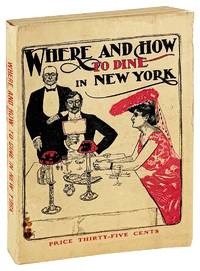
190345614New York: Lewis Scribner & Co 1903. Very Good. New York: Lewis Scribner & Co. 1903. First Edition. Octavo 19cm; publisher's cream pictorial wrappers; 2621416pp.; frontispiece and seventeen 17 halftone plates throughout extensive illustrated advertisements at beginning and end of the volume. Very light shelf wear textblock slightly starting to pull from binding else a fresh Very Good to Near Fine example.<br /> <br /> Brilliant example of this uncommon dime novel-format guide to dining out in turn-of-the-century New York City. The entries deal primarily with the hotels and major restaurants of Manhattan with just a couple forays into New Jersey or Brooklyn. Each entry is given two or three pages of description and frequently a photographic illustration of the dining room or the facade. <br /> <br /> Diners are reminded to visit the Waldorf Astoria during Horse Week while at the Pabst Grand Circle one can enjoy both "liquid and solid refreshments" while looking out over Central Park. At the Women's Lunch Club on West 23rd there is a strictly restricted membership limited to "fashionable shoppers" to keep the establishment from overcrowding. The many nationalities promised in the title appear to be limited to English American French and German. Lewis, Scribner & Co unknown
2019x-0198778767Oxford Univ Pr 2019. Hardcover. New. 504 pages. 9.50x6.75x1.25 inches. Oxford Univ Pr hardcover
2021BN215346DALLOZ 2021. 2021. Hardcover. Droit patrimonial de la famille 2021/2022. 7e éd. <br/><br/>Droit patrimonial de la famille 2021/2022. 7e éd. Bahurel Charles; Bicheron Frédéric; Boisson Julien; Collectif DALLOZ hardcover
2005__9004137025Brill Academic Pub 2005. Hardcover. New. bilingual edition. 798 pages. French language. 9.00x6.00x2.00 inches. Brill Academic Pub hardcover
195563056New York: Thomas Y. Crowell Co. 1955. 8vo. viii 6 274 pp. Publisher’s half-beige cloth over blue boards black lettering on spine slight toning to fore-edges minor shelfwear w/d.j. splendid wraparound pictorial map cover art depicting regional and local foods across the U.S. slight darkening to spine very minor edgewear still NF/VG copy inscribed by author on first dedication page “To Bessy Morris Eat & have fun.†First edition inscribed of this gastronomical memoir and guidebook by the esteemed authority on the best restaurants to be found while traveling the back roads of America in the first half of the 20th Century. Although Hines could barely cook he was a consummate traveling businessman whose adventures encouraged him to search for the best restaurants keeping notes and eventually writing his iconic guidebooks advising on restaurants and eateries wherever the tired motorist may stop. Prior to modern guidebooks ratings websites and other travel advisories Hines was an investigative epicurean who not only kept meticulous notes on the meals he ate but visited the kitchens and even the garbage outback to confirm cleanliness standards. He partnered in 1952 with Roy Park to form Hines-Park Co. in Ithaca NY and later began marketing everything from ice cream to cake mixes. Scarce in original dustjacket or signed. Thomas Y. Crowell Co., hardcover
193558780Lowell MA & Boston MA: J.W. Greer Co. The Fellman Studio for Creative Photography 30 Huntington Ave.; Marion Photographers ca. 1935. Ten silver gelatin photographs sized 8 x 10 in. inserted through corner slots on Bainbridge Board sized 10.5 x 12 in. mimeograph typescript labels neatly mounted at lower fore-edge of all images some creasing to corners from having been inserted into slots many w/ pencil annotations nearly all w/ photographer’s imprints on versos minor scuffing & wear to boards some edgewear wear to corners still VG set. A scarce group of original sales photographs for Greer biscuit cracker & cookie making machinery which allowed automated production and packaging. The first image depicts the “Cutting Machine†which rolled the dough into sheets and cut out the individual crackers placing them onto conveyors to the ovens. The immense gas burning oven with valves and temperature mixers mounted alongside includes photos of both the discharge from the cutting machine onto the oven conveyor and the discharge onto the cooling conveyors. The final five photos focus on the filling and weighing machinery which would ensure the correct amounts per package and then pack them in rolls insert into cartons and tightly seal each carton. Greer 1876-1950 was a machinist and inventor who began producing some of the world’s first automated bakery and confectionery equipment before World War I founded J.W. Greer Co. in 1919 and would eventually grow to a company of over 650 employees. The company continued to expand through World War II and later became the Wire Belt Co. still operating today in Londonderry NH. Since half of these photographs were shot by a Lowell MA photographer these could possibly have been automated machines installed for use by the Lowell Cracker Co. beloved for their soda oyster crackers or the Johnson Educator Food Company best known for Crax crackers sprayed with butter oil. J.W. Greer Co., The Fellman Studio for Creative Photography, 30 Huntington Ave.; Marion Photographers, hardcover
172264189London UK: Printed for George Strahan; G. Strahan 1725; 1722. Two works in one vol. Small 8vo. xx 24 232; 2 iv 10 133 plus 3 pp. of publisher’s ads. First title w/ ruled borders both works with head- and tail-pieces historiated initials flower ornaments on p. 77 and several leaves with contemporary manuscript marginalia. Contemporary English paneled calf red & gilt morocco spine label perished raised bands front hinge split edgewear scuffing occasional light interior toning still a G copy w/ extended notes on endpapers for particular curatives and citations for remedies of certain diseases from the library of Eleanore Weinstock. Fourth editions of both treatises which “were essentially practical guides that placed considerable emphasis on the medical wisdom of moderation in diet and drink. . . In medical theory for example he was much committed to directing attention from the body’s fluids to its fibrous solids his uncited guide in this matter almost certainly being the influential Leiden professor Hermann Boerhaave.†One of the drugs he urges in dealing with pain common miseries and other medical issues was Opium with its “wonderful effects. . . which when properly prescribed and prudently managed is a most certain and sudden relief in all exquisite and intense pain p. 213.†Cheyne 1671-1743 was a Scottish physician and mathematician who first lived in Scotland before moving to London in the early 1700’s and he focused his practice and writings on the lay reader. Much of his commonsense advice in these two works was based upon his own hypochodria gouty arthritis and continue struggle with obesity. See: DNB IV pp. 217-219; DSB III pp. 244-245; Cushing C212 1st work C213 2nd work; Garrison & Morton 4487 Osler 2303 2300; Wellcome II p. 338; Heirs of Hippocrates 761 London 1724. Printed for George Strahan; G. Strahan, hardcover
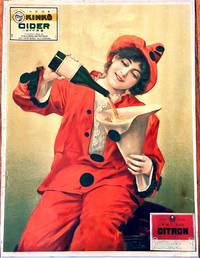
191010474Yokohama: Unknown 1910. Print. <p>'Kinko Cider' 510x375mm chromolithograph advertising poster. First Showa Era. Faint edge wear; Near Fine</p> <p><br /> JAPANESE SOFT DRINK POSTER<br /> <br /> 'Kinko Cider' and 'Kin Suzu Citron' <br /> <br /> <br /> 510x375mm single leaf French style commercial chromolithographic advertising poster depicting a woman in a red French Comedy Pierrot style costume pouring a sparkling drink into her hat verso blank with two Japanese soft drink labels to the corners. Printer and illustrator unknown.<br /> <br /> First Showa Era circa 1910. Faint edge wear corners slightly rounded small edge repair to verso else Near Fine.<br /> <br /> Carbonated drinks were first introduced to Japan by Commodore Perry in 1853 when he served lemonade to Japanese officials. Western habits fashions and products were quickly adopted in many areas of life as Japan opened to the West. Soft drinks became popular after the various cholera outbreaks of the late nineteenth century as they were often marketed as safer than local water supplies. Many water companies and utilities began to manufacture soft drinks during the late nineteenth century. Yokohama was a particular centre for their production. The drinks were often sealed in 'crown-top' bottles as can be seen in the illustration. <br /> <br /> 'Cider' was the generic name given to an American soda style drink; carbonated usually fruit-flavoured; nothing to do with the European concept of apple based brewed cider. 'Citron' was the name given to a Japanese soda flavoured with lemon Citron became popular after 1909 and by 1919 Japanese soda style drinks were widely available. In 1865 torpedo style and marble stopper bottles began to be used for some drinks - which became known as 'Ramune' but are similar to 'Cider' and 'Citron'. By 1921 as mechanical production was widespread and there were over 2000 Japanese soft drink companies producing 'Cider' 'Ramune' and 'Citron'.<br /> <br /> Rare. A fascinating example of the influence of nineteenth century Western food and drink culture on Japanese consumers in the Meji and Showa Eras.<br /> <br /> § Apparently unrecorded. No reference to the commercial image could be found.<br /> <br /> </p> Unknown unknown
192863706Leeds: Geo. H. Harrison & Sons Statue Printing Works 1928. 4to. 76 leaves. Colour-illust. printed title 74 colour box top labels 11 w/ gold foil background. Textured & embossed softcovers Statue of Liberty cover art illustration on front cover minor curling to spine very minor soiling to fore-edges some shelfwear 1 box top label w/ partial lower fore-edge cropped still a VG- copy w/ price list tipped-in on verso of front cover. First edition of this exceedingly scarce and exceptional printer’s sample catalogue filled with box top labels for British Chocolates sold between the World Wars. Initially chocolates had been packed as unwrapped bars in the Victorian era with paper labels displayed on the counter. Later gold printing and metal foils repeated the luxury message of chocolate. Inspired by the innovations of Cadbury the designs for many British fancy chocolate boxes were prized by the British as special gifts to be used as trinket or button boxes and even cut out and saved in scrapbooks. Many of the images on the labels in the present catalogue include idyllic landscapes English Chocolate-box cottages vivid art deco art work and even images of King George V Queen Mary the Duke of York later Edward VIII and others. The artists represented here include Ernest Boye Uden 1911-1986 noted illustrated and watercolour painter best remembered for his pastoral landscapes of English villages; Henry R. Wilkinson 1884-1975 noted for his landscapes and images of Venice; and many beautiful portraits of women by Percy Bell Hickling 1876-1951 illustrator for Sherlock Holmes stories cartoonist and frequently illustrated many of the Cassell & Co. girls annuals and girls series books. The price list indicates that they could be purchased in 1000 count lots with all white backgrounds overlap sides Royalty Ribbons and All over designs and the most expensive were the Gold and grained backgrounds. No copies located in NUC. Geo. H. Harrison & Sons, Statue Printing Works, paperback
192163908Rochester NY: Co-Operative Foundry Company ca. 1921. Oblong 12mo. 6.75 x 4 in. 66 leaves unnumbered. all linen-backed silver gelatin photographs sized 5.5 x 3.75 in. mounted on white linen hinges at gutter margin w/ first photo providing a birds-eye view of the factory in Rochester NY and sign atop the factory announcing “Red Cross Stoves & Furnaces.†Flexible maroon-coloured cloth cover post-binder nickel-plated screwposts at gutter margin minor thumbing soiling minor curling to photo block still a VG exemplar. First edition thus of very scarce original salesman sample photo catalogue of the noted Co-Operative Foundry Co. line-up of gas combination ranges cabinet kitchen ranges with vent collars in front of the back guards as well as line-up of home and commercial building furnaces. These beautiful stoves could be purchased with enamel finish and as one oven cabinet ranges two oven cabinet ranges some with nickel-plated accents others with baked enamel as well as a few fitted with glass-fronted upper stoves and warming units. The nicely executed colour-tinted linen-backed photographs depict such Red Cross stove line-ups as Popular Welcome along with Empire & Prize commercial kitchen ranges. Also included are coal and wood stoves for heating including Bermuda Ajax as well as Genesee and Empire parlour stoves. Their company logo was the Maltese Red Cross and were one of the most successful employee-owned foundry operations in the United States. They were founded during the post-Civil War depression of 1867 when John K. French & Co. went under and the unemployed molders with the aid of Henry Cribben and encouragement of William Sylvis the molders union leader organized the Equitable Foundry Co. later the Co-Operative Foundry Co. and within 1 year were operating in Rochester Troy West Troy Albany and other locations with still more under consideration. The company remained in operation until the Great Depression. No similar copies located in Worldcat specifically Univ. of Rochester which holds a number of ephemeral catalogues trade cards and items. Co-Operative Foundry Company, hardcover
185756060New York: C.M. Saxton & Co. Agricultural Book Publishers No. 140 Fulton St. 1857. 8vo. 106 pp. plus 11 1 pp. publisher’s catalogue. Woodcut-engraved frontisp. 1 text engraving. Original printed softcovers minor chipping head & foot of spine slight chipping couple lower corners dustsoiling still a VG bright copy. First edition of one of the earliest American studies on Chinese Sugarcane Sorghum and the possibilities that this was the sorghum plant that American farmers hoped would grow in the Northern United States and definitive work on growing harvesting and distilling sorghum. A variety of “Chinese Sugarcane†was imported by Father Du Halde from Sichuan China in 1851 where it was quickly adopted also under the name of “Northern Chinese or Shanghai Sugarcane†as a crop to provide sugars for alcoholic products filling the void left by the grape crop failure in the 1850s. Chinese Sugarcane seeds were first brought into United States by Jay Browne Esq. in 1854 and a few intrepid American nurseries began planting and determining if it could be planted and harvested profitably in the North. Hyde writes that in his test crop he was able to secure a dark sugar from the cane molasses and notes that it will be of tremendous value in producing alcohol and confectionaries and that the Sorghum remnants could be fed to livestock. Hyde 1825-1898 worked with his father James Hyde in developing the very successful nursery emphasizing fruit trees ornamental trees and cash crops. He was a pioneering environmentalist who founded the first improvement society in the United States the Newton Centre Tree Club whose purpose was to emphasize beautifying the roads and commons in Massachusetts. He was Newton MA first mayor after the city was incorporated in 1873 and was also successful in persuading the Boston & Albany RR to acquire the existing single-track line of the Charles River Railroad to aid his nursery business. Original editions of this work have become quite scarce in the trade. See: Deborah Jean Warner Sweet Stuff: An American History of Sweeteners from Sugar to Sucralose pp. 252-253; Watts Dictionary of Chemistry and the Allied Branches 1869 Vol. V p. 354; Newton’s First Mayor: A Hard Act to Follow Historic Newton 2019; Walnut Grove Nursery The New England FarmerVol. IV 1852 p. 538 C.M. Saxton & Co., Agricultural Book Publishers, No. 140 Fulton St., paperback
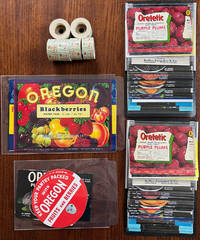
195561665Salem OR: Oregon Fruit Products Co. 1955. Oblong 4to. Sales kit archive: 1st - Oblong 4to. 11 x 6.75 in. Two sales counter displays w/ 25 mylar louvered leaves for with nearly all featuring inserted labels catalogue and Real Photo Postcard of company products; 2nd - 31 separate can and fruit box labels sized from 4 x 5 in. up to 7 x 10.5 in. large 12 oz. can labels folded in half; 3rd - two circular mountable clips 5.25 in. round for removing fruit can lids w/ adhesive and instructions on verso still intact; 4th - 5 unused rolls of adhesive labels marking Oregon Fruit Products Co. items. Preserved in original Dubl-Frunt File Pocket printed label for Oregon Fruit Products at upper fore-ede expandable sized 9.5 x 11.5 in. minor edgewear couple minor closed tears in the folds still a VG exemplar. First edition of this exceedingly scarce original salesman sample kit for the Oregon Fruit Products Co. in the Mid-20th-Century featuring over 50 different labels used on fruit crates canned fruit and frozen fruit packages two promotional photo postcards showing off their new frozen product line as well as touting their latest offering of Sucaryl-packed fruit products for the dieter or diabetic. Their locally Pacific Northwest-sourced fruit offerings included BlackberriesBoysenberries Royal Anne Cherries dark Sweet Cherries Purple Plums Strawberries Gooseberries Loganberries Peaches and whole Apricots. A wide variety of packing options included water pack light syrup heavy syrup and frozen offerings which were packed into 10 oz. metal and paper fibre cans. Oregon Fruit Products was one of the many U.S. Companies to quickly expand their offerings with Abbot Laboratories notorious artificial sweetener Sucaryl Calcium Cyclamate which was marketed towards those dieters and customers with diabetes or other metabolic disorders wishing for sweet-tasting foods. However within 12 years after the “Oretetic†brand products were introduced in 1969 the FDA banned cyclamates due to two 1968 studies tracing links to bladder cancer. Gehlhar 1886-1969 originally purchased 10 acres in the West Side Fruit Farm district of Salem OR in 1910 and began farming and by 1920 was operating 160 acres producing cherries & prunes and later built the Gehlhar prune dryer in 1926. In 1931 he served as the first Oregon State Director of Agriculture and after a 1935 fire destroyed his fruit dryer the cannery remained and he chose to instead focus on canning and marketing canned fruit products for distribution in the Pacific Northwest. Although originally focused on canned fruits and then later frozen products by the late 1980’s and early 1990’s the company began diversifying their product line. In 2011 the Gehlhar family sold the company to Ed Maletis who have now expanded to a new location in Salem OR. No similar copies of this collection located in Worldcat 1 WWII-era fruit label located at Wolfsonian several 1950’s labels located at OHS in Portland. Oregon Fruit Products Co., unknown
191661117Mount Pleasant Westmoreland County PA: Bryce Brothers Company 1916. Oblong folio. 19 x 12.25 in. 6 389 1 pp. Illustrated in sepia & black throughout. Brown-cloth-backed decorated tan softcovers decorative borders brown lettering minor creasing & thumbing at corners very minor edgewear rubbing still a VG bright copy. First edition of this famed glassware catalogue which represented the height of the noted Pittsburgh area glass manufacturing firm just a couple years prior to Prohibition which after repeal of Prohibition it would later be augmented twice in the 1936 & 1938 in smaller format with supplements. This catalogue filled with 100’s of full-size illustrations offers essential reference for cocktail glassware and stemware including Whiskey Tumblers Cut glass Whiskey Tumblers Wine glasses for Burgundy Rhine Port & Champagnes Toddy tumblers over 20 pp. devoted entirely to cocktail classes and a substantial array of beer glasses. Included as well are fancy cut glassware monogrammed glassware specialized items such as Oyster Cocktails Oyster Glasses Decanters Ice Cream Dishes Fruit Salad Dishes Hat Pin Holders Horse Radish glasses and so much more. The company was originally founded by James S. Bryce together with his brothers Frederick & James McKee Bryce in 1850 succeded by his son James S. Bryce Jr. becoming one of the most significant glass manufacturers in the United States. The company’s clients included Curtiss-Wright Corporation the Hotel San Diego Wesley Memorial Hospital the Top of the Needle Restaurant and hotels country clubs social clubs and restaurants across the country. In 1965 Lenox Inc. acquired the Bryce Brothers Co. to manufacture and market glassware with their china market creating the Lenox Crystal booklet and high-end glassware. Worldcat locates 6 physical copies Rakow Lib. Winterthur McKinley Mem. Lib. Carnegie Lib. Heinz Hist. Center US Patent Office. Bryce Brothers Company, paperback
179843Japan: mid-20th century. A collection of five maekake bearing the logos of famous companies including Asahi and Kikkoman. Alongside beer and soy sauce these aprons advertise Mitsuuroko's line of coke and coal briquettes the chicken served at an izakaya called Yamauchi Nojo and the shuroku brand of sake from the Otsuka brewery closed in 2011. These aprons would have been worn either by workers at the restaurants and breweries themselves or at other locations that served those products. Similar apron designs are worn by restaurant workers to this day. Five machine-woven cotton aprons in various colours 580 x 460 mm to 710 x 460 mm. Company logos to each; text in Japanese. Top edges with red orange and white striped cotton waist ties 1935 to 2540 mm bottom edges with tassels lettered and decorated in white 2 with metal 2 two with open pockets. Some soiling fraying and sunning consistent with use a few minor holes: a very good collection. unknown
2016__1783476052Edward Elgar Pub 2016. Hardcover. New. 1344 pages. 9.75x6.75x3.00 inches. Edward Elgar Pub hardcover
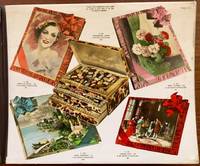
194053482Kingston upon Hull UK: Needler Ltd. ca. 1940. Oblong folio. 13.5 x 10.25 in. 14 leaves unnumbered. with 14 hand-coloured silver gelatin photographs sized 10 x 11.75 in. mounted on thick card stock leaves hinged with black cloth printed sales information on facing leaves each photo w/ War Restrictions Notice printed in upper fore-edge and supplementary product information in negative below each product. Original black pebbled cloth spine stiffened w/ wood spacers covered in black cloth minor bowing to leaves very minor wear to corners front outer hinge just starting still a VG copy w/ pencil date of 1940 on front pastedown. First edition of this scarce and exceptional photographic sample catalogue filled with the styles of Needler chocolate box assortment and chocolate packaging in the first years of World War II. Initially chocolates had been packed as unwrapped bars in the Victorian era with paper labels displayed on the counter. Later gold printing and metal foils repeated the luxury message of chocolate. Inspired by the innovations of Cadbury the designs for many British fancy chocolate boxes were prized by the British as special gifts to be used as trinket or button boxes and even cut out and saved in scrapbooks. The chocolate boxes in this catalogue include mixed assortments in faux 3-drawer cabinets decorated with fancy ribbons chromolithograph and colour-printed covers featuring historic scenes pets flowersArt Deco designs gold foil and more. Of special interest are the wonderful Needler’s figurine bowls and boxes featuring porcelain figurines dressed in silk fabrics atop bowls or boxes as well as a splendid pair of porcelain bookends “Sweet & Twenty†to hold up the customer’s chocolate boxes. Needler’s began as Fred Needler Ltd. in 1902 when established in Hull by Fred Needler 1865-1932 who began as a confectioner’s assistant in the 1880s. The company was a pioneer in fair treatment of his workforce incorporated profit-sharing for the staff from the beginning and covered sick pay retirement benefits and even established holiday homes in British seaside resort towns. By 1940 the company was one of the largest businesses in Hull with over 2000 employees. The company continued to operate until acquired through multiple buyouts by several different corporations until the label was acquired by Ashbury Confectionary and the factory was closed in Hull in 2002. No copies located in Worldcat; See: Chocs away: Needler of Hull History of Needlers Confectionary Let’s Look Again: A History of Branded Britain 2015. Needler Ltd., hardcover