- Meyer Joseph - de Sylva BudLivre Rare Book

1 192 résultats
192628062Partitions sur les Enfants Salabert 1926
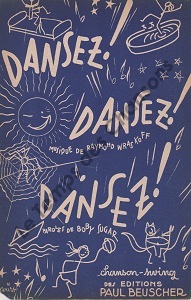
194021972Beuscher Paul 1940
First Edition, [ii],46pp., title and last leaf a little dusty, disbound. "The quality of sugar formed no just basis for taxation. Such a system was inexpedient because it would encourage the production of low-grade product, particularly in the newly conquered colonies which were capable of supplying an almost unlimited quantity of the superior article. It would be impossible to grade sugars properly into the several classes according to which they would be taxed in the proposal under consideration. There would be much fraud to secure the benefit of low rates. Completely side-steps the great fact that it was not equitable to exact the same duty as formerly when sugar had declined to one-third of its one-time value."?Ragatz, p.281. Copac locates the Bodleian copy only; OCLC adds NHL & INU. Goldsmiths'-Kress no. 19403.3; Sabin,102848
First and only edition, [2], 30pp., stitched as issued in blue paper wrappers, a very good copy. The author argues against putting an additional duty on sugar "which... would be a great hardship on the sugar-planter in the West Indies, and very little benefit to the revenue...". He sets out all the costs involved in producing sugar, such as the price of slaves and the cost of keeping them, the higher freight costs, insurance, cost of animals and contributions to the defence force. Finally, he states the advantages of the sugar trade for Britain and shows how an additional duty would be to the detriment of the trade. Goldsmiths'-Kress, 8163; Hanson, 5917; Sabin, 40397; ESTC gives the British Library as the only UK hold.
185756060New York: C.M. Saxton & Co. Agricultural Book Publishers No. 140 Fulton St. 1857. 8vo. 106 pp. plus 11 1 pp. publisher’s catalogue. Woodcut-engraved frontisp. 1 text engraving. Original printed softcovers minor chipping head & foot of spine slight chipping couple lower corners dustsoiling still a VG bright copy. First edition of one of the earliest American studies on Chinese Sugarcane Sorghum and the possibilities that this was the sorghum plant that American farmers hoped would grow in the Northern United States and definitive work on growing harvesting and distilling sorghum. A variety of “Chinese Sugarcane†was imported by Father Du Halde from Sichuan China in 1851 where it was quickly adopted also under the name of “Northern Chinese or Shanghai Sugarcane†as a crop to provide sugars for alcoholic products filling the void left by the grape crop failure in the 1850s. Chinese Sugarcane seeds were first brought into United States by Jay Browne Esq. in 1854 and a few intrepid American nurseries began planting and determining if it could be planted and harvested profitably in the North. Hyde writes that in his test crop he was able to secure a dark sugar from the cane molasses and notes that it will be of tremendous value in producing alcohol and confectionaries and that the Sorghum remnants could be fed to livestock. Hyde 1825-1898 worked with his father James Hyde in developing the very successful nursery emphasizing fruit trees ornamental trees and cash crops. He was a pioneering environmentalist who founded the first improvement society in the United States the Newton Centre Tree Club whose purpose was to emphasize beautifying the roads and commons in Massachusetts. He was Newton MA first mayor after the city was incorporated in 1873 and was also successful in persuading the Boston & Albany RR to acquire the existing single-track line of the Charles River Railroad to aid his nursery business. Original editions of this work have become quite scarce in the trade. See: Deborah Jean Warner Sweet Stuff: An American History of Sweeteners from Sugar to Sucralose pp. 252-253; Watts Dictionary of Chemistry and the Allied Branches 1869 Vol. V p. 354; Newton’s First Mayor: A Hard Act to Follow Historic Newton 2019; Walnut Grove Nursery The New England FarmerVol. IV 1852 p. 538 C.M. Saxton & Co., Agricultural Book Publishers, No. 140 Fulton St., paperback
30964Paris, Héliotypie Fortier et Marotte, 1912. Fort volume In folio, format à l'italienne (30 x 41 cm), 178 pp, Relié en demi-percaline à coins, plat décoré d'une grande betterave dorée avec les dates 1812-1912 de chaque côté estampée à l'or au centre du plat supérieur, dos lisse (coins émoussés et auréole trace d'eau en haut de la reliure). Cartonnage éditeur. BEL ÉTAT INTERIEUR.
Paris, Héliotypie Fortier et Marotte, 1912. Fort volume In folio, format à l'italienne (30 x 41 cm), 178 pp, Relié en demi-percaline à coins, plat décoré d'une grande betterave dorée avec les dates 1812-1912 de chaque côté estampée à l'or au centre du plat supérieur, dos lisse (coins émoussés et auréole trace d'eau en haut de la reliure). Cartonnage éditeur. BEL ÉTAT INTERIEUR. Édition originale de ce très rare album commémoratif : car 1812 n'est pas seulement l'année de la désastreuse campagne de Russie, mais aussi celui du décret impérial du 24 janvier 1812 par lequel, à la suite de la première extraction industrielle de sucre de betterave par Jean-Baptiste Quéruel et Benjamin Delessert (fin 1811), fut organisée la première production industrielle sur le territoire de la France métropolitaine, alors complètement coupée de ses colonies sucrières comme du commerce britannique : cent élèves, pris parmi les étudiants en pharmacie, en médecine et en chimie, devront être attachés à diverses fabriques de sucre de betteraves nouvellement établies ; chaque étudiant ayant suivi les cours pendant plus de trois mois et ayant prouvé qu'il connaît parfaitement les procédés de fabrication recevra une indemnité de 1 000 francs. Par ailleurs, le ministre de l’intérieur prendra des mesures pour faire semer dans l'étendue de l'Empire cent mille arpents métriques de betteraves, 500 licences pour la fabrication du sucre de betterave seront accordées dans tout l'Empire. Quatre fabriques impériales de sucre de betterave seront établies en 1812 devant fabriquer avec le produit de la récolte de 1812 à 1813, deux millions de kilogrammes de sucre brut.
179028397La Rochelle 1790 un ACQUIT d'une page imprimée en noir et manuscrite à l'encre brune, sur papier vergé crème ligné, format : 24,7 x 19,5 cm, DIRECTION DE LA ROCHELLE - ACQUIT DE PAIEMENT N° 955 - COMMIS & GARDES DES TRAITES FORAINES & DOMANIALES, LAISSEZ PASSER POUR MR LOUIS ADMYRAULT [NÉGOCIANT ARMATEUR NÉGRIER A LA ROCHELLE] POUR SORTIR DE L'ENTREPÔT : DEUX QUARTS DE CAFÉ PESANT TROIS CENT QUARANTE CINQ LIVRES, FAIT AU BUREAU DE LA ROCHELLE, LE 20 AOUT 1790, SIGNÉ : JOUSSOMME, au dos tampon noir dans un décor à la fleur de lys : La Rochelle - Expedition des fermes du roy T. D. D.Beau DOCUMENT D'EPOQUE
179028398la rochelle 1790 un ACQUIT d'une page imprimée en noir et manuscrite à l'encre brune, sur papier vergé crème ligné, format : 24,7 x 19,5 cm, DIRECTION DE LA ROCHELLE - ACQUIT DE PAIEMENT N° 1063 - COMMIS & GARDES DES TRAITES FORAINES & DOMANIALES, LAISSEZ PASSER POUR MR LOUIS ADMYRAULT [NÉGOCIANT ARMATEUR NÉGRIER A LA ROCHELLE] POUR SORTIR DE L'ENTREPÔT : UN TIERCON ET UN SAC DE CAFÉ ET DEUX QUARTS DE SUCRE TERRÉ, FAIT AU BUREAU DE LA ROCHELLE, LE 18 SEPTEMBRE 1790, SIGNÉ : JOUSSOMME, au dos tampon noir dans un décor à la fleur de lys : La Rochelle - Expedition des fermes du roy T. D. D.
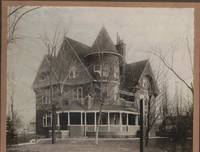
71027Photograph. Good. Large format photograph 9 1/2 inches wide x 7 1/2 inches tall with a tan border and gray mount 12 1/4 inches wide x 9 7/8 inches tall. No backstamp. "Residence of F. A. Timby. Salt Lake City Utah. 2157 Grand Ave" in pen on front of mount. Corners worn one with small loss. Moisture staining to several areas of mount. Small stain to surface of image near the center. Photographer unknown. We have not seen this photograph before. A large format photograph of this historic house located in the Sugar House neighborhood of Salt Lake City Utah. Frank Arthur Timby 1863-1927 was president of F. A. Timby General Insurance Company. He is buried in Mount Olivet Cemetery Salt Lake City Salt Lake Utah. unknown
190925351Vienne Hartleben 1909 -in-8 demi-chagrin un volume, reliure demi-chagrin havane in-octavo Editeur (binding half shagreen in-8 Editor)(22,8 x 15,3 cm), dos long (spine without raised bands), Titre et Auteur frappés "or" (gilt title) avec trois filets "or" de part et d'autre du titre et du nom de l'Auteur, entre-nerfs avec décor "nouille" (Art Nouveau à froid, triple filets "or" en tête et en pied, plats décorés à froid, d'une roulette à froid aux mors, percale verte aux plats, titre imprimé en noir sur le premier plat, toutes tranches lisses peignées, texte en allemand, orné de 125 illustration in et hors-texte en noir, XI + 283 pages, 1909 Vienne, Hartleben Editeur,
179222256nantes 1792 une lettre (de 4 pages , une grande feuille pliée en deux) manuscrite à l'encre brune sur les 4 pages sur papier crème, format : 19 centimètres de large x 29 centimètres de haut, signé LECHALAS , Nantes, le 20 FEVRIER 1856, + 7 documents :1 - compte dintérêts de Mr Lechalas au 31 décembre 1857 , 1er, 2ème et 3ème Voyage du Franklin (un compte sur une double page papier pelure crème, manuscrite à lencre brune (26 x 21 cm) ecrite dun seul côté.2-compte du Navire le Benjamin Franklin: 2ème Voyage de la Reunion à Nantes(un compte sur une page de papier pelure crème manuscrite à lencre brune (26,5 x 21,5 cm) écrite dun seul côté.3- Compte de règlement avec Mr Léchalas pour 300/1414 dintérêts dans le corpus du Benjamin Franklin 2ème Voyage (un compte sur une page quadrillée avec des lignes en rouge, manuscrite à lencre brune (27,2 x 21 cm) écrite dun seul côté.4- compte dintérêts de Mr Lechalas au 17 juillet 1879, 4ème et 5èmeVoyage du Franklin (un compte sur une double page quadrillée avec des lignes en rouge, manuscrite à lencre brune (27,2 x 21 cm) écrite dun seul côté.5- compte de repartition du 4ème voyage de Nantes à Colombo et de Colombo au Havre(un compte sur une page quadrillée avec des lignes en rouge, manuscrite à lencre brune (27,2 x 21 cm) écrite dun seul côté.6 - COMPTE DE DESARMEMENT DU FRANKLIN LORS DU DERNIER VOYAGE(ile Maurice Nantes), LE 18 FEVRIER 1898 (un compte sur une page quadrillée avec des lignes en rouge, manuscrite à lencre brune (26,5 x 21,6 cm) écrite dun seul côté.
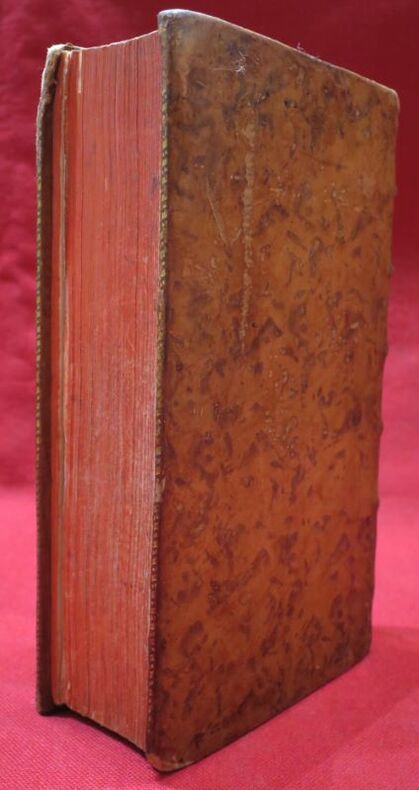
108916A Paris, Chez Veuve Savoye, Le Clerc, Hochereau, Didot jeune, Leclerc, Humblot, Delalain, 1776, xvj-3 planches dépliantes dont une double-554 pages, 2ff. (approbation, privilège), 1f.blanc, reliure plein veau marbré caramel, dos à 5 nerfs portant titres dorés sur pièce de titre en maroquin bordeaux orné de fleurons et motifs dorés, coupes dorées, gardes marbrées, tranches rouges. Deux coins dénudés, quelques rousseurs, une coiffe légèrement fendue, petites épidermures et frottements d'usage sur le cuir. Complet des 3 planches dépliantes. Rare.
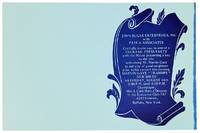
197645489Buffalo NY: John Sugar Enterprises Inc. with Pate & Associates 1976. Fine. Buffalo NY: John Sugar Enterprises Inc. with Pate & Associates 1976. Unused invitation printed in dark blue on light blue cardstock. Fine. <br /> <br /> Invitation to a cocktail party in which the mayor of Buffalo NY Stanley Makowski was to present the key to the city to the R&B and soul singer Marvin Gaye. The local concert with opening acts Trammps and New Birth was covered in the local paper which also featured an interview with an indifferent yet reflective Gaye who clutching a Carlos Castaneda paperback talked of his dislike of touring and bristled at the reporter framing "Let's Get It On" as "raunchy" countering "I'm singing about life and things people are afraid to sing about. People are still in the Dark Ages. I don't think sex and love-making is raunchy. Leastwise I don't do it raunchy. I imagine it is raunchy though."<br /> <br /> Jackie Farnan "Touring -- Thing I have to do" in the Democrat and Chronicle Rochester NY Saturday August 14 1976 p. 27. . John Sugar Enterprises, Inc. with Pate & Associates unknown
187528755NANTES 1875 une lettre avec en-tête pré-imprimée en noir "RAFFINERIE DE EMILE ETIENNE NANTES", manuscrite à l'encre noire, sur papier bleu clair à petits carreaux, format : 19 x 27 cm , LETTRE AUTOGRAPHE MANUSCRITE D'EMILE ETIENNE avec signature manuscrite en noir : EMILE ETIENNE, Nantes, le 15 avril 1875,
187528756NANTES 1875 une lettre de 4 pages(un grand feuillet plié en deux) avec en-tête pré-imprimée en noir "RAFFINERIE DE EMILE ETIENNE NANTES", manuscrite à l'encre noire, sur papier bleu clair , format : 21 x 27 cm , LETTRE AUTOGRAPHE MANUSCRITE D'EMILE ETIENNE avec signature manuscrite en noir : EMILE ETIENNE, Nantes, le 3 MARS 1875, avec in fine en plus de la signature d'émile etienne, les signatures des membres du conseil de famille, reçues le 18 mars 1875,
187928762NANTES 1879 un projet broché de 16 pages manuscrit à l'encre noire et au crayon de bois, sur papier crème , format : 20 x 32 cm , projet de formation d'une société anonyme ayant pour objet l'exploitation de 2 raffineries de sucre Nantaises, une appartenant à Emile Etienne à Nantes, rue Grande Biesse et l'autre appartenant à Madame CEZARD, située à Chantenay au lieu dit le Cordon-Bleu, la Sté prendra le denomination de Sté Anonyme des Anciennes Raffineries Emile Etienne et Cezard, projet manuscrit réalisé en 1879 + Projet de traité broché de 4 pages, manuscrit à l'encre noire, format : 20 x 32 cm , PROJET DE TRAITE TRANSACTIONNEL ENTRE RENE EMILE ETIENNE RAFFINEUR ET EUGENE HENRI BOURCARD (CANDISERIE BOURCARD ET COMPAGNIE) - NANTES - 1879, ce traité a pour objet de liquider entre emile etienne et Mr Voruz tuteur de son neveu Jean Baptiste Etienne l'intérêt que la maison Emile et Gustave Etienne avait dans la raffinerie de Candy Eugene Bourcard et Cie, Nantes 1879
186725609NANTES Napoléon Chaix et Cie imprimeur 1867 une ACTION de cinq cents francs au porteur "RAFFINERIES NANTAISES - ANCIENNES RAFFINERIES CEZARD"- 1867 - Paris Napoléon Chaix et Cie imprimeur,
188028244NANTES 1880 -in-8 un bon à tirer ORIGINAL, de 22 feuillets in-octavo, imprimés en noir d'un seul côté des STATUTS DE LA "SOCIÉTÉ ANONYME DES ANCIENNES RAFFINERIES ÉMILE ÉTIENNE ET CÉZARD" avec corrections manuscrites en marge à l'encre brune, les 22 feuillets sont reliés à un angle par une agraphe parisienne en cuivre, fait à Nantes chez Me Joseph Grizolle NOTAIRE 1880,
178628404NANTES boulogne 1786 un document ORIGINAL de 2 pages manuscrites à l'encre brune sur papier vergé crème, ligné, format : 24,5 x 18,5 cm : avec timbre fiscal royal en noir en haut de la 1ère page : "GÉNÉRALITÉ D'AMIENS - P-P- 2 SOLS", EXTRAIT DES MINUTES DU GREFFE DE L'AMIRAUTÉ DE BOULOGNE : DEMANDE DE VISITE DE SUCRE PAR FRANCOIS BECQUEREL NÉGOCIANT RAFFINEUR A BOULOGNE ET S'EN SUIT LE PROCÈS-VERBAL DE VISITE DE SUCRE PAR DEUX EXPERTS SUR LE NAVIRE (NEGRIER) "LE PÈRE DE FAMILLE" CHARGÉ A NANTES, COMMANDÉ PAR LE CAPITAINE PIERRE PINCET AFIN DE CONSTATER L'ETAT ACTUEL DES MARCHANDISES, LA FONTE, LE DOMMAGE ET LES AVARIES Q'ILS Y RECONNAITRONT ET LA CAUSE D'OU ILS PROCÈDENT , FAIT A BOULOGNE, LE 28 NOVEMBRE 1786,
187028376NANTES 1870 une lettre avec en-tête pré-imprimée en noir "RAFFINERIE DE EMILE ETIENNE NANTES", manuscrite à l'encre noire, adressée à BOURCARD Adolphe Jules notaire à nantes, format : 21 x 27 cm , LETTRE AUTOGRAPHE MANUSCRITE D'EMILE ETIENNE avec signature manuscrite en noir : EMILE ETIENNE, Nantes, le 11 Mai 1870,
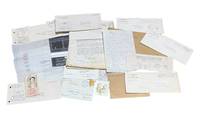
19459277New York New York and Havana Cuba 1945. <br /> <br /> William John Mantz Jr. worked as an engineer and assistant manager for the West Indies Sugar Corporation for 10 years traveling back and forth frequently between his home in Tarrytown New York and the sugar plantations in Havana Cuba. This archive contains travel materials government documents and other personal artifacts pertaining to his time in Cuba and concerning his status with the draft during World War II. Most correspondence in original postmarked envelope.<br /> <br /> Included:<br /> <br /> <p dir="ltr">- One black and white photograph of Bill and Marjorie Mantz</p> <br /> <p dir="ltr">- Birth certificate copy with raised seal for Bill Mantz dated January 1938 </p> <br /> <p dir="ltr">- Two personal letters from Marjorie to Bill in 1938 that mention her recent travels to visit him in Cuba</p> <br /> <p dir="ltr">- Cuban drivers license for Bill dated January 1940 with photo attached and stamped by the police department</p> <br /> <p dir="ltr">- Cuban Foreign Identification Card for Marjorie dated June 1940 with receipt and three copies of her photo attached</p> <br /> <p dir="ltr">- Receipt for surrendered passport in Miami Florida December 1940</p> <br /> <p dir="ltr">- Letter from Bill's sister Margie in May 1942 forwarding paperwork from Selective Services</p> <br /> <p dir="ltr">- Two Cuban tax withholding documents from May/July 1942</p> <br /> <p dir="ltr">- Letter from Bill in Spanish requesting the renewal of Marjorie's Foreigner's Identification card in May 1943 and follow up letter to a different recipient in English dated June 1943 regarding missing documents</p> <br /> <p dir="ltr">- Three permits from Selective Services for to depart from the United States 1943-1945 plus one duplicate</p> <br /> <p dir="ltr">- Four pieces of correspondence from the American Consulate in Cuba dated December 1944 - April 1945 regarding passports medical exams and registering the Mantz’s infant daughter</p> <br /> <p dir="ltr">- Sixteen letters and other correspondence between Bill his boss Arthur Kirstein and Selective Services mostly regarding Bill’s draft status but also some sugar industry business such as frequent air travel to Havana trains and fuel options and US politics after Truman assumed the presidency.</p> <br /> . unknown
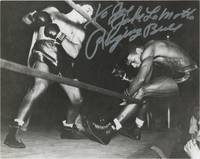
1990167454N.p.: N.p. 1990. Vintage photograph of Italian-American champion boxer Jake LaMotta taken in 1943 and struck circa 1990s showing LaMotta knocking Sugar Ray Robinson through the ropes during one of their famed fights on February 5 1943. INSCRIBED by LaMotta on the upper right corner: "to Joe / Jake LaMotta / Raging Bull." <br /> <br /> LaMotta's 1970 memoir served as the basis for Martin Scorsese's award-winning 1980 film "Raging Bull" starring Robert De Niro as LaMotta.<br /> <br /> LaMotta held the middleweight title from 1949 to 1951 and was inducted into the International Boxing Hall of Fame in 1990.<br /> <br /> 10 x 8 inches. Fine. N.p. unknown
1761Paris Au Bureau 1896 - 1914 Dix-huit volumes in-8 demi basane noire (et rouge pour deux tomes), réunissant les publications de la "Sucrerie Indigène et Coloniale" de mi-septembre 1896 à 1900, puis de 1902 à 1909 et des années 1912 et 1914. De 400 à 800 pp. par volume. Epidermures.
1943LFA-126735006Une revue de 56 pages, format 165 x 245 mm, illustrée, brochée couverture couleurs, bon état