888 résultats
170444385Paris Jean Boudot 1704. 4to. Without wrappers. Extracted from "Mémoires de l'Academie des Sciences. Année 1702". Pp. 155-174 a. textillustrations. <br/><br/><em>First appearance of this paper in which Amontons describes his invention construction and function of his air thermomer. He thus improves on Gallileo's design by using air pressure instead of volume. The paper is the earliest study in this field and Amontions concludes "that unequal masses of air under equal weights invcrease equally the force of their spring for equal degrees of heat" Fifteen years later Gay-lussac performed the same experiments with better technique and results - the Gay-Lussac laws.The paper "contains Amontons' account of the first thermometer with which temperature was measured by the pressure of air."Magie "A Source book in Physics" pp. 128 ff."His first scientific production was a Hygrometer in 1687.The other was an air thermometer independent of the atmospheric pressure. Air occupied the top of one of the branches of a U-shaped tube and by its dilation it pushed down one of the mercury columns so that the other end ofthe branch formed a barometric chamber."DSB I p. 138 a.Parkinson "Breakthroughs" 1702 M. </em> unknown
179549686City of the Regent St. Petersburg November 7303 = 1795. 4to. Contemp. full calf over wood remains of clasps. The covers bent. A crack in the wood and leather on the backcover. 82 leaves 164 pp. Printed on thick paper internally clean. A small nick to margin on the first leaf. <br/><br/><em>First edition of Catherine's Church Ritual for the Old Believers. </em> hardcover
176954520Nürnberg Joh. Andr. Endt. 1769. 8vo. Contemp. full calf. Gilt spine. Titlelabel with gilt lettering. Gilding weak. Large engraved oval vignette on first titlepage. 22315 pp. Latin & German Indexes - 2449 pp. Latin & German Indexes. Profusely illustrated with more than 300 wood-engraved illustrations in the text showing different trades industries occupations geography astronomy etc. etc. A few minor brownspots. old name on title-page J.D. Tode. <br/><br/><em>With German and Latin text by the "father of modern education". Comenius was the innovator who first introduced pictorial educational textbooks as here and written in native language. </em> unknown
175045497Berlin Haude et Spener 1750. 4to. No wrappers as issued in "Mémoires de l'Academie Royale des Sciences et Belles-Lettres" tome IV pp. 103-121 pp. 122-132 pp. 133-148 and 6 engraved plates on 5. <br/><br/><em>Three first editions by Euler. Euler's goal in the first paper is to show that certain phenomena that resulted from the eclipse of July 25 1748 are evidence that the moon has an atmosphere that is almost 200 times less dense than that of the earth. The phenomena Euler observed are optical effects of light passing close to a sharp edge and not the refraction of a lunar atmosphere.The other papers on the physics of rigid bodies are groundbreaking as Euler here set forth what is known as "Euler's dynamical equations of the motion of the mass-center of any solid" and thus STATING FOR THE FIRST TIME THE LAW OF DRY FRICTION mathematically. Euler explains his experiments with the inclined plane and discovers the DIFFERENCE BETWEEN KINETIC AND STATIC FRICTION."Leonhard Euler occupied himself with the mathematical point of view of friction as well as the experimental. He introduced the differentiation between static frictional forces and kinetic frictional forces and solved the problem of rope friction probably the first contact problem to be analytically solved in history. 1750 the papers offered. He was the first to lay the foundations of the mathematically way of dealing with the law of dry friction and in this way promoted further development. We have to thank for the symbol as the coefficient of friction. Euler worked with the idea that friction originates from the interlocation between small triangular irregularities.This understanding survived in different variationsfor a hundred years and is also used today as the "Tomlinson Model" in connection with friction on atomic scale."L. Popov "History of the Contact Mechanics and the Physics of Function" p.3.Eneström: E142 E143 E144. </em> unknown
179852947Åbo Frenckellska Boktryckeriet 1798. Orig. blanke kartonomslag. Håndskrevet rygtitel. Lidt rifter i rygpapiret. 41502 pp. Lidt spredte brunpletter. De sidste 5 blade med en skjold øverst. <br/><br/><em>Originaludgaven. First edition. "His Inleding till chemien 1798 was the first Swedishlanguage textbook written in the spirit of the new combustion theory. Although he accepted the phlogiston theory early in his career Gadolin attempted to understand Lavoisier’s ideas. In a paper published in 1788 he tried to define phlogiston and admitted that the French explanation of combustion was superior to some phlogiston theories but for a long time he was not wholly converted. His lectures always made use of the new chemistry and he eventually became the spokesman in Scandinavia for Lavoisier’s nomenclature and combustion theory often encountering Berzelius opposition."DSB.Poggendorff I 827. - Neville I p. 496. </em> unknown
178544925Paris Moutard 1785. 4to. Extracted from "Mémoires fe Mathematique et de Physique Présentés à l'Academie des Sciences par divers Savans" Tome X. Pp. 65-160. Wide-margined clean and fine. <br/><br/><em>First appearance of this groundbreaking paper in which Lagrange presented his invention of the new method of solving differential equations as VARIATION OF PARAMETERS and in which the method was completely developed for the first time. He applies the method to the determination of the orbit of a comet from three observations; this formed the basis of subsequent recherches on the subject." In the summer of 1779 Lagrange submitted "Recherches sur la théorie des perturbations que les cométes peuvent éprouver par l’action des planétes" which won the double prize of 4000 livres. This was the last time that he participated in the competitions of the Paris Academy."DSB."Lagrange whose contributions to celestial mechanics were of the most brilliant characther wrote his first memoir in 1766 on the perturbations of Jupiter and Saturn. In this work he developed still further the method of the variation of parameters leaving his final equations still incorrect.their true form being that of the long period terms as was shown by Laplace in 1784.The method of variatiobn of parameters was completely developed for the first time in 1782 by Lagrange in his prize memoir on the perturbations.the paper offered." </em> unknown
172759045Berlin Ambrosius Haude 1727. 4to. Contemp. full calf. Raised bands. Tome- and titlelabels with gilt lettering. Minor repairs at upper joint. In: "Miscellanea Berolinensia ad Incrementium scientiarum ex Scriptis Societati Regiæ Scientiarum exhibitis editia Continuatio II." 63464 pp. 11 partly folded engraved plates. Scattered brownspots. Roemer's letter to Leibniz: pp. 276-78 2 textillustrations. The entire volume offered. <br/><br/><em>First printing of Roemer's letter to Leibniz in which he describes his plan for a new observatory and the circle-instrument."In a letter written to Leibniz dated December 15 1700 - the offered item - in reply to Leibniz's request for the most suitable plan for an observatory Roemer describes his plans for the "Observatorium Tusculanum". He has an excellent discussion of the need of building the observatory so that it can best serve the function for which it is intended namely observation. He probably was thinking of the construction of the Paris Observatory a beautiful building but impractical as far as actual observational needs were concerned. He also describes the prime vertical transit and states his preference for the circle as compared to quadrants and sextants saying that he would have confidence in a circle of four feet in diameter than a quadrant of ten." I. Bernard Cohen in "Roemer and the first determination of the Velocity of Light" p. 48. </em> hardcover
179750776A Geneve Biblioth. Britannique 1797. 8vo. Contemp. marbled boards. Paperlabel with handwritten volume- title on spine. Boards rubbed. In: "Bibliotheque Britannique" Tome cinquieme. Sciences et Arts. A name cut from titlepage no loss of letters. Entire volume offered. 392 pp. 4 folded tables a. 3 folded engraved plates. A faint dampstain to foot of titlepage otherwise clean printed on good paper. Rumford's paper: pp. 97-200 a. 1 engraved folded plate. <br/><br/><em>First printing of the founding paper on Oceanography describing the experiments leading to the discovery of the convection currents in the sea. Cold water at depth in the tropics implies a meriodinal circulation transporting deep water from the polar regions towards the equator. Water cooled at the surface in high latitudes gets denser and hence descends. Parkinson "Breakthroughs" 1797.The volume also contains the first translation of any part into French of JAMES HUTTON "Theory of the Earth &c. Théorie de la Terre avec des preuves & des éclaircissemens; en guatre parties. 1.-2. Extrait.". Pp. 53-73 a. pp. 262-273. </em> hardcover
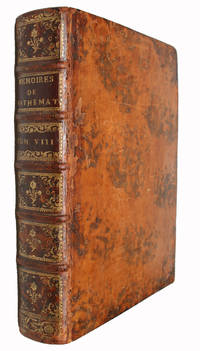
178044929Paris Moutard Panckoucke 1780. 4to. Contemp. full sprinckled calf with 5 raised bands on spine. Richly gilt compartments title-and tomelabels with gilt lettering. "Mémoires fe Mathematique et de Physique Présentés à l'Academie des Sciences par divers Savans" Tome VIII. XXIV624 pp. 8 engraved plates a. 52 folded tables. Entire volume offered. Van Swinden's work: pp. 1-576 3 folded engraved plates and 52 folded tables. <br/><br/><em>First edition of Van Swinden's large work on magnetism and the function of the compass and the variability of magnetic needles. It also explained the diurnal variation of the earth's magnetic force.In 1767 van Swinden obtained the chair of philosophy logic and metaphysics at Franekar University. He studied all the popular scientific topics of the period especially magnetism electricity meteorolgy and chemistry and corresponded with many leading scientists including Bonnet Euler Deluc J. C. Wilcke Bertholon and Lalande. His Tentamen de magnete 1772 dealt with his mathematical theory of magnetism and in 1777 he and Coulomb shared the gold medal of the Paris Academy of Sciences for a very detailed prize essay on magnetism Recherches sur les aiguilles aimantées. the essay offered.Poggendorff II 1057 </em> hardcover
1797884537London:: Andrew Strahan 1797. From Jacob's tenth edition Sir Thomas Edilyne Tomlins enlarged and re-edited this work and earned the following critique from Marvin: " . volumous and prepared with skill and accuracy" and "Mr.Tomlins is the best". Two quarto sized unpagenated volumes with the pages double columned.Hinges restored; bindings show moderate wear otherwise a very good copy of a classic 18th century legal classic. 11th Edition. Full Contemporary Calf. Very Good. 4to. 2 Volumes. Andrew Strahan, Hardcover
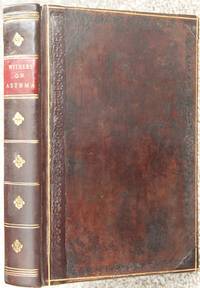
178693Scarce. Most attractive condition. 444pp xx 2pp advertisements to the rear. No inscriptions. Title continues: "To Which are Added Cases and Observations in which the Asthma is complicated with the following Diseases: Catarrhs. Humoral asthmas. Tubercles in the Lungs. Consumptions. Universal dropsical Swellings. A Dropsy of the Breast. Jaundice. Gout. Rheumatism. Chronic Weakness. Intermittent Fevers. Inflammations of the Lungs. Abcesses and Ulcers in the Lungs. The False Peripneumony. Spittings of Blood. Excessive Corpulency. Severe Headachs. Teething. Cutaneous Eruptions. Obstruction of the Menses. A Venereal Ulcer of the Nose. Spasmodic Affections of the Throat. Hysteric Fits. General Convulsions." Withers' treatise provides a rare glimpse of the prevalence of asthma in the 18th century. He felt the condition was becoming more frequent and attributed it to the perils of modern living: "The greater irritability and weakness of the constitution in these days may in some measure account for the greater frequence of the Asthma especially if we add the inventive genius and the rapid progress of mankind in all the various arts of modern luxury and refinement" p. 2. G.G.J and J Robinson & W Richardson & Meff. Fletchers & J Merrill & C Elliott and W Creech hardcover
1800133Boston: Isaiah Thomas & E.T. Andrews 1800. Leather Bound. Near Fine. 4 1/2 x 7 1/8 inches. 2 ffep 189 unnumbered leaves 1 blank. Library stamp of Episcopal Theological School Cambridge Mass. to title page and small tear to lower margin at Psalm 140 affecting two letters of text else fine. Griffiths 1800/11. Bound with: The Whole Book of Psalms in Metre; with Hymns Suited to the Feasts and Fasts of the Church and Other Occasions of Public Worship Boston: Isaiah Thomas & E.T. Andrews. 1800. 70 numbered pages 1 unnumbered leaf table 2 rfep. Text of both works printed in two columns with light scattered foxing and age toning. Bound in full brown modern calf with blind rolled borders on both boards and six gilt lines to spine and red morocco spine label with gilt "Common Prayer. A scarce and unusually well preserved example of the only BCP printed by Isaiah Thomas whom Benjamin Franklin praised as "the American Baskerville." A scarce edition. I[saiah] Thomas & E.T. Andrews unknown
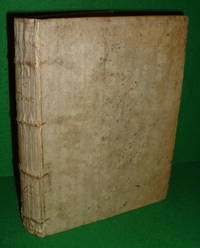
1708#BIBLIO-1153Analyse démontrée ou la méthode de resoudre les problêmes de mathématiques et d'apprendre facilement ces sciences; Expliquée & démontrée dans le premier Volume & appliquée dans le second à découvrir les proprietés des figures de la Geometrie simple & composée ; à resoudre les Problêmes de ces sciences & les Problêmes des sciences Physico-mathématiques en employant le calcul ordinaire de l'Algebre le calcul differentiel & le calcul integral ; Ces derniers calculs y sont aussi expliqués & démentrés. Dediée a Monseigneur le Du de Bourgogne Charles-René Reynaud or Reyneau. Tome I. Demonstrated analysis or the method of solving mathematical problems and of easily learning these sciences; Explained and demonstrated in the first Volume and applied in the second to discover the properties of the figures of simple and composite Geometry; to solve the Problems of these sciences and the Problems of the Physico-mathematical sciences by using the ordinary calculation of Algebra the differential calculus and the integral calculus; These last calculations are also explained and disproved. Dedicated to Monseigneur the Duke of Burgundy Charles-René Reynaud or Reyneau. Volume I Paris: Jacque Quillau 1708. Hardback full speckled calf raised bands with gilt-blocked title and decoration to spine. Quarto/4to measures around 7 7/8" x 10" x 1 5/8" xxiv 486 pp and two-page list of corrigenda. Extensive scuffing and wear to binding with some loss to leather at head and tail of spine a little to top of hinge corners of boards and more so to lower fore-edge of front board. Title label also missing although gilt title lettering itself can still partially be seen. Rubbing at edges and on hinges. Some cracking to outer hinges and extensively to inner hinges whereby daylight can be seen through them but boards are still attached. Otherwise reasonably firm. Bumped and torn corners. Speckled page edges which are browned scuffed and otherwise marked especially to upper and lower edges. A little puckering tearing and staining to pastedowns and endpapers with marking. Heavy marking to title page and previous owner inscription to top in ink with name of author written in pencil towards bottom. The odd dog-eared page corner. A little marking to page surfaces throughout but generally reasonably clean no underlining marginalia etc. A scarce first edition copy of one of the earliest calculus textbooks and a work of some significance in the field. See pictures for further information.<em>Charles-René Reynaud or Reyneau 1656 Brissac – 24 February 1728 Paris was a French mathematician. A priest of the Oratory of Saint Philip Neri father Reyneau was successively professor of philosophy at Toulon and Pézenas and then of mathematics at the college of Angers. He was a member of the Académie des sciences belles-lettres et arts d'Angers and free associate of the French Academy of Sciences. </em><em>Source: Wiki</em><em>Reyneau was a priest who served as a professor of philosophy at Toulon and Pezenas and then as professor of mathematics at the College of Angers. While he made no significant discoveries in the field of mathematics Reyneau had a talent for explicating new discoveries in mathematics. His most important work the Analyse demontree was a popular textbook in the early 18th century and was the book used by Jean le Rond d'Alembert to learn the fundamentals of the subject. In it Reyneau describes explains and demonstrates the main theories found in the works of Leibniz Newton Descartes Bernoulli and other pioneering mathematicians of the day. </em><em>Source: Jeff Weber Rare Books</em> Jacque Quillau hardcover
175975246Hand coloured map measuring 44 x 53 cm 50 x 62 cm full page scale of approximately 3.5 cm to 1 mile also includes an insert map of "A Continuation of Corke Harbour from a smaller scale" and profile view of the land and decication to Lords Commissioners inside a decorative crest. Map appeared in editions of "Great Britain's Coasting Pilot" by Greenville Collins between 1760 and 1792 but was first published in 1759 in John Lindsay's A voyage to the coast of Africa in 1758 Published by W & I Mount T & T Page unknown
175550315Altenburg Richterischen Buchhandlung 1755. 4to. Contemp. boards. Handwritten titlelabel on spine. Engraved titlevignette. 205315 pp. and 22 folded engraved plates. A few scattered brownspots but in general clean. <br/><br/><em>Scarce first German edition of this hugely influential textbook in optics."Smith wrote on optics and harmonics. In 1738 he published A Compleat System of Optics in Four Books viz. A Popular at Mathematical a Mechanical and a Philosophical Treatise. Both comprehensive and reliable the work became probably the most influential optical textbook of the eighteenth century. It was also published in Dutch in 1753 in German in 1755 and in two different French translations in 1767 In 1778 an abridged version was published in English. In turn its popularity helped to establish the eighteenth-century conviction that light is particulate." DSB. </em> hardcover
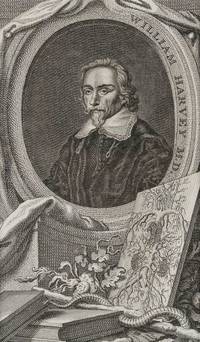
1770100010AG1770. Amsterdam J. Houbraken no year c.1770. Original copper engraving portrait of english physician William Harvey " first known physician to describe completely and in detail the systemic circulation and properties of blood". The vintage engraving shows William Harvey head-and-shoulders portrait facing slightly left in a medallion draped with cloth also shows a drawing of the cardiovascular system parts of a plant and a snake entwined around a stick suggesting a caduceus. The original engraving is framed and comes with an exceptional Facsimile of the first edition of "De Motu Cordis see images". Beautifully Framed. Size of frame with Harvey's portrait: 32 cm x 38 cm. Size of the actual portrait engraving: 9.5 cm x 15.5 cm. Excellent condition ! William Harvey 1 April 1578 3 June 1657 was an English physician who made seminal contributions in anatomy and physiology. He was the first known physician to describe completely and in detail the systemic circulation and properties of blood being pumped to the brain and body by the heart though earlier writers such as Realdo Colombo Michael Servetus and Jacques Dubois had provided precursors of the theory. In 1973 the William Harvey Hospital was constructed in the town of Ashford a few miles from his birthplace of Folkestone. William's father Thomas Harvey was a jurat of Folkestone where he served the office of mayor in 1600. Records and personal descriptions delineate him as an overall calm diligent and intelligent man whose "sons. revered consulted and implicitly trusted in him. they made their father the treasurer of their wealth when they acquired great estates.He kept employed and improved their gainings to their great advantage." Thomas Harvey's portrait can still be seen in the central panel of a wall of the dining-room at Rolls Park Chigwell in Essex. William was the eldest of nine children seven sons and two daughters of Thomas and his wife Joan Halke. Notable family connections include Heneage Finch 1st Earl of Nottingham who married William's niece Elizabeth Harvey and the diplomat Sir Daniel Harvey. Harvey's initial education was carried out in Folkestone where he learned Latin. He then entered the King's School Canterbury. Harvey stayed at the King's School for five years after which he matriculated at Gonville and Caius College in Cambridge in 1593. Harvey graduated as a Bachelor of Arts from Caius in 1597. He then travelled through France and Germany to Italy where he entered the University of Padua in 1599. During Harvey's years of study there he developed a relationship with Fabricius and read Fabricius's De Venarum Ostiolis. Harvey graduated as a Doctor of Medicine at the age of 24 from the University of Padua on 25 April 1602. It reports that Harvey had "conducted himself so wonderfully well in the examination and had shown such skill memory and learning that he had far surpassed even the great hopes which his examiners had formed of him." After graduating from Padua Harvey immediately returned to England where he obtained the degree of Doctor of Medicine from the University of Cambridge that same year and became a fellow of Gonville and Caius College. Following this Harvey established himself in London joining the Royal College of Physicians on 5 October 1604. A few weeks after his admission Harvey married Elizabeth Browne "daughter of Lancelot Browne Dr. Physic". They had no children. Harvey was elected a Fellow of the Royal College of Physicians on 5 June 1607 which earned him the Post-nominal letters FRCP and he then accepted a position at St Bartholomew's Hospital that he was to occupy for almost all the rest of his life. Succeeding a Dr Wilkinson on 14 October 1609 he became the Physician in charge at St Bartholomew's Hospital which enjoined him "in God's most holy name" to "endeavor yourself to do the best of your knowledge in the profession of physic to the poor then present or any other of the poor at any time of the week which shall be sent home unto you by the Hospitaller. You shall not for favor lucre or gain appoint or write anything for the poor but such good and wholesome things as you shall think with your best advice will do the poor good without any affection or respect to be had to the apothecary. And you shall take no gift or reward. for your counsel. This you will promise to do as you shall answer before God. " Harvey earned around thirty-three pounds a year and lived in a small house in Ludgate although two houses in West Smithfield were attached as fringe benefits to the post of Physician. At this point the physician's function consisted of a simple but thorough analysis of patients who were brought to the hospital once a week and the consequent writing of prescriptions. Published in 1628 in the city of Frankfurt host to an annual book fair that Harvey knew would allow immediate dispersion of his work the 72 page Exercitatio Anatomica de Motu Cordis et Sanguinis in Animalibus contains the matured account of the circulation of the blood. Opening with a dedication to King Charles I the quarto has 17 chapters which give a clear and connected account of the action of the heart and the consequent movement of the blood around the body in a circuit. Having only a tiny lens at his disposal Harvey was not able to reach the adequate pictures that were attained through such microscopes used by Antonie van Leeuwenhoek; thus he had to resort to theory and not practical evidence in certain parts of his book. After the first chapter which simply outlines past ideas and accepted rules regarding the heart and lungs Harvey moves on to a fundamental premise to his treatise stating that it was important to study the heart when it was active in order to truly comprehend its true movement; a task which even he found of great difficulty as he says: ".I found the task so truly arduous. that I was almost tempted to think. that the movement of the heart was only to be comprehended by God. For I could neither rightly perceive at first when the systole and when the diastole took place by reason of the rapidity of the movement." This initial thought led Harvey's ambition and assiduousness to a detailed analysis of the overall structure of the heart studied with less hindrances in cold-blooded animals. After this Harvey goes on to an analysis of the arteries showing how their pulsation depends upon the contraction of the left ventricle while the contraction of the right ventricle propels its charge of blood into the pulmonary artery. Whilst doing this the physician reiterates the fact that these two ventricles move together almost simultaneously and not independently as had been thought previously by his predecessors. This discovery was made while observing the heart of such animals as the eel and several other types of fish; indeed the general study of countless animals was of utmost importance to the physician: among the ones already cited one can add the study of the snail the invisible shrimp the chick before its hatching and even the pigeon. A digression to an experiment can be made to this note: using the inactive heart of a dead pigeon and placing upon it a finger wet with saliva Harvey was able to witness a transitory and yet incontrovertible pulsation. He had just witnessed the heart's ability to recover from fatigue. As early as the 17th century William Harvey had already discerned the existence of the Ductus Arteriosus and explained its relative function. Here he says ".in embryos whilst the lungs are in a state of inaction performing no function subject to no movement any more than if they had not been present Nature uses the two ventricles of the heart as if they formed but one for the transmission of the blood." However the apex of Harvey's work is probably the eighth chapter in which he deals with the actual quantity of blood passing through the heart from the veins to the arteries. Coming into conflict with Galen's accepted view of the liver as the origin of venous blood Harvey estimated the capacity of the heart how much blood is expelled through each pump of the heart and the number of times the heart beats in a half an hour. All of these estimates were purposefully low so that people could see the vast amount of blood Galen's theory required the liver to produce. He estimated that the capacity of the heart was 1.5 imperial fluid ounces 43 ml and that every time the heart pumps 1/8 of that blood is expelled. This led to Harvey's estimate that about 1/6 imperial fluid ounce 4.7 ml of blood went through the heart every time it pumped. The next estimate he used was that the heart beats 1000 times every half an hour which gave 10 pounds 6 ounces of blood in a half an hour and when this number was multiplied by 48 half hours in a day he realized that the liver would have to produce 498 pounds of blood in a day more than the weight of the whole body. Having this simple but essential mathematical proportion at hand which proved the overall impossible aforementioned role of the liver Harvey went on to prove how the blood circulated in a circle by means of countless experiments initially done on serpents and fish: tying their veins and arteries in separate periods of time Harvey noticed the modifications which occurred; indeed as he tied the veins the heart would become empty while as he did the same to the arteries the organ would swell up. This process was later performed on the human body in the image on the right: the physician tied a tight ligature onto the upper arm of a person. This would cut off blood flow from the arteries and the veins. When this was done the arm below the ligature was cool and pale while above the ligature it was warm and swollen. The ligature was loosened slightly which allowed blood from the arteries to come into the arm since arteries are deeper in the flesh than the veins. When this was done the opposite effect was seen in the lower arm. It was now warm and swollen. The veins were also more visible since now they were full of blood. Harvey then noticed little bumps in the veins which he realized were the valves of the veins discovered by his teacher Hieronymus Fabricius. Harvey tried to push blood in the vein down the arm but to no avail. When he tried to push it up the arm it moved quite easily. The same effect was seen in other veins of the body except the veins in the neck. Those veins were different from the others they did not allow blood to flow up but only down. This led Harvey to believe that the veins allowed blood to flow to the heart and the valves maintained the one way flow. Contrary to a popular misconception Harvey did not predict the existence of capillaries. His observations convinced him that direct connection between veins and arteries are unnecessary; he wrote "blood permeates the pores" in the flesh and it is "absorbed and imbibed from every part" by the veins. Wikipedia hardcover
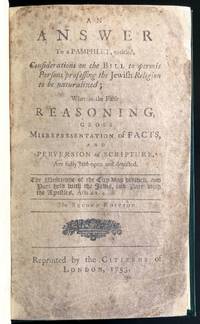
175343176London: “Reprinted by the Citizens of London†1753. Second edition. Modern attractive green cloth with title in gilt on spine. Small 8vo 8 5-67 pages. Roth Bibliotheca Anglo-Judaica p. 222 no. 102; Hyamson Bibliography of Pamphlets Relating to the Jew Bill of 1753 in: TJHSE Vol. VI 1908-1910 p. 181 no. 24.Halkett and Laing I 95.An example of the backlash to the short-lived Jew Bill of 1753. In the year 1609 the naturalization of any foreigner settled in England was made contingent on receiving the Sacrament. Although this act was deliberately directed against Catholics it incidentally would later affect Jews following the Re-Admission of 1653. This disability was lifted by the Whig Government of Henry Pelham in the Act of 1753 to permit persons professing the Jewish religion to be naturalized by Parliament. The bill was at best a limited advantage to the Jews since only the wealthy would have been able to set in motion the machinery necessary to obtain naturalization. Although the measure was accepted unanimously by the House of Lords it became a pawn in the upcoming general election campaign that resulted in its eventual repeal by the House of Commons. Taking full advantage of the prejudices and fears that the grant of naturalization to Jews had aroused the Tory opposition fueled the unpopularity of the Act with a pamphlet and broadsheet campaign that warned of an England overrun with Jews. The Whig government was forced by public opinion to give way and the pro-Jewish legislation was duly repealed in the same year that it was enacted. The present pamphlet is a response to the pro-Jewish pamphlet Considerations on the Bill to permit persons professing the Jewish religion to be naturalized by Parliament London 1753 by the pseudonymous “Philo-Patriae†Roth p. 221 no. 95. The present author makes the claim that the Jews employed an unnamed non-Jew to write that pamphlet. Summoning various passages from the New Testament our pamphleteer argues that the naturalization of the Jews would be in violation of “these Divine Laws†pp. 14-15.“In 1752-53 Romaine became nationally known for opposing a bill before Parliament relating to 'the naturalisation of those professing the Jewish religion'. He produced an opposing pamphlet and preached a sermon in which he took the ill-chosen text ‘These people being Jews do exceedingly trouble our city Acts 16:20'†John Crosby Evangelical Times. <br> This is his antisemitic pamphlet responding to Considerations on the Bill to permit persons professing the Jewish religion to be naturalized by Parliament 1753 attributed to “Philo-Patriae†Roth 221:95. Romaine issued it in the context of the fierce public backlash against the Whig-sponsored Jewish Naturalization Act of 1753 which temporarily lifted a 144-year-old requirement barring non-Christians from naturalization. <br> Though passed unanimously in the House of Lords the Act was quickly weaponized by Tory opposition ahead of the general election igniting a pamphlet and broadsheet campaign warning of a supposed Jewish inundation. Public pressure forced the Act’s repeal within the same year.The present pamphlet asserts that “Philo-Patriae†the author of the original pro-reform pamphlet was merely a gentile mouthpiece for Jewish interests. Citing the New Testament the anonymous author William Romaine argues that Jewish naturalization contravenes “Divine Laws†pp. 14–15. A stark example of 18th-century Anglican Antisemitism.<br> See: J. Picciotto Sketches of Anglo-Jewish History 1956 pp. 73-86; A. M. Hyamsonâ€The Jew Bill of 1753†in: TJHSE Vol. VI 1908-1910 pp. 156-188<br> A copy sold at auction for almost $1200 with commissions in 2023. <br> OCLC: 65524788<br> Title page and several leaves edgeworn no loss to text and reinforced with transparent Japanese tissue light shelf wear to boards good attractive condition. B BRIT-2-10-MV. London: “Reprinted by the Citizens of London†unknown
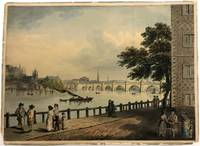
18003220069<i>Watercolour 330 × 460mm in modern mount. </i><br /><br />The view shows part of the gateway of Lambeth Palace to the right and on the left Westminster Abbey and the Palace of Westminster to the left. - A closely allied view by Malton was apparently sold at auction in 1925 whereabouts unknown with figures differently placed.<br />
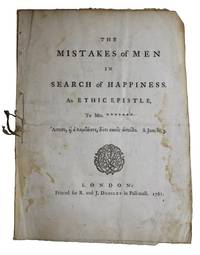
1761AQ25307London: Printed for R. and J. Dodsley 1761. 11pp 1. Uncut. Later restitched. Creased fore-edge damp-stained several small holes to water-marked final leaf early inked ownership inscription to blank verso: 'Donald Williamson Culloden near Inverness'. A rare survival of the sole edition of an anonymous epistolary poem of unrequited love that from the opening couplet is evidently the work of a rejected suitor to the unidentified addressee: 'Fair maiden once the hope of 's life / Fair woman now and happy 's wife'. The Critical Review Vol. XI 1761 was succinct in its praise their entire appraisal consisting of only four words 'Elegant moral and poetical'. The Monthly Review Vol. 24 1761 was less kind and a tad more verbose: 'Middling poetry and common-place sentiments as old as the first satire in Horace'. ESTC records a single copy in the British Isles BL and three further in North America Cincinnati Kansas and LoC. ESTC T231. First edition. Quarto. Printed for R. and J. Dodsley unknown
1709GT861London: Eben. Tracy at The Three Bibles on London Bridge 1709. Hardback. Vg. small 8vo. Title-page and Foreword to the reader xx 447pp. Lacking the f.f.e.p. blank. Original full calf with blind dec. border to the cover edges. Raised band wirh no label. Originally pub. in 1661 by Robert Wilson. 16.5cms. A 1700 copy has been traced in Trinity Coll. Dublin. A RARE ITEM. No copy traced. Edward Burrough 1634-1662 was a Quaker activist and writer of Kendal and died in Newgate prison aged 29. The DNB has an article on Edmund Burrough and his many works pub. before death at 30. He was one of the 'Valiant Sixty' <br/> <br/> Eben. Tracy at The Three Bibles on London Bridge hardcover
17369910LONDON: PRIVATE 1736 Hard back full Vellum with titles to spine in Ink250 x 195 mm approx. viii 204 2 124. The second part being a collection of papers records etc referred to in the foregoing history. Frontis Portrait of author 25 plts incl maps and plans some fold out.Other illustrations in text. Privately printed for the author and Joseph Ames and Peter Thompson at the Golden Ball Pater-noster-Row. 2nd Edition 1736 Printed on hand made rag paper sewn on four cords tight back with integral sewn plain headbands in a contemporary English Binding. A very good copy. No previous owner name or inscription. Shelf soiling to vellum which appears to have been used from an earlier parchment as shadow of writing shows through principally to rear which adds to the charm of the binding.A little soiling to the reverse of the frontis. No other notable defects. PRIVATE hardcover
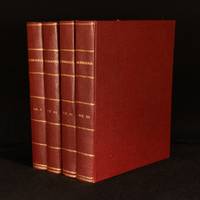
1779973Z17London: The Society of Antiquaries of London; White Robson Conant Leigh et al. 1779-96. First edition. Cloth. Near Fine. 11" by 9". None stated. Four volumes of this periodical from 'The Society of Antiquaries of London' providing insight into the archaeological discoveries of the eighteenth century adorned with many fantastic plates. The first edition. A four volume set. This set includes; "Archaeologia: or Miscellaneous Tracts Relating to Antiquity" Volume XII 1796; Volume XI 1794 Volume VII 1785 and Volume V 1779. Illustrated with thirty one engraved plates to "Vol V" including many folding plates. Thirty-four to "Vol VII". Twenty-one plates to "Vol XI" with plate 312 next to pp. 320. Fifty-three to "Vol XII". Collated complete. "Archaeologia: or Miscellaneous Tracts Relating to Antiquity' is a scholarly print journal published by the Society of Antiquaries of London. The journal features a series of articles on important developments in the world of antiquities covering topics such as; antiquities and inscriptions found in the Tower of London druidical remains found in Derbyshire an account of the Bicknacre Priory in Essex the discovery of ancient swords and remains and an essay on the history of the Venta Incenorum. Bound in modern cloth. Bound in modern cloth. Externally excellent with only rear hinge to Vol V and "XII" tender. Internally firmly bound with generally bright and clean pages with the odd spot and occasional offsetting. Near Fine The Society of Antiquaries of London; White, Robson, Conant, Leigh et al. hardcover
17992092902141505094Sowler and Russell 1799. Soft Cover. Fine. Size: A5 Size: 566 pages Sowler and Russell paperback
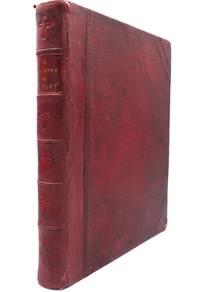
1780243Basel: Mechel 1780. Very good. Chrétien de Mechel. <p data-start="345" data-end="767">c.1860–1880. Later Edition Albumen Reproduction. Approx. 45 leaves. Basel: Chrétien de Mechel after Hans Holbein.<br data-start="466" data-end="469" /> Half calf over red pebbled cloth raised bands gilt title to spine all edges gilt t.e.g. Light rubbing and toning; minor foxing to margins. Each plate with printed caption leaf; albumens clean and richly toned mounted on stiff card. Plate 45 bound before Plate 44 as issued in some copies.<br /> <br /> A striking 19th-century photographic reproduction of Le Triomphe de la Mort after the original engravings by Hans Holbein the Younger engraved by Chrétien Christian de Mechel of Basel. Each albumen print approx. 14 × 18 cm to 18 × 19 cm is mounted on card and accompanied by explanatory text. The final two plates are slightly smaller completing the sequence of 45.<br /> <br /> Produced during the Victorian revival of Renaissance moral imagery this edition re-presents Holbein’s famed Dance of Death cycle with remarkable tonal depth and precision. The red half-calf binding and gilt spine suggest mid-century continental craftsmanship while the t.e.g. finish and numbered mounts indicate a deluxe presentation - offering collectors both the visual drama of early photography and the moral gravitas of Renaissance print art.<br /> <br /> A handsome and uncommon survival from the early era of photographic publishing exemplifying 19th-century engagement with fine art reproduction. In store case 2.</p> . Mechel unknown
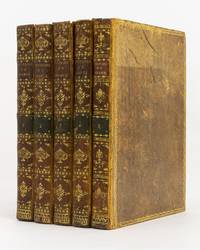
1787133057Paris: Chez l'auteur F.A. David 1787. First Edition. Hardcover. Very Good. Paris Chez l'auteur F.A. David 1787 to 1796. Quarto five volumes 184; 199; 223; 192; and iv 206 pages plus an engraved title in each volume and a total of 140 engraved plates with tissue-guards. Early mottled calf; spines extensively tooled in gilt with contrasting morocco lettering-pieces; sides bordered with gilt rolls; all edges gilt; spines tanned with the leather now somewhat brittle; a few joints splitting but sound; covers slightly worn; backstrip of the first volume partially detached; some plates a little tanned; occasional light foxing; half a dozen closed tears to margins; a few other minor signs of age and use but internally a crisp clean wide-margined set in very good condition meriting a sympathetic restoration of the bindings. The 140 plates illustrating scenes from French history to 1768 are engraved by François-Anne David after designs by Nicolas Lejeune. <p>The 'Gazette nationale ou le Moniteur universel' for 5 November 1794 contains a lengthy advertisement for David's series of illustrated histories indicating that the print run included a deluxe issue with the plates printed in 'bistre sanguin anglais' on wove paper; this set is from the standard issue printed in black ink. 5 items. Chez l'auteur, F.A. David hardcover