888 résultats
180054439London:: Printed For J. Wright Piccadilly By John Dean 1800. 1800. First edition in English. 4to. Translated from the original Spanish by Maurice Keatinge. Leather and boards viii 514 1 pp. frontispiece map preface. One of the most important firsthand accounts of the Spanish conquest of Mexico. Written by Bernardo Diaz del Castillo a foot soldier who served under Hernan Cortes during the expedition that led to the fall of the Aztec Empire. The book covers the expedition from Cuba to Mexico in 1519; first encounters with Indigenous peoples along the Gulf Coast; the alliance with the Tlaxcalans; the march to Tenochtitlan; meetings between Cortes and Moctezuma II; the uprising in Tenochtitlan and the retreat known as the La Noche Triste; the siege and fall of Tenochtitlan in 1521; etc. The book provides detailed descriptions of Indigenous cities markets and customs; military operations and logistics; relationships among Spanish commanders; daily life of common soldiers; the cultural shock experienced by Europeans encountering Mesoamerican civilization; etc. Encyclopedia Britannica: "Bernal Diaz del Castillo 1495 – 1584 was a Spanish soldier and author who took part in the conquest of the Aztec nation. Diaz's account is written in an unassuming colloquial style and has both historical and artistic value." A.S.W. Rosenstock 19 #193: "All the later histories of America have acknowledged their debt to Bernal Diaz and his work has been acclaimed one of the most valuable source books of the period." The author was an original member of Cortez’s expedition to conquer the Aztec nation. He was involved in the initial planning stages all the way to its culmination. One of the most important sources on the conquest of the Aztec Empire and Mexico. The original leather spine label is missing but a new leather label approximating the original has been placed inside this copy. Retains the original leather boards which exhibit perimeter wear. Internally there are repairs to the hinges with some toning of the text but remarkably free of foxing. In all a very good copy. Printed For J. Wright, Piccadilly, By John Dean, 1800. hardcover
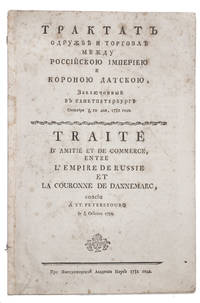
1782K1VFD9JN4VH6St. Petersburg 1782. Small folio 29.5 x 19.5 cm. Imperial Academy of Sciences Disbound. Treaty between Russia and Denmark in Russian and French in 2 parallel columns in cyrillic left and roman right types. 22 pp. Very rare first edition in Russian and French of a treaty for friendship and commerce concluded at St Petersburg negotiated between Tsarina Catherine the Great of Russia and King Christian VII of Denmark. The relationship between the two countries had become hostile after Peter III became the Russian Tsar in 1762. His descent from Holstein-Gottorf led to territorial conflicts between the two powers and even to a threat of war. When Catherina II took the throne their relation stabilized. In 1765 they made an alliance and in the 1773 Treaty of Tsarskoe Selo Russia returned Schleswig-Holstein to Denmark in exchange for Russian control over the Duchy of Oldenburg. The present treaty emphasizes the "peace" and "eternal friendship" between Russia and Denmark and gives specific conditions for trade.Old vertical crease from a former fold first and last leaf lightly soiled and spotted and the sewing has partly come loose but still in good condition.l KVK & WorldCat 2 copies; G.F. von Martens Recueil des principaux traités . II 1801 no. 100 pp. 284-300. unknown
1764183079London: T. Jefferys Geographer to the King 1764. 1st Edition . Hardcover. Very Good/No Jacket. 288pp 19p Index. 9 folding maps lacking the frontispiece "Map of Westphalia" but otherwise complete. Rebound in 3/4 leather over marbled boards with 5 raised bands; new blank endpapers. The maps and text are in excellent condition Inscribed in ink to the top of the title page "Camarthen 1780." A very nice copy of the rare first edition. <br/> <br/> T. Jefferys, Geographer to the King hardcover
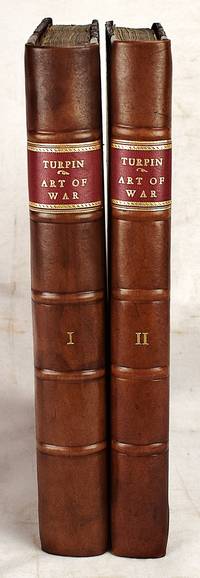
17612107060009London : A. Hamilton for W. Johnston 1761-01-01. First Edition. Hardcover. Good. Presentation copy with Interesting Napoleonic War Provenance: Inscribed by Sir Wroth Palmer Acland 1770-1816 to Sir Galbraith Lowry Cole 1772-1842 inside front cover. 2 volume set. Quartos. Bound in contemporary leather. Rebacked with renewed spine. Good binding and cover. Complete with 25 folding engraved plates. <br> Translation of Turpin's "Essai sur l'art de la guerre" first printed in 1754. ESTC T101571. <br> Interesting Napoleonic / Peninsular War Provenance: Lt. General Acland served in the 17th Regiment 3rd Regiment Buffs 19th Regiment of Foot Coldstream Guards and the 60th Regiment. He was active in the Peninsular War as one of Wellington's brigade commanders in Portugal and Spain and also in Flanders during the French Revolution and Napoleonic wars. General Cole was an Irish peer and General in the Peninsular War. He also served in the West Indians Egypt Italy and Ireland. He was active in the 27th Inniskilling Regiment of Foot. He notably commanded the 1st Brigade in the Battle of Maida as well as the battles of Albuhera Salamanca Vittoria Pyrenees Nivelle Orthez and Toulouse. He was also the Governor of the Cape Colony South Africa and of Mauritius. <br> Also includes related biographic information about Acland and Cole and photocopies from Elizabeth Longford's book "Wellington Years of the Sword." 19th century booktag from "Miss Millard: Book and Curio Finder Teddington Middlesex." Clara Millard was an exceptionally interesting book huntress. Read Laurence Worms of Ash Rare Books' fascinating blog post about her. London : A. Hamilton, for W. Johnston hardcover
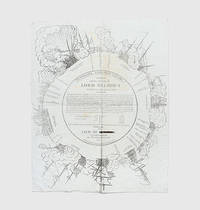
1799183885London: printed by J. Adlard 1799. An immersive experience of Nelson's victory A key to one of Robert Barker's popular panoramas depicting and explaining the course of the battle fought just one year prior. The destruction of Brueys's flagship the Orient is evocatively rendered in the upper left corner while HMS Vanguard is depicted in the lower right. The captions name each ship her captain and her arms. Barker 1739-1806 invented the concept of the panorama in the mid-1780s while walking on Calton Hill in Edinburgh. In 1787 he took out a patent for his "Nature à Coup d'Oeil" a circular building with light entering from the ceiling only. The walls would be covered with a continuous painting stretching around all 360 degrees of the circle such that the viewers would be fully immersed in the scene. After successful trials in Edinburgh and Castle Street Barker erected a rotunda in Leicester Square in 1792. It housed two panoramas each on a separate floor such that one could be replaced while the other was still open for public view. Visitors to the Barker's rotunda were able to buy keys to the paintings which "gave detail to what the audience were seeing. This included names of landmarks and people and sometimes historical context. The circular designs. allow the viewer to engage with the scene by rotating the paper. Later designs sadly ditched the circular aesthetic and instead used simple rectangular panoramas" Gehrmann. In many cases these keys are the only records of the designs. Nelson reportedly met Barker in Palermo in 1799 thanking him for prolonging the popularity of his victory. Single sheet 410 x 330 mm watermarked "1797" woodblock on one side only edges untrimmed. Framed glazed and mounted 548 x 463 mm. "Margate" crossed out in black ink. Creased where sometime folded lightly foxed a few repaired closed tears and holes along fold lines otherwise bright: a very good copy. Leif Gehrmann "The Cyclorama: Virtual Reality in the 1800s" 2024. unknown
174050862Petropoli St. Petersburg Typis Academiae 1740. 4to. No wrappers. In: "Classes Tertia continens Historica. Commentarii Academiae Scientiarum Imperialis Petropolitanae" Tomus VII ad Annos 1734 & 1735. The whole section of "Historica"offered. Title-page to Tome VII with engraved vignette halftitle to the section a. pp. 345-426 6 engraved plates. Bayer's paper: pp. 362-426 and 5 engraved plates with numerous chinese characters. Clean and broad-margined. <br/><br/><em>First printing in part of the first Western translation of any part of Confusius' influential Chun Cieu being the fourth volume of his works. "The title Chun Cieu Chunqiu signifies the Spring and Autumn. He discourses like an historian of the expditions of diversr princes of their Virtues and Vices of the fatigues they underwent. The title is an emblematic title because that states flourish when their Princes are endowed wit Virtue and Wisdom which is represented by the Spring and that on the contrary they fall like the leaves and are utterly destroyed when their Princes are dispirated or are wicked which is represented by the Autumn."James Legge.The section also comprises Bayer. Elementa Calmucia. 1 pp. and 1 engraved plate numerous characters and Bayer. De Venedis et Eridano Fluvvio. Pp. 346-361. </em> unknown
175650678London N. Gibson 1756. 8vo. Contemp. full calf. Raised bands. Titlelabel with gilt lettering. Blindtooling to covers. A neath repair at upper compartment. Spine slightly rubbed. VIII4764 pp. A very faint dampstain to lower right corners. A few scattered brownspots. Printed on good paper. <br/><br/><em>Very scarce first edition in English a translation of the relevant part of Chr. V's Danske Lov 1683 relating to the Danish West Indies. All laws and regulations on St. Thomas St. Croix and St. John were based on this lawcomplex in the period of the Danish possession of these islands.Sabin No 18501. </em> hardcover
176053320Sorøe Jonas Lindgren 1760. Samtidigt hldrbd. Ryggen med blindtrykte dekorationer. Rygtitlen slidt. Hjørner lidt stødte. 83831 pp. samt 2 kobberstukne plancher. Spredte brunpletter og lettere brugsspor.Contemp. hcalf. Blindtooled decorations on spine. Titlelabel worn. Corners a bit bumped. Scattered brownspots and light traces of use. <br/><br/><em>Scarce first edition of this pioneering work by leading historians of ethnology considered the true beginning of scientific ethnology and anthropology. </em> unknown
177256743Hafniæ Godiche N. Möller 1772-92. - VIII 1834 og Registerbind IX 1878. Folio. Bind 1-7 i samtidige hellædrbind i flammet kalv. Ophøjede bind. Rig rygforgyldning. Forgyldte tome- og titelfelter i skind. Nogle kapitæler slidte. Bind 8 som ikke udkom i samtiden men først 1834 er i originalt papbd. med shirtryg. Bind 9 som først udkom 1878 er i nyere hfableabd. De 7 første bind indeholder en del foldetabeller kobberstukne faksimiler af håndskrifter kobberstukne foldekort etc. Disse 7 bind har tilhørt retshistorikeren J.L.A. kolderup-Rosenvinge. <br/><br/><em>The largest collection of Danish medieval texts. In 1834 - 30 years later - a supplementary volume was published called Vol. VIII this is present here together with the Index-volume published more than 100 years after the first volume. - From vol. IV P.F. Suhm was editor after the death of Langebek. </em> unknown
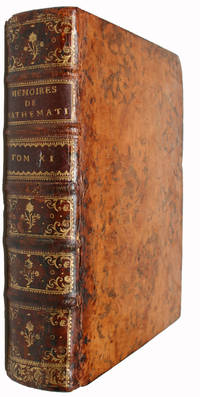
178644923Paris Moutard 1786. 4to. Contemp. full sprinckled calf with 5 raised bands on spine. Richly gilt compartments title-and tomelabels with gilt lettering. A small nich to leather at middle of front hinge. A small tear to rear hinge at upper compartment. "Mémoires fe Mathematique et de Physique Présentés à l'Academie des Sciences par divers Savans" Tome XI. 4198682 pp. Wide-margined fine and clean. <br/><br/><em>This collective work is the French Academy's monumental treatise on the chemistry and the production of Salpetre a topic of great importence for the war-industry in making gunpowder. The volume contains papers by Macquer Darcy Lavoisier Sage Baumé de la Rochefoucault Clouer and an anonymous report on experiments made in England CAVENDISH'S on the composition of nitric acid.papers by Cornette Thouvenel and Thouvenel Le Lorgna Gavinet and Chevrand de Beunie Romme Clouet and Lavoisier de Rochefoucault etc.Partington III p. 467 n."The Regie des Poudres et Salpetres had the monopoly of refining salpetre from 1775 until it was suppressed during the Revolution. Until his retirement in 1791 the leading light in it was Lavoisier who seems to have written its publications. - In 1775 the Academy offered a prize of 4000 livres for a process for procuring an abundant supply of salpetrethe announcement being written by Lavoisier. Altogether 66 papers were received and the prize was finally awarded in 1782 to the brothers Thouvenel who gave a full account of nitre plantations. The material was published in 1786 in one volume by the Academy. In it Lavoisier describes 'Experiences sur la décomposition du nitre par le charbon' said to have been made in 1784."Partington III pp. 466 ff."Peu de temps après que Lavoisier eut été nommé régisseur des poudres et salpêtres il suggéra à Turgot alors contrôleur général des finances l'idée de charger l'Académie des sciences de décerner un prix au meilleur mémoire sur la formation du salpêtre. 'Académie nomma une commission dont Lavoisier fut le rapporteur ; c'est lui qui examina tous les mémoires présentés au concours en fit l'analyse et quand l'Académie publia en 1786 un volume contenant l'histoire du prix du salpêtre et les mémoires présentés au concours c'est encore Lavoisier qui en fut le rédacteur. Ce volume fait partie du Recueil des mémoires de mathématiques et de physique présentés à l'Académie royale des sciences par divers savants et lus dans ses assemblées tome XI contenant le Recueil des mémoires sur la formation et la fabrication du salpêtre à Paris de l'imprimerie Moutard DCCLXXXVI. Sauf les mémoires des concurrents et un mémoire du duc de la Rochefoucault ce volume est tout entier de la main de Lavoisier. Il est formé de deux parties ; la première est intitulée : Histoire de ce qui s'est passé relativement au prix proposé sur la formation du salpêtre ; la seconde partie comprend les mémoires présentés au concours ainsi que des mémoires de Lavoisier et Clouet un mémoire sans signature mais qui appartient à Lavoisier le manuscrit autographe a été conservé le mémoire du duc de La Rochefoucault et les expériences de Lavoisier sur la décomposition du nitre par le charbon." </em> hardcover
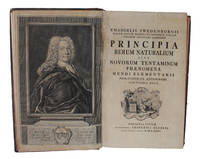
173450434Dresden et Leipzig Frederik Hekelius 1734. Folio. Contemp. full mottled calf. Upper half of spine rebacked. Raised bands. Lower part of spine gilt. A crack to leather at lower part of fronthinge cover not loose. Engraved portrait. 16452 pp. and 28 engraved plates on 26 sheets. A dampstain in upper part of inner margins throughout otherwise clean and wide-margined. The plates with some browning. <br/><br/><em>Scarce first edition of Swedenborg's main scientific work. The volume also form part one of his "Opera Philosophica et Mineralia"."In his Principia rerum naturalium Leipzig 1734 probably conceived as a counterpart to Newton’s Principia he sought a comprehensive physical explanation of the world based on mathematical and mechanical principles. While remaining faithful to the general principles of Cartesian natural philosophy which he had learned while studying at Uppsala Swedenborg elaborated upon them. According to his cosmogony the physical reality has developed from the mathematical point which was an entity between infinite and finite. Through a vortical movement implanted on the point a series of material particles developed the "first finiata "the second finita"and so on that eventually led to the cosmos in its present state. In contrast to Descartes Swedenborg believed that the planets had developed from the chaotic solar mass through expansion of its surrounding shell which finally joined to form a belt along the equatorial plane of the sun. It then exploded forming the planets and the satellites. Although the basic construction of Swedenborg’s thought heralded the later planetary theories of Buffon Kant and Laplace there is nothing to indicate that it exerted any direct influence on posterity." DSB.In 1738 Swedenborg's magnum opus was placed on the "Index Librorum Prohibitorum". </em> hardcover
17753730London: Printed for T.Lowndes 1775 1775. First edition. 4to. 265x210mm. pp. iv 764 10 index. Ten engraved plates frontispiece portrait of the author and a further nine. The verso of the second leaf of preliminaries is numbered vi. Some foxing in places but otherwise internally very good with the plates in excellent condition. Handsomely bound in slightly later red straight-grained morocco upper and lower covers decorated with two double fillet borders in gilt enclosing a continuous "drawer-handle" design in blind and framing a continuous swag and drop border in blind. Spine with five double raised bands decorated in gilt and blind and lettered in gilt to the second and fifth compartment. Edges of the boards decorated in gilt. Turn-ins decorated in gilt with a wavy dotted line and ears of wheat with a flower motif in the corners. All edges gilt. The binding is of a very high standard. It is unsigned but the tooling and overall design conforms to the work of the German emigré binders and we would tentatively attribute the binding to either Christian Kalthoeber or John Bohn and date it to the 1790s or the very early years of the 1800s. A previous owner has inscribed the verso of the front free endpaper "Bound by Edwards of Halifax ". This seems unlikely but it is possible given the subject matter of the book and the links between Edwards and the German emigré binders that this copy did pass through Edwards's hands. John Watson 1723-1783 was that perfect eighteenth-century combination of clergyman and antiquary. He was the curate of Halifax between 1750 and 1754 and retained links with the town throughout his life. Starting with Druidical remains and moving through Roman affairs Watson brings the reader up to the eighteenth century. He covers the history of Halifax and provides details of the main buildings in the town as well as exploring fascinating byways such as "Remarks on the Dialect of Halifax""Vocabulary of Uncommon Words used in Halifax" and "A Catalogue of Plants Growing in the Parish of Halifax". London: Printed for T.Lowndes 1775 hardcover
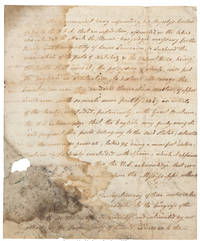
1797List2522New Orleans 1797. Three pages of a bifolium 8 x 9 ½ inches New Orleans; May 31 1797. Fair only with moisture damage and some text illegible. Fair. An interesting document from the period following the Treaty of San Lorenzo and before the eventual surrender of Natchez to the Americans in 1798 in which the governor of Louisiana and West Florida Francisco Luis Hector de Carondelet issues a statement regarding the delayed withdrawal of Spanish troops from the region. Carondelet is concerned with the British presence in the area and notes that it is a violation of “the treaty concluded with Spain†- or Pinckney’s Treaty which opened up navigation rights of the Mississippi to the United States. The letter describes the possibility of escalating hostilities between the United States Great Britain and Spain as a result of an impending American mission against the Illinois the motives of which Carondelet questions as he notes that “These hostile dispositions can naturally only concern these provinces because the U.S. are in peace with all the savages…†He raises the possibility of British invasion of Louisiana and potential danger to the city of New Orleans and states that the Spanish will maintain their presence at Natchez and Walnut Hills unless the American soldiers withdraw. This is a copy of Carondelet’s speech in the hand of Lieutenant Piercy Smith Pope and we find no other record of it. A full transcription follows:<br /> <br /> “The Government being informed by his Majesty’s Ambassador to the U.S. that an expedition assembled on the lakes was intended to attack the Illinois has judged necessary for the surety and tranquility of Lower Louisiana to suspend the evacuation of the posts of Natchez & the Walnut Hills being the posts that cover it; the possession of which will put the English in a situation to disturb and ravage the country in case they rendered themselves masters of upper Louisiana with so much more facility as by an article of the treaty concluded posteriously with Great Britain the U.S. acknowledge that the English may freely navigate and frequent the posts belonging to the said States; situated on the river in general lakes &c being a manifest contradiction to the treaty concluded with Spain which it appears. because by this the U.S. acknowledge that no other nation can navigate upon the Mississippi without the consent of Spain.<br /> <br /> . the legitimacy of these motives the .presented to the Congress of the U.S. with all the necessary veracity and intimated by our orders in the Commissary of Limits as well as to the Commandant of the Detachment of American troops now at Natchez. We are now informed that a detachment of the army of the U.S. cantoned on the Ohio are on their way by Holstein towards Natchez while the Militia of Cumberland are intimated to hold themselves ready to march at the first notice.<br /> <br /> These hostile dispositions can naturally only concern these provinces because the U.S. are in peace with all the savages the anterior menaces of the Commissary of Limits & the Commandant of the detachment of Americans now at Natchez; the immediate rupture & if the American Gazettes are to be believed already effected between France our intimate ally and the U.S. engage us to be on our guard to defend our property with that valor & energy which the inhabitants of these Provinces have manifested on all occasions with the advantage and superiority which a knowledge of our local situation will procure and that confidence which right and justice inspires. If the Congress of the U.S. had no hostile intention against these provinces they will either leave the post of Natchez or Walnut Hills the only bulwarks of Lower Louisiana that can stop the courses of the English or that they give us security against the article of the Treaty with Great Britain which exposes lower Louisiana to be pillaged and destroyed down to the Capitol. We will then deliver up the said posts and lay down our arms which they have forced us to take up by arming their Militia in time of peace and sending a considerable body of troops by round about ways to surprise us.<br /> <br /> New Orleans 31st May 1797 <br /> <br /> A copy of the Baron de Carondelet’s Proclamation. <br /> P. Popeâ€<br /> <br /> Overall a document of significance in United States / Spanish relations in the period following Pinckney’s Treaty worthy of further study for scholars of the diplomatic history of the period. unknown
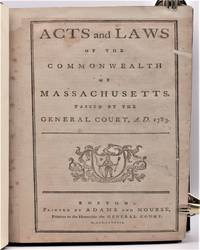
1789W2124Boston: Adams and Nourse 1789. Complete Collection of Adams & Nourse Printings of Massachusetts Laws 1783-1789. Compilation of the acts passed by the General Court of the Commonwealth of Massachusetts from 1783 through 1789. 1-746 pages followed by 63 pages numbered 433-495 of "Perpetual Laws." Sympathetically rebound in full brown leather. The title page carries a publication date of 1783 but the consecutive pagination suggests to me that the title page may have been inserted from another disbound book at the time this volume was rebound. First Edition Thus. Hardcover. Collectible-Very Good. Folio - over 12" - 15" tall. Book. Adams and Nourse Hardcover
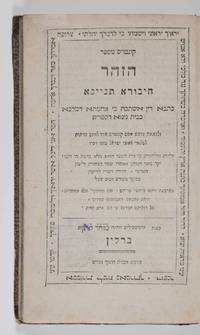
178248885Berlin and Dessau: Hevrat Hinukh Ne‘arim Berlin Freischule/n.p. 1782. First editions 2 of 4. Hardcover. Nearly Fine. Sammelband of four opuscules published between 1782 and 1819 octavo. Contemporary half calf top inch perished over pastepaper boards; spine lettered and tooled in gilt. Edges speckled blue. Covers lightly worn else fine clean copies the fourth work lightly foxed throughout. The first three works issued from the Hevrat Hinukh Ne'arim Berlin Freischule under the supervision of Isaac Satanow 1732-1804 the most prolific Hebrew writer of the Berlin Haskalah. As director of the publishing house Satanow was assigned the task of reissuing old Hebrew classics by the Marpeh ha-Nefesh a philanthropic group headed by the banker Daniel Itzig his son-in-law David Friedländer and the famous physican and philosopher Marcus Herz. A number of these editions however were in fact original works by Satanow which he presented as the work of earlier writers. The first item in the sammelband is an outstanding example of this latter type.<br /> <br /> I. Kuntres mi-Sefer ha-Zohar Hibura Tinyana Berlin: Hevrat Hinukh Ne‘arim 1783. aleph-gimel8 dalet1; 25ff. Vinograd Berlin 313. First edition of this polemic styled in imitation of the Zohar as a response to the Mitpahat Sefarim 1768 of Jacob Emden 1697-1776 in which the latter calls into question the antiquity and textual integrity of that chief work of the Jewish mystical tradition. Emden's critique may be understood as an attempt to undermine the doctrinal foundation of the Frankists who based their beliefs on the Zohar. "Emden had suspected the authenticity of the Zohar for a long time and he hoped some time 'to reveal the strange things found in the book.' But these intentions were secretly nursed within him for many years until the time was propitious for his exposé" Cohen. Perhaps surprisingly for a maskil Satanow held a very different view: "While advocating secular knowledge and the study of science Satanow also expressed great admiration for Kabbalah. In contrast to Emden he claims that the whole Zohar was written by Bar Yohai and Moses De Leon had nothing to do with its writing. He also rejects Emden's claim that in the Zohar there are words against the Talmud and promises to 'consult the Zohar and prove that all its words are right and truthful none of them is crooked Kuntres mi-Sefer ha-Zohar pp. 25 26" N. Rezler-Bersohn. Born in the Polish now Ukrainian town of Satanov Isaac Satanow settled in Berlin around 1771. "Among the most prolific of the early Haskalah writers. Satanow demonstrated a wealth of knowledge of the Hebrew language ranking as a model stylest throughout the Haskalah period" EJ 14: 905-906. As a leading representive of the eighteenth-century Jewish Enlightement Satanow boldly displayed a "conglomeration of contrasts" Jewish Enc. XI: 71: “Though Orthodox in his beliefs he nevertheless favored Reform in practice. He was one of the greatest authorities on Jewish tradition and lore yet he was one of the most free-thinking of philosophers.†For a more detailed discussion of this and other works by Satanow see N. Rezler-Bersohn "Isaac Satanow - An Epitome of an Era" in: Year Book XXV Leo Baeck Institute 1980. For Emden in the present context see M. L. Cohen Jacob Emden A Man of Controversy Philadelphia: The Dropsie College 1937 pp. 254ff.<br /> <br /> II. Sefer Igeret ha-Kodesh Berlin 553 1793. 7ff. Vinograd Berlin 415. Later edition of this well-known work. The celebrated talmudist and exegete Nachmanides the Ramban Moses ben Nachman ca. 1195-ca. 1270 acted as a conciliator between the parties in the early 13th-century controversies surrounding the philosophical and secular direction of Maimonides' growing influence. "After having given the earlier part of his life to his Talmudical works Moses Nachmanides devoted himself to writing of a homiletic-exegetic and devotional character. To these belong the "Iggeret ha-Kodesh" and the "Torat ha-Adam." In the former which deals with the holiness and significance of marriage Moses criticizes Maimonides for stigmatizing as a disgrace to man certain of the desires implanted in the human body. In Moses' opinion the body with all its functions being the work of God none of its impulses can be regarded as intrinsically objectionable" Jewish Enc. IX:88. The rare editio princeps appeared at Rome in 1546; the editor of the present edition Isaac Satanow notes at the title that the letter was “printed in Basel in the year 5340†referring to the 1580 edition of Ambrosius Froben Prijs 127.<br /> <br /> III. Nevu’at ha-Yeled Berlin: Hevrat Hinukh Ne‘arim 549 1789. asterisk8 2asterisk2. 10 unnumbered leaves. Vinograd Berlin 384. Later edition of a medieval Hebrew short story with commentary first printed at the end of Jacob Zemah's Sefer Nagid u-Metzaveh Constantinople 1726. "The body of the tale is followed by a number of occult prophecies in Aramaic. it was known already as early as the end of the 15th century and the beginning of the 16th when some kabbalists among them R. Abraham b. Eliezer ha-Levi wrote commentaries on the prophecies. The story tells of a wonder child Nahman born in the fifth century to a kabbalist; the child died very young but immediately upon birth began to tell his mother secrets of the heavenly worlds. His father cautioned him not to reveal mysteries forbidden to man and from then the child spoke only obscurely and enigmatically. Modern scholars have attempted to date the story and the prophecies therein by tracing known historical events hinted at and relating them to the text. The obscurity of the text makes this very difficult but it seems probable that historical events in the 15th century especially in the East are referred to in the prophecies. However the purpose of the story and its prophecies was to anticipate the coming of the Messiah and to describe the major political and historical events and catastrophes bringing about his final revelation. The kabbalists interpreted the prophecies as hinting at the coming of the Messiah in the early 16th century" JE XII:1020. Here the commentary on the Aramaic "prophecies" is likely attributable to Satanow.<br /> <br /> IV. Herev Nokemet Nekam Berit Dessau 5579 1819. 16pp. Vinograd Dessau 77. First edition of this famous polemical letter. A leader of the Reform movement Meyer Israel Bresselau d. 1839 together with I. S. Fraenkel edited and adapted in 1818 a prayer book for the Hamburg Reform Temple under the title Seder ha-Avodah. He anonymously published the present work in response to Eleh Divrei ha-Berit Altona 1819 "a pamphlet which collated the views of the greatest Orthodox rabbis of Western Europe against Reform Judaism and its innovations." A rhymed work written in a satirical biblical style Herev Nokemet is "remarkable in its witty take-off on the Orthodox rabbis who opposed the reforms in the Hamburg Reform synagogue. It ranks among the best Hebrew polemic literature written at the time of the Haskalah" EJ 4:1358 In response Meir Leib Reinitz published his Lahat ha-Herev ha-Mithappekhet in 1820. Bresselau's polemic was reprinted as an appendix to Bernfelds's Toledot ha-Reformazyon ha-Datit be-Yisrael in 1900. ×§×•× ×˜×¨×¡ מספר הזהר ×—×™×‘×•×¨× ×ª× ×™×™× ×<br /> ספר ×גרת הקדש<br /> × ×‘×•×ת הילד<br /> חרב × ×§×ž×ª × ×§× ×‘×¨×™×ª. Hevrat Hinukh Ne‘arim (Berlin Freischule)/[n.p.] hardcover
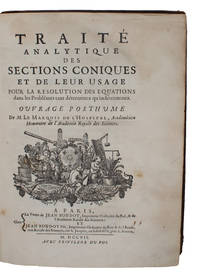
170748217Paris Jean Boudot et Jean Boudet fils 1707. 4to. Contemporary full calf. A bit of cracking to front hinges so that cords are seen but cover not loosening. Spine with 6 raised bands richly gilt compartments. Wear to top of spine. Two small old paperlabels one to upper compartment one to frontcover. Covers slightly rubbed. 44595 pp. Large woodcut vignette on titlepage 2 other vignettes one engraved one in woodcut. 32 folded engraved plates and one smaller folded plate Fig. A. An old owners stamp on flyleaf. Internally clean and fine. A few tiny brownspots. Wide-margined and printed on good paper. <br/><br/><em>Scarce first edition of l'Hôspital's second book - his second successfull textbook - the manuscript of which was left completed at his death in 1704. His first book "Analyse des infiniment petits pour l’intelligence des lignes courbes" 1696 was the first textbook of the differential calculus and his name lives on in the name of the rule for finding the limiting value of a fraction whose numerator and denominator tend to zero. His mathyematical teacher was Jean Bernoulli.The year in which Newton published the anti-Cartesian "Arithmeticus" there appeared in France a conspicuously successfull textbook on Cartesian geometry along the lines of that of Guisnée. This was the "Traité Analytique des Sections Coniques". a book which contains less original material than that of Guisnée but which is more extensive and closer to the modern manner of treatment. The work had been intended for publication at the time the authors famous calculus textbook appeared in 1696 but l'Hospital's illness apparently led to delay and it appeared posthumously in 1707. It is Cartesian in emphasis and although it consists of but one volume follows generally the tripartite plan of Lahire and Ozanam: first an algebraic quasi-analytic treatment of the Conic Sections along the lines of Apollonian theory; then an analytic study of the loci and finally a long section on the customary construction by conics of the roots of cubic and quartic polynominal equations. LHospital sometimes used two axes and seems to have recognized the interchangeability of these but he betrays some hesitation. In general L'Hospital like Descartes was more interested in analytic geometry as a measure of ecpressing loci algebraivcally than as a method of deriving the properties of a curve from its equation." Carl B. Boyer "History of Analytic geometry" pp. 150-154. </em> hardcover
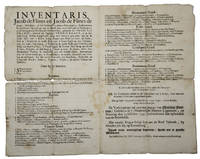
1747ABC_46688Amsterdam 1747. Folio. Jan van der Linde Folded. 1 blank 2 1 blank pp. Unrecorded printed auction announcement and inventory of the frigate Prins van Oranje which was launched in 1729 commanded by Teunis Kragt and put up for auction in 1747 by the brokers Jacob de Flines and his son in Amsterdam. Its great detail makes it a highly interesting source for the equipment supplies and provisions of an 18th-century Dutch frigate. It mentions the various ropes sails ships cabin goods for example tea and coffee pots the helmsmens goods compass lamp etc. the cooks goods kettles pans spoons artillery and munition among other things a linstock pistols and gunpowder and many other goods aboard a 18th-century frigate. The auction took place on 23 October 1747 at the home of Matthijs Poolman casteleyn van Nieuwezijds Heeren Logement. One copy of another inventory and announcement of an auction by Jacob de Flines almost identical in lay-out to the present is recorded in the STCN for the ship Magdalena Ester sold in 1745. It is now in the Amsterdam city archives.With a small drawing in black ink and two contemporary inscriptions in brown ink by the same hand on the blank pages. With tears and holes along the folds and some small stains.l Cf. STCN 428250548 similar inventory and auction announcement by Flines of the Magdalena Ester 1745; not in Cat. NHSM; WorldCat. unknown
179332480London: Printed for J. Debrett 1793. The Second Edition with Considerable Additions. Three-quarter leather. Good. Octavo. 1 xvi 433 pages 1 page blank 19 page index 1 page errata 2 pages advertisements 1. Recased binding with three-quarter brown leather and marbled paper covered boards. Gilt title and five raised bands on the spine. Newer front and rear end papers and one front blank end sheet inserted. The original rear end sheet is present. The folding frontispiece map is toned on the verso with an old repair made also on the verso. Some light edge wear to the map. The folding view of the Rapids of the Ohio and the State Map of Kentucky are in very good condition with light toning. <br /> <br /> Pages 417-433 includes a "Report of the Secretary of State to the President of the United States of the Quantity and Situation of the Lands not Claimed by the Indians Nor Granted to Nor Claimed by Any Citizens Within the Territory of the United States. Read in the House of Representatives Nov. 10 1791" by Thomas Jefferson. <br /> <br /> Howes I 12; Howes Reference Filson - F 129; Sabin 34355; Streeter III 1523; Clark II 41 "An early account of the western country.which was produced by a man who left Kentucky without settling his obligations who seems to have been involved in efforts to organize a French expedition to take the lower Mississippi Valley and who treated Mary Wollstonecraft Shamelessly. This book was written in the form of letters from Kentucky to a friend in England. In all probability they were written in Europe. Printed for J. Debrett unknown
178544907Paris Moutard Panckoucke 1785. 4to. Extract from "Mémoires fe Mathematique et de Physique Présentés à l'Academie des Sciences par divers Savans" Tome X. Withtitlepage to vol. X. Pp. 131-332 and 5 folded engraved plates. The memoir has also its own titlepage. Fine and clean. Wide-margined. <br/><br/><em>First edition of this monumentalwork by which Coulomb CREATED THE SCIENCE OF FRICTION."1781 saw him win the Academy prize for his mémoir "Théorie des Machines Simples" in which the results of his experiments on the friction of different bodies slipping on one another dry or coated with greasy substances were presented."Timoshenko p. 48."Coulomb’s most celebrated study one that brought him immediate acclaim was "Théorie des machines simples" his prize-winning friction study of 1781. He investigated both static and dynamic friction of sliding surfaces and friction in bending of cords and in rolling. From examination of many physical parameters he developed a series of two-term equations the first term a constant and the second term varying with time normal force velocity or other parameters. In agreement with Amontons’s work of 1699 Coulomb showed that in general there is an approximately linear relationship between friction and normal force; but he extended the investigation considerably to show complex effects due to difference in load materials time of repose lubrication velocity and other considerations. Coulomb’s work in friction remained a standard of theory and experiment for a century and a half until the advent of molecular studies of friction in the twentieth century. To quote Kragelsky and Schedrov’s recent monograph p. 52 on the history of friction: "Coulomb’s contributions to the science of friction were exceptionally great. Without exaggeration one can say that he created this science."DSB.Poggendorff I:487. </em> unknown
18002305250028Philadelphia : Printed by W.W. Woodward 1800. First Edition. Hardcover. Acceptable. Quackery: Early American Law and Medicine; Defamation Slander Rare publication of the infamous libel trial of William Cobbett by Dr. Benjamin Rush. Cobbett had printed strident criticism of Rush's advocacy of bloodletting in his Porcupine's Gazette in 1797. "The times are ominous indeed When quack to quack cries purge and bleed." Under the pen-name Peter Porcupine Cobbett had referred "to Rush as a bleeder the Samson of medicine who had actually slaughtered thousands of citizens and as a poisonous trans-Atlantic quack." During the calamitous Yellow Fever outbreak of 1797 Rush's advocacy of bleeding may have resulted in the death of numerous patients. Rush was a prominent founding father and signer of the Declaration of Independence. Cobbett lost this libel trial and was ordered to pay Rush $5000. To avoid the hefty judgement Cobbett left Philadelphia for New York set up his "Rush Light" and fled ultimately to Britain. An interesting proceeding where the question of what is a "quack" is explored and the patriotism and republicanism of Rush is oratorically chest thumped. Possibly Austin 1597. <br> Collated: 64 pages of 70 Lacks first 2 leaves and final leaf but complete provided in facsimile. Bound in modern cloth. Fine binding and cover. Library stamps. Title page has numerous marks. Scattered marginalia. Shelf wear to edges. Light damp stain along top edge. Lacking last leaf. Refs: Evans 37103. Sabin 14030. NLM 2182034R. <br> IMPORTANT TRIAL IN THE SUPREME COURT OF PENNSYLVANIA. Doctor Benjamin Rush versus William Cobbett. December term 1799. ACTION on the case for a Libel was brought in the autumn of 1797 by the Plaintiff against the Defendant for certain defamatory publications which appeared in a newspaper entitled "Porcupine's Gazette" of which COBBETT was the Editor. Philadelphia : Printed by W.W. Woodward hardcover
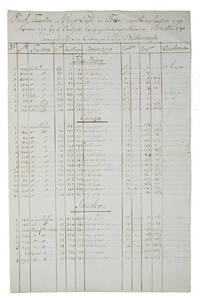
1790ABC_45663Amsterdam 1790. Folio 37.5 x 24 cm. Single sheet. Manuscript in brown ink on paper. 2 pp. Manuscript inventory of and receipt for tea imported from China to The Netherlands by the VOC Dutch East India Company in 1790 written and signed by tea master Herman de Hoogh of Amsterdam. The tea was transported on the VOC ship Blitterswijk from China to the VOC-port of Hoorn in North Holland. It had arrived in Hoorn on 12 October 1790 and the present inventory was made on the 15 October. The last column indicates which bales were reserved.The present shipment brought in an enormous amount of tea. Altogether the ship carried 55 bales of 10 tea varieties and for each bale the list describes the quality weight and price. The prices reflect the type and quality the most expensive tea was a quarter chest of "zeer goed" very good "Pecco". The bales marked as reserved contain only the best teas very good Thee Boey very good Hysant etc. The present shipment was formed a significant amount of all tea that was imported from China to The Netherlands and Europe in 1790.l For the author and the auction of tea in Holland see: Bierens de Haan Memorie-boek van pakhuismeesteren van de thee te Amsterdam 1818-1918 en de Nederlandsche theehandel in den loop der tijden 1919. unknown
179863098London Scatcherd & Whitaker; Parsons; Cawthorn 1793 - 1798. 8vo. Bound in 11 volumes. Volume 2 - 11 uniformly bound in contemporary half calfs. Volume 1 in half calf with later marbled paper covered boards. Bindings with wear and stains. Leather on spines cracked. Volume 1 with reinforced hinges a dampstain to first leaves. A few volumes with dampstain to first leaves but internally generally a nice and clean set. 616 4 pp. 2 frontispiece and 7 engraved plates; 4 480 pp. 7 plates Wolstieg only calling for 5; 4 450 4 pp. 7 engraved plates; 4 426 6 8 pp. 7 engraved plates Wolstieg only calling for 3; 2 436 pp. 6 engraved plates Wolstieg only calling for 2; 2 452 4 pp. 6 engraved plates Wolstieg only calling for 4; 6 438 4 pp. 8 engraved plates Wolstieg only calling for 6; 4 464 4 pp. 8 engraved plates Wolstieg only calling for 4; 6 506 pp. 9 engraved plates Wolstieg only calling for 4; 2 430 pp. 6 engraved plates Wolstieg only calling for 1; 2 IV 338 8 pp. 9 engraved plates Wolstieg only calling for 2. This set has a total of 79 engraved plates Wolfstieg only calls for 47 plates. <br/><br/><em>Rare complete run of the first English periodical dedicated to freemasonry “the archetype of later Masonic periodicals†Önnerfors The Freemasons’ Magazine 1793–1798 published at a crucial time in the history of European Freemasonry in the immediate aftermath of the French Revolution. It represents one of the first efforts by the fraternity to define consolidate and disseminate its intellectual and moral identity in public. Its contents - lodge proceedings philosophical essays antiquarian inquiries biographical notices poetry and finely executed symbolic engravings - reflect the full breadth of late Enlightenment Masonry. The importance of the work lies in its function as a precursor since it anticipates the Masonic journals in the 19th century and marks the transition of Freemasonry into a self-conscious print-based intellectual culture. â€The Freemasons’ Magazine represent a forceful statement of British Freemasonry concerning its vigour loyalty and societal engagement. During 1794 the journal for the first time served as a platform to refute anti-Masonic writings that circulated in the public. Important apologies such as Defence of masonry 1730 or Cousto’s spiced account of his treatment by the Portuguese inquisition were republished. Parts of Ramsay’s ‘Oration’ were republished not just once but twice. We can also witness how the Knights Templar called the ‘sublime degree of masonry’ entered the world of British Masonic imagination long after the continental development. Nevertheless at the very same time Freemasonry in Britain was also celebrating technological progress in industry agriculture and science which makes its relationship to modernity complex. The Freemasons’ Magazine managed to attract correspondents in different parts of the empire and even the USA. A particularly strong link throughout the first seven volumes was Edinburgh. In the last four volumes we find more material inserted from Ireland at exactly the time when political tensions there erupted into a full-scale rebellion. The political tense years of 1797 and 1798 offer an intriguing insight into the British psyche at the time. Under constant real and imagined threat of French invasion internally shaken by the Irish rebellion uprisings and repeated mutinies public opinion was fuelled with anti-Masonic ideas not at least by Robison’s book Proofs of a conspiracy. The Freemasons’ Magazine unfortunately did not survive 1798. Most importantly perhaps it can be regarded as the archetype of later Masonic periodicals developing into a archtype Masonic press by the middle of the nineteenth century with titles such as he Freemasons’ Quarterly Magazine and Review 1834–53 The Masonic observer 1856–9 he Freemason’s Magazine and Masonic mirror 1856–71 the Freemason 1869–1951 some of them surviving well into the twentieth century. Whereas Masonic periodicals during the first century of their existence tied into the ongoing debates and controversies surrounding Freemasonry in culture and society they developed more and more into purely internal membership magazines with little connection to the outside world.†Önnerfors The Freemasons’ Magazine 1793–1798. Wolfsteig 516 </em> hardcover
1759137120Paris: J. Barbou 1759. Full period French binding in Calf five raised bands gilt ornamentation on spine author and title in gilt on red leather spine label in second compartment. 8vo. Full period French binding in Calf five raised bands gilt ornamentation on spine author and title in gilt on red leather spine label in second compartment. 263 pages. First edition Bigmore and Wyman p.228. Minor soiling to the text block else a fine copy.<BR> <br /> <BR> <br /> In this volume Fournier sets out to prove that Gutenberg was not the inventor of the printing press by examining the history of printing. He believes that the technology Gutenberg made popular existed long before the German printer's work. <BR> <br /> <BR> <br /> "Peter Simon Fournier a French engraver and letter-founder was born at Paris 1712 and died 1768. He studied under Colson painter of the Academy of Saint Luc and devoted himself first to the art of wood-engraving; he afterwards as an engraver on steel rendered himself famous in all countries. In some of his works he seeks to prove that Gutenberg is not the inventor of printing and maintains that long before Gutenberg engraving on wood had been employed for printing images and inscriptions; that during his residence in Strasburg Gutenberg attempted the application of this art to the printing of books and that on his return to Mayence he first printed the Donatus and the Catholicon of Johannes de Janua with engraved and solid blocks. Fournier's ingenious theories were ably refuted by Baron Heinecken in his "Idée Générale d'une Collection complette d'Estamples" Leipsic: 1771" Bigmore & Wyman p 229. J. Barbou unknown
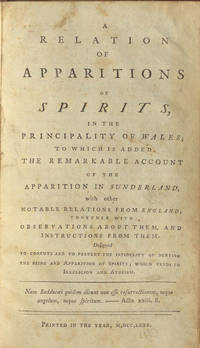
1780007385Trevecka: The Old Family 1780. 1st Edition 1st Printing. Hardcover. Very Good. 8vo - over 7¾ - 9¾" tall. First Edition First Issue VG 1780 in mid 20c half calf over contemporary red marbled boards. Re-spined with the old laid down gilt tooling & titles. Internally 2 iii-viii 1 2-133 pp 1 2 contents interesting ms note to fpd stating that it was printed privately by The Rev Edmund Jones & that it was reprinted in 1813 without all the Relations listed here bookplate to fpd George Montgomery Traherne - possibly his ms notes remains of removed bookplate to verso fep marbled endpapers some light browning mark to p42. p75 miss-numbered 57 small print run The First edition was published in the same year as this & there was a facsimile edition of the first edition published in 1813. This the 2nd issue was probably published without the authors knowledge or consent. Adding the English apparitions to make Wales appear less superstitious. 200121 mm. ESTC T130273. Title continues: together with Observations about them and Instructions from them: Designed to Confute and to Prevent the Infidelity of Denying the being and Apparition of Spirits; which tends to Irreligion and Atheism <br/> <br/> [The Old Family] hardcover
1780111436Printed for C. Bathurst : J.F. and C. Rivington : A. Hamilton : T. Payne : T. Longman : S. Crowder : B. Law : J. Robson : F. Newbery : G. Robinson : T. Cadell : J. and T. Bowles : S. Bladon : J. Murray : J. Nichols : J. Bowen and W. Fox 1780-1784. Leather. Very Good. 5x1x9. 42 volume set bound in full leather bindings. Previous owner's book plate to front paste downs. Sewn in markers marbled edges. Foldouts and illustrations. oversized and overweight additional shipping will apply. E67 & F66 Please email for photos. Printed for C. Bathurst : J.F. and C. Rivington : A. Hamilton : T. Payne : T. Longman : S. Crowder : B. Law : J. Robson : F. New hardcover