888 résultats
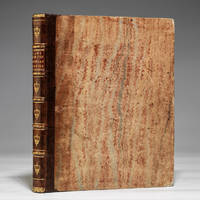
1701ABC_48243Amsterdam 1701. Small 4to ca. 20 x 15 cm. Nicolas Chevalier Contemporary limp vellum with the manuscript title on the spine and a paper shelf mark label at the foot. With a general title and 2 divisional titles for ad 6 and ad 11 all with a woodcut vignette further with 2 hand-coloured engraved maps 1 folding engraved plate and several woodcut initials. 12 parts in 1 volume. 134 pp. Collection of very rare pamphlets and printed letters published under a collective title on the actual political circumstances of Northern Europe in the years 1699-1701 especially in connection with the death of the Spanish King Charles II born in 1661 in 1700 leading to the War of the Spanish Succession 1701-1714. The work includes 2 maps of Flanders and a folding plate of the Battle of Narva which took place on 30 November 1700. Although the pamphlets and letters were printed separately the present collection appears to be very rare as we have not been able to find any other copies with the same contents.Charles died childless. His possessions would go to one of his brothers-in-law: the French King Louis XIV 1638-1715 or the German Emperor Leopold I 1640-1705. Both had agreed already beforehand that they would divide Charles heritage to avoid disturbance of the European balance of power. In his last will however Charles had appointed the grandson of Louis XIV as his successor named from now on Philip V of Spain 1683-1746. The Treaty of The Hague affirmed this in 1701. With the deaccession stamp of the "Bibliothèque municipale de Nîmes" on the title page and its shelf mark label at the foot of the spine. The vellum at the foot of the spine with a tear the boards are somewhat stained. The leaves are occasionally browned and foxed. Otherwise in good condition.l Cf. Knuttel no. 14.510 ad 1 14.543 ad 6 14.588-14.589 ad 9 14.538 ad 10 and 14.538 a comparable collective title page with the imprint "Amsterdam Daniel de la Feuille 1701" with various texts ca. 78 pp.; STCN 317179241 1 copy the same general title page but with only 3 letters all different from ours. hardcover
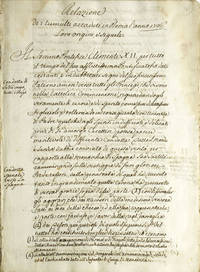
1736257005Rome 1736. 59 pp. in all on laid paper. 4to all with one exception approx. 27 x 20 cm. Provenance: Frederick North 5th Earl of Guilford 1766-1827; library of Sir Thomas Phillipps ex Ms. 7544; with H.P. Kraus. 59 pp. in all on laid paper. 4to all with one exception approx. 27 x 20 cm. Following the acquisition of the Kingdom of Naples and the Two Sicilies by the Bourbons of Spain in 1736 the conquering Spanish troops returning through Rome and Papal States provoked anti-Spanish riots in March of 1736. The following 6 manuscripts each in a different contemporary hand all from the collection of Sir Thomas Phillips and comprising Phillips Ms. 7544 relate to those events. They are as follows:<br /> <br /> 1 CONTI Antonio attributed to. "Relazione dei tumulti accaduti on Roma l'anno 1736. Loro origine e sequele." 13 pp. on 7 leaves.<br /> 2 "Sopra il tumulto populare seguito in Roma il 13 Marzo 1736." 6 2 blank pp. on rectos of 7 leaves. <br /> 3 "Se domanda se un Popolo si solleva tumultiamente nel Domnio altrui contro una nazione con offesa del Sovrano di essa ottenuto il perdona generale ." 4pp. on two leaves.<br /> 4 Same text as above with minor differences e.g. "amnistà" for "perdona". 4 pp. 21.5 x 15 cm.<br /> 5 Manuscript Letter fair copy headed "Sigl. Mio" 2 Giuglio 1736" beginning: "Non potevate far cosa pui grata all mia amicizia che commnicarmi la lettera trasmessa da Roma ."12 4 blank pp. Docketed on final page: "Relazione dei tumulti seguiti in Roma l'anno 1736 per i scrivi Austrici contro i Spagnuoli"<br /> 6 Manuscript Letter fair copy headed "Sigl. Mio". 15 pp. N.p. n.d. <br /> <br /> From the collection of Thomas Phillips 1792-1872. "His collection of over 60000 manuscripts was an outstanding achievement in the annals of bibliophily" ODNB and such was the scale that over 100 years passed after his death until the last tranche of the papers were finally sold in 1977 to H.P. Kraus.<br /> <br /> The attribution would seem to be based on a manuscript of the same title in the University of Chicago Special Collections Library v. OCLC: 154339939. unknown
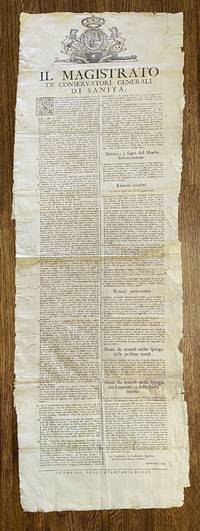
17444109Turin Italy: Stamperia Reale 1744. Very good. Huge letterpress broadside 1070 x 360 mm printed on 2 1/2 folio sheets edges untrimmed. A few sections underlined and annotated in a contemporary hand in the left blank margin worn; paper extensions mainly in the right margin; prominent horizontal central fold other folds reinforced on verso with occasional lost of one or two letters. A remarkable survival preserved in mylar L-sleeve backed with lig-free board. GIGANTIC APPARENTLY UNRECORDED BROADSIDE ISSUED BY THE STATE MAGISTRATE WARNING AGAINST THE 1744 "CATTLE PLAGUE" EPIDEMIC IN NORTHERN ITALY A FLIMSY ATTEMPT AT GOVERNMENTAL MANAGEMENT AND DISEASE CONTROL. <br /> <br /> The disease described herein was almost certainly RIDERPEST a highly contagious viral infection which can produce a 100% death rate among herds the colloquial term "cattle plague" is a misnomer because sheep and goats can also be afflicted by it. <br /> <br /> The 1744 outbreak had been observed in The Netherlands in the months before our broadside was printed but the Magistrate mentions only the reports from Franche Comté. While the devating consequences of cattle plague in The Netherlands are well researched its effects in Italy at this same time are not well-known probably due to the comparatively low survival rate of contemporary documentation. <br /> <br /> Indeed no other copy of our broadside can be found. Here the Magistrate of the Conservatory General of Health gives warning signs of the infection and preventative measures against its spread including mandatory "lazarettos" quarantine areas for livestock. The "nature and the signs" of the disease is addressed along with a dubious and ineffectual attempt at a remedy which involved cold water salt vinegar pepper and camphor; "Rimedi preservativi" prophylactic measures are recommended and steps for "fumigating" i.e. disinfecting livestock and their owners are given. <br /> <br /> The urgency of Magistrate's is justified: less than 30 years earlier through circuitous trade routes cattle plague had spread like wildfire even the most remote regions of Eastern and Western Europe and Britain. Such trade networks had become larger and more sophisticated in order to supply food to growing urban centers.<br /> <br /> Throughout history outbreaks of cattle plague led to severe economic crisis: the resulting famine inflation civil unrest and overall moral decay destabilized societies with crippling effect as had been seen in The Netherlands in the first outbreak of 1713-1720. Wherever and whenever cattle plague emerged religious figures government officials technocrats and the public wrested with the meaning and consequences of these disasters.<br /> <br /> Students and scholars of socio-economics in the Early Modern era would do well do incorporate primary sources of veterinary history in their research.<br /> <br /> NB: Interested parties are advised that this huge broadside will be shipped folded. Stamperia Reale unknown
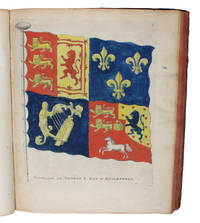
171951669Amsterdam David Mortier 1719-18. 4to. Contemp. full calf. Spine defective lacking leather at upper and lower compartment and frontcover detached from spine. Front free endpaper gone. The first two title-pages printed in red/black and both with an engraved vignette with a portrait of Erasmus. 482;294;22412 pp. Vol I: 1 large folded engraved plate and 1 textengraving. - Vol. II: 34 textengravings 1/2-page a. full-page 21 engraved plates 4 large and folded. - "Les Pavillons": 90 engraved plates of flags. The first flag "Pavillon de George I" is handcoloured. Last printed leaf numbered 101 because the 90 engraved plates is counted as pages !. Complete. Light marginal browning a few leaves with small closed tears. <br/><br/><em>A classic on shipbuilding finely illustrated with construction drawings and nautical instruments and equipment. It is the first edition in French of Allard's "Nieuwe Hollandse Scheeps-bouw" first published in 1695. Polak notes that though known as 'L'Allard français' it was more than a straightforward translation being augmented with chapters by Witsen and van Eyk and with plates representing vessels and nautical instruments as well as the flags of the maritime nations. </em> hardcover
177244162Five maps and one engraving all fldg The author was Colonel of Foot and Commodore of the Expedition in the Frigate La Boudeufe and the Store-Ship L'Etoile from the title page. Bougainville Nov.121729-Aug 31 1811 was a French Admiral and expolorer who circumnaviagated the globe in a scientific expedition. This is the travel log of that journey which proved to be very popular when it was published especially his observations on Tahitian society. J. Nourse hardcover
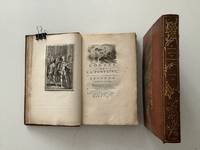
176420446AB1764. 2 volumes. Amsterdam 1764 22 : 14 cm. X 214 pages 1 leaf; VIII 254 pages 1 leaf engraved Portrait of Fontaine 2 engraved title-vignettes 77 full-page engraved plates 63 engraved text-vignettes. Red half-calf binding spine richly gilt with title in gold top edge gilt singed Blanchetiere-Bretault This rare and very beautiful Amsterdam edition is printed two years after the monumental first edition from Paris which was commissioned by Ferniers Géneraux and which is very scarce and sought after. This is the most beautiful and well-executed of the re-impressions Paris 1762 -without vignettes Amsterdam 1764 and London 1764. -"Celle d'Amsterdam 1764 2 vol. in-8. fig. copiées sur celles de l'édition de 1762 est assez belle." Brunet III:760. The illustrations of this edition are excellent and copied from the beautiful first edition" many of them are engraved and signed by C. Boily and all are after Eisen. Most of the vignettes are after Choffard. The portrait of La Fontaine is engraved by Macret after Ficquet. "Cette imitation de l'édition des fermiers généraux est assez jolie. Le portrait de La Fontaine est tantôt gravé par Savaret et tantôt par Macret suivant les exemplaires." Cohen p. 310.The illustrations of this work are considered Eisen's main work the book is considered one of the greatest works of rococo book-illustration and it has greatly inspired later tradition in this field. - Occasionally some minor spotting but allover clean with wide margens two edges uncut beautifully bound by Blanchetiere-Bretault. unknown
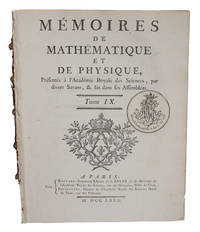
178044921Paris Moutard Panckoucke 1780. 4to. Extract from "Mémoires fe Mathematique et de Physique Présentés à l'Academie des Sciences par divers Savans" Tome IX. With titlepage to vol. IX. Pp. 2 167- 264 and 4 folded engraved plates. The memoir has also its own titlepage. Fine and clean. Wide-margined. <br/><br/><em>First printing of this monumental memoir the invention of the TORSION BALANCE dealing with the best way to construct a magnetic compass. The paper contains the design of a torsion suspension declination compass and the demonstration that the forces of torsion is proportional to the angle of twist. Coulomb received the prize awarded by the Academy for this paper drafted by the Academy in 1777 he shared the prize with Van Swinden. - "The importance of this memoir for Coulomb's career is that it CONTAINED ELEMENTS OF ALL HIS MAJOR PHYSICAL STUDIES: the quantitative study of magnetism torsion and the torsion balance friction and fluid resistance and the germ of his theories of elasticity and magnetism."DSB."Coulomb’s first writings on torsion were presented in his Academy prize-winning memoir of 1777 "Recherches sur la meilleure maniere de fabriquer les aiguilles aimantées.". his simple elegant solution to the problem of torsion in cylinders and his use of the torsion balance in physical applications were important to numerous physicists in succeeding years. In chapter 3 Coulomb developed the theory of torsion in thin silk and hair threads. Here he was the first to show how the torsion suspension could provide physicists with a method of accurately measuring extremely small forces. He showed that within certain angular limits torsional oscillation consisted of simple harmonic motion. He examined the parameters relating the angle of twist to the length diameter and elastic properties of the torsion thread. In the range of simple harmonic oscillation Coulomb demonstrated that the force of torsion was proportional to the angle of twist. He used this principle in measuring small magnetic forces and also called attention to its use in measuring other forces notably those of fluids in motion. Eventually he was able to measure forces of less than 9 x 10⁻⁴ dynes.""Coulomb’s major memoirs in electricity and magnetism are his 1777 memoir on magnetic compasses the famous series of seven electricity and magnetism memoirs read at the Academy from 1785 to 1791 and several magnetism memoirs prepared after the French Revolution. In his electrical studies Coulomb determined the quantitative force law gave the notion of electrical mass and studied charge leakage and the surface distribution of charge on conducting bodies. In magnetism he determined the quantitative force law created a theory of magnetism based on molecular polarization and introduced the idea of demagnetization basically that combinations of magnetic poles can "cancel" each other."DSB.Parkinson "Breakthroughs": 1777:P </em> unknown
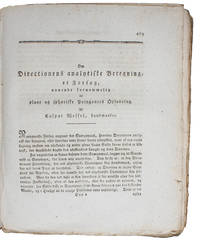
179758364Kiøbenhavn Johan Rudolph Thiele 1797 1799. 4to. Uncut and unopened in original blue boards. Published in: "Nye Samling af det Kongelige Danske Videnskabernes Selskabs Skrifter." Vol. V. Wessel's paper: pp.469-518 and 3 folded engraved plates the last plate inserted at p. 463. The whole volume V offered in its original binding. Engraved titlevignette. XII670 pp. 15 engraved plates. 4 leaves with upper right corners gone not affecting Wessel's paper. <br/><br/><em>First edition of this important first systematical treatment of the theory of complex numbers and at the same time the first work to add vectors in three-dimensional space."Wessel’s fame as a mathematician is based entirely on one paper written in Danish and published in the Mémoires of the Royal Danish Academy that established his priority in publication of the geometric representation of complex numbers. John Wallis had given a geometric representation of the complex roots of quadratic equations in 1685; Gauss had had the idea as early as 1799 but did not explicitly publish it until 1831. Robert Argand’s independent publication in 1806 must be credited as the source of this concept in modern mathematics because Wessel’s work remained essentially unknown until 1895 when its significance was pointed out by Christian Juel. The title of Wessel’s treatise calls it an "attempt" to give an analytic representation of both distance and direction that could be used to solve plane and spherical polygons. The connection of this goal with Wessel’s work as a surveyor and cartographer is obvious. The statement of the problem also suggests that Wessel should be credited with an early formulation of vector addition. In fact Michael J. Crowe in A History of Vector Analysis University of Notre Dame Press 1967 defines the first period in that history as that of a search for hypercomplex numbers to be used in space analysis and dates it from the time of Wessel whom he calls the first to add vectors in three-dimensional space." DSB. </em> hardcover
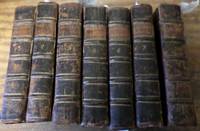
17396829G. Smith In Stanhope-street near Clare-market et al 1739. 1st Edition . Book Hardcover. Good/No Jacket. G. Smith In Stanhope-street near Clare-market et al 1739. 1st Edition . Good/No Jacket. Seven of the ten volumes of this set published in 1739 and 1740 these volumes. Volume 1 contains the alegorical frontispiece indicating that no branch of natural philosophy is foreign to the society. In addition each volume has thirteen numbered engraved plates mostly folding of which plate 5 in volume 4 and plate 9 in volume 5 are missing apparently never having been bound in. Contemporary full calf with simple gilt panelling on the covers and rules across the spine simple blind-embossed borders within the panels raised bands and volume numbers in gilt arabic numerals on spine "BADDAM'S MEMOIRS" on red Morocco labels gilt bordered. All page edges red-sprinkled. The condition of the bindings is worn with some splitting of joints and parting of paper at hinges but still strong with no incipient detaching of boards. Occasional loose free endpaper. Text pages and plates with little if any foxing. Pagination: vi5168; 5164; 1-512489 mis-numbered page 5137;5066;5145blank; 515blank 4; 5164.Usual double free endpapers of this period. The provenance going back through time is indicated by the bookplates of a recent FRS of John Hallifax displaying his arms as granted in 1788 and finally the pioneer inventor and mill-owner Jedediah Strutt who partnered Richard Arkwright in the world's first water-powered cotton mill in CromfordDerbyshire which still largely survives as a shell and later set up giant mills of his own in Belper and Milford sadly almost completely lost in the carpet demolition of the 60's. His small ornate-lettered "Jedh. Strutt" bookplate is attached to the top corner of each front pastedown. G. Smith, In Stanhope-street near Clare-market, et al hardcover
1800003804Printed By W. Bulmer and Co. Cleveland-Row St. James's for the Author; and Sold By G. And W. Nicol Booksellers to His Majesty Pall-Mall; and Messrs. J. And J. Boydell Cheapside 1800 COMPLETE with 8 engraved plates 5 of which are hand coloured. Title continues: Exemplified by Suitable Sketches and More Finished Paintings. As This Work is Chiefly Intended for the Mere Beginner The Rules Are Both Familiar and Progressive. To Which Are Added Instructions For Executing Transparencies In a Style Both Novel and Easy. 4 36pp bound in paper vellum and marbled paper over boards deckled page edges with binding and hinges tight. Covers show edge/corner wear small paper label on front cover some pages uncut offsetting from plates occasional light foxing on the preliminary pages. SCARCE. Printed By W. Bulmer and Co. Cleveland-Row, St. James's, for the Author; and Sold By G. And W. Nicol, Booksellers to His Ma hardcover
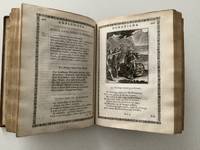
175520474AB1755. Tha Hague Duren 1755. 20 : 165 cm. 4 leaves 420 pages with 103 engraved illustrations. Contemporary calf on 5 raised bands spin gilt back lable. The Spectacle of Human Life: Or Lessons in Wisdom is a book written by Jean Le Clerc in 1755. This book is a collection of reflections on human life and the lessons in wisdom that can be drawn from it. The author addresses topics such as death loneliness love family religion and morality. He also offers practical advice on how to lead a happy and fulfilling life. The book is written in a clear and accessible style making it an enjoyable read for anyone seeking to better understand life and find answers to the most profound questions of human existence. - On second leaf the Dutch title: 'Schouwtoneel des menschelyken leevens' the explanations to the engravings are in Latin German French and Dutch. The engravings in the text are after Otto van Veen - The two title-pages verso with annotations which show through to the main title the first and the last four pages with some stain inside fine with the engravings in strong impressions ca 1 cm of top of spine missing joins a bit rubbed. - Still a desirable copy of this scarce oeuvre. hardcover
1701AQ33150London: Printed by T. Ilive for Edward Brewster 1701. 160pp. With a terminal leaf of publisher's advertisements. ESTC T60836. Bound with: The Most Pleasant and Delightful history of reynard the fox. The second part. London. Printed by A. M. and R. R. for Edward Brewster 1681. 112pp. ESTC R218371 Wing M2912. And: The shifts of reynardine The son of Reynard the Fox Or a Pleasant history of his life and death. London. Printed by Thomas James for Edward Brewster 1684. 8 160pp. ESTC R40614 Wing S3426. Quarto. Text predominantly black letter with headlines and side notes in roman and italic. Modern blind-ruled chestnut morocco lettered in gilt to spine. Very occasional minute marginal worm-tracks scattered spotting naive marginal paper repairs to title page and first mentioned and terminal leaf of final mentioned work. Reynard the Fox 'hero of several medieval European cycles of versified animal tales that satirize contemporary human society. Though Reynard is sly amoral cowardly and self- seeking he is still a sympathetic hero whose cunning is a necessity for survival. He symbolizes the triumph of craft over brute strength usually personified by Isengrim the greedy and dull-witted wolf.The main literary tradition of Reynard the Fox descends from the extant French 'branches' of the Roman de Renart about 30 in number nearly 40000 lines of verse. The facetious portrayal of rustic life the camel as a papal legate speaking broken French the animals riding on horses and recounting elaborate dreams all suggest the atmosphere of 13th-century France' Merriam-Webster's Encyclopedia of Literature. ESTC R35186. Quarto. Printed by T. Ilive, for Edward Brewster unknown
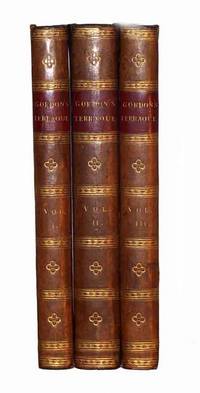
17901102170067William Porter Skinner-Row 1790. Leather Bound. Very Good. 3 volumes. 8vo. Superior copy near fine. Clean unmarked pages including four beautiful folded maps in fine condition with no splits or foxing. Good binding and covers bound in full contemporary leather very minor rubbing. Spines solid with six compartments. Gold gilt lettering and decorations on the spine bright spine lettering. Inside cover labelled with the crest and motto of Edward Westby of County Clare Ireland. Volume I: 34 336 2 pp. Volume II: 24 383 2 pp. 12 371 2 pp. Maps: Volume 1: p. 1. The World with the Latest Discoveries p. 290. A New Map of Spain Designed for the Present State of Spain Volume 3: p. 1. The British Islands p. 335. A Map of Ireland principally intended to show the position of the Chief Groups of Mountains and the courses of the greater Rivers. Copied with some additions from Beaufort's small Map by permission. William Porter, Skinner-Row hardcover
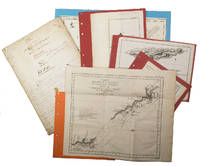
1755ABC_474521755. Manuscript of 24 pages 6 printed maps on cardboard. This wonderful logbook details the journey of a French captain from Manila to the Maluku Islands in todays Indonesia. The journey took place during the months of March to May of 1755. The captain of the ship recounted with great detail the events of every day of the journey with detailed daily accounts of the weather winds manoeuvres of the ship its departures anchorages and precise coordinates at every point of the journey. The captain furthermore had a keen eye for the geographical and nautical details along the journey. He recounted the exact locations of for example sandbanks and bays where ships and their crews can take provisions and fresh water. The accounts are detailed and captivating: "After our boats were back on board we set sail . in the afternoon to moor under the old Portuguese fort on the Solor island Indonesia the winds for the tide were fresh at 1:34 a.m. . sand and gravel and then I went back to mooring. The pavilion of the fort . the village is under the said fort at 3 cables from us .". The captain goes on to describe the geographical features of the islands as well as other places en route with great detail. Curiously we find inscriptions in Spanish and the names of one don Phelipe Qui who describes himself as el piloto and one Padre Don Estevan de Melo. The latter might be identical with Don Estevan Roxas y Melo a native of Lima Peru and secretary to the Archbishop of Manila Rodriguez since 1736. Roxas y Melo was part of the 1751 reconstruction of the Cathedral of Manila working under the auspice of the Italian architect Juan de Uguccioni.The logbook comes with six printed maps partly illustrating the journey of the captain pasted on contemporary cardboard. They depict the Bay of Sulavesi with the city of Bantang Pitcairn the coast of New Guinea the coast of Queensland the Santa Cruz Islands in the present-day Solomon Islands and Alejandro Selkirk Island. The plates stem from the French translation of James Hawkesworths An Account of the Voyages Hawkesworth Relation des voyages entrepris par ordre de sa Majesté Britannique actuellement regnante; pour faire des découvertes dans l'hemisphère meridional Paris 1774.Some holes on the first sheet not affecting the text. Small water damage some slighlty affecting the text. Remnants of seals on last page. Otherwise in good condition. unknown
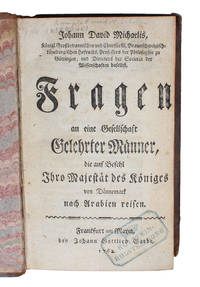
176256918Frankfurt am Mayn Garbe 1762. 8vo. Very nice contemporary full mottled calf with five raised bands to richly gilt spine. Titlelabel with gilt lettering. A bit of wear to spine causing slight loss of leather and a neat restoration to lower compartment. A paperlabel pasted on top of spine. Small loss of leather to back board. A stamp on title-page Holstein=Holsteinborg. 70 397 pp. 4 folded tables paginated 391-97. Internally clean some quires printed on thick paper. <br/><br/><em>The rare first edition of the founding work of Niebuhr's Arabia-expedition which would gain world-wide fame and establish the scientific description of the Arabian peninsula. The present work consists in 100 questions the answers to which constitute the purpose of the Royal Danish Arabia Expedition. In fact the present work is the handbook of Niebuhr's travel to Arabia Felix as its author is the spiritual father of it. The work is extraordinary in many ways and it not only served as the basis for the Arabia-expedition it also constitutes a forerunner of modern bible science that would begin to emerge a few decades later. Johann Davis Michaelis 1717-19 was a theologian and orientalist whose fame today rests upon the present work and upon the fact that he was responsible for the first scientific expedition to Arabia Felix namely that of Niebuhr. In 1753 he had come up with the idea for the the Royal Danish Arabia Expedition 1761-1767 and had gotten the Danish minister Bernstoff to agree to it. In 1760 when the expedition was becoming a reality Michaelis recommended Niebuhr as a participant and he outlined the entire purpose of the trip - namaly the list of 100 questions that he prepared and published for the members of the expedition in order for them to answer in the course of the voyage. For all intents and purposes Michaelis was the spiritual father of the Arabia-expedition. As a theologian and an orientalist many of Michaelis' questions have root in the Bible. But unlike many other theolgians of the time Michaelis sought to shed light over biblical themes through sources outside of the Bible - especially from the Middle East not least Arabia. In this regard his 100 Questions also came to be a precursor to the emergence of modern bible science.Although the expedition would have never taken place had it not been for Michaelis and his 100 questions - many of which are also purely naturalistic - he could not quite have foreseen the scientific outcome of the expedition. He had not foreseen that Niebuhr would become the founder of the scientific description of the Arabian peninsula and that Niebuhr's notes would become the basis for the first decipherment of Mesopotamian and Persian cuneiform. On the contrary he was probably quite disappointed that his questions were not all answered as thoroughly as the had anticipated. Adding to that Niebuhr's answer to the questions "only" takes up six pages in the preface to "Description of Arabia" although the text itself contains many detailed explanations and answers to Michaelis' questions. </em> hardcover
17891296<p>London: Philadelphia printed Re-Printed J. Debrett 1789. First edition. Leather_bound. Very Good. 4 3/4 x 7 1/2 inches. 8vo. 364 pages including the errata sheet and terminal advertisement. Collates as: a 2 leaves b 6 leaves A - B in 6s C - P in 12s Q 6 leaves. Handwritten note to ffep in near contemporary hand noting "Rev'd Marshall D. Smith Passaic New Jersey. Very rare and therefore to be carefully used and returned to the owner." Small thumbnail sized chip at bottom outer margin of title page with no loss of text. Some light soiling to first half of the text but pages otherwise clean and free from marking soiling or staining. Top edge brightly gilt. Other edges uncut. Bound in early 20th Century polished calf by Pratt with gilt panels of triple gilt-ruled borders and gilt acorn decorations in corners. Original spine with six gilt decorated compartments and two black morocco spine labels relaid. Extremities lightly rubbed. Griffiths 1789/8. A spectacular and uncut copy of the rarest Anglican/Episcopal Prayer Book. The Protestant Episcopal Church was founded at a convention at Philadelphia in 1785. After the American Revolution a new American Prayer Book was proposed and printed in an edition of 4000 copies by a Philadelphia printer. This edition was printed in a very limited number for the use of the bishops in England. Only fifty 50 copies were printed. "A rarer book connected with American church history can hardly be named." Perry's History.</p> Philadelphia printed, Re-Printed J. Debrett hardcover
17793689<b>Scarce Contemporary Stony Point Battle Plan</b><br /><br />This rather crude woodcut depicts a battle plan of General "Mad Anthony" Wayne's daring and dramatic capture of the British fortification at Stony Point about 30 miles up the Hudson River from New York City. The battle planned in detail by Washington took place around midnight on July 16 1779. <br /><br /> The lower portion of the battle plan includes a four item key: "A. The British Fortress B. Abattes abatis in front C. The Reserve D. The detached Party who stormed the Works." Nebenzahl's <i>A Bibliography of Printed Battle Plans of the American Revolution 1775-1795</i> cites only a 1784 London-printed battle plan by Faden for the Stony Point engagement #145. The offered plan is not noted by Nebenzahl was published in America and was issued five years earlier than the Faden plan. The<i> Bickerstaff's Boston Almanack</i> for 1780 would almost certainly have been published in November or December of 1779 – within six months of the actual battle. <br /><br /> A very scarce almanac in the trade. Auction records indicate the most recent copy sold at the Gutman sale in 2005 for $4800. Prior to that Swann sold an example in 1979. <br /><br /><b>References:</b> For the almanac: Evans: 16287; Drake: 3290. For the map: Cresswell: 309. <br /><br /><b>Condition: </b>Map appears on verso of title page and measures about 6 ½ x 3 ¾." Almanac is complete in 24 pp. Slight loss of road table text at upper tip of final leaf.<br /><br />ICN 7643. Printed and sold by Draper and Folsom, and John Mycall of Newbury.
1758141839Paris: J. Barbou 1758. full brown leather border stamped in blind on the front and rear boards gilt ornaments on spine title in second compartment five raised bands all edges stained red marbled endsheets. small 8vo. full brown leather border stamped in blind on the front and rear boards gilt ornaments on spine title in second compartment five raised bands all edges stained red marbled endsheets. 1ff.-92 3 -263 pages. Pour éclaircir quelques traits de l"histoire de l'Imprimerie & prouver que Guttemberg n'en est pas l'Inventeur. Two works bound in one. Very rare first edition Bigmore and Wyman p.228. Private bookplate of Jackson Burke on the verso of the front free endpaper. Contemporary boards with some rubbing to the spine and extremities corners a bit worn gilt on the spine is lightly flaking evidence of bookplate removal to front and rear pastedowns. Else a fine copy of this very scarce work.<BR> <br /> <BR> <br /> Two works bound together. Complete titles are: Dissertation sur l'origine et les progrès de l'art de graver en bois 1758 and De l'origine et des productions de l'imprimerie primitive en taille de bois 1759.<BR> <br /> <BR> <br /> Fournier 1712--1768 was born in Paris and trained as a wood engraver. He later turned to steel engraving. In the first essay Fournier sets out to prove that Gutenberg was not the inventor of the printing press by examining the history of printing. He believes that the technology Gutenberg made popular existed long before the German printer's work. The second volume follows this up with further discussion of the origins of woodcut prints. <BR> <br /> <BR> <br /> Fournier wrongly disputes the dating of Mr. De Bure le Jeune concerning the Gutenberg Bible but he is the first with the help of an observation by Gerard Meerman to note the progressive increase in the number of lines per page in the early stages of Bible production. J. Barbou unknown
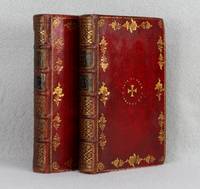
1779ST12581London: Sold by Dodsley 1779. 165 x 102 mm. 6 1/2 x 4". Complete with usual jump in pagination in volume II. Two volumes. <br/> Pleasant contemporary crimson morocco BOUND FOR JONAS HANWAY BY HIS SECOND BINDER covers gilt with twining border enclosing a frame of roses with sunburst cornerpieces upper cover with Greek cross at center encircled by the motto "O save us from ourselves" lower cover with winged hourglass and the motto "Revere the appointment of Nature"; raised bands spine compartments gilt in a checkerboard pattern punctuated by daisies one olive and one black morocco label gilt turn-ins marbled endpapers all edges gilt. Engraved title pages with emblem depicting Death hovering over socializing persons with a lutist in the background. A Large Paper Copy. Verso of front free endpapers with armorial bookplate from which the name has been excised. ◆Spines a bit darkened with muted gilt leather on covers varying in color from fading or soiling but the bindings entirely solid and with only trivial wear to the joints. Leaves with a hint of offsetting and isolated soiling faint dampstain to lower fore edge of one gathering otherwise extremely pleasing internally the text clean fresh and bright and with vast margins.<br/> <br/> These bindings were specially crafted for Jonas Hanway 1712-86 an eccentric philanthropist and prolific pamphleteer who designed custom bindings for edifying works usually his own which he often presented to libraries friends and even the king; our binding was in fact probably intended for presentation though the recipient is unknown. In his "English Bindings in the Library of J. R. Abbey" G. D. Hobson has done a census of 26 Hanway bindings but the present one is not listed there. Hobson states that Hanway has been unjustly overlooked whereas another 18th century eccentric "who took an interest in the art of decorating bookcovers Thomas Hollis has appeared in every account of English binding" after J. A. Arnett's "The Books of the Ancients" appeared in 1837. "The bindings executed for Hanway are of better material" says Hobson "and the tools which decorate them are more amusing than those of his contemporary; perhaps they have been neglected because they are comparatively rare." Hanway employed two different binders to translate his ideas into leather and the present volumes represent the work of his second binder who entered his employ in 1765. This binder has not been identified by name but his work is known as here by the appearance of a small number of tools used in various combinations. For example our winged hourglass rose ornaments twining roll sunburst and checkerboard design on the spine also appear on Hobson's "Abbey" #91 and on item #155 in Maggs Catalogue 1212. An enthusiastic and effective philanthropist concerned with child welfare Hanway founded schools to teach boys farming trades and seamanship. He also wrote some 150 books and pamphlets and perhaps his reputation as an eccentric derived from his being the first male in London to use an umbrella. Nixon notes in "Oldaker Collection" that he was "a highly estimable character but one of the greatest bores of his day." An advocate of such practices as the consumption of whole wheat bread and abstinence from tea drinking he inveighs in the present work against "nocturnal diversions" and the keeping of late hours. Midnight should be the signal to end dancing music and other amusements if one wishes to preserve one's health and virtue. Thankfully the author's bindings remain more interesting than the written works he produced. Sold by Dodsley unknown
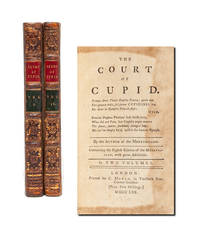
17705057London: Printed for C. Moran 1770. First collected edition. Contemporary speckled calf skillfully rebacked with original spines laid down. Gilt and morocco labels to spines. Marbled endpapers. Measuring 155 x 96mm and collating complete including final advert leaf to volume II: 2 ii 147 1 blank; 2 v 1 advert 139 3. Bookplates of J. O. Edwards to front pastedowns of each with additional bookseller's ticket to front endpaper of volume II. Front endpaper of volume I detached at base but holding well else; some offsetting to preliminary and terminal leaves of both volumes. Occasional light pencil marginalia. Overall a fresh copy of a scarce work on the women of the London sex trade. ESTC reports only 8 copies in libraries and its most recent appearance at auction was in 1931. The present is the only complete copy on the market.<br /> <br /> Edward Thompson's position as a satirist "has drawn the attention of commentators from Dr. Johnson to modern times" and given that his "verse and prose was generally in the manner of his declared mentors the ancients Horace Juvenal and Ovid.his targets were frequently political and ad hominem" Bibliographic Society. Among his most notable works were those that addressed London's widespread sex trade praising and critiquing the women who had been immortalized as Toasts of the Town in Harris' Guide to Covent Garden Ladies. These were drawn together for the first time as a collection under the title The Court of Cupid: The Meretriciad 1761 The Temple of Venus 1663 The Courtesan 1765 and The Demi-Rep 1765. <br /> <br /> The Court of Cupid allowed Thompson to capitalize on the fame of London's courtesans reprinting and expanding works that were already popular; but it was also commercially beneficial to the demi-reps as well. For the most successful members of the trade staying in the public eye was necessary. It could help young courtesans develop reputations and clientele; it could ensure that established courtesans continued to be seen as desirable and thus could justify or increase their fees. Certainly this was the case for Kitty Fisher who appeared among a multitude of other Toasts and bawds in The Meretriciad and then became the central focus of The Courtesan four years later. By this time poetry satires and gossip columns could not get enough of her. "Her name grew familiar to the beaux of clubland and curiosity was piqued when it was known that she was an exclusive young lady who would accept no present and grant no interview without a formal introduction" Bleackley. As a woman immortalized in print and paint Joshua Reynolds famously did a series of portraits of her she could even publicly turn down and humiliate Casanova as being beneath her.<br /> <br /> Kitty is not alone among the multitude of women mentioned in this collection --- bawds and brothels friends and rivals were preserved for literary critics and historians to remember. Satires like Thompson's assist us in remembering that during the height of London's sex trade there existed a vibrant and successful community of women who profited from their sexual desirability and who used those profits to carve out a desirable social space outside of the constrained domestic roles into which patriarchy had insisted they fit.<br /> <br /> Register of Erotic Books 1097. ESTC T126148. Printed for C. Moran unknown
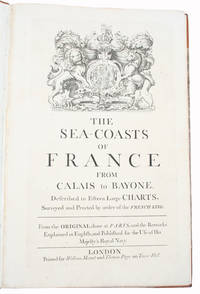
171534417London Printed for William Mount and Thomas Page on Tower Hall no date c. 1715. Folio. 53X35 cm. Cont. hcalf with marbled boards. Rebacked and recornered in old style with raised bands. Engraved typographical titlepage with a large engraved vignette showing the English King's Coat of Arms. With all 15 double-page engraved sea-charts numbered 1-15 in lower right corners. Neat repairs to inner margins of free endpapers and titlepage. Some browning to charts. Chart 5 45x755 cm having the right margin shaved reaching the printed frame. <br/><br/><em>Second edition of this scarce "Atlas Maritime". According to Shirley it was first published by Richard Mount and Thomas Page in 1701 and re-issued with undated title as this in ab. 1715 but with the charts unchanged and a new engraved titlepage. A third issue came out in 1737 with a dated title. The fine charts are copied from Pieter Mortier's famous "Neptune Francois" 1693-1702 and reduzed in size."The charts in this early Mount & Page atlas "The Sea-Coasts of France" are re-engravings reduzed in size from the charts in the French Neptune of 1693. The charts may also be found in the 1702 edition of Mount and Page's Atlas Maritimus Novus." Rodney Shirley. - Not in Phillips. - Shirley Vol. II: M.M&P - 12 b. </em> hardcover
17701845<p><strong>A rare example of Russian text of the Enlightenment --- "The best and most luxurious edition" of Catherine's famous 'Great Instructions' </strong>such described by Count M.A. Korf then director of the Imperial Library. First published and "signé de la propre main de Sa Majesté Impériale" in 1768; this edition however is the only in several languages and illustrated.</p><p>These instructions were "largely compiled and adapted by Catherine personally from the texts of Montesquieu and Beccaria. Although the project was never brought to fruition the impulse behind it stands as one of the nobler concepts of Catherine's reign" Fekula 2013 for a later edition.</p><p>A major document of the Enlightenment it condemned torture and capital punishment and endorsed such principles as the equality of all before the law.</p><p>The illustration consists of two detailed symbolic engravings each repeated once by Roth d. 1798 an engraver from Nuremberg who mostly worked in Russia.</p><p><strong>"The most magnificent and desirable of the more than 40 editions of the Nakaz"</strong> Widener <strong>"one of the most remarkable political treatises ever compiled and published by a reigning sovereign in modern times"</strong> I. de Madariaga Russia in the Age of Catherine the Great 1981 p. 151. Some great scholarly publications have taken place among these numerous editions especially published in St. Petersburg in 1893 using the French text from this edition and 1907 as well as the more recent The Nakaz of Catherine the Great: Collected Texts 2010 with a bibliography of the 43 editions edited by Butler and Tomsinov.</p><p><strong>Physical description:</strong> Quarto 26.3 x 20.5 cm. Title pages in Russian Latin German and French 403 pp. with 4 allegorical head- and tailpieces engraved by Christopher Melhior Roth after Jacob Shtelin. Contemporary full Russian calf spine with raised bands stamped in bling label lettered in Russian patterned endpapers red edges.</p><p><strong>Condition</strong>: Binding covered with clear adhesive film dampstain to back cover; very occasional light spotting otherwise a lovely attractive example.</p><p><strong>Bibliography</strong>: Drage 208; Fekula 2013; Sopikov 6456 'best edition'; SK 2151; Widener M. Yale Law School Lillian Goldman Law Library on their copy exhibited in 2012.</p> Imp. Akad. Nauk, Skt. Peterburg, hardcover
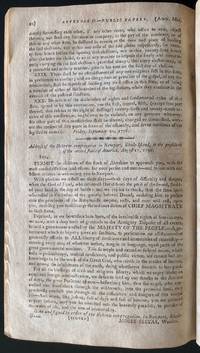
179143202Philadelphia: Mathew Carey; Carey Stewart and Co. No. 188 Market-street 1791. Original Sewn Binding without outer wrappers or boards 8vo pages 285-344 1-48 1-40 1-48 total 196 pages with different sections correctly paginated for this issue.<br> With Moses Seixas’ famous letter to President George Washington<br> Seixas wrote to President Washington on behalf of the Newport congregation whose home is the Touro Synagogue the oldest synagogue still standing in America. This letter which appears on p 40 of Appendix II and Washington's reply comprise one of the most famous statements on religious freedom of this period. <br> Here published in America’s first literary magazine George Washington’s famous phrase describing a government that "gives to bigotry no sanction and to persecution no assistance" was originally coined by Seixas in this very letter. It is a moving Biblically toned greeting to the president and was repeated by Washington in his reply assuring it a place among the most cherished in the American historical vocabulary.<br> George Washington's visit to Newport Rhode Island August 17-18 1790 ranks among the seminal episodes in the history of American Jewish religious liberty. Washington left Rhode Island off his travel itinerary the previous year in response to the state's failure to ratify the Constitution. By 1790 after becoming the last state to ratify Washington visited Newport along with members of his administration including Thomas Jefferson. <br> Moses Seixas 1744-1809 a Newport merchant warden of Kaal Kadosh Yeshuat Israel Newport Hebrew Congregation and a prominent Mason was one of the civic leaders who met with Washington. Seixas had a long history as a revolutionary patriot: he remained in the city after it was occupied by the British during the war and signed a document during the occupation pledging loyalty to the patriotic cause. <br> Additionally his brother Rabbi Gershon Mendes Seixas minister of New York's Shearith Israel Congregation known as the "patriot rabbi" was one of fourteen clerygymen officiating at Washington's 1789 Presidential inauguration. <br> Finally as a fellow Mason he and Washington would have had a natural connection. Seixas' eloquent message reads in part: <br> "Deprived as we heretofore have been of the invaluable rights of free Citizens we now with a deep sense of gratitude to the Almighty Disposer of all events behold a Government erected by the MAJESTY OF THE PEOPLE – a Government which to bigotry gives no sanction to persecution no assistance – but generously affording to ALL Liberty of conscience and immunities of Citizenship: – deeming every one of whatever Nation tongue or language equal parts of the great governmental Machine: – This so ample and extensive Federal Union whose basis is Philanthropy Mutual confidence and Public Virtue we cannot but acknowledge to be the work of the Great God who ruleth in the Armies of Heaven and among the Inhabitants of the Earth doing whatever seemeth him good." <br> Grounding religious freedom in natural rights and echoing Seixas' words Washington later replied with an echo of Seixas' language regarding religious freedom: <br> "The Citizens of the United States of America have a right to applaud themselves for having given to mankind examples of an enlarged and liberal policy: a policy worthy of imitation. All possess alike liberty of conscience and immunities of citizenship. It is now no more that toleration is spoken of as if it was by the indulgence of one class of people that another enjoyed the exercise of their inherent natural rights. For happily the Government of the United States which gives to bigotry no sanction to persecution no assistance requires only that they who live under its protection should demean themselves as good citizens in giving it on all occasions their effectual support."<br> See JE Vol. IX pp. 294-295; EJ. Vol. XIV p. 1117; J.L. Blau and S.W. Baron The Jews of the United States 1790-1840 A Documentary History Vol. 1 1963 pp. 8-10.<br> Other pieces of interest include notes on the slave trade by Benjamin Franklin and notes on the Revolutionary War. <br> “The American Museum or Repository of Ancient and Modern Fugutive Pieces &c. Prose and Poetical “title changed to “The American Museum or Universal Magazine†in January 1790 was America's first literary magazine featuring early printings of the US Constitution the Bill of Rights various State constitutions Alexander Hamilton's Report on Manufactures and parts of the Federalist Papers. <br> Complete issue in original sewn binding. Overall condition is very good with scattered darkening and foxing though paper and binding remain nice and strong with clean crisp edges including the notable page containing the address to Washington<br> A Cornerstone of American Judaica. BAMR-69-7A. Philadelphia: Mathew Carey; Carey, Stewart, and Co. No. 188 Market-street unknown
17681206031768. First Edition. CATHERINE THE GREAT. The Grand Instructions to the Commissioners Appointed to Frame a New Code of Laws for the Russian Empire: Composed by Her Imperial Majesty Catherine II. Empress of All the Russias. To which is prefixed A Description of the Manner of opening the Commission with the Order and Rules for Electing the Commissioners. London: T. Jefferys 1768. Quarto contemporary marbled boards rebacked in period-style calf-gilt red morocco spine label raised bands; pp. i-v vi-xxiii 1 3-258. $5000.First edition in English of the celebrated Nakaz of Catherine the Great drawing extensively on Montesquieu's Spirit of the Laws heralded by Voltaire and Diderot initially issued in Russia in 1767 ""the single piece of Russian legislative material best known abroad""aligned with the later American constitution for its ""shared characteristics and techniques"" highly elusive in contemporary boards.""Born into a family of obscure German aristocrats delivered to St. Petersburg at the age of 14 and married in great pomp to the feckless heir to the Russian throne Catherine found herself"" in a loveless marriage and without political support Smithsonian. In 1765 after Peter's death and several years into her reign Catherine began crafting the Nakaz working on its almost daily for nearly two years. ""Fundamentally the Nakaz which Voltaire is said to have called the finest monument of the century is a legal and a political document. It represents Catherine's ambition early in her reign to remodel Russia's laws in accordance with new principles expounded in Western Europe. The Nakaz consists of three parts containing 655 articles in all. The major part 526 articles was made public in Moscow on July 30 1767. It treats the historical development of Russia and monarchial absolutism; the nature and forms of laws; crime and punishment; social structure and religious freedom. On February 28 and April 8 1768 two supplements of 40 and 89 articles respectively dealing with police expenditures revenues and taxation were added to the Nakaz"" Dmytryshyn Economic Content 1-2. ""While she worked alongside a secretary it was Catherine herself who selected and organized the material and wrote out the finished version."" In creating the Nakaz she chose her texts carefully. Nearly 300 ""owe something to Montesquieu's Spirit of the Laws 1748"" with about 100 clauses traced to Beccaria's On Crimes and Punishments 1764 and many from Voltaire's Encyclopédie."" While the Nakaz is ""not a written constitution it nonetheless shared characteristics and techniques with later texts that were constitutions"" Colley Gun Ship and Pen 61-73 emphasis in original.Catherine was ""not out to create a constitutional monarchy"" yet her Nakaz ""was innovative and influential the Legislative Commission that met in Moscow in August 1767 to discuss the Nakaz differed from later seminal constitution-making assemblies but it also anticipated and even exceeded them. Like the convention that met in Philadelphia in 1787"" this Russian Commission assembled delegates from across the empire. Further these ""Moscow deputies were also markedly more diverse in terms of social economic religious and ethnic background than the men of Philadelphia women too received some recognition in this Moscow commission something that did not happen in revolutionary America Moreover in sharp contrast with the men of Philadelphia in 1787 not all of the Moscow deputies were white and not all of them where Christian"" Colley 73-77. ""It was doubtless because of its 'radical' content that its publication was banned in France The significance of the Nakaz centers not only in its West European content"" but also on distinctive aspects of Russian culture that ""make the Nakaz an outstanding document in Russian political economic and historical literature"" Dmytryshyn 9. The Nakaz was never enacted yet it is ""the single piece of Russian legislative material best known abroad. It secured for Catherine the encomium 'the Great'"" Yale Law School. First edition in English. Catherine's manuscript was written in French from which she produced a Russian translation First editions were published in Moscow on August 10 1767 in Russian and German: a first German edition appeared in 1769. Little is known of translator Mikhail Tatischeff other than that he was attached to the Russian Embassy in London. Engraved ornamental initials and headpieces. Mispaginated as issued without loss of text. ESTC N6651. With trace of bookplate removal; later blank free endpapers. Bookseller ticket.Text fresh and fine light edge-wear rubbing to contemporary marbled boards. A handsome wide-margined near-fine copy. hardcover
17952111902160201111Suharaya Mohei 1795. Soft Cover. Fine. Number of pages: 74 pages 84 pages Size: 2.5 cm x 13.6 cm Number of books: 5 volumes 2 volumes Suharaya Mohei paperback