George Bickham the ElderBiblio.com
888 résultats
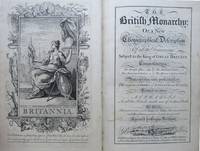
17483799Frontispiece of Britannia enthroned engraved Title list of Subscribers Contents Title of 1743 and 190 engraved plates many illustrated with head & tail pieces: Folding map of the King's Dominions in Europe Africa and America follows plate 7; A folding Table of Several Particulars. as plate 163. Tastefully rebound in eighteenth century style full lozenge blind ruled calf; five raised bands; ruled green morocco label. A handsome supple copy.; All shipments through USPS insured Priority Mail. George Bickham hardcover
1797035987London: G. Nicol 1797. 1st Edition 1st Printing. Hardcover. Very Good . 11 1/8" Tall. Frontispieces Plates And Illustrations. Ii Xxxiv518; Ii Xx 626. The Two Complete Text Volumes In Full Size Text Blocks 10 5/8" Tall; The Plates Were Issued 1796 In A Separate Volume Not Present Here; But The Plate Of The Camellia Sesanqua Is Present Between Pp 466 And 467. Original Quarter Morocco Binding Five Bands Morocco Spine Labels Over Boards Covered With Marbled Paper Original Off-White Endpapers Preliminary And Final Blank In Each Volume. Bindings With Old Wear But Nicely Furbished Morocco Labels Clean With Brilliant Gilt A Little Loss Of Leather At Tops Of Spines And At Top Right Front Spine Edge Paper Frayed Along All Edges Of Boards Hinges Tight Contents Clean Just A Few Tiny Foxing Spots. Small Very Old Booksellers' Label Of The China Times Bookseller 94 Consular Road Tientsin. And Another From Sydney. Former Owner's Signature Dated 1894 Erased In Volume 1 Of George Ernest Morrison And A Few Marginalia Which Appear To Be His; George Ernest "G. E." Morrison 1862 - 1920 Also Known As Morrison Of Peking Or Chinese Morrison Was An Australian Adventurer Appointed In February 1897 As The Times Correspondent In Peking Despite His Lack Of Knowledge In The Chinese Language. He Traveled To Vladivostok And Reported To The Times That Russian Engineers Were Making Preliminary Surveys From Kirin Towards Port Arthur Then Sent A Telegram To Say That Russia Had Presented A Five-Day Ultimatum To China Demanding The Right To Construct A Railway To Port Arthur. This Was A Triumph For The Times And Its Correspondent But He Had Also Shown Prophetic Insight In Another Phrase Of His Dispatch When He Stated That "The Importance Of Japan In Relation To The Future Of Manchuria Cannot Be Disregarded". After A Visit To Siam And England Then To Australia 1899-1900 He Returned To Peking. When The Boxer Uprising Broke Out And During The Siege Of The Legations From June To August Morrison As An Acting-Lieutenant Showed Great Courage Always Ready To Volunteer For Every Service Of Danger. After A Siege Of 55 Days The Legations Were Relieved By A Multinational Force Which Then Ransacked Much Of The Palaces In Peking With Morrison Taking Part In The Looting. There Was Great Uncertainty Regarding The Future Of China In The Following Months And Through The Times Morrison Managed To Depict A Skewed Picture Before The British Public. While Russia And Japan United In Opposing Any Dismemberment Of China The Country Was Nevertheless Punished By The Imposition Of A Heavy Indemnity. In 1904 Morrison Became A Correspondent With The Japanese Army. He Was Present At The Entry Of The Japanese Into Port Arthur Early In 1905 And Represented The Times At The Usa Peace Conference. In 1907 He Crossed China From Peking To The French Border Of Tonkin And In 1910 Rode From Honan Across Asia To Russian Turkestan. From Andijan He Took A Train To St Petersburg And Then Traveled To London Arriving On 29 July 1910. A Great Chinese Physician Dr. Wu Lien-Teh Succeeded In Staying The Spread Of This Mortal Sickness Which Seemed To Threaten The Whole World. Morrison Published A Series Of Articles Advocating The Launching Of A Modern Scientific Public Health Service In China. When The Chinese Revolution Began In 1911 Morrison Took The Side Of The Revolutionaries. In August Morrison Resigned His Position On The Times To Become Political Adviser To The Chinese Government And Immediately Went To London To Assist In Floating A Chinese Loan Of £10 Million. In China During The Following Years He Had An Anxious Time Advising And Endeavoring To Deal With The Political Intrigues That Were Continually Going On. He Visited Australia Again In December 1917 And Returned To Peking In February 1918. He Represented China During The Peace Discussions At Versailles In 1919 But His Health Began To Give Way And He Retired To England Well Aware That He Had Only A Short Time To Live. He Died On 30 May 1920 . A Nice Historical Association. Later Ownership Signatures Of G B Wilson. <br/> <br/> G. Nicol hardcover
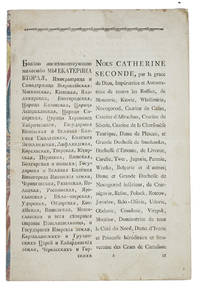
1790K1VF2DNXCCLTSt. Petersburg 1790. Folio. 30 x 20 and 29.5 x 20.5 cm. Imperial Printing Office Unsewn marbled paper spine ad 1; side stitched blue paper spine ad 2. With the text in Russian and French in parallel columns and with ornamental rules at the head of each page. 10; 20 pp. First and only editions of two peace treaties between Catherine the Great of Russia and Gustav III of Sweden which concluded the Russo-Swedish war of 1788-1790 each page with the Russian text in the left column and the French text in the right column. The Treaty of Värälä signed on 14 August 1790 though here dated 6 August by Catherine's representative Otto Heinrich Igelström and Gustav II's proxy Gustaf Mauritz Armfelt effectively restored the pre-war status quo and barred Russia from interferring in Swedish internal affairs which had been one of the reasons Gustav III a cousin of Catherine the Great declared war on Russia in 1788. After initial defeats Sweden was able to destroy nearly a third of the Russian fleet at sea. The second treaty signed on 19 October 1791 at Drottningholm outside of Stockholm established a close military alliance between Sweden and the Russian Empire with each power pledging active support and Catherine agreeing to pay Sweden annual subsidies. Since it was signed with a keen eye on the French Revolution the treaty can been seen as a predecessor to the war of the first coalition of 1792-1797 though neither Russia nor Sweden participated in the latter. Both are printed on Russian paper with cyrillic names and initials in the watermarks. Very good copies old horizontal crease first and last leaves lightly soiled.l KVK & WorldCat ads 1 & 2 SUB Göttingen ad 1 Ohio State ad 2 Strassbourg; not in Bitovt. unknown
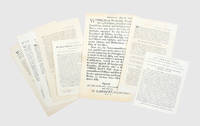
1797170560England: 2 undated but all from 1797. We are ready at all times to crush the efforts of such seditious Incendiaries Unrecorded by ESTC these broadsides variously commit to ferreting out sedition offer rewards for exposing traitors in the ranks and thank the King for pay increases approved by Parliament on 24 May 1797. Arguments that a foreign-backed disloyal minority are trying to "seduce" a loyal majority betray concern that mutinous feeling could spread quickly through the ranks. Loyalty paid. One broadside offers soldiers in the Oxfordshire Regiment Militia then stationed in Norfolk three days' pay for apprehending those who put "scandalous wicked and seditious handbills" by the entrance to the barracks. In another the signatories subscribe to a pot of 100 guineas payable to anyone discovering future mutinous activity. a "To Field-Marshal His Royal Highness the Duke of York the Humble Address of the Non-commissioned Officers Trumpeters and Privates of His Majesty's Fourth or Somerset Regiment of Fencible Cavalry " Undated. 233 x 185 mm partial watermark of "I Taylor." b "We the Non-commissioned Officers Drummers and Privates of the Shropshire Regiment of Militia cannot sufficiently express the indignation William Loader Serg.Maj. and Pay-Mast. Lieut. Colonel F. Powell's Company " Head Quarters Blythe Camp: undated. 321 x 195 mm watermarked "J. Wickwar 1794". c "Whereas on Wednesday Evening the 24th Instant a Number of most scandalous wicked and seditious Handbills were put under the Gate of the Barracks occupied by the Oxfordshire Regiment of Militia . G. Lambert Serjeant-Major O.R.M." Norwich: 26 May 1797. 370 x 225 mm watermarked "I Taylor 1796". d "To Field Marshal His Royal Highness the Dule of York We the Non-Commissioned Officers Trumpeters and Privates of His Majesty's 10th or Prince of Wales's Own Regiment of Light Dragoons Thomas Souter Serjeant-Major." Guilford Barracks: 29 May 1797. 237 x 181 mm partial watermark of "GR". e "We the Non-commissioned Officers and Privates of the East and West Lothian Regiment of Fencible Cavalry John Virtue Serj. Majorm on behalf of Col. Hamilton's troop " Durham: 31 May 1797. 216 x 165 mm partial watermark corresponding to that in d. f "We the Non-commissioned Officers and Privates of the Two Troops of the Norfiolk Fencible Cavalry now quartered at Carlisle John Hone Nathan Hewstead " Carlisle: 5 June 1797. 330 x 198 mm watermarked "GR". g "To Lieut. Col. William Mure We the Non-Commissioned Officers Drummers and Privates of His Majesty's 3d or West Lowland Fencible Regiment of Infantry Geo. Clark Serj. Major " Newcastle upon Tyne: 6 June 1797. 335 x 196 mm watermarked "1794". h "To Field Marshal His Royal Highness the Duke of York. We the Non-commissioned Officers and Private Soldiers of the Somerset Regiment of Militia Nathan Ashhurst Serjeant-Major " Ipswich: 7 June 1797. 335 x 190 mm watermarked "1794". i "We the Non-commissioned Officers Drummers and Privates of His Majesty's Royal North Lincolnshire Regiment of Militia James Spellman Serj. Maj. " Head Quarters Scarborough: 12 June 1797. 340 x 198 mm watermarked "1794". Nine printed sheets all with letterpress one side only. See note for dimensions and watermarks. All sometime stabilized at edges with paper strips a few old folds chips and short closed tears: a very good collection. unknown
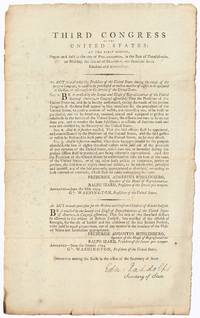
1794544490Philadelphia: Printed by Childs and Swaine 1794. Very Good. Broadside. Folio 8" x 13 ¼". Untrimmed as issued. Three slight horizontal folds modest foxing edges lightly toned very good. The rare variant printing Signed in ink by U.S. Secretary of State Edmund Randolph a Founding Father of the United States and 7th Governor of Virginia. An early act of the Third Congress setting forth provisions for building up the U.S. Navy up to 10 vessels "to be fitted out manned armed and equipped as gallies" . "for the protection of the United States." The act was issued in response to Barbary pirates disrupting American trade with Europe. It is followed by a shorter act "to make provision for the Widow and Orphan Children of Robert Forsyth." Both acts are signed and dated in letterpress by George Washington June 5th and June 7th 1794. An important variant copy signed by Edmund Randolph who served as both attorney general and secretary of state in George Washington's cabinet. Though not stated the broadside was printed in Philadelphia by Francis Childs and John Swaine printers to the Congress in 1794. Evans 27865; ESTC W28073. Printed by Childs and Swaine] unknown
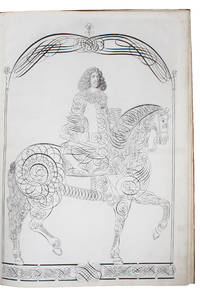
170954195København 1709. Folio. In contemporary full calf Cambridge-style mirror binding with blindstamped borders. Light wear to extremities. Seven leaves with minor repairs to margins one leaf with a 15 cm long closed tear and one leaf with an 30 cm long closed tear all professionally executed and with no loss of imprint. Margins slightly soiled. 19 leaves -text and frames engraved. The broad frames that all differ from each other ornamentally depict animals and plants as well as the different trades of the country. A nice copy printed on thick heavy paper. Housed in a cardboard box.Provenance: From the collection of Danish book collector Viggo Lohse. The present copy was exhibited at 'Dansk Bibliofil-Klubs 50 års Jubilæumsudstilling' in 1992 The 50 year anniversary exhibition for the Danish Society of Bibliophiles no. 94. <br/><br/><em>First edition of this landmark work of Danish book production and the constitution of the Danish absolute monarchy. The Royal Law established the absolute right of the Monarch to rule and it defined the line of royal succession. It was more rigorous than the other monarchal laws of Europe at the time.The text which is written by Peder Griffenfeld is engraved in copper throughout in order to prevent the possibility of re-printing pirated editions and text-counterfeiting. Frederik Rostgaard the King's state archivist who was famous for his excellent taste in books was in charge of the editing and issuing of the work. In front of the actual law text a leaf is inserted with the portrait of King Frederik III on his horse and everything except for the head of the king which was engraved after his death-mask is executed in the beloved flourishing- or scroll- manner of the time. The titles and the text are engraved throughout by Michael Røg. </em> unknown
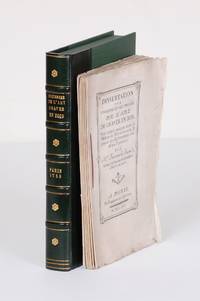
175876869Paris: J. Barbou 1758. unbound cord tied housed in a green half-morocco goat over cloth boards clamshell case spine tooled in gold leaf with title author and date. large 12mo. unbound cord tied housed in a green half-morocco goat over cloth boards clamshell case spine tooled in gold leaf with title author and date. 92 3 pages. Pour éclaircir quelques traits de l"histoire de l'Imprimerie & prouver que Guttemberg n'en est pas l'Inventeur. Very rare first edition Bigmore and Wyman p.227. Unbound textblock lightly soiled with minor creasing at corners. Faint moisture staining throughout with some affecting the text. In this text Fournier sets out to prove that Gutenberg was not the inventor of the printing press by examining the history of printing. He believed that the technology Gutenberg made popular existed long before the German printer's work. Fournier also followed up this text with two additional works which are not present: De l'origine et des productions de l'imprimerie primitive en taille de bois 1759 and Observations sur un ouvrage intitulé Vindiciae Typographicae 1760. These two works provided further discussion of the origins of woodcut prints including a passage refuting popular belief about the origin wood engraving and some ideas for further study. <BR> <br /> <BR> <br /> Fournier 1712--1768 was born in Paris and trained as a wood engraver and type founder being a member of the 18th century dynasty of the well-known Fournier family. He later turned to steel engraving. He published a table of the proportions of the different printing characters whose purpose was to propose for all typefaces a fixed measurement in "typographic points" and a systematic gradation. He worked closely with the collaborators of the Encyclopédie providing the printer Le Breton with all the documentation relating to the typographic foundry and plans for his own instruments as well as providing Diderot with his collection of ancient alphabets. Finally after multiple disputes with his Parisian colleagues he became infamous for the printing of his famous Manuel Typographique 1764 1766 just prior to his death. J. Barbou unknown
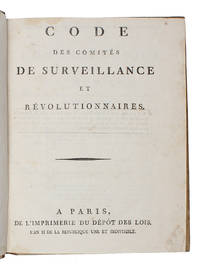
179360748Paris Impremerie du depot des lois An II 1793. 4to. In contemporary half calf with gilt lettering and ornamentation to spine. Wear to extremities. Upper part of back hinge split with minor loss of letters. Small dampstain to upper inner margin otherwise a nice copy. 2 VII 2-116 100 8 pp. <br/><br/><em>Exceedingly rare first edition of this highly interesting document being the Code of the Committees of Surveillance containing 106 regulations and guidelines for the functioning of these committees during the French Revolution. The Committees of Surveillance were established during the Reign of Terror September 5 1793 - July 27 1794 as part of the revolutionary government's efforts to identify and suppress counter-revolutionary activities. These committees were tasked with monitoring individuals' behavior enforcing revolutionary laws and ensuring loyalty to the revolutionary government. The document outlines the powers duties and procedures of these committees as well as the penalties for those found to be opposing the revolution providing a unique and fascinating insight into the legal and administrative framework of revolutionary France – arguable one of the most profound and radical moments in modern European history. The Committee of Surveillance in France during 1793 was established as a part of the radical phase of the French Revolution. Its function was to oversee and monitor the activities of suspected counter-revolutionaries and enemies of the Revolution as well as to enforce laws related to internal security and revolutionary principles. The committee was tasked with identifying individuals or groups deemed to be a threat to the revolutionary government often leading to arrests interrogations and in some cases executions by the Revolutionary Tribunal. It played a significant role in the Reign of Terror a period marked by extreme political violence and repression in France. The present work is of the utmost scarcity. We have not been able to trace a single copy at auction and OCLC only lists one copy in Paris. Nadaillac Catalogue d’une Collection Importante Sur la Revolution Francaise 724 </em> unknown
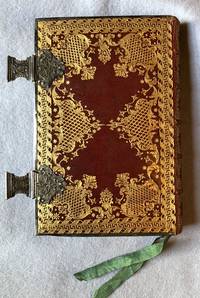
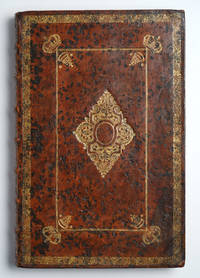
17562896Rome: Gioacchino & Giovanni Giuseppe Salvioni 1756. <p>8vo 208 x 133 mm. 24 407 1 pp. 2 parts the Office of the Dead separately titled. Printed in red and black. Engraved frontispiece and 12 full-page engravings by Arnold Van Weserhout and Jacob Frey after Joseph Passarus Giuseppe Passaro two engraved title vignettes 12 engraved tailpiece vignettes a few unsigned others by Frey after Passaro or by M. Schedi engraver 3 engraved capital initials numerous red-printed woodcut initials. Foxing occasionally severe short marginal tear to fol. Z7.<br /> Slightly later eighteenth-century Roman gold-tooled red goatskin covers with large dentelle border composed of a triple neo-classical roll-tooled outer frame enclosing six large ornaments each with a basketweave design of diagonally crossing gilt fillets framed in volutes and leafy sprigs a few tiny petal or star tools board edges protected with a probably later frame of silver or silver-plated metal discreetly nailed to the binding two elaborately chased silver fore-edge clasps and catches spine in six uniformly gold-tooled compartments gilt edges with gauffred border design pair of green ribbon page markers marbled endpapers; 20th-century black morocco felt-lined case. Provenance: with Gumuchian Catalogue XII/1930/225; Maurice Burrus bookplate purchased from Gumuchian in 1934 purchase notes at end. <br /> <br /> A striking rococo binding in fine condition on a luxuriously printed and illustrated Office of the Virgin from the official Vatican press.<br /> <br /> From the mid- to late eighteenth century the Salvioni press used one or more bookbinding workshops that produced finely gold-tooled bindings for their Vatican publications. Although often referred to as the “Salvioni bindery†this appellation is circumstantial: â€the Salvioni firm was responsible for promoting the bindings but it is not known which workshop produced them†British Library Database of Bookbindings. Some of these “Vatican†bindings incorporated variously colored or mottled leather. This example with its basketweave cartouches relies purely on tooling for its effect. An example evidently from the same workshop on a book printed at Rome in 1791 by Salomini using analogous cartouches as corner-pieces as well as a similar “spiraling†border design and some of the same leafy spray and star tools is reproduced in Legature papali no. 264.<br /> <br /> “Whereas the . more flamboyant bindings produced by the Salvioni Bindery rely frequently on polychrome enamel heightening these Vatican bindings strike a somewhat more sober note with their very fine dark-red morocco and rich gold-tooling of high quality†Martin Breslauer Catalogue 107/428.<br /> <br /> Gumuchian Catalogue de Reliures du XVe au XIXe siecle no. 225 plate 68. Cf. British Library Database of Bookbindings Shelfmark c27e18; For other “Salvioniâ€Â bindings see Miner / Walters Art Gallery The History of Bookbinding no. 523; Biblioteca Apostolica Vaticana Legature papali da Eugenio IV a Paolo VI no. 264 plate CXCIII. </p> Gioacchino & Giovanni Giuseppe Salvioni unknown
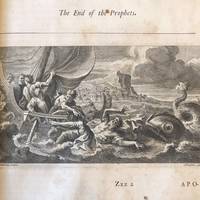
1717062622Oxford: John Baskett Printer to the King's most Excellent Majesty 1717. Leather Bound. Folio. Measures 52 x 34 x 14 cm. Bound in leather likely late 19th century. Binding split at rear joint. Some damage to text block especially prelims; a few loose pages some chips and tears foxing some pages darkened. Three rounds of restoration are evident the most recent carefully documented a fourth round required. Herbert 942A: "A magnificent edition printed in large type. With many plates at the beginning and end of books engraved on steel from the designs of various artists. Some of the initial letters are similarly engraved. Unfortunately the book contained many misprints and earned the nickname 'A Baskett-ful of Errors'. From the misprint The Parable of the Vinegar for vineyard in the headline above Luke xx this edition is commonly known as the 'Vinegar Bible'." "John Baskett 1665–1742 attained the title of “printer to the King’s most excellent majesty†in 1709 but his publishing career turned for the worse when he issued this richly-engraved folio Bible in 1717. Quick to point out the Bible’s numerous misprints Baskett’s competitors branded it “a Baskett-ful of Errors.†The edition’s more lasting nickname has been the “Vinegar Bible†because the words “Parable of the Vinegar†appear at the top of the page containing Luke 20:9 Christ’s Parable of the Vineyard." - smu.edu Special Collections. John Baskett, Printer to the King's most Excellent Majesty unknown
176354525Kiøbenhavn Godiche 1763 - 81. 4to. Indbundet i 8 tome V i 2 samtidige helldrbd. Rig rygforgyldning og forgyldte skindtitler. Rygge på de 4 første bind med lette brugsspor. Marmorerede snit. Stempel på titelblade. Slesvigbindet på skrivepapir. Med 295 kobberstukne prospekter planer grundtegninger foldekort m.v. Nogle af foldekortene fint forstærkede på bagsiden. rent eksemplar kun enkelte spredte brunpletter. Nogle eksemplarer er forsynet med Pontoppidans Danmarkskort. Dette er ikke her og det er heller ikke nævnt i oversigterne. <br/><br/><em>Originaludgaven af Danmarks topografiske hovedværk. </em> unknown
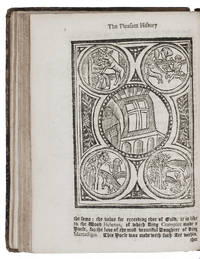
170122642London 1701. 4to. Thomas Ilive for Edward Brewster Late-18th-century sprinkled calf sewn on 5 cords 3 attached to the boards and 2 cut short gold double fillets blind-tooled board edges red morocco spine label in 2nd of 6 compartments red sprinkled edges. With woodcut of King Lion's court on the title page 61 woodcuts in text of part 1 including 23 repeats all signed Edward Brewster and all half-page 7.5 x 10.5 cm to nearly full-page 13 x 9.5 cm and 15 woodcuts in part 2 all repeated from part 1. Further with a large woodcut decorated initial in part 3 and decorations built up from cast fleurons in parts 1 and 2. Set in textura types with incidental roman and italic including Moxon's 1669 Canon roman on the title-page of part 3. 3 parts in 1 volume. 160; 112; 4 160 pp. One of the rare sets of all 3 parts of the English Reynard the Fox the third part here in its first edition. The Reynard stories were already established as a coherent collection in the 12th century and were first printed in 1479 in a Dutch prose edition. They became especially well known when translated into English and adapted for Caxton's 1481 edition in 43 chapters. The publisher Edward Alde in London began work on an extensive revision of Caxton's text with many new additions but he published only the first part probably in 1620 the first edition of the present part 1 containing 25 chapters some corresponding with chapters in Caxton's edition and some not. Although the second part would have to wait 52 years the first part quickly became the standard English version of the Reynard the Fox stories with 8 editions from 1620 to 1671. Its language was modernized giving both a view of the stories as they were known through most of two centuries and insights into English values and culture of the time. In 1684 Brewster added the present first edition of part 3 giving the adventures of Reynard's son Reynardine.With 20th-century woodcut bookplate. The woodcut on C1 of part 1 is printed upside down. In good condition with parts 2 and 3 slightly browned. One front endleaf is detached the spine slightly damaged at the head and the front hinge cracked.l Ebert II 18879; ESTC T60836 R218371 R40614; Kirmse 15; Menke V B c note on pp. 221-222 nos. 35 29 30; Wing S3512 S3436 parts 1-2; not in Prien. hardcover
1800CJW1405London: T. Bensley for T. Macklin final volume Bensley for T. Cadell & W. Davies 1800. First Printing of this Edition. 484 x 390 mm. 19 x 15 1/4". Seven volumes. <br/> Once splendid contemporary black straight-grain morocco gilt covers framed by Greek key roll palmette roll and multiple gilt rules double raised bands spine compartments densely gilt with rows of alternating star and circlet tools gilt titling turn-ins with gilt chain roll purple endpapers all edges gilt some inexpert but not obvious repairs to joints and backstrips. With more than 100 allegorical headpieces and tailpieces and some 70 SPLENDID LARGE-FOLIO SIZE COPPER PLATES after Fuseli Reynolds West and others. Herbert 1442 and 1651. ◆Extremities rather rubbed boards a bit scuffed but the decorative contemporaneous bindings solid and not without appeal. Plates somewhat foxed mostly to margins mild to moderate offsetting from plates occasional mild offsetting in the text bed but still a fresh wide-margined copy.<br/> <br/> The most prodigious form of scripture in English ever published the Macklin Bible features very large and bold type fine Whatman paper and a series of engravings by some of the most celebrated artists of the period. Like the Boydell "Shakespeare Gallery" also printed by Bensley our Macklin Bible is a vast picture book with illustrations that are grand both in size and emotional impact. According to DNB Macklin 1752/3-1800 announced his intention to produce a lavishly illustrated luxuriously produced folio Bible in 1789 and he spent the next 11 years and £30000 making his dream a reality. His efforts paid off: "the subscription list for 703 copies at £46 1s. apiece was headed by the king the queen and the prince of Wales." Sadly Macklin died just five days after the last engraving was finished and did not live to see his masterpiece become one of the most acclaimed English Bibles. As DNB observes "The Macklin Bible endures as the most ambitious edition produced in Britain often pirated but never rivalled." Copies of the Macklin Bible were often put into ornate bindings as was the present set; despite the depradations of time the workmanship of a superior London binder remains apparent. T. Bensley for T. Macklin [final volume Bensley for T. Cadell & W. Davies] unknown
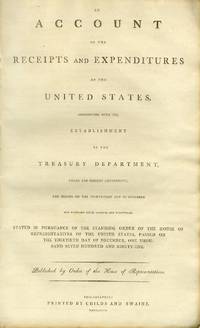
179032820355<p>Three volumes. Folio. Generally in very good condition details below.</p><p>Three rare Treasury reports as follows:</p><p>1. <i>An Account of the Receipts and Expenditures of the United States commencing with the establishment of the Treasury Department . . . ending on the thirty-first Day of December One Thousand Seven Hundred and Ninety-one.</i> Philadelphia: Childs and Swaine 1793. Folio 61 pp. folding table. Removed. Very good.</p><p>FIRST EDITION. This is a highly detailed report of the federal government's receipts and expenditures during the crucial first two years of the new government 1790-91. Locations: AAS Library Company Brown Harvard Yale and Princeton. Evans 26341. </p><p>2. <i>The Treasurer of the United States' Accounts of Payments and Receipts of Public Monies from 1st October 1790 to 30th June 1791</i>. Philadelphia: Childs and Swaine 1791. Folio. Original front wrapper. First few leaves stained. 52 pp. </p><p>FIRST EDITION. Samuel Meredith was first Treasurer of the United States. This is a detailed report of the expenditures and receipts of the federal government in 1790-1. Evans 23923. </p><p>3. <i>The Treasurer of the United States' Accounts of Payments and Receipts of Public Monies from 1st of January to the 30th of September 1792</i>. Philadelphia: Childs and Swaine 1793. Folio. Removed. Untrimmed. 67 pp. Very good.</p><p>FIRST EDITION. This is a detailed report of the expenditures and receipts of the federal government in 1792. Evans 24939.</p><br /> Childs and Swaine
178341192Bath 1783. Watercolour on laid paper with manuscript description on verso of the fine gold-leaf frame. Image size: 13 1/2 x 8 3/4 inches. Framed size: 22 1/4 x 18 inches. Thomas Robins a native of Bath was an enigmatic artist known for his watercolors. A small number of signed watercolors in the Broughton Collection at Cambridge University have been attributed to him particularly in an album inscribed as 'Drawings of Flowers Ehret and Robins.' In 1967 the Bath and West Agricultural Society sold a collection of 'Pictures of Exotic Plants and Insects' by Thomas Robins the Younger who was the son and pupil of the first Thomas Robins. Though there have been debates about differentiating their artistic styles the exhibition Gardens of Delight curated by John Harris at the R.I.B.A. in 1976 not only established the importance of the elder Robins' work in 18th-century English Topographical drawing but also shed light on the distinctive style of his son. Thomas Robins the Younger followed in his father's footsteps focusing on capturing grand residences gardens and the natural world. He drew inspiration from his father both in the subjects he chose and his artistic approach. Robins the Elder's views and landscapes are often noted for exuding the charm and freshness of a personal discovery and the similar joy of a chance encounter manifests here in the watercolour's dynamic scene. The image captures a split-second moment when a butterfly and a bee hovering into the scene from different directions about to land on the plant already blissfully occupied by their fellow creatures. By choosing to depict this moment Robins the Younger suspends the viewer in a state of anticipation that intense delicious but ultimately fleeting moment that can only be re-lived through memory or masterly depictions; the present's work ability to captivate and delight makes it an exquisite example of an especially fine decorative watercolour. The Linnaean and common English names of the plants and insects along with their classification and order are noted on a sheet of paper accompanying this watercolour. Depicted plants include: "shrubby rose colour'd periwinkle" "greater Indian cress or Nasturtium" and "double strip'd stock Gilliflower." The insects shown descending upon the petals are "Marmoris or Half Mourner Butterfly" "East Indian Bee Tyger Moth" and "English Bee Tyger Moth or Death's Head."<br/> <br/> The Fitzwilliam Museum University of Cambridge exhibition catalogue: British Flower Drawings: An Eight Selection Principally from the Broughton Collection 1 July - 18 October 1981. unknown
1794277980Philadelphia: John Fenno 1794. Second. paperback. very good-. Published for the House of Representatives. 4 folding tables. 65pp. 12pp. appendix. Folio original blue wrappers margins uncut backstrip of spine lacking front and back wrapper with some light dampstaining internally very good. Philadelphia: Printed by John Fenno 1794. Very Scarce.<br/> <br/> Enlarged second edition printed the same year as the first edition. Folding tables show the exact expenditures and receipts of the United States government for the year 1793. The rest of the text are figures of receipts from custom duties duties on alcohol and other revenue sources and payments by the Federal government are delineated item by item and dated. Payments to individuals have each person's name listed. The appendix is titled: Appendix containing statements shewing the operation of the funds for reducing the domestic debt to the close of the year 1793. Also statements of the foreign and domestic debts of the United States and of the expenditure of the proceeds of foreign loans to the same period. In 1793 the revenue for the Federal budget was 4.8 million dollars and the public debt was 80.4 million dollars. John Fenno the printer of this work printed many works for the administration of George Washington and the Congress. He was an ardent Federalist and a protege of Secretary of the Treasury Alexander Hamilton. Fenno also was the publisher of the Federalist newspaper Gazette of the United States. Evans 27931<br/> <br/> John Fenno unknown
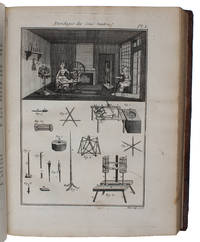
177156289Neuchatel L'Imprimerie de la Société Typographique 1771-83. 4to. Bound in 19 contemp. uniform full mottled calf. Raised bands. Gilt spines. Title-and tomelabels with gilt lettering. Spine-ends on nearly all volumes strenghtened. Stamp on title-pages. Each volume around 650 pp. With 508 fine engraved plates. <br/><br/><em>Second edition and the first 4to-edition was published in 19 volumes plus an additional volume by Jean Elie Bertrand where vol. 20 is an additional volume published much later 1799 - not present here - dealing with the art of printing. This importent collection of books on crafts was published by between 1761 and 1788. The full series comprises 113 parts cahiers in 27 folio volumes along with three supplements and "provide detailed accounts of a wide range of handcraft and manufacturing processes carried out in France at that time. The volumes are well-illustrated with precise engravings by Jean Elie Bertrand 1737-1779 a noted typographer from Neuchâtel where the printing was done. Many of them provide the background for shorter articles in Diderot's Encyclopedia which was appearing at much the same time. The project had its origin in request from Colbert in 1675 to the Academy Royal des Sciences for detailed accounts of various mechanic arts to be prepared and for new machines to be reported upon. This led to the formation of the Bignon Commission under Abbé Bignon. René-Antoine Ferchault de Réaumur 1683-1757 became editor soon after he joined the Academy. He inherited number of drawings the earliest prepared in 1693 and an illustrated manuscript on printing type and book binding which had been prepared in 1704. It was left to Réaumur's successor Duhamel du Monceau to bring about the publication of the series probably as the result of the competition from the Encyclopedia." Wikipedia.Brunet II618 ff. - Graesse II 367. </em> hardcover
17016399London: T. Ilive 1701. Early English editions. Bound together with:<br /> <br /> The Most Pleasant and Delightful History of Reynard the Fox. The Second Part. Containing Much Matter of Pleasure and Content. Written For the Delight of young Men Pleasure of the Aged and Profit of all. To which is added many Excellent Morals. London: Printed by A.M. and R.R. for Edward Brewster 1681.<br /> <br /> And:<br /> <br /> The Shifts of Reynardine The Son of Reynard the Fox Or a Pleasant History of His Life and Death. Full of Variety &c. And may fitly be applied to the Late Times. Now Published for the Reformation of Mens Manners. London: Printed by T.J. for Edward Brewster and Thomas Passenger 1684.<br /> <br /> Three parts in one small quarto volume 7 5/16 x 5 9/16 inches; 186 x 141 mm. 156 2 table of contents 2 publisher's advertisements; 111 1 publisher's advertisements; 8 160 pp. Mostly black letter with titles and side notes in roman letter. Sixty-two woodcuts in the first part printed from thirty-nine blocks and fifteen woodcuts in the second part five repeated all repeats from the first part. Most cuts signed "E.B." Edward Brewster. Woodcut on C1 recto Part I printed upside down. Some browning occasional light damp staining and soiling. Part I with tiny puncture marks in the lower blank margin through gathering I just touching one letter in the imprint on the title-page six small holes in I3 and one tiny hole in I4 causing loss of a couple of letters. Part III with paper flaw in the upper blank corner of A3 and A4 tiny tear 1/4 inch in the lower blank margin of F4 and paper flaw in the lower blank corner of I2 none affecting text. Contemporary sprinkled sheep. Covers ruled and decoratively tooled in blind spine decoratively tooled in gilt in compartments with two red morocco gilt lettering labels. Some expert restoration to joints and corners. Armorial bookplate of Gloucester on front free endpaper. Bookplate of Hugh Cecil Lowther 5th Earl of Lonsdale 1857-1944 on front pastedown his sale 12 July 1937 lot 445. An excellent copy. Housed in a felt-lined quarter brown morocco clamshell case spine with five raised bands decoratively tooled and lettered in gilt in compartments.<br /> <br /> Reynard the Fox "hero of several medieval European cycles of versified animal tales that satirize contemporary human society. Though Reynard is sly amoral cowardly and self-seeking he is still a sympathetic hero whose cunning is a necessity for survival. He symbolizes the triumph of craft over brute strength usually personified by Isengrim the greedy and dull-witted wolf. . The main literary tradition of Reynard the Fox descends from the extant French 'branches' of the Roman de Renart about 30 in number nearly 40000 lines of verse. The facetious portrayal of rustic life the camel as a papal legate speaking broken French the animals riding on horses and recounting elaborate dreams all suggest the atmosphere of 13th-century France" Merriam-Webster's Encyclopedia of Literature. There is some variation in chapter number within the early editions: From "Caxton's first edition 1481 to Thomas Gaultier's only edition 1550 the story is divided into 43 chapters" while the anonymous edition 1560-1585 has 58 chapters Varty. By the 17th century when the text is titled The Most Delectable History of Reynard the Fox it appears with only 25 chapters and maintains its image cycle. Early 17th century editions also maintained this "picture cycle" through Edward Brewster's 1662 edition but at this point the Wynkyn de Worde blocks were extremely worn and new set was created Varty. Forty images were used for his second edition 1671 and all contain his initials EB. "He published further illustrated editions in 1676 1681 1694 and 1701. in 1672 he grafted new life onto the old story with A Continuation Or Second Part of the Most Pleasant and Delightful History of Reynard the Fox" Varty for which he eventually created an additional 15 illustrations. In 1684 he would produce an additional sequel following the adventures of Reynard's son Reynardine. <br /> <br /> Brunet IV cols. 1228-1229. Lowndes p. 2076. Varty Appendix Three: "A Short-Title List of All Extant Illustrated Histories of Reynard the Fox from Wynkyn de Worde c. 1495 to A. Soulby c. 1800 which are kept in United Kingdom libraries based on H. Menke Bibliotheca Reinardiana" 24 18 and 21. Wing S3512 Part II and S3436 Part III. T. Ilive unknown
1721146284London: Printed by John Darby for the Author 1721. Rare second English edition of Leoni's English translation of Palladio's monumental work containing new typesetting but reusing the same plates from the first edition. Folio two volumes bound in full contemporary polished calf with gilt titles and ruling to the spine in six compartments within raised bands double gilt ruling and decorative stamping to the front and rear panels engraved frontispiece portrait of Palladio illustrated with 104 numbered engraved plates on 203 leaves including 15 double-page plates as well as 12 engraved in-text plates. Armorial bookplate to the pastedown of each volume. In very good condition. One of the giants of Venetian Renaissance architecture of the 16th century Andrea Palladio based his designs on the values of Greek architecture and the traditions of Roman architecture as outlined by Vitruvius. He is regarded as one of the greatest architects in the history of Western art best known for his villas in the Veneto as well as his palaces Vicenza and churches Venice all located within the Venetian Republic. His architectural theories were laid out in his treatise Quattro Libri dell Architettura The Four Books of Architecture which had a profound impact on building design throughout Europe and America. His style of architecture - a blend of Greek Roman and Renaissance art later known as Palladianism - accorded the greatest priority to maintaining symmetry perspective and overall harmony in the manner of Greco-Roman temple architecture and was widely imitated during the 17th and 18th centuries. Printed by John Darby for the Author hardcover
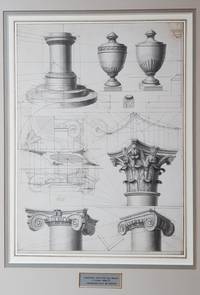
17753622n.p. n.p. n.d. pre-1775 1775. Original drawing of classical capitals and urns with lines of perspective. Pen and brown and black ink pencil and grey wash on laid paper without visible watermark ruled border in brown ink. Sheet 302x218mm window mount 350x275mm. Very slight soiling and foxing but overall in excellent condition. A very good and rare example of a study for an important book on perspective. � In 1775 Thomas Malton the Elder 1726-1801 published A Compleat Treatise On Perspective In Theory and Practice; on the True Principles Of Dr. Brook Taylor. This drawing is a preliminary study for plate XXII from this book. Such drawings are rare; the last to appear before this one was sold at Christie's in 2011. Malton's book was important: the Royal Academy had been founded only seven years before and in its Instrument of Foundation there was a specific requirement that the art and science of perspective be taught. A Compleat Treatise was the first book to be published on the subject following the founding of the RA. Malton was perhaps making a bid for his book to be adopted as a sort of "set text" and many Royal Academicians were among the initial subscribers. It was from the outset regarded as one of the best modern books on the subject based as it was on the newest contemporary mathematical studies of perspective. The combination of science and art is captured beautifully in this drawing. Bad luck in business forced Malton to leave England to start afresh as an artist in Dublin where he died in 1801 but his influence extended well into the nineteenth century thanks to his son also called Thomas and to Turner's use of A Compleat Treatise in his own lectures at the Royal Academy where he was Professor of Perspective. Malton's book and drawings would almost certainly have been introduced to Turner by Malton's son in whose studio Turner worked as an apprentice in the 1780s and whom Turner regarded as his "my real master". Some of Turner's own drawings and sketches used in these lectures are held at the Tate and among them are two of the capitals from plate XXII of A Compleat Treatise whose origins can be traced back to this drawing by Thomas Malton the Elder. n.p. n.p. n.d. [pre-1775]
17205138<p><em>The World's first Global Stock Market Bubble Illustrated</em></p><p>STOCK MARKET - THE GREAT MIRROR OF FOLLY. Het groote Tafereel der Dwaasheid.The great mirror of folly showing the rise progress and downfall of the bubble in stocks and windy speculation especially in France England and the Netherlands in the year 1720 being a collection of all the terms and proposals of the incorporated companies. with prints comedies and poems published by various amateurs scoffing at this terrible and deceitful trade. n.p. Amsterdam after 1720.</p><p>Folio pp. ii 25 1 52 26 29-31 thus complete 1 8 10 engraved frontispiece Muller plate No.1 title printed in red and black Cole version 2 text in double columns and 74 engraved plates 2 of them in duplicate mostly double-page and/or folding including maps portraits playing cards broadsides; text a little browned due to paper quality some foxing; plates generally clean and crisp one plate cropped at foremargin with loss of text but not to image; contemporary full mottled panelled calf spine gilt in compartments sides with rich gilt decoration head and tail of spine repaired corners strengthened; a good copy.</p><p>The classic rare literary and pictorial satire on John Law's 'system' and the wild speculation in stocks at that time. As part of Law's well-conceived plan to finance the French national debt funds were raised a portion of which was invested in the 'Compagnie d'Occident' which was given rights to exploit trade in Louisiana and Canada. The underlying plan was sound but unprecedented wild speculation sent the share price rocketing to unrealistic levels. Inevitably the 'bubble' burst; the Company was bankrupted and many investors ruined and the 'Système Law' unfortunately discredited. Law himself had foreseen the developments and had withdrawn funds from the French scheme to invest in the British South Sea affair which was being set up at that time. This 'bubble' also burst in 1720.</p><p>'Rarely does a single volume combine in itself so much economic interest. in neither of these countries France and England however did appear such a stout and extravagant piece as this Dutch volume' Cole p. 1.</p><p>Each copy of this work is unique. The number of plates varies from 60 to 90 though generally around 70 and the order of the text and the plates differs from copy to copy. The present copy has the regular plates 1-23 25 28 30-51 53-68 70 - 73 with 36 and 37 bound in twice in different places as well as the supplementary plates 1 2 4 and 5. This includes the very uncommon 'Register of all the prints' first issue with 47 prints listed and a further one added in ink and a fascinating portrait of Madame Law.</p><p>In addition to the vivid portrayals of the 'wind-trade' and stock market frenzy the double-page folding plate with playing cards known as Aprilkaart 65 and the Magic card 73 are particularly appealing. The special feature of this copy is the etched portrait of Madame Law but not with the usual richly decorated border of scrolls foliage fruits and flowers but surrounded by Callot style figures of dwarves. This border has been used on another print in the collection of de Koninklijke Bibliotheek Den Haag see BM 1868-0808-9693.</p><p>Arthur H. Cole The Great Mirror of Folly 1949; Sperling The South Sea Company 205; Kress 3217; Goldsmiths 5879; Sabin 28932; Lipperheide 3550; see Goetzmann et al The Great Mirror of Folly Finance Culture and the Crash of 1720 2013.</p>
1787122705Downing Street: 2 November 1787. Pitt attempts a joint Anglo-French abolition of the slave trade Autograph letter signed by Pitt the Younger as prime minister to his close advisor William Eden at the height of Eden's influence as envoy to France in which Pitt attempts to gauge potential French support for the early Abolitionist movement spearheaded by his friend and political ally William Wilberforce and the prospect of a joint Anglo-French abolition of the trade. "You have had a letter from my friend Wilberforce on a scheme which may appear to some people chimerical but which I really believe may with proper management be made practicable. If it can I am sure it is an object well worth attending to and perhaps you may be able to learn the private sentiments of the French Government upon it. to Judge whether it can be carried further. I mean the idea of the two nations agreeing to discontinue the villainous traffic now carried on in Africa". 1787 saw the foundation of the Society for the Abolition of the Slave Trade and was also the year in which Wilberforce took political leadership of the Abolition movement. There is no evidence that any overtures Eden made to France for a joint anti-slave trade approach made any impression - had this letter achieved its aim the history of transantlantic slavery would have been vastly different. Although Pitt's support for the movement to abolish slavery was unflagging throughout his tenure as prime minister the eventual abolition of the trade would not occur until a year after his death in 1807. In December 1785 the penal reformer and diplomatist William Eden 1st Baron Auckland 1744-1814 was sent by Pitt the Younger to serve "as an envoy to negotiate a commercial treaty with France a task which particularly suited Eden's expertise in matters of finance and commerce. This step inaugurated the most important and successful phase of Eden's career" ODNB. The skill and delicacy with which he cajoled both Britain and France through the Versailles negotiations eventually resulted in the signing of the final treaty in September 1786 as well as two further commercial agreements between the countries one to resolve the disputes between the British and French East India companies. However Eden's peers viewed his successes as proof of his francophile leanings and he was swiftly reassigned as ambassador to Madrid. "Following the end of his diplomatic career Auckland remained a political figure of some significance. He was still close to Pitt and his public pronouncements were often regarded as reflecting the thinking of the prime minister. Pitt was indeed so close to Auckland and his family at this time that he came very near to marrying Auckland's daughter Eleanor Eden 1777-1851 in 1796-7 only to break off his dalliance suddenly and mysteriously for reasons which are not fully understood to this day. Although this episode curtailed the social relationship between Auckland and Pitt they remained politically close. In 1798 Auckland was appointed by Pitt to the position of joint postmaster-general and he was one of Pitt's closest advisers on the prospective union with Ireland in the years 1798-1800" ODNB. Single sheet quarto 239 x 196 mm handwritten in ink across two pages. Remains of verso guard where laid down overwritten in another hand annotated at foot of second page in a later hand "To Lord Auckland." Browned with a few areas of discolouration or marks tiny wear and puncture to left edge not obscuring text else in very good condition. unknown
1794000035bNew Spain Mexico. Fine with no dust jacket. 1794. Full-Leather. Handsome Folio Manuscript in early calf with gilt written by the Attorney of the Real Audiencia see Bibliografia Mexicana 220 and prepared for the Viceroy. Lengthy stipulations of taxes for the freed mestizos mulattoes and negroes as well as exemptions for Indians of the repartimientos even when married to Spanish women. These taxes were the root of the perceived injustice that explains why freed men formed the core of the Revolution when it came. EXTREMELY RARE AND IMPORTANT FIRST HAND TEXT OF MEXICAN HISTORY. see Archivo General de la Nation "Los Precursores Ideologicos della Guerra de Independencia 1929 pgs 137.139." LAID IN NOTE: Arce Y Echeagary J. Yinstruction para que los Administradores de Aduanas del Reyno de Nueva Espana hagan la legitima exaccion de los dros. de Alcabalas y Pulques en los casos que por lo regular se ofrecen en las propias Aduanas. Mexico 1794. ADDITIONAL BACKGROUND: In 1519 the Spaniards conquered Mexico. This led to the formation of a new state called New Spain and later into a new hybrid culture. Several military expeditions were led to extend 'New Spain'. The whole of Central America West Indies Philippines and parts of the current Texas and California were later conquered to become part of New Spain. The Spanish political control over Mexico lasted for three centuries. The entire region was formed into a viceroyalty in 1535. The colony was divided into provinces ruled by governors. These provinces were divided into departments and subdivided into districts. Magistrates controlled the districts and mayors led smaller villages. The parliament court handled all political matters and the Council of Indies controlled the other administrative matters. Off course the supreme authority over the Spanish empire belonged to the king. This system was pretty inefficient as it took several years for directives from the king to be implemented at the lower levels. During the initial administration grants called Encomiendas were given to colonists which controlled Indian labor and produce. This led to the misuse of power and atrocities against the Indians increased. The Indians revolted against the Spaniards in 1541 but were easily subdued. The Spanish emperor Charles V initiated the decline of the Encomienda system in 1542. This decline saw the emmergence of the Roman Catholic Church. The church was successful in carrying out mass conversions. The Spaniards protected the Indians that converted. Missions and monasteries dominated much of the land. The Spaniards thrived by the new found wealth in the colonies. They amassed huge wealth by controlling silver mining large ranches and estates that grew wheat sugarcane and indigo for export. Spanish merchants exported such goods as cotton silk and dye that were produced by the Indians. The prosperity of New Spain began to decline in the 17th century. Disease and natural disasters destroyed most of the Indian population. Most others migrated slowly to remote parts. Mines were abandoned and large areas of farmland were destroyed. The economy of New Spain collapsed. In 1810 a catholic priest named Miguel Hidalgo called upon Mexicans to rise up and fight the Spanish. Although father Hidalgo was killed another priest Jose Morelos continued to lead the fighting. New Spain finally won its independence from Spain in 1810 and came to be called Mexico. ; Spanish Language; 4to - over 9¾" - 12" tall; MEXICO MEXICAN TAXES NEW SPAIN MEXICAN REVOLUTION NAPOLEON BONAPARTE CHARLES V HIDALGO MORELOS HANDWRITTEN HISTORICAL HISTORY HAND WRITTEN HOLOGRAPH MANUSCRIPT MANUSCRIPTOS SPANISH ESPANOL VICEROY mestizos repartimientos antiquité contrat vélin document manuscrit papier Antike Brief Pergament Dokument Manuskript Papier oggetto d'antiquariato atto velina documento manoscritto carta antigüedad hecho vitela documento manuscrito papel. . hardcover
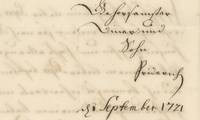
17213633109/1721. <blockquote><p>Theirs was a famously combative relationship; Frederick would attempt to flee to Britain 9 years later</p></blockquote><p>In his early youth Frederick lived with his mother and sister Wilhelmine although they regularly visited their father's hunting lodge at Königs Wusterhausen. Frederick and his older sister formed a close relationship which lasted until her death in 1758. Frederick was educated to speak both French and German and many of his tutors were French Calvinists.</p><p>The relationship between Frederick the Great and his father Frederick William I was deeply strained and often hostile. Frederick William I was a rigid militaristic ruler who valued discipline obedience and a strong army above all else while his son was drawn to music literature and French Enlightenment culture. The King saw these interests as weak and unmanly and he frequently criticized and even physically punished Frederick in an attempt to force him into a more soldierly mold.</p><p>Their conflict reached a peak in 1730 when Frederick attempted to flee Prussia to escape his father’s control. The plan failed and Frederick William I reacted harshly—he had Frederick arrested and forced him to watch the execution of his close friend Hans Hermann von Katte who had helped in the escape attempt. Although Frederick later became a brilliant military ruler the emotional distance between father and son never fully disappeared. In fact Frederick’s later embrace of culture and philosophy can be seen partly as a reaction against his father’s severity.</p><p>Wusterhausen was an important royal residence in early 18th-century Prussia and played a key role in the upbringing of Frederick the Great. In the early 1720s when Frederick was still a child he spent time there with his father Frederick William I who used the palace as a retreat from Berlin. The site was known for the King’s informal “Tobacco Parliament†where political and military matters were discussed. For the young Frederick Wusterhausen symbolized the strict militaristic environment imposed by his father which sharply contrasted with his own developing interests in culture music and Enlightenment thought—tensions that would later shape his character and reign.</p><p><strong>Autograph letter signed</strong> in old Germanic script from then Prince Frederick to the King ""<em>My dear Papa"" ""in September 1721.""</em> The General mentioned is likely Johann Matthias von der Schulenburg.</p><p><em>""I hope that my dear Papa is still doing well and I am longing very much to go to Wusterhausen. I am constantly hoping that my dear Papa will order for me to come. I am awaiting with the greatest impatience to see my dear Papa. I am humbly requesting my dear Papa that he may let me come to Wusterhausen. I remain my dear Papa’s Most obedient servant and son Frederich.""</em></p><p><em>""The general Schulenburg has told me that my dear Papa is still doing well about which I am very glad and he also asked me to be godfather.""</em></p><p><img class=""alignnone wp-image-25018 size-post-window"" src=""https://cdn.raabcollection.com/wp-content/uploads/20231204144051/Folder-site-11-1600x1327.jpg"" alt=""historical memorabilia dealer"" width=""1600"" height=""1327"" /></p> unknown
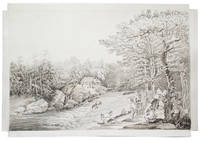
180052601Canada 1800. Graphite pen-and-ink and grey wash on wove paper watermarked "W. Elgar 1796". 13 5/8 x 20 inches. Corners clipped outside the image verso toned. Graphite pen-and-ink and grey wash on wove paper watermarked "W. Elgar 1796". 13 5/8 x 20 inches. Along the falls of a tree-lined river two First Nations men are pulling a canoe into the water directed by another in an elaborate feather headdress; a wigwam with mother and child is on the same shore to their left; across the river a longhouse and structure for smoking fish with another group of native people can be seen; at the far left a First Nations man is standing in his canoe fishing with a pole in the water just below the rapids.<br /> <br /> Although the 1796 watermark on the paper is consistent with drawings by Heriot the unfinished quality of this work make attribution difficult. However it is somewhat reminiscent of a smaller grisaille watercolor signed by Heriot titled FALLS OF THE POQUISQUE ON THE RIVER ST JOHN on verso sold at Waddington's March 15 2018 lot 137.<br /> <br /> Furthermore this scene is reminiscent of one described by Heriot in his Travels in the Canadas 1807 in which he describes Native American fishing on the cacasdes of St. Mary nine miles below the entrance to Lake Superior: "It is at the bottom of the rapids and even among their billows which foam with ceaseless impetuosity that innumerable quantities of excellent fish may be taken from the spring until the winter; the species which is found in the greatest abundance is denominated by the savages atticameg or white fish; the Michilimakinac trout and pickerell are likewise caught here. These aflford a principal means of subsistence to a number of native tribes. No small degree of address as well as strength is employed by the savages in catching these fish; they stand in an erect attitude in a birch canoe and even amid the billows they push with force to the bottom of the waters a long pole at the end of which is fixed a hoop with a net in the form of a bag into which the fish is constrained to enter. They watch it with the eye when it glides among the rocks quickly ensnare it and drag it into the canoe. In conducting this mode of fishing much practice is required as an inexperienced person may by the efforts which he is obliged to make overset the canoe and inevitably perish."<br /> <br /> Trained by Paul Sandby at the Royal Military Academy Woolwich London Heriot worked as a clerk for Board of Ordnance. "In 1792 Heriot was posted to Quebec and promoted clerk of the cheque in the Ordnance department. Heriot was to remain in Lower Canada until 1816 except apparently for two periods of absence in 1796-97 and in 1806. His first years at Quebec are not well documented. Sketches record visits in and about Quebec and Montreal perhaps on Ordnance business. In November 1792 he published a sketch of Jersey in the Quebec Magazine and the following year he prepared a view of Quebec perhaps also intended for publication. When he returned to Britain in 1796 he resided in London travelled to the south coast and made at least one sketching foray into Wales . A watercolour prepared from his sketches of Wales and two Canadian views were accepted by the Royal Academy of Arts for exhibition in the spring. Heriot probably sailed for Lower Canada soon afterwards taking notes and making sketches on the voyage. The impact of his visit to Britain was considerable. While there he had been stimulated by the art he had seen and by his success as an artist. He returned with a fresh enthusiasm for the Canadas; he began to read about their past and to make elaborate notes and numerous sketches of the places he visited and the peoples he encountered. His sojourn abroad had affected his artistic vision of the Canadas; his drawings and water-colours assumed a new confidence and his landscape forms developed a new strength and grandeur. In London he had probably studied the simply handled and remarkably strong water-colours of younger British artists such as Thomas Girtin Joseph Mallord William Turner and John Varley. Either in Britain or in Lower Canada he had also become familiar with Lieutenant George Bulteel Fisher's Six views of North America . London 1796. He was influenced by this work especially by Fisher's use of the Picturesque in depicting Canadian landscape" Dictionary of Canadian Biography. unknown